
Emerald Green Arborvitae are a staple of structured, year-round privacy, but their shallow, fibrous root systems and dense foliage make them uniquely sensitive to fertilizer burn and imbalanced nutrition. A product that works on a maple or a rose bush can scorch an arborvitae’s interior needles in days, leaving brown patches that take seasons to outgrow. Selecting a formula with a controlled-release nitrogen source and the correct NPK profile is the difference between a hedge that thrives and one that struggles.
I’m Rikta — the co-founder and writer behind Lawn Gear Lab. I’ve spent hundreds of hours analyzing soil science data, comparing slow-release mechanisms, and cross-referencing aggregate owner feedback across dozens of arborvitae-specific fertilizer formulations to isolate what actually drives dense, healthy growth without damaging tender feeder roots.
Whether you need systemic insect protection or a balanced granular feed, this guide breaks down the top-rated options for dense, green growth. Here is the best fertilizer for emerald green arborvitae on the market right now.
How To Choose The Best Fertilizer For Emerald Green Arborvitae
Emerald Greens are acid-loving evergreens with a preference for slightly acidic to neutral soil. Fertilizing them with a balanced, slow-release formula prevents the sudden nitrogen flush that causes tip burn. Understanding three key factors will help you avoid costly mistakes.
NPK Ratio & Nitrogen Source
A ratio such as 19-8-10 or 13-3-3 supplies enough nitrogen for deep green needles without forcing excessive soft growth. The nitrogen should come from a controlled-release source like sulfur-coated urea. Quick-release ammonium nitrate can overload the shallow roots, causing the browning that arborvitae owners dread.
Application Method: Granules vs. Spikes vs. Liquid
Granular formulas spread evenly under the drip line and water in gradually, making them the safest choice for hedges with many plants. Spikes deliver a concentrated dose directly to the root zone of individual trees, ideal for isolated specimens. Liquids offer rapid uptake for stressed or chlorotic trees but require more frequent application and careful dilution to avoid chemical burn on young plants.
Bonus Protection: Insecticide & Fungicide Additives
Arborvitae are vulnerable to bagworms, spider mites, and root rot in poorly drained soil. A systemic granular product that contains imidacloprid controls pests for up to 12 months while feeding the plant. If you prefer an organic approach, select a straight fertilizer and apply a separate insecticidal drench as needed.
Quick Comparison
On smaller screens, swipe sideways to see the full table.
| Model | Category | Best For | Key Spec | Amazon |
|---|---|---|---|---|
| Fertilome Tree and Shrub Food 19-8-10 | Granular | Established hedges needing uniform feed | 19-8-10 slow-release granules | Amazon |
| BioAdvanced 12 Month Tree and Shrub | Granules | Pest-prone arborvitae | Systemic insecticide + 12-month feed | Amazon |
| The Old Farmer’s Almanac 13-3-3 Spikes | Spikes | Individual specimen trees | 13-3-3 slow-release spike | Amazon |
| TPS Nutrients Evergreen Tree Fertilizer | Liquid | Quick green-up for stressed trees | 1 tsp per quart liquid concentrate | Amazon |
| TPS Nutrients Spruce Tree Fertilizer | Liquid | One-gallon coverage for multiple trees | 128 oz ready-to-use liquid | Amazon |
| Miracle-Gro Tree and Shrub Spikes 15-5-10 | Spikes | Seasonal maintenance planting | 15-5-10 once-per-season spikes | Amazon |
| Power Spike Fruit Tree Spikes | Spikes | Entry-level root zone feeding | 3.2 lbs, 10 spikes per box | Amazon |
In‑Depth Reviews
1. Fertilome Tree and Shrub Food 19-8-10
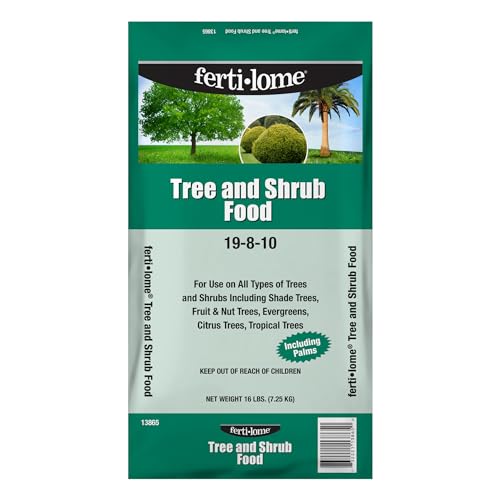
The Fertilome 19-8-10 granular formula strikes the ideal NPK balance for Emerald Green Arborvitae. The nitrogen is slow-release, which prevents the root burn common with quick-release urea. The 19% nitrogen content supports dense needle growth, while the 8% phosphorus and 10% potassium promote deep root development and winter hardiness — critical for arborvitae hedges in cold climates.
Owners consistently report “unprecedented spring growth” with noticeable greening in two to three weeks. The granules are easy to sprinkle under the drip line, and no digging or hammering is required. Users with long rows of arborvitae appreciate that one 16-pound bag covers a substantial hedge without needing to mix or measure.
The only real drawback is its lack of insecticide. Arborvitae prone to bagworms or spider mites will need a separate pest-control treatment. But for a dedicated, balanced evergreen feed, Fertilome delivers the cleanest results with the least risk of chemical damage.
What works
- Slow-release nitrogen eliminates burn risk on sensitive roots.
- 18-pound bag provides excellent coverage for large hedges.
- Visible greening reported within two to three weeks of application.
What doesn’t
- No systemic insect protection included.
- Requires thorough watering-in to activate granules.
2. BioAdvanced 12 Month Tree and Shrub Protect and Feed
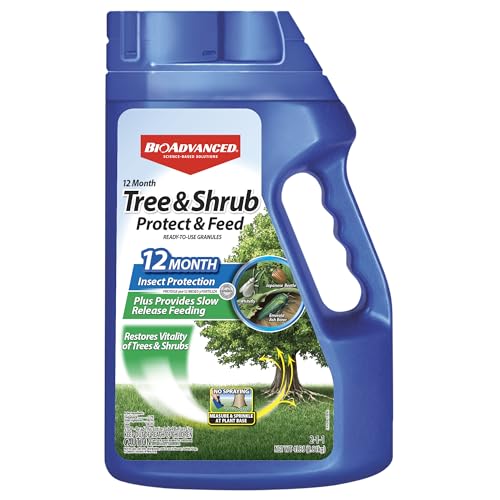
BioAdvanced combines a slow-release 12-month fertilizer with a systemic insecticide that targets Japanese beetles, aphids, and spider mites — the most common pests that weaken arborvitae. The 4-pound granular bag is measured using the built-in cup, sprinkled at the base, and watered in for a one-and-done application that feeds and protects simultaneously.
Owner feedback on arborvitae specifically highlights its effectiveness against adelgids and scale, with users noticing healthier needle color and less dieback within one month. The systemic protection moves into the sap, meaning it works even after you apply it. It also eliminates the need for separate spray treatments during the growing season.
Because it contains imidacloprid, this product is toxic to bees and should not be applied near flowering plants or during bloom. It is also not suitable for edible plantings. But for a privacy hedge facing persistent insect pressure, the dual-action formula is a major time-saver.
What works
- One application kills pests and feeds roots for up to 12 months.
- Built-in measuring cup makes dosing straightforward.
- Resolved severe scale and adelgid infestations in user reports.
What doesn’t
- Toxic to pollinators; avoid use near flowering underplantings.
- Not safe for edible gardens.
3. The Old Farmer’s Almanac Tree & Shrub Fertilizer Spikes 13-3-3
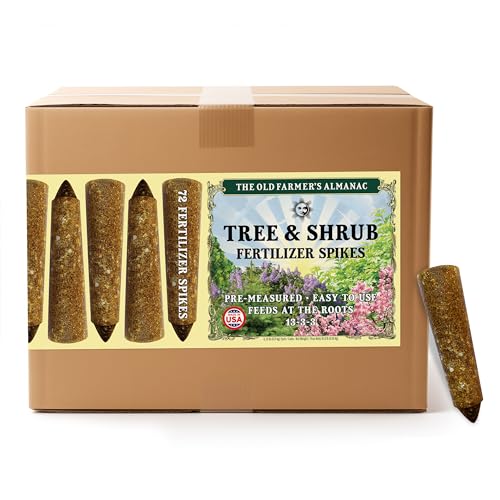
The Old Farmer’s Almanac TruSpikes stand out for their build quality: they are solid, 5-inch spikes that do not crumble when hammered into compacted soil. The 13-3-3 ratio with 13% controlled-release nitrogen provides steady nutrition for up to three months per spike. Each spike feeds directly in the root zone, which is ideal for individual Emerald Green Arborvitae that need a targeted nutrient boost.
Users who manage specimen arborvitae report that the spikes remain intact even after driving into dry clay. The case of 72 spikes covers a large number of trees for two to three seasons, making the upfront investment economical over time. The formulation also avoids the runoff issue associated with granular broadcasting on slopes.
The spike format makes it difficult to distribute evenly among a tightly planted hedge. For a row of arborvitae spaced 3 feet apart, granular or liquid options may offer more uniform coverage. Additionally, the 13-3-3 ratio is lower in nitrogen than some granular competitors.
What works
- Spikes are dense and do not shatter when hammered into hard soil.
- Each spike feeds the root zone for up to three months.
- 72-count case provides excellent value for multiple trees.
What doesn’t
- Difficult to apply evenly in tightly spaced hedges.
- Lower NPK ratio may require more spikes per tree than granular alternatives.
4. TPS Nutrients Evergreen Tree Fertilizer 32 oz
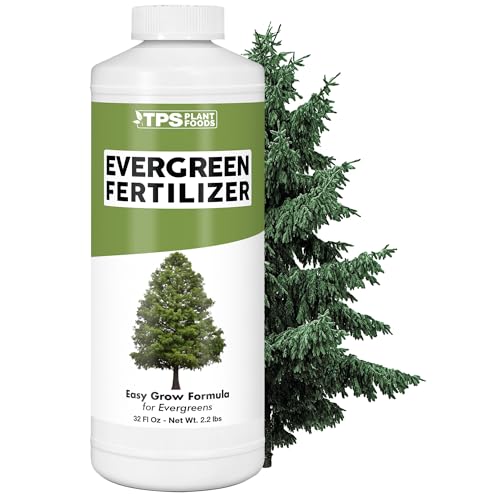
The TPS Nutrients Evergreen Tree Fertilizer is a liquid concentrate specifically formulated for conifers and evergreens, including Emerald Green Arborvitae. A small dose — 1 teaspoon per quart of water — delivers a balanced blend of macro and micronutrients that the roots absorb almost immediately. This makes it an effective rescue treatment for arborvitae showing chlorotic yellowing or slow growth after transplant.
Several owners reported that their blue spruce and pine trees “looked refreshed and healthy” after a single application. The liquid format allows you to spot-treat weak trees in a hedge without over-fertilizing their neighbors. It is also simple to apply with a standard hose-end sprayer or watering can.
Some users noted that the concentrate is less concentrated than they expected, requiring frequent reapplication for sustained results. A 32-ounce bottle may not go far if you are treating a long row of mature trees. There is also a risk of chemical burn if you double the recommended dose on small arborvitae.
What works
- Fast uptake corrects chlorosis and transplant shock quickly.
- Low dose per tree reduces risk of over-fertilization.
- Easy to apply with a watering can or hose-end sprayer.
What doesn’t
- Requires monthly reapplication for continuous feeding.
- Some users reported chemical burn on young trees at full strength.
5. TPS Nutrients Spruce Tree Fertilizer 1 Gallon
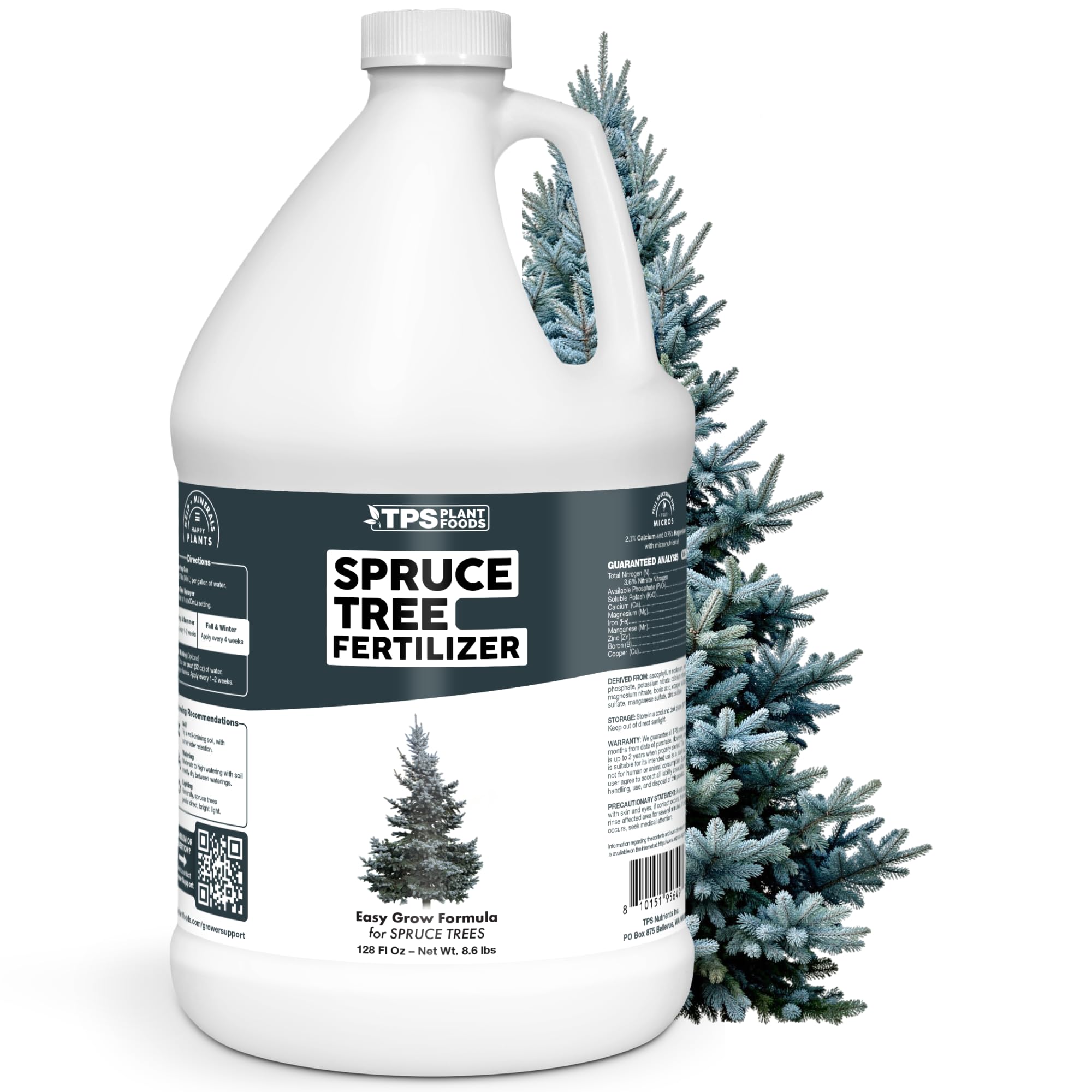
This one-gallon liquid formulation from TPS Nutrients covers substantially more ground than the 32-ounce version. Designed to support rich green needles and strong root systems, it is suitable for Emerald Green Arborvitae, blue spruce, and other narrow-leaved evergreens. The ready-to-use formula eliminates mixing guesswork and can be applied directly at the root zone.
Users with multiple arborvitae trees appreciate the larger volume, noting that their blue spruce “filled out” after two monthly applications. The product is gentle enough for landscape trees but potent enough to correct nutrient deficiencies in stressed specimens. It also avoids the needle burn risk that sometimes accompanies high-nitrogen granular feeds during dry weather.
The liquid must be reapplied monthly for the best results, which may be less convenient than a one-time granular or spike application. Some owners noted that it is expensive relative to its coverage, especially for larger hedges. The gallon size also takes more storage space in a garden shed.
What works
- One-gallon size delivers multiple monthly applications for a hedge.
- Ready-to-use formula eliminates mixing and measuring.
- Supports denser branching and richer needle color.
What doesn’t
- Monthly reapplication required for sustained feeding.
- Cost per dose is higher than granular alternatives.
6. Miracle-Gro Fertilizer Spikes for Trees and Shrubs 15-5-10

Miracle-Gro’s 15-5-10 spikes offer a well-known, accessible entry point for tree and shrub feeding. The 15% nitrogen is balanced with lower phosphorus and potassium, which is a safe profile for Emerald Green Arborvitae if used as directed. The spikes are hammered into the soil around the drip line and release nutrients gradually through the season.
Homeowners report that the spikes corrected yellowing leaves on shrubs within weeks and maintained color through hot summers. The once-per-season application is convenient, and the 12-pack can handle four to six small to medium arborvitae depending on their size. Users with large hedges will need multiple packages to cover the entire row.
The spikes do not contain any insecticide, so pest-prone arborvitae will still need separate protection. Some owners also noted that the spikes are less effective in heavily compacted clay soils where the nutrients cannot spread laterally through the root zone. For optimal results, pre-water the soil to soften it before hammering.
What works
- Simple once-per-season application saves time.
- Safe NPK ratio minimizes burn risk on sensitive evergreens.
- Corrected leaf yellowing in user reports within two weeks.
What doesn’t
- Not effective in compacted clay without pre-watering.
- No pest protection; separate insecticide may be needed.
7. Power Spike Fruit Tree Fertilizer Spikes
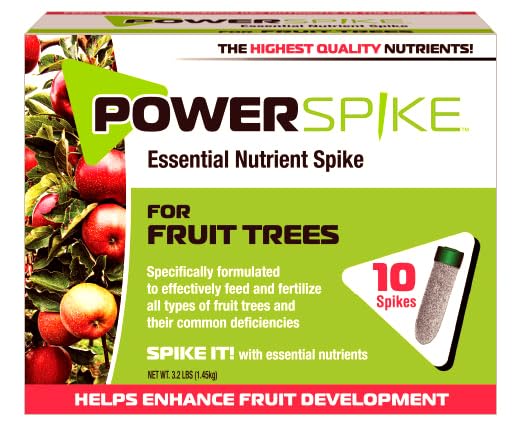
The Power Spike Fruit Tree Fertilizer Spikes are marketed for fruit trees, but their general nutrient composition — targeting common deficiencies — can be adapted for broadleaf evergreen hedges in a pinch. The spikes are hammered into the ground near the root zone and include a pounding cap to prevent damage during installation. The 10-spike box provides enough material for three to five small arborvitae.
Owners who used these spikes on apple and peach trees reported that the plants “fulfilled their job beautifully,” noting easier installation compared to traditional crumbly spikes. The direct root-zone delivery minimizes waste and avoids the broadcast pattern of granular feeds.
These spikes are formulated for fruit production, not dense needle growth, so the NPK balance may not be optimal for arborvitae. The nutrient profile is geared toward flowering and fruit set rather than lush evergreen foliage. Users with established, healthy arborvitae may find them adequate, but those correcting deficiencies should choose a dedicated evergreen formula.
What works
- Low entry cost makes them accessible for budget-conscious buyers.
- Direct root-zone feeding reduces nutrient runoff.
- Includes a pounding cap for easy installation.
What doesn’t
- Fruit-tree NPK not optimized for evergreen needle growth.
- Small 10-spike count covers only a few trees.
Hardware & Specs Guide
NPK Ratio & Nitrogen Source
The NPK number tells you the percentage of nitrogen, phosphorus, and potassium. For Emerald Green Arborvitae, a ratio near 15-5-10 or 19-8-10 works well. The nitrogen should be slow-release (sulfur-coated urea or polymer-coated) to prevent root burn. Quick-release ammonium nitrate can cause needle tip browning on shallow-rooted arborvitae.
Granular vs. Spike vs. Liquid Delivery
Granular products spread evenly under the drip line and are best for hedges of many trees. Spikes deliver a concentrated dose to individual trees and work well in loose soil. Liquids provide the fastest uptake but require monthly reapplication. Choose granular for new plantings, spikes for mature specimens, and liquids for emergency rescue of chlorotic trees.
FAQ
Can I use a high-nitrogen lawn fertilizer on my Emerald Green Arborvitae?
How often should I fertilize my Emerald Green Arborvitae hedge?
What does it mean if my arborvitae needles are turning brown after fertilizing?
Final Thoughts: The Verdict
For most gardeners, the best fertilizer for emerald green arborvitae winner is the Fertilome Tree and Shrub Food 19-8-10 because it provides a balanced slow-release NPK ratio that promotes dense needle growth without root burn. If you also need systemic insect protection, grab the BioAdvanced Protect and Feed. And for targeted feeding of individual specimen trees, nothing beats the Old Farmer’s Almanac Spikes.