
Weeds wedged between pavers mock every attempt at a clean patio. They send taproots deep into the sand-and-gravel base beneath your brickwork, making surface-level pulling or spraying pointless — within weeks the same thistle or crabgrass erupts again. A tool dedicated to this specific crack environment changes that reality by grabbing the root itself, not just the visible foliage.
I’m Rikta — the co-founder and writer behind Lawn Gear Lab. I’ve spent hundreds of hours comparing the mechanical leverage, metal gauge, claw geometry, and handle ergonomics of every serious weeding tool on the market, cross-referencing owner feedback to separate the designs that actually extract the full taproot from those that just snap the stem.
Stand-up weeders with four-claw heads and long bamboo or steel handles dominate this category because they let you work a full driveway or patio without ever bending your knees. This guide helps you choose the right tool to remove weeds from pavers based on soil type, weed species, and your tolerance for assembly hassle.
How To Choose The Best Tool To Remove Weeds From Pavers
A tool that works beautifully on a dandelion in loose lawn soil can fail completely when its claws hit the compacted sand-and-stone base under a paver. You need a design that fits the narrow, hard-bottomed crack environment.
Claw Count and Blade Width
Four claws grip the root from four directions, which matters when the taproot runs straight down through a ¼-inch crack. Two- or three-claw designs often miss the root center in tight gaps, leaving the bottom half behind. The claw width should ideally measure under 1.5 inches to fit standard paver seams.
Handle Length and Material
Stand-up weeders with handles of 39 inches or longer let you use your legs and body weight instead of your lower back. Bamboo handles dampen vibration but can split under high torque on deep roots; steel or fiberglass handles resist twisting better when you lean into a stubborn plantain root in compacted joint sand.
Eject Mechanism
Removing a pulled weed from the claws by hand slows you down and forces repeated bending. A sliding collar, push-button eject, or trigger-slider system clears the claw in one motion. This feature becomes indispensable when you are clearing fifty or more weeds from a long paver driveway.
Quick Comparison
On smaller screens, swipe sideways to see the full table.
| Model | Category | Best For | Key Spec | Amazon |
|---|---|---|---|---|
| Fiskars Stand-Up Weed Puller | Premium 4-Claw | Long sessions on soft-to-moderate soil | 4 serrated stainless steel claws; 39 in. offset handle | Amazon |
| Grampa’s Weeder Original | Premium Stand-Up | Back-friendly dandelion removal in moist beds | Bamboo handle; 45 in.; 4-claw alloy steel head | Amazon |
| BULLY TOOLS Bean Hook/Paver Weeder | Heavy-Duty Hook | Lifting weeds and debris from tight paver gaps | 7-gauge steel; dual-sided blade; 43 in. fiberglass handle | Amazon |
| BARAYSTUS Crack Weeder | Narrow-Crevice L-Blade | Sidewalk expansion joints and thin paver cracks | L-shaped high-carbon steel blade; 55 in. handle | Amazon |
| CKLT 2-in-1 Hoe and Rake | Dual-Head Tool | Hoeing large weeds and raking joints clean | Spring steel trapezoid hoe + 9 cm rake; 60 in. adjustable | Amazon |
| Rocklin Stand Up Weed Puller | All-Steel 4-Claw | Taproot weeds on hard clay and compacted soil | Hardened steel build; 48 in. threaded handle; 4-claw head | Amazon |
| RexWeed Stand Up Puller (FX-TGWT) | Adjustable All-Metal | Chemical-free control of dandelions and crabgrass | 4 serrated steel claws; adjustable handle 32–46 in. | Amazon |
In‑Depth Reviews
1. Fiskars Stand-Up Weed Puller Tool

The Fiskars 39-inch stand-up weeder combines an offset handle that reduces wrist strain with an integrated viewing window that lets you see exactly where the claws enter the soil. Its four serrated stainless steel claws grip the entire taproot of dandelions, thistles, and crabgrass, and the easy-eject slider clears the weed directly into a bag without bending. This design is optimized for soft to moderately firm soil — light watering 30 minutes before use ensures full root extraction even in slightly compacted paver bases.
Owner feedback across hundreds of verified reviews consistently praises the lightweight aluminum handle and the lever-action mechanism that requires minimal effort per pull. The push-out eject function prevents soil from clogging the claw assembly, which is a common failure point on cheaper weeders. Fiskars backs every unit with a lifetime warranty, reflecting confidence in the stainless steel blade’s long-term sharpness and corrosion resistance.
The only meaningful trade-off is that the plastic lever base can crack under aggressive single-pull force on very deep, thick roots. Users who adopt a gentle rocking motion instead of yanking avoid this issue entirely. For paved surfaces with moderate weed pressure, this tool delivers the best balance of speed, comfort, and root-removal reliability in the category.
What works
- Offset handle and viewing window make precise placement fast and comfortable
- Easy-eject slider clears the claw without bending and allows bag-direct disposal
- Serrated stainless steel claws grip taproots securely for permanent removal
What doesn’t
- Plastic eject mechanism can crack if you apply abrupt, full-force pulls
- Not designed for hard, dry clay or rocky paver bases without pre-watering
2. Grampa’s Weeder Original

Grampa’s Weeder has been in continuous production since 1913, and its design is nearly unchanged — a 45-inch bamboo handle mated to a four-claw alloy steel head. The bamboo shaft provides a warm, comfortable grip that reduces hand fatigue on long weeding sessions, though it adds a slight flex that can absorb shock on shallow-rooted weeds. The claws are uncoated steel, which means they bite into taproots aggressively but may require occasional oiling to prevent surface rust in humid storage conditions.
Verified owners report the tool works best on dandelions and thistles after a soaking rain or a thorough watering, when the soil is soft enough for the claws to sink the full four inches. The absence of an eject mechanism means you must pull the weed from the claws by hand, which adds a second bending motion. Many long-time users consider this a fair trade for the tool’s mechanical simplicity and the absence of any plastic parts that could break.
On hard clay or rocky paver bases the claws can struggle to penetrate deeply enough for a full root grab. The manufacturer explicitly advises avoiding these soil types. For homeowners whose pavers sit on a softer sand-and-gravel base and who value a classic, repairable tool, Grampa’s Weeder is an heirloom-quality choice with a lifetime guarantee from a family-owned American company.
What works
- Bamboo handle dampens vibration and is comfortable for extended use
- No plastic components means nothing to crack or wear out over time
- Lifetime guarantee from a company with over a century of production history
What doesn’t
- No eject mechanism — you must remove the weed from the claws by hand
- Performs poorly in hard clay, rocky, or dry-compacted paver bases
3. BULLY TOOLS Bean Hook/Paver Weeder

The BULLY TOOLS paver weeder takes a different approach from the four-claw stand-ups. It features a 7-gauge heavy-duty steel bean-hook blade with a dual-sided sharpened edge, mounted on a 43-inch fiberglass handle with a rubber grip. Instead of grabbing the root, you hook the blade under the weed at the crack line and lever it upward, cutting through the root mass. This design excels at pulling debris, moss, and shallow-rooted weeds from tight paver gaps where four-claw heads cannot fit.
Owners report that the rust-resistant powder coat holds up well against repeated exposure to moisture and soil, and the fiberglass handle eliminates splinter risks common with wooden shafts. Assembly requires only a Phillips head screwdriver and pliers, taking under a minute. The 15-degree blade bend allows a natural scraping motion along paver seams, though some users note the blade arrives dull and requires a file sharpening for optimal cutting performance.
The primary limitation is that the blade is designed for cutting and prying, not for gripping and lifting a deep taproot. Weeds that have established a thick root system below the paver base may break off at the surface rather than pull out entirely. For this reason, the BULLY TOOLS weeder is best suited as a complementary tool — used for scraping joints clean and removing surface weeds, while a four-claw puller handles the deep-rooted specimens.
What works
- 7-gauge steel blade is extremely tough and resists bending on stubborn roots
- Fiberglass handle with rubber grip reduces fatigue and provides a secure hold
- Quick assembly with common household tools; made in the USA with lifetime warranty
What doesn’t
- Blade often arrives unsharpened and may require immediate filing
- Hook design struggles to extract deep taproots, often leaving the root base behind
4. BARAYSTUS Crack Weeder

The BARAYSTUS Crack Weeder is purpose-built for the narrowest gaps between pavers and against curbs. Its L-shaped high-carbon steel blade measures just 0.9 inches wide and carries multiple sharp edges designed for pushing, pulling, and digging motions. The 55-inch stainless steel handle keeps you fully upright while you work, and the anti-rust coating on the blade resists corrosion even after scraping against damp concrete and joint sand.
Verified reviews highlight the tool’s effectiveness on sidewalk expansion joints and tight paver seams where four-claw heads cannot fit. The L-blade slides into cracks as narrow as 0.1 inch and digs down to a maximum depth of roughly 2 inches, making it ideal for surface-rooted weeds and moss. The lightweight aluminum shaft reduces arm fatigue, and the sharp pointer can also be used to score and lift stubborn root clumps.
The design has two practical limits. First, the sharp steel pointer can scratch and mark soft stone or unsealed concrete pavers if used aggressively. Second, it relies on scraping and prying rather than gripping, so weeds with deep taproots in loose, deep joint sand may break off rather than extract completely. The BARAYSTUS works best as a dedicated crack-scraper for established patios and walkways where gap sizes are uniform and weed roots remain shallow.
What works
- Ultra-narrow L-blade fits cracks as tight as 0.1 inch with ease
- Long 55-inch handle eliminates bending during extended paver-cleaning sessions
- Anti-rust coating and high-carbon steel construction hold up to frequent moisture exposure
What doesn’t
- Sharp steel pointer can scratch and mar soft paver surfaces during aggressive use
- Not effective at extracting deep taproots; works best on shallow moss and surface weeds
5. CKLT 2-in-1 Garden Hoe and Weed Puller Rake
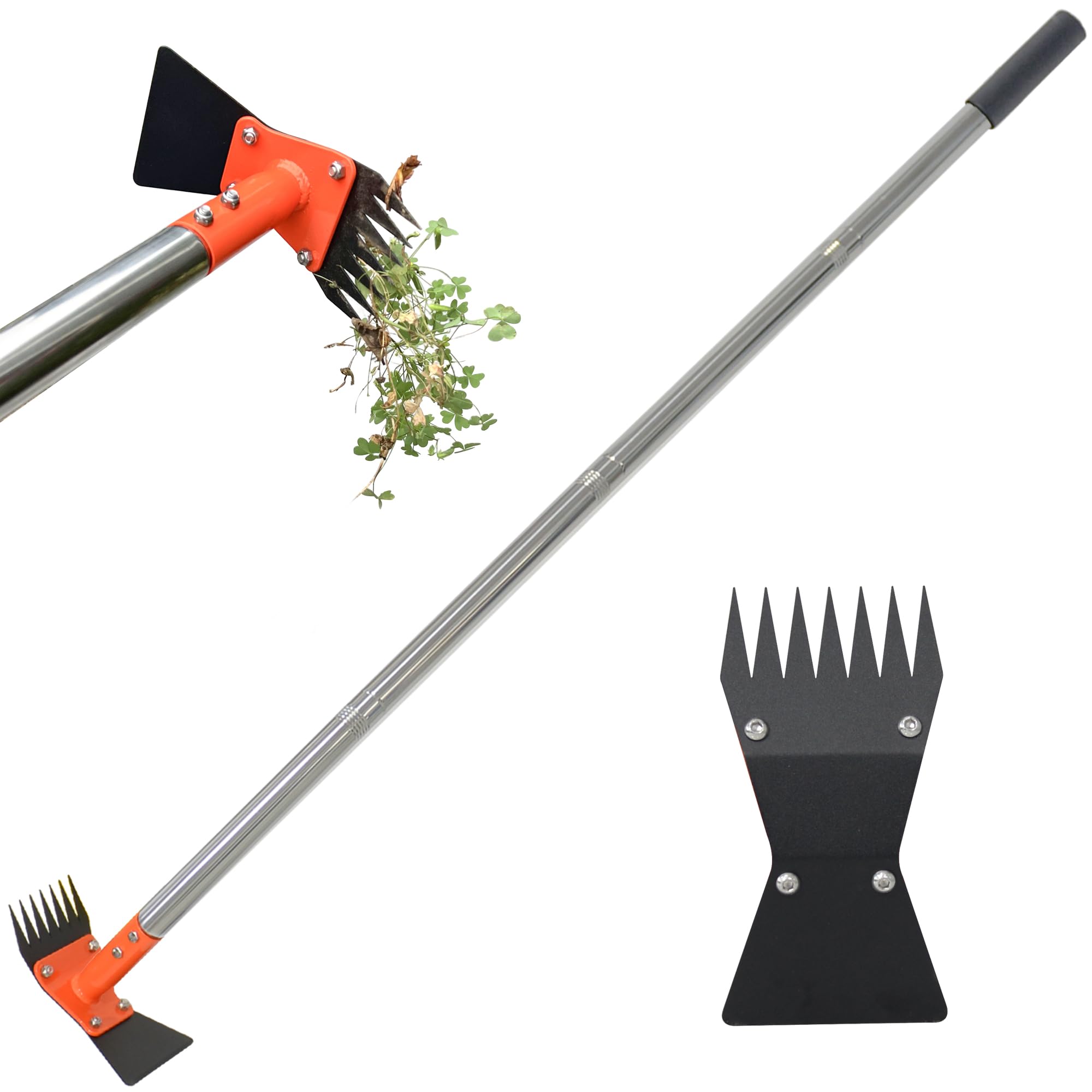
The CKLT 2-in-1 combines a sharp trapezoid hoe on one side and a 9-centimeter rake on the other, both crafted from tempered spring steel. The hoe side slices through compacted soil and cuts larger weeds at the base, while the rake side is sized to clear dirt and debris from brick and paver joints. The handle adjusts from its full 60-inch length down to a shorter configuration for raised beds or detail work, using 304 stainless steel hardware that resists rust.
Owners note that the hoe blade arrives razor-sharp and handles tree roots and large thistle clumps effectively. The rake teeth are aggressive enough to pull loose joint sand and moss from between pavers, though some users report the teeth can bend if forced against buried rocks at full body weight. The sand texture finish on the head provides better grip than a polished surface and contributes to the tool’s corrosion resistance.
The adjustable handle relies on screw-locking sections that can loosen during heavy use if not periodically tightened. The CKLT is a versatile companion to a dedicated stand-up weed puller — use the hoe for slicing large weeds in open areas, then switch to the rake for clearing paver joints, but rely on a four-claw tool for deep taproot extraction in tight cracks.
What works
- Sharp tempered spring steel hoe cuts through thick roots and compacted soil effectively
- Adjustable handle from full 60 inches to shorter length adapts to multiple tasks
- Sand texture finish resists corrosion and improves grip during wet-weather use
What doesn’t
- Rake teeth can bend under heavy force against buried stones or deep roots
- Screw-locked handle sections require periodic tightening to prevent loosening during use
6. Rocklin Stand Up Weed Puller Tool
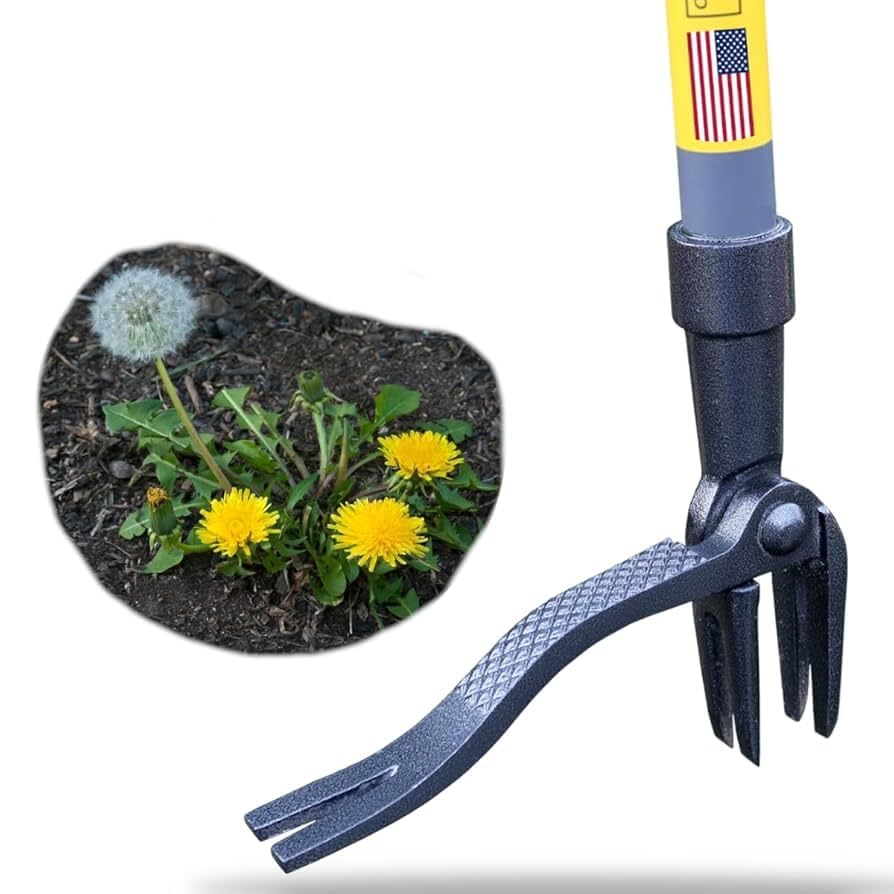
The Rocklin weed puller is a no-plastic, all-metal design built around a 48-inch threaded steel handle and a hardened four-claw head with a rhino-coated finish. The threaded sections lock together tightly, eliminating the wobble that plagues friction-fit or push-button handles on other weeders. The claws drive down roughly four inches and close around the taproot in a single press-and-pull motion, making it effective for dandelions, dock, plantain, and crabgrass growing in paver gaps.
Verified reviewers consistently describe the tool as solid and durable, noting that the metal head shows no signs of bending or loosening after months of use in compacted clay soil. The 48-inch handle is a comfortable height for users between 5’6″ and 6’0″, and the all-metal build gives a satisfyingly heavy feel that conveys confidence during the extraction stroke. The absence of any plastic in the working assembly means there is no eject mechanism — you must remove the weed from the claws by hand, which slows down high-volume work.
The Rocklin lacks the easy-eject convenience of the Fiskars, but its pure steel construction eliminates the plastic breakage risk entirely. For gardeners who work on hard, rocky paver bases and want a tool that can withstand years of heavy leverage without a single component failure, this is the most durable four-claw puller in the mid-range price tier.
What works
- Fully hardened steel construction with zero plastic parts ensures exceptional longevity
- Threaded handle sections stay tight during use, eliminating wobble on deep root pulls
- Rhino-coated head resists rust and provides good grip in moist soil conditions
What doesn’t
- No eject mechanism requires you to pull each weed from the claws by hand
- Heavier than aluminum-handled competitors, which can cause fatigue on multi-hour sessions
7. RexWeed Stand Up Weed Puller Tool (FX-TGWT)
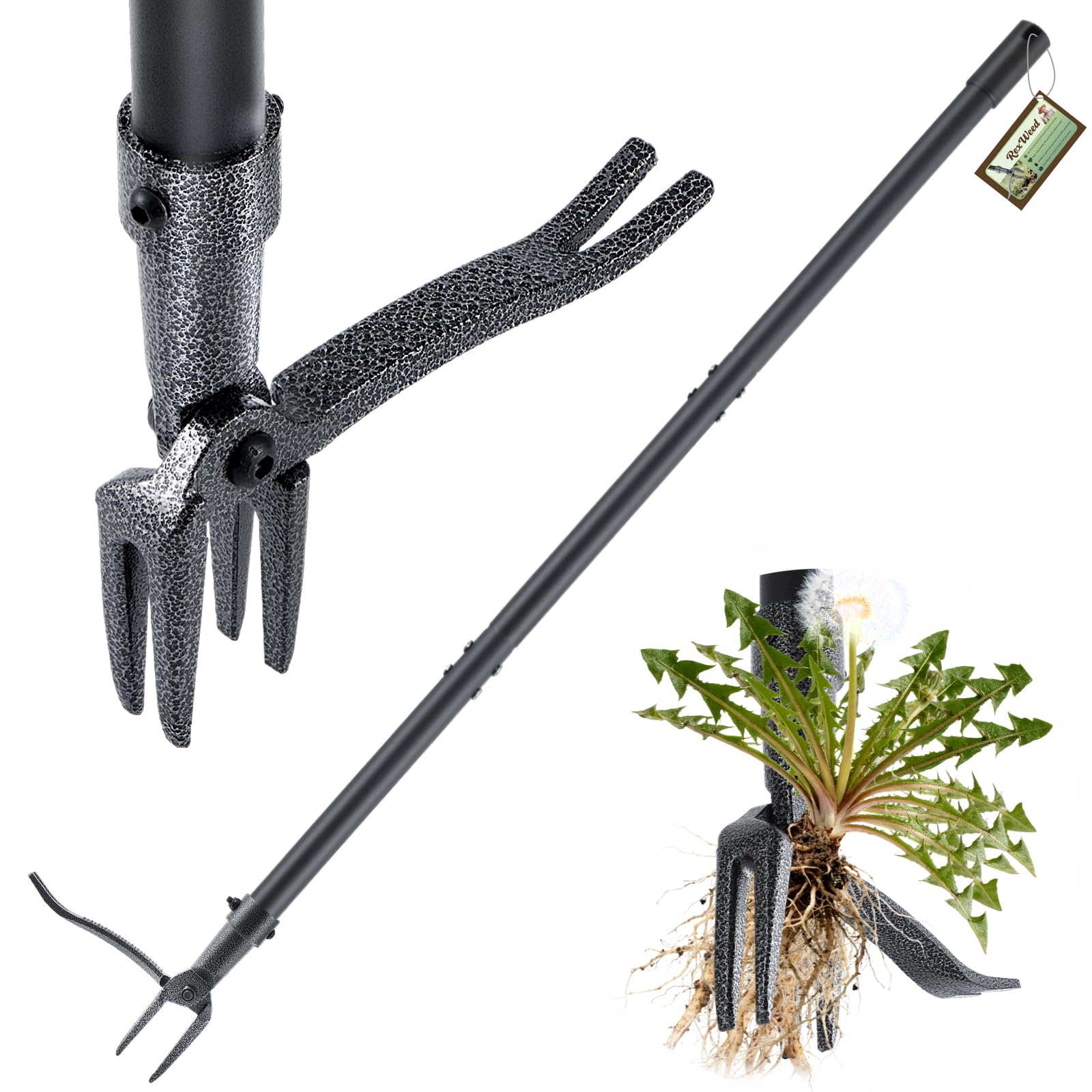
The RexWeed stand-up puller offers the widest handle adjustability in the lineup, ranging from 32 to 46 inches via three reinforced steel pipe sections. This makes it suitable for users of different heights and for adapting between flat lawn work and raised paver patios. The four serrated steel claws are designed to grip deep dandelion and crabgrass roots securely, and the head is made from cast metal rather than stamped steel, which contributes to its durability against rocky soil.
Owner feedback emphasizes the easy four-screw assembly and the tool’s light overall weight of just over three pounds, which reduces arm fatigue during long weeding sessions. The serrated claw edges provide a more aggressive bite on smooth-rooted weeds than smooth claws, improving extraction success rates. Many reviewers note a 95 percent or higher root-removal success rate when the claws are centered directly over the weed crown.
The RexWeed is best for homeowners who need a single tool that works across both lawn and paver areas, thanks to its height adjustability. However, like many non-premium stand-up pullers, it does not include an eject mechanism, so you will need to knock or pull the weed from the claws after each extraction. For the price, it delivers solid steel construction and effective root grabbing without any bending required.
What works
- Adjustable handle from 32 to 46 inches fits multiple user heights and task types
- Serrated steel claws provide aggressive grip on smooth-rooted weeds like crabgrass
- Lightweight all-metal build reduces fatigue without compromising durability
What doesn’t
- No built-in eject mechanism slows down high-volume weed removal
- Adjustable pipe sections can loosen over time without periodic retightening
Hardware & Specs Guide
Claw Geometry and Material
The number of claws and their material determine how well a tool extracts deep taproots from paver gaps. Four-claw designs provide the most balanced grip, distributing force around the root to prevent snapping. Serrated stainless steel claws resist corrosion and bite into smooth-rooted weeds more effectively than smooth steel. Hardened carbon steel claws are tougher but require wiping dry after use to prevent rust in storage.
Handle Length and Leverage
A handle length of at least 39 inches allows you to stand fully upright while applying leverage through your legs rather than your back. Aluminum handles keep the tool light for extended sessions, while steel handles add heft that can help drive claws into compacted joint sand. Bamboo handles absorb vibration but can crack under high torque on deep-rooted weeds in dry soil.
FAQ
Will a four-claw weed puller fit between standard paver gaps?
Why do some reviews say the weed breaks off instead of pulling the root?
Can I use a propane torch or boiling water instead of a mechanical weeder?
Final Thoughts: The Verdict
For most gardeners, the tool to remove weeds from pavers winner is the Fiskars Stand-Up Weed Puller because its easy-eject mechanism, offset handle, and serrated stainless steel claws deliver the best combination of speed, comfort, and root-removal reliability on moderate soil. If you want a classic, plastic-free design with a warm bamboo handle and a century-long track record, grab the Grampa’s Weeder Original. And for ultra-narrow paver gaps where four-claw heads cannot go, nothing beats the BARAYSTUS Crack Weeder for precise scraping and lifting in tight seams.