
The first weeks after snowmelt or the final frost create a narrow window where the wrong fertilizer choice can stunt root development for the entire growing season. High-nitrogen products applied too early can burn tender new shoots, while balanced formulas without slow-release technology wash away before the soil warms up, leaving your lawn patchy and your foundation plants hungry. Matching the NPK ratio to your specific grass type and soil temperature is not optional—it is the single most important decision you will make for your yard this year.
I’m Rikta — the co-founder and writer behind Lawn Gear Lab. For this guide, I cross-referenced manufacturer specifications from seven distinct products, analyzing their NPK ratios, nitrogen-release profiles, coverage areas, and micronutrient compositions to isolate the exact formulations that deliver measurable green-up in early spring without the risk of turf injury.
After evaluating slow-release nitrogen percentages, liquid versus granular application methods, and verified owner feedback across thousands of square feet of planted area, I narrowed the field to the formulations that earned a spot in every serious lawn-care rotation: the best early spring fertilizer.
How To Choose The Best Early Spring Fertilizer
Early spring fertilization is a balancing act between supplying enough nitrogen to wake the lawn from dormancy and starving weed seeds that germinate alongside your grass. The wrong NPK ratio, release timing, or form factor undoes weeks of potential growth before temperatures even stabilize.
Nitrogen Release Profile: Slow vs. Quick
Granular fertilizers with at least 40% slow-release nitrogen provide steady feeding over 8–12 weeks, matching the grass’s gradual ramp-up in metabolic activity as soil warms. Quick-release-only formulas deliver a jolt of green within 48 hours, but the surplus nitrogen often leaches below the root zone during spring rains, requiring reapplication within three weeks. For most lawns applying a single early-season treatment, a blend with 50–70% slow-release nitrogen is the sweet spot.
NPK Ratio and Soil Temperature
High-nitrogen ratios like 28-0-0 or 27-0-5 drive leaf-blade greening but must wait until soil temperatures reach a consistent 55°F—applying them earlier feeds emerging weeds instead of dormant grass roots. Phosphorus-heavy ratios such as 20-27-5 are reserved exclusively for new turf establishment; applying them to established lawns risks runoff into waterways. Balanced 10-10-10 formulations offer flexibility across flower beds, shrubs, and trees, but their lower nitrogen density means you need more product to achieve the same lawn-greening effect.
Liquid vs. Granular Application
Liquid formulations deliver nitrogen directly past the thatch layer into the soil within hours, making them ideal for rapid correction of nitrogen deficiency or for spot-treating thin areas. The trade-off is shorter feeding duration—most liquids provide only two to three weeks of active nutrition per application. Granular products require soil moisture to activate but provide sustained release; their distribution uniformity depends entirely on spreader calibration, and uneven application creates striping patterns visible from the street.
Micronutrient and Iron Additives
Iron content between 1% and 3% produces a deep green color within days of application without stimulating excessive leaf growth that demands more mowing. Humic acid, seaweed extract, and chelated trace minerals unlock nutrients already present in the soil, improving root biomass and drought tolerance. Products that list only the macronutrient NPK but omit these secondary ingredients often leave micronutrient deficiencies unaddressed, particularly in sandy soil or heavy clay environments.
Quick Comparison
On smaller screens, swipe sideways to see the full table.
| Model | Category | Best For | Key Spec | Amazon |
|---|---|---|---|---|
| Yard Mastery Flagship 24-0-6 | Granular | Large established lawns | 24% slow-release N, 3% iron | Amazon |
| The Andersons PGF 16-0-8 | Granular | Phosphorus-sensitive soil | Humic DG, 8-week feeding | Amazon |
| The Andersons Starter 20-27-5 | Granular | New seed establishment | High-P 20-27-5 for roots | Amazon |
| GreenView Fairway 27-0-5 | Granular | Medium lawns on a budget | 63% slow-release N | Amazon |
| Petramax Liquid N 28-0-0 | Liquid | Rapid green-up correction | 70% quick-release N | Amazon |
| Great Big Roses Liquid Booster | Liquid | Flower beds and shrubs | 70 chelated trace minerals | Amazon |
| GreenView Multi-Purpose 10-10-10 | Granular | Vegetable gardens and ornamentals | Balanced N-P-K ratio | Amazon |
In‑Depth Reviews
1. Yard Mastery 24-0-6 Flagship Granular Lawn Fertilizer

Yard Mastery’s Flagship formula delivers 24-0-6 NPK with 24% slow-release nitrogen and 6% potassium for drought resistance, making it the strongest all-in-one granular option for established lawns going into early spring. The 45-pound bag covers up to 15,000 square feet, which positions it as a premium-tier product for large properties where a single application must drive the entire early-season greening. The 3% iron content produces visible darkening within four to seven days of application, provided soil moisture activates the granules.
User reports highlight exceptional Bermuda grass thickening that choked out existing weeds after one bag, and multiple verified buyers noted neighbors asking which commercial lawn service they used—a direct indicator of the visual result density. The Bio-Nite additive improves soil microbial activity, which helps break down thatch layers that accumulate over cold months. The 24% slow-release profile sustains feeding for roughly eight weeks, bridging the gap from last frost into the late spring heat without a second application.
The large bag size and premium price tag make this unsuitable for small urban lawns or first-time owners who want to experiment with different formulas. Over-application risks excessive growth that demands twice-weekly mowing, and the high nitrogen content requires precise spreader calibration against the manufacturer’s settings. For owners of at least 5,000 square feet who are committed to a single, high-quality early feeding, this fertilizer eliminates guesswork across the entire season.
What works
- Exceptional greening from 3% iron content
- Large 15,000 sq ft coverage reduces application frequency
- Bio-Nite additive improves long-term soil health
What doesn’t
- High price point limits appeal for small lawns
- Over-application forces twice-weekly mowing schedule
- Requires precise spreader calibration to avoid striping
2. The Andersons Professional PGF 16-0-8 with Humic DG
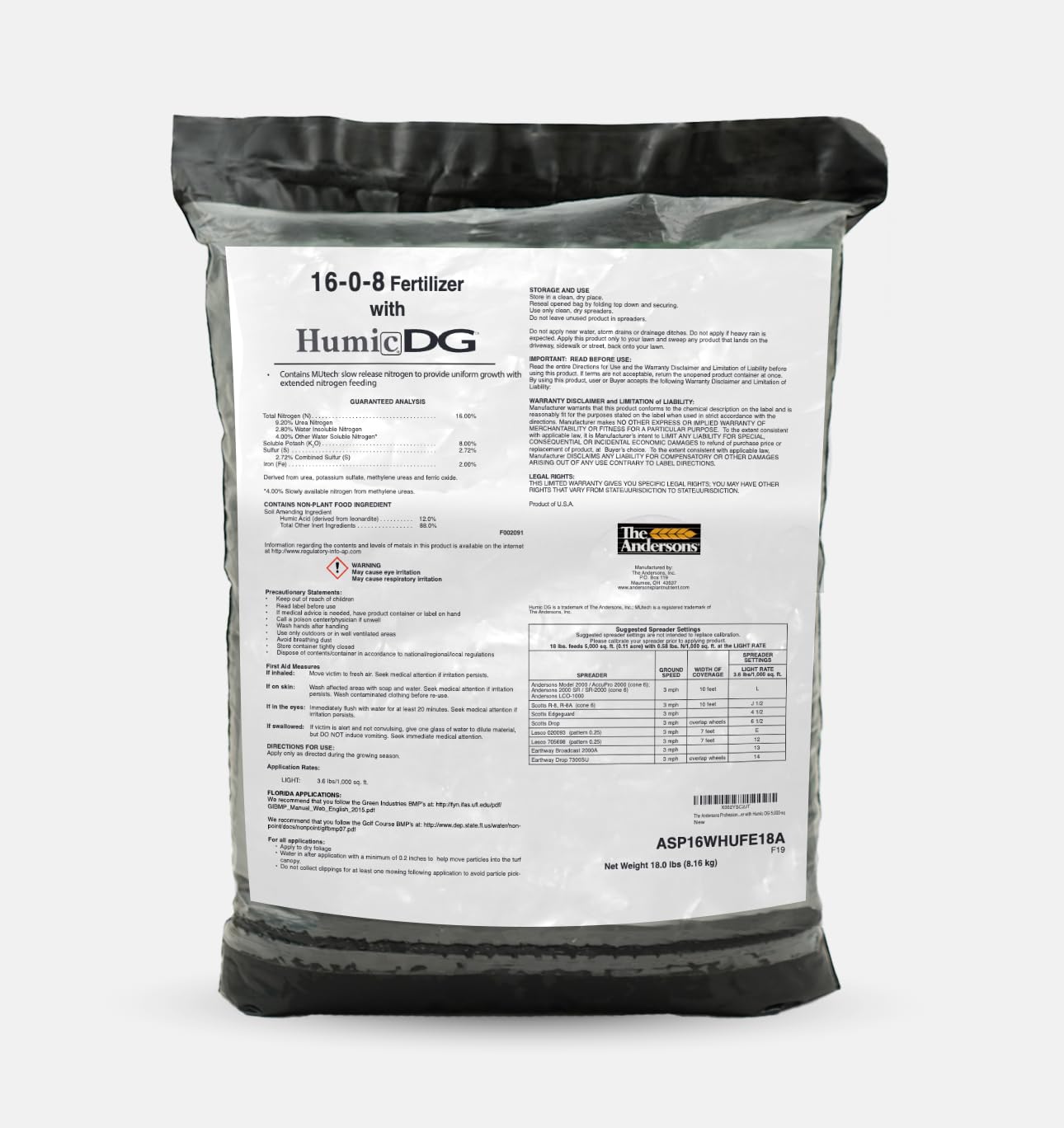
The Andersons PGF 16-0-8 eliminates phosphorus entirely while delivering quick- and slow-release nitrogen for up to eight weeks of feeding, an ideal formulation for soils already high in phosphorus from prior seasons. The 18-pound bag covers roughly 10,000 square feet, and the super-fine particle design—twice the number of granules per square foot compared to standard fertilizers—ensures distribution uniformity that prevents the dark green stripes common with cheaper granular blends. The inclusion of Humic DG, a soil conditioner that increases nutrient uptake, makes this product function as both a fertilizer and a root-zone amplifier.
Verified buyers who tested their soil and found excessive phosphorus levels specifically switched to this 16-0-8 version and reported sustained deep green color without the flush of top-heavy growth that attracts fungal pressure. The iron and micronutrient package covers trace minerals that are particularly depleted in sandy loam and clay soils after winter rains. The absence of phosphorus also makes this a safer choice for waterfront properties where phosphorus runoff restrictions apply.
The super-fine granules can drift in moderate wind during application, reducing effective coverage and wasting product, and the bag’s price-per-pound is among the highest in this comparison. Owners who do not have a soil test confirming high phosphorus levels are paying for a feature they might not need. For lawn caretakers who understand their soil chemistry and want a phosphorus-free, slow-release option with root-activated feeding, this formulation is the most scientifically precise tool available.
What works
- Phosphorus-free design suits high-P soil and waterfronts
- Humic DG improves nutrient uptake at root level
- Ultra-fine granules prevent application striping
What doesn’t
- Fine particles drift in wind during spreader use
- High cost per pound compared to balanced alternatives
- Best value depends on prior soil test confirmation
3. The Andersons Premium New Lawn Starter 20-27-5
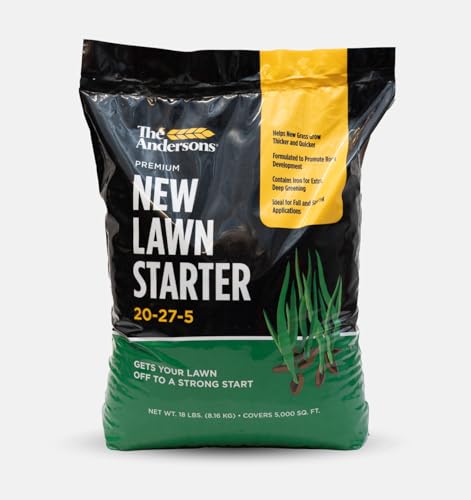
The Andersons Premium New Lawn Starter uses a 20-27-5 NPK ratio that delivers the highest phosphorus concentration in this lineup, specifically formulated to drive root development in freshly seeded or sodded turf. The 18-pound bag covers up to 5,000 square feet, and the combination of quick-release and slow-release nitrogen provides immediate seedling fuel while sustaining feeding as the root system establishes. The added 1% iron gives new grass a deep green tone that helps it compete against early spring weed pressure.
Customer feedback consistently notes visible grass establishment within seven to ten days of application, with several reviewers reporting that this starter outperformed their previous standard fertilizer routine. The phosphorus density stimulates lateral root branching, which is critical for creating dense sod coverage before summer heat stress arrives. The granular form requires incorporation into the top inch of soil or watering-in within 24 hours; leaving it on the surface reduces phosphorus availability.
The high phosphorus content makes this product unsuitable for established lawns or soils with existing phosphorus buildup—applying it without a soil test risks environmental runoff and algae bloom contribution. The coverage area of 5,000 square feet is smaller than many general-purpose fertilizers, so owners of larger properties will need multiple bags. For anyone establishing new turf this spring—whether from seed, plugs, or sod—this starter fertilizer provides the highest phosphorus loading available in this comparison.
What works
- High phosphorus ratio accelerates seedling root growth
- Quick+slow nitrogen supports immediate and sustained feeding
- Iron content adds visible green color to new turf
What doesn’t
- Unsuitable for established lawns without soil test
- Only covers 5,000 sq ft per bag
- Phosphorus runoff risk if not watered in properly
4. GreenView Fairway Formula Lawn Fertilizer 27-0-5

GreenView’s Fairway Formula delivers a 27-0-5 NPK with an unusually high 63% slow-release nitrogen, sustaining feeding for up to twelve weeks from a single 16.5-pound bag that covers 5,000 square feet. That slow-release percentage is the highest in this group, making it the most maintenance-free granular option for homeowners who want to apply once in early spring and trust the lawn to feed itself through late spring. The zero-phosphorus formulation protects waterways and matches regulations in phosphorus-restricted counties.
Verified owners report visible greening within one week when the granules encounter light rain or irrigation, and the small blue granules distribute evenly through standard broadcast spreaders without clumping or bridging in the hopper. Multiple reviewers specifically praised its effectiveness on Carpet Grass and Centipede in Zone 7a, indicating strong performance on warm-season grass types that are notoriously sensitive to early overfeeding. The 12-week nitrogen release window covers the entire spring transition period without a second application.
The 5,000-square-foot coverage requires at least two bags for lawns one acre or larger, diminishing its price advantage at scale. The high nitrogen ratio can still produce excessive leaf growth if applied too early in northern climates where soil temperatures stay below 55°F into late April. For mid-sized lawns in transition zones where a single, phosphate-free spring application is the goal, this presents the best coverage-per-dollar ratio in the comparison.
What works
- Highest slow-release nitrogen at 63% for 12-week feeding
- Zero phosphorus protects waterways
- Small granules prevent spreader clumping
What doesn’t
- Coverage limited to 5,000 sq ft per bag
- Excessive growth risk if applied before soil warms
- Best value diminishes for large acreage lawns
5. Petramax Liquid Nitrogen Fertilizer 28-0-0

Petramax’s liquid 28-0-0 formulation provides the highest nitrogen concentration in this comparison with a 70% quick-release / 30% slow-release split, designed for immediate green-up of nitrogen-deficient lawns. The 32-ounce bottle treats up to 12,800 square feet at maintenance rate or 6,400 square feet for corrective applications, and the liquid format bypasses thatch layers to reach soil within hours—critical for owners who skipped fall fertilization and entered spring with pale, thin turf. The 28-0-0 ratio contains zero phosphorus and zero potassium, focusing exclusively on foliar and root-zone nitrogen delivery.
User reviews consistently call this the product that produced the greenest lawn in the neighborhood, with several buyers reporting visible darkening within 48 hours of spraying. The liquid is compatible with hose-end sprayers and backpack units; Petramax recommends using their own battery-powered sprayer for even distribution, but any calibrated sprayer works. The inclusion of both quick and slow-release nitrogen in one bottle means one application covers the immediate visual improvement while residual feeding continues for roughly two weeks.
The 28-0-0 NPK contains no potassium or micronutrients, so it functions solely as a nitrogen supplement—not a complete lawn food—and lawns already low in potassium will still show weak drought tolerance. Liquid applications require more frequent reapplication than granular products, and the 30% slow-release portion is shorter than most granular extended-release windows. For a targeted nitrogen correction on a lawn that already has adequate phosphorus and potassium levels from prior seasons, this delivers the fastest visible transformation.
What works
- Visible greening within 48 hours of application
- Liquid format bypasses thatch for direct soil delivery
- High 28-0-0 concentration corrects deficiency quickly
What doesn’t
- No potassium or micronutrients for full lawn nutrition
- Requires reapplication more frequently than granular
- Slow-release portion is shorter than extended-release blends
6. Great Big Roses and Flowers Liquid Fertilizer Booster
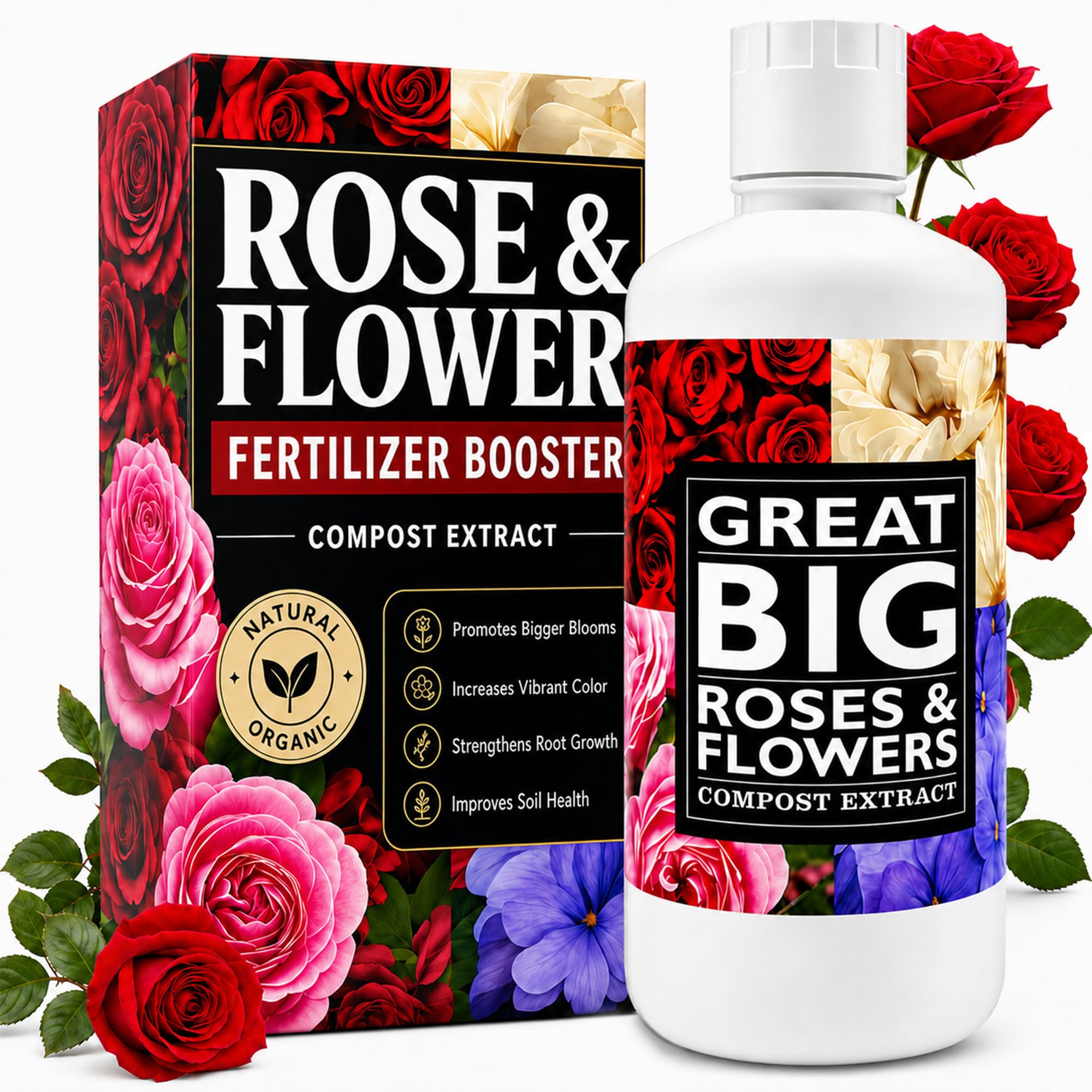
Great Big Roses and Flowers is a liquid fertilizer booster that supplies humic acids, seaweed extract, and over 70 chelated trace minerals to unlock nutrients already present in garden soil rather than adding high NPK macronumbers. The 32-ounce bottle concentrates into roughly eight applications, with each 4-ounce dose mixing into one gallon of water for root-zone drenching around rose bushes, hydrangeas, citrus trees, and perennials. The formula is designed to amplify the effectiveness of existing fertilizers—fish emulsion, bone meal, worm castings—by making soil nutrients more plant-available through chelation.
Verified customers who owned rose bushes that had not bloomed in years reported massive flower production within three weeks of the first application, with abundant budding and early blooms even after a harsh winter. Multiple reviews noted that the liquid flows into the root zone without digging or tilling, making it accessible for established shrub beds where soil disruption is impractical. The combination of humic acid for soil structure improvement and seaweed for cytokinin content supports both root development and stress resistance during fluctuating spring temperatures.
The product’s strength lies in soil activation rather than direct feeding, so owners expecting a high-nitrogen green-up in their lawn will be disappointed—it is formulated specifically for flowering ornamentals. The jug’s wide mouth causes spillage during measurement, and the price per application is higher than standard granular fertilizers for flower beds. For rose and hydrangea enthusiasts who want to maximize bloom output from their existing fertilization program, this booster provides the micronutrient diversity that granular NPK alone cannot supply.
What works
- 70+ chelated trace minerals unlock soil nutrients
- Proven to stimulate blooms on non-flowering bushes
- No digging or tilling required for application
What doesn’t
- Not a standalone nitrogen source, works best alongside other fertilizers
- Wide jug mouth causes spillage during measuring
- Higher cost per application than standard granular rose food
7. GreenView Multi-Purpose Fertilizer 10-10-10

GreenView’s Multi-Purpose 10-10-10 delivers a perfectly balanced NPK ratio at the lowest per-pound cost in this comparison, making it the ideal general-purpose fertilizer for vegetable gardens, flower beds, trees, shrubs, and ornamental gardens rather than turf-focused lawns. The 33-pound bag offers substantial coverage—the label directs users to adjust application rates based on plant type—and the granule size is large enough to stay stable in a drop spreader without blowing away in spring wind. The balanced formulation makes it impossible to accidentally burn plants with excess nitrogen, a common early-spring mistake from beginners.
Customer reviews from Midwestern growers confirm strong results across hostas, perennials, vegetables, and trees throughout the growing season, noting fast greening and no granule clumping even in humid conditions. The formulation includes no slow-release coating, so the nutrients dissolve within two to three weeks and must be reapplied more frequently than premium blends. The 10-10-10 ratio works on almost everything planted in the ground, eliminating the need to buy separate fertilizers for different garden sections.
The equal-ratio NPK provides only moderate nitrogen compared to the 24-0-6 or 27-0-5 formulations, so lawns that need high-nitrogen feeding for thick green cover will require more frequent applications or higher spreader settings. The lack of iron, humic acid, or slow-release technology means this is a bare-minimum nutrient package—adequate for general maintenance but not optimized for any single plant type. For gardeners who manage mixed beds of flowers, shrubs, and vegetables and want one bag that works across all of them without risk, this is the safest entry-level granular fertilizer available.
What works
- Balanced NPK works safely across all plant types
- Lowest cost per pound in the comparison
- Large granule size resists wind drift during spreading
What doesn’t
- Lower nitrogen density than lawn-specific formulas
- No slow-release coating requires frequent reapplication
- Lacks iron and humic acid for deep greening
Hardware & Specs Guide
NPK Ratio and Nitrogen Release
The three numbers on every bag represent nitrogen (N), phosphorus (P), and potassium (K) percentages by weight. Early spring fertilizers emphasize nitrogen from 24% up to 28% to drive leaf blade expansion after winter dormancy. Slow-release nitrogen is coated with a polymer or sulfur layer that dissolves gradually as soil temperature and moisture increase; a percentage above 50% slow-release sustains feeding for eight to twelve weeks from a single application. Quick-release-only formulas green the lawn in 48 hours but require reapplication every three weeks.
Phosphorus Content and Soil Testing
Phosphorus supports root development and is critical for newly seeded lawns. Starter fertilizers like 20-27-5 contain high phosphorus, but established lawns often have sufficient soil phosphorus from previous seasons. Applying phosphorus to soil already high in it contributes to algal bloom in local waterways, and many states now restrict phosphorus lawn fertilizers entirely. Using a simple soil test kit in early spring—testing at two inches depth, when soil is moist but not saturated—tells you whether a phosphorus-free formula like 16-0-8 or 27-0-5 is the correct choice.
Micronutrients and Iron Additives
Iron content between 1% and 3% produces a dark green visual effect separate from nitrogen. Humic acid improves soil cation exchange capacity, meaning roots hold onto nutrients longer between waterings. Seaweed extract supplies auxins and cytokinins that stimulate root branching. Chelated trace minerals such as zinc, manganese, and copper are bonded to organic molecules that prevent them from locking up in alkaline soil. Products listing only NPK without these secondary ingredients may produce top growth that is lighter in color and more susceptible to environmental stress.
Liquid Versus Granular Application
Liquid fertilizers bypass thatch layers and deliver nitrogen directly to soil within hours, making them ideal for rapid deficiency correction or spot treating thin areas. Granular formulations require soil moisture to dissolve the coating before nutrients become available; application timing should coincide with a predicted light rainfall or scheduled irrigation session. Granular spreaders must be calibrated to the specific product’s recommended pounds per 1,000 square feet—over-application at overlap points creates discernible stripes that last until the next mowing.
FAQ
Can I apply early spring fertilizer before the last frost?
What is the difference between 27-0-5 and 10-10-10 for my lawn?
How soon after applying granular fertilizer will I see green grass?
Is liquid fertilizer better for early spring than granular fertilizer?
What does Humic DG do in lawn fertilizer?
Final Thoughts: The Verdict
For most gardeners, the best early spring fertilizer winner is the Yard Mastery 24-0-6 Flagship because its 24% slow-release nitrogen, 3% iron content, and 15,000-square-foot coverage eliminate the need for a second spring application while producing deep greening that neighbors will notice. If you need a phosphorus-free option for tested soil, grab the The Andersons PGF 16-0-8 with Humic DG for its precision formulation and soil-conditioning additive. And for the budget-conscious owner of a medium lawn, nothing beats the GreenView Fairway Formula 27-0-5 for 63% slow-release nitrogen at the lowest cost per thousand square feet in this comparison.