
Dragging a hose wand through your flower beds every evening isn’t just tedious—it’s inefficient. Overhead watering wastes moisture to evaporation and promotes leaf disease, while uneven hand-watering leaves thirsty patches hidden behind dense foliage. A purpose-built system replaces guesswork with targeted, low-pressure hydration that goes straight to the roots, where it counts.
I’m Rikta — the co-founder and writer behind Lawn Gear Lab. I spend hours comparing flow rates, tubing diameters, and assembly logic across dozens of watering kits, cross-referencing real owner feedback to separate products that deliver even coverage from those that frustrate with leaks and uneven output.
After analyzing seven distinct approaches to automated hydration, I’ve narrowed the market to the one setup that balances coverage, durability, and ease of use. This is your complete guide to the best flower bed watering system for your garden’s specific layout and budget.
How To Choose The Best Flower Bed Watering System
Flower beds vary in shape, plant density, and sun exposure. A system that works for a linear row of roses may drown a mixed perennial border. Focus on these three decisions before buying.
Tubing Diameter & Coverage Length
Standard drip kits use 1/4-inch distribution tubing, but the pressure drop over 50 feet can starve far-end emitters. Systems with 5/16-inch or 1/2-inch main lines maintain more consistent flow at the last nozzle. If your bed runs longer than 30 feet, look for larger-diameter tubing or a pressure-compensating design that self-regulates output regardless of distance from the faucet.
Emitter Type: Drip, Spray, or Soaker
Adjustable drip emitters let you dial flow from a slow trickle up to a full spray—ideal for mixed plantings where annuals need less water than deep-rooted shrubs. Flat soaker hoses weep along their entire length and work best for tight, narrow beds where you can snake the hose to follow the planting line. Pre-assembled grid panels spray 16 streams per square foot, perfect for rectangular raised beds with uniform plant spacing but inflexible for irregular shapes.
Timer Compatibility & Automation
All serious kits connect to standard hose timers, but check whether the manufacturer explicitly supports the added back pressure. Some smart valves (especially Orbit BHyve and Eve Aqua) can trigger water hammer with systems that lack built-in pressure regulation. If you plan to automate, choose a kit with a fine-mesh filter screen and confirm the flow rate stays under 1.5 GPM to avoid stressing residential hose timers.
Quick Comparison
On smaller screens, swipe sideways to see the full table.
| Model | Category | Best For | Key Spec | Amazon |
|---|---|---|---|---|
| Garden Grid 3×6 | Grid Panel | Raised beds, instant uniform watering | 16 streams per sq. ft. | Amazon |
| Rain Bird LNDDRIPKIT | Drip/Micro-Spray | Mixed landscapes, shrubs & trees | Pressure-compensating drippers | Amazon |
| Thiswing Drip 100FT | Spray/Nozzle | Large beds needing 360° coverage | Copper nozzles, 5/16″ tubing | Amazon |
| Bonviee 230FT Drip | Drip/Spray Combo | Multiple small beds & containers | 230-ft total tubing, quick-connect | Amazon |
| Suneed Flat Soaker 100FT | Soaker Hose | Narrow rows, dense ground cover | 100 ft x 4 packs | Amazon |
| Secbulk Flat Soaker 150FT | Soaker Hose | Long, straight beds & vegetable rows | 150 ft, 40-90 psi range | Amazon |
| Secbulk Flat Soaker 100FT | Soaker Hose | Budget-friendly, linkable sections | Dual-layer, recycled vinyl | Amazon |
In‑Depth Reviews
1. Garden Grid 3×6 Watering System
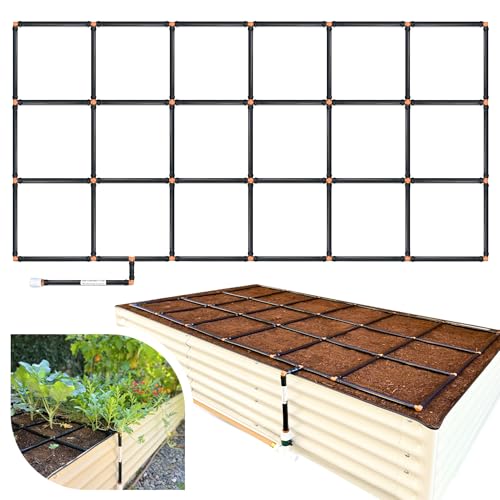
The Garden Grid arrives in preassembled sections and sets up in under two minutes—just lay it on the raised bed and connect a garden hose. Each square foot delivers 16 individual streams straight to soil level, eliminating the dry spots that plague single-line soaker hoses. The polypropylene construction includes a built-in fine mesh filter screen, and owners report original units from 2013 still functioning without cracked emitters or brittle tubing.
This is not a modular system. You cannot reposition emitters or extend the grid beyond its 33.5 by 66-inch footprint. It is dimensionally precise—designed for standard 3×6 raised beds—so irregular-shaped beds or curved borders require a different approach. The rigid grid also sits above the soil surface, which can make mulch application slightly fiddly underneath.
For square-foot gardeners who value instant, even coverage over flexibility, this system eliminates the assembly frustration of traditional drip kits. Pair it with a hose timer and you have a set-and-forget automatic watering solution that simply works, season after season.
What works
- Two-minute tool-free setup is genuinely faster than any modular kit
- Stream pattern covers every square inch of the bed evenly
- UV-resistant build outlasts standard soaker hoses 5-10x
What doesn’t
- Fixed 3×6 size—no flexibility for irregular or curved beds
- Premium price point is the most expensive entry in this list
- Rigid grid can be awkward to work around when planting or mulching
2. Rain Bird LNDDRIPKIT Drip Irrigation Kit

Rain Bird’s 108-piece kit is the most versatile option for mixed landscapes, including drippers, micro-bubblers, and micro-sprays that let you match watering style to each plant. The pressure-compensating technology ensures every emitter delivers the same flow rate regardless of how far it sits from the faucet—critical when your flower bed has a 40-foot run of 1/2-inch supply tubing.
Some owners report that the included 50 feet of 1/2-inch polyethylene tubing is sufficient for an average landscape bed but tight for large gardens. The barbed fittings require a bit of hand strength to push into the tubing, and the instructions are minimal—first-timers may need to search YouTube for assembly clarity. Additionally, users with smart water valves (Orbit BHyve, Eve Aqua) have noted intermittent water hammer issues.
If you want the flexibility to water creeping phlox with drip emitters one foot away and a rose bush with a micro-bubbler the next, this kit gives you that granular control. The clog-resistant drippers and zero-maintenance design mean you can bury the 1/2-inch main line under mulch for a clean, invisible installation.
What works
- Three emitter types cover everything from pots to shrubs
- Pressure compensation keeps far-end flow identical to near-end
- Durable 1/2-inch main line survives freezing temperatures
What doesn’t
- Instructions are sparse; some assembly intuition required
- Not compatible with certain smart water timers without modification
- Single 50-ft main line may need an expansion kit for larger beds
3. Thiswing 360° Adjustable Drip Irrigation System

The Thiswing kit solves the low-pressure problem of 1/4-inch systems by supplying 100 feet of 5/16-inch tubing with a larger inner diameter. The result is noticeably stronger flow at the far end, and each of the 32 solid copper nozzles can be rotated 360 degrees and bent to direct the spray pattern exactly where needed. The pneumatic quick-connect tees lock tubing without barbed fittings, making layout changes simple.
Assembly is genuinely fast—experienced users report a 50×3-foot bed setup in under 30 minutes. However, the terminal plug can be tricky to seal; a few owners discovered they needed to heat-seal the end with a lighter to prevent a slow drip at the final tee. The misting nozzles, when fully open, produce a fine spray that works well for overhead cooling but can overspray onto pathways if you don’t angle them carefully.
This is the strongest candidate for long, rectangular beds where you need high-volume coverage at the end of the line. The included pipe cutter and zip ties simplify installation, and the ability to run 15-minute watering cycles with full coverage makes it ideal for busy gardeners.
What works
- Larger 5/16-inch tubing prevents flow drop at distant nozzles
- Copper nozzles resist rust and allow 360° directional adjustment
- Quick-connect tees are faster than traditional barbed fittings
What doesn’t
- Terminal plug seal is unreliable without additional heat treatment
- Fine mist may drift in windy conditions onto non-target areas
- No written manual—only picture-based instructions
4. Bonviee 230FT Drip Irrigation System

The Bonviee kit packs the most total tubing of any kit here—197 feet of 1/4-inch drip line plus 33 feet of 5/16-inch main line—giving you flexibility to run multiple branches to separate flower beds, containers, and a small greenhouse in one purchase. The push-to-connect fittings click into place without tools and create a tight seal that owners consistently describe as leak-free out of the box.
While the kit includes adjustable stake sprayers with three flow modes (drip, stream, spray), the 1/4-inch secondary tubing does lose pressure faster than 5/16-inch or 1/2-inch lines. For runs longer than about 25 feet on a single branch, the far-end emitters may trickle rather than spray. The sheer number of included parts (65 pieces) can also feel overwhelming if you only need to water a single bed.
If you have multiple small flower beds, patio pots, and a row of foundation shrubs, this all-in-one approach saves you from buying separate kits for each zone. The quick-connect design and compatibility with standard hose timers make it an easy weekend project with immediate results.
What works
- 230 feet of combined tubing covers multiple zones in one kit
- Tool-free push-to-connect fittings install without frustration
- Three spray modes per emitter for plant-specific watering
What doesn’t
- 1/4-inch tubing loses pressure over long individual runs
- 65 pieces can be confusing to organize for small gardens
- Extra stakes needed for complex layouts beyond basic rows
5. Suneed Flat Soaker Hose 100FT (4x25ft)

The Suneed flat soaker hose bundle includes four separate 25-foot sections, allowing you to water up to four narrow beds simultaneously with a simple splitter. Unlike round soaker hoses that kink and produce uneven weeps, the flat vinyl construction lies flush against the soil and weeps consistently along the entire length. At a suggested operating pressure of 30-60 psi, these hoses deliver root-level hydration without overhead leaf wetting.
Some owners note that the included 100 feet total (four 25-ft hoses) is actually four individual pieces that must be connected end-to-end if you want a single 100-foot run. The material is vinyl, which is lighter and less puncture-resistant than rubber—avoid dragging sharp garden tools across the hose. A few users also mentioned that the end caps must be tightly secured or water will dribble from the far end rather than weep through the fabric.
For dense ground covers, narrow perennial borders, or rows of edging plants, the flat soaker approach delivers water precisely where it’s needed. The 25-foot individual sections are easy to position without cutting or splicing, and the lightweight material stores compactly in winter.
What works
- Flat design lies flush against soil without kinking
- Four separate 25-ft hoses for multi-bed use
- Minimal water waste—delivers directly to root zone
What doesn’t
- Vinyl material is less puncture-resistant than rubber alternatives
- End caps can leak if not tightened firmly
- Cannot adjust flow rate per section—on/off only
6. Secbulk Flat Soaker Hose 150FT (2x75ft)
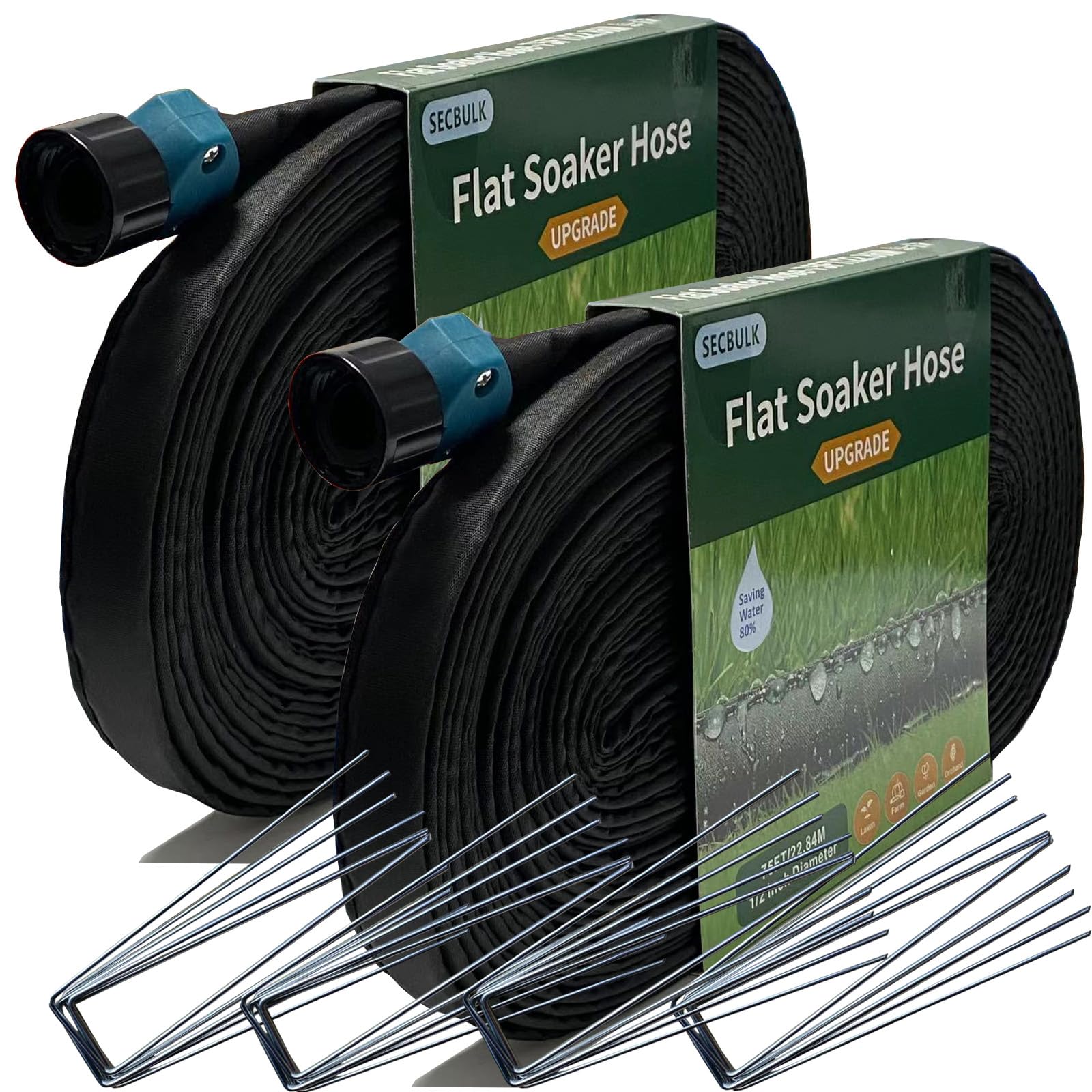
The Secbulk 150-foot soaker hose comes as two 75-foot linkable sections, giving you the reach to snake through a long vegetable patch or wrap around a large flower bed perimeter. The dual-layer construction pairs a PVC inner core with an extra-strength fabric cover that resists UV degradation better than standard rubber weeping hoses. Owners report the design holds up through full summer seasons without cracking or splitting.
At 150 feet, water pressure drops noticeably toward the far end—Secbulk recommends 40-90 psi input, but if your home supply is on the lower end, the last 20-30 feet may only produce a faint seep rather than a consistent soak. The recycled vinyl material also has a distinct odor when new, though it dissipates after a few watering cycles. Like all flat soaker hoses, you cannot zone different flow rates along the length without adding inline valves.
This is a strong choice for single 100- to 150-foot straight beds or long borders where you want to avoid assembling a multi-branch drip system. The fabric outer layer withstands accidental tugs from garden tools better than thin vinyl, and the linkable design lets you run two separate 75-foot paths if needed.
What works
- 150-ft length covers large beds without multiple splitters
- Fabric outer layer resists sun damage better than bare vinyl
- Two 75-ft sections offer flexible routing options
What doesn’t
- Pressure drops noticeably on the last 30 feet at lower psi
- Recycled vinyl has a temporary chemical odor initially
- No built-in flow adjustment—single weep rate along entire hose
7. Secbulk Flat Soaker Hose 100FT (2x50ft)

The 100-foot Secbulk set splits into two 50-foot hoses that link end-to-end or run independently to separate beds. The dual-layer PVC-and-fabric construction and CA65 certification make the water safe for edible gardens—a detail budget hoses often skip. The flat design lies close to the ground, minimizing evaporation and keeping moisture off foliage, which reduces fungal issues on ornamentals and vegetables alike.
At the lower end of the price spectrum, the vinyl material is thinner than the premium Suneed or Secbulk 150-ft version. Owners note that the fabric cover can snag on rough stone edging or sharp metal bed corners. The maximum pressure of 90 psi is generous, but the hose performs best at the lower end of the 40-90 psi range to prevent bursting the inner PVC tube.
For the gardener who needs reliable weep irrigation across two medium flower beds without investing in a modular drip system, this entry-level soaker delivers solid performance per dollar.
What works
- Entry-level price with dual-layer durability
- CA65 certified—safe for vegetable and herb beds
- Two 50-ft sections offer layout flexibility
What doesn’t
- Fabric cover snags on rough edges and sharp stones
- Vinyl inner tube may burst if pressure exceeds 90 psi
- Single weep rate—no per-section flow control
Hardware & Specs Guide
Tubing Inner Diameter & Flow Rate
The most overlooked spec in drip irrigation is the tubing’s inner diameter. 1/4-inch tubing (the most common in cheap kits) limits flow to roughly 0.6 gallons per minute at 40 psi over 100 feet. Upgrading to 5/16-inch tubing nearly doubles flow capacity to 1.1 GPM, while 1/2-inch main lines push up to 3 GPM. If your flower bed has more than 20 emitters or runs longer than 30 feet, step up to at least 5/16-inch distribution tubing to avoid weak far-end performance.
Pressure-Compensating vs. Non-PC Emitters
Pressure-compensating (PC) drippers contain a silicone diaphragm that self-regulates output regardless of inlet pressure within a specified range (usually 15-50 psi). Non-PC drippers rely solely on friction inside the emitter, so flow varies with elevation changes and line length. For flower beds with gentle slopes or runs over 25 feet, PC emitters ensure the last rose bush receives the same 0.5 GPH as the first—without visible water pooling at the head of the bed.
FAQ
Can I connect a drip kit to a smart hose timer?
How do I prevent soaker hoses from clogging over time?
Should I bury drip tubing or leave it on the surface?
Final Thoughts: The Verdict
For most gardeners, the flower bed watering system winner is the Garden Grid 3×6 because it eliminates the setup frustration of modular kits and delivers truly uniform coverage in a standard raised bed with zero maintenance. If you want granular control with pressure-compensating drippers that adapt to mixed plantings across a landscape bed, grab the Rain Bird LNDDRIPKIT. And for a no-fuss soak along narrow borders or long vegetable rows, nothing beats the straightforward reliability of the Secbulk 150FT Flat Soaker Hose.