
Indoor gardening without a window sill means your plants depend entirely on artificial light. Standard lamps emit wavelengths that foliage barely uses, leading to leggy growth and pale leaves. The market now offers bulbs purpose-built for photosynthesis, but the real challenge is finding one that delivers sufficient intensity without turning your living room into a disco with purple haze.
I’m Rikta — the co-founder and writer behind Lawn Gear Lab. I’ve spent countless hours cross-referencing PAR/PPFD crop sheets against commercial grow bulb specs, analyzing owner feedback on longevity and heat management, and verifying spectral coverage claims to cut through the marketing around indoor plant lighting.
This guide ranks the top models by real-world output, beam control, and energy efficiency so you can confidently select the best grow bulbs for keeping your herbs, succulents, or fruiting plants productive through every season.
How To Choose The Best Grow Bulbs
Selecting a grow bulb is less about wattage and more about how efficiently the bulb converts electricity into usable photons for photosynthesis. The key specs—PPFD, beam angle, spectral balance, and heat management—determine whether your indoor garden thrives or just survives.
PPFD and Coverage Intensity
PPFD (Photosynthetic Photon Flux Density) measures how many usable light particles hit a square meter every second. For herbs and leafy greens, you need at least 100-200 µmol/m²/s; for fruiting plants like tomatoes or peppers, aim above 300 µmol/m²/s. A bulb with a tight 50-degree beam angle delivers higher PPFD at a close range, while a wide 230-degree angle covers a broader area but dilutes intensity quickly.
Spectral Balance: White Light vs. Red-Blue
Old-school “blurple” bulbs emit heavy red and blue bands, omitting green and yellow wavelengths that penetrate deeper into the leaf canopy. Modern full-spectrum white-light bulbs (4000K-5000K) provide a balanced wavelength from 380nm to 800nm, making them more pleasant for the eye and often more effective for all growth stages. Look for bulbs that include 500-570nm green light and 570-599nm yellow light to support leaf expansion and root development.
Heat Dissipation and Bulb Form Factor
A18 and A21 bulbs fit standard lamps but can trap heat inside cheap fixtures. PAR38 flood bulbs feature larger aluminum heat sinks that shed heat more efficiently, enabling higher sustained PPFD without scorching leaves. Ceramic-substrate technology, used by some premium brands, pulls heat away from the LED junction faster than traditional MCPCB aluminum, extending lifespan and maintaining consistent output over 25,000 hours.
Quick Comparison
On smaller screens, swipe sideways to see the full table.
| Model | Category | Best For | Key Spec | Amazon |
|---|---|---|---|---|
| SANSI 32W A21 | Premium A21 | High PPFD up close | 423 µmol/m²/s @ 1FT | Amazon |
| GE PAR38 | Premium PAR38 | Flowering & fruiting | 50 µmol/s PPF | Amazon |
| Philips PAR38 | Mid-Range PAR38 | Durable wide coverage | 50-degree beam angle | Amazon |
| SANSI Dual-Head Clip | Premium Clip | Adjustable desktop setups | 2000LM / 20W total | Amazon |
| Necgemlex A21 Smart | Mid-Range Smart | Auto-timer convenience | 4500K, 9W dimmable | Amazon |
| ALIDE A19 6-Pack | Budget Multi-Pack | Broad area coverage | 230-degree beam angle | Amazon |
| ALIDE A19 3-Pack | Budget Starter | Entry-level seedling light | 10W, 1000LM each | Amazon |
In‑Depth Reviews
1. SANSI 32W Full Spectrum A21 Grow Bulb

The SANSI 32W delivers the highest PPFD in its class—423 µmol/m²/s at just one foot—thanks to a secondary optical lens that concentrates light onto plants. The ceramic substrate (Chip on Ceramic technology) pulls heat away from the junction rapidly, meaning the bulb can sustain this intensity without thermal throttling. At 4000K with a CRI of 95, the emitted light appears as a natural daylight white rather than a harsh purple hue, making it livable in a home office or kitchen.
Real-world owners report that succulents and jade plants 10–12 inches away show visible color blushing and tighter rosette formation within weeks. The bulb weighs noticeably more than standard A19s due to the ceramic shell and aluminum heat sink, so a sturdy clamp lamp or pendant fixture is advisable. The 60-degree beam angle works best focused on a single plant or a small cluster rather than diffusing across an entire shelf.
ETL listing and a 5-year warranty back the build quality. The one trade-off is the lack of any dimming or timer features—this is a dedicated, high-intensity tool that stays on or off via your existing lamp switch. For growers who prioritize raw photosynthetic power in a compact footprint, this bulb is the clear leader.
What works
- Highest PPFD of any standard E26 bulb tested
- Ceramic heatsink stays cool to the touch
- Natural white light, no purple glare
What doesn’t
- Heavier than typical A19 bulbs
- No dimming or timer built in
- Narrow 60-degree beam needs close placement
2. GE PAR38 LED Grow Bulb

GE’s PAR38 is engineered specifically for the flowering and fruiting stage, with a high PPF of 50 micromoles per second that supports tomatoes, peppers, and citrus indoors. Unlike the typical 90-degree PAR38 spread, GE optimized the beam to maintain usable intensity out to a recommended 24–30 inches from the canopy. Owners who overwintered outdoor lemon trees reported better growth than the previous summer’s natural sunlight after just one month under this bulb.
The large aluminum heat sink dissipates heat so effectively that the bulb runs cool even when left on for 18-hour photoperiods. The visible light is a warm white without blue spikes, which makes it comfortable for eyes during extended use. It weighs slightly less than comparable premium PAR38 bulbs but still requires a fixture rated for at least a pound—standard clip-on lamps may sag.
One notable detail is GE’s inclusion of an advanced red spectrum specifically tuned for flowering. While the broad full-spectrum covers 380–800nm, the extra red boost gives it an edge for bloom-phase crops. The 25,000-hour lifespan is standard for the class, but the consistent output over time sets it apart from cheaper knockoffs that degrade within a year.
What works
- Red-enhanced spectrum improves flowering
- Runs cool even on 18-hour cycles
- Even beam spread without harsh hot spots
What doesn’t
- Heavy, needs a sturdy fixture
- Works best 24–30 inches away
- Single bulb cost is premium-tier
3. Philips PAR38 LED Plant Grow Bulb

Philips takes a different approach: instead of extreme intensity from a tight lens, this PAR38 uses a 50-degree beam angle to bathe the entire plant—from top to lower leaves—with even light. At 1325 lumens and 5000K daylight color, it mimics the sun’s midday spectrum closely enough that succulents, aloe, and peace lilies show strong growth at distances up to 18 inches. The high CRI of 92 indicates accurate color rendering, useful for monitoring leaf health.
Build quality is where Philips excels. The housing feels dense and the glass lens is thick, making it suitable for outdoor covered fixtures despite the non-waterproof rating. However, the bulb weighs nearly two pounds, which disqualifies most common clamp lamps. Owners recommend using a tabletop stand or a heavy-duty pendant socket to hold it securely.
The lower PPFD compared to the SANSI or GE means this bulb is better suited as a primary light for low-to-medium light plants or as a supplemental source for larger specimens. It draws 15.5W and is Title 20 certified. If your setup covers a multi-plant tray and you prioritize even spread over raw power, this is a robust choice.
What works
- Even 50-degree beam lights full plant profile
- Excellent build quality with thick glass
- High CRI for monitoring leaf condition
What doesn’t
- Very heavy, needs a dedicated fixture
- Lower PPFD than premium competitors
- Only effective within 1–2 feet
4. SANSI Dual-Gooseneck Clip Light with Timer

The SANSI dual-head system solves the mounting problem: two PAR20 bulbs on fully adjustable goosenecks clamp onto shelves, desks, or poles. Each head uses a 10W E26 bulb, totaling 20W with a 2000LM output. The replaceable-bulb design means if one LED eventually degrades, you swap only the bulb, not the whole fixture—SANSI even offers lifetime free replacement on the bulbs.
The built-in timer offers 4, 8, or 12-hour cycles based on a 24-hour reset, automatically turning the lights on and off daily. The clamp is strong enough to hold the arms steady at any angle, though the combined weight of the metal clamp and two bulbs is substantial—some users found the clamp struggles on thin desk edges. The bulbs themselves run warm but only become hot if the ambient temperature is high; keep them at least 6 inches from leaf tips.
Owners consistently report that plants kept in a dark garage over winter survived and even grew under these lights. The natural 4000K white light avoids the alien-glow effect, and the dual heads allow targeting two separate plant zones from a single power outlet. The only limitation is that the timer drifts slightly after months of use, requiring a manual reset every few weeks to maintain exact timing.
What works
- Two adjustable heads cover separate plant zones
- Lifetime free bulb replacement
- Auto timer with 4/8/12 hour options
What doesn’t
- Timer drifts slightly over time
- Heads can sag on very thin surfaces
- Bulbs get hot up close
5. Necgemlex Smart A21 Dimmable Remote Bulb (2-Pack)

The Necgemlex set includes two 9W A21 bulbs with an infrared remote that lets you dim brightness and set a daily timer from 2 to 22 hours. The standout feature is the “Sun Mode” that auto-adjusts brightness throughout the day, simulating sunrise to sunset. This gradual transition reduces stress on plants transitioning from dark to full light, and owners noted their ivy and pothos showed noticeable new growth within weeks of installation.
These bulbs fit standard E26 sconces and lamps without any adapter, making them an invisible upgrade for decorative fixtures. The 4500K color temperature is a neutral white that blends with household lighting, and the dimming capability (0–100%) means you can lower intensity for shade-loving plants like ferns without buying a separate fixture. The remote has a range of about 15 feet and controls all bulbs simultaneously.
The trade-off is that the timer schedule can drift forward by 30–60 minutes over the course of a month, according to multiple long-term owners. Additionally, the beam angle is 120 degrees, which spreads light wide but sacrifices depth—ideal for tabletops but less effective for tall plants in deep pots. For automated low-maintenance supplemental lighting, this pack offers strong value.
What works
- Sunrise/sunset simulation reduces plant stress
- Dimming down to 0% for low-light species
- Blends invisibly into home sconces
What doesn’t
- Timer drifts earlier over weeks
- 120-degree beam is shallow on tall plants
- Remote required for all control
6. ALIDE A19 Full Spectrum 6-Pack
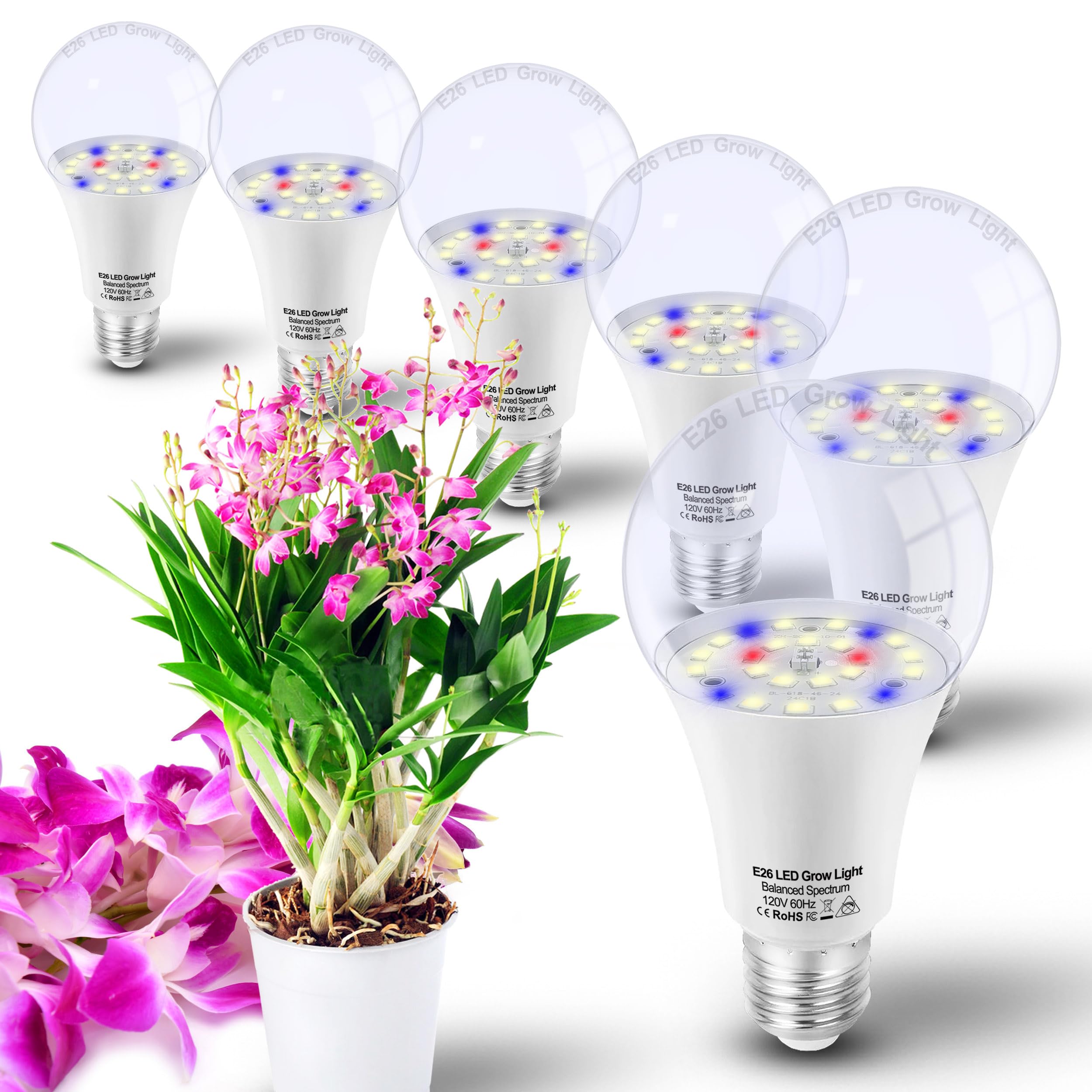
ALIDE’s 6-pack is built for covering large areas with minimal investment. Each 10W bulb emits 1000 lumens with a 230-degree beam angle, meaning the light floods out in every direction rather than focusing downward. This is perfect for a greenhouse shelf or a multi-tier plant stand where you want every corner lit—just screw them into standard A19 sockets spaced 12–18 inches apart.
The spectral mix includes red, blue, 5000K white, and yellow chips, targeting multiple growth stages. Owners report that seedlings under these bulbs show strong root development and compact stems, though the wide beam means intensity drops off quickly beyond 12 inches. At that distance, expect about 23 µmol/s PPF total, which is enough for greens and herbs but insufficient for fruiting plants.
Heat output is low because of the modest 10W draw, so you can use them in enclosed fixtures without fire risk. The bulb housing is standard A19 plastic, not ceramic, so longevity is less than premium models, but at this pack cost, replacing a unit every 1–2 years is economical. If you are rigging a light wall for microgreens or starting dozens of seed trays, this is the most cost-effective solution.
What works
- Extremely wide 230-degree coverage
- Very low heat, safe for enclosed fixtures
- Generous 6-pack for multi-shelf setups
What doesn’t
- Low PPFD limits usefulness past 12 inches
- Plastic housing less durable than ceramic
- Not suitable for flowering or fruiting plants
7. ALIDE A19 Full Spectrum 3-Pack

This three-pack mirrors the larger ALIDE set but at a lower entry point for growers who only need a few bulbs. Each unit draws 10W with a 100W incandescent equivalent and uses the same 230-degree beam angle for wide dispersal. The spectral recipe combines 5000K white, red (600–699nm), and blue (400–499nm) to support germination, leaf expansion, and early flowering.
Verified buyers praised the lack of heat and the straightforward screw-in installation—no drivers, no adapters. Many use them in track lighting fixtures to replace standard bulbs without any visible “grow light” appearance. The PPF of 23 µmol/s is modest, but for a south-facing window that needs a few extra hours of light in winter, these bulbs provide just enough boost.
The downsides are the same as the 6-pack: plastic construction, low intensity beyond a foot, and the noticeable blue spike that some users found harsh to look at directly. Fit them into lamps with shades to diffuse the blue glare. For someone dipping a toe into indoor growing without major investment, this set removes the barrier.
What works
- Instant upgrade from standard bulbs
- No heat output, safe for lampshades
- Balanced red/blue/white mix
What doesn’t
- Blue light feels harsh without a shade
- Low intensity limits distance effectiveness
- Plastic housing not as durable as ceramic
Hardware & Specs Guide
PPFD vs. PPF
PPF (Photosynthetic Photon Flux) measures total light output from the bulb in micromoles per second. PPFD (Photosynthetic Photon Flux Density) measures how much of that light reaches a specific square meter. A high PPF number means nothing if the beam angle spreads it too thin; always prioritize PPFD at your target distance.
Beam Angle
A 50-degree beam (PAR38 flood) concentrates light into a tight cone, delivering high PPFD within a 12–18 inch radius. A 230-degree beam (A19 bulb) floods a much larger area but halves the usable intensity every 6 inches you move away. Choose beam angle based on plant count and physical arrangement.
Color Temperature (Kelvin)
4000K–5000K daylight bulbs mimic the solar spectrum and contain enough blue (400–499nm) and red (600–699nm) photons for most growth stages. Bulbs that claim 2700K “warm white” lack the blue spike needed for compact vegetative growth, so stick to the neutral-to-cool range.
Heat Management
Ceramic substrate (Chip on Ceramic technology) transfers heat away from the LED junction faster than aluminum MCPCB, allowing higher sustained current without degradation. Plastic A19 bulbs with no heatsink rely on lower wattage (10W or less) to stay cool. For high-output bulbs above 20W, an external heatsink or metal housing is essential for lifespan.
FAQ
How close should a grow bulb be to my plants?
Can I use a grow bulb in a regular lamp with a shade?
Does the blue-pink purple light actually matter for growth?
How many hours per day should grow bulbs run?
Final Thoughts: The Verdict
For most gardeners, the grow bulbs winner is the SANSI 32W A21 because it packs the highest PPFD into a standard E26 package with ceramic cooling that outlasts plastic alternatives. If you want a focused flowering booster for tomatoes or citrus, grab the GE PAR38. And for an adjustable desktop setup with a reliable timer, nothing beats the SANSI dual-head clip light.