
Dense, waterlogged soil suffocates fine root hairs and leaves seedlings fighting for oxygen before they even break the surface. Coco coir replaces that compaction with a fibrous structure that holds moisture while letting air circulate freely — a mechanic that makes it the preferred base for seed starting, hydroponics, and aeration-sensitive potting mixes.
I’m Rikta — the co-founder and writer behind Lawn Gear Lab. I’ve spent hundreds of hours comparing EC levels, expansion ratios, wash protocols, and fiber consistency across the leading coco coir suppliers to isolate which blocks and pucks actually deliver on their yield claims without introducing excess salt or woody debris into your root zone.
Whether you are mixing a custom aroid blend, prepping a tray of microgreens, or replacing peat moss in raised beds, the right coco coir needs low salt content, reliable rehydration, and a texture fine enough for roots yet coarse enough for drainage — this guide ranks the bricks and pucks that meet those standards.
How To Choose The Best Coco Coir
Not all compressed coconut fiber is the same. The difference between a brick that expands into a fluffy, aerated medium and one that turns into a muddy, salty paste comes down to three specs: EC reading, wash protocol, and fiber grade. Beginners often grab the cheapest block without checking if it has been buffered — then wonder why their seedlings stall at the cotyledon stage.
EC and Salt Content — the silent root killer
Unwashed coir carries residual sea salt from the coconut husk. An EC reading above 1.0 mS/cm means the medium will burn delicate roots, especially in seedlings and hydroponic systems. Target coir washed to EC below 0.5 mS/cm. The best bricks in this roundup are triple-washed or explicitly state a low-EC spec on the packaging — skip anything that omits this data.
Expansion ratio — getting what you pay for
A standard 650-gram brick should yield roughly 8-9 quarts of hydrated coir. Cheap blocks often under-expand because manufacturers compress a lower density of fiber per pound. Check whether the listed volume is dry weight or hydrated yield. A 10-pound block that promises 75 quarts of medium is a real value; a 1-pound puck that only fills one 4-inch pot is not worth the shelf space.
Fiber texture — pith versus chips
Fine, dust-like pith (often called coir peat) holds water like a sponge and works best in seed-starting trays and hydroponic grow bags. Coarser chips provide drainage channels and are better suited for orchid bark mixes and reptile substrates. Many premium products blend both for a balanced structure. Decide your primary use case before choosing a grind size.
Quick Comparison
On smaller screens, swipe sideways to see the full table.
| Model | Category | Best For | Key Spec | Amazon |
|---|---|---|---|---|
| Vivlly 10 lb Brick | Block | Large volume & hydroponics | Triple-washed; EC below 0.5 | Amazon |
| Modellor 4-Pack Brick | Bricks | Versatile mid-size gardening | Triple-washed; yields 36 quarts | Amazon |
| MagJo 11 lb Block | Block | Heavy soil amendment | OMRI-listed; low EC & pH | Amazon |
| Back to the Roots Worm Castings | Amendments | Nutrient boost for coir | Slow-release; no-burn granules | Amazon |
| Minute Soil 30 Pucks | Pucks | Quick seed starting | Expands 15x; OMRI-listed | Amazon |
| CJGQ 4-Pack Brick | Bricks | Budget amendment | Low EC; yields 36 quarts | Amazon |
| ZeeDix 100 Pack Pellets | Pellets | Seed staples & reptile bedding | 30mm pre-compressed discs | Amazon |
In‑Depth Reviews
1. Vivlly 10 lb Coco Coir Brick

Vivlly’s 10-pound block delivers the largest hydrated yield in this lineup — 75 quarts of medium from a single brick — making it the clear choice for serious soil mixers and hydroponic growers who need bulk volume without sacrificing cleanliness. The triple-wash process brings EC levels below 0.5, so you can use this coir straight from the bag for seed trays without burning tender roots. Customers across mycology and vegetable cultivation consistently note that the block absorbs water easily and breaks apart without the hard inner clumps that plague poorly compressed bricks.
The fiber grade leans toward a fine-to-medium pith that provides excellent capillary action while maintaining roughly 30 percent air porosity — a balance that works for both moisture-loving aroids and bench-draining cannabis pots. Each block is aged for over 18 months and buffered during processing to remove excess calcium and magnesium competition, so the final pH lands in the 5.5–6.5 sweet spot. The rehydration process asks for 3–4 gallons of warm water and a little patience while the core saturates, but the resulting texture is fluffy, clean, and free of the stringy ropes that sometimes appear in cheaper brands.
For the price per quart, this is the most economical premium block available. The only real friction point is the 10-pound weight when dry — you need a sufficiently large container for hydration. Some users also report a fine dust during the initial pour, though this settles quickly once water hits the brick. If you need one consistent source for all your coir needs — seed starting, soil blending, reptile terrariums, or mushroom substrate — this block earns the top spot.
What works
- Massive 75-quart yield from a single block
- EC below 0.5 — safe for seedlings and hydro
- Breaks apart easily once hydrated, minimal clumps
What doesn’t
- Requires 3-4 gallons of water and a large bin
- Fine dust may puff during dry handling
2. Modellor 4-Pack Premium Super Washed Coco Coir
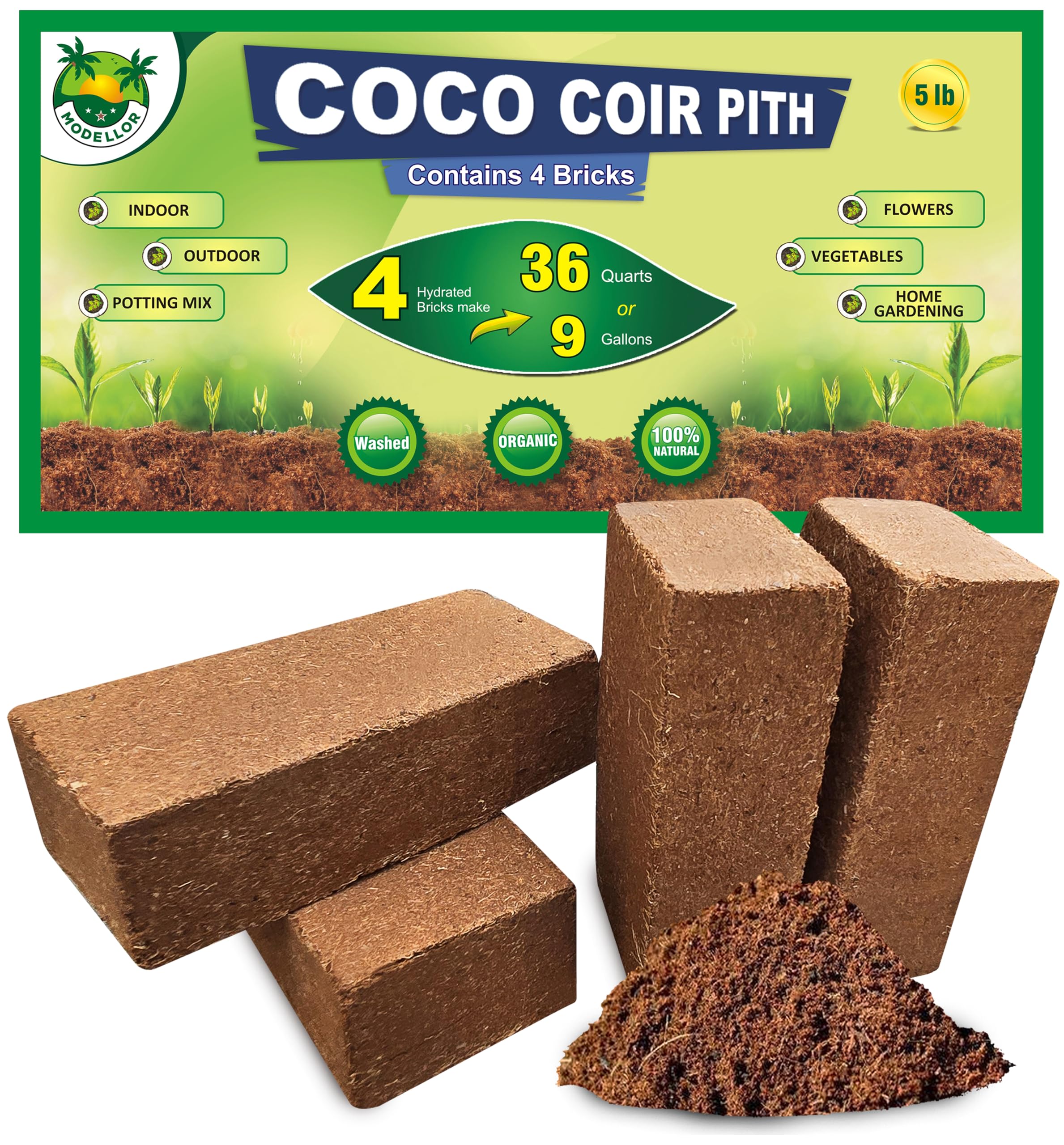
Modellor’s 4-pack of five-pound bricks offers the convenience of modular expansion — each brick yields 9 gallons (36 quarts total) — so you can hydrate exactly what you need without committing to a giant block. The triple-wash and pH-buffered formulation mean this coir arrives ready to use straight out of the bag. Customers growing microgreens and houseplants consistently praise the clean texture — no smell, no bug hitchhikers, no salty residue — confirming the wash process is thorough enough to skip the pre-rinse step that many gardeners dread.
The fiber consistency is notably fluffy and uniform, striking a middle ground between fine dust and coarse chips. Seeds germinate quickly in this medium because the pore structure holds moisture near the seed coat while still draining excess water away from the base. Reviewers note that the bricks hydrate in roughly 15–20 minutes with warm water, and the resulting volume comfortably fills a standard 1020 propagation tray to a depth of two inches. The 5-pound individual brick size also makes this a good option for urban gardeners with limited counter space who cannot wrestle a 10-pound block into a five-gallon bucket.
While the expansion ratio is slightly less aggressive than the Vivlly block on a per-pound basis, the pre-washed convenience and consistency make this the better pick for gardeners who prioritize cleanliness over raw volume. The only notable downside is that the 4-pack price per quart is higher than buying a single large block — you are paying for the modular packaging and guaranteed wash quality. For mixed-use growing that cycles between seed starting, potting up, and worm bins, this four-brick set hits the sweet spot.
What works
- No rinsing required — ready to use immediately
- Consistent, clean texture brick to brick
- Modular 5-lb bricks are easy to handle
What doesn’t
- Higher cost per quart than bulk blocks
- Bricks are hard when dry — must soak fully
3. MagJo Naturals 11 lb Coco Peat Block

MagJo’s 11-pound block brings OMRI-listed organic certification to the table, a distinct advantage for gardeners who require verifiable input compliance for certified organic operations or who simply want assurance that no synthetic additives were involved in the processing. The block is washed thoroughly to remove sea salt, and the EC levels are consistently reported by customers in the 40–200 ppm TDS range — low enough for sensitive seedlings. The pH leans slightly acidic, which pairs well with amendments like dolomitic lime if you are targeting a neutral soil blend.
The fiber texture is a medium grind that works well as a soil amendment to lighten heavy clay or to boost water retention in sandy patches. Users report that the brick hydrates to fill a standard five-gallon bucket completely, and the resulting coir holds moisture like a sponge while still allowing excess water to drain. One frequent use case among reptile keepers is using this block as a substrate base because the low salt content makes it safe for turtles and lizards. The 11-pound block is dense, so break it into a 20-gallon bin and add water rather than trying to chip off pieces — it is too hard to split when dry.
On the downside, some customers note a faint tea tree-like scent during initial hydration, though this disappears once the medium is fully saturated. The block also lacks the explicit EC value printed on the packaging, so you are relying on the brand’s reputation rather than a stamped spec. For organic growers who need a large, inexpensive block for heavy soil amendment, MagJo delivers consistent performance at a moderate cost per pound.
What works
- OMRI-listed for certified organic use
- Good moisture retention for heavy feeders
- Safe for reptile and amphibian substrates
What doesn’t
- EC not explicitly printed on package
- Block too hard to break dry — must soak whole
4. Back to the Roots Organic Worm Castings

While not a straight coco coir product, Back to the Roots’ worm castings are the exact amendment that coir-based soils need to become complete growing mediums. Coco coir is naturally inert in nutrients — it provides structure and water retention but zero NPK. Mixing in 10–20 percent worm castings by volume introduces a rich microbial load and a slow-release nutrient profile (roughly 1-0-0 NPK plus trace minerals) without the risk of chemical burn that comes with synthetic fertilizers. The granules are fine enough to blend evenly with hydrated coir without clumping or compacting the air pockets.
The castings are produced from US-sourced vermicompost and packaged in a resealable bag that keeps the material from drying out between uses. Customers report that amending coir with this product eliminates the need for additional fertilization during the first 4–6 weeks of vegetative growth — a major convenience for growers who want to simplify their feeding schedule. The material has a mild earthy smell, not the ammonia odor associated with raw manure, and it does not attract fungus gnats when used at recommended ratios. For houseplant enthusiasts mixing custom aroid blends, this is the simplest way to add fertility to an otherwise sterile coir base.
The main limitation is that this is a soil supplement, not a standalone medium — you still need coir as your primary structural base. The 5-pound bag also runs out quickly if you are amending large raised beds. For anyone building a coir-based potting mix from scratch, this is the most reliable nutrient addition you can make.
What works
- No-burn, slow-release nutrition for coir mixes
- Odorless and fine texture blends evenly
- Resealable bag maintains freshness
What doesn’t
- Requires a separate coir base — not a standalone soil
- Small bag for the price; runs out quickly
5. Minute Soil 40mm Discs (30 Pack)
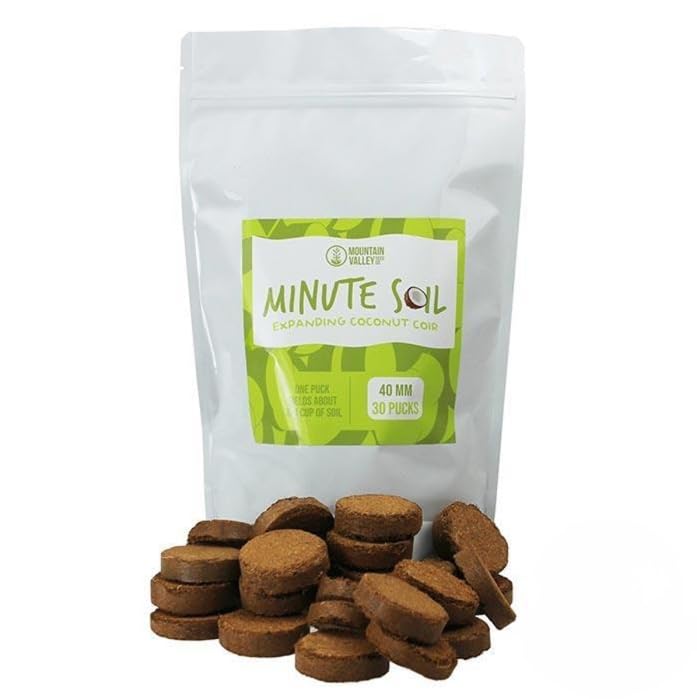
Minute Soil’s compressed discs are the most convenient coco coir format for small-scale seed starting and cat grass cultivation. Each 40mm wafer requires just one-third cup of water to expand into roughly three-quarters of a cup of medium — no buckets, no measuring, no cleanup. The discs are OMRI-listed for organic production and arrive as untreated, raw fibrous coir with no added fertilizers, giving you full control over your nutrient regimen. The expansion ratio is approximately 15x, and the rehydration speed is fast enough that you can go from dry puck to planted seed in under two minutes.
The texture is a fine pith that holds moisture well against the seed while remaining light enough for the first root hairs to push through without resistance. Customers growing organic cat grass appreciate the clean, chemical-free composition, and several repeat buyers note that the discs are produced in the US, which provides assurance for those avoiding imported soil products. The 30-pack yields about 5.5 quarts of total medium — enough to fill a single 1020 tray or a dozen 4-inch pots. For gardeners who only need coir occasionally, this eliminates the waste that comes from hydrating an entire brick and then storing leftover wet medium.
The downside is purely economic: on a per-quart basis, these discs cost significantly more than bulk bricks. If you are mixing soil for a full raised bed or a large hydroponic system, the discs are not the right format. But for the grower who values convenience, cleanliness, and zero waste, they are a brilliant tool. The thin wafer shape also makes them space-efficient to store — the entire bag fits in a kitchen drawer.
What works
- Fast hydration — soil ready in under 2 minutes
- OMRI-listed and made in the USA
- Compact storage, no leftover waste
What doesn’t
- High cost per quart compared to bulk bricks
- Limited total volume — only 5.5 quarts per bag
6. CJGQ 4-Pack Coco Coir Brick
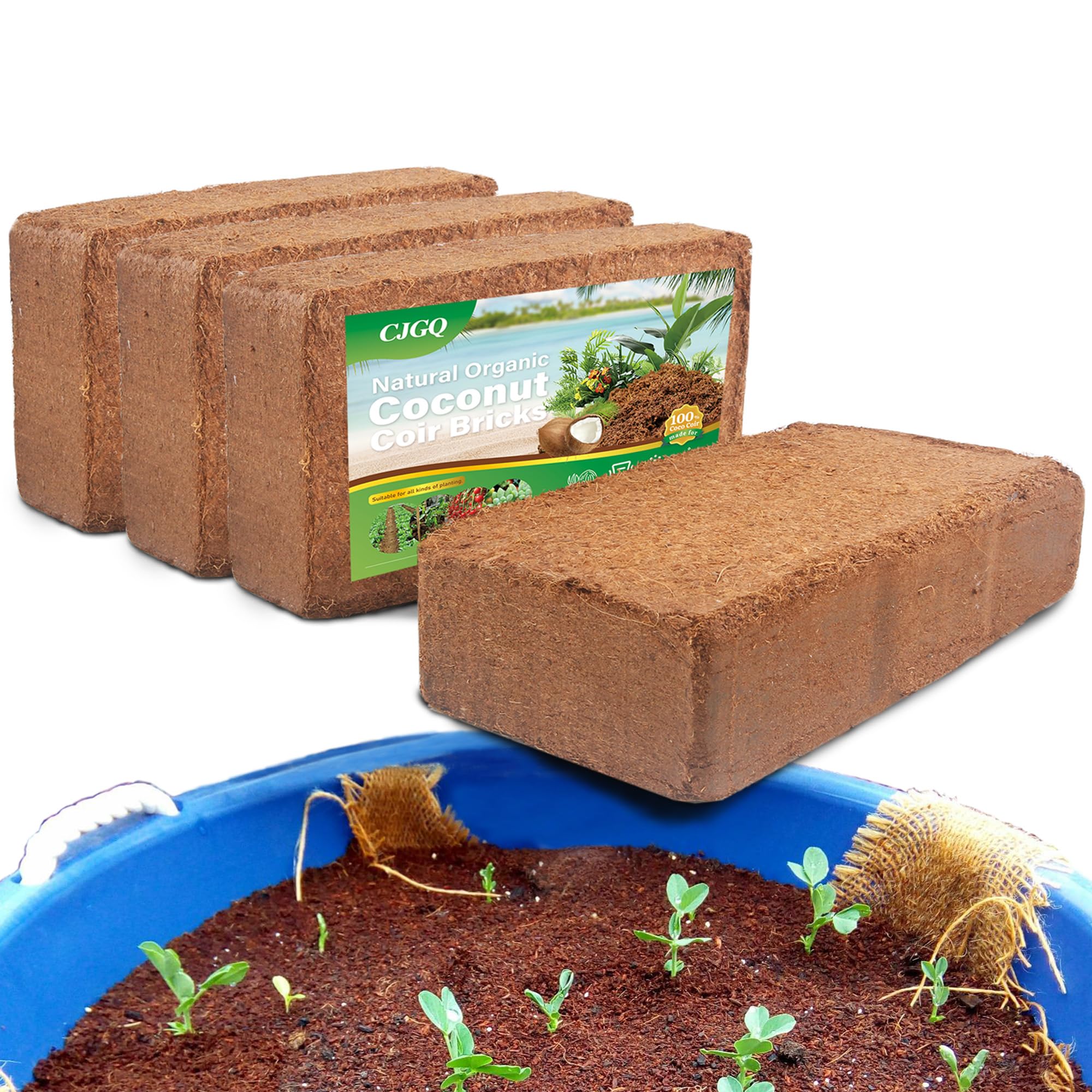
CJGQ’s 4-pack offers a budget-friendly entry point into compressed coir bricks without completely ignoring quality. Each 1.4-pound brick expands to approximately 9 quarts, giving you 36 quarts total from the set — a volume comparable to Modellor’s offering but at a lower price per pack. The bricks claim low EC and balanced pH, and most customer reviews confirm that the medium supports healthy germination and moisture retention when used as a seed starter or soil amendment. The fiber texture is clean and free of large debris, though some packs have been reported to contain slightly stringier fibers than the premium options.
The main area where this product splits from the higher-tier competitors is in consistency. Some users report that the bricks take longer than advertised to fully break down — one brick required over eight hours of soaking to lose its core — and a small number of customers found white egg-like objects in the hydrated medium, suggesting that the wash process may not be as rigorous as the triple-washed alternatives. These are not widespread issues based on the volume of positive reviews, but they are worth noting if you are starting high-value seeds where contamination risk matters.
For general-purpose soil amendment, container gardening, and fill-in applications where you are mixing the coir with compost and perlite anyway, this 4-pack is a functional, economical choice. The price per quart is among the lowest in this guide, making it suitable for gardeners who go through large volumes of medium and are willing to accept slightly more variability in exchange for savings. Just keep a bucket of hot water ready and give the bricks a full 12-hour soak.
What works
- Low cost for 36 quarts of total medium
- Clean fiber with no strong odor
- Sustainable peat moss alternative
What doesn’t
- Inconsistent rehydration speed between bricks
- Some batches contain stringy fibers or debris
7. ZeeDix 100 Pack 30mm Coco Coir Pellets
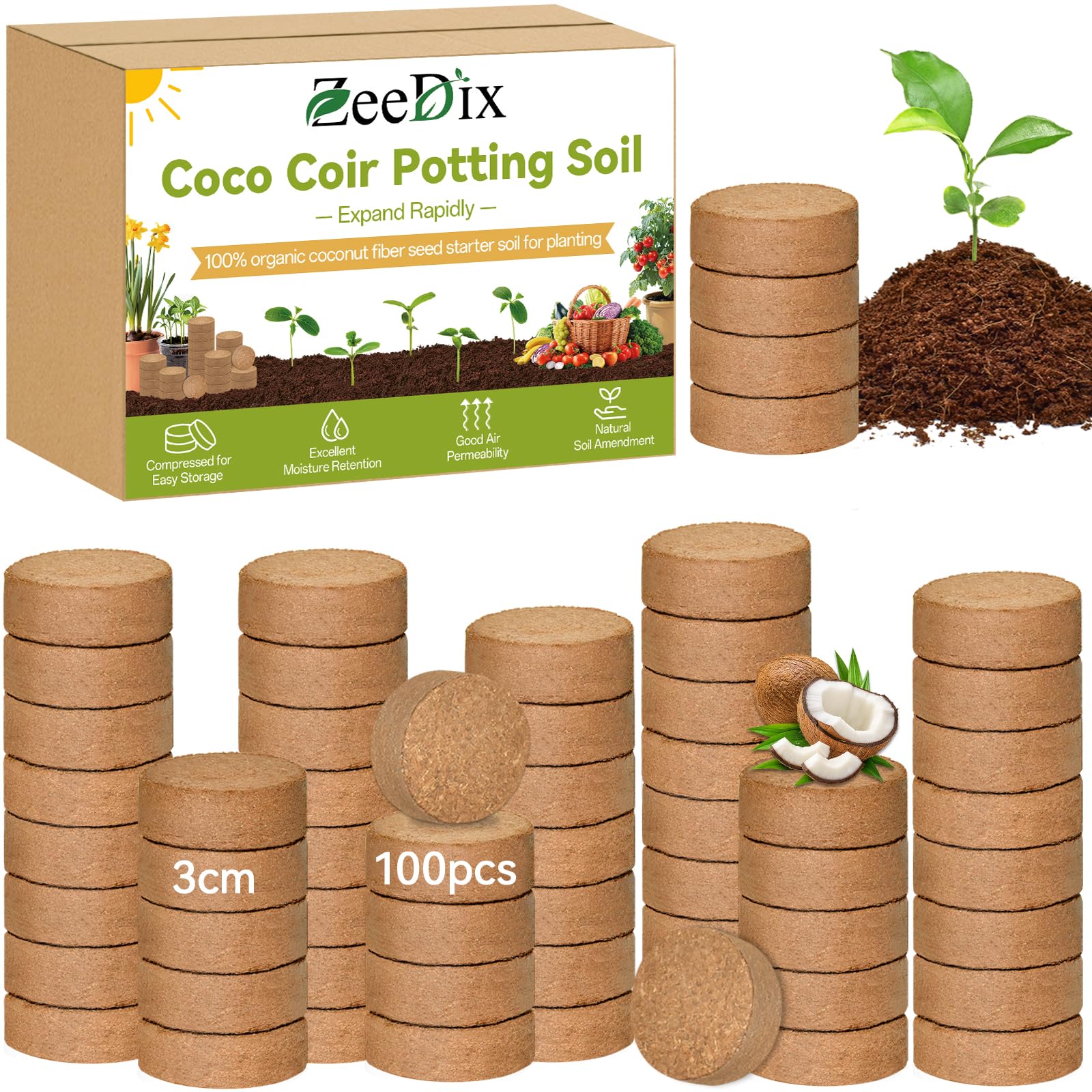
ZeeDix’s 100-count pellet pack is the most accessible format for bulk seed starting on a budget. Each 30mm disc expands into a small plug that fits neatly into standard 1020 cell trays — one pellet per cell with no measuring or mixing required. The compressed coconut fiber is low EC and pH balanced, making it suitable for vegetables, herbs, and flowers straight out of the package. The 100-count provides enough medium for an entire season of indoor starts, and the discs store flat in the included bag without taking up shelf space.
The rehydration process is straightforward: drop the pellets into a container, add water gradually to avoid oversaturation, and wait a few minutes for expansion. The resulting plugs are dense enough to hold a seed in place but airy enough for root penetration. Customers consistently mention that the pellets are beginner-friendly because there is almost no learning curve — add water, insert seed, and place under lights. Several reviews highlight successful germination of peppers, citrus, and microgreens within a week using a heat mat and these pellets.
The trade-off is that these pellets are the smallest format in the lineup. Each plug yields only about 1–2 tablespoons of medium, so they are not suitable for potting up seedlings beyond the first true-leaf stage. You will need to transplant into larger containers with additional coir or potting mix after two to three weeks. For gardeners starting large quantities of seeds where uniformity and convenience matter more than volume, this pack is a practical, low-waste solution.
What works
- 100 pellets — enough for full seed-starting season
- Easy expansion; no measuring required
- Compact storage, minimal waste
What doesn’t
- Small plug size — must transplant early
- Higher cost per quart than bricks
Hardware & Specs Guide
EC (Electrical Conductivity)
The single most important chemical spec in coco coir is EC, measured in mS/cm or ppm. High EC means residual sea salt or fertilizer salts remain in the fiber, which can burn root tips and stunt germination. Premium bricks target EC below 0.5 mS/cm (roughly 250 ppm) and are labeled “low EC” or “triple washed.” Entry-level bricks often skip EC data entirely — treat absent EC disclosure as a red flag. For hydroponic use, EC below 0.4 is ideal. For soil amendment, EC below 0.8 is usually acceptable because the surrounding soil buffers the salt.
Expansion Ratio and Yield
Compressed coir is sold by dry weight, but you garden by hydrated volume. A properly compressed 650-gram (1.4-pound) brick should yield 8–9 quarts of medium. A 5-kilogram (11-pound) block should yield 16–18 gallons. Brands that under-expand often use a higher percentage of short fibers and fine dust that pack more densely without creating air pockets. Check customer images of the hydrated yield — if the block looks like loose peat rather than fluffy chips, it likely under-expands. Warm water accelerates the rehydration process by softening the compressed fibers faster than cold water.
FAQ
Do I need to rinse my coco coir before using it?
Can I reuse coco coir for a second growing cycle?
How is coco coir different from peat moss for seed starting?
Final Thoughts: The Verdict
For most gardeners, the coco coir winner is the Vivlly 10 lb Brick because it provides the lowest per-quart cost, triple-washed purity with EC below 0.5, and a massive 75-quart yield that covers seed starting, soil amendment, and hydroponic growing from one block. If you want modular convenience and guaranteed pH balance, grab the Modellor 4-Pack. And for quick seed starting without waste, nothing beats the Minute Soil 30-Puck Discs.