
Mounds popping up overnight, spongy patches that collapse underfoot, and the constant traffic of ants marching across your turf signal a colony that has moved in beneath your grass. A targeted granular or liquid treatment stops them at the source, but choosing the wrong formula leaves mounds intact while wasting your weekend. The active ingredient, application method, and residual duration all determine whether your lawn stays ant-free.
I’m Rikta — the co-founder and writer behind Lawn Gear Lab. My approach to this guide relies on deep market research, comparing active ingredient concentrations, analyzing coverage estimates, and aggregating hundreds of verified owner experiences to separate fast-acting killers from slow performers.
By focusing on active chemistry, residual time, and application method, I’ve narrowed the field to what actually works so you can confidently pick the right pesticide for ants in lawn without guessing.
How To Choose The Best Pesticide For Ants In Lawn
Ant colonies in turfgrass are complex. A broadcast treatment that kills surface workers but misses the queen guarantees the mound returns within a week. Matching the right formulation and active ingredient to your lawn size, ant species, and tolerance for reapplication separates a one-and-done solution from a seasonal chore.
Active Ingredient: Contact Kill vs. Systemic Action
Permethrin and bifenthrin (found in Talstar and Martin’s) deliver fast contact kill but break down in sunlight within weeks. Imidacloprid (Bayer Merit) is systemic — it’s absorbed by the grass and ingested by ants feeding on roots, making it slower but more effective at wiping out the entire colony. If you want instant mound knockdown, choose a pyrethroid. If you want season-long colony suppression, go systemic.
Formulation: Granules vs. Liquid Concentrate
Granules (Ortho BugClear, BioAdvanced) are spread with a broadcast spreader and watered in, offering uniform coverage across large lawns but requiring activation via rain or irrigation. Liquid concentrates (Martin’s Permethrin) mix with water in a hose-end sprayer, delivering precise dosing to mound tops and perimeter zones. Granules win on ease for whole-lawn treatment; liquids win on targeted spot control.
Residual Duration and Weather Resistance
Manufacturers claim 1 to 4 months of protection, but actual residual depends on soil type, thatch thickness, rainfall frequency, and temperature. Pyrethroids like bifenthrin (Talstar PL) hold residual for 2–4 months even without watering in, while permethrin degrades faster under UV exposure. If your region gets heavy summer rain, prioritize a formulation that resists leaching.
Coverage Area and Bag Size
A 10 lb bag typically covers 5,000–10,000 sq ft, while a 20 lb bag pushes closer to 20,000–25,000 sq ft. Measure your lawn with a GPS tool or wheel before ordering — buying a 20 lb bag for a 3,000 sq ft lot leaves you with expensive surplus that loses potency in storage.
Quick Comparison
On smaller screens, swipe sideways to see the full table.
| Model | Category | Best For | Key Spec | Amazon |
|---|---|---|---|---|
| Talstar PL Granules | Granule | Longest residual control | 2–4 month residual, bifenthrin | Amazon |
| Ortho BugClear Lawn Insect Killer | Granule | Broad-spectrum yard cleanup | 20,000 sq ft coverage | Amazon |
| Bayer Merit 0.5 G | Systemic Granule | Colony elimination via grass roots | Imidacloprid 0.5%, 30 lb | Amazon |
| Sevin Lawn Insect Granules | Granule | Tree-base and perimeter ant control | Kills 30+ listed pests | Amazon |
| Ortho Bug B Gon Max | Granule | All-in-one lawn + garden defense | 10 lb, 10,000 sq ft | Amazon |
| BioAdvanced Complete Insect Killer | Granule | Season-long whole-lawn protection | 20 lb, 25,000 sq ft | Amazon |
| Martin’s Permethrin 13.3% | Liquid Concentrate | Budget-friendly concentrated spot treatment | 13.3% permethrin, 32 oz | Amazon |
In‑Depth Reviews
1. Talstar PL Granules Insecticide
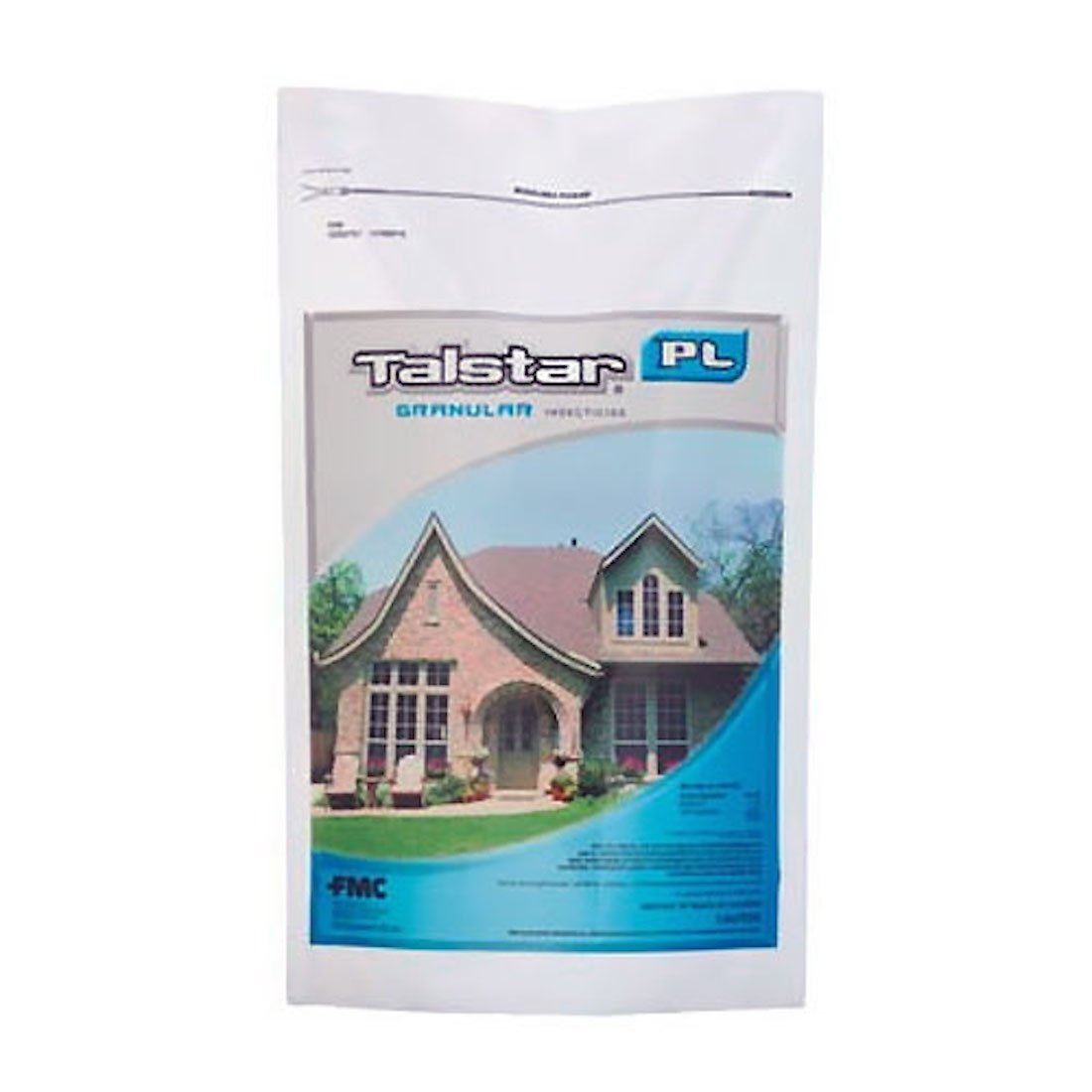
Talstar PL offers the longest residual of any granular insecticide on the market, holding bifenthrin active on the soil surface for 2 to 4 months without requiring watering in. The sand-core granule penetrates mulch and dense thatch layers where many ant species hide, making it a top performer for deep colony disruption. Verified owners report that cutter ants vanish within 24 hours of application, and combined granular + liquid Talstar programs have kept heavy ant infestations suppressed for the first time in decades.
This formulation works on crickets, earwigs, fleas, and black widows alongside ants, which simplifies lawn pest management to a single product. The bag covers roughly 4,000 to 5,000 sq ft per 25 lb bag at standard rates, putting it in a higher per-square-foot cost tier than broadcast granules. Owners note that millipedes and very high-pressure infestations may require a professional pre-treatment before Talstar can hold the line alone.
The lack of watering-in requirement saves time on application, especially useful for homeowners who don’t own a sprinkler system or live in drought-prone areas where soaking the lawn isn’t practical. Some users also add Talstar liquid to their spray rotation every 3 months to extend the barrier against incoming colonies.
What works
- 2–4 month residual without watering in
- Kills cutter ants within 24 hours per verified reports
- Penetrates thatch and mulch layers effectively
What doesn’t
- Higher cost per square foot than broadcast granules
- May require professional pre-treatment for severe infestations
- Can kill non-target insects including beneficial predators
2. Ortho BugClear Lawn Insect Killer, 20 lb
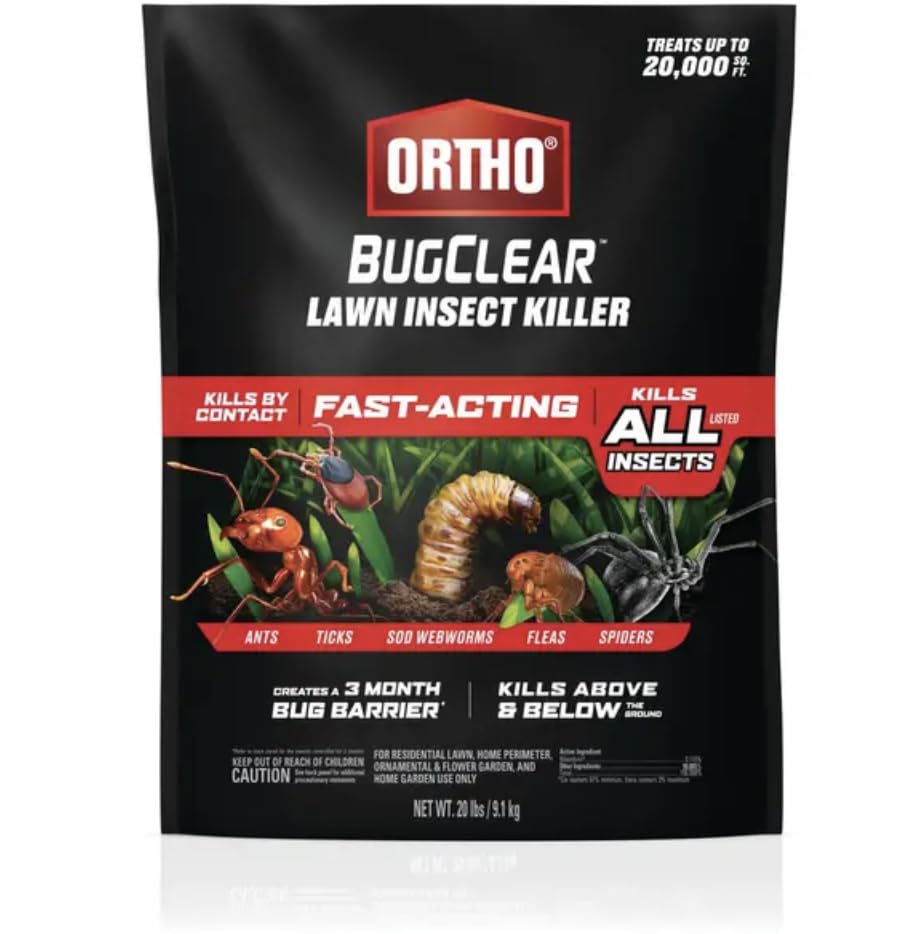
Ortho BugClear covers up to 20,000 sq ft per 20 lb bag with a fast-acting formula that kills ants, ticks, armyworms, sod webworms, fleas, and spiders both above and below the soil surface. The contact barrier it creates keeps crawling insects from migrating indoors, which verified reviewers in Florida and Texas confirm holds up through humid summers when applied twice per season. One owner noted that after applying in early and late spring, mole activity stopped entirely because the food source was eliminated.
The granule spreads easily through drop and broadcast spreaders, and the manufacturer recommends watering in immediately after application to activate the chemical and drive it down to the root zone. Owners who skipped this step saw reduced efficacy against established ant mounds, especially in dry conditions. The product also controls crane flies, a pest not commonly listed on competitor labels, giving it an edge for homeowners in the Pacific Northwest.
Some long-time users in high-heat zones report that fleas developed resistance after repeated applications over multiple seasons, suggesting rotation with a different active ingredient every 12 to 18 months to maintain efficacy. The guarantee covers a money-back refund if the product fails to kill listed pests, reducing financial risk for first-time buyers.
What works
- 20,000 sq ft coverage from a single 20 lb bag
- Creates a barrier that keeps ants from moving indoors
- Controls crane flies and sod webworms alongside ants
What doesn’t
- Must be watered in for full activation
- Flea resistance reported after repeated use in warm climates
- Bag weight is heavy for carrying across large lawns
3. Bayer Merit 0.5 Granular Systemic Insect Control, 30 lb

Bayer Merit 0.5 G uses imidacloprid, a systemic neonicotinoid that moves through the grass plant and is ingested by ants feeding on roots and foliage. This makes it exceptionally effective against whole colonies rather than just surface workers, with verified owners reporting that heavy grub infestations, spittle bugs, and the ant populations they support disappear within weeks of a single application. The 30 lb bag provides season-long coverage for large properties when applied at the correct rate.
Application timing is critical — Merit works best when applied in early spring or late summer when ants are actively foraging and grass is growing. Users who applied during drought or extreme heat saw delayed results because the imidacloprid wasn’t being translocated effectively. The EPA-registered label specifies a maximum of 80 lb per acre per year, so careful measurement with a spreader is necessary to avoid over-application.
As a neonicotinoid, Merit has drawn scrutiny for potential impact on pollinators if misapplied. It should never be used on flowering weeds or clover that bees visit. Some owners noted the upfront cost is higher per bag than bifenthrin alternatives, but the systemic action reduces the need for repeated applications, narrowing the long-term cost gap.
What works
- Systemic action eliminates entire colonies through root feeding
- Season-long control with a single properly timed application
- Effective against grubs, spittle bugs, and ant populations simultaneously
What doesn’t
- Higher upfront cost per bag than pyrethroid granules
- Timing is critical — underperforms when applied during drought
- Neonicotinoid toxicity concerns for bees if misapplied
4. Sevin Lawn Insect Granules, 20 Pounds

Sevin Lawn Insect Granules use carbaryl, a broad-spectrum insecticide that kills over 30 listed pests including ants, ticks, fleas, and worms. Verified owners report that applying the granules around the base of trees stopped ant infestations that had already killed several trees on the property. The 20 lb bag provides ample coverage for perimeter treatment around homes, foundations, and flower beds where fire ant mounds tend to cluster.
The product works best when spread thickly and left undisturbed — one long-time user describes the tactile satisfaction of broadcasting it annually and hearing the audible reduction in insect activity. However, some buyer feedback is polarizing: a subset of verified owners reported zero visible reduction in ant mounds after application, suggesting that carbaryl efficacy varies by ant species and local soil conditions. It performed strongest against surface-foraging ant species like pavement ants and less reliably against deep-nesting carpenter ants.
Carbaryl breaks down relatively quickly in soil, with a half-life of 3 to 7 days depending on moisture and temperature. This means Sevin requires more frequent reapplication than bifenthrin or imidacloprid alternatives to maintain season-long protection. For homeowners who prefer a granular that works without watering in, this may not be the best fit — activation requires rain or irrigation.
What works
- Highly effective against tree-base ant infestations
- Kills over 30 pests, including ticks and fleas
- Easy to spread with a broadcast spreader
What doesn’t
- Mixed results on deep-nesting ant species
- Short soil half-life requires more frequent reapplication
- Must be activated by water, not ideal for dry-climate users
5. Ortho Bug B Gon Max Insect Killer for Lawns, 10 lb

Ortho Bug B Gon Max claims to kill and prevent over 100 listed insects for up to 3 months, with a 10 lb bag covering 10,000 sq ft. Verified users who have relied on this product for nearly a decade report superior colony suppression compared to alternative brands, noting that ant hills in grass disappeared after the first application. One owner described how ants returned after two months following heavy rain, suggesting that actual residual may be closer to 8–10 weeks in wet climates.
The formula works above and below the surface, making it suitable for fire ant mounds and general broadcast treatment across lawns, ornamentals, vegetable gardens, and flower beds. The manufacturer guarantees a money-back refund if the product doesn’t kill, which offers peace of mind for first-timers. Owners also report that it eliminates flying beetles and June bugs around the house perimeter, adding value beyond ant-specific control.
Some customers felt the performance was only “OK,” still spotting active ants two weeks after application. This inconsistency appears linked to application method — pellets left on top of dry grass without watering in fail to reach the thatch layer where ants travel. The 10 lb bag is well-sized for small to mid-sized properties but requires two bags for a full acre lot plus perimeter.
What works
- Controls 100+ insect types including flying beetles
- Safe for use on vegetable gardens and flower beds
- Money-back guarantee if it fails to kill
What doesn’t
- Actual residual may drop to 8 weeks in rainy conditions
- Requires thorough watering in for reliable ant control
- Inconsistent results reported when applied to dry grass
6. BioAdvanced Complete Insect Killer for Lawns, 20 lb
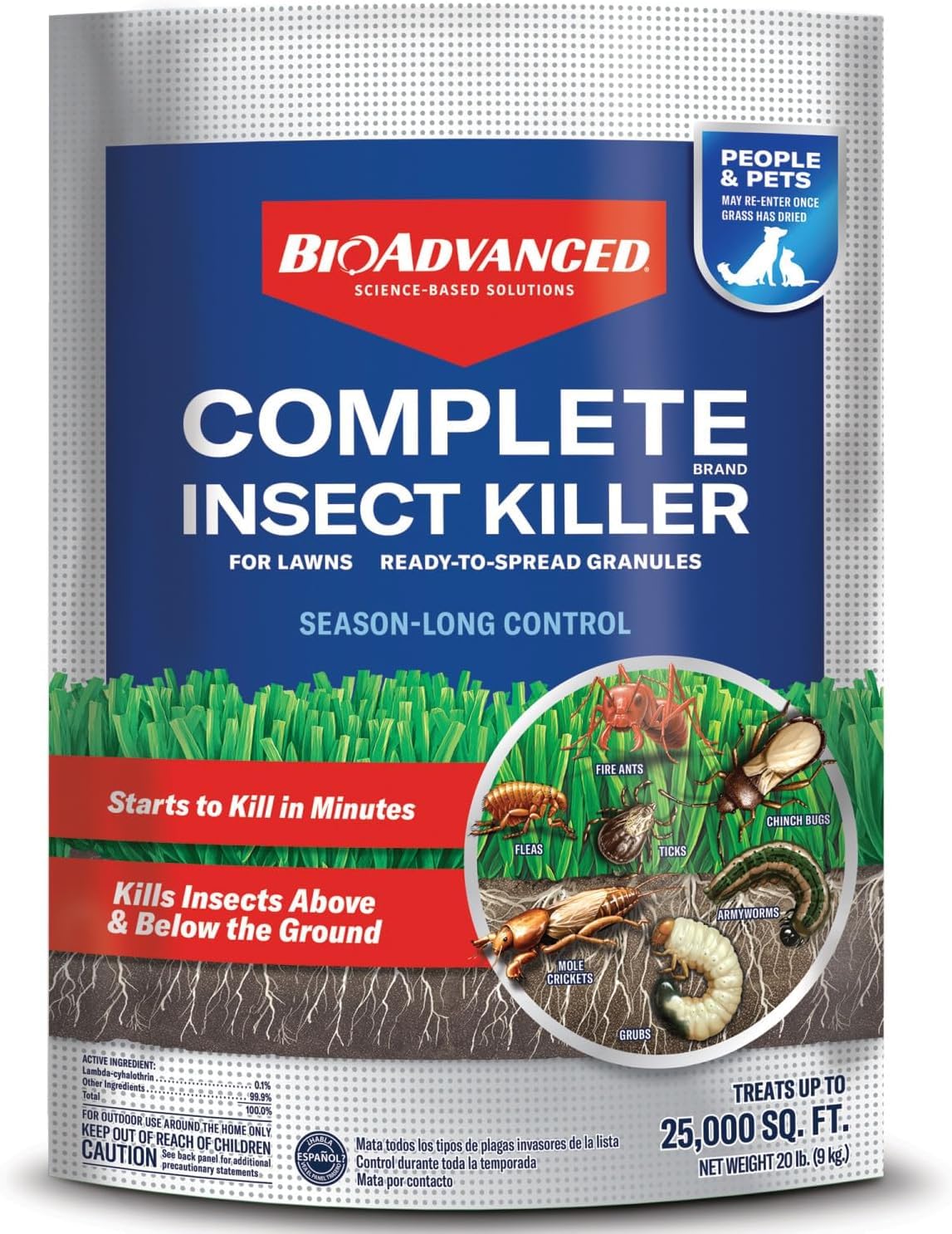
BioAdvanced Complete Insect Killer in the 20 lb bag treats up to 25,000 sq ft, making it the highest-coverage option in this lineup for homeowners with large properties. The formula kills listed insects both above and below ground on contact, including ants, fleas, ticks, chinch bugs, mole crickets, and grubs. Verified users in warm climates report that a single application holds for roughly 3 months on St. Augustine grass without damaging the turf.
The ready-to-spread granules work with any broadcast or drop spreader, and the manufacturer labels it for use on fire ant mounds and around home foundations. Some owners noted that while it eliminated spiders and general lawn insects, stink bugs seemed unaffected — a reminder that no single insecticide covers every pest. Flea control was also inconsistent on properties with heavy flea pressure, with some users seeing no reduction after application.
Mole activity is a common frustration tied to insect infestations, and several verified buyers purchased this product hoping to remove the food source. Reports were mixed: some moles migrated away after the insect population collapsed, while others remained, suggesting that deeper-burrowing earthworms may sustain them. The 20 lb bag is heavy but justifies its weight with coverage that spans most residential lots.
What works
- Covers 25,000 sq ft from a single 20 lb bag
- Safe for St. Augustine and other warm-season turfgrasses
- Provides ~3 months protection in warm climates per verified owners
What doesn’t
- Does not control stink bugs
- Flea control inconsistent under heavy pressure
- Mole reduction not guaranteed as earthworms remain
7. Martin’s 32 oz Permethrin 13.3% Concentrate
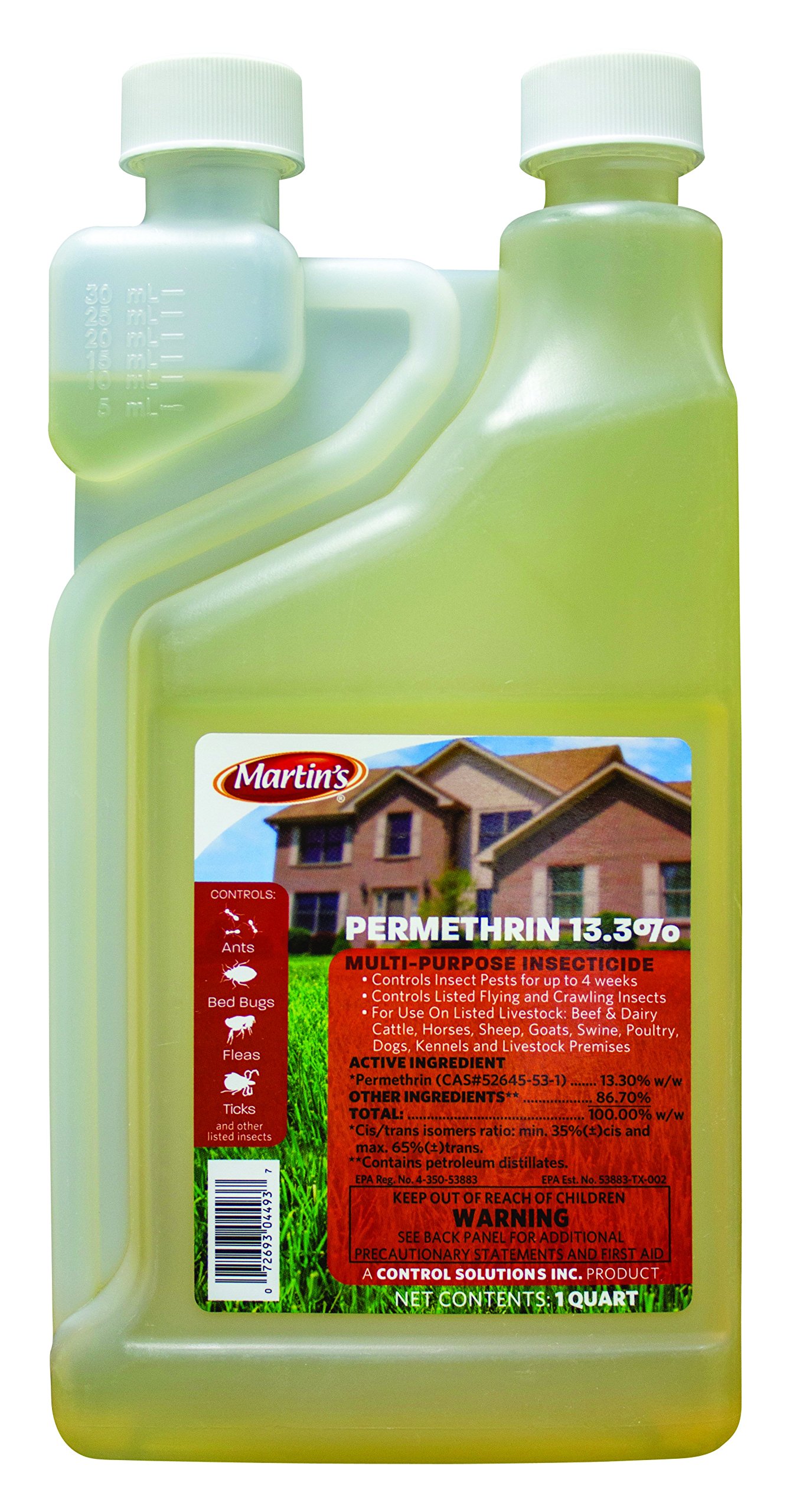
Martin’s Permethrin 13.3% is a liquid concentrate that delivers one of the highest active-ingredient percentages in this class, with a mixing rate of roughly 1.5 to 3 ounces per gallon of water. Each 32 oz bottle makes enough solution to treat 800 to 1,000 sq ft per gallon, making it an economical choice for targeted mound treatment and perimeter spraying rather than whole-lawn broadcast. Verified owners who use it in misting systems report 4 to 6 weeks of tick and mosquito control, though ant and roach efficacy was notably lower.
The concentrate has a strong chemical odor that some users describe as paint-thinner strength, and it should never be used indoors despite the label’s ambiguous language. Owners caution that the 13.3% formulation from Martin’s contains petroleum distillates that can damage clothing if sprayed directly, unlike the 10% livestock-grade version. Application at dawn or dusk minimizes harm to pollinators, but the broad-spectrum nature of permethrin still kills beneficial insects on contact.
This is not the product for someone looking for a set-and-forget granular. It requires a sprayer, careful mixing, and protective gear. But for budget-conscious owners who want to spot-treat individual mounds and monitor results, the concentrate offers the lowest per-application cost of any product here. The 4-week residual means reapplication every month during peak ant season.
What works
- Highest active ingredient concentration for targeted spot treatment
- Lowest per-application cost when mixing your own spray
- Effective for tick and mosquito perimeter control
What doesn’t
- Strong chemical odor limits indoor and enclosed-area use
- Ineffective against ants, roaches, and spiders per verified reports
- Requires sprayer, mixing, and protective gear for safe application
Hardware & Specs Guide
Active Ingredient Chemistry
The active ingredient determines how the pesticide kills and how long it lasts. Pyrethroids like bifenthrin (Talstar PL) and permethrin (Martin’s) attack the nervous system on contact, providing fast knockdown but degrading under UV light within 2–4 weeks. Carbaryl (Sevin) works via cholinesterase inhibition with a short soil half-life of 3–7 days. Imidacloprid (Bayer Merit) is a systemic neonicotinoid absorbed by the grass, offering season-long protection but requiring careful timing and pollinator awareness. Match the chemistry to your tolerance for reapplication and the ant species on your property.
Granule Size and Spread Pattern
Granule diameter and density affect how evenly the product distributes through a broadcast spreader. Sand-core granules (Talstar PL) fall straight through dense thatch without getting hung up on grass blades, while larger polymer-coated pellets (BioAdvanced, Ortho) sit on the soil surface and require watering in. For lawns with heavy thatch buildup exceeding 0.5 inches, sand-core or fine granules penetrate better and do not need post-application irrigation to reach the soil line where ants travel.
FAQ
How long does a granular ant pesticide stay effective in the soil?
Can I use a liquid concentrate on ant mounds instead of granules?
Will a lawn ant pesticide kill my grass or damage my garden plants?
Final Thoughts: The Verdict
For most gardeners, the pesticide for ants in lawn winner is the Talstar PL Granules because its 2–4 month bifenthrin residual eliminates the need for constant reapplication and works without watering in. If you want systemic colony elimination from the grass roots up, grab the Bayer Merit 0.5 G. And for targeted spot treatment of individual mounds on a budget, nothing beats the Martin’s Permethrin 13.3% Concentrate.