
Finding a plant insect spray that kills pests without torching your leaves or leaving toxic residue is the single hardest decision in indoor and outdoor gardening. Most formulas either smell like a chemistry lab, fail against spider mites, or cause more leaf damage than the insects themselves — and buying the wrong one means wasting weeks of growth on a product that simply doesn’t work.
I’m Rikta — the co-founder and writer behind Lawn Gear Lab. After spending many hours cross-referencing active ingredient concentrations, comparing label claims against real-world pest life cycles, and analyzing thousands of verified owner reports across seven top-tier formulas, I built this guide to cut through the marketing fog.
Whether you’re battling aphids on your tomatoes or powdery mildew on your prize roses, this data-backed breakdown of the best plant insect spray options will help you match the right chemistry to your specific pest problem without trial-and-error waste.
How To Choose The Best Plant Insect Spray
Selecting the right spray starts with identifying your target pest and understanding how different active ingredients work. A spray that demolishes aphids may do nothing to fungal spores, and an oil-based formula can smother eggs but burn sensitive foliage in direct sun. Match the chemistry to the life stage you’re fighting.
Identify Your Pest and Life Stage
Soft-bodied insects like aphids, whiteflies, and mealybugs are vulnerable to contact sprays containing potassium salts of fatty acids or neem oil. Harder-to-kill pests like spider mites and thrips often require spinosad or a miticide-specific formulation. Fungal diseases such as powdery mildew need sulfur or neem oil fungicide action — not just insecticidal ingredients.
Read the Concentration, Not Just the Name
Two products may both say “neem oil,” but one may contain 0.9 percent clarified hydrophobic extract while another uses 100 percent cold-pressed concentrate. The difference determines whether you’re getting a gentle maintenance spray or a knockdown-strength treatment. Higher concentration means better control but also requires careful dilution to avoid phytotoxicity.
Check the Application Window and Plant Tolerance
Oil-based sprays can burn leaves if applied in direct sunlight or high heat. Sulfur-based fungicides can cause damage when combined with other treatments. Always verify whether a product is labeled for flowering plants, edibles, or specific ornamental species before spraying your entire garden.
Quick Comparison
On smaller screens, swipe sideways to see the full table.
| Model | Category | Best For | Key Spec | Amazon |
|---|---|---|---|---|
| Bonide Captain Jack’s Neem Max | Hose-End Spray | Large-scale outdoor gardens & trees | 4-in-1: insecticide, fungicide, miticide, nematicide | Amazon |
| Grower’s Ally Crop Defender 3 | Triple-Action RTU | Indoor gardens & sensitive seedlings | Botanical oil blend with surfactant built in | Amazon |
| Fertilome Spinosad Soap Insecticide | Spinosad + Soap | Thrips, caterpillars & chewing insects | Spinosad 0.005% + Potassium Salts 0.94% | Amazon |
| Trifecta Natural Outdoor Pest Control | Essential Oil Yard Spray | Mosquito, gnat & tick yard control | Essential oils; covers up to 5,000 sq ft | Amazon |
| Botanical Tradesman Neem Oil Concentrate | Cold-Pressed Concentrate | Users who want to mix custom batches | 100% cold-pressed; makes 338 fl oz | Amazon |
| Safer Garden 3-in-1 Spray | Sulfur + Soap RTU | Fungal disease + soft insect control | Potassium Salts 0.75% + Sulfur 0.40% | Amazon |
| Natria Neem Oil Spray | Clarified Neem RTU | Budget-friendly houseplant maintenance | Clarified hydrophobic neem oil 0.9% | Amazon |
In‑Depth Reviews
1. Bonide Captain Jack’s Neem Max
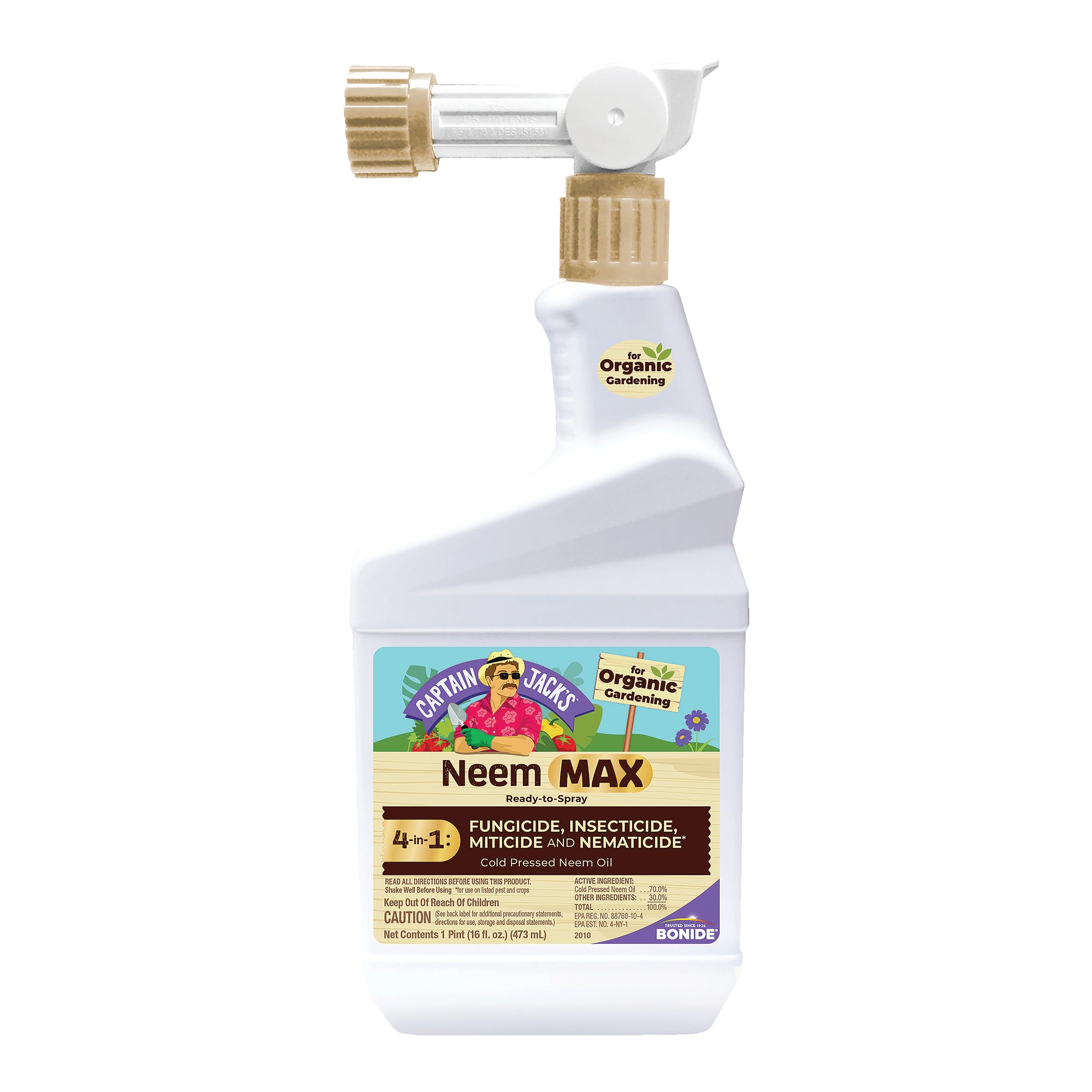
Captain Jack’s Neem Max stands apart because it functions as a 4-in-1 insecticide, fungicide, miticide, and nematicide in a hose-end spray format — meaning you attach it to your garden hose and cover large areas without mixing or pumping. The cold-pressed neem oil base attacks eggs, larvae, and adult insects simultaneously, providing complete life-stage control that ready-to-use sprays often lack.
Owner reports confirm it suppresses Japanese beetles on apple trees and revives lawns affected by fungal issues within days of first application. The hose-end design automatically dilutes the concentrate at the correct ratio, so you don’t have to measure. Some users reported the viscous oil causes aspiration issues in the bottle’s pickup tube, though removing the tube and gravity-feeding resolves the problem.
For anyone with fruit trees, large ornamental beds, or vegetable patches covering significant square footage, this hose-end system eliminates the tedium of hand-spraying while delivering professional-grade coverage. The neem oil also provides residual protection against reinfestation, making it a true set-it-and-forget-it solution for the growing season.
What works
- Hose-end design covers large areas without mixing
- Attacks eggs, larvae, and adult insects for complete control
- Effective on both fungal diseases and chewing insects
What doesn’t
- Viscous oil can clog the aspiration tube on some bottles
- Packaging occasionally arrives with cross-threaded caps causing leaks
2. Grower’s Ally Crop Defender 3
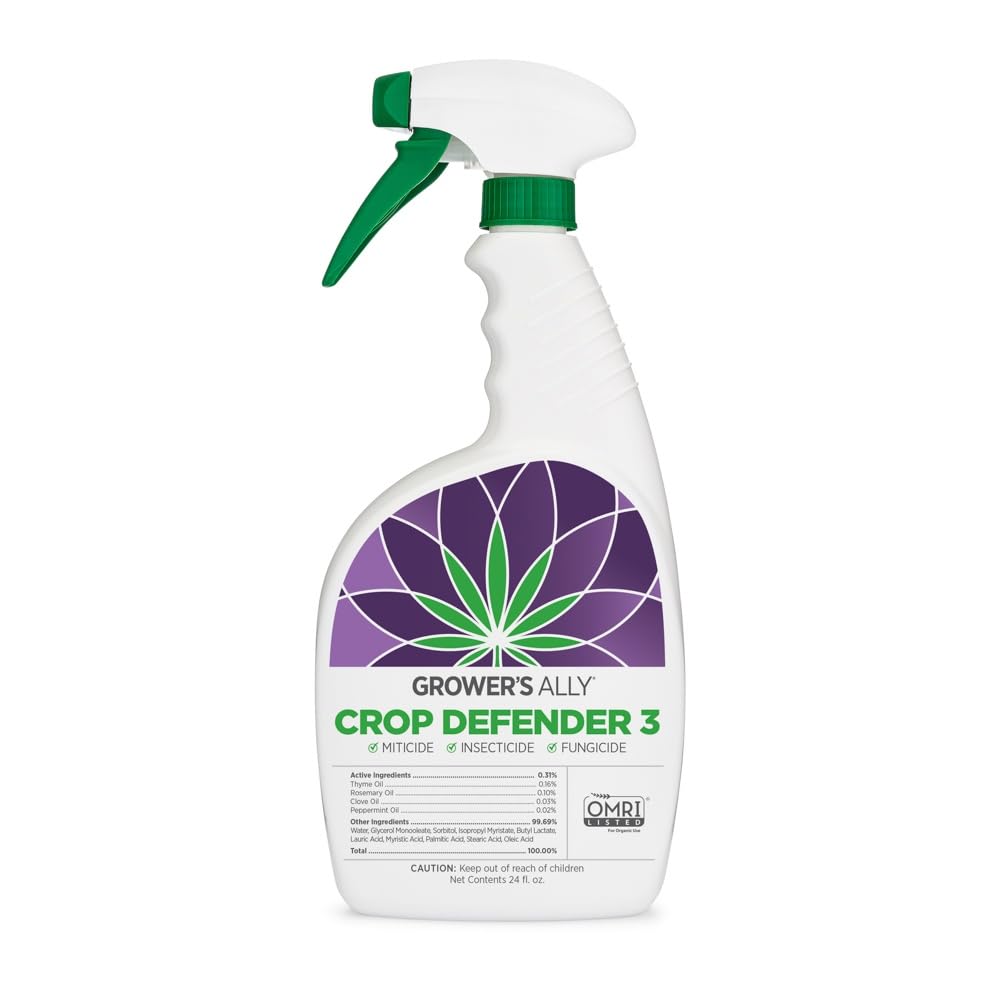
Grower’s Ally Crop Defender 3 uses a synergistic blend of botanical oils with a built-in surfactant to kill powdery mildew, spider mites, russet mites, thrips, and aphids on contact — and it’s formulated to be safe enough for use up to and including the day of harvest. The FIFRA 25(b) exempt status means it contains no synthetic pesticides, heavy metals, or residual solvents, making it a top choice for conscientious organic growers.
Indoor gardeners who tried multiple DIY and organic solutions for spider mites reported that this spray finally eradicated the infestation when others only managed suppression. Users specifically noted it does not burn leaves — even on tender seedlings — and the pleasant botanical scent is a welcome departure from sulfur or neem’s strong odor. Cultivators recommend it for indoor, outdoor, greenhouse, and hydroponic setups.
The 24-ounce ready-to-use trigger sprayer is ideal for targeting specific plants without waste. Its bee-safe and pet-safe formulation, combined with the ability to spray through flowering cycles, makes it the most versatile option for growers who want one spray for all stages of plant development.
What works
- Does not burn leaves even on sensitive seedlings
- Same-day harvest safety with no synthetic residues
- Pleasant botanical scent compared to other organic sprays
What doesn’t
- Small 24-ounce bottle goes quickly on large gardens
- Not effective against hard-shell beetles or caterpillars
3. Fertilome Spinosad Soap Insecticide

Fertilome’s Spinosad Soap Insecticide combines two active ingredients — 0.005 percent spinosad and 0.94 percent potassium salts of fatty acids — to deliver a dual-action attack on both chewing insects and soft-bodied pests. Spinosad targets the nervous system of caterpillars, thrips, bagworms, and Colorado potato beetles, while the soap breaks down the outer cuticle of aphids and whiteflies on contact.
Verified buyers with recurring thrips infestations called this their go-to treatment, noting it eliminated the pests quickly and effectively. Because spinosad works through ingestion as well as contact, it provides residual protection that simple contact sprays cannot match. Owners recommend alternating with an oil-based spray to prevent pest resistance from building up over multiple seasons.
OMRI listed for organic gardening and designed specifically for outdoor use on vegetables, trees, shrubs, flowers, fruits, and citrus, this 32-ounce ready-to-use bottle covers a solid amount of garden real estate. It only targets insects — not fungal diseases — so pair it with a separate fungicide if powdery mildew or black spot is also present on your plants.
What works
- Dual-action spinosad plus soap stops chewing and soft-bodied insects
- Residual protection prevents quick reinfestation
- OMRI listed for certified organic production
What doesn’t
- No fungal disease control — requires separate fungicide treatment
- Resistance can build if used exclusively without rotation
4. Trifecta Natural Outdoor Pest Control

Trifecta Outdoor Pest Control takes a fundamentally different approach from the rest of this list — it uses plant-based essential oils (cedarwood, citronella, geraniol, and thyme oil) to kill mosquitoes, ants, fleas, ticks, gnats, mites, and stink bugs on contact across your entire yard. A single 32-ounce bottle covers up to 5,000 square feet when applied through a hose-end sprayer.
Midwest homeowners living next to farms reported that applying Trifecta the morning of outdoor events eliminated gnat and fly problems entirely, while other yards saw effective suppression of biting midges for the duration of an evening party. The formula is safe around kids, pets, and pollinators once dried, and the citronella scent is noticeable but not overpowering. Some users noted it dried out ornamental flowers like irises when over-applied.
This is not a targeted plant insect spray for aphids or spider mites — it’s a perimeter defense for your patio, deck, and lawn against flying and crawling pests. If you need a solution for evening barbecues and yard gatherings without synthetic pyrethroids, Trifecta delivers effective short-term suppression with a non-toxic profile.
What works
- Kills mosquitoes, gnats, and ticks on contact with essential oils
- Covers up to 5,000 sq ft per bottle through hose-end sprayer
- Safe around kids and pets once dried
What doesn’t
- Not formulated for targeted plant pest control on foliage
- Can dry out delicate ornamental flowers if over-sprayed
5. Botanical Tradesman Neem Oil Concentrate

The Botanical Tradesman Neem Oil Concentrate delivers 100 percent cold-pressed neem oil in a 3.4-ounce bottle that dilutes into approximately 338 fluid ounces of finished spray — that’s about 20 refills of a standard 16-ounce trigger bottle. The concentrate contains no added water, vegetable oils, or diluents, so you control exactly how strong each batch is depending on your pest pressure.
Users battling fungus gnats saw populations drop from 3-8 per plant down to 1-2 after a four-week treatment cycle. The oil is very thick at room temperature — owners recommend warming the closed bottle in hot water before measuring and diluting to ensure proper mixing with water and mild liquid soap. The included 16-ounce trigger spray bottle with adjustable nozzle makes first use easy out of the box.
This concentrate is ideal for anyone who wants to avoid paying for pre-diluted water and prefers to mix fresh batches as needed. Because the oil is pure, you can use it as a foliar shine for ornamental plants or amp up the concentration for heavy infestations. The strong neem scent dissipates within two days, leaving treated plants pest-free and glossy.
What works
- Pure cold-pressed concentrate yields up to 20 bottles of spray
- Gives full control over dilution strength per application
- Works as both pest control and natural foliar shine
What doesn’t
- Thick oil requires warm water bath to mix properly
- Strong neem smell lingers for up to two days after spraying
6. Safer Garden 3-in-1 Spray

Safer Garden’s 3-in-1 formula combines 0.75 percent potassium salts of fatty acids with 0.40 percent sulfur to deliver fungicide, miticide, and insecticide action in a single ready-to-use spray. The soap component kills aphids, mealybugs, spider mites, and whiteflies on contact by breaking down their outer shells, while the sulfur attacks fungal diseases like powdery mildew, black spot, rust, and leaf spot by stopping spore germination.
Hoya growers reported that bi-weekly treatment over six weeks eliminated flat mites and triggered new growth on three out of five previously struggling plants. However, the spray bottle design is the most consistent criticism — multiple owners reported the trigger mechanism fails halfway through the bottle, leaking product onto hands and spraying unevenly. The bottle cap is also non-removable, making it impossible to refill or clean.
OMRI listed for organic gardening and gentle enough to use until the day before harvest, this spray is a strong entry-level choice for small gardens and houseplant collections. Just be prepared to transfer the liquid into a better sprayer if the factory bottle gives out mid-season. For a few dollars more, you get all-in-one disease and pest coverage that saves the guesswork of rotating separate products.
What works
- True 3-in-1 coverage: fungicide, miticide, and insecticide
- Gentle enough for bi-weekly use on sensitive houseplants
- OMRI listed and safe up to the day before harvest
What doesn’t
- Included spray bottle frequently fails or leaks halfway through use
- Non-removable cap prevents refilling into a better sprayer
7. Natria Neem Oil Spray
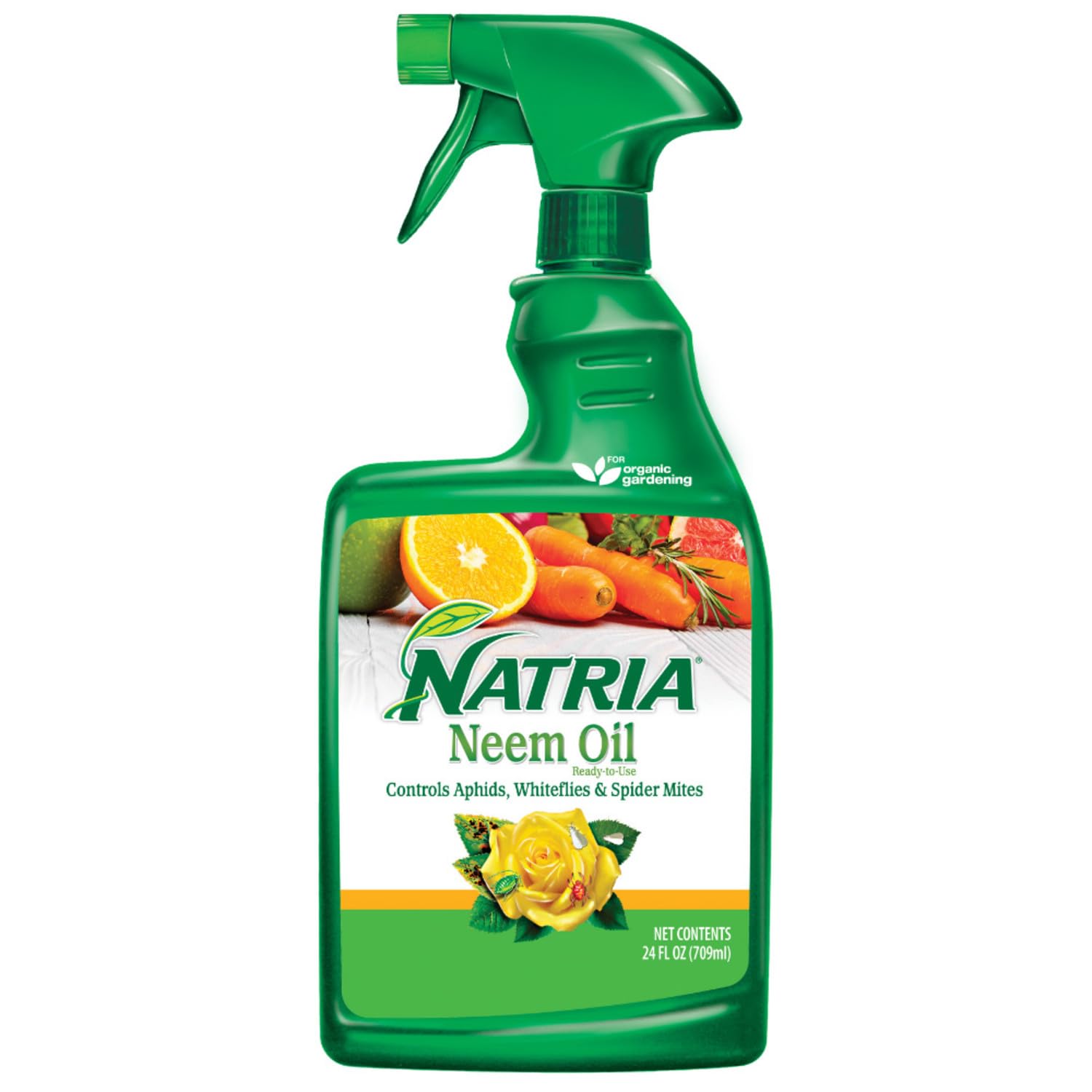
Natria Neem Oil Spray uses 0.9 percent clarified hydrophobic extract of neem oil in a ready-to-use 24-ounce trigger sprayer that requires no mixing or measuring — just point and spray. The clarified extraction process removes much of the heavy sediment and strong odor associated with cold-pressed neem, making it a more pleasant option for indoor use where smell matters.
Verified buyers consistently report it eliminates fruit flies immediately and keeps vegetable gardens clear of pests throughout the growing season. Anecdotal feedback notes that aphids and whiteflies are well-controlled, and the formula can be used up to the day of harvest on edibles. Some users with heavy tomato pest pressure felt the effect was moderate rather than complete, suggesting it works best as a preventive maintenance spray rather than a knockdown treatment for established infestations.
For indoor houseplant owners and small raised-bed gardeners looking for a low-cost, low-effort entry into neem-based pest control, Natria delivers reliable results without the fuss of dilution ratios or special equipment. It controls both insects and fungal diseases like powdery mildew and black spot in one bottle, making it a solid foundational option for gardeners who want simplicity over raw knockdown power.
What works
- Ready-to-use with no mixing required
- Milder odor than cold-pressed neem oil concentrates
- Effective as a preventive maintenance spray on vegetables and houseplants
What doesn’t
- Lower neem concentration may not fully knock down heavy infestations
- Some users saw only moderate improvement on stubborn tomato pests
Hardware & Specs Guide
Active Ingredient Concentration
The percentage of active ingredient dictates how aggressive the spray is against pests. Clarified neem oil at 0.9 percent (Natria) is gentle enough for weekly maintenance but struggles against established infestations. Cold-pressed concentrates at 100 percent (Botanical Tradesman) let you dial in the exact strength but require proper dilution to avoid phytotoxicity. Spinosad at 0.005 percent targets the insect nervous system and requires careful rotation to prevent resistance in consecutive seasons.
OMRI Listing and Organic Compliance
The Organic Materials Review Institute (OMRI) seal means the product is allowed for use in certified organic production. Safer Garden and Fertilome carry OMRI listing, while Grower’s Ally qualifies under FIFRA 25(b) exemption as a minimum-risk pesticide. Non-OMRI neem products may still be natural but could contain undisclosed inert ingredients — always check the label for the full ingredient statement to verify what you’re spraying on edible crops.
Application Method and Coverage
Ready-to-use trigger sprayers (Natria, Grower’s Ally, Safer Garden) offer precision targeting for small areas but run out quickly on large gardens. Hose-end sprayers (Bonide Captain Jack’s) automatically dilute concentrate and cover hundreds of square feet per bottle. Concentrates (Botanical Tradesman) require a separate sprayer and manual mixing but provide the lowest cost per application and the most control over dosage strength.
Mode of Action and Residual Activity
Contact sprays kill pests only when directly hit, requiring thorough coverage of leaf undersides. Spinosad adds a stomach poison effect that continues killing chewing insects after spraying. Neem oil works by smothering eggs and larvae while also disrupting insect feeding and molting hormones. Sulfur-based fungicides prevent spore germination on the leaf surface but do not cure existing infections — they must be applied before disease takes hold.
FAQ
Can I use neem oil spray on edible vegetables and herbs?
How often should I reapply plant insect spray during an active infestation?
Will plant insect spray harm my beneficial pollinators like bees?
What causes leaf burn after I spray my plants with insecticide?
Final Thoughts: The Verdict
For most gardeners, the best plant insect spray winner is the Bonide Captain Jack’s Neem Max because its hose-end spray system covers large areas with a 4-in-1 formula that kills insects, mites, fungi, and nematodes in one pass. If you want a spray that won’t burn delicate indoor seedlings and smells pleasant, grab the Grower’s Ally Crop Defender 3. And for targeted chewing insect control with residual protection in an organic garden, nothing beats the Fertilome Spinosad Soap Insecticide.