
The difference between a thriving vegetable patch and a bed of stunted leaves often comes down to a single hidden factor: the acidity of your soil. Without knowing whether your dirt leans acidic, neutral, or alkaline, you are fertilizing and watering in the dark, guessing at why your hydrangeas refuse to bloom or your tomatoes fail to set fruit.
I’m Rikta — the co-founder and writer behind Lawn Gear Lab. I’ve spent hundreds of hours cross-referencing manufacturer spec sheets, studying horticultural pH requirements for dozens of common garden plants, and analyzing thousands of owner-reported accuracy results to separate the genuinely useful kits from the ones that only add confusion to your garden shed.
To save you time and disappointment, I’ve evaluated the top contenders in this reliable best dirt ph test kit guide to help you pick a unit that provides consistent, actionable readings for your lawn, garden, or houseplants.
How To Choose The Best Dirt pH Test Kit
Selecting the right kit for your soil comes down to understanding two distinct technologies: electronic probe meters that measure electrical conductivity and chemical reagent kits that change color. Your choice depends entirely on whether you need a quick spot-check or a broader nutrient profile, and how much precision your plants demand.
Probe Meters vs. Reagent Kits: The Core Decision
Probe meters (including pen-style digital units) use a glass electrode to detect hydrogen ion activity in a moist soil sample. They provide a direct numerical readout and require periodic calibration with buffer solutions to maintain accuracy. Reagent kits, on the other hand, mix a soil sample with a chemical dye and compare the resulting color against a chart. They measure multiple parameters — nitrogen, phosphorus, potassium, and pH — in one session, making them ideal for a broad fertility snapshot, though color interpretation introduces some subjectivity.
Calibration Complexity and Long-Term Accuracy
Any digital pH meter worth your time supports at least a two-point calibration (pH 4.01 and 7.00). Premium models add a third point (pH 10.01) for extended range reliability. A meter that arrives pre-calibrated can be convenient, but you should verify its drift after several uses. Reagent kits require no calibration but depend on your consistency with the mixing and settling steps; cloudy or unfiltered soil water will skew the color match.
Durability of the Sensing Element
For probe meters, the glass bulb is the most vulnerable component. Units that include a protective cap or a stainless-steel dibber (a pointed sleeve that surrounds the probe) are far more likely to survive repeated insertion into compacted garden beds. If you intend to test heavy clay or rocky soil, a reinforced probe design is non-negotiable.
Quick Comparison
On smaller screens, swipe sideways to see the full table.
| Model | Category | Best For | Key Spec | Amazon |
|---|---|---|---|---|
| YINMIK Digital Soil pH Meter | Premium Probe | Avid gardeners needing app logging | Replaceable spear-tip electrode | Amazon |
| Tadeto Multifunctional pH Meter | Premium Probe | Food and soil dual use | 3-point calibration firmware | Amazon |
| Tadeto Soil pH Tester | Premium Probe | Hard soil with protective alloy cap | Zinc alloy protective tip | Amazon |
| VIVOSUN Digital pH/TDS Kit | Mid-Range Probe | Hydroponics and water testing | pH range 0-14, ±2% TDS | Amazon |
| HSLGOVE 7-in-One Soil Tester | Mid-Range Probe | Quick spot checks with extra sensors | 7 functions incl. temp/humidity | Amazon |
| Soil Test Kit 140 Tests | Budget Reagent | Broad NPK plus pH analysis | 140 tests with pH, N, P, K, NH3 | Amazon |
| Maxsolve 3-in-1 Soil Tester | Budget Probe | Simple moisture, light and pH check | No battery required analog probe | Amazon |
In‑Depth Reviews
1. YINMIK Digital Soil pH Meter

YINMIK addresses the single biggest pain point of probe-style meters: fragility. The package includes a replaceable electrode and a tapered stainless-steel dibber that screws onto the pen, letting you push the probe into dry or compacted garden beds without snapping the glass bulb. The included extra probe effectively doubles the working life of the tool, which is a genuine rarity in this segment.
The three-point auto-calibration (pH 4.01, 7.00, and 10.01) brings laboratory-like repeatability to a handheld form factor. The real differentiator, however, is the companion app that stores time-stamped pH readings from the probe. You can insert the meter into a patch of blueberries, leave it for a day, and later scroll through the logged data to see how the pH fluctuates after watering or rain.
Some users report that dry soil samples produce misleadingly alkaline readings (8.4 or higher) compared to the same soil when moistened, so wetting the test area before inserting the probe is essential for accurate data. The automatic temperature compensation (ATC) helps keep readings stable across seasons, and the backlit display makes late-evening garden checks practical.
What works
- Replaceable electrode extends meter lifespan significantly
- Bluetooth app with data storage for trend tracking
- Steel dibber protects glass probe in hard soil
What doesn’t
- Soil must be sufficiently moist for repeatable readings
- Calibration process requires careful following of instructions
2. Tadeto Multifunctional Digital pH Meter

This Tadeto model is designed for the gardener who also wants to test the pH of their kombucha, bread dough, or pool water. The unit ships with three pre-mixed calibration solutions (pH 4.01, 7.00, and 10.01) plus a storage solution for the probe, eliminating the hassle of mixing powders. The firmware runs a three-point calibration routine, which is the same algorithm used in many food-industry testers costing multiples of this price.
The protective gear includes both a standard plastic cap and a zinc alloy protective cap for the conical probe tip, allowing you to measure soil directly without worrying about shattering the electrode. The backlit LCD shows both pH and temperature simultaneously, and the temperature compensation function adjusts the reading automatically as the soil warms during the day.
For food testing, the meter handles everything from lemon juice to soft cheese, and the included carrying case keeps everything organized. The main downside reported is that the pre-mixed calibration solutions do not carry expiration dates on the bottles, so you should mark them yourself to avoid using degraded buffer liquid. Some soil users found that readings can drift if the probe is not wiped clean between samples.
What works
- Comes with liquid calibration solutions, no mixing required
- Zinc alloy cap protects probe in tough soil
- Handles both garden dirt and food pH testing accurately
What doesn’t
- Calibration bottles lack expiration dates
- Drift possible if probe is not cleaned between tests
3. Tadeto Soil pH Tester (TE027)

This Tadeto variant focuses exclusively on durability for outdoor use. The probe is protected by a hard zinc alloy cap with a conical tip that screws directly onto the electrode, allowing you to push the meter into compacted clay or rocky beds without fear. The meter uses a three-point calibration similar to its sibling, and the LCD backlight automatically turns red when the pH drops below 3.5 or rises above 12, acting as a hazard alert for extreme conditions.
The included calibration powder packets (pH 4.01, 7.00, and 10.01) require you to mix your own buffer solutions, which adds a small step but ensures the chemicals are fresh. The meter also features a data-hold function that locks the reading on screen so you can pull the probe out and write down the result without rushing.
While many owners praise its out-of-box accuracy, a small number of units have shown calibration drift — reading 4.1 instead of 4.01 or 6.7 instead of 7.00 — indicating occasional firmware variance. Checking the calibration against known standards immediately after receiving the unit is wise. The meter also requires periodic storage in potassium chloride solution to keep the glass electrode hydrated.
What works
- Zinc alloy cap withstands insertion into hard soil
- Red backlight alarm for extreme acidity/alkalinity
- Data-hold function locks readings for note-taking
What doesn’t
- Calibration powders must be mixed fresh for each use
- Some units exhibit calibration offset out of the box
4. VIVOSUN Digital pH and TDS Meter Kits
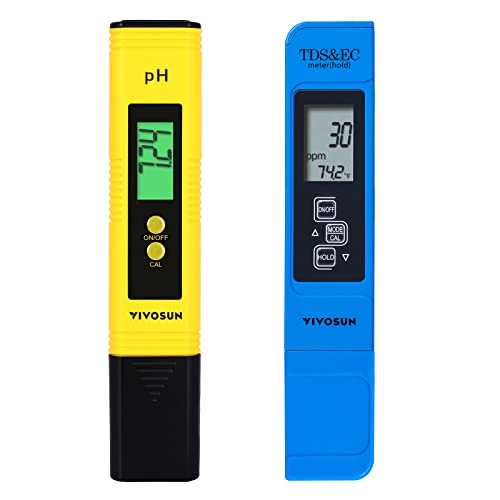
VIVOSUN’s kit bundles a dedicated pH pen with a separate 3-in-1 TDS/EC/temperature meter, covering both acidity and dissolved solids in one package. The pH meter covers the full 0–14 range and claims ±0.01 pH resolution, making it suitable for hydroponic nutrient solution monitoring as well as garden soil slurries. The included carrying case holds both pens and the calibration buffers, keeping everything organized for travel between beds.
The TDS meter measures ppm up to 9990 and also displays electrical conductivity in µS/cm, which is useful for growers using liquid fertilizers. The unit is UL certified, which adds a layer of confidence regarding electrical safety and component quality. The kit arrives pre-calibrated with batteries installed, so you can start testing immediately after unpacking.
Reliability reports are split: many owners find the meters accurate for months, while others report that the pH pen drifts significantly within weeks and becomes difficult to recalibrate. The TDS meter appears more resilient, though its temperature reading has been known to drift by 5–10°F after a month of use. This is a solid entry-level option if you understand that the pH pen may require replacement sooner than premium single-function meters.
What works
- UL certification for electrical safety
- Includes both pH meter and TDS/EC meter
- Comes pre-calibrated with batteries and case
What doesn’t
- pH meter can drift after several weeks of use
- TDS temperature sensor accuracy declines over time
5. HSLGOVE 7-in-One Soil Tester
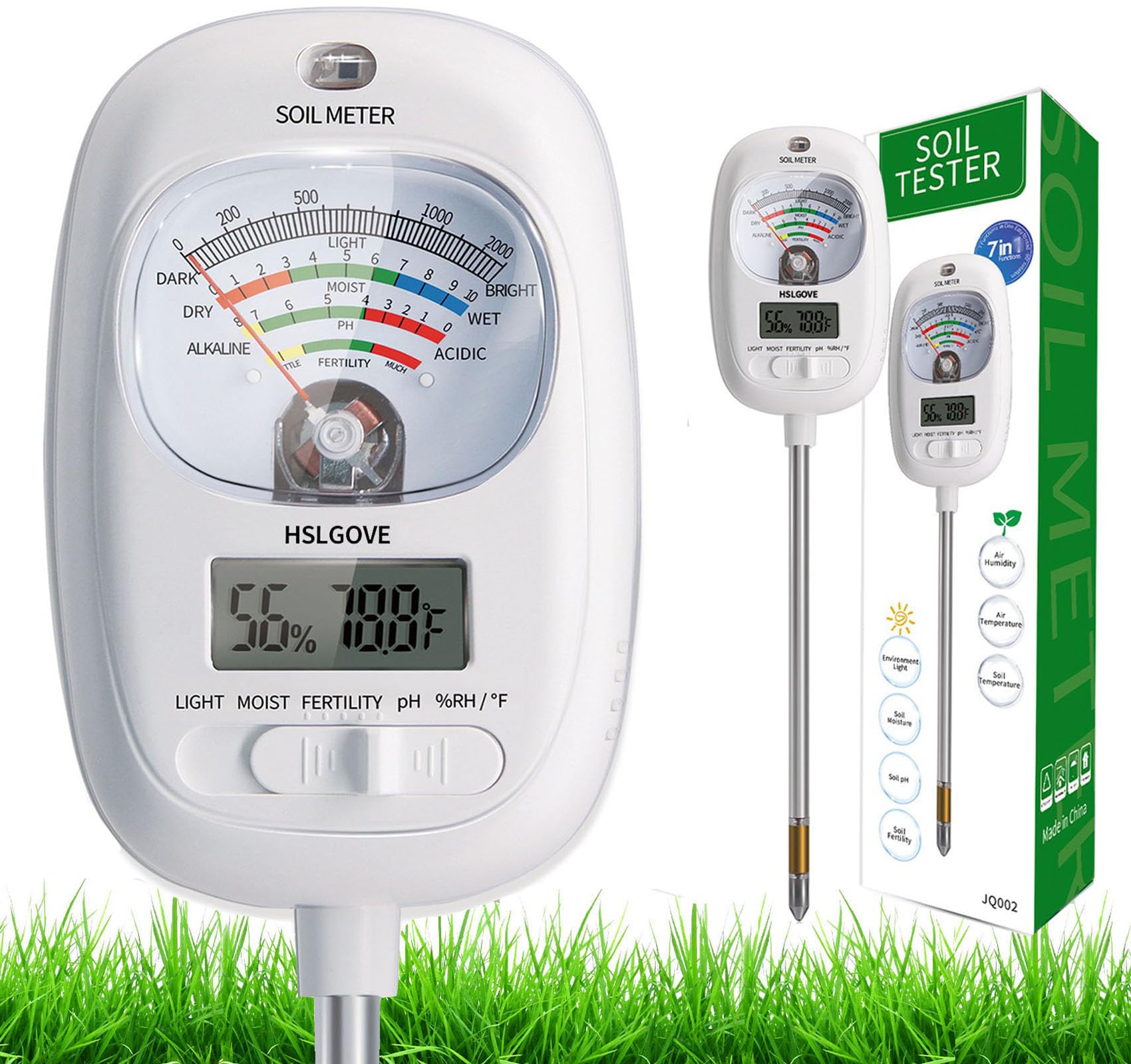
The HSLGOVE 7-in-One combines an analog dial for moisture, pH, fertility, and light with a separate LCD screen that displays soil temperature, air temperature, and air humidity. This dual-display approach lets you assess plant conditions without fumbling through digital menus — a single switch flips between the analog zones. The probe measures 6.8 inches, which is long enough to reach the root zone of medium to large potted plants.
The fertility function uses a color-coded zone on the analog dial (low/normal/ideal) rather than a specific NPK number, so it works as a relative trend indicator rather than a precise nutrient measurement. The pH reading on the analog scale is also approximate compared to a digital pen, but it is consistent enough to tell you whether your soil is broadly acidic or alkaline. The LCD adds value by tracking ambient conditions that affect plant transpiration.
The biggest caution comes from a professional agronomist who reported that the light sensor failed and the pH function read too acidic compared to a calibrated meter. Other owners find the tool perfectly adequate for routine checks. Temperature and humidity data appear reliable. Handle the probe gently when inserting into compacted soil, as the single-probe design can bend under lateral force.
What works
- Dual analog/digital display for fast visual feedback
- Measures air temperature and humidity in addition to soil
- Long 6.8-inch probe reaches deep root zones
What doesn’t
- Analog pH scale offers only approximate readings
- Fertility indicator shows zones, not numeric NPK
6. Soil Test Kit 140 Tests (Dewilde Trading Co)
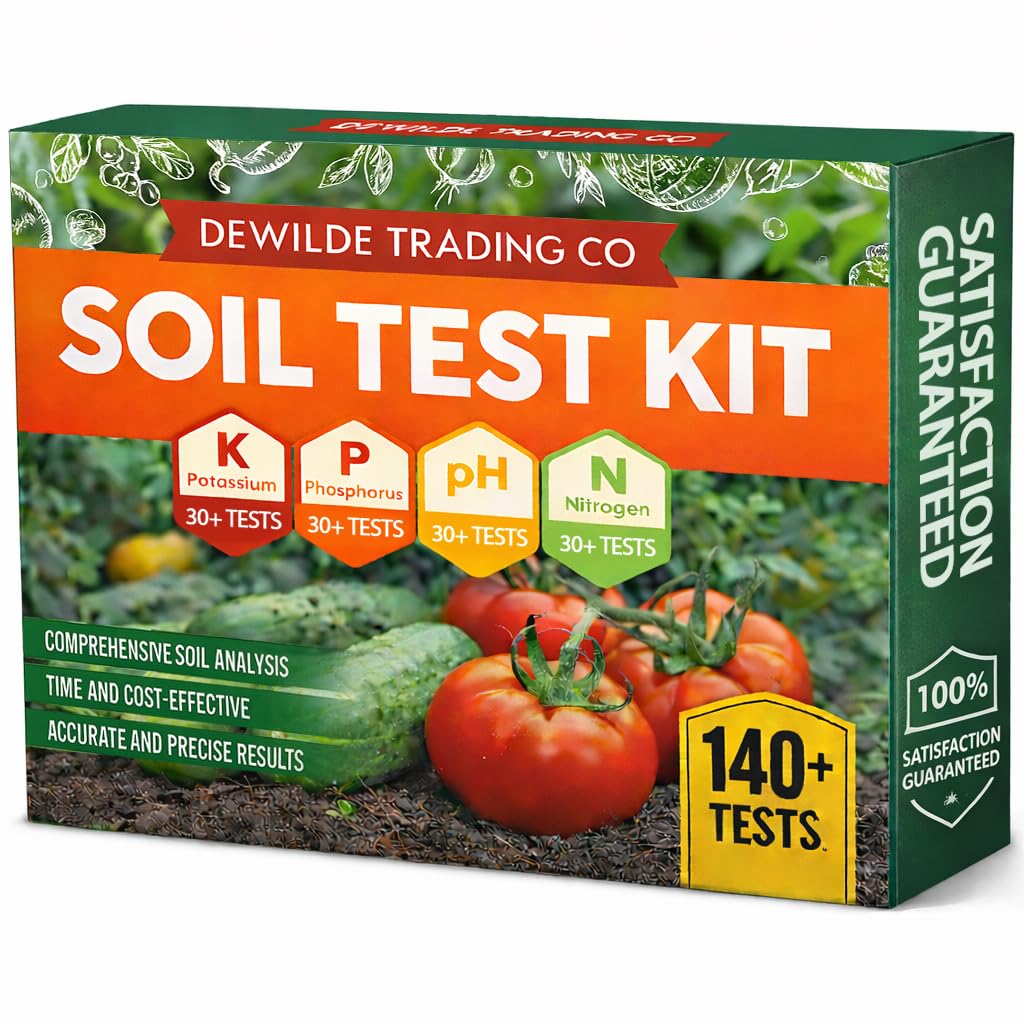
This reagent-style kit is designed for the gardener who wants to know not just the pH but also where their nitrogen, phosphorus, potassium, and ammonia levels stand. With roughly 40 tests available for each of five parameters, you have enough capacity to map an entire vegetable plot and run follow-up tests after amendments. The liquid reagents are mixed with a sieved, filtered soil solution, and the resulting color is compared to an included chart.
The pH test works well when you follow the instructions carefully — many owners report results that match their expectations based on plant health and local soil knowledge. The nitrogen test, however, is a single broad category rather than the split between nitrate and ammonium that aquarium users might expect. If you are accustomed to the API master freshwater kit, this kit’s nitrogen reading will feel less nuanced.
The packaging looks polished, but some units arrive with leaky solution bottles, and the instruction sheet does not explain how to interpret the NPK results after the color match (e.g., whether a dark green means high or optimal). The chart lacks a clear “optimal range” reference, so you may need to consult external resources to decide how much sulfur or lime to add. Filtering the soil water is essential — cloudy solutions produce unreliable colors.
What works
- Tests five parameters (pH, N, P, K, NH3) in one kit
- Large total of 140 tests for repeated monitoring
- Liquid reagent method provides chemistry-based results
What doesn’t
- NPK interpretation chart lacks optimal range guidance
- Some kits arrive with leaking solution bottles
7. Maxsolve 3-in-1 Soil Tester (2-Pack)

This is the simplest possible entry into pH testing: a dual-prong analog probe that needs no batteries and gives you a needle deflection for moisture, light, and pH. The 2-pack means you can keep one in the potting bench and one in the raised bed without moving a single tool. It works on the galvanic principle — metals in the probe generate a tiny voltage proportional to soil conditions — so there are no buttons to press or calibrations to perform.
The pH scale is marked from 3.5 to 8, but the analog needle increments are wide, making it difficult to distinguish between, say, 5.5 and 6.5. For a coarse check — “is my soil acidic or alkaline?” — it delivers a usable answer. The moisture function is the most popular feature among owners, who use it to prevent overwatering in deep containers where the top feels dry but the bottom remains wet.
The light sensor on the back of the dial is sensitive to orientation and can give inconsistent readings if you hold it at the wrong angle. Several owners have found the pH accuracy poor compared to chemical test strips. Treat this as a convenient watering guide that also provides a rough pH hint, not as a substitute for a calibrated digital meter when you need to treat a specific deficiency.
What works
- Zero maintenance — no batteries or calibration needed
- Two-pack allows one for garden, one for indoor pots
- Excellent as a moisture check tool to prevent overwatering
What doesn’t
- Analog pH scale lacks fine resolution for precise work
- Light sensor readings vary with hand position
Hardware & Specs Guide
Electrode Type and Protection
The pH probe’s glass bulb is its most sensitive component. Premium meters like the YINMIK and Tadeto models use spear-tip glass electrodes paired with a stainless-steel or zinc alloy sleeve that prevents the glass from snapping when pushed into dry or stony dirt. Budget analog probes eliminate glass entirely by using a dual-metal galvanic sensor, which is tougher but far less precise — you trade fine resolution for durability.
Three-Point vs. Two-Point Calibration
Calibration aligns the meter’s internal reference to known buffer standards. Two-point calibration (pH 4.01 and 7.00) is sufficient for most garden work where the expected range is 5.0 to 8.0. Three-point calibration adds pH 10.01, which corrects the meter’s response curve across the entire 0–14 range and is necessary if you test alkaline peat, compost tea, or hydroponic reservoirs that swing outside the neutral zone.
FAQ
Do I need to calibrate a new dirt pH meter before first use?
Why does my probe meter give different readings in wet vs. dry soil?
Can a chemical reagent kit measure pH more accurately than an analog probe?
Final Thoughts: The Verdict
For most gardeners, the best dirt ph test kit winner is the YINMIK Digital Soil pH Meter because it combines a replaceable electrode for longevity with Bluetooth data logging for tracking soil trends over time. If you want a rugged dual-purpose meter that tests both garden soil and kitchen foods, grab the Tadeto Multifunctional pH Meter. And for a budget-friendly broad fertility snapshot that includes nitrogen, phosphorus, and potassium alongside pH, nothing beats the Soil Test Kit 140 Tests.