
Fescue lawns demand a specific balance of nutrients and weed control that common all-purpose fertilizers can’t deliver. The wrong NPK ratio stresses the turf, while harsh herbicides can thin the stand instead of thickening it, leaving you with more weeds than grass.
I’m Rikta — the co-founder and writer behind Lawn Gear Lab. I’ve spent countless hours cross-referencing granular nitrogen release rates, herbicide active-ingredient profiles, and application timing data from owner reports to isolate the seven formulas that actually work on tall fescue and fine fescue without scorching the crown.
Whether you’re battling dandelions in the spring or nursing the turf through the summer, the right weed and feed for fescue hinges on matching slow-release nitrogen percentages to the grass’s growth cycle and choosing a broadleaf killer that leaves the root system intact.
How To Choose The Best Weed And Feed For Fescue
Fescue is a cool-season bunch grass that forms a thick turf when managed correctly, but it struggles if the fertilizer pushes rapid top growth instead of root depth. The right product must feed the plant without forcing a growth surge that invites summer heat stress.
Nitrogen Release Speed
Fescue thrives on a steady diet of slow-release nitrogen (SRN). Look for a bag where at least 40 to 60 percent of the nitrogen is labeled as slow-release or polymer-coated. Quick-release urea spikes growth, weakens cell walls, and makes the grass more susceptible to leaf spot and brown patch.
Herbicide Spectrum
Post-emergent broadleaf herbicides containing 2,4-D, mecoprop, dicamba, or prodiamine (pre-emergent) are safe on established fescue when applied at the right rate. Avoid products that list atrazine or mesotrione at high percentages — these can yellow or stunt cool-season turf in hot weather.
Application Timing
Fescue responds best to weed and feed applications in early spring when soil temperatures hit 55°F and again in early fall. Summer applications stress the grass, and the herbicide can volatilize in high heat. Always water the lawn lightly before applying granular formulas so the particles stick to weed leaves.
Quick Comparison
On smaller screens, swipe sideways to see the full table.
| Model | Category | Best For | Key Spec | Amazon |
|---|---|---|---|---|
| The Andersons Professional Surge | Post-Emergent | Heavy weed infestations | 16-0-9, 40 lb bag | Amazon |
| Yard Mastery Flagship 24-0-6 | Slow-Release | All-season feeding | 24% SRN, 45 lb bag | Amazon |
| GreenView Fairway Formula 27-0-5 | High Nitrogen | Spring green-up | 63% SRN, 33 lb bag | Amazon |
| Jonathan Green Green-Up 21-0-3 | Broadleaf Killer | Over 250 weed types | Fine particles, 15 lb bag | Amazon |
| Scotts Turf Builder Weed and Feed | Easy Application | Dandelion control | Weedgrip Technology | Amazon |
| The Andersons Barricade 18-0-4 | Pre-Emergent | Crabgrass prevention | Prodiamine, 18 lb bag | Amazon |
| GreenView Fall Lawn Food 22-0-10 | Winterizer | Fall root building | 22-0-10, 48 lb bag | Amazon |
In‑Depth Reviews
1. Yard Mastery 24-0-6 Flagship Granular Lawn Fertilizer with 3% Iron

This 45-pound bag delivers a 24-0-6 NPK profile with 24 percent slow-release nitrogen, which aligns perfectly with fescue’s need for steady feeding rather than a quick green flash. The 3 percent iron content deepens the color without pushing excessive blade elongation, reducing mowing frequency during the active growth windows of spring and fall.
Bio-Nite additive improves soil microbial activity, helping the fescue rootzone access trace nutrients that typical high-nitrogen blends ignore. Coverage of 15,000 square feet per bag makes this a strong option for medium-to-large lawns; the granular consistency spreads evenly through a rotary spreader without clumping when stored correctly.
Owner reports consistently note a dark green color within two weeks and a thickening of the stand that chokes out light weed pressure naturally. The lack of a built-in post-emergent herbicide means you’ll need a separate weed spray for active broadleaf infestations, but the feeding results alone justify the premium tier for fescue-focused turf managers.
What works
- High slow-release nitrogen matches fescue’s growth rhythm.
- Iron and Bio-Nite improve color and soil biology.
- Large bag covers 15k sq ft efficiently.
What doesn’t
- No herbicide included for active weed killing.
- Stimulates heavy top growth if over-applied.
2. The Andersons Professional Surge Weed and Feed 16-0-9
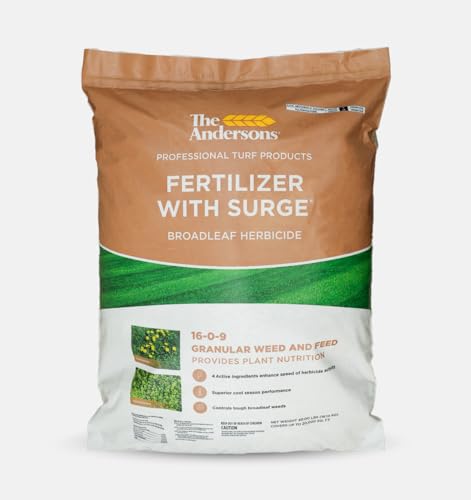
This professional-grade blend packs a four-way herbicide complex that targets over 250 broadleaf weeds including dandelion, clover, chickweed, and creeping charlie. The 16-0-9 ratio provides moderate nitrogen with elevated potassium — a profile that strengthens fescue cell walls and improves drought tolerance during summer stress periods.
The 40-pound bag covers up to 16,000 square feet, making it the largest coverage option in this comparison. The dispersible granule technology ensures the herbicide activates quickly upon contact with moist weed foliage, reducing the risk of wash-off before the chemical penetrates the leaf cuticle. It performs well even in cooler spring and fall temperatures when fescue is actively growing.
User feedback highlights its effectiveness against creeping charlie and crabgrass when applied with proper timing — early enough in the season to catch weed seedlings before they establish deep taproots. The product is not labeled for Floratam St. Augustine or dichondra, so check your grass species if you have a mixed lawn.
What works
- Four-way herbicide kills over 250 weed species.
- High potassium supports fescue root strength.
- Large coverage reduces number of bags needed.
What doesn’t
- Not for use on Floratam St. Augustine or clover lawns.
- Premium price per bag compared to commodity brands.
3. GreenView Fairway Formula Lawn Fertilizer 27-0-5

With 63 percent slow-release nitrogen in a 27-0-5 formula, this 33-pound bag delivers a steady nutrient supply for up to twelve weeks on a 10,000-square-foot lawn. The high nitrogen content is ideal for giving fescue a robust spring green-up without the surge-and-crash pattern that quick-release products cause.
The formulation contains zero phosphate, making it a suitable choice for properties near waterways or in regions with phosphorus restrictions. The bags are consistently well-sealed, and the granules flow cleanly through rotary and drop spreaders without bridging or clogging — a practical detail when treating large areas quickly.
Customer reports confirm a visible darkening of the turf within a few days of application, with sustained color through the summer if moisture is adequate. The product does not include a herbicide, so you will need a separate weed killer for any active broadleaf issues in the lawn.
What works
- Very high slow-release nitrogen percentage (63%).
- Phosphate-free formula protects waterways.
- Feeds consistently for up to 12 weeks.
What doesn’t
- No weed control components included.
- Bag size may be heavy for smaller spreaders.
4. Jonathan Green Green-Up Weed & Feed 21-0-3

This 15-pound bag uses a fine particle size that helps the granular herbicide stick to weed leaves more effectively than larger pellets. The 21-0-3 analysis delivers a moderate nitrogen boost while the proprietary weed killer targets over 250 broadleaf species including dandelion, chickweed, clover, and wild onion.
The formula feeds the fescue for up to three months with gradual nutrient release, reducing the need for reapplication during the spring window. It cannot be used at the same time as overseeding, so plan your renovation schedule around this product’s application timing — apply it at least four weeks before or after seeding for best results.
Some users report inconsistent weed kill on established clover patches, and the small bag size means you’ll need multiple bags for lawns larger than 5,000 square feet. The grass green-up response is generally strong, making it a solid integrated option for homeowners who want a single-product solution for moderate weed pressure.
What works
- Fine granules adhere well to weed leaves.
- Controls a wide spectrum of broadleaf weeds.
- Gradual nitrogen release for 3 months.
What doesn’t
- Small bag covers only 5,000 sq ft.
- Inconsistent results on stubborn clover patches.
5. Scotts Turf Builder Weed and Feed
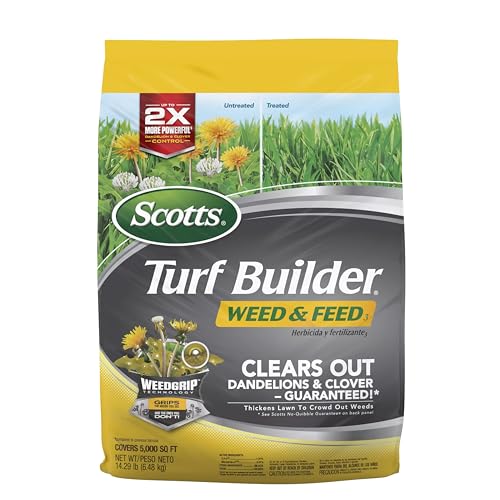
Scotts built this 14.3-pound bag around Weedgrip Technology, a formulation designed to make the granules cling to weed foliage even after a light watering. The herbicide blend focuses on dandelion and clover control, and the company claims it is twice as powerful as its previous formula against those target species.
The product is available in both granular and hose-end spray versions — the granular version requires the weeds to be wet before application for best adhesion, and you should avoid watering for two to three days afterward. The lawn feed component thickens the turf, which naturally suppresses weed germination by reducing bare soil exposure.
Several users note that the granular form struggles with crabgrass and creeping charlie, so match your weed pressure to the product’s herbicide strengths. The spray version offers more uniform coverage on uneven lawns and is easier to calibrate for smaller lots.
What works
- Effective dandelion and clover knockdown.
- Weedgrip Technology improves granule adhesion.
- Available in spray or granular formats.
What doesn’t
- Limited efficacy on crabgrass and clover.
- Granules must be applied to wet weeds for best results.
6. The Andersons 18-0-4 Barricade Fertilizer with Pre Emergent Weed Control
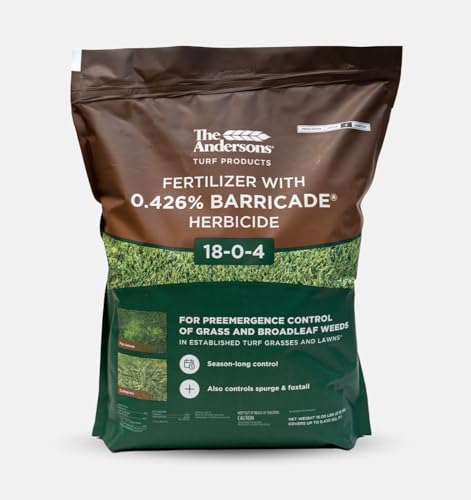
This 18-pound bag is formulated for early spring and early fall applications, using 0.426 percent prodiamine as the pre-emergent active ingredient. It prevents 30 grass and broadleaf weed species from germinating, including crabgrass, poa annua, goosegrass, and henbit — all of which compete with fescue for water and nutrients during the establishment window.
The patented Dispersible Granule (DG) Technology causes the particles to break down rapidly once watered in, moving the prodiamine into the soil profile quickly for maximum weed-barrier formation. The 18-0-4 fertilizer component provides a modest nitrogen dose that supports fescue root development without forcing excessive blade growth.
It is critical to apply this product before weeds emerge — it will not kill existing weeds, so pair it with a post-emergent herbicide if your lawn already has active broadleaf pressure. The small particle size delivers excellent coverage density per square inch, which translates to fewer skips and more uniform control across the lawn.
What works
- DG Technology delivers fast soil penetration.
- Effective against crabgrass, poa annua, and henbit.
- Safe for established fescue when applied correctly.
What doesn’t
- Will not kill existing weeds — must be applied pre-emergent.
- Higher price per bag than basic pre-emergent granules.
7. GreenView Fall Lawn Food 22-0-10

This 48-pound bag of fall-specific fertilizer uses a 22-0-10 ratio with GreenSmart Enhanced Efficiency Technology that feeds the lawn continuously for up to eight weeks. The elevated potassium content supports root carbohydrate storage, which helps fescue survive winter dormancy and green up faster the following spring.
It covers 15,000 square feet, making it the highest-coverage fall-specific product in this group. The granules flow smoothly through broadcast spreaders, and the large bag size reduces the number of refills needed for properties over half an acre. Apply it while the fescue is still actively growing in late September through November for maximum root uptake.
Owner feedback confirms a noticeable difference in spring green-up speed compared to skipping the fall feed, with denser turf that resists early-season weed invasion. This product contains no herbicide, so it is strictly a feeding tool — best used in combination with a pre-emergent application in early spring for year-round weed management.
What works
- High potassium strengthens fescue roots for winter.
- Large bag covers 15,000 sq ft.
- Eight-week continuous feeding window.
What doesn’t
- No weed control component included.
- Heavy bag (48 lbs) is awkward to carry.
Hardware & Specs Guide
Slow-Release Nitrogen Percentage
The single most important number on a fescue weed-and-feed bag is the percentage of total nitrogen that is slow-release. A figure above 50 percent (as seen in the GreenView Fairway Formula at 63 percent) ensures the grass receives a steady nutrient stream over weeks rather than a spike that stresses the crown. Low SRN products force rapid leaf growth, increasing mowing frequency and vulnerability to fungal disease.
Herbicide Active Ingredient Profile
Post-emergent formulas typically use 2,4-D, mecoprop, and dicamba in varying ratios. Pre-emergent products rely on prodiamine or dithiopyr for season-long germination control. For fescue, avoid products with atrazine as the primary herbicide — it can cause interveinal chlorosis on cool-season grasses in warm conditions. Check the active ingredient percentage to calculate effective coverage across your lawn’s weed spectrum.
Coverage Area and Bag Weight
Fescue lawns vary widely in size, and the bag weight directly correlates with coverage. A 15-pound bag covering 5,000 square feet fits small suburban lots, while a 48-pound bag covering 15,000 square feet suits larger properties. Over-application beyond the label rate risks herbicide damage and nitrogen runoff, so always match the bag size to your measured lawn area.
Particle Size and Spreadability
Fine-particle formulas (like the Jonathan Green 21-0-3) stick better to weed foliage but can drift in windy conditions. Larger granules fall more predictably from rotary spreaders but may bounce off weed leaves onto the soil. The Andersons DG Technology bridges this gap by using small particles that dissolve rapidly upon watering, ensuring both weed adhesion and quick soil penetration for the pre-emergent component.
FAQ
When is the best time to apply weed and feed to fescue lawns?
Can I use a weed and feed on newly seeded fescue?
Will weed and feed kill existing dandelions in fescue?
Why is slow-release nitrogen better for fescue than quick-release?
Final Thoughts: The Verdict
For most gardeners, the weed and feed for fescue winner is the Yard Mastery 24-0-6 Flagship because its 24 percent slow-release nitrogen and 3 percent iron deliver a deep, steady green that strengthens the turf without forcing excessive mowing. If you want heavy broadleaf knockdown in a single pass, grab the The Andersons Professional Surge 16-0-9. And for a pure fall root-building feed that preps fescue for winter survival, nothing beats the GreenView Fall Lawn Food 22-0-10.