
Cutting the grass is the single most repetitive chore of homeownership, and a robotic mower promises to erase it from your calendar entirely. But the market is flooded with options that rely on buried perimeter wires, struggle to find their way home, or simply can’t handle an uneven yard. The real challenge is finding a unit that navigates your specific terrain, avoids obstacles intelligently, and delivers a consistent cut without constant babysitting.
I’m Rikta — the co-founder and writer behind Lawn Gear Lab. I’ve spent hundreds of hours studying RTK, LiDAR, and vision-based navigation systems, cross-referencing technical specifications with verified owner feedback to separate mowers that truly automate the job from those that create more work than they save.
Wire-free models now dominate the conversation, but the differences in mapping accuracy, obstacle detection, and slope handling are massive across price tiers. This guide cuts through the noise to help you pick the right robotic lawn mower for your property without wasting time on marketing fluff.
How To Choose The Best Robotic Lawn Mower
The decision comes down to three factors: navigation technology, physical capability, and your yard’s layout. A vision-only mower can fail under dense tree cover, while a premium LiDAR unit may be overkill for a simple, open rectangle of turf. Here’s what separates a good fit from a constant headache.
Navigation: Wire-Free vs. Perimeter-Wire Systems
Perimeter-wire mowers require you to bury a boundary cable around the entire lawn — a weekend project that becomes a nightmare when you redesign landscaping or need to remove the wire. Wire-free models use RTK (satellite corrections), vision cameras, or LiDAR to create a virtual map. RTK systems need a clear view of the sky; vision-based units rely on daylight and contrast. LiDAR works in complete darkness and under heavy tree canopy but adds significant cost. For most buyers today, a wire-free system is the clear choice, but pick the sensor type that matches your property’s worst-case conditions.
Slope Handling and Traction
Manufacturers advertise slope ratings as percentages (20%, 45%, 80%). A mower rated for 45% can handle a moderately steep hill, but real-world traction depends on wheel design, tire tread, and whether the unit has two-wheel drive or all-wheel drive. AWD models with independent motors, like the Mammotion LUBA 3 or Segway Navimow X430, can climb 80%+ slopes and cross obstacles up to 2.8 inches without getting high-centered. Two-wheel drive units often spin out on wet grass or uneven transitions. If your yard has any slope over 20%, prioritize AWD.
Cutting Width, Height Range, and Edge Management
Cutting width determines how fast the mower covers your lawn — a 17-inch disc cuts more than twice as fast as a 7-inch disc, but it also needs wider paths and better obstacle clearance. Cutting height range matters if you have mixed grass types or seasonal variations; look for at least 1.2 inches to 3.5 inches of adjustment. Edge trimming is a weak point for most robotic mowers. Some models use an offset blade to get closer to borders (“Ride-on-Edge”), while premium units like the ECOVACS Goat A3000 include a dedicated edge trimmer. Expect to do some manual string trimming around tight corners and flower beds with any model.
Battery Life, Charging Speed, and Coverage Capacity
Runtime per charge ranges from 45 minutes to over 200 minutes, but the more important metric is how the mower handles recharge-and-resume cycles. A unit with fast charging (90+ watts) can return to work in under an hour, maintaining continuous coverage across a large yard. Coverage capacity (rated in acres) is often conservative — many owners report the mower handles 20–30% more than the spec sheet claims. However, battery degradation over multiple seasons is a real concern. Check whether the battery is user-replaceable, especially on premium models, since a dead battery can turn a costly mower into a lawn ornament.
Obstacle Avoidance and Multi-Zone Management
Early robotic mowers relied on bump sensors, which meant they hit objects before reacting. Modern units use AI-powered cameras or LiDAR to identify 150 to 1,000+ object types and reroute in real time. This is critical if you have kids, pets, toys, or irregular garden features. Multi-zone management lets you divide the lawn into front, back, and side yards with separate schedules — essential for properties with driveways, gates, or pathways. No-go zones allow you to keep the mower away from pools, vegetable gardens, and delicate flower beds. The best apps, like those from Segway and Mammotion, let you draw zones and pathways directly on a satellite map.
Quick Comparison
On smaller screens, swipe sideways to see the full table.
| Model | Category | Best For | Key Spec | Amazon |
|---|---|---|---|---|
| WORX Landroid Vision Cloud WR320 | Mid-Range | ½-acre yards with varied shapes | 8.7 in cutting width, RTK Cloud | Amazon |
| ANTHBOT M5 | Mid-Range | Small complex lawns under ⅛ acre | Dual AI Vision + RTK, 45% slope | Amazon |
| Segway Navimow i105N | Mid-Range | Yards needing AI-assisted mapping | RTK+Vision, 7.1 in cutting width | Amazon |
| YARDCARE N1600 PRO | Mid-Range | Up to 0.4 acres with 3D obstacle sense | RTK+Vision, 0.8–2.4 in height range | Amazon |
| Sunseeker X3 Plus | Mid-Range | Suburban 0.3-acre lots | RTK+VSLAM, 8 in cutting width | Amazon |
| eufy E15 | Premium | Pure vision-based small yards | No RTK/wire, AI 3D avoidance | Amazon |
| ANTHBOT Genie 3000 | Premium | 0.9-acre yards with 30+ zones | 4-Eye Vision, Full Band RTK | Amazon |
| ECOVACS Goat A2000 LiDAR PRO | Premium | ½ acre with thick grass types | Dual-LiDAR, 32V platform, edge trimmer | Amazon |
| ECOVACS Goat A3000 LiDAR PRO | Premium | ¾ acre needing fast recharge cycles | Dual-LiDAR, 7500 mAh, 189W charge | Amazon |
| Segway Navimow X430 | Premium | Large, steep, complex properties | 4WD, 17 in cut, 84% slope climb | Amazon |
| Mammotion LUBA 3 AWD 5000H | Premium | 1.25-acre estates with varied terrain | 360° LiDAR+NetRTK+AI Vision | Amazon |
In-Depth Reviews
1. WORX Landroid Vision Cloud WR320
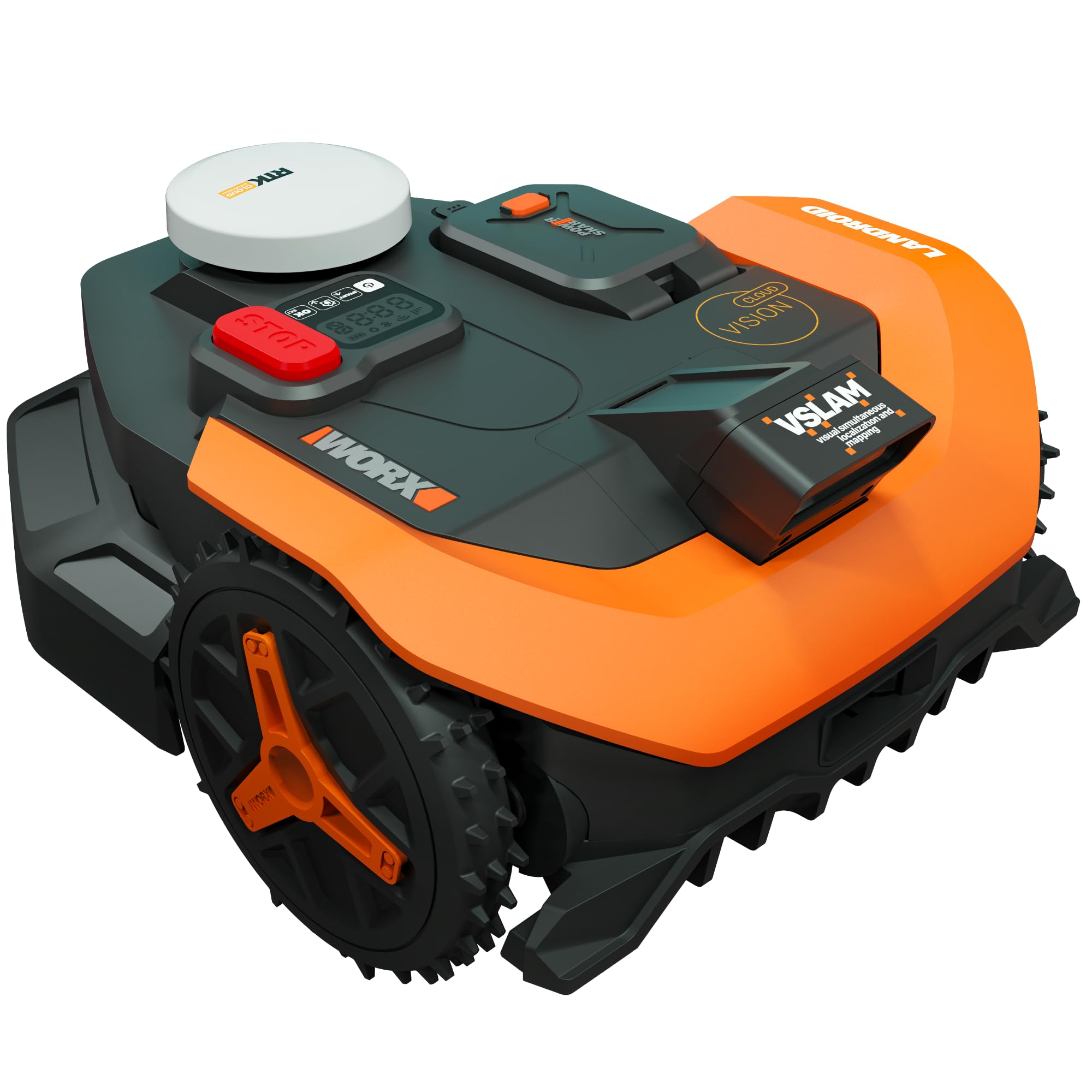
The WR320 strikes a rare balance: centimeter-level RTK accuracy delivered from the cloud without a local antenna installation, paired with Vision AI that understands boundary types. It auto-maps your yard on day one, and its 8.7-inch cutting width paired with a 60-minute runtime covers up to half an acre efficiently. The unit supports infinite zones, parallel/checkerboard/diamond mowing patterns, and RadioLink connectivity for reliable communication across larger lawns where standard Wi-Fi drops out.
Owner feedback highlights the importance of a dedicated 2.4GHz Wi-Fi network for initial setup, but once updated, the mower runs reliably, handling sidewalks, trees, and 30-degree slopes without issue. The cut quality is consistent, with quiet operation and fast 30–45 minute charging that keeps downtime minimal. Reports note the mower covers roughly 0.4 acres in 1.5 days when running during daylight hours, making it ideal for busy homeowners who can’t afford a premium price tag.
What really sets the WR320 apart is the combination of no perimeter wire, no recurring cloud subscription costs, and commercial-grade positioning technology typically reserved for mowers costing twice as much. The Vision AI does require good lighting conditions, and some users with complex layouts near fences note occasional path-planning confusion, but WORX has been pushing regular OTA updates to improve edge-following. For the price, it delivers the best all-around package for a mid-sized property.
What works
- Cloud-based RTK requires no local antenna installation
- AI obstacle avoidance handles pets and yard objects reliably
- Fast charging (30–45 min) reduces downtime during long mowing sessions
What doesn’t
- Setup requires a dedicated 2.4GHz Wi-Fi network
- Vision AI needs good daylight conditions
- Manual doesn’t cover advanced app features in depth
2. ANTHBOT M5
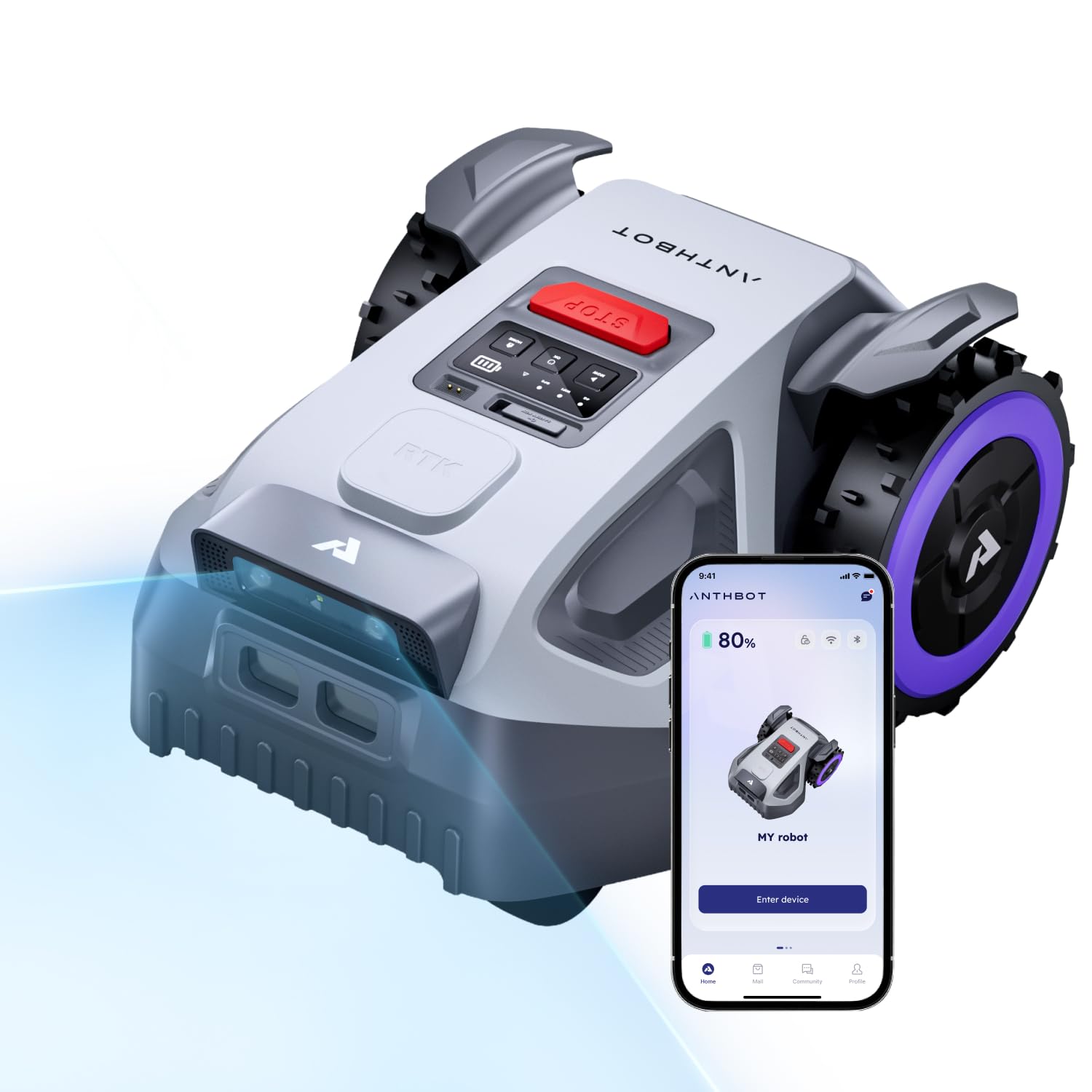
The ANTHBOT M5 brings dual-camera AI vision and full-band RTK positioning to entry-level pricing, making it one of the most affordable wire-free options on the market. It handles slopes up to 45%, recognizes over 1,000 obstacles, and automatically maps a yard up to 0.15 acres in roughly 10 minutes with no manual driving. The 7.9-inch cutting width and five free-rotating blades aim to create a carpet-like finish, and the cutting height adjusts from 1.2 to 2.7 inches.
Real-world owners consistently praise its obstacle detection under both day and night conditions, thanks to the HDR cameras and built-in AI algorithms. The M5 maintains a consistent cut on medium-sized lawns, with many reports noting that it handles a 12,000+ sq ft yard comfortably despite the conservative 0.15-acre rating. Charging is reasonably quick, and the mower returns to the base automatically, then resumes exactly where it left off.
Where the M5 falls short is in software polish — some users experience app connectivity errors, and a minority report the mower gets stuck on minor terrain irregularities that more expensive units would navigate. The lack of included cable shielding and dock slack storage also means installation requires careful cable management. Still, for homeowners with a small to medium yard who want wire-free automation without spending significantly more, the M5 is a compelling entry point.
What works
- Excellent obstacle recognition (1,000+ object types)
- Quick auto-mapping in about 10 minutes
- Slope handling up to 45% covers most residential properties
What doesn’t
- Occasional network connectivity errors in firmware
- No cable shielding or dock storage for excess wire
- App design could be more intuitive
3. Segway Navimow i105N

The Navimow i105N leverages Segway’s custom RTK technology with vision enhancement to deliver stable centimeter-level positioning even under tree cover and in narrow corridors. Its standout feature is AI-assisted mapping: the unit identifies clear lawn edges during the initial mapping walk and automatically navigates and maps the entire working area, reducing setup time compared to manual zone drawing. The i105N covers up to 1/8 acre, with a 7.1-inch cutting width and five-position height adjustment from 2 to 3.6 inches.
Owner experiences consistently highlight excellent GPS accuracy under trees and near fences, where many RTK-only systems lose lock. The mower follows planned mowing patterns to produce clean stripes and changes direction after 100% coverage to minimize tire tracks on the lawn. Multi-zone management supports up to 12 zones with separate schedules, and the optional 4G module adds GPS anti-theft tracking. The unit is quiet at 58 dB and includes a three-year warranty, which adds peace of mind for long-term ownership.
Where the i105N struggles is on sloping or uneven ground — the 2-wheel drive can get stuck on small divots unless the front bumper is removed (a known owner fix that increases ground clearance). Some users report that the initial mapping process can delete itself if paused too long, requiring a complete re-map. Customer support response times are inconsistent. For relatively flat, well-defined lawns under 1/4 acre, however, this is one of the most refined wire-free options available, with deep parent-company backing and regular OTA improvements.
What works
- Excellent GPS lock under trees and near structures
- AI-assisted mapping reduces initial setup time
- 3-year warranty with good manufacturer support
What doesn’t
- Tendency to get stuck on uneven terrain without bumper removal mod
- Mapping can be lost if setup is paused for too long
- Customer support response can be slow
4. YARDCARE N1600 PRO
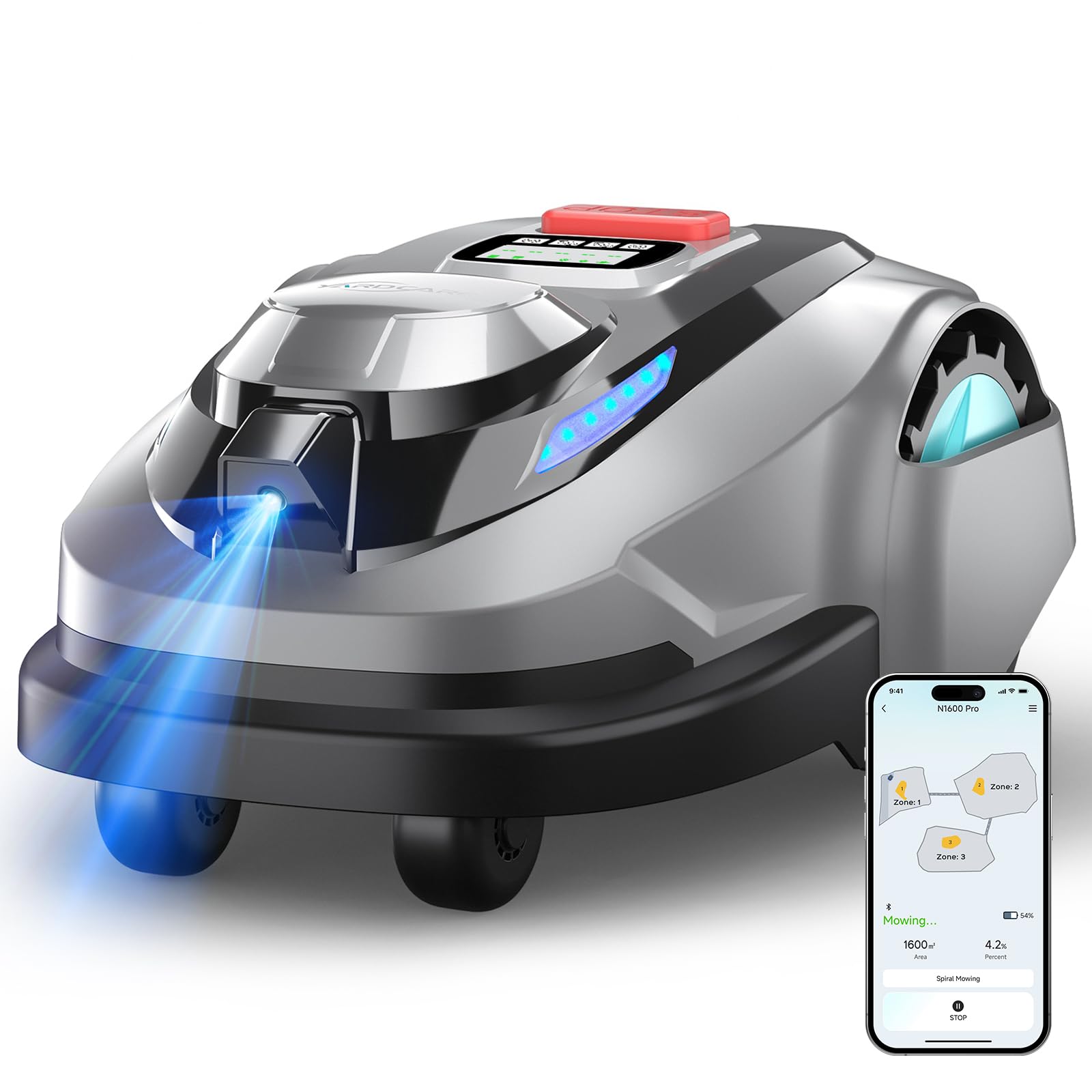
The YARDCARE N1600 PRO combines RTK positioning with AI visual navigation for centimeter-level accuracy across lawns up to 0.4 acres. It features intelligent 3D obstacle detection that identifies and avoids yard objects, and a brushless motor provides strong traction on slopes up to 20°. The cutting height is adjustable from 0.8 to 2.4 inches across 17 positions — an unusually wide range that works for everything from fine Bermuda to taller fescue. The unit returns to charge and auto-resumes, and the app supports multiple zones and custom no-go areas.
Early adopters highlight the mower’s methodical U-shaped navigation pattern and its strong edge-to-edge cutting, which reduces the need for follow-up trimming. The app interface is straightforward for creating zones without boundary wires, and owners note that the 45-minute battery is sufficient to cover the rated area on a single charge with some margin. Quiet operation is a consistent positive, with reports that it doesn’t disturb neighbors even during evening mowing.
The downside is that customer support has received mixed feedback — some users report receiving unhelpful responses in foreign languages with no follow-up. The N1600 PRO is also on the heavier side at 39.5 pounds, which makes manual handling more cumbersome if you need to move it around obstacles or store it. For homeowners with a medium-sized, relatively flat lawn who want the convenience of RTK+Vision navigation plus a wide cutting height range, this is a strong mid-range contender.
What works
- 17-position cutting height range (0.8–2.4 inches)
- Methodical U-shaped navigation for even coverage
- Quiet operation suitable for evening mowing
What doesn’t
- Customer support quality is inconsistent
- Heavy (39.5 lbs) makes manual transport difficult
- Some error messages during setup reported by users
5. Sunseeker X3 Plus
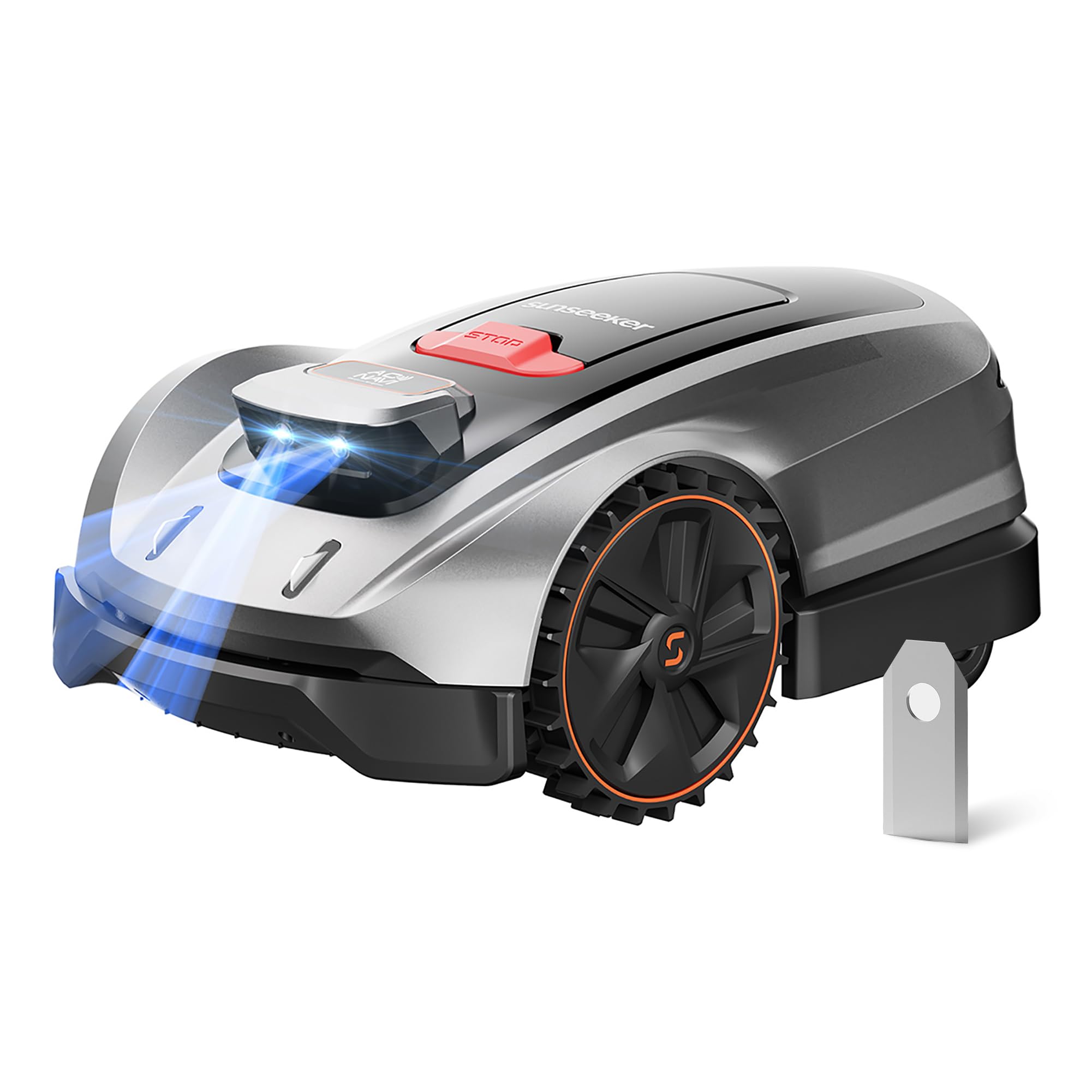
The Sunseeker X3 Plus targets small to medium suburban yards up to 0.3 acres with a two-pronged navigation approach: RTK for satellite positioning and VSLAM (visual simultaneous localization and mapping) for when GPS is weak. The 8-inch cutting width is paired with an offset blade design called Ride-on-Edge that allows the mower to cut closer along fences, walkways, and hardscape borders, reducing the need for manual trimmer work. It also uses both camera and ultrasonic sensing for obstacle detection.
Owner feedback is largely positive, with particular praise for the mower’s ability to handle slopes and tight passages where other units fail. The RTK stays locked consistently, even near fences, and the mower recovers well from tricky spots. Setup takes about two hours via the app and included YouTube guide, and the battery frequently covers the entire yard on a single charge. The app receives frequent updates, and dealer support is reported as responsive.
Where the X3 Plus struggles is with Network-level connectivity. Some users report that the mower’s app attempts to connect to servers in China/Hong Kong more than 100 times daily, leading to “plan path failed” errors if those connections are blocked by a firewall. GPS signal reliability can also vary depending on the time of day. For buyers who don’t have restrictive network setups and want good edge cutting performance on a modest property, this is a solid choice.
What works
- Ride-on-Edge cutting reduces follow-up trimming
- Consistent RTK lock on slopes and in tight passages
- Good self-recovery from tricky spots
What doesn’t
- App connectivity may conflict with restrictive network firewalls
- GPS signal reliability varies by time of day
- App setup not as intuitive as some competitors
6. eufy E15
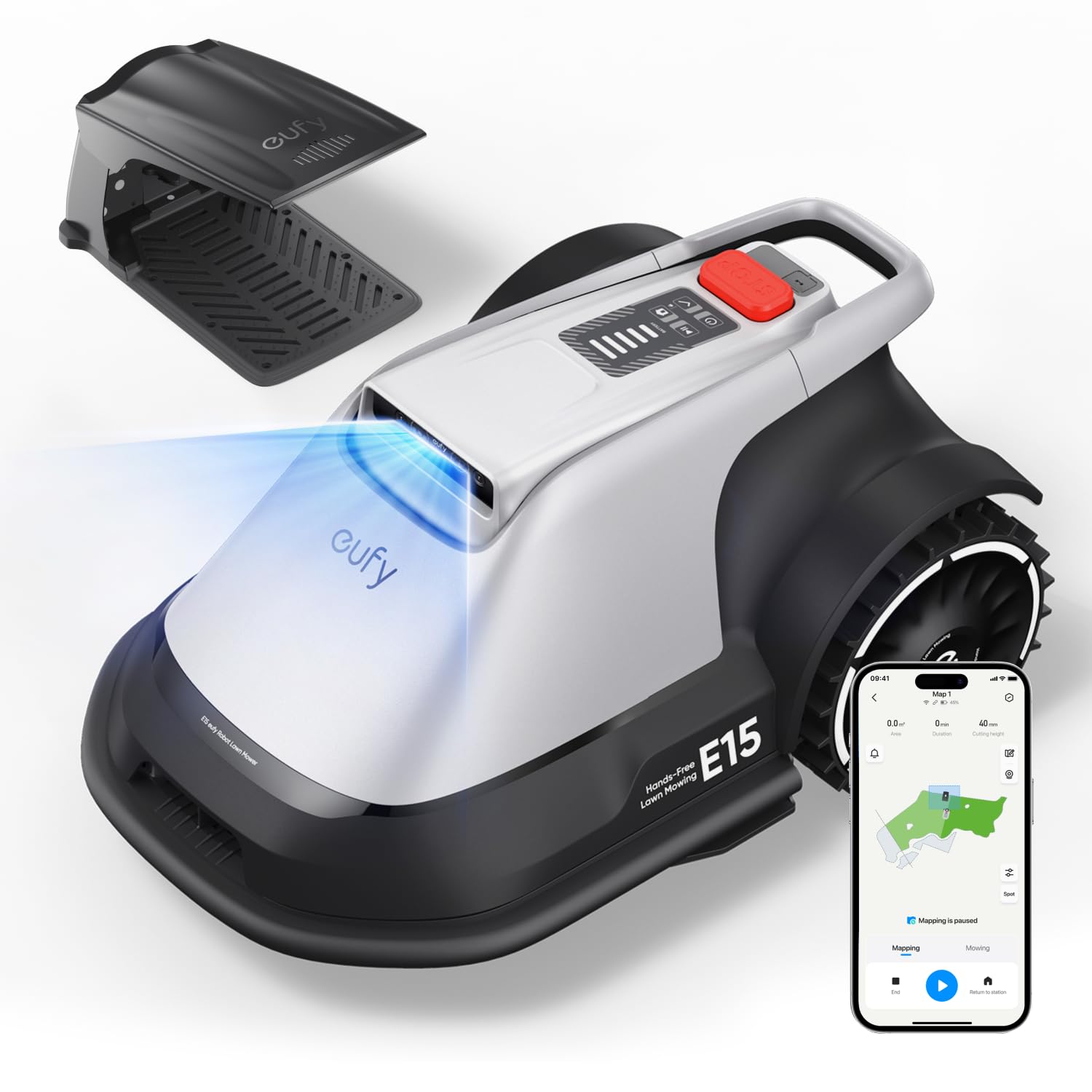
The eufy E15 is unique in this lineup because it uses pure vision navigation — no RTK, no GPS — relying entirely on high-precision stereo cameras and AI algorithms (V-FSD 1.0) to map and navigate your yard. This eliminates the need for any external antenna or base station setup beyond the charging dock. The dual-camera system creates a detailed map with 0.2m precision, and AI 3D obstacle detection identifies low obstacles like rocks and toys as well as tall objects like trees and garden beds. Cutting width is 8 inches, with height adjustable from 1 to 3 inches, and it supports slopes up to 18°.
Owners consistently praise the striped cut quality, which outperforms perimeter-wire systems from larger brands. The mower handles urban fenced yards beautifully, with effective rain detection and quiet operation that doesn’t scare pets. The GPS anti-theft tracking adds security, and the auto-recall feature during rain or low-light conditions protects the unit. For a small yard under 8,700 sq ft with good daylight exposure, the E15 delivers a near-perfect hands-free experience.
The E15’s pure vision approach has significant limitations. It cannot mow at night or in heavy shade, and mapping fails on sandy, patchy, or non-lush turf where the camera loses visual contrast. The single-map limit is a major restriction if you need separate zones for front and back yards. It’s also not suitable for St. Augustine or dense Zoysia grass. For homeowners with a well-maintained, open lawn who want a truly wire-free system with no external equipment, the E15 is a clean solution — but it’s not a universal fit.
What works
- No RTK antenna or base station needed for setup
- Excellent striped cut quality on well-maintained lawns
- Quiet enough for pets and close neighbors
What doesn’t
- Cannot mow at night or in heavy shade
- Limited to a single map; no multi-zone support
- Struggles with sandy or patchy turf that lacks visual contrast
7. ANTHBOT Genie 3000
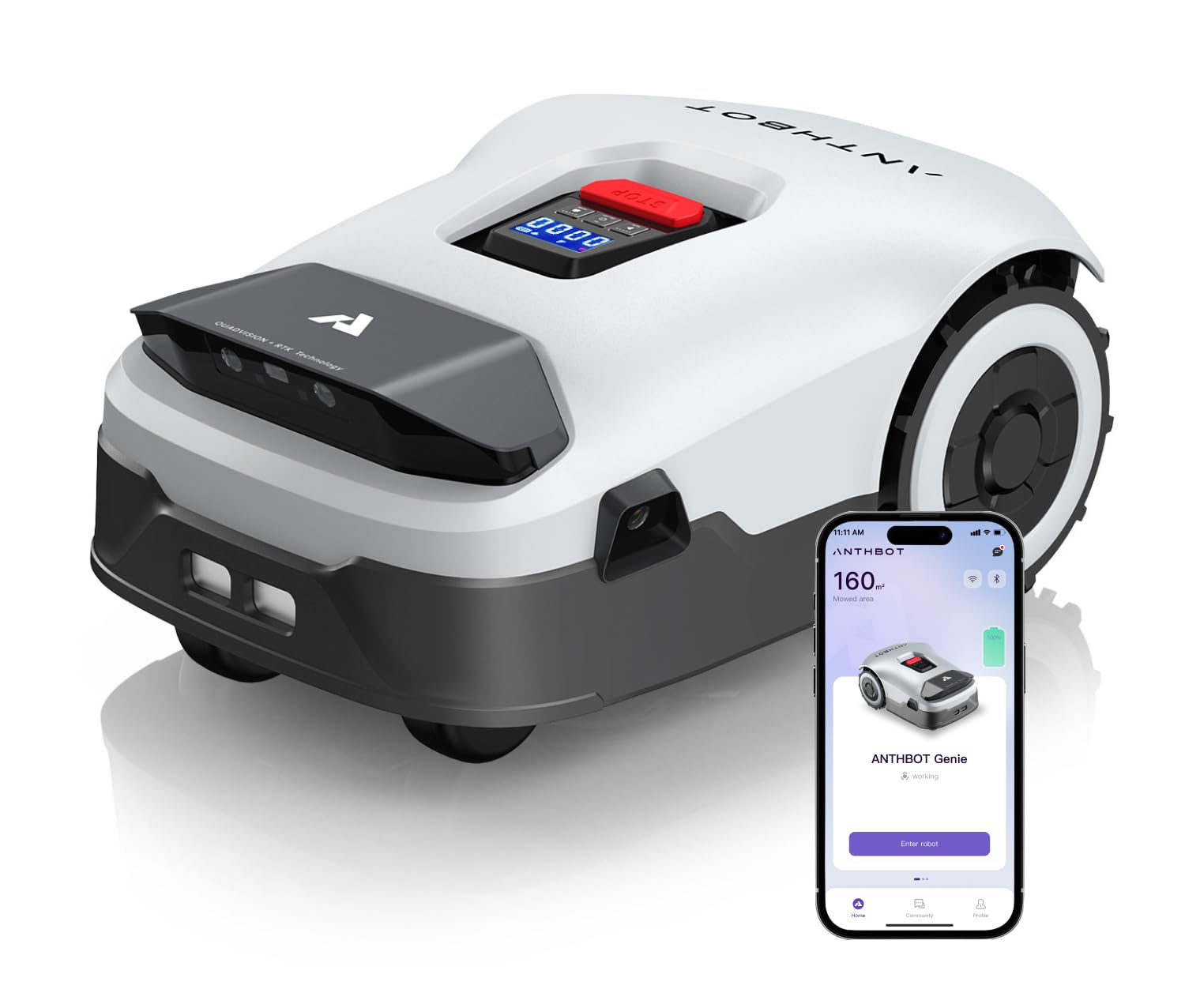
The ANTHBOT Genie 3000 steps up from the M5 with a four-camera system (300° field of view) combined with full-band RTK, designed for lawns up to 0.9 acres. The ACC (Adaptive Cruise Control) auto-mapping identifies boundaries and creates optimal cutting routes without manual intervention, and the four cameras provide a 300° field of view for obstacle detection covering over 1,000 object types. It supports up to 30 mowing zones and 30 no-go zones, making it one of the most flexible multi-zone systems on the market.
Owner feedback emphasizes excellent performance on complex, obstacle-filled lawns, with the Genie 3000 handling uneven terrain and thick grass through dual-pass mowing. The app is intuitive, and firmware updates have been frequent, addressing early issues. The RTK placement is straightforward, and the unit’s long battery life allows extended coverage. Many owners who have used previous robotic mowers note the Genie 3000 is a significant improvement in navigation and cut quality.
Reliability over time is a concern, with a few owners reporting random charging failures, frequent suspension errors, and battery degradation after 12 months. The subscription fee for 4G connectivity is an extra ongoing cost that isn’t transparent upfront. The mower’s handling of steep slopes is below average — it can struggle on gradients that the M5 handles, which is odd given the price jump. For complex, large, and relatively flat properties with many distinct zones, the Genie 3000 is a powerful tool, but it requires patience with occasional firmware quirks.
What works
- 300° field-of-view cameras for excellent obstacle detection
- Supports up to 30 mowing zones and 30 no-go zones
- Long battery life with frequent firmware improvements
What doesn’t
- Some owners report battery degradation and charging errors after 1 year
- Subscription fee required for 4G connectivity
- Slope handling worse than lower-priced ANTHBOT M5
8. ECOVACS Goat A2000 LiDAR PRO
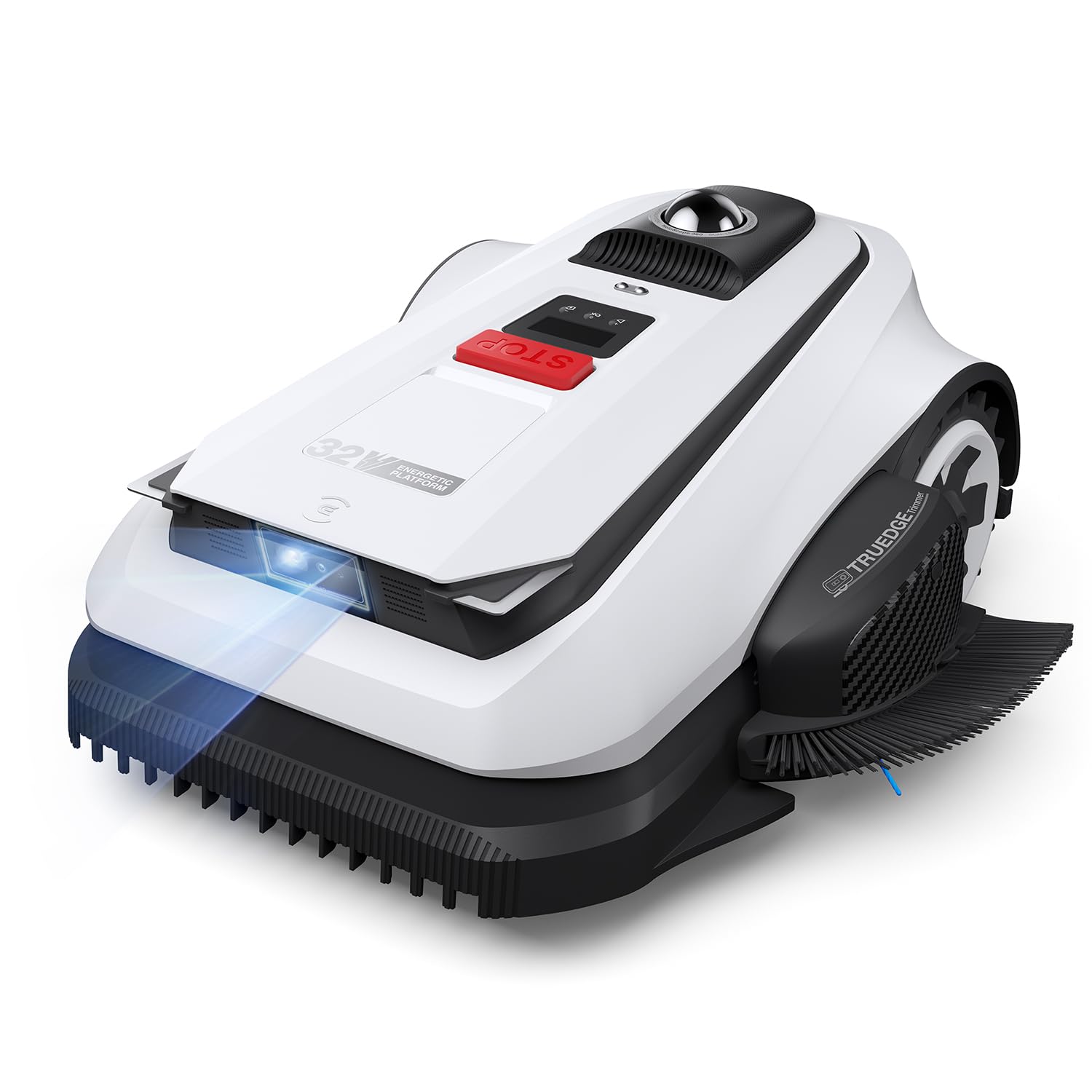
The ECOVACS Goat A2000 LiDAR PRO is one of the few wire-free mowers that doesn’t need RTK or satellite positioning — its HoloScope 360° Dual-LiDAR system creates a map and maintains 2 cm accuracy autonomously, even under trees, near fences, and in full shade. This makes it uniquely suitable for heavily treed lots where GPS-based mowers lose signal. The 32V high-power platform and dual-blade disc system provide strong cutting torque for thick American grass types (Bermuda, Zoysia, Fescue, St. Augustine). It includes a built-in TruEdge trimmer that acts like a string trimmer along borders, significantly reducing manual follow-up.
Owners consistently praise the 30-minute setup time and the immediate, accurate mapping. The mower handles 3,000+ sq ft yards with multiple zones easily, and the AIVI 3D obstacle avoidance detects over 200 object types to avoid collisions. The 1.2 to 3.6-inch cutting height range covers most grass needs, and the app allows detailed schedule, zone, and direction customization. The anti-theft alarm and password lock add security for a unit that lives outdoors.
The main drawback is that the real-world coverage is closer to 3,000–4,000 sq ft per charge than the advertised half-acre, requiring multiple charge cycles. Some owners report persistent “ERROR STUCK” messages on uneven ground, with the wheels digging ruts before the mower stops. The 50-minute runtime and 113W fast charging are decent, but larger yards will need patience. The integrated edge trimmer line has a limited lifespan (about 3 km per roll). For homeowners with shaded, complex yards where GPS won’t work but budget allows a premium solution, this is the best option in this list.
What works
- Dual-LiDAR works in full shade and under dense tree canopy without GPS
- Built-in edge trimmer reduces manual string trimming
- Strong 32V motor handles thick Bermuda and Zoysia grass
What doesn’t
- Real-world battery coverage is less than rated half-acre
- Can get stuck on uneven ground and dig ruts
- Edge trimmer line needs periodic replacement
9. ECOVACS Goat A3000 LiDAR PRO
The Goat A3000 LiDAR PRO is essentially the A2000’s big sibling: the same Dual-LiDAR navigation and built-in TruEdge trimmer, but with a massive 7500 mAh battery and 189W fast charging that fully recharges in about 70 minutes. It’s rated for up to ¾ acre, making it a strong contender for larger properties where the A2000 would need multiple charge cycles. The 32V dual-blade system and 1.2–3.6-inch height adjustment remain, and the app supports detailed multi-zone customization.
Owner feedback is overwhelmingly positive regarding time savings — users with nearly 1-acre properties report the mower handles the entire yard over two days, splitting front and back zones automatically. The LiDAR navigation is consistently reliable under trees and along fences, with no GPS dropouts. The walk-around mapping setup takes about 30 minutes, and once configured, the mower requires almost no attention. Owners describe it as a beautiful, well-crafted machine that saves 1+ hours of manual mowing per week.
The A3000 has similar limitations to the A2000: it mows about 98% of the lawn, leaving small areas that need touch-up trimming, and the stripes are less perfect than manual mowing. Some owners report that the first unit had mapping failures that required a two-week replacement wait. For buyers with a ¾-acre property who want a wire-free, LiDAR-based mower that can cover the whole yard without running out of battery, the A3000 is the most capable option from ECOVACS, but it demands a significant investment.
What works
- Large 7500 mAh battery with fast 189W charging
- Consistent LiDAR navigation under trees and in shade
- Easy walk-around mapping setup in about 30 minutes
What doesn’t
- Requires occasional touch-up trimming on 2% of lawn
- High price point requires careful consideration
- Some units require replacement for initial mapping failures
10. Segway Navimow X430
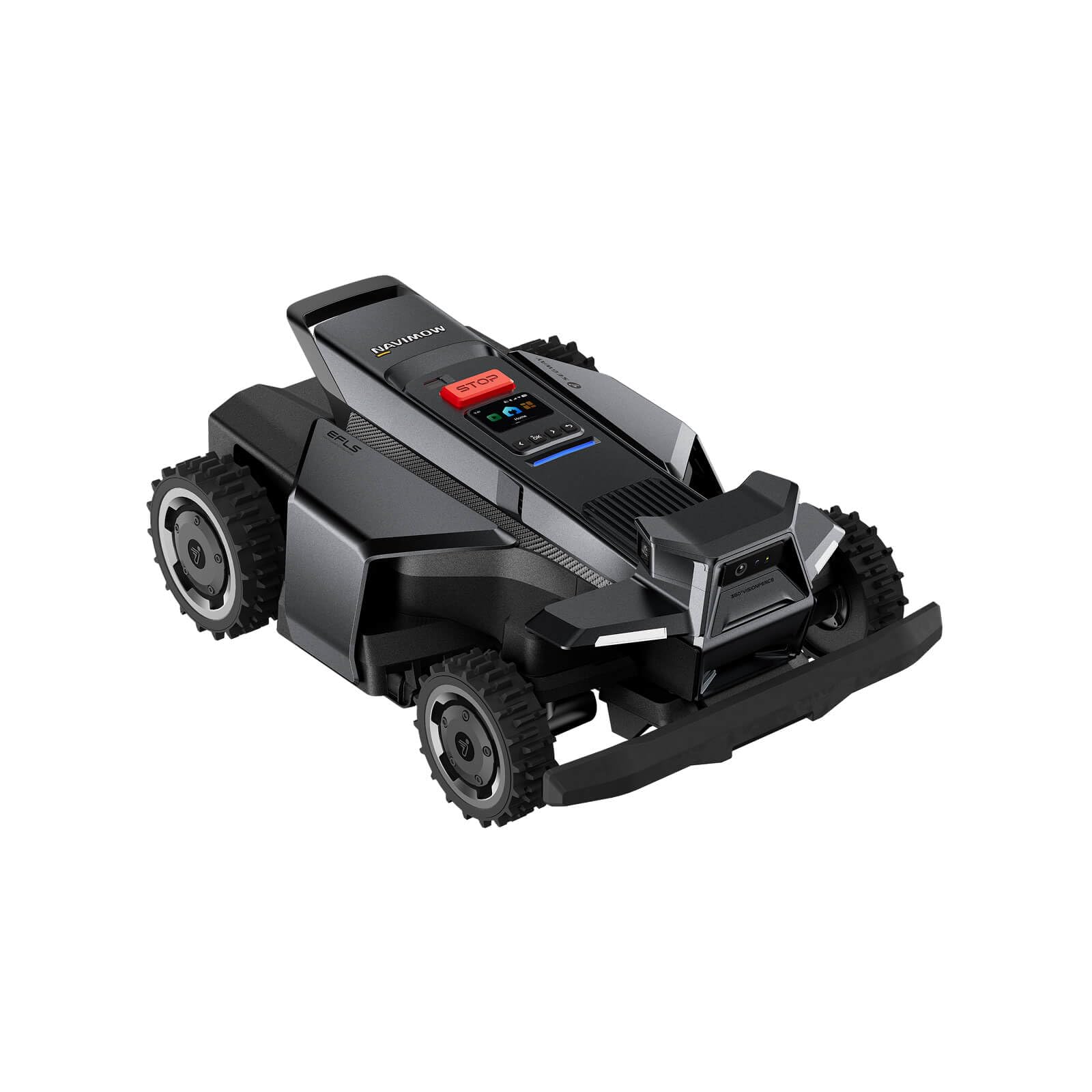
The Segway Navimow X430 is a heavy-duty, all-wheel-drive mower designed for the most demanding properties. Its ORV-tuned dual suspension and four independent wheels climb slopes up to 84% (40°) and cross obstacles up to 2.8 inches high, while the Xero-Turn AWD steering prevents turf scuffing by turning without dragging the wheels. The dual 180W motors drive a 17-inch cutting deck with 12 blades, and the EdgeSense system reduces trimming margins to under 2 inches. It covers up to 1 acre and uses EFLS tri-frequency Network RTK combined with 360° Vision and VIO for centimeter-level accuracy even under trees.
Owners who have previously used other robotic mowers report that the X430 goes where others can’t — steep slopes, bumpy terrain, and narrow passages are handled without drama. The auto-mapping via the app is fast, and the GeoSketch map editing tool lets you refine boundaries, no-go zones, and pathways easily. The cut quality is excellent, with visible straight lines and clean edges. The unit is large (63.7 pounds) and heavy, which contributes to its stability on slopes.
The X430 isn’t without issues. Some owners received units with defective charging components that required replacement parts. The camera system can become confused near low-hanging branches, and the unit is large enough to be a visual presence in the yard. Customer support communication has been described as slow by some. For homeowners with steep, complex terrain who have been frustrated by 2-wheel drive mowers, the X430’s AWD and zero-turn steering are transformative — but the premium price means expectations for reliability are very high.
What works
- All-wheel drive climbs 84% slopes without scuffing turf
- Dual 180W motors with 17-inch cutting deck cover large areas quickly
- EdgeSense system reduces trimming margins to under 2 inches
What doesn’t
- Large and heavy (63.7 pounds) makes handling difficult
- Camera confusion near low-hanging branches reported
- Some units have defective charging components out of the box
11. Mammotion LUBA 3 AWD 5000H
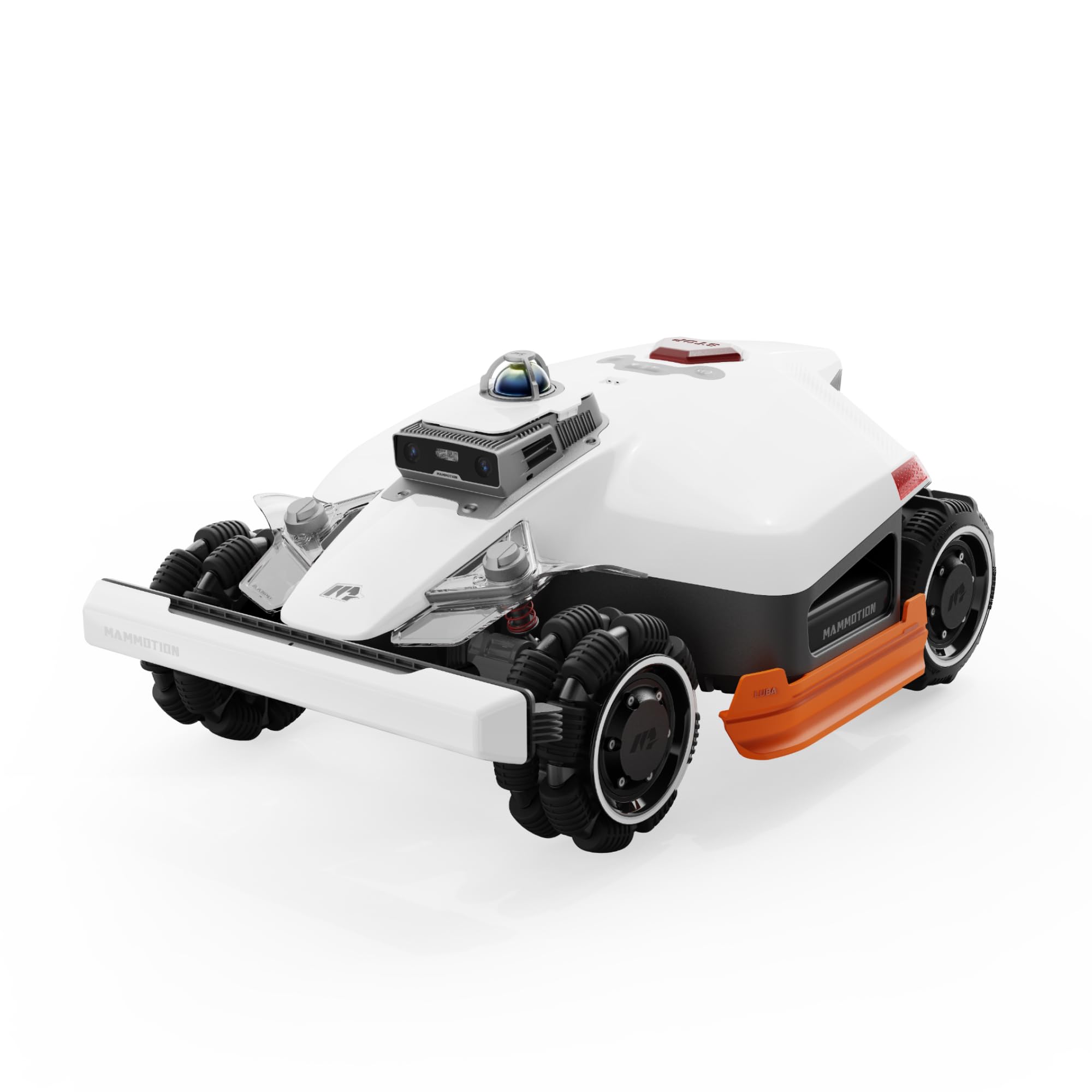
The Mammotion LUBA 3 AWD 5000H is the most feature-packed mower in this lineup, combining 360° LiDAR, NetRTK, and dual-camera AI Vision in a tri-fusion navigation system that handles any condition — shade, darkness, dense tree cover, and open sky. The 360° LiDAR with a 230 ft range and 59° vertical field of view creates a dense point cloud of the entire property. Four independent motors deliver all-wheel drive for slopes up to 80% (38.6°), and the adaptive suspension steps over curbs, roots, and thresholds up to 50 mm. Two 165W motors drive six blades for a 15.75-inch cutting width, with battery life up to 215 minutes covering 1.25 acres.
Owner feedback is exceptional: users report flawless mowing with perfectly straight lines, excellent cut quality on tall fescue, and reliable navigation that never gets stuck. The AWD handles bumpy terrain effortlessly, and the omni wheel allows precise zero-turn maneuvering without damaging grass. The app supports up to 50 mowing zones, multiple path patterns (perimeter-only, zigzag, checkerboard, adaptive zigzag), and real-time AI adjustment of motor speed based on grass density. Many owners note that it has completely replaced their push mower or lawn service.
The LUBA 3’s drawbacks are few but significant: the real-world battery coverage is about 60% of the theoretical maximum, meaning the 1.25-acre rating is optimistic for most users. The battery is not user-replaceable, which is a concern for long-term ownership. The price is the highest on this list, and the unit’s size means it needs a clear path to its charging station. For large, complex estates up to 1.25 acres where no-compromise automation is the goal, the LUBA 3 AWD 5000H sets the current benchmark for robotic lawn mowing.
What works
- Tri-fusion navigation (LiDAR+RTK+AI) works in all conditions and darkness
- Powerful 165W motors with AI-adjusted speed for thick grass
- Excellent AWD with adaptive suspension for bumpy terrain and 80% slopes
What doesn’t
- Real-world battery coverage is about 60% of rated capacity
- Battery is not user-replaceable, raising long-term durability concerns
- Highest price point requires serious commitment
Hardware & Specs Guide
Cutting Width and Deck Design
Cutting width determines how fast your mower covers the lawn. Entry and mid-range models typically use a 7–8-inch disc with 3–5 free-rotating blades. Premium units like the Segway X430 use a 17-inch deck with 12 blades for significantly faster coverage. Larger decks require wider turning paths and better obstacle clearance, so match the width to your yard’s obstacle density. Wider decks also mean the mower is physically larger and heavier, which affects slope stability and manual handling.
Battery Chemistry and Charging Speed
Lithium-ion batteries are standard across all price tiers, but capacity varies from 3.0 Ah to 15 Ah. The critical spec is charging wattage — a 50-minute runtime with 113W fast charging (ECOVACS A2000) is very different from a 45-minute runtime with 50W charging (budget models). Higher charging power means the mower returns to work faster, which is essential for large yards needing multiple cycles per session. Confirm whether the battery is user-replaceable before buying a premium model, as internal batteries may degrade in 2–3 seasons.
Navigation Sensor Redundancy
The most reliable mowers use redundant navigation: RTK + vision, LiDAR + inertial sensors, or all three. Redundancy matters because every sensor has a failure mode — RTK fails under dense tree cover, vision fails in darkness, LiDAR can miss low obstacles. The Mammotion LUBA 3 and Segway X430 use sensor fusion that switches seamlessly between systems. Budget wire-free mowers usually rely on RTK + a single camera, which works well in open yards but fails in the same conditions as the camera’s weakness.
IP Rating and Weather Resistance
Most robotic mowers are designed to live outdoors, but IP ratings vary. Look for IPX5 or higher for rain resistance, and check whether the charging base is weatherproof. Some mowers include rain sensors that automatically return the unit to the base before a storm — useful for protecting electronics. Snow and ice can cause traction problems even with AWD models, so regardless of rating, a garage or covered storage extends the mower’s lifespan significantly.
FAQ
Will a wire-free robotic mower work under large shade trees?
How much follow-up manual edging is still needed with a robotic mower?
How long does a robotic mower battery typically last before replacement is needed?
Can a robotic mower handle thick Bermuda or Zoysia grass?
What happens to the mower when it rains?
Final Thoughts: The Verdict
For most gardeners, the robotic lawn mower winner is the WORX Landroid Vision Cloud WR320 because it combines commercial-grade RTK Cloud navigation with AI obstacle avoidance and fast charging at a price that doesn’t break the bank for a half-acre property. If you need reliable navigation under heavy tree cover without any satellite dependency, grab the ECOVACS Goat A2000 LiDAR PRO — its Dual-LiDAR system works flawlessly in shade where GPS mowers fail. And for the most demanding terrain with steep slopes, uneven ground, and 1+ acre coverage, nothing beats the Mammotion LUBA 3 AWD 5000H, which sets the performance standard with its tri-fusion navigation and all-wheel drive.