
Balanced nutrition is the difference between a grapevine that merely survives and one that loads the trellis with plump, sweet clusters. A precise 10-10-10 NPK ratio delivers equal parts nitrogen, phosphorus, and potassium—the trio that fuels leafy canopy development, robust root anchoring, and fruit sugar accumulation without pushing vines into excessive vegetative growth that blocks airflow and invites disease.
I’m Rikta — the co-founder and writer behind Lawn Gear Lab. I’ve spent many hours comparing label guarantees, studying micronutrient inclusion, analyzing soil test reports, and sifting through verified owner feedback to identify the most effective granular and liquid 10-10-10 formulations for grape cultivation.
Whether you manage a backyard arbor or a small vineyard row, the 10-10-10 fertilizer for grapes you choose must balance quick nutrient availability with sustained release to match the vine’s seasonal growth phases without scorching delicate feeder roots near the soil surface.
How To Choose The Best 10-10-10 Fertilizer For Grapes
Grapevines have specific nutrient timing that differs from annual vegetables. Selecting the right 10-10-10 product means matching the physical form (granular vs. liquid), the release speed, and the presence of secondary micronutrients to your vine’s age, soil texture, and the growth stage you want to support.
Release Speed: Slow-Release Granules vs. Fast-Acting Liquids
Granular 10-10-10 formulations release nutrients gradually as soil microbes break down the prills, providing a steady supply over several weeks. This reduces the risk of nitrogen burn and aligns well with the moderate feeding needs of mature grapevines. Liquid 10-10-10 concentrates, on the other hand, deliver an immediate nutrient pulse, which can be useful for correcting early-season deficiencies or giving container-grown vines a quick boost, but they require more frequent reapplication.
Secondary Nutrients and Micronutrients
A straight 10-10-10 bag covers the primary macronutrients, but grapevines also demand calcium for cell wall strength, magnesium for chlorophyll production, and iron to prevent interveinal chlorosis on younger leaves. Products that incorporate these secondary elements into the same prill or liquid concentrate reduce the need for separate supplements and help prevent common vine disorders like blossom-end rot and poor fruit set.
Application Method and Coverage Area
For a few backyard vines, a small bag (6–10 pounds) or a liquid concentrate bottle is practical and easy to store. If you’re managing a larger planting or multiple fruit trees alongside your grapes, a 33- to 35-pound bag offers better per-pound value and covers more ground with fewer trips to refill. Always check the label’s recommended application rate per vine or per 100 square feet—over-applying nitrogen encourages leaf growth at the expense of fruit quality.
Quick Comparison
On smaller screens, swipe sideways to see the full table.
| Model | Category | Best For | Key Spec | Amazon |
|---|---|---|---|---|
| Espoma Garden Food | Granular | Premium all-purpose vine feeding | 13.5 lbs (2-pack), agricultural-grade blend | Amazon |
| GreenView Multi-Purpose | Granular | Large garden & orchard coverage | 33 lbs, covers 10,000 sq. ft. | Amazon |
| Gardenera 10-10-10 Slow Release | Granular | Controlled feeding with less frequency | 3 quarts, slow-release prills | Amazon |
| Covington Liquid 10-10-10 | Liquid | Fast green-up for vines in stress | 32 oz, 1:200 mixing ratio | Amazon |
| TPS Nutrients 10-10-10 | Liquid | Vegetable beds & young grape starts | 32 oz, includes iron & micronutrients | Amazon |
| Growth Technology GT Fruit Focus | Liquid | Container & hydroponic grape feeding | 8.45 oz, includes calcium | Amazon |
| Howard Johnsons 7136 | Granular | Budget-friendly bulk for large plots | 35 lbs, no pre-emergent additives | Amazon |
In‑Depth Reviews
1. Espoma Garden Food 10-10-10 (6.75 lb Bag, Pack of Two)
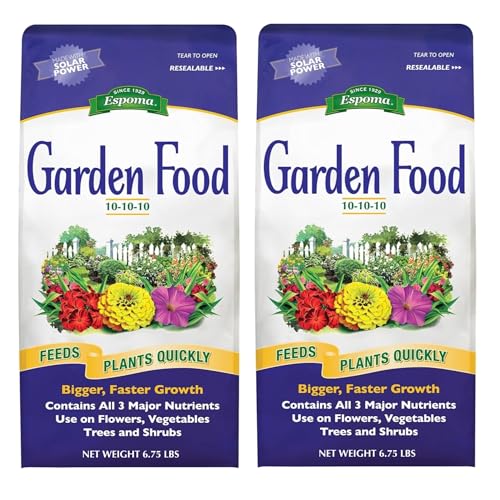
Espoma’s 10-10-10 Garden Food is built around agricultural-grade ingredients that feed grapevines quickly without the harsh salt index found in many synthetic blends. The 13.5-pound total weight (two 6.75-pound bags) is enough for a dozen mature vines or a mixed bed of fruit trees and shrubs, and the granular form allows precise side-dressing along the drip line where feeder roots are most active.
Verified owners report dramatic recovery on stressed fruit trees: one reviewer’s lightning-damaged magnolia rebounded with fragrant blooms, while a 46-year-old fig tree produced approximately 5,000 fruits in a single season after switching to Espoma. The low-salt formulation is particularly important for grapevines grown in sandy or low-organic-matter soils where salt accumulation can inhibit water uptake.
Because this is a conventional 10-10-10 (not organic), it delivers nutrients in a form vines can access immediately after watering—making it ideal for early spring applications when soil temperatures rise above 50°F and root activity accelerates. Apply monthly through the growing season for sustained cluster development.
What works
- Agricultural-grade ingredients provide fast, clean nutrient availability for vines.
- Dual-bag format lets you store one bag while using the other, keeping granules fresh.
- Low salt index reduces risk of root burn in sandy or low-organic soils.
What doesn’t
- No added micronutrients like iron or calcium—requires separate supplementation for chlorosis-prone sites.
- Individual bag size (6.75 lbs) is small for large vineyard rows; you may need multiple packs.
2. GreenView Multi-Purpose Fertilizer 10-10-10 (33 lb Bag)

GreenView’s 33-pound bag delivers a massive 10,000-square-foot coverage capacity, making it the most economical choice for grape growers managing multiple vines spread across a large garden or small vineyard. The balanced 10-10-10 ratio supports the entire vineyard—from the young canes that need phosphorus for root anchoring to the fruiting spurs that rely on potassium for sugar transport.
Customer feedback highlights the well-formed granules that resist clumping even when stored in humid conditions, a practical advantage for anyone who buys in bulk. Several users reported that their plants greened up noticeably within a week of application, which aligns with the product’s fast-acting urea-based nitrogen source. For grapes, this means you can correct early-season nitrogen deficiency quickly without waiting for microbial breakdown.
The primary trade-off is that GreenView is a general-purpose formulation without slow-release coating. On sandy soils with high rainfall, the nitrogen can leach below the root zone before vines can fully use it. Plan to split the total annual application into two or three smaller feedings—early spring, post-bloom, and just before veraison—to keep nutrient levels steady.
What works
- 33-pound bag covers up to 10,000 square feet—excellent value for large plantings.
- Uniform granules stay free-flowing, easy to broadcast with a hand or drop spreader.
- Fast-acting nitrogen gives a visible green-up response within days of application.
What doesn’t
- No slow-release coating; nitrogen can leach quickly in sandy or heavy-rain regions.
- Lacks secondary micronutrients—you may need to supplement calcium or magnesium for optimal fruit set.
3. Gardenera 10-10-10 Slow Release Granules (3 Quarts)
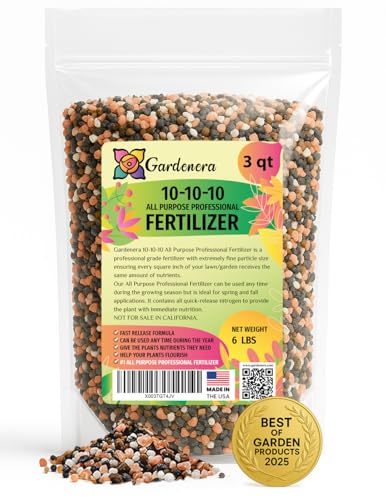
Gardenera’s slow-release 10-10-10 granules are engineered to meter out nutrients over an extended period, reducing the application frequency to just twice during the growing season for most vines. This controlled delivery is particularly valuable for grapevines because it prevents the sudden nitrogen surge that can trigger excessive leaf growth and delay fruit ripening while still providing steady phosphorus for root expansion.
Owner reviews consistently mention how easy the product is to use—simply scatter a few pellets around the base of each vine and water in. One verified buyer even declared it their “forever fertilizer” after seeing exceptional flower and fruit development with minimal effort. The 3-quart bag size is convenient for a home gardener with 4–6 mature vines or a mix of fruit trees and berry bushes.
Storage and packaging are the weak points here. Several reviewers noted that the bag arrived open in transit due to insufficient internal sealing, causing dust to leak into the shipping box. Once you transfer the granules to a sealed container, the product itself performs reliably, but the initial handling experience could be improved.
What works
- Slow-release coating feeds vines for weeks with only two seasonal applications needed.
- Small pellet size distributes easily around individual vine root zones without clumping.
- Balanced 10-10-10 ratio supports steady leaf, root, and fruit development simultaneously.
What doesn’t
- Bag packaging is not reliably sealed; granules may spill during shipping.
- 3-quart volume is relatively small—not ideal for covering a large vineyard.
4. Covington Naturals 10-10-10 Liquid Fertilizer (32 oz)

Covington’s liquid 10-10-10 concentrate offers a low-salt-index formula made with food-grade ingredients that grapevines can absorb immediately through both roots and foliage. The 32-ounce bottle mixes at a 1:200 ratio, producing roughly 50 gallons of finished solution—enough to feed a row of mature vines multiple times or treat a dozen container-grown grape plants weekly.
Verified buyers have reported visible improvements in stressed plants within 10 days. One reviewer shared that a dogwood tree with sparse leaf coverage produced new green leaves and small berries just one month after applications began. For grapevines, this fast response is useful when correcting early-season chlorosis or giving a weak vine a quick nitrogen lift before bloom. The liquid format also works well with hose-end sprayers for uniform coverage.
Because liquid feeds provide a short-term nutrient pulse, you’ll need to apply this product every 2–3 weeks during the active growing season to maintain consistent nutrition. It’s best used as a supplement to a granular slow-release base or as the primary feed for container vines where frequent watering flushes nutrients out of the pot.
What works
- Low salt index and food-grade ingredients minimize root burn risk on sensitive vines.
- Concentrated 1:200 ratio stretches the 32 oz bottle into ~50 gallons of feed solution.
- Visible plant response within 10–14 days—great for correcting nutrient gaps quickly.
What doesn’t
- Requires repeat applications every 2–3 weeks during the growing season.
- Bottle lacks a built-in measuring compartment; you need a separate dropper or syringe.
5. TPS Nutrients 10-10-10 Liquid Plant Food with Iron (32 oz)
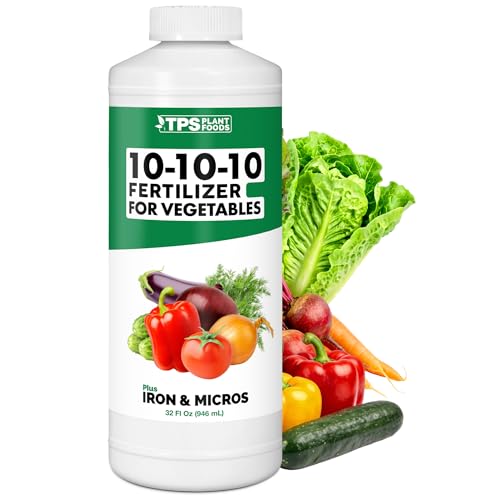
TPS Nutrients adds iron and a suite of micronutrients to their balanced 10-10-10 liquid formula, addressing two common grapevine issues in one bottle: general macronutrient shortage and iron chlorosis, which shows as yellowing between the veins on newer leaves. The 32-ounce container mixes at either a 1:128 or 2:128 ratio, giving you flexibility to apply a maintenance dose or a stronger correction rate depending on vine condition.
Customer reports highlight the product’s ability to revive struggling basil and other plants, but for grapes the iron content is the standout feature. Vines grown in alkaline or compacted clay soils often struggle to uptake iron even when it’s present, and the chelated form in this liquid makes it biologically available immediately after soil drenching. You can also use it as a foliar spray—just dilute to the weaker ratio to avoid leaf burn.
The main concern across reviews is packaging: multiple buyers received bottles that leaked during shipping due to insufficient seal integrity. While the formula itself earns high marks, the packaging inconsistency means you should inspect the bottle upon arrival and transfer the concentrate to a leak-proof container if necessary.
What works
- Includes chelated iron to prevent and correct leaf chlorosis on alkaline or clay soils.
- Flexible mixing ratios allow both maintenance feeding and corrective-strength applications.
- Micronutrient suite supports balanced vine health beyond just NPK.
What doesn’t
- Bottle seal can fail during shipping—leaks reported by multiple customers.
- Liquid format requires frequent reapplication compared to slow-release granular products.
6. Growth Technology GT Fruit Focus Liquid (8.45 oz)
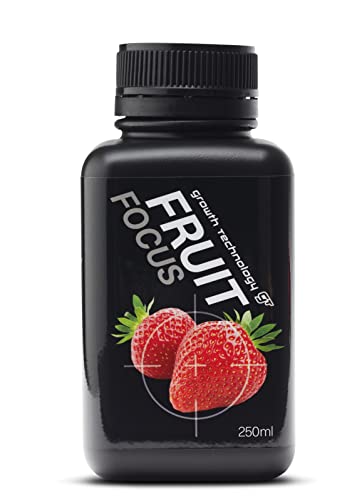
Growth Technology’s GT Fruit Focus is unique among the liquid options because it supplies calcium alongside the primary NPK trio—a critical secondary nutrient for grapevines that directly impacts berry cell wall integrity and reduces the risk of blossom-end rot. The 8.45-ounce bottle is small, but the concentrated dosing (5–7 ml per liter for hydroponics, 3–5 ml per liter for soil) means a single bottle lasts through an entire season for a handful of container vines.
Hydroponic and semi-hydro grape growers will appreciate the precision of this formula: all 12 essential minerals are present in an easy-to-absorb liquid that won’t clog drip lines or leave salt deposits. Soil-based growers can still benefit by using it as a weekly foliar feed during fruit set, ensuring the calcium reaches developing clusters when soil uptake may be inconsistent due to dry periods.
The main drawback is the bottle design—several users reported that the original cap does not create a perfect seal, allowing concentrate to leak during transport. A quick transfer to a glass dropper bottle resolves the issue. Also, this is a premium-priced product per ounce, but the extreme concentration keeps the per-feeding cost very low.
What works
- Includes calcium essential for preventing blossom-end rot and improving berry firmness.
- Highly concentrated formula—a single bottle can last an entire season for 4–6 vines.
- Excellent for hydroponic or semi-hydro setups where dissolved nutrients must stay residue-free.
What doesn’t
- Original bottle cap seals poorly—leakage during shipping is common.
- High up-front cost per ounce, though the per-feeding value is good due to high concentration.
7. Howard Johnsons 7136 All-Purpose 10-10-10 (35 lb Bag)

Howard Johnsons 7136 is a straight 10-10-10 granular fertilizer in a 35-pound bag with no added weed killers, pre-emergents, or non-nutrient fillers—just the three primary macronutrients. For grape growers, the absence of pre-emergent is a major advantage: many weed-and-feed lawn products contain chemicals that can persist in the soil and damage dormant vine buds or inhibit beneficial mycorrhizal fungi in the root zone.
Customers note that the bag covers large areas effectively and the price is right for budget-conscious gardeners managing extensive plantings. One reviewer specifically switched from a weed-and-feed product to this 10-10-10 after learning that pre-emergents suppressed their bluebonnets for three years—the same chemicals can stunt the cover crops and pollinator companions that many vineyard managers plant between rows.
The formulation is basic, so you’ll need to monitor your vines for any secondary nutrient deficiencies and supplement accordingly. On the plus side, the large bag provides enough fertilizer for two full seasons on a 10-vine plot, making it a solid value anchor for this list if your primary concern is cost efficiency and you already have a soil management plan for micronutrients.
What works
- No pre-emergent herbicides—safe for use around vine root zones and pollinator plantings.
- 35-pound bag provides multi-season supply for most home grape plantings.
- Pure 10-10-10 granular formulation with no unnecessary additives or coatings.
What doesn’t
- No slow-release mechanism—nutrients can leach quickly from sandy soils.
- Lacks secondary micronutrients like calcium, magnesium, or iron—may require separate supplements.
Hardware & Specs Guide
NPK Ratio in Grapevine Nutrition
The 10-10-10 ratio delivers 10% nitrogen, 10% phosphorus (as P₂O₅), and 10% potassium (as K₂O) by weight. For grapevines, timing is everything: apply nitrogen early in spring for canopy development, then rely on the potassium component during fruit ripening to improve berry sugar content and skin thickness.
Granular vs. Liquid Delivery
Granular 10-10-10 (prilled or pelletized) is best applied by broadcasting under the vine canopy or banding along the drip line, then watering in. Liquid concentrates must be diluted per label instructions and applied as a soil drench or foliar spray. Granular options require less frequent application but need soil moisture to activate; liquid options are faster-acting but demand repeat applications every 2–3 weeks.
Secondary Nutrient Monitoring
Straight 10-10-10 formulas cover NPK only. Grapevines are heavy users of calcium (for cell walls) and magnesium (for chlorophyll). If your soil test shows these are low, choose a liquid feed like GT Fruit Focus that includes calcium, or supplement with a side-dress of gypsum and Epsom salts to prevent deficiency symptoms before they affect fruit quality.
Soil pH and Nutrient Availability
Grapes thrive best at a soil pH between 5.5 and 6.5. Outside this range, phosphorus and iron become less available even when present in the fertilizer. Always test your soil pH before selecting a 10-10-10 product—if the pH is above 7.0, you may need a formulation with chelated micronutrients to overcome alkaline lockup.
FAQ
How often should I apply 10-10-10 fertilizer to established grapevines?
Can I use a lawn 10-10-10 fertilizer on my grapevines?
Does 10-10-10 fertilizer help grapevines produce sweeter fruit?
Final Thoughts: The Verdict
For most gardeners, the 10-10-10 fertilizer for grapes winner is the Espoma Garden Food because it combines agricultural-grade purity with a low salt index that protects sensitive vine roots while delivering fast-available nutrition. If you want large-coverage value for a multi-vine planting, grab the GreenView Multi-Purpose. And for a low-fuss slow-release solution that cuts your application schedule in half, nothing beats the Gardenera Slow Release.