
For a rose bush, the difference between a handful of scraggly flowers and a cascade of velvety, fragrant blooms often comes down to one thing: what you put in the soil around its roots. Rose compost is not a garden afterthought; it is the primary nutrient delivery system that determines stem thickness, bud count, and disease resistance across an entire growing season.
I’m Rikta — the co-founder and writer behind Lawn Gear Lab. I’ve spent hundreds of hours cross-referencing chemical analysis of NPK ratios, Bio-tone enhancements, release kinetics, and organic certifications, then stacking those specs against verified owner outcomes to find which products consistently deliver measurable results rather than just promising them.
The best rose compost feeds the microbial life in the soil while supplying the precise macro and micronutrients roses demand. After comparing seven top formulations, one clear winner emerged that gives you the most bloom mass per pound of applied material. This is best rose compost broken down by science, not label hype.
How To Choose The Best Rose Compost
Not all rose composts work the same way. A formula built for container-grown miniature roses will underperform on a mature climber planted in native clay. The key is matching the compost’s nutrient profile, release speed, and organic content to your specific rose type and soil condition.
NPK Ratio and the Middle Number
Roses are heavy feeders, but they crave phosphorus more than most other flowering plants. The middle number in the NPK analysis (the phosphorus content) directly influences bud set and bloom size. Look for a ratio where phosphorus is at least equal to nitrogen — something in the range of 4-6-4 or higher on the second digit. A low-phosphorus lawn fertilizer applied to roses will push foliage at the expense of flowers.
Release Mechanism and Feeding Frequency
Time-release coatings, like those used by Jackson & Perkins Dynamite, meter out nutrients over a full season from a single application — ideal for forgetful gardeners. Slow-release organic granules break down through microbial activity and require reapplication every 4-8 weeks. Liquid formulas deliver an immediate boost but demand weekly or biweekly mixing. Your schedule dictates which system fits.
Organic Matter vs. Synthetic Concentrate
Mushroom compost and forest-product blends (like Espoma’s) improve soil texture, water retention, and beneficial fungi populations. Synthetic concentrates (like Scotts) feed the plant directly but add minimal structure. If your soil is heavy clay or sandy, an organic compost that conditions the soil profile will outperform a purely chemical feed over multiple seasons.
Quick Comparison
On smaller screens, swipe sideways to see the full table.
| Model | Category | Best For | Key Spec | Amazon |
|---|---|---|---|---|
| Jackson & Perkins Select Rose Fertilizer | Time-Release | One-and-done feeding | NPK 14-5-10, 80 tbsp per bag | Amazon |
| Espoma Organic Rose-Tone 4-3-2 | Organic Granular | Soil health plus blooms | NPK 4-3-2 + Bio-tone, 18 lb bag | Amazon |
| EB Stone Organic Rose and Flower Food | Organic Granules | Certified organic feeding | NPK 4-6-4, 4 lb bag | Amazon |
| Jobe’s Rose Fertilizer Spikes 10 Spikes 3 Pack | Spike | No-measure application | NPK 12-9-9, 30 total spikes | Amazon |
| Bloom City Rose & Flower Plant Food | Liquid | Fast-acting foliar/root feed | Dilution 1 oz per gallon | Amazon |
| Scotts Rose & Bloom Food 3LB (2 Pack) | Slow-Release Granular | Budget-friendly coverage | NPK 12-4-8, 6 lb total | Amazon |
| Espoma Organic Mushroom Compost Blend | Soil Conditioner | Amending poor soil texture | 0.75 cu ft, 25 lb bag | Amazon |
In‑Depth Reviews
1. Jackson & Perkins Select Rose Fertilizer

Jackson & Perkins Dynamite Select Rose Fertilizer uses a proprietary time-release coating that meters out a 14-5-10 NPK blend across the entire growing season from one single application. That is the highest nitrogen count in this roundup, which drives vigorous cane and leaf development while the phosphorus in the middle number supports heavy bud set. The broadcast rate is 4 tablespoons per square foot, so a 2-pound bottle (80 tablespoons) covers a 20-square-foot area — enough to feed 11 five-gallon rose plants or 15 three-gallon plants.
Owner reports consistently mention “enormous” blooms and “prize-winning” results, with multiple verified buyers calling it the best rose food they have ever used. The convenience factor is significant: one application in early spring and your roses are fed through frost. No measuring every two weeks, no mixing, no guesswork about timing. The liquid form is poured directly onto the soil around the drip line.
The main tradeoff is the nitrogen-heavy ratio. On established bushes that already push aggressive foliage, you may see more leaf mass than flower mass unless you supplement with a phosphorus booster during bud initiation. The price per square foot of coverage is higher than generic granular options, but the labor savings offsets that for most serious rosarians.
What works
- True season-long feeding from one application
- High analysis (14-5-10) delivers rapid visible results
- Excellent coverage per bottle for multiple plants
What doesn’t
- High nitrogen can over-favor foliage on already vigorous varieties
- Premium price per square foot compared to granular options
2. Espoma Organic Rose-Tone 4-3-2

Espoma Rose-Tone is an 18-pound bag of organic granular fertilizer with an analysis of 4-3-2, enhanced with Espoma’s proprietary Bio-tone formula — a cocktail of beneficial microbes and mycorrhizal fungi that colonize the root zone and improve nutrient uptake. This is not a synthetic quick-fix; it is a slow-release soil-building system. The 5% calcium content is a standout feature for roses, as calcium strengthens cell walls and reduces the risk of blossom-end rot and black spot susceptibility.
Verified owners consistently report that their roses “bloom and thrive” and that the product works on all flower types, not just roses. The bag is designed to be applied monthly through the growing season (May to September), scratched into the soil around the drip line, then watered in. One customer noted that the roses survived Hurricane Milton with this feeding regimen, which speaks to the root resilience the product builds. There is no mixing, no liquid measuring — just dry granules.
The 4-3-2 ratio is lower in overall nutrient concentration than synthetic competitors, so you need more product per square foot to match the immediate green-up of a high-nitrogen feed. This two-pack is a significant investment, and those with a single bush may find the volume excessive. But for a bed of 10 or more bushes, the per-application cost is competitive and the soil conditioning benefits compound year after year.
What works
- Bio-tone microbes improve long-term soil fertility
- Added calcium strengthens rose cell structure
- Organic formula is safe for pollinators and kids
What doesn’t
- Low NPK requires more volume per application
- Two-pack is lot of material for small gardens
3. Jobe’s Rose Fertilizer Spikes 10 Spikes 3 Pack
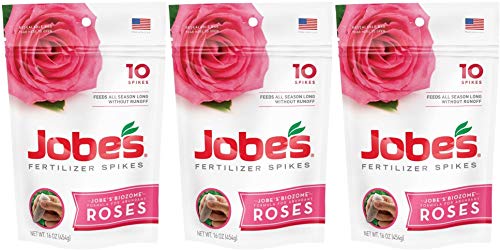
Jobe’s Rose Fertilizer Spikes deliver a 12-9-9 NPK analysis in a pre-measured spike format — just hammer them into the soil around the drip line and they dissolve slowly over weeks. Each three-pack contains 30 total spikes (10 spikes per box), providing enough material for roughly 15 bushes if you use two spikes per plant. The spike system eliminates dust, measuring, and mixing entirely. The 9 in the phosphorus position is high enough to promote prolific flowering.
Owner reports are emphatic. One verified buyer noted that after switching to these spikes, their roses produced “5-10 times more” flowers, with new shoots emerging from the base of 20 bushes after the second application. Another customer with sixteen rose bushes uses these spikes exclusively for twice-yearly feeding. The consistency of the spike dissolution means you do not get the nutrient surge and crash that liquid feeds can create.
The downside is placement precision. If you drive the spike too close to the main stem, you risk root burn on young plants. The spike format also makes it harder to adjust the dosage for individual bush sizes — all spikes release the same amount regardless of whether you are feeding a 3-gallon miniature or a 20-gallon climber. The cost per feeding is higher than buying bulk granular, but the convenience is undeniable.
What works
- Zero measuring or dust — truly mess-free
- High phosphorus (9) drives heavy bloom production
- Twice-yearly application is all most roses need
What doesn’t
- Spike placement must be precise to avoid root burn
- Less cost-effective than bulk granular per square foot
4. EB Stone Organic Rose and Flower Food 4 lb

EB Stone Organic Rose and Flower Food is a 4-pound granular bag with an NPK analysis of 4-6-4 — a formulation deliberately heavier on phosphorus than nitrogen, which makes it a targeted bloom booster rather than a general green-up feed. The granules are OMRI-listed for organic production, meaning they meet the standards for certified organic gardens. The 4-6-4 ratio is particularly effective for established rose bushes that already have a strong leaf canopy but need more energy directed into bud formation and flower size.
Verified owners praise the “gorgeous blooms” and describe it as the best rose fertilizer they have ever used. One buyer noted that the brand was previously only available through a nursery 30 miles away, making Amazon delivery a practical solution for those outside the product’s regional distribution. The granules are applied to the soil surface and watered in, with a mixing ratio of about 1:20 (one part fertilizer to twenty parts soil volume). A 4-pound bag covers roughly 60 square feet of bed space at the recommended rate.
The product has a mild natural odor typical of organic fertilizers, and some users note that it can attract ants if left on the soil surface without incorporation. The 4-6-4 analysis is lower in total nutrient load than synthetic competitors, requiring reapplication every 4-6 weeks during the growing season. This means more trips to the garden, but each feeding builds soil biology instead of depleting it.
What works
- Phosphorus-heavy 4-6-4 targets bloom production
- OMRI-listed for organic certification compliance
- Granules are easy to measure and apply
What doesn’t
- Needs 4-6 week reapplication schedule during season
- Natural odor and possibility of ant attraction
5. Bloom City Rose & Flower Plant Food – Liquid Fertilizer

Bloom City Rose & Flower Plant Food is a liquid concentrate made in the USA, designed to be mixed at a rate of 1 ounce per gallon of water. It provides all-in-one nutrition for roses and ornamental flowers, supporting continuous blooming, rich petal color, and healthy foliage development. The liquid form means nutrients are immediately available to the root system upon application, making it one of the fastest-acting options in this roundup. The 32-ounce bottle yields 32 gallons of mixed feed, sufficient for consistent weekly feeding of a medium-sized rose bed throughout the season.
Verified owners report seeing “new leaves and buds sprouted within a week” of first use, with particular success in challenging soil conditions such as sandy, nutrient-poor ground. One customer noted that 2-gallon roses with few leaves showed rapid leaf growth after two weeks, and two of three plants had buds after just ten days. The formula has a mild fishy smell that dissipates quickly, and users recommend watering the soil first, then applying the diluted feed to prevent root shock. The fishy odor is actually a positive indicator of organic marine-based ingredients.
The downsides are the frequency of application and the need for precise mixing. Liquid feeds require weekly or biweekly mixing and application during the growing season, which means more hands-on time compared to spikes or time-release granules. Over-concentrating the mix can cause nitrogen burn on tender new growth, so the 1-ounce-per-gallon ratio must be respected. The bottle is also single-concentrate, not a multi-year supply, so the per-season cost is higher than granular alternatives.
What works
- Leaves and buds visible within one week of feeding
- Works effectively in poor, sandy, or depleted soils
- Easy to scale up or down with water ratio
What doesn’t
- Requires weekly mixing and application
- Over-concentration risks nitrogen burn on shoots
6. Scotts Rose & Bloom Food 3LB (2 Pack)

Scotts Rose & Bloom Food comes in a two-pack of 3-pound granular bags, providing 6 pounds total of a 12-4-8 NPK formula with slow-release nitrogen that feeds roses for up to two months per application. The 12-4-8 ratio is nitrogen-heavy, which supports strong leaf and stem growth while the phosphorus at 4 still provides moderate bloom support. The granular form is applied directly to the soil and watered in, with a safety guarantee that it will not burn plants when used as directed.
Verified owners consistently report that their plants “love this product” and note “overnight differences” in the health of their roses, shrubs, and patio plants within 72 hours of application. Multiple users mention using it successfully on perennial gardens and mixed flower beds, not just roses. The two-month feeding interval means you only need to apply three to four times per growing season, which is significantly less frequent than liquid or weekly organic regimens. The total coverage of 6 pounds is enough for a substantial rose bed.
The 4 in the phosphorus position is on the lower end for roses that are specifically grown for exhibition blooms. If your primary goal is maximum flower size and count rather than overall bush vigor, the phosphorus level may be insufficient without supplementation. The granular dust can also be messy during application, especially in windy conditions. This is a solid general-purpose feed but not a specialist’s bloom maximizer.
What works
- Very cost-effective per square foot of coverage
- Slow-release formula feeds for 2 months per application
- Safe on mixed flower beds and shrubs, not just roses
What doesn’t
- Phosphorus (4) is low for serious bloom maximization
- Granular dust can be messy in windy conditions
7. Espoma Organic Mushroom Compost Blend
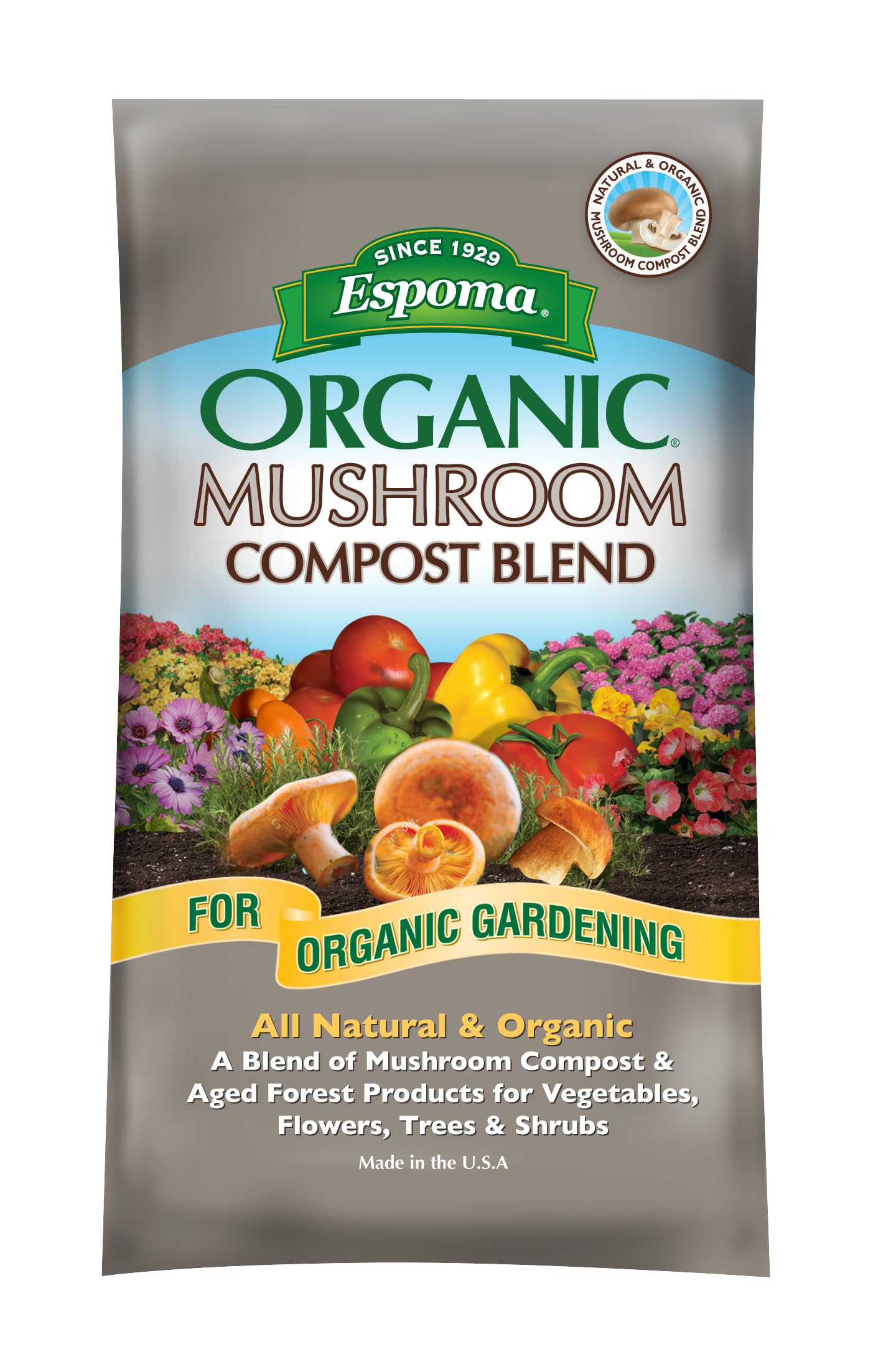
Espoma Organic Mushroom Compost Blend is a 0.75-cubic-foot bag (25 pounds) that combines rich spent mushroom substrate with aged forest products to create a soil conditioner rather than a concentrated fertilizer. It is designed to be mixed or rototilled into existing soil to a depth of 4-6 inches at planting time, improving water retention in sandy soils and aeration in clay soils. This is not a direct feed — it is a long-term soil structure amendment that slowly releases organic matter and nutrients as it decomposes.
Verified owners report “great improvement in growth” when used around peonies, vegetables, trees, and shrubs. One buyer noted they used it on peonies planted in spring instead of fall and saw “terrific” results. The mushroom compost adds beneficial fungi and microbial life that synthetic fertilizers do not provide, making it an ideal base layer before applying a concentrated rose-specific feed. The 25-pound bag is enough for roughly 4-6 square feet at the recommended 4-inch incorporation depth.
The primary limitation is that mushroom compost alone does not supply enough NPK for heavy-feeding roses. It should be used as a soil foundation or side-dressing, with a balanced rose fertilizer like the Jackson & Perkins or Rose-Tone layered on top. The bag is also heavy and can be difficult to transport from a car to a back garden. It is also not a stand-alone solution for container roses, where the bulk density can compact potting mix over time.
What works
- Dramatically improves soil texture and water retention
- Adds beneficial fungi and organic matter to the root zone
- Versatile for flowers, vegetables, trees, and shrubs
What doesn’t
- NPK content is too low to be a sole rose feed
- Heavy bag — difficult to move and incorporate
Hardware & Specs Guide
NPK Ratio — What the Numbers Actually Mean
The three hyphenated numbers (e.g., 14-5-10) represent the percentage by weight of Nitrogen (N), Phosphorus (P), and Potassium (K). For rose compost, the middle number (phosphorus) matters most because it drives flower bud formation and root development. A ratio of 4-6-4 or 12-9-9 will produce more blooms per plant than a 12-4-8 formula, even though the total NPK sum may be higher in the latter.
Release Mechanism Duration
Time-release products use a polymer coating that dissolves slowly over a defined period (typically 6-9 months). Slow-release granules break down through soil moisture and microbial activity over 2-3 months. Liquid formulas deliver 100% of their nutrients within days. Matching this duration to your garden schedule is critical — a time-release formula is ideal for a single spring application, while liquid requires a weekly ritual.
FAQ
Can I use mushroom compost alone to feed my roses?
How often should I apply slow-release granular rose compost?
What NPK ratio is best for climbing roses versus hybrid tea roses?
Final Thoughts: The Verdict
For most gardeners, the best rose compost winner is the Jackson & Perkins Select Rose Fertilizer because it delivers a complete season of feeding from one application with a proven 14-5-10 analysis that produces visibly larger blooms and denser foliage. If you want organic soil conditioning and microbial root enhancement, grab the Espoma Organic Rose-Tone 4-3-2 two-pack, which builds fertile soil year after year with Bio-tone. And for a completely mess-free, no-measure solution that still pushes heavy bloom output, nothing beats the Jobe’s Rose Fertilizer Spikes.