
If your garden spade pings off rock-hard soil, water puddles for hours after a rain, and plant roots struggle to push through dense, sticky clay, you are fighting the most common soil problem in America. The right blend of minerals, organic matter, and pH adjusters physically restructures that clogged earth, turning baked-clay subsoil into a friable, root-friendly loam that drains properly and holds nutrients.
I’m Rikta — the co-founder and writer behind Lawn Gear Lab. I’ve spent countless hours analyzing the chemical composition, particle size, and application methods of a dozen soil conditioners to determine which products genuinely break down clay’s crystalline structure and which just add dust to the pile.
This guide ranks seven targeted conditioners by their ability to improve water infiltration, add critical trace elements, and adjust pH in heavy clay, giving you a clear path to the best soil amendments for clay soil that deliver measurable results in a single growing season.
How To Choose The Best Soil Amendments For Clay Soil
Clay soil is made of microscopic, flat particles that pack tightly together, leaving almost no pore space for air or water. The right amendment introduces a counteracting element — calcium ions from gypsum, organic carbon from biochar, or sulfur for pH management — that forces the clay platelets apart into a granular, crumb-like structure called flocculation.
Gypsum for Structural Breakdown
Gypsum (calcium sulfate dihydrate) is the single most effective amendment for pure clay structure. The calcium ions displace sodium and magnesium that glue clay particles together, and the sulfate is a secondary plant nutrient. Unlike lime, gypsum is pH neutral — it will not raise the pH of alkaline clay, making it safe to apply without a soil test if your only goal is to loosen the dirt.
pH Adjusters for Nutrient Availability
Clay soil often sits at a pH above 7.0, locking up iron, manganese, and phosphorus. Elemental sulfur granules slowly lower pH as soil bacteria oxidize the sulfur into sulfuric acid. If your soil is already acidic (below 6.0), a calcium-magnesium product like Mag-I-Cal Plus raises pH into the 6.2–7.0 sweet spot where turf grass and vegetables absorb nutrients efficiently.
Trace Minerals and Long-Term Biology
Once the structure is opened, the soil still needs a full spectrum of micronutrients for plant health. Azomite and biochar serve different roles: Azomite delivers 70+ trace minerals from ancient volcanic ash, while biochar provides a carbon-sequestering habitat for beneficial bacteria and fungi that continue to improve soil aggregation over multiple seasons.
Quick Comparison
On smaller screens, swipe sideways to see the full table.
| Model | Category | Best For | Key Spec | Amazon |
|---|---|---|---|---|
| Jonathan Green Mag-I-Cal Plus | Soil Food | Raising pH & Loosening Turf Clay | 5,000 sq ft coverage | Amazon |
| The Andersons BioChar DG | Biochar | Long-Term Soil Biology | 10 lb / 5,000 sq ft | Amazon |
| Espoma Garden Gypsum | Gypsum | Heavy Clay Loosening | 36 lb pelletized | Amazon |
| Cz Garden Organic Gypsum | Gypsum Powder | Blossom End Rot Prevention | 10 lb powder form | Amazon |
| Earth Science Fast Acting Gypsum | Gypsum | Quick Clay Penetration | 5 lb Nutri-Bond | Amazon |
| Earth Science Fast Acting Sulfur | Sulfur | Lowering pH for Acid-Lovers | 5 lb Nutri-Bond | Amazon |
| Down To Earth Azomite | Trace Minerals | Replenishing Micronutrients | 5 lb / 70+ minerals | Amazon |
In‑Depth Reviews
1. Jonathan Green Mag-I-Cal Plus Soil Food

The Mag-I-Cal Plus stands apart because it addresses both the structural and chemical problems of clay in a single 18 lb bag covering 5,000 sq ft. Its calcium content works like gypsum to flocculate clay particles, while the proprietary blend also raises soil pH into the optimal 6.2–7.0 range for lawn grasses. Users in Virginia and other heavy-clay regions report visibly improved soil texture and spot weed reduction after one application.
The powder formulation dissolves rapidly when watered in, making calcium immediately available for root uptake and pH correction. Reviews consistently note that the product makes fertilizer more efficient — balanced pH unlocks nitrogen, phosphorus, and potassium that would otherwise remain bound in alkaline clay. The spring/summer/fall flexibility means you are not locked into a narrow application window.
Where it falls short is the need for a second bag on large new-seeding projects. Some users found the online coverage instructions ambiguous and had to make a second purchase to cover the same square footage. This is a planning detail rather than a product flaw, but it adds cost for first-time overseeders.
What works
- Simultaneously loosens clay and corrects acidic pH
- Large 18 lb bag covers 5,000 sq ft efficiently
- Rapid calcium uptake improves root health quickly
What doesn’t
- Coverage rate for new seeding may require two bags
- Powder form can be dusty in windy conditions
2. The Andersons BioChar DG Organic Soil Amendment
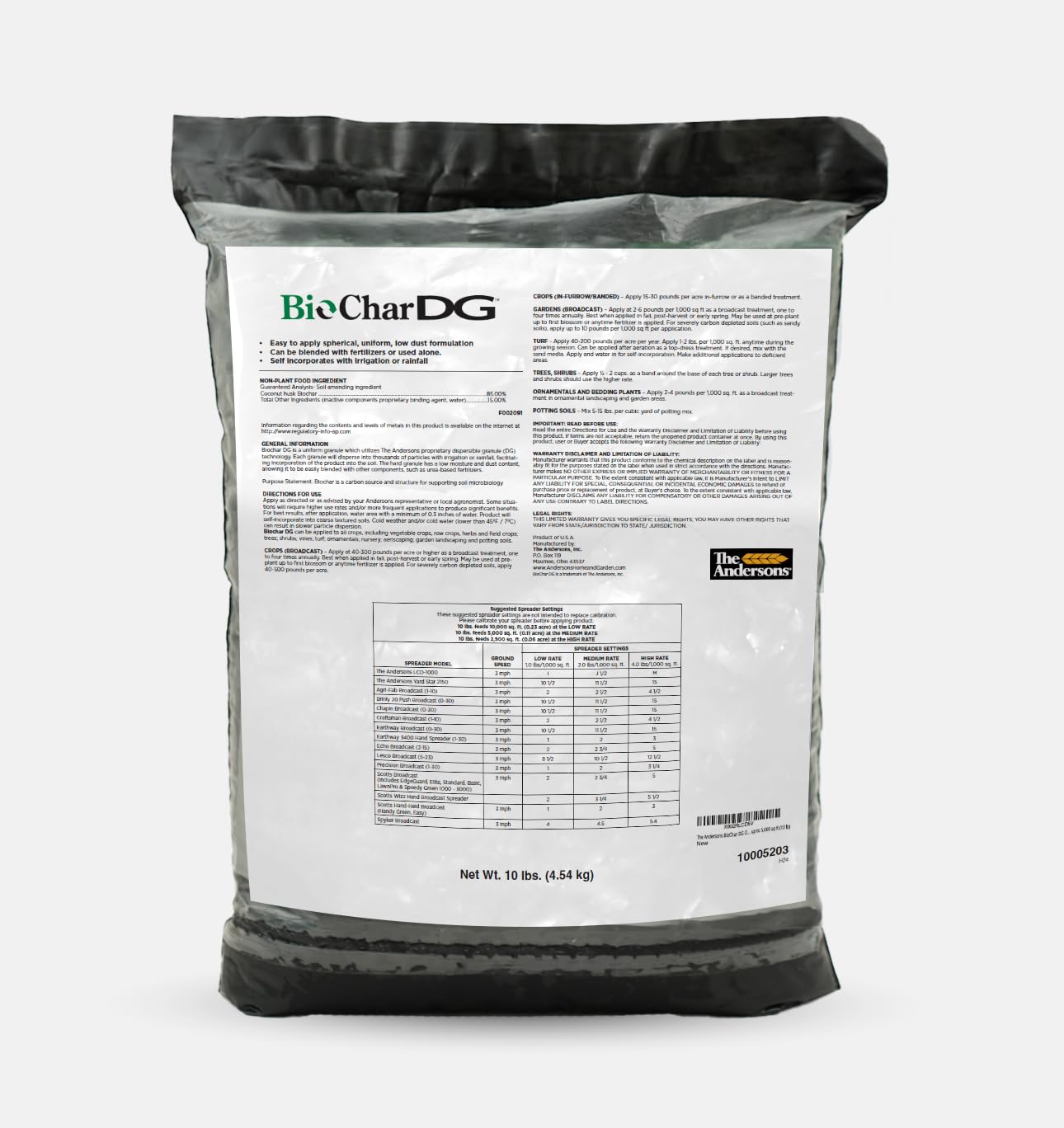
The Andersons BioChar DG uses patented dispersible granule technology that allows the char to break down rapidly with water, distributing carbon deep into the soil profile. Unlike raw lump charcoal, this product is ground to a uniform sphere and engineered to integrate with clay without clumping. Once in the ground, the biochar acts as a long-term home for mycorrhizal fungi and beneficial bacteria that naturally create soil aggregates.
Multiple verified buyers with heavy clay report that repeated application over two to three years transforms the soil texture into a workable, water-permeable medium. The modern DG (dispersible granule) format means you can broadcast it with a standard spreader with very low dust, unlike older char products that required hand-mixing into the top few inches.
The critical catch is that biochar must be pre-loaded with nutrients, or it will temporarily adsorb nitrogen and stunt grass growth. The Andersons claims the product is pre-charged, but several customers saw yellowing followed by recovery only after applying a nitrogen source. This makes it less beginner-friendly than a gypsum or lime product that produces results without a multi-step feeding schedule.
What works
- Improves clay structure persistently over multiple years
- DG technology spreads uniformly with minimal dust
- Supports long-term microbial activity in dense soil
What doesn’t
- May require supplemental nitrogen to prevent initial yellowing
- Higher upfront cost per square foot
3. Espoma Organic Garden Gypsum
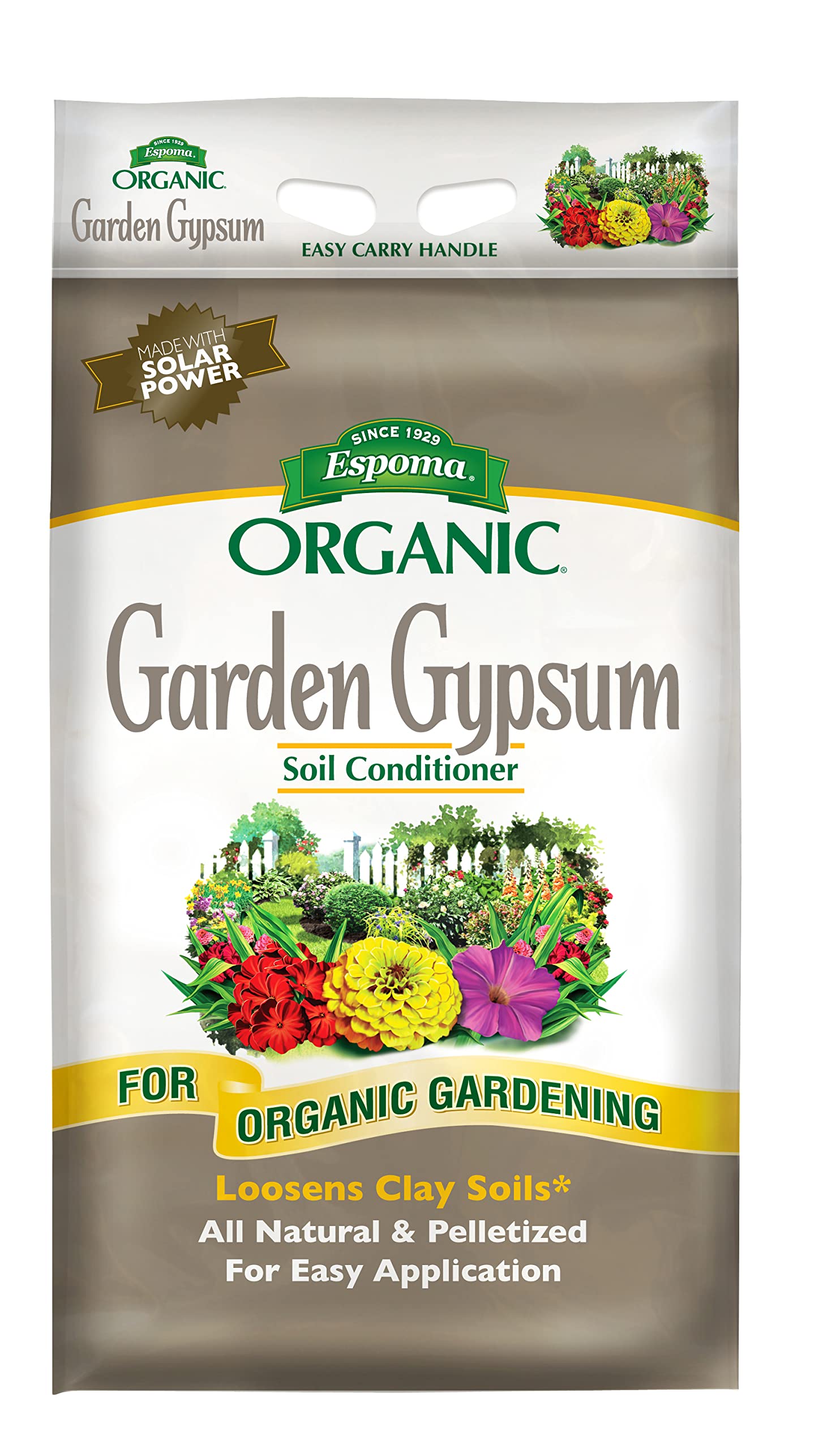
The 36 lb Espoma bag is the heavyweight champion for anyone with a large clay patch who wants pure, unfilled gypsum. Mined from natural deposits and pelletized for easy broadcast spreading, this product contains zero synthetic additives or fillers. The calcium sulfate dihydrate formula directly attacks the sodium-rich structure of clay, flocculating the platelets so water penetrates instead of pooling on the surface.
Customer accounts from gardeners with red clay so hard it was like concrete confirm that Espoma gypsum turned their soil workable within a single growing season. The pelletized form is significantly easier to spread with a drop spreader than powder, and the 36 lb size means fewer trips to the garden center. It is also one of the few gypsum products that explicitly lists winter ice-melt salt repair as a use case.
The largest issue is delivery time — multiple buyers noted that third-party sellers sometimes add ten business days beyond the Amazon estimate, so plan ahead if you need the gypsum for a specific planting window. The price per pound is also higher than commodity gypsum from big-box hardware stores, though the purity and OMRI listing justify the premium for organic gardeners.
What works
- Pure mined gypsum with no synthetic fillers
- Pellet form spreads cleanly with broadcast spreaders
- Large 36 lb bag covers substantial clay areas
What doesn’t
- Shipping delays from some third-party sellers
- Premium price per pound vs generic gypsum
4. Cz Garden Organic Gypsum Powder

This Cz Garden gypsum powder is OMRI listed and manufactured in the USA, offering a strong value proposition for gardeners who do not mind hand-mixing their amendments. The 10 lb resealable pouch is ideal for container gardens, raised beds, and small clay patches where spreader application is impractical. The finely ground powder dissolves faster than pellets, making calcium immediately available to combat blossom end rot in tomatoes — a classic symptom of calcium deficiency exacerbated by heavy clay.
Customers confirm that a soil drench of 1–2 oz per gallon of water arrests blossom end rot quickly, and the pH-neutral nature means you can apply it without worrying about alkalinity spikes. The resealable packaging is a genuine improvement over single-use paper bags, allowing you to store the remaining powder through the off-season without moisture clumping.
The powder format creates dust during pouring, and broadcast spreading is not feasible in wind. The manufacturer lists mushroom cultivation as a target use, which confirms the high purity of the calcium sulfate — but also means the particle size is optimized for substrate mixing rather than broadcast lawn application.
What works
- Fast-dissolving powder stops blossom end rot rapidly
- Resealable pouch stores well for future applications
- OMRI listed and made in the USA
What doesn’t
- Powder form creates dust and is hard to broadcast
- Small 10 lb size limits coverage on large lawns
5. Earth Science Fast Acting Gypsum
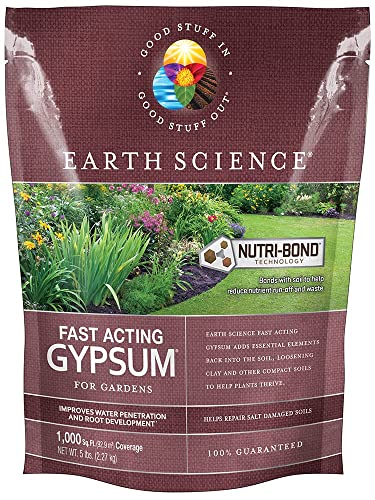
Earth Science Fast Acting Gypsum is distinguished by its Nutri-Bond Technology, a patented coating that reduces nutrient runoff by up to 50%. For clay soil that naturally sheds water and soluble nutrients, this binding mechanism keeps the calcium where it is needed rather than washing into the drainage layer. The granules are finely ground and pelletized, striking a balance between fast dissolution and spreader compatibility.
Users report visible improvement in compacted clay within weeks — water stops pooling, digging becomes easier, and grass roots grow deeper. The gypsum also addresses salt damage from dog urine and winter de-icers, making it doubly useful for turf lawns in cold climates. The label explicitly states it is safe for kids and pets immediately after application, a practical advantage for families.
The 5 lb bag is relatively small for the price, limiting its use to gardens or small lawns. Gardeners with large expanses of clay will need multiple bags to see meaningful percolation improvement, which cuts into the value equation.
What works
- Nutri-Bond reduces calcium runoff on heavy clay
- Faster dissolution than large-chip gypsum from big box stores
- Safe for immediate pet and kid access
What doesn’t
- Small 5 lb bag is expensive per square foot
- Not cost-effective for large lawns without bulk buying
6. Earth Science Fast Acting Sulfur

For gardeners with high-pH clay that turns hydrangeas pink and blueberries chlorotic, Earth Science Fast Acting Sulfur provides the elemental sulfur needed to push pH downward into the acid-loving zone. The Nutri-Bond Technology again plays a role here, keeping the sulfur granules in the root zone rather than allowing the particles to wash laterally across the clay surface.
Verified buyers confirm that hydrangeas, azaleas, and rhododendrons respond with deeper color and more vigorous growth after application. Strawberry growers report larger fruit compared to untreated plants. The sulfur is finely granulated but some users note that the pellets require multiple watering sessions to fully dissolve, meaning the “fast acting” label refers to the bacterial oxidation timeline (weeks) rather than instant dissolution.
The 5 lb bag size is appropriate for flower beds and small shrub borders but is insufficient for lowering pH across a full acre of lawn. Like the companion gypsum product, the per-pound cost is higher than bulk agricultural sulfur, but the Nutri-Bond technology and pelletized format offer convenience for the home gardener.
What works
- Effectively lowers pH for hydrangeas and blueberries
- Nutri-Bond reduces nutrient runoff in clay
- Safe for immediate use around people and pets
What doesn’t
- Pellets dissolve slower than claimed for “fast acting”
- Small bag size limits application to small areas
7. Down To Earth Organic Azomite Granulated Trace Minerals

Azomite is not a structural amendment in the same way gypsum or biochar are — it does not physically flocculate clay plates. Instead, this granulated volcanic ash delivers over 70 trace minerals including calcium, magnesium, iron, and molybdenum that are often locked in unavailable forms inside high-clay soil. By dusting the root zone with these micronutrients, Down To Earth Azomite helps plants overcome the invisible malnutrition that causes stunted growth even when NPK fertilizer is applied.
Indoor potted plant growers and cacti/succulent enthusiasts are the most vocal advocates, reporting visibly stronger root systems and more vigorous growth after mixing Azomite into container mixes. For clay soil, the granulated 5 lb bag can be sprinkled directly on beds or blended into compost before top-dressing. The OMRI listing makes it suitable for certified organic vegetable gardens.
The main limitation is that Azomite alone cannot fix drainage or compaction — you must first use gypsum or organic matter to break up the clay physically. Additionally, the 5 lb bag covers a modest area, and the cost per pound is higher than single-mineral amendments. Some users question whether the minerals are in a plant-available form, though overwhelming anecdotal evidence supports its effectiveness.
What works
- Delivers over 70 trace minerals missing from clay soil
- Granulated form is nearly dust-free and easy to apply
- OMRI listed for organic vegetable production
What doesn’t
- Does not improve clay structure or drainage on its own
- Small 5 lb bag covers limited garden area
Hardware & Specs Guide
Particle Size and Dissolution Rate
Gypsum amendments come in three textures: finely ground powder (Cz Garden), small pellets (Earth Science, Espoma), and large chips (common at hardware stores). Powder dissolves within hours of watering, making calcium immediately available, but it is hard to spread evenly outdoors. Pellets dissolve over several waterings, providing a sustained release but requiring more moisture to break down. Large chips can sit on clay for weeks before penetrating, which is why pelletized products like Espoma and Earth Science are the sweet spot for most home gardeners.
Application Method and Coverage
Broadcast spreaders work best with uniform pellets (Espoma, Earth Science, Andersons BioChar DG). Hand application is practical for powders (Cz Garden, Azomite) if you are targeting specific planting holes or rows. Coverage rates vary dramatically: Jonathan Green Mag-I-Cal covers 5,000 sq ft at 18 lb, while a 5 lb bag of Earth Science gypsum covers roughly 200–400 sq ft depending on the soil condition. Always calculate your square footage before ordering to avoid mid-project shortages.
FAQ
Will gypsum alone fix my hard clay soil?
How long does elemental sulfur take to lower soil pH in clay?
Can I apply gypsum and lime at the same time?
Final Thoughts: The Verdict
For most gardeners, the soil amendments for clay soil winner is the Jonathan Green Mag-I-Cal Plus because it combines calcium-driven clay flocculation with pH correction in one application, making it the most efficient solution for heavy turf and garden beds alike. If you want a dedicated long-term biology booster that improves soil texture year after year, grab the The Andersons BioChar DG. And for a quick, targeted fix for blossom end rot or small container gardens, nothing beats the Cz Garden Organic Gypsum Powder.