
The search for a lawn that turns heads often leads homeowners down a path of harsh synthetic chemicals that promise quick results but leave soil biology depleted over time. The real challenge is finding a slow-release nitrogen source that feeds the turf and the microbial life beneath it without the risk of fertilizer burn or toxic runoff.
I’m Rikta — the co-founder and writer behind Lawn Gear Lab. I’ve spent countless hours comparing NPK ratios, reading through owner feedback on organic breakdown rates, and studying how different natural ingredients like fish emulsion, corn gluten, humic acid, and sea kelp perform across cool-season and warm-season grass varieties.
Whether you’re managing a lush fescue lawn, a Bermuda patch, or a mix of bluegrass and rye, choosing the right organic grass fertilizer means balancing nitrogen content, micronutrient availability, and safety for pets and children.
How To Choose The Best Organic Grass Fertilizer
Choosing an organic lawn food means decoding the label beyond the marketing claims. The three numbers on the bag — N-P-K — tell you exactly what the product prioritizes, but the ingredient source determines how quickly it releases and whether it feeds the soil or just the leaf blade.
Nitrogen Source and Release Speed
Organic nitrogen comes from materials like feather meal, fish emulsion, corn gluten meal, or plant-based byproducts. Feather meal releases slowly over several weeks, feeding steadily without a growth flush, while fish emulsion offers fast foliar uptake but requires reapplication every few weeks. Look for a blend of fast and slow sources for a balanced feed.
Phosphorus and Potassium in Organic Fertilizers
Many organic lawn foods intentionally keep phosphorus (the middle number) low or at zero to comply with municipal phosphate restrictions. Established lawns rarely need phosphorus — it’s mainly for root establishment during seeding. Potassium (the last number) supports drought tolerance and disease resistance; a value between 1 and 3 is sufficient for most turf types.
Granular vs Liquid Organic Fertilizers
Granular organic fertilizers are easier to spread evenly and provide slow-release nutrition over 6 to 10 weeks, making them ideal for maintenance programs. Liquid concentrates penetrate quickly and show visible greening within days, but demand more frequent applications. Granules are often simpler for large lawns, while liquids give you precise control over application timing and coverage.
Quick Comparison
On smaller screens, swipe sideways to see the full table.
| Model | Category | Best For | Key Spec | Amazon |
|---|---|---|---|---|
| Jonathan Green Organic 10-0-1 | Granular | Deep greening with slow release | 17 lb bag / 5,000 sq ft / 10-0-1 | Amazon |
| Espoma EOLF28 Organic Lawn Food | Granular | Sustained nitrogen for all grass types | 28 lb bag / 9-0-0 / Bio-tone formula | Amazon |
| PetraMax Neighbor’s Envy 7-in-1 | Liquid | Fast results with micronutrient boost | 64 oz / 8,000 sq ft / 19% N + 2.5% Fe | Amazon |
| Purely Organic Lawn Food 10-0-2 | Granular | Pet-safe, plant-based formula | 15 lb bag / 3,000 sq ft / 10-0-2 | Amazon |
| Safer Brand Lawn Restore 9-0-2 | Granular | Reviving stressed lawns fast | 20 lb bag / 5,000 sq ft / 9-0-2 | Amazon |
| Alaska Fish Fertilizer 5-1-1 | Liquid | Gentle nitrogen for foliage growth | 115 oz / 1,000 sq ft / OMRI listed | Amazon |
| FoliarTech Humic Acid Blend | Liquid | Soil conditioning and nutrient unlock | 1.1 gal / 43,500 sq ft / OMRI listed | Amazon |
In‑Depth Reviews
1. Jonathan Green Organic Organic 8-0-1 Lawn Food

Jonathan Green’s 10-0-1 granular formula delivers a nitrogen-rich feed with zero phosphorus, making it compliant with phosphate-restricted municipalities while still pushing out deep green color within 10 days. The slow-release mechanism from plant-based ingredients feeds the turf steadily for 8 to 10 weeks, which means fewer applications over the growing season compared to liquid alternatives.
Owner feedback consistently highlights the absence of manure or sludge-based fillers — a major plus for homeowners who want a genuinely clean organic product. The large 17-pound bag covers up to 5,000 square feet, and the homogenous granules spread evenly through rotary or drop spreaders without clumping. Several reviewers noted visible greening that rivaled professional lawn services within two weeks.
Pet owners repeatedly mention the ability to let their dogs back onto the lawn immediately after application, which is rare even among organic fertilizers. The 10-0-1 ratio is well-suited for established lawns where root depth is already good and the primary goal is leaf color and density without a growth spike.
What works
- True slow-release nitrogen for 8 to 10 weeks of steady feeding
- Zero phosphorus meets local phosphate bans
- Safe for pets and children to walk on immediately
What doesn’t
- Lower potassium content (1) may not suit high-traffic or drought-prone lawns
- Best applied with a spreader — not ideal for spot feeding
2. Espoma EOLF28 Organic All Season Lawn Food

Espoma’s 28-pound bag of All Season Lawn Food offers the most concentrated nitrogen-only organic feed in this lineup at 9-0-0, and the inclusion of Bio-tone beneficial microbes separates it from simpler plant-meal blends. The microbes help break down organic matter in the soil, making nutrients more bioavailable to grass roots over time rather than just coating the leaf surface.
The label is approved for all cool-season and warm-season grasses — fescue, bluegrass, rye, St. Augustine, and zoysia — which makes it a versatile choice for homeowners with mixed lawns. Because it contains no phosphorus or potassium, this is a targeted tool for mid-season nitrogen boosts when soil phosphorus levels are already adequate. Veteran users report consistent results across multiple seasons without the soil acidification common with synthetic urea.
Reviewers who have relied on Espoma for years praise the slow-release nature that avoids the sudden growth flush that attracts pests and disease. The absence of sludges and toxic ingredients reinforces its organic integrity, and the smaller particle size spreads cleanly through broadcast spreaders even at low settings.
What works
- High nitrogen concentration in a pure organic form
- Bio-tone microbes improve long-term soil health
- Suitable for both cool and warm season grasses
What doesn’t
- No potassium or phosphorus limits standalone use to specific growth phases
- Only 9% nitrogen means you need more product than synthetic high-N feeds
3. PetraMax Neighbor’s Envy 7-in-1 Liquid Fertilizer
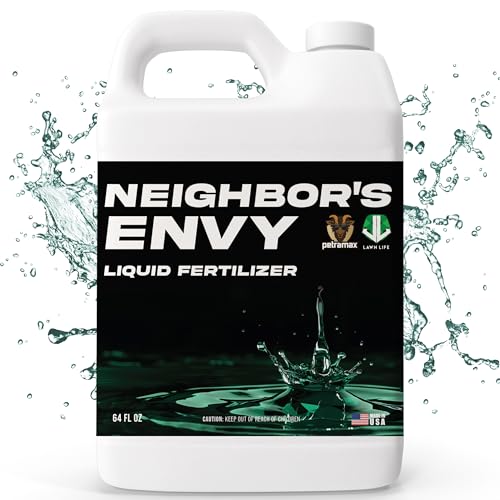
Neighbor’s Envy brings a unique 7-in-1 liquid formulation that combines 19% nitrogen, 2.5% iron, humic acid, sea kelp, potassium, and sulfur into one concentrate. The high iron content is the primary driver behind the dramatic dark green color that many reviewers noticed within 1 to 3 days — though some of that initial darkening is staining from the brown liquid itself, not true chlorophyll buildup.
The liquid format is best applied with a sprayer or hose-end applicator, and the manufacturer recommends coverage up to 8,000 square feet per 64-ounce bottle. Users on Bermuda and fescue lawns reported the thickest, darkest turf they had ever achieved, but noted that the results require bi-weekly reapplication because liquids leach faster than granules. A few reviewers experienced light burn from over-application, which highlights the importance of proper watering before and after use.
Despite the higher application frequency, the convenience of a single-bottle solution that includes kelp and humic acid alongside macronutrients is appealing for small to mid-sized lawns. The formula is non-toxic for pets once dry, and the USA-made production with direct customer support adds confidence for homeowners trying a liquid organic for the first time.
What works
- Visible color change within days on most grass types
- Contains humic acid and kelp for soil structure benefits
- Safe for pets and kids once watered in and dry
What doesn’t
- Requires reapplication every 2 to 4 weeks — higher labor cost
- Expensive for lawns over 10,000 square feet
4. Purely Organic Lawn Food 10-0-2

Purely Organic uses distillers grains and soy as the base ingredients instead of manure or biosolids, making it one of the cleaner organic options for homeowners who dislike the smell and texture of traditional organic fertilizers. The 10-0-2 ratio provides adequate nitrogen and a modest potassium boost for stress tolerance, while the zero-phosphorus formulation keeps it legal for use in phosphorus-sensitive watersheds.
The 15-pound bag covers only 3,000 square feet, which is lower coverage than most granular competitors in this price tier, but the concentrated nutrient density means each pound delivers more nitrogen than many bulk organic products. Owners in Florida and other warm-zone states reported rapid greening even during summer heat without a single case of leaf burn, which is a strong indicator that the nitrogen release is genuinely temperature-responsive and not forced.
Multiple reviewers specifically chose this product because they keep horses, chickens, or free-roaming pets and could not risk toxic residues. The manufacturer backs it with a 30-day Happy Plant Promise that offers a hassle-free refund if results don’t meet expectations, which reduces the risk for first-time organic users.
What works
- Plant-based ingredients — no manure smell or biosolids
- Pet and family safe with zero re-entry restriction
- No phosphorus — safe for sensitive watersheds
What doesn’t
- Coverage is limited to 3,000 sq ft per bag
- Potassium content (2) is modest for high-traffic lawns
5. Safer Brand Lawn Restore 9-0-2
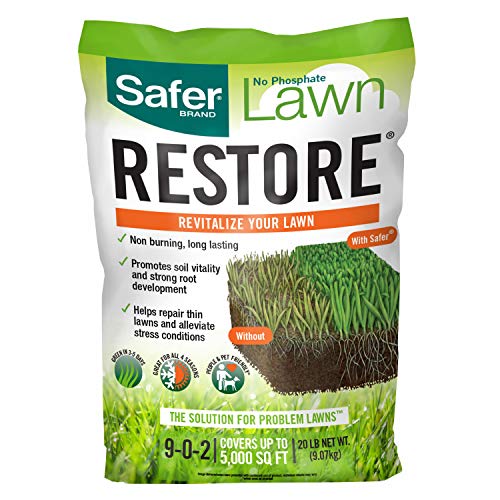
Safer Brand’s Lawn Restore positions itself as the rescue option — formulated specifically to revive weak, stressed, or yellowing lawns using a naturally derived 9-0-2 granular blend that includes corn gluten meal. The non-burning formula means you can apply it during the heat of summer without the fear of chemical burn that plagues synthetic fertilizers, and multiple reviewers reported visible green-up within 3 to 5 days on lawns that looked completely dead.
The corn gluten provides a dual benefit: it supplies nitrogen while acting as a pre-emergent weed suppressant. This is excellent for established lawns but creates a timing challenge — reviewers warn against using it during seeding because the corn gluten will inhibit grass seed germination. You need to either apply it weeks before seeding or wait until after the new grass has gone through two mowings.
The 20-pound bag covers up to 5,000 square feet, which places it in the mid-range for coverage at this price point. Recurring buyers use it twice per year — once in spring and once in fall — and note that their lawns stay dense and green without the need for synthetic supplements. The pet safety feedback is consistently positive, with owners of small dogs especially appreciative of the immediate re-entry allowance.
What works
- Fast green-up reported within days on stressed lawns
- Corn gluten suppresses weeds pre-emergence
- Safe for pets and wildlife with zero burn risk
What doesn’t
- Corn gluten blocks seed germination — not suitable during overseeding
- Lower nitrogen density means more frequent applications
6. Alaska Fish Fertilizer OMRI Listed 5-1-1
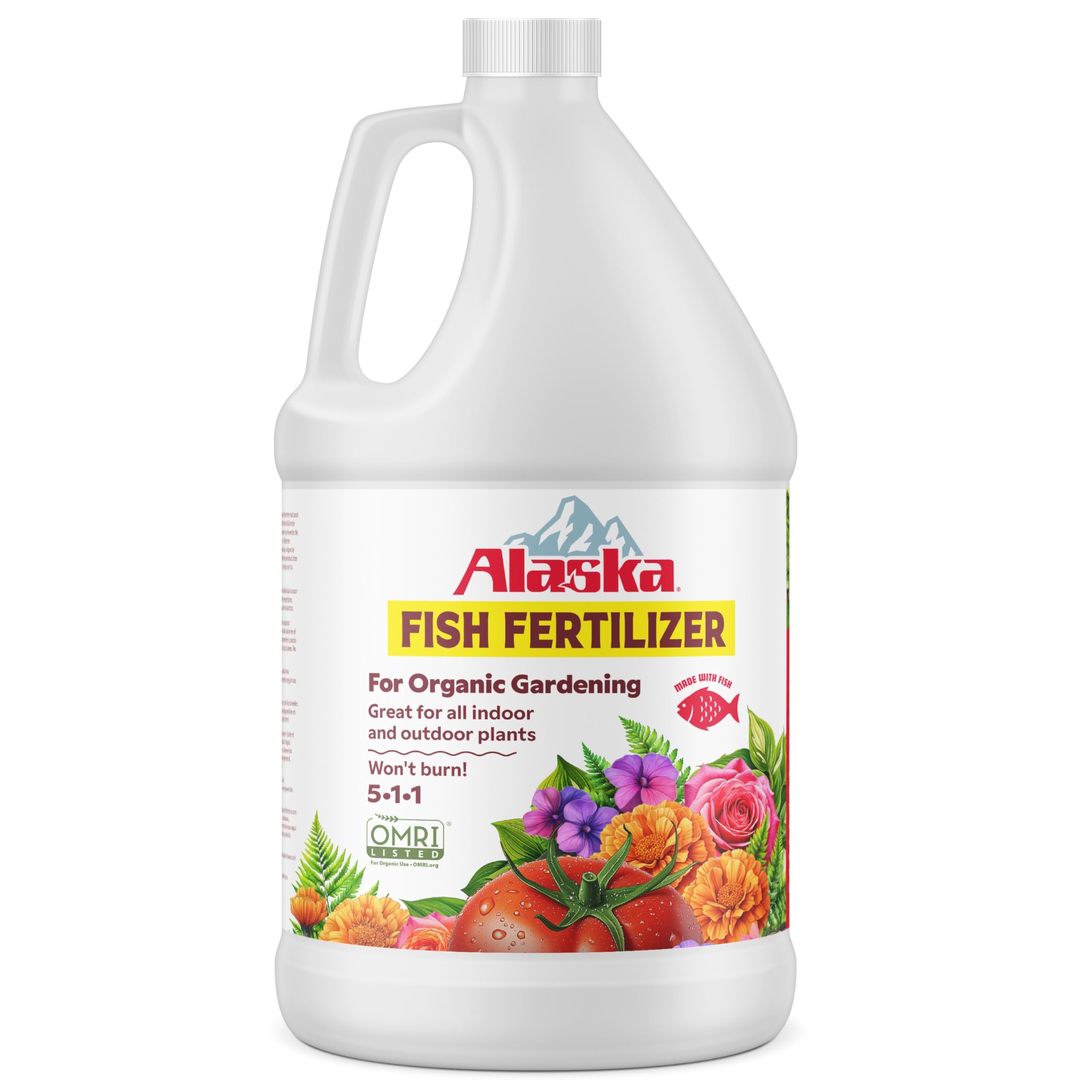
Alaska Fish Fertilizer is one of the most well-known organic plant foods in the market, and the OMRI listed 5-1-1 formula is a cold-processed fish emulsion that preserves natural micronutrients and enzymes. The low NPK numbers make it nearly impossible to burn plants even with generous application, which is why it’s a go-to for transplant starters, greenhouse seedlings, and indoor plant owners who need a gentle but steady nitrogen source.
The 115-ounce jug covers only about 1,000 square feet when mixed as directed, which seems limited compared to granular options, but the product is primarily intended as a liquid feed for targeted or container use rather than large-acreage broadcast. It feeds vegetables, roses, shrubs, fruit trees, and perennials equally well, which makes it a multi-purpose tool for gardeners who grow more than just turf. The fishy odor is strong during application but dissipates within a day once the soil absorbs it.
Reviewers with a decade of use confirm that consistent application every three weeks through spring and summer produces lush foliage and vigorous root systems. The 5-1-1 ratio is heavily skewed toward nitrogen for vegetative growth, so gardeners growing flowering plants or fruiting vegetables may need to supplement with a bloom booster that provides phosphorus and potassium.
What works
- Extremely gentle — nearly impossible to over-fertilize or burn
- OMRI certified for organic gardening across a wide plant range
- Provides rapid foliar uptake for quick greening
What doesn’t
- Strong fish odor during and immediately after application
- Low nitrogen concentration requires frequent reapplication every 3 weeks
7. FoliarTech Humic Acid Organic Lawn Fertilizer
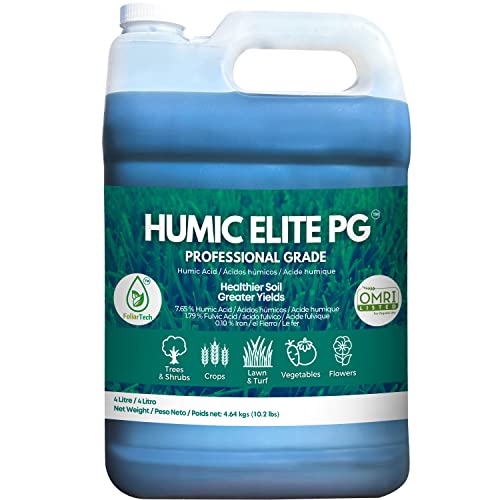
FoliarTech’s humic and fulvic acid concentrate takes a fundamentally different approach from traditional NPK fertilizers. Rather than supplying macronutrients directly, this OMRI certified liquid works by chelating bound nutrients in the soil and regulating pH to eliminate nutrient lockout. The result is that whatever native or applied nutrients already exist in your soil become more available to grass roots, which is especially valuable for lawns that receive plenty of sun and water but remain yellow or thin.
The 1.1-gallon container delivers a tremendous 43,500 square feet of coverage when used as a spray, which makes it the most cost-efficient option for large properties. It is fully water-soluble and compatible with any spray system, including hose-end sprayers, backpack sprayers, and drip irrigation. Users on tall fescue reported that grass turned visibly greener even through winter freezes, with improved resistance to compaction-related stress in high-traffic areas.
Several gardeners using this product noticed a reduction in blossom-end rot on tomatoes and peppers because the humic acid freed up calcium that was previously locked in the soil. This dual benefit for lawns and vegetable beds makes it a versatile soil health tool rather than just a grass fertilizer, though it does not supply macronutrients — you will still need to pair it with a primary organic nitrogen source for full-season feeding.
What works
- Massive coverage — up to 43,500 square feet per bottle
- Improves nutrient uptake from existing soil or applied fertilizers
- Reduces compaction and improves soil structure
What doesn’t
- Contains no macronutrients — must be used alongside a nitrogen source
- Results depend heavily on existing soil nutrient levels
Hardware & Specs Guide
NPK Ratio and Why the Numbers Matter
Organic grass fertilizers display three numbers representing nitrogen, phosphorus, and potassium by weight. Nitrogen (first number) drives leaf growth and color; a value between 5 and 10 is typical for lawn foods. Phosphorus (middle) supports root growth and is rarely needed by established lawns — most organic formulas hover at 0 or 1. Potassium (last number) improves drought and disease tolerance; look for a value between 1 and 3 for healthy turf. Organic nitrogen sources like feather meal or corn gluten release slower than synthetic urea, so a 9-0-0 organic will not green as fast as a 30-0-0 synthetic but causes no salt buildup.
Granular vs Liquid: Coverage and Frequency Trade-offs
Granular organic fertilizers spread easily with drop or broadcast spreaders and release nutrients gradually over 6 to 10 weeks, requiring 2 to 3 applications per season for most lawns. Liquid concentrates must be mixed with water and applied with sprayers; they penetrate the soil profile within hours and feed the turf faster, but the nutrients leach more quickly, demanding reapplication every 2 to 4 weeks. For homeowners managing more than 5,000 square feet, granular formulas are usually more practical in terms of time and effort, while liquid products suit small lawns, spot treatments, or quick recovery needs.
FAQ
How can I tell if an organic grass fertilizer is truly organic?
Why do some organic fertilizers block grass seed from germinating?
Final Thoughts: The Verdict
For most gardeners, the organic grass fertilizer winner is the Jonathan Green Organic 10-0-1 because its slow-release granular formula feeds the lawn steadily for up to 10 weeks with zero phosphorus, making it ideal for both municipal compliance and pet owners who need immediate re-entry. If you want a fast liquid boost with micronutrients for deep color, grab the PetraMax Neighbor’s Envy 7-in-1. And for improving soil structure and unlocking nutrients across a massive 43,500-square-foot area, nothing beats the FoliarTech Humic Acid Blend as a year-round soil conditioner.