
Buying a cheap robotic lawn mower used to mean accepting random bump-and-go navigation, tangled perimeter wires, and a mower that missed half the yard. But the entry-level segment has shifted. New models now pack RTK satellite positioning, dual-camera AI vision, and full app control—all without requiring you to bury a single wire. The result is a genuinely capable machine that keeps your lawn trimmed without the backache, even on a budget.
I’m Rikta — the co-founder and writer behind Lawn Gear Lab. I spend my time comparing specs, sorting through hundreds of owner reports, and studying the technical data behind each machine to find the real value in this rapidly evolving category.
Whether you are tackling a 1,000-square-foot side yard or managing a quarter-acre lot with multiple zones, finding the right machine starts here. This guide breaks down the eleven best models worth your time to help you pick the best cheap robotic lawn mower for your specific lawn conditions and budget.
How To Choose The Best Cheap Robotic Lawn Mower
Price is the entry threshold, but a mower that fails to navigate, cuts unevenly, or dies after 30 minutes is no bargain. Focus on these three factors to avoid the common pitfalls that plague budget robotic mowers.
Navigation: Wire-Free RTK vs. Boundary Wires vs. Random Bump
The single biggest differentiator in this category is how the mower finds its way. Entry-level random-bump models bounce off obstacles and leave visible streaks. Mid-range wire-free mowers use RTK (satellite) or vision-based positioning to follow systematic coverage paths. Avoid any mower that requires burying a perimeter wire if you want the simplest setup — the magnetic strip boundary options on budget units are far easier to reposition.
Cutting Deck Width & Motor Power
Narrower decks (around 6-7 inches) mean more passes to cover the same ground, but they often come with lighter, cheaper brushless motors that still handle weekly maintenance cuts. For lawns with occasional growth spurts, look for a mower with at least a 7-inch cutting width. The real spec to check is the slope rating — a 20-degree rating is fine for flat yards, but anything steeper demands a unit rated for 35% or more.
Battery Runtime & Acreage Claims
Manufacturer acreage ratings assume ideal flat, obstacle-free grass at low cutting height. Real-world runtime is often half the advertised number, especially on thicker grass. A 30-minute battery covers roughly 500-700 square feet of dense turf. For a 1/4-acre lawn, you need at least 90 minutes of real runtime, which usually means the mower returns to charge and resumes automatically — a feature worth prioritizing even on a budget.
Quick Comparison
On smaller screens, swipe sideways to see the full table.
| Model | Category | Best For | Key Spec | Amazon |
|---|---|---|---|---|
| Segway Navimow X430 | Premium | Large complex lawns, steep slopes | 17″ cutting width, 4WD, 84% slope | Amazon |
| eufy Robot Lawn Mower E15 | Premium | Small high-precision lawns | Pure Vision, 8″ deck, 0.2 acre | Amazon |
| Sunseeker X3 Plus | Mid-Range | Ride-on-edge cutting | 8″ deck, RTK+VSLAM, 0.3 acre | Amazon |
| YARDCARE N1600 PRO | Mid-Range | Systematic RTK coverage | 7.09″ deck, RTK+Vision, 45 min | Amazon |
| Segway Navimow i105N | Mid-Range | Obstacle-dense small yards | 7.1″ deck, RTK+Vision, AI mapping | Amazon |
| Mammotion YUKA mini 600H | Entry-Level Premium | Ultra-easy setup, small yards | 7.5″ deck, NetRTK+AI Vision | Amazon |
| ANTHBOT Genie600 | Mid-Range | Multi-zone, 4-eye vision | 7.9″ deck, RTK+4-Eye Vision | Amazon |
| ECOVACS Goat O1000 RTK | Mid-Range | Long-term value, RTK precision | 8.66″ deck, RTK, 90 min | Amazon |
| ANTHBOT M5 | Mid-Range | Dual vision, app advanced control | 7.9″ deck, Dual Vision+NRTK, 45% slope | Amazon |
| LawnMaster OcuMow | Value | Small flat lawns, budget-focused | 6″ deck, Optical Nav, 3 hr runtime | Amazon |
| YARDCARE V100 | Budget | Tiny yards, absolute lowest entry | 6.3″ deck, HD Vision, 30 min | Amazon |
In‑Depth Reviews
1. Segway Navimow X430
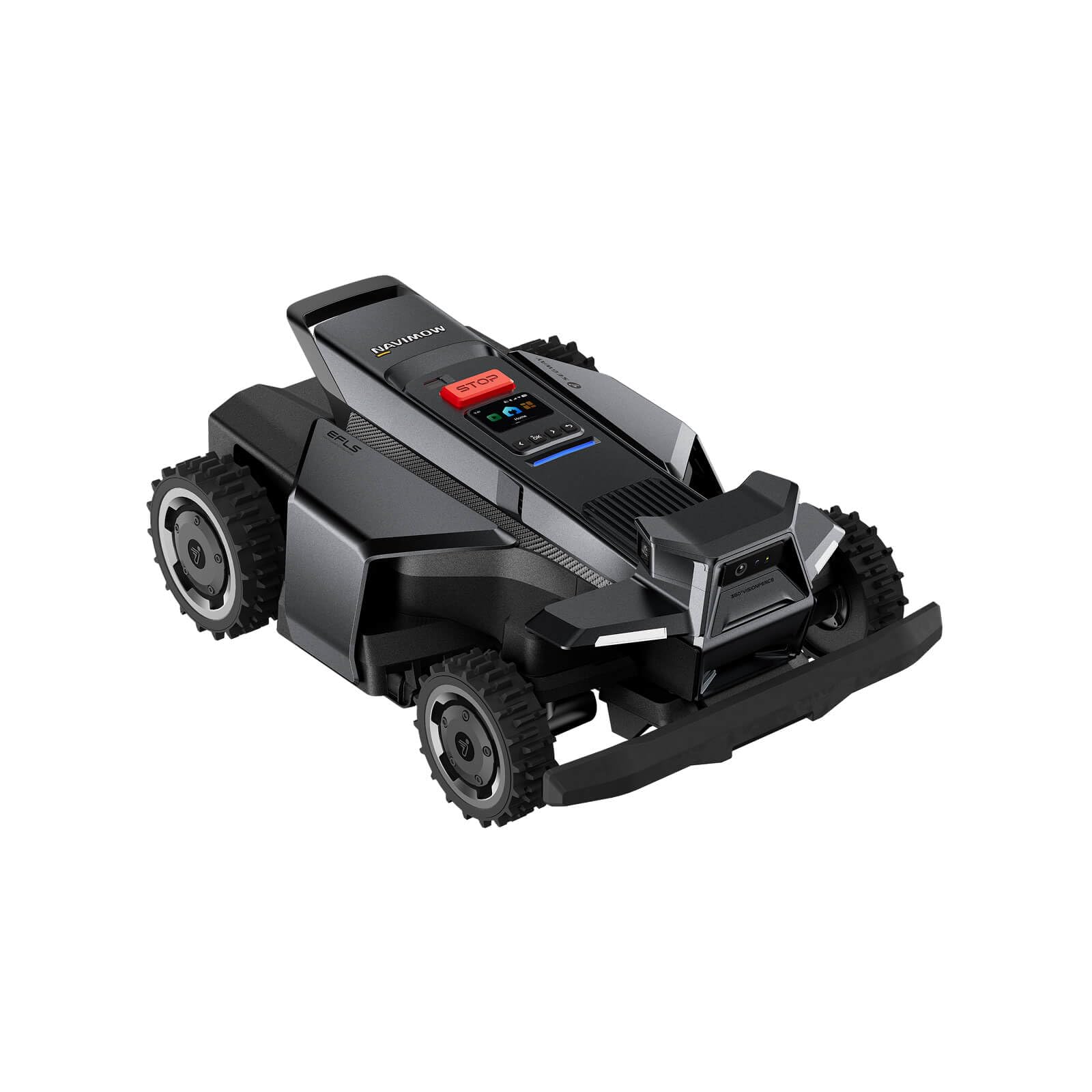
The Segway Navimow X430 is in a different class entirely. This is a full-acre-capable machine with four-wheel drive, an 84% slope rating, and dual 180W motors driving a 17-inch cutting deck. The Xero-Turn AWD system prevents turf scuffing during zero-radius turns — a common problem with cheaper differential-steer mowers. The EFLS tri-frequency RTK plus 360-degree vision delivers centimeter-level accuracy even under dense tree cover.
Real-world battery performance matches the 1-acre rating, with the mower handling complex multi-zone layouts and steep inclines that would strand any of the budget units. The EdgeSense feature reduces trimming margins to under two inches, which cuts down on manual edging significantly. The mower self-charges and resumes automatically, so it can run continuously for large areas.
The primary drawback is the price — this is a premium investment. The unit is also heavy at over 63 pounds, so hauling it around for maintenance is a two-person task. A few users reported firmware quirks that required a reboot, but overall reliability has been strong once initial updates are applied. For anyone with a large, complex yard who wants a true set-and-forget solution, this is the top pick.
What works
- Four-wheel drive climbs 84% slopes without slipping
- Zero-turn steering eliminates turf scuffing
- 17-inch deck covers large areas quickly
What doesn’t
- Price is significantly higher than other options
- Heavy build makes relocation difficult
- Initial firmware updates sometimes needed for stability
2. eufy Robot Lawn Mower E15
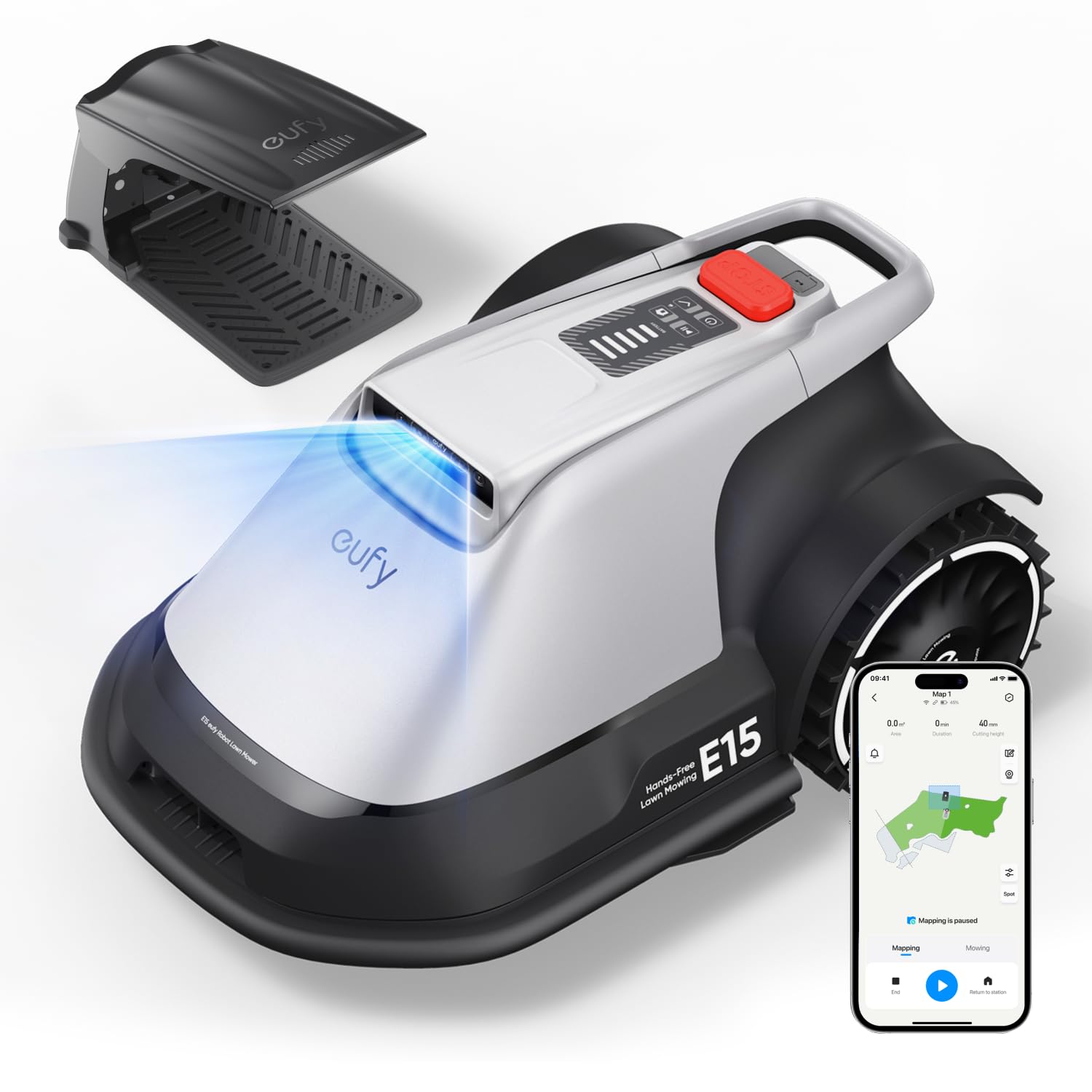
The eufy E15 is unique in this lineup because it uses pure vision navigation — no RTK antenna, no GPS, no boundary wire at all. The V-FSD 1.0 system relies on stereo cameras and SLAM algorithms to map and navigate entirely on its own. This makes setup incredibly simple: place the base station, open the app, and let the mower self-map. The 8-inch cutting deck and Ride-on-Edge technology ensure clean cuts right to the lawn boundary.
Cut quality is excellent, with parallel lines that rival what you would expect from a manual walk-behind mower. The AI 3D obstacle detection successfully identifies low obstacles like children’s toys and pet bowls, rerouting without bumping into them. The mower is limited to 0.2 acres, but within that range it delivers consistent coverage. It automatically returns to charge and resumes, and GPS anti-theft tracking is built in.
The 0.2-acre limit and the requirement for grass under 3.5 inches are real constraints. It is also not recommended for St. Augustine or dense Zoysia grasses. Some users found the initial mapping finicky on patchy or sandy lawns. But for a well-maintained small yard where you want the simplest possible setup, the E15 is a strong choice.
What works
- True wire-free pure vision navigation without RTK
- Produces clean, parallel cut patterns
- AI 3D obstacle avoidance protects pets and objects
What doesn’t
- Limited to 0.2 acres and grass under 3.5 inches
- Struggles with patchy or sandy lawn textures
- Not compatible with St. Augustine or dense Zoysia
3. Sunseeker X3 Plus
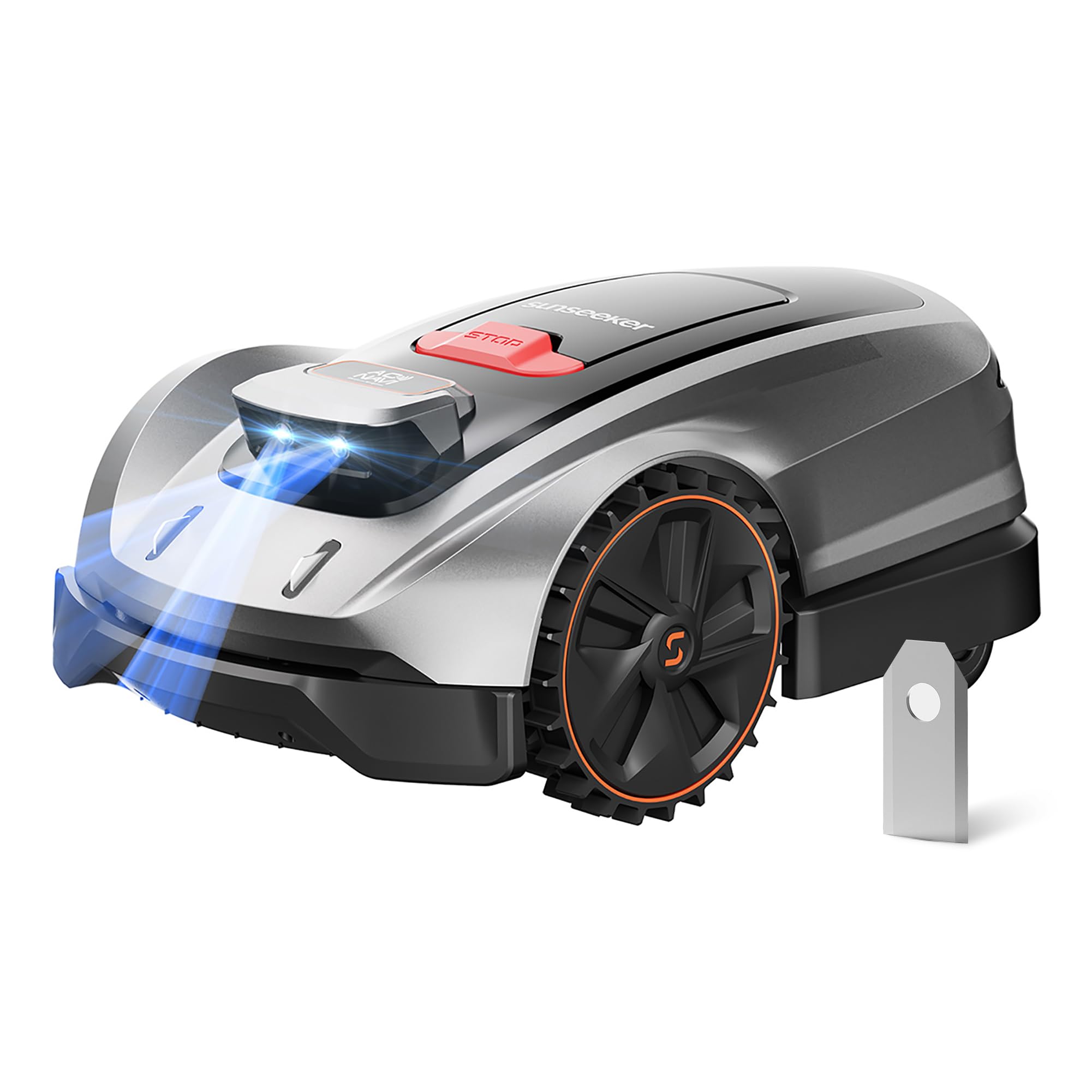
The Sunseeker X3 Plus is built around a clever offset blade design that extends the cut right to the edge of fences, walkways, and garden beds. This Ride-on-Edge feature reduces the amount of manual trimming needed after each mow — a real time-saver for suburban yards with lots of hardscape borders. The navigation combines RTK with VSLAM visual mapping, ensuring the mower follows planned paths even near buildings where GPS can drift.
Covering up to 0.3 acres, the X3 Plus uses camera and ultrasonic sensing to detect common obstacles and adjust routes. The app allows full schedule control, multi-zone management, and cutting height adjustment across 7 positions ranging from 1.6 to 3.2 inches. The mower handles slopes well and maintains stable satellite lock even near back fences, according to owner reports.
The main concern is that the mower requires periodic connections to servers for path planning, which some users flagged as a privacy consideration. A few owners reported signal dropouts at certain times of day, though customer support was responsive. The X3 Plus is a solid mid-range choice for homeowners who want near-edge precision without paying premium pricing.
What works
- Offset blade design cuts very close to edges
- RTK+VSLAM navigation maintains stable coverage
- Responsive customer support and frequent app updates
What doesn’t
- Requires periodic server connections for mapping
- Signal can drop depending on time of day
- Setup process is not the most intuitive
4. YARDCARE N1600 PRO
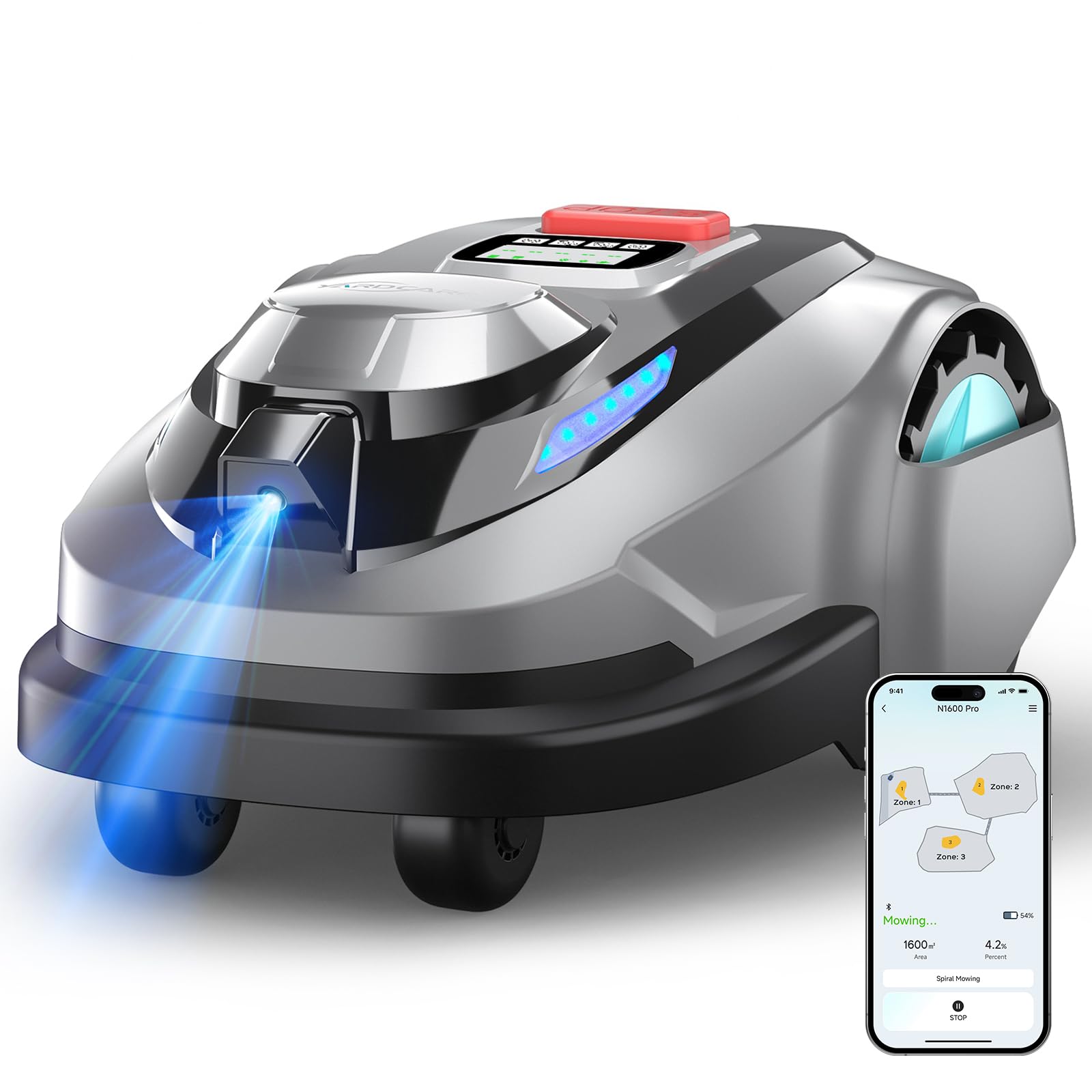
The YARDCARE N1600 PRO represents the budget-friendly end of the RTK-enabled market without skimping on core navigation tech. It uses a combination of RTK positioning and AI visual navigation to achieve centimeter-level accuracy, allowing it to follow systematic U-shaped coverage paths rather than random patterns. The brushless motor powers a 7.09-inch cutting deck with 17 height positions from 0.8 to 2.4 inches.
The mower handles slopes up to 20 degrees and includes 3D obstacle detection to avoid collisions. Users report that the app interface is clear and allows precise zone management without needing any physical boundary wires. The battery runtime of roughly 45 minutes is sufficient for moderate-sized yards, and the mower automatically returns to charge and resumes mowing.
Customer feedback is mixed on long-term reliability. While many owners praise the consistent cutting and quiet operation, a small number report persistent error messages and difficulty getting support. The weight of 39.5 pounds makes it feel sturdy but can be cumbersome to move manually. For the price, the N1600 PRO delivers RTK precision that was once exclusive to much more expensive models.
What works
- RTK+Vision delivers systematic coverage paths
- Intuitive app with clear zone management
- Strong brushless motor and 17 cutting heights
What doesn’t
- Support quality can be inconsistent
- Some units experience persistent error codes
- Heavy build at 39.5 pounds
5. Segway Navimow i105N

The Navimow i105N is the entry point into Segway’s well-regarded robotic mowing ecosystem. Despite the lower price, it still uses EFLS enhanced RTK technology with a camera for vision-based navigation, eliminating the need for perimeter wires. The AI-assisted mapping feature allows the mower to automatically identify lawn edges during setup, cutting mapping time significantly. The 7.1-inch cutting deck adjusts from 1.6 to 3.6 inches in 0.04-inch increments.
Real-world performance is strong for small yards up to 1/8 acre. The mower follows planned patterns rather than random wandering, and changes direction after full coverage to minimize visible tracks. Obstacle detection covers over 150 object types via the 140-degree field-of-view camera. The app supports up to 12 individual zones with separate scheduling, and the mower auto-returns and resumes charging.
The i105N requires a reasonably smooth lawn — deep divots can cause the mower to get stuck. Some users reported that the map can be deleted during initial setup if certain steps are missed. Customer support for advanced issues like satellite signal problems has been a frustration for a few owners. However, for a compact yard owner who wants a reliable, wire-free Segway experience at a lower price, the i105N is hard to beat.
What works
- Segway’s reliable RTK+Vision navigation at a lower price
- AI-assisted mapping reduces setup time
- Precise cutting height adjustment in 0.04-inch steps
What doesn’t
- Gets stuck in deep divots on uneven lawns
- Mapping can be accidentally deleted during initial setup
- Support response for satellite issues can be slow
6. Mammotion YUKA mini 600H
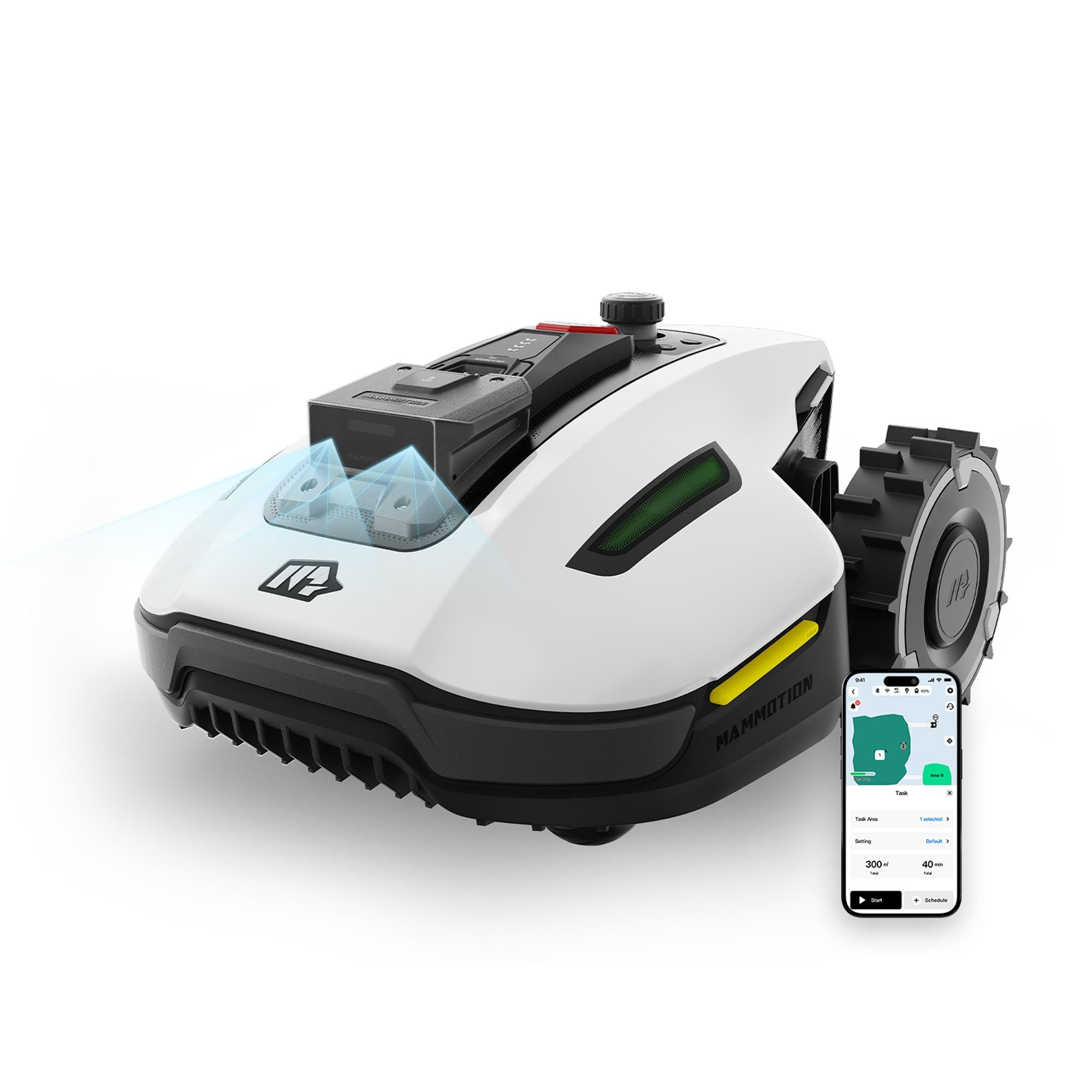
The Mammotion YUKA mini 600H is designed for absolute ease of entry into wire-free mowing. It uses NetRTK (cloud-based RTK correction) combined with AI vision, meaning there is no RTK base station to install. The app-driven mapping process takes less than 10 minutes — the mower identifies lawn boundaries automatically. The floating cutting disc design allows a 7.5-inch deck to follow ground contours for a carpet-like finish.
Cutting height adjustment ranges from 2 to 3.5 inches, which is a slightly higher minimum than some competitors but works well for warm-season grasses. The mower handles slopes up to 50%, which covers virtually all residential yard conditions. The Mammotion app supports up to 15 work zones and includes creative lawn printing features for custom patterns. The IPX6 waterproof rating and 3-year warranty provide peace of mind.
Connectivity issues are the main complaint. Some users experienced persistent Wi-Fi connectivity problems that required holding the phone near the mower. The mower can also get stuck on low obstacles and sometimes loses positioning. Customer service responsiveness has been inconsistent. Despite these caveats, the YUKA mini 600H is one of the most beginner-friendly wire-free options available for small lawns.
What works
- No RTK base station needed — NetRTK simplifies setup
- 10-minute auto-mapping with AI vision
- 3-year warranty and IPX6 waterproof rating
What doesn’t
- Wi-Fi connectivity can be unreliable
- Gets stuck on low obstacles and uneven ground
- Customer support response can be slow
7. ANTHBOT Genie600
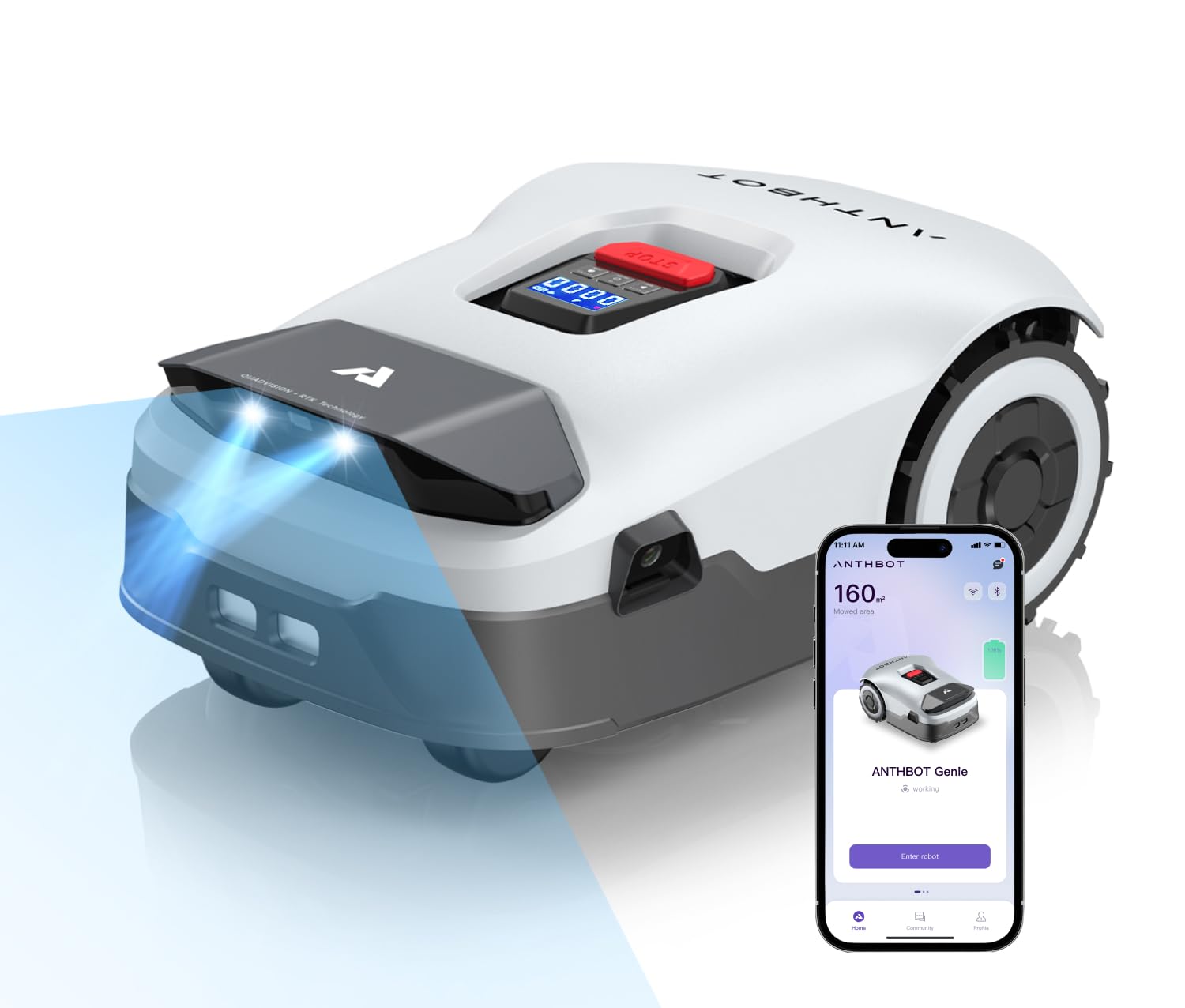
The ANTHBOT Genie600 stands out with its 4-eye vision system — four cameras providing a 300-degree field of view for obstacle detection. Combined with full-band RTK positioning, the mower maintains precision even under dense trees, eaves, or near buildings where GPS signal is weak. The 7.9-inch cutting deck and aluminum-reinforced frame offer a sturdy build at 45 pounds. The ACC (Adaptive Cruise Control) auto-mapping feature creates optimal cutting routes with minimal manual driving.
Multi-zone management supports up to 20 zones with customizable schedules and no-go areas. The Intelligent Hosting Mode adjusts mowing schedules based on seasonal changes and weather conditions. Owners report the mower produces excellent cut quality and follows systematic paths rather than random patterns. The flip-blade design allows extended use between replacements.
The most serious concern is RTK antenna reliability. Multiple owners reported RTK antenna failure due to water ingress or other issues within months of purchase. Customer support has been described as slow and unresponsive, with some users waiting weeks for replacements. When the hardware works, the Genie600 is a powerful machine, but the support experience makes it a higher-risk purchase.
What works
- 4-camera vision covers 300-degree field of view
- Dual positioning works under dense tree cover
- Aluminum frame provides robust build quality
What doesn’t
- RTK antenna prone to failure from water ingress
- Customer support is slow and unresponsive
- Multiple users received defective units
8. ECOVACS Goat O1000 RTK CARE Kit
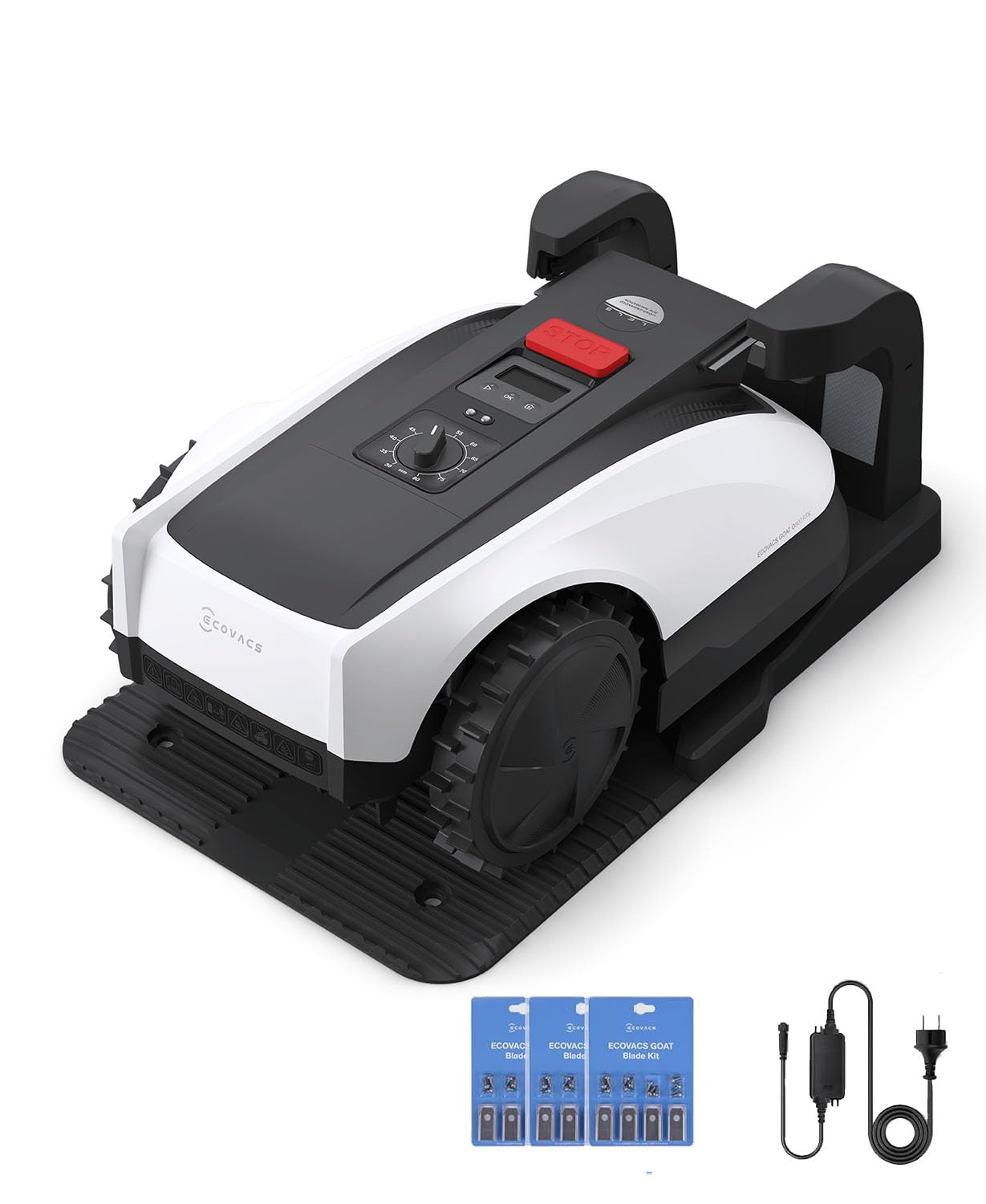
The ECOVACS Goat O1000 RTK CARE Kit brings premium RTK precision to the sub- price point. The system provides centimeter-level positioning without requiring perimeter wires, and the CARE version includes 36 extra replacement blades to extend maintenance intervals significantly. The 8.66-inch cutting width is the widest among the mid-range options, covering ground faster. The mower automatically scans and maps yards, enabling precise multi-zone management through the app.
Owner experiences are overwhelmingly positive, with particular praise for the mower’s ability to follow maps with precision and produce professional straight-line cut patterns. The mower auto-returns to charge and resumes mowing, and the battery runtime of 90 minutes is enough to cover a 1/4-acre yard in a single session. The kit includes an RTK extension cable for optimal antenna placement, which improves signal reliability in yards with trees or obstacles.
The primary criticism is that the initial auto-mapping feature may fail on lawns with poorly defined edges, requiring manual mapping via the app. At 44.5 pounds, this is a heavy unit to move around. Some users noted that the mower works best in relatively flat, open yards without excessive tree cover. Overall, the Goat O1000 RTK offers exceptional RTK cutting performance at a price that undercuts most competitors with similar specs.
What works
- RTK delivers professional straight-line cut patterns
- 36 extra blades extend maintenance intervals
- 90-minute battery covers 1/4 acre easily
What doesn’t
- Auto-mapping may fail on lawns with vague edges
- Heavy at 44.5 pounds
- Best suited for flat, open lawn conditions
9. ANTHBOT M5
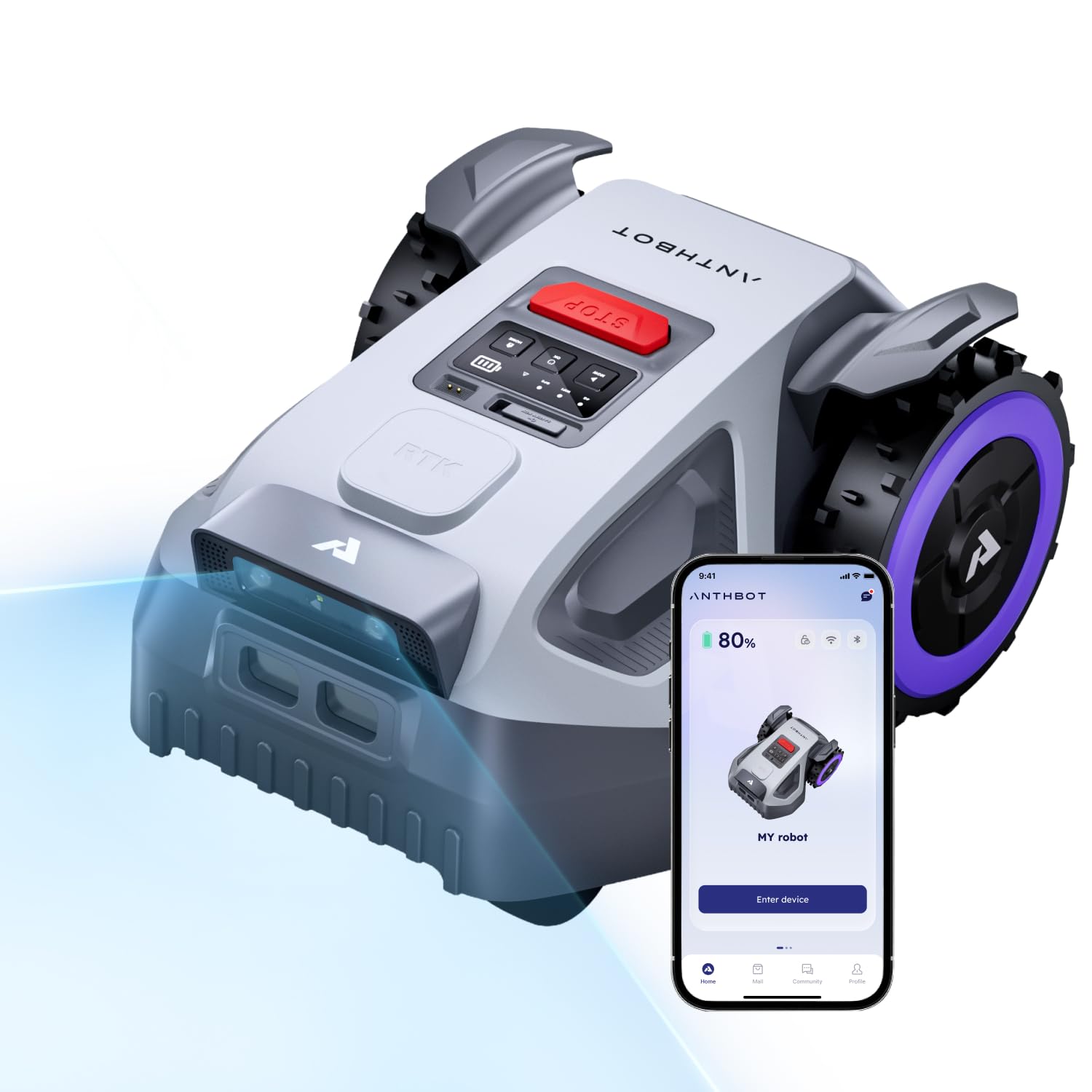
The ANTHBOT M5 uses a dual AI vision system combined with NRTK positioning technology to achieve centimeter-level precision. The Adaptive Cruise Control (ACC) feature automatically navigates the mower during mapping without requiring manual driving, completing the map in about 10 minutes. The 7.9-inch cutting deck with five free-rotating blades creates a carpet-like lawn finish. The mower handles slopes up to 45% gradient, covering over 99% of residential yard conditions.
The app supports up to 20 work zones with customizable mowing paths, no-go zones, and scheduling. The dual 150-degree HDR cameras can recognize over 1,000 types of obstacles, which is significantly more than most competitors. Operating noise stays under 58 dB, quiet enough for early morning or evening mowing without disturbing neighbors. The mower self-charges and resumes automatically.
Reliability is the biggest concern. A significant number of users report network and communication errors that cause the mower to spin in circles, lose track of the map, or fail to return to the charger. Some units required manual restart every few days. While many owners have had excellent experiences, the failure rate appears higher than average for this price segment, making it a bit of a gamble.
What works
- Dual vision system recognizes 1,000+ obstacle types
- 10-minute auto-mapping with ACC technology
- Quiet operation under 58 dB
What doesn’t
- Higher failure rate for navigation/communication errors
- Some units require frequent manual restarting
- Support responsiveness is inconsistent
10. LawnMaster OcuMow

The LawnMaster OcuMow is the budget sweet spot for owners of very small, flat lawns. It uses optical navigation with a wide-angle HDR camera to identify grass boundaries, and two ultrasonic sensors detect obstacles as small as six inches. The included 33-foot magnetic strip allows you to create no-go zones without any digging. The 6-inch cutting deck is narrow, but the 3-hour battery runtime means it can cover up to 2,000 square feet in a single charge cycle (including recharge stops).
For a sub- unit, the OcuMow offers surprising value. The lack of app setup is actually a feature for some owners — you can just place it on the lawn, press start, and let it go. The deep-tread wheels and powerful drive system handle 19-degree slopes well. Owner reviews consistently mention quiet operation and good battery life for small yards. The mower’s random pattern is acceptable for open, simple lawn shapes.
The random cutting pattern is the main limitation — it misses spots and leaves streaks compared to systematic path mowers. It also requires a clearly defined lawn edge; if the grass doesn’t have a sharp boundary, the mower may wander onto garden beds. It struggles with thick or overgrown grass. For a tidy, flat, small lawn where you want to set a timer and forget it, the OcuMow delivers impressive bang for the buck.
What works
- Excellent value for small flat lawns
- 3-hour total runtime covers 2,000 sq ft
- No app setup required for basic operation
What doesn’t
- Random cutting pattern misses spots
- Requires clearly defined lawn edges
- Struggles with thick or overgrown grass
11. YARDCARE V100
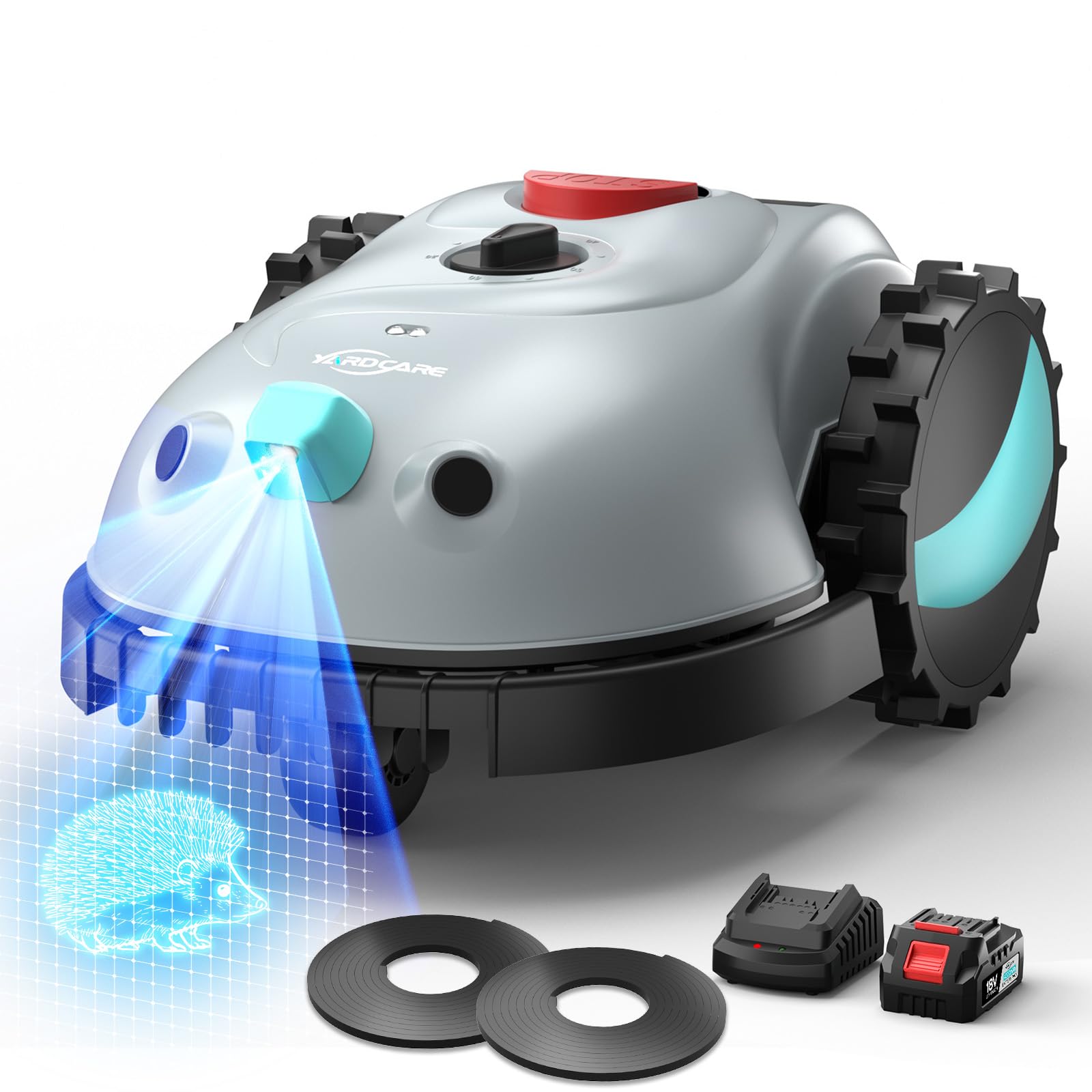
The YARDCARE V100 is the most affordable wire-free option that still uses genuine camera-based navigation rather than random bump. The HD Vision system uses a visual sensor and AI to distinguish grass from non-grass areas, detecting up to 150 obstacle types. The included 32-foot magnetic strip lets you create no-go zones easily. The 6.3-inch cutting deck adjusts from 0.8 to 2.4 inches across 17 positions, offering fine control over cut height.
For very small lawns up to 1,600 square feet, the V100 is a functional entry point. The tilt sensor and rain sensor provide safety features typically found on more expensive mowers. The battery runtime of 30 minutes is short but realistic for tiny yards. The three included blade sets and straightforward assembly are appreciated by first-time robotic mower owners. The machine is quiet during operation.
The V100’s biggest flaw is its traction. It loses grip in 4-inch or taller grass, and the simple navigation logic means it follows a somewhat random path that misses sections. It also cannot escape from low pits or dips in the yard. The mower is best viewed as an introduction to the category — great for learning whether robotic mowing works for your lawn, but with enough limitations that many owners will want to upgrade.
What works
- Lowest entry price for camera-based navigation
- 17 cutting height positions for fine adjustment
- Safety sensors (tilt, rain) included at low price
What doesn’t
- Poor traction in thick or tall grass
- Random navigation misses coverage areas
- Cannot escape from dips or pits in the yard
Hardware & Specs Guide
RTK vs. Pure Vision vs. Optical Navigation
RTK (Real-Time Kinematic) positioning uses a reference station to correct satellite signals, providing sub-4-inch accuracy even under moderate tree cover. Pure Vision navigation relies entirely on cameras and SLAM algorithms — no satellite needed, but it requires good lighting and clearly defined lawn edges. Optical navigation is a simpler camera-based system that identifies grass vs. non-grass boundaries but does not track position. RTK is best for multi-zone or irregularly shaped yards; pure vision works well for small, open lawns; optical navigation is acceptable only for the simplest, most rectangular plots.
Cutting Deck Width and Motor Type
Cutting width directly impacts coverage speed. A 6-inch deck requires roughly 33% more passes than an 8-inch deck to cover the same area. Brushless motors are strongly preferred — they run cooler, last longer, and are more energy-efficient than brushed motors. The motor’s real-world torque determines how well the mower handles thick grass. Look for mowers with brushless motors and at least a 7-inch deck for reasonable coverage times on lawns above 1,000 square feet.
FAQ
What does the slope rating number mean for a robotic lawn mower?
Can a cheap robotic lawn mower handle grass taller than 4 inches?
How much area can a budget robotic lawn mower actually cover?
Final Thoughts: The Verdict
For most gardeners, the best cheap robotic lawn mower winner is the Segway Navimow X430 because it combines 4WD, a 17-inch deck, and RTK precision in a package that handles nearly any lawn condition without getting stuck or losing coverage. If you want the simplest possible setup at a mid-range price, grab the eufy Robot Lawn Mower E15 for its pure vision navigation that needs no RTK antenna. And for a tight budget with a tiny yard, nothing beats the YARDCARE V100 as an entry point into wire-free mowing.