
A lawn entering winter with weak roots is a lawn that will struggle to green up next spring. The 32-0-10 ratio—high nitrogen with zero phosphorus and a solid dose of potassium—is the go-to formulation for fall and winterizer applications, designed to push root depth and carbohydrate storage without promoting a flush of vulnerable top growth before a freeze.
I’m Rikta — the co-founder and writer behind Lawn Gear Lab. My process involves comparing the slow-release nitrogen percentages, iron additives, coverage areas, and application methods across the leading 32-0-10 products, then cross-referencing hundreds of verified owner experiences to separate effective formulations from duds.
This guide walks through the top performers in the high-nitrogen winterizer space so you can pick the right bag or bottle for your yard. A great 32-0-10 fertilizer delivers deep greening without surge growth and protects your turf through the cold months ahead.
How To Choose The Best 32-0-10 Fertilizer
Not all 32-0-10 bags are equal. The ratio tells you the percentage of nitrogen (N), phosphorus (P), and potassium (K) by weight. Zero phosphorus means you aren’t feeding unwanted weed growth or contributing to runoff in phosphorus-sensitive areas. The 10 potassium strengthens cell walls and boosts cold tolerance—critical for a winterizer. Beyond the NPK label, three specs define whether a product earns its spot in your spreader.
Slow-Release Nitrogen Percentage
The single most important number on a winterizer bag is how much of the nitrogen is slow-release. A formulation with at least 50% slow-release nitrogen (often from polymer-coated urea or sulfur-coated urea) feeds the lawn steadily over 8 to 16 weeks. High quick-release content (anything above 50%) forces a rapid green-up that requires frequent mowing and leaves the lawn vulnerable if a hard frost hits before the nitrogen is fully metabolized.
Iron Content for Deep Color Without Growth
Iron (Fe) provides a dark green color without pushing leaf growth. A 32-0-10 product containing 2% to 5% iron gives you that rich, golf-course look in late fall while keeping the top growth tight. If you want color without the mowing load, prioritize bags that list iron on the guaranteed analysis.
Coverage Area and Bag Weight
Check the labeled coverage—most 32-0-10 granular formulas cover between 5,000 and 12,000 square feet per bag. Calculate your lawn’s actual square footage (length x width of each section) before buying. An under-sized bag forces you to skip sections or under-apply, while over-buying leaves you storing leftover product that may degrade before the next season.
Quick Comparison
On smaller screens, swipe sideways to see the full table.
| Model | Category | Best For | Key Spec | Amazon |
|---|---|---|---|---|
| Green Thumb GT58105 | Granular Winterizer | Deep root growth before frost | 50% slow‑release N + 2% iron | Amazon |
| Pennington Full Season 32-0-5 | Slow-Release Granular | One‑application seasonal feeding | Polymer‑coated urea (4‑month feed) | Amazon |
| GreenView Fairway Formula | High N Granular | Large lawns needing 12‑week feed | 63% slow‑release N, 10,000 sq ft | Amazon |
| Petramax Liquid 28-0-0 | Liquid High N | Quick green‑up on small lawns | 70% quick‑release, 12,800 sq ft | Amazon |
| Scotts Turf Builder Lawn Food 38-0-4 | Granular Fast Green | Greening in 3 days | 38‑0‑4 ratio, 5,000 sq ft bag | Amazon |
| Scotts Liquid Green Max | Liquid + Iron | Hose‑end application for quick color | 2‑in‑1 with iron, 2,000 sq ft | Amazon |
In‑Depth Reviews
1. Green Thumb GT58105 Winterizer Lawn Fertilizer
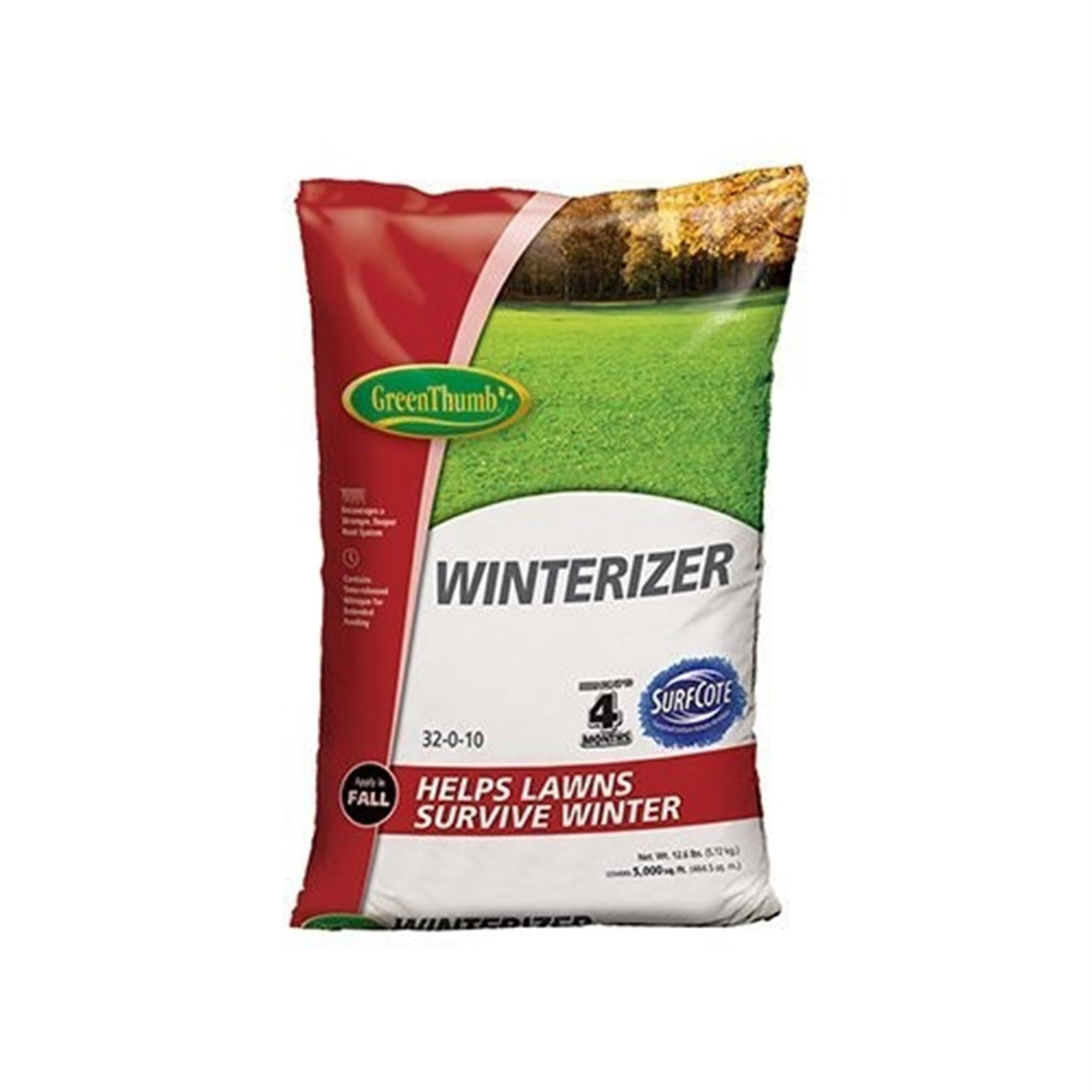
The Green Thumb GT58105 is the closest product in the list to a true 32-0-10 winterizer, with 50% of its nitrogen in controlled-release form—meaning it delivers steady root-feeding nutrition over a 16-week window. That extended release window is exactly what a cool-season lawn needs heading into dormancy; you get root development without forcing a growth spurt that frost would kill. The 2% iron content adds noticeable darkening within a week of application, giving the lawn a deep green appearance without pushing aggressive leaf elongation.
Coverage comes in at 5,000 square feet for the 12.6-pound bag, which puts it right in the sweet spot for average suburban front yards. Users report spreading it in late October to November, watering it in for a few minutes daily over the first month, then seeing a noticeably thicker, greener lawn the following April. The zero-phosphorus formulation also makes it compliant in states with phosphorus restrictions on residential lawns.
The granular texture is fine enough to pass through most rotary spreaders without clogging, though a drop spreader requires a bit more patience to avoid overlap streaks. A few owners noted the bag could be heavier for the coverage, but the nutrient density per pound is higher than budget blends. For a dedicated fall/winterizer application, this product checks every box a discerning lawn owner would prioritize.
What works
- 16-week sustained nitrogen release for deep root feeding
- 2% iron provides visible darkening without growth surge
- Zero phosphorus protects waterways and works under local restrictions
- Fine granule size spreads evenly with rotary spreaders
What doesn’t
- Bag size covers only 5,000 sq ft—large lawns need multiple bags
- Some drop spreader users report light streaking if application speed varies
2. Pennington Full Season Lawn FERT 12M 32-0-5 RF
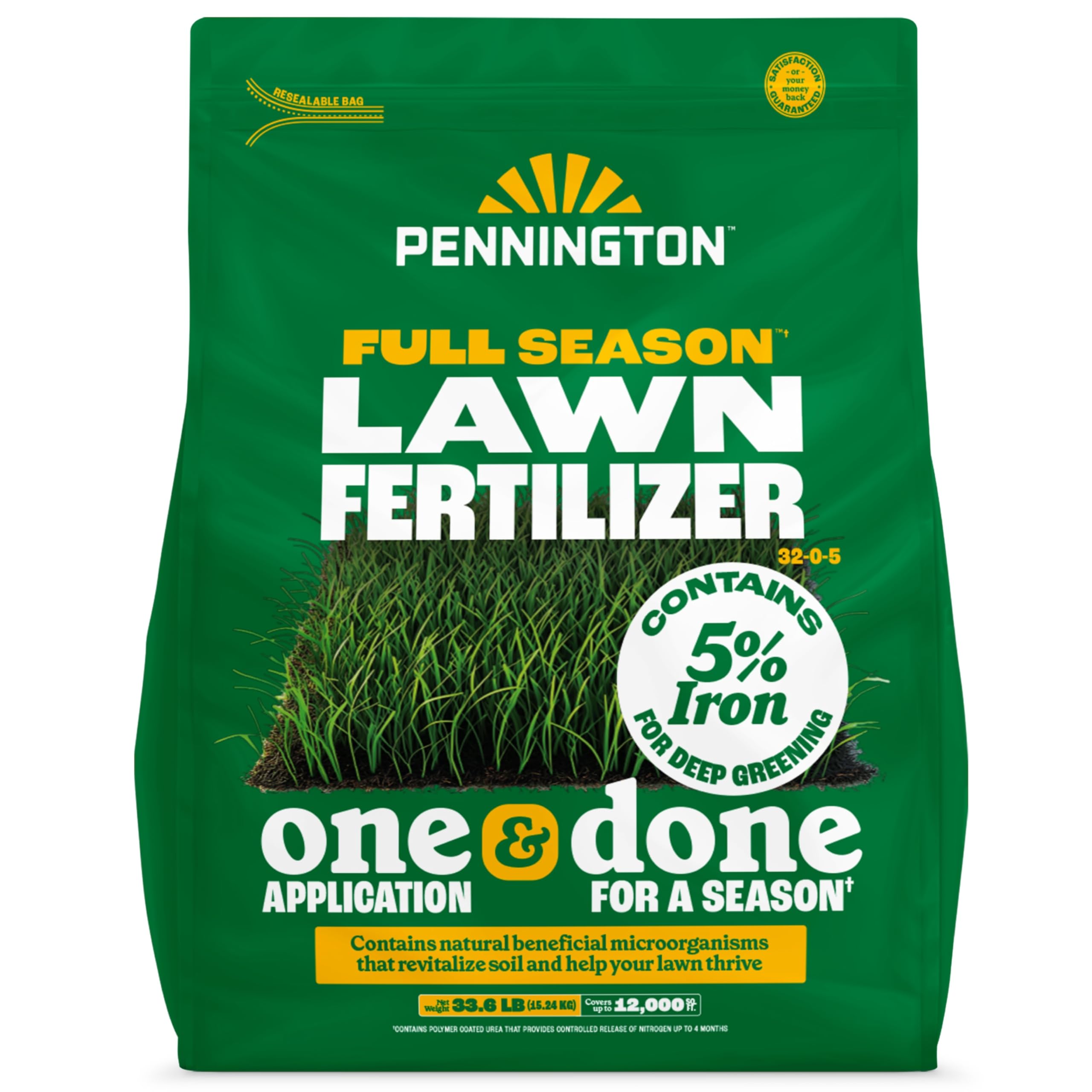
The Pennington Full Season formulation (32-0-5) swaps the typical 10 potassium for 5, but it compensates with two features that matter for owners who hate reapplying mid-season: polymer-coated urea that meters out nitrogen over four months, and 5% iron—the highest concentration in this roundup. On warm-season grasses like Bermuda, reviewers describe a nearly instant color shift to dark green that persists weeks longer than quick-release blends. The polymer coating works by releasing nutrients proportional to soil temperature, which prevents the flush-and-fade cycle common with cheaper urea-only products.
Coverage is listed at 12,000 square feet from the 33.6-pound bag, making it the most efficient option for larger properties. The formula also includes natural beneficial microorganisms meant to revitalize soil biology, though the real-world impact of those microbes is difficult to separate from the nitrogen response. Owners consistently praise the sustained green color—most report still seeing results at the 8-week mark with no need for a booster application.
The main tradeoff is availability: Pennington restricts shipment to Hawaii and South Dakota, so residents of those states need to look elsewhere. A few buyers also noted the bag weight per square foot feels lighter than competing products, but since the nutrient release is temperature-activated, the total nitrogen delivered over four months is comparable to heavier bags with lower efficiency coatings. For a single-application season-long strategy, this product delivers on its promise.
What works
- 4-month polymer-coated urea eliminates mid-season reapplication
- 5% iron content produces the deepest color response in the lineup
- 12,000 sq ft coverage reduces per-application cost for large lawns
- Soil temperature release prevents surge growth patterns
What doesn’t
- Potassium at 5 is half of a traditional winterizer’s K value
- Not shippable to Hawaii or South Dakota
3. GreenView Fairway Formula Lawn Fertilizer

The GreenView Fairway Formula uses a 33-pound bag with 63% of its nitrogen in slow-release form—the highest slow-release ratio in this guide. That means less nitrogen is lost to leaching or volatilization, and the lawn receives a steady supply for up to 12 weeks. The NPK ratio is not stamped as exact 32-0-10, but the high-nitrogen and zero-phosphorus composition aligns closely with the winterizer philosophy. The 33-pound bag covers 10,000 square feet, which places it in the same large-lawn tier as the Pennington but with a heavier physical bag weight per square foot.
Owners report seeing a visible darkening within three to five days of application, especially after a good rain or irrigation event. The slow-release profile prevents the yellow-then-burn sequence that happens when high quick-release nitrogen hits dry soil. Bermuda and carpet grass users specifically praise the even greening without the striped pattern that poorly formulated blends can cause on warm-season turf. The lack of phosphate also means it meets waterway protection standards without extra paperwork.
The granule size runs slightly larger than the Green Thumb product, so a drop spreader needs a wider opening setting to avoid under-delivery. A few users mentioned the bag does not include a built-in handle, making it awkward to carry from garage to spreader. Still, for the price per thousand square feet, this is one of the most economical ways to apply a high slow-release nitrogen dose to a mid-to-large lawn.
What works
- 63% slow-release nitrogen minimizes leaching and burn risk
- 10,000 sq ft coverage suits medium-to-large lawns in one bag
- Phosphate-free formulation works under environmental restrictions
- Fast color response within 3-5 days of watering
What doesn’t
- Large granules may require spreader adjustment for even distribution
- Bag lacks ergonomic handle for easy carrying
4. Petramax Liquid Nitrogen Fertilizer 28-0-0

The Petramax Liquid 28-0-0 offers a 70/30 split between quick-release and slow-release nitrogen, which means it delivers a visible green-up in about 3 to 5 days while the slower portion continues feeding between applications. At 28-0-0 it is not a precise 32-0-10 match, but the high-nitrogen liquid format makes it a practical alternative for owners who prefer spraying over spreading. The 32-ounce bottle dilutes to cover up to 12,800 square feet at the maintenance rate, making this the highest coverage-per-container product in the group.
Liquid fertilization bypasses the granule distribution challenges of uneven spreader patterns, especially on slopes, small irregular patches, or new lawns where you want precise placement. The formula mixes easily with water and works through standard hose-end sprayers or backpack sprayers without clogging. Reviews from users on St. Augustine and Bermuda turf confirm steady darkening over the first week, with runners beginning to fill patchy areas by week two. The 30% slow-release component reduces the need for weekly reapplications compared to pure quick-release liquids.
The tradeoff is the zero potassium content—if your soil test shows low K levels, you will need to supplement with a separate potassium source. Also, because 70% of the nitrogen is quick-release, applying during a dry spell without irrigation increases the risk of leaf burn on sensitive grass types. For a fast-response high-nitrogen liquid that covers a lot of ground per bottle, the Petramax delivers excellent cost efficiency.
What works
- High coverage per bottle saves money on small-to-medium lawns
- Liquid format enables spot treatment and slope application
- 30% slow-release component extends feeding window
- Works with all common sprayer types without nozzle clogging
What doesn’t
- Zero potassium means K-deficient soils need a separate supplement
- 70% quick-release requires careful watering to avoid burn
5. Scotts Turf Builder Lawn Food 38-0-4
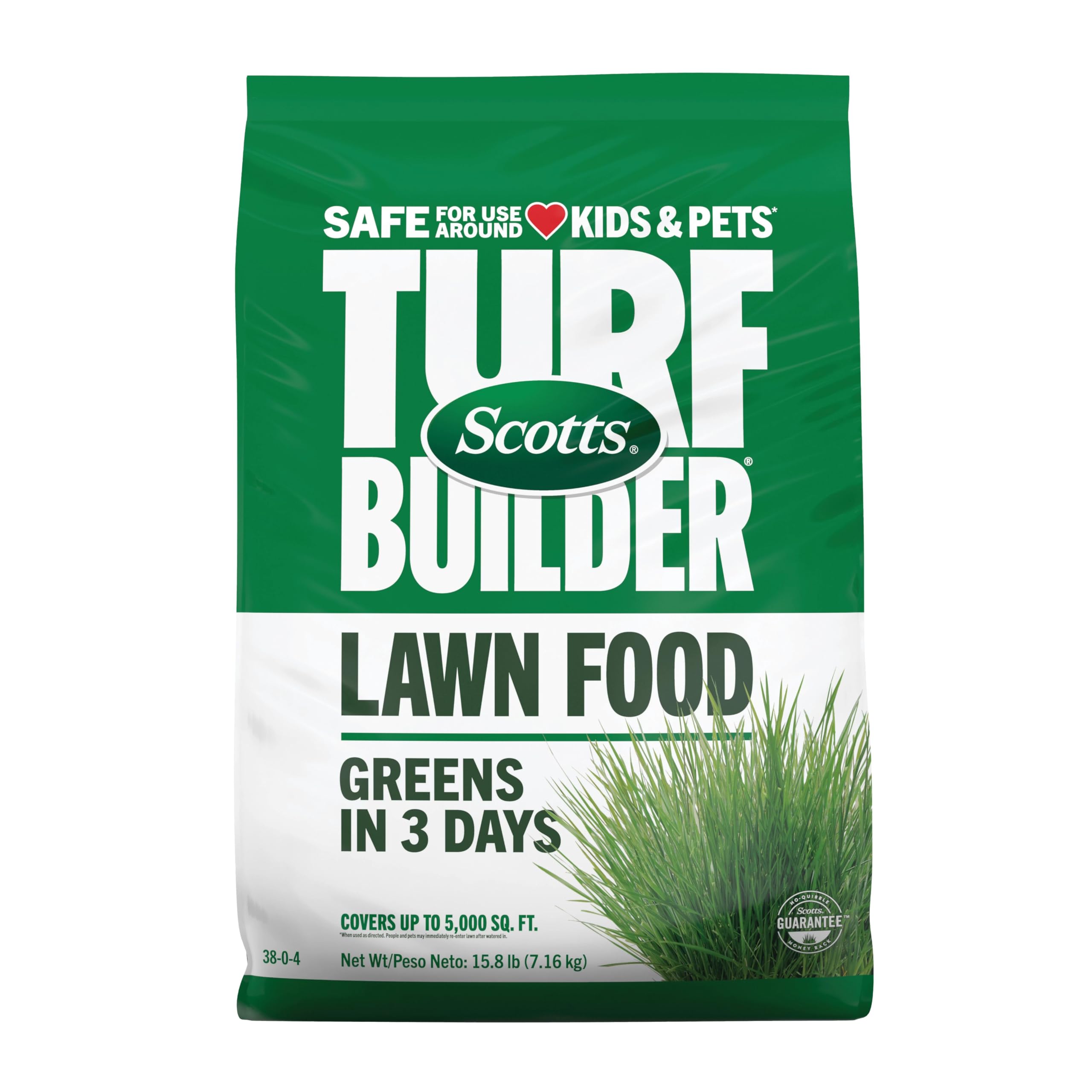
The Scotts Turf Builder Lawn Food at 38-0-4 is designed around speed of greening rather than extended feeding. Scotts markets this for visible results in three days, and the high quick-release nitrogen fraction delivers exactly that—a rapid chlorophyll flush that satisfies the ego of any homeowner wanting an immediate transformation. The 15.8-pound bag covers 5,000 square feet and uses a double spreader setting that offers either a standard feeding rate or a “Max Greening” rate for deeper color. It works on all grass types at the standard rate, though the maximum setting should be reserved for established lawns with consistent irrigation.
User feedback is overwhelmingly positive on the speed of color change, with many reviews mentioning greener grass within the first week. The product is labeled safe for kids and pets once watered in, which adds convenience for families who want the lawn back in use quickly. The 4 potassium is low compared to dedicated winterizers but acceptable for a mid-season booster when K levels are not a limiting factor.
The main drawback for anyone seeking a true winterizer is the N-P-K mismatch: 38-0-4 is a growth-phase formula, not a dormancy-prep formula. Applying it in late fall could stimulate top growth that gets killed by frost. Also, the quick-release nitrogen means more frequent mowing during active growth, and some users in drier conditions reported uneven green-up or patchy results if rain did not follow within 24 hours. For spring and summer greening, it is one of the most reliable consumer-grade options.
What works
- Visible color improvement reported in 3 days
- Two spreader settings for standard or max greening
- Safe for kids and pets after watering
- Compatible with all grass types at standard rate
What doesn’t
- 38-0-4 is a growth formula, not ideal for fall winterization
- High quick-release N requires rain or irrigation within 24 hours
6. Scotts Liquid Green Max Lawn Food

The Scotts Liquid Green Max combines a liquid fertilizer with an iron supplement in a hose-end sprayer format, making it the most convenient product in this roundup for owners who want to avoid spreaders altogether. The 32-ounce bottle covers 2,000 square feet—a smaller area than the granule products—but the effort-to-result ratio is exceptional: connect the bottle, turn on the water, spray, and you are done. The formula is designed for any grass type, including St. Augustine and Bermuda, and the iron component produces a deep green that reviewers consistently describe as “golf-course” quality.
Owner feedback across multiple climates—from upstate New York to Texas to Georgia—confirms that the darkening effect appears within 5 to 7 days, with runners actively filling thin spots on St. Augustine lawns. The liquid format also allows you to target specific patchy areas without wasting product on parts of the lawn that already have adequate color. Because it is a liquid, the nutrients are available to the grass immediately after application, assuming the lawn is already moist or you water it in.
The tradeoff is limited per-bottle coverage and the need to reapply more frequently than a slow-release granular. At 2,000 square feet per bottle, a 5,000-square-foot lawn requires three bottles for a single feeding. The product also contains no phosphorus or potassium, making it a pure color-and-growth tool rather than a balanced maintenance feed. For quick cosmetic greening between granular applications, the Liquid Green Max is hard to beat in ease of use.
What works
- Effortless hose-end application with no spreader needed
- Iron delivers visible darkening on St. Augustine and Bermuda
- Spot-treatment capability for patchy lawns
- Works in cold climates—survives upstate NY winters
What doesn’t
- Only 2,000 sq ft per bottle—large lawns need multiple units
- No phosphorus or potassium—requires separate balanced feeding
Hardware & Specs Guide
Slow-Release vs Quick-Release Nitrogen
The coating technology on the urea granule determines release duration. Polymer-coated urea (Pennington) releases based on soil temperature and moisture, lasting up to 4 months. Sulfur-coated urea (found in many winterizers) provides a 6- to 10-week window. Products without coating, like standard Scotts 38-0-4, are nearly 100% quick-release—the nitrogen dissolves in water within days and must be taken up quickly by the grass or it leaches away. For a 32-0-10 fertilizer, look for at least 40% slow-release if you want steady feeding through the fall.
Iron Content and Color Response
Iron (Fe) in fertilizer acts as a catalyst for chlorophyll production without pushing stem elongation. A concentration of 2% to 5% is typical for high-nitrogen winterizers. The iron works best when applied to moist soil and followed by light watering. Darkening is usually visible within 3 to 7 days. Over-application of iron can cause dark spotting on hardscapes or concrete if overspray occurs, so it is worth sweeping granules off driveways immediately after spreading.
Coverage Calculations
Granular fertilizer bags list coverage at a specific application rate, usually between 1 and 1.5 pounds of nitrogen per 1,000 square feet. To calculate how many bags you need: measure your lawn’s total square footage (length x width for rectangles, pie-slice formulas for odd shapes) and divide by the labeled coverage. For example, a 10,000-square-foot lawn needs two bags of a 5,000-square-foot product or one bag of a 10,000-square-foot product. Buying too large a bag means leftover product may cake or degrade if not stored in a cool, dry place.
Spreader Settings for 32-0-10 Granules
Most rotary spreaders (Scott’s EdgeGuard, Lesco, Earthway) require a setting between 4 and 6 for fine winterizer granules. Drop spreaders typically need a wider opening—often setting 8 to 10—because the smaller granules flow less freely. Always calibrate by applying a test strip over a known area (e.g., 10 feet x 10 feet) and checking the amount dispensed. If you see dark green stripes or yellow gaps, adjust the opening in 0.5-point increments. Liquid products bypass this issue entirely.
FAQ
Can I use a 32-0-10 fertilizer on warm-season grass in early spring?
How long should I wait after applying 32-0-10 before letting my dog on the lawn?
What does the zero mean in 32-0-10, and why should I care?
Should I apply 32-0-10 before or after a rain?
Final Thoughts: The Verdict
For most gardeners, the 32-0-10 fertilizer winner is the Green Thumb GT58105 because it balances 50% slow‑release nitrogen with 2% iron for a targeted winterizer application that delivers deep color and root growth without surge. If you want a single application to last all season without reapplying, grab the Pennington Full Season 32-0-5 with its polymer‑coated urea and 5% iron content. And for the best per‑bottle coverage on a budget, nothing beats the Petramax Liquid 28-0-0 for small to medium lawns that need a quick color lift.