
Thatch—the dense layer of dead grass, roots, and organic debris that builds up between the soil and your lawn’s living blades—chokes your turf, blocks water penetration, and invites disease. A dedicated dethatching blade slices through that accumulation without gouging your yard, but choosing the wrong one means wasted passes, scalped patches, or a blade that dulls after a single use. The difference comes down to tine material, working width, and depth adjustability.
I’m Rikta — the co-founder and writer behind Lawn Gear Lab. This guide compiles hundreds of hours of spec analysis, cross-referencing motor amperage, tine count, RPM curves, and collection bag ratings against verified owner experience to separate real performers from overpriced or underbuilt options.
Whether you’re reviving a neglected lawn or maintaining a healthy turf, finding the right tool means understanding core metrics like width, power, and depth control. Here is your complete analysis of the dethatch blade for lawn mower market.
How To Choose The Best Dethatch Blade For Lawn Mower
A dethatching blade is fundamentally different from a standard mowing blade. It uses spring tines or metal fingers to comb through the top layer of soil, raking out dead material without cutting live grass. Understanding blade design, power delivery, and depth control will prevent a wasted purchase.
Motor Power and RPM
Amperage determines how aggressively the blade can bite into compacted thatch. Entry-level units with 12A motors manage light to moderate thatch on typical residential lawns, while 13A and above provide consistent torque for thick, neglected build-up. RPM—usually 3,000 to 3,800—dictates how many times the tines strike the ground per minute; higher RPM cleans deeper in fewer passes.
Working Width and Collection Capacity
A wider cutting path (13 to 16 inches) reduces the number of overlapping passes, cutting total job time. The trade-off is that a wider swath demands more power to stay engaged. Collection bag size is just as critical—a 30-liter (8-gallon) bag fills in minutes on thick thatch, so larger bags (10.5+ gallons) reduce trips to the compost pile or the need to rake debris afterward.
Depth Adjustment and Blade Type
Look for at least four depth positions that let you start shallow and work deeper as you assess the thatch layer. Units that combine dethatching and scarifying blades in one package offer flexibility: the dethatcher lifts surface debris, while the scarifier cuts vertical grooves for seed and water infiltration. Tool-free blade swaps save significant time when switching functions mid-job.
Quick Comparison
On smaller screens, swipe sideways to see the full table.
| Model | Category | Best For | Key Spec | Amazon |
|---|---|---|---|---|
| Earthwise DT71613AA | Standalone Dethatcher | Large lawns with heavy thatch | 13A motor, 16″ width, 10.5 gal bag | Amazon |
| Westinghouse W13ADAC | Standalone Dethatcher | Slice-aeration & deep thatch pull | 12A motor, 13″ width, 8 gal bag | Amazon |
| TIECTOWN LM01 | Standalone Dethatcher | Quick blade swaps mid-job | 13.5A motor, 14″ width, 11.5 gal bag | Amazon |
| MAXLANDER 13″ | Standalone Dethatcher | Compact storage & light maintenance | 12A motor, 13″ width, 30L bag, foldable | Amazon |
| ZEGJAW WR-5011 | Standalone Dethatcher | High RPM on moderate thatch | 12A motor, 13″ width, 30L bag, 3300 RPM | Amazon |
| OKKMAX 13″ | Standalone Dethatcher | Small yards & budget entry | Brushless motor, 13″ width, 2-year warranty | Amazon |
| Oregon 690-521-0 | Retrofit Blade | Converting a gas mower to dethatch | Alloy steel, 20″, universal fit, spring tines | Amazon |
In‑Depth Reviews
1. Earthwise DT71613AA 13-Amp 16-Inch Corded Dethatcher

The Earthwise DT71613AA stands out for its 13-amp motor paired with a 16-inch working width—the widest path in this lineup. On a half-acre lot with neglected thatch, it pulls itself forward without bogging, thanks to the zinc-plated piano-wire spring pins that resist deformation over repeated passes. The 10.5-gallon collection bag is the largest here, but even that fills fast on thick debris; many owners prefer to skip the bag and let the mower collect loosened material afterward.
Depth adjustment spans -0.4 to +0.4 inches, giving you enough range to scratch the surface or dig into compacted roots. Switching between the dethatcher and scarifier blades is straightforward, though the front height-adjustment lever feels flimsy—it shifted during heavy use for some owners. The unit weighs 34.3 pounds, which is heavier than most competitors, but that weight aids stability when cutting deep.
For a homeowner facing heavy, multi-year thatch buildup on a medium-to-large lot, the Earthwise delivers the most aggressive bite and widest coverage at a reasonable investment. The bag fills in roughly ten feet on deep thatch, so factoring in a separate leaf blower or mower collection pass is wise. The 13A motor handles 100-foot extension cords without noticeable power drop if you use a 12-gauge wire.
What works
- Widest 16-inch working width minimizes passes
- 13A motor maintains torque through thick thatch
- Large 10.5-gallon bag reduces emptying frequency
What doesn’t
- Front depth lever feels loose during aggressive use
- Bag fills in seconds on deep thatch, requiring extra cleanup
- Heavier build can feel sluggish on steep slopes
2. Westinghouse W13ADAC 13″ 12-Amp 2-in-1
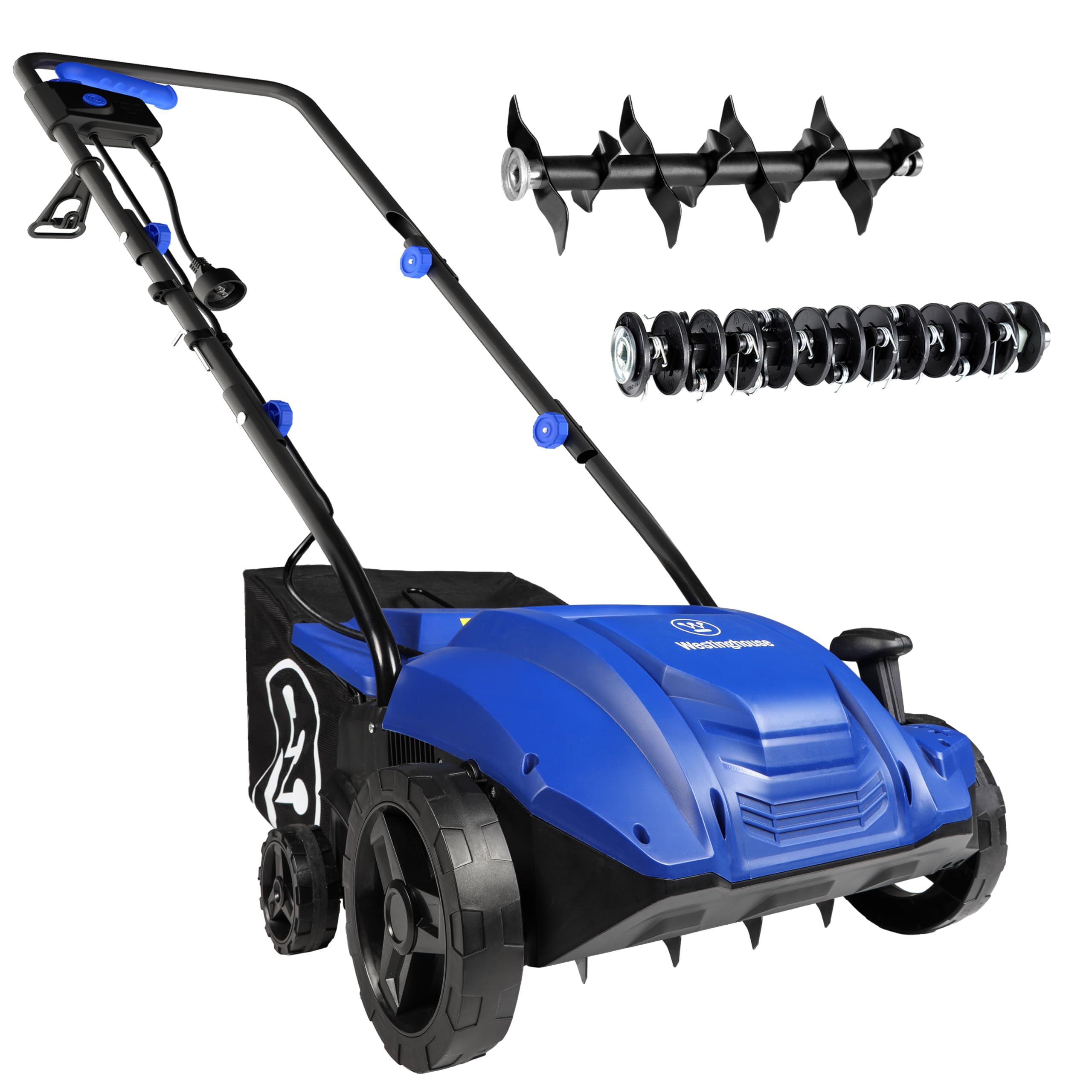
The Westinghouse W13ADAC distinguishes itself by including a dedicated slice aerator blade—a steel tool that cuts narrow channels into compacted soil, improving air and water infiltration without the mess of plug aerators. The 12-amp motor spins at 3,000 RPM, adequate for moderate thatch layers but may require a second pass on neglected turf. The 13-inch working width is standard for this class, and the 8-gallon collection bag fills rapidly, often within a few passes on heavy debris.
Assembly instructions are minimal, but the physical layout is intuitive: the blade swap uses a single Allen wrench, and the 4-position depth lever adjusts from -0.5 to +0.16 inches. Weighing 22.9 pounds, it is light enough for easy maneuvering, and the foldable handle simplifies garage storage. Owners running a 50-foot standard extension cord report no power loss; longer runs require a heavier 12-gauge cord and a 30-amp outlet to maintain voltage.
Where the Westinghouse shines is the dual-function value: you get dethatching and slice aeration in one machine at a mid-range price. For yards with compacted soil where overseeding is planned, the scarifier blade creates better seed-to-soil contact than a dethatcher alone. The trade-off is a smaller bag and a motor that struggles slightly if the thatch exceeds two inches in depth.
What works
- Slice aerator blade improves soil penetration for seeding
- Lightweight frame eases maneuverability
- Dual-function design eliminates need for separate aerator
What doesn’t
- 8-gallon bag fills too fast on heavy thatch
- Assembly instructions lack detail
- Motor struggles on very deep thatch layers
3. TIECTOWN LM01 14-Inch 13.5-Amp 2-in-1
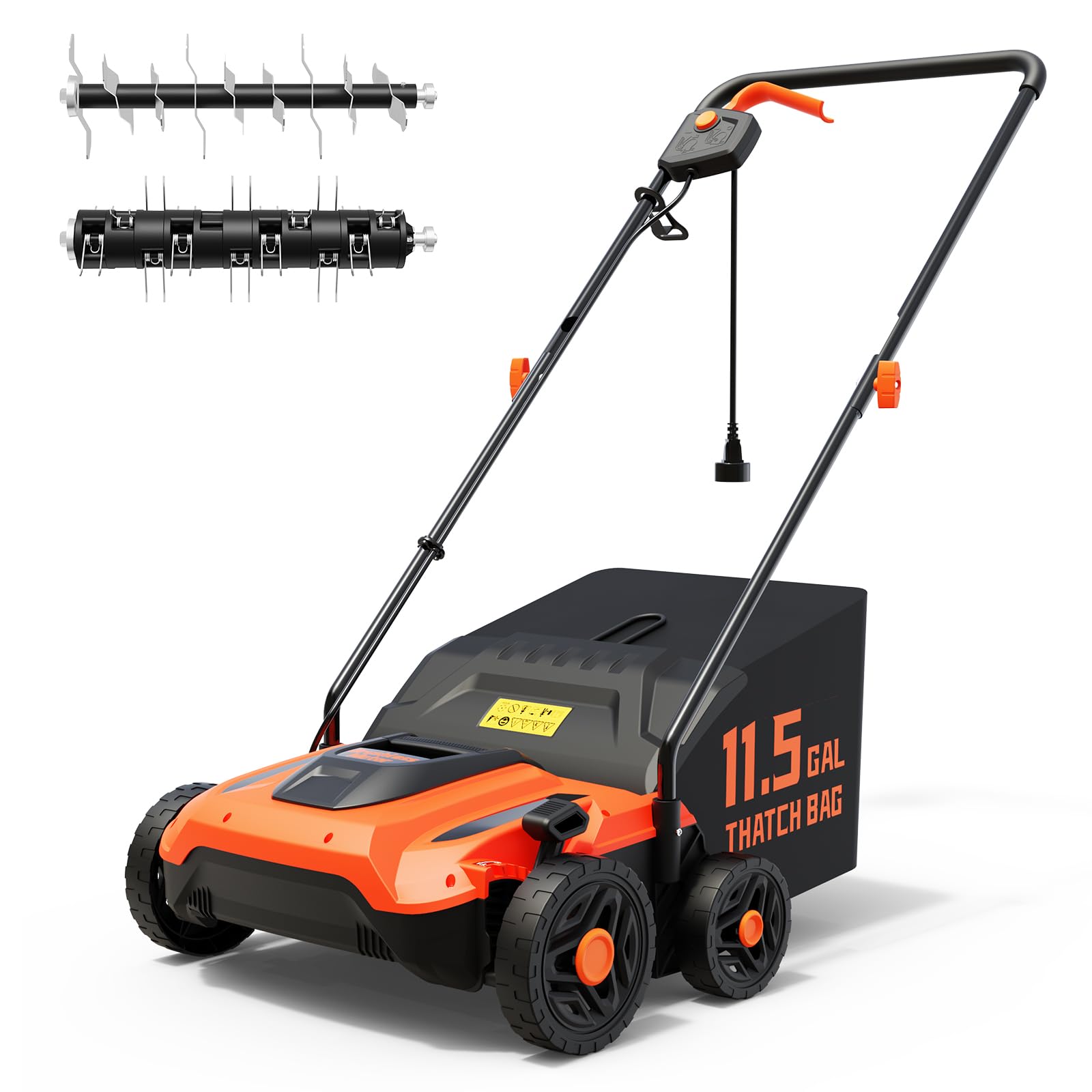
The TIECTOWN LM01 packs a 13.5-amp peak brushless motor that spins at 3,800 RPM with a 14-inch rake path—the highest power-to-width ratio in this comparison. The quick-release mechanism lets you switch between dethatching and scarifying blades without tools, a feature that saves five minutes per swap compared to models requiring wrenches. Five depth positions give precise control from -0.47 to +0.24 inches for scarifying and -0.32 to +0.39 for dethatching.
The 11.5-gallon collection bag is only slightly smaller than the Earthwise unit, but the machine weighs just 21 pounds, making it noticeably easier to push and lift over uneven terrain. The handle adjusts in three positions to accommodate different operator heights, and a built-in cord clip prevents the power cable from pulling the machine sideways during turns. Owners report assembly takes about 20 minutes, with all tools included.
The only consistent complaint involves the plastic trigger lever and push-button safety—they feel cheaper than the rest of the build and some users worry about long-term durability. At this power level, the LM01 handles moderate-to-heavy thatch on lawns up to a half-acre without bogging. The 3-year manufacturer warranty provides additional confidence for frequent seasonal use.
What works
- Tool-free blade swap saves time
- 13.5A brushless motor delivers strong torque
- 5-position depth adjustment offers fine control
What doesn’t
- Plastic start lever feels less durable than metal alternatives
- Cord management still required despite clip
- Bag orientation must be checked for proper debris collection
4. MAXLANDER 13 Inch 12 Amp 2-in-1
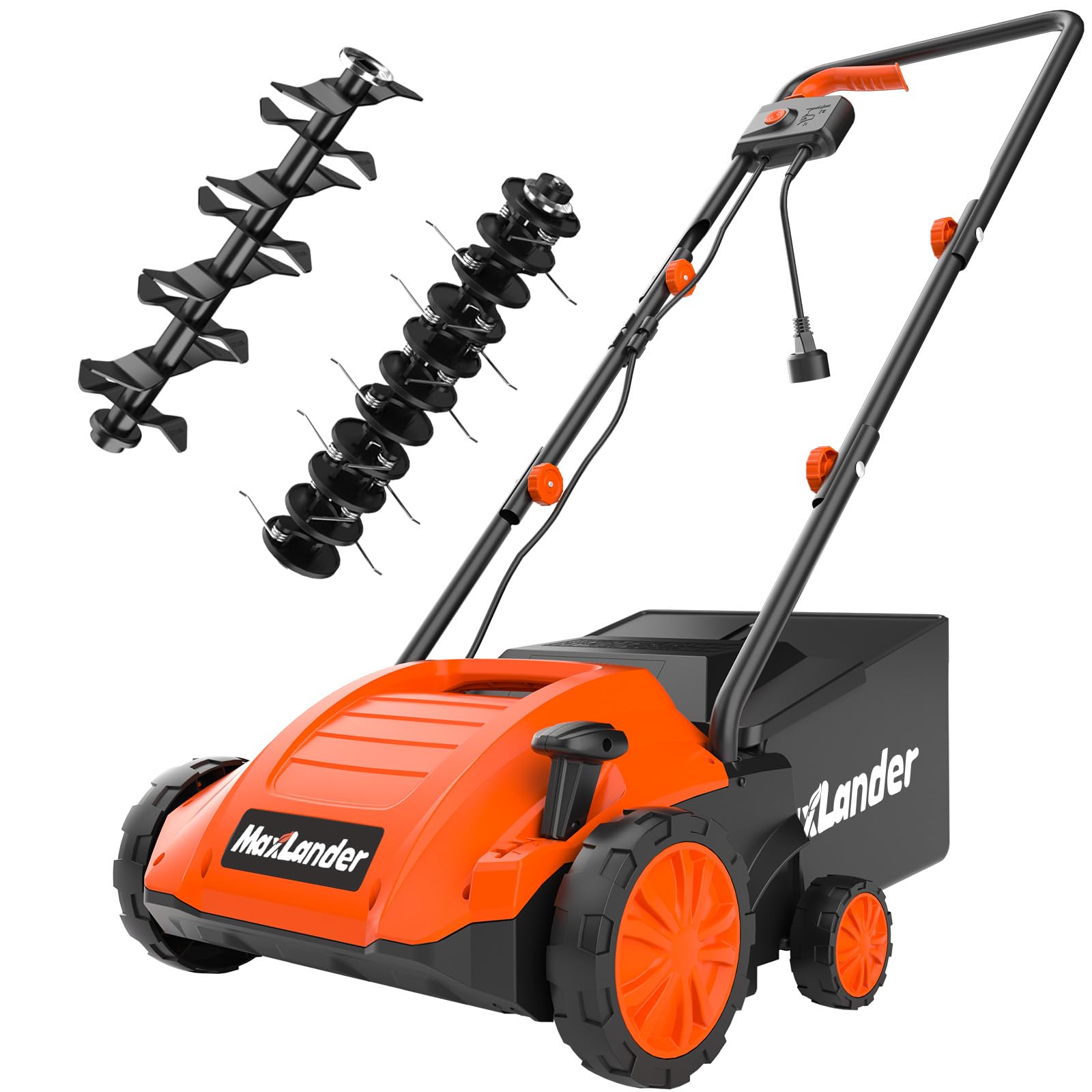
The MAXLANDER 13-inch dethatcher prioritizes storage convenience with a foldable handle that collapses without tools, shrinking the footprint to fit on a shelf or in a small shed. Its 12-amp copper-wound motor reaches 3,000 RPM, suitable for regular maintenance on lawns with light-to-moderate thatch accumulation. The 30-liter collection bag is the same capacity as several competitors, but the plastic housing feels lighter—20.3 pounds—which aids portability but raises concerns about long-term impact resistance.
Depth adjustment offers four positions, with the dethatching blade ranging from -0.47 to +0.16 inches and the scarifying blade from -0.6 to +0.2 inches. Dual safety switches prevent accidental startup, a feature appreciated by users storing the unit in tight spaces. Switching between the two included blades takes a few minutes with the provided hex key, though not as fast as the TIECTOWN’s tool-less system.
Owner feedback notes that only about half of the loosened material ends up in the bag on the first pass, requiring a second pass or a leaf blower to collect the rest. The handle is plastic and has been reported to crack on units subjected to rough handling or high-volume use. For a homeowner with a small lawn (under a quarter-acre) who values compact storage above raw collection efficiency, the MAXLANDER provides a functional balance.
What works
- Foldable handle saves significant storage space
- Lightweight frame is easy to carry and maneuver
- Dual safety switches add protection
What doesn’t
- Bag only catches about half of debris on first pass
- Plastic handle prone to cracking under stress
- Motor lacks torque for thick, neglected thatch
5. ZEGJAW WR-5011 13” 12Amp 2-in-1
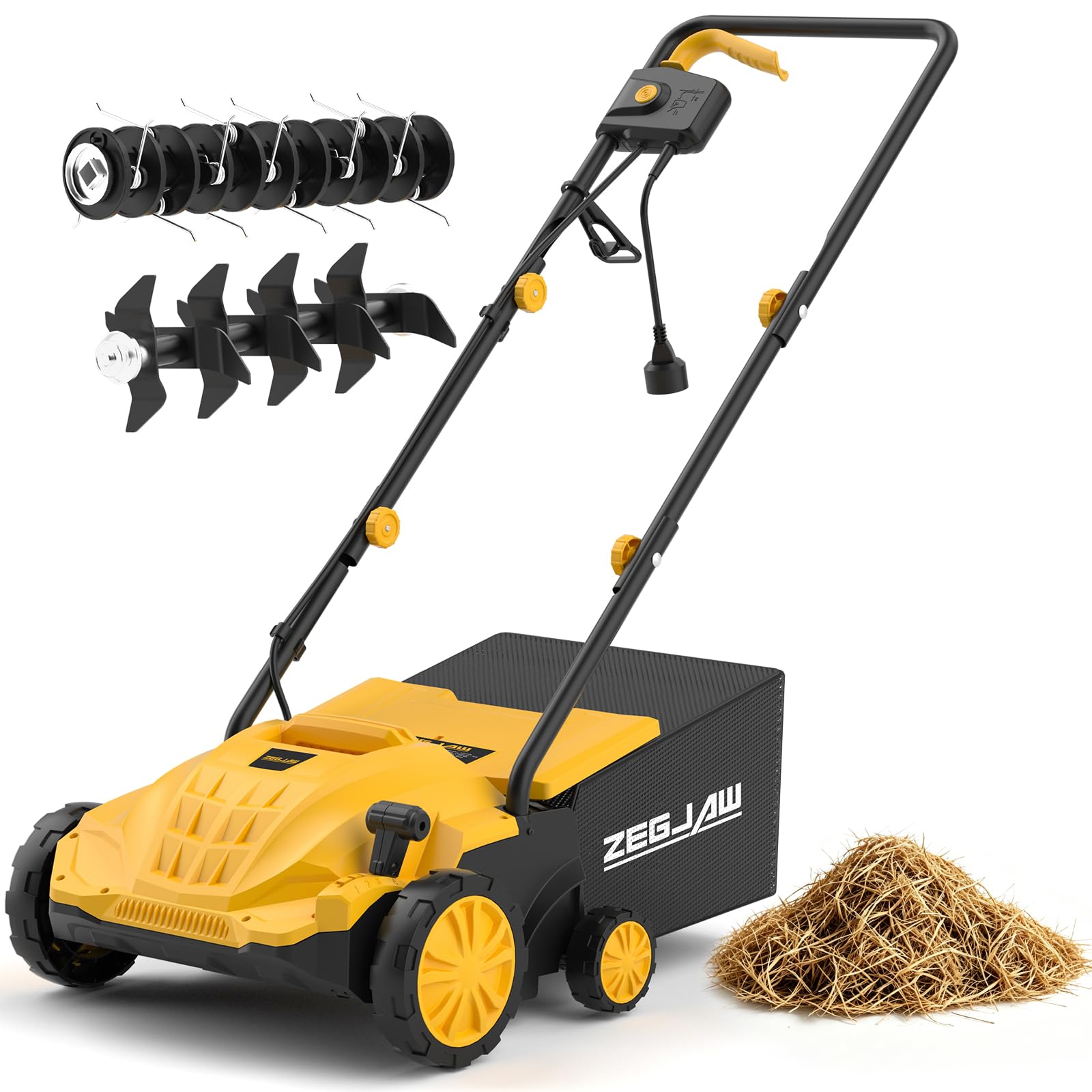
The ZEGJAW WR-5011 uses a 12-amp motor tuned for 3,300 RPM—300 RPM higher than similarly amped competitors—giving its tines more strikes per pass across the 13-inch cutting swath. On moderate thatch layers this translates to a cleaner strip in fewer passes, but the trade-off is noticeable vibration at maximum depth. The 30-liter collection bag matches the MAXLANDER in size and shares the same limitation: it fills quickly and doesn’t capture all debris, especially on the first pass over dense material.
Four depth positions adjust from -0.46 to -0.16 inches, a narrower range than the TIECTOWN or Earthwise models. The unit requires assembly, taking most owners around 20 minutes. At 23 pounds, the ZEGJAW is light enough for easy handling but still feels stable during operation. The interchangeable dethatching and scarifying blades are swapped via hex bolts rather than a quick-release mechanism, adding a few minutes to the transition.
Owner reports highlight effectiveness on turf-type lawns with embedded leaves and pine needles, where the higher RPM helps pull material that lower-speed units leave behind. The biggest weakness is edge coverage—the design leaves roughly six inches of uncut thatch along fences and walls, requiring a manual rake or blower for finishing. For central-lawn cleaning where speed per pass matters, the ZEGJAW delivers solid value.
What works
- Higher RPM (3,300) improves cleaning on moderate thatch
- Lightweight frame reduces operator fatigue
- Effective on embedded debris like pine needles
What doesn’t
- Edge coverage leaves ~6 inches unprocessed
- Bag fills fast and misses debris on first pass
- Blade swap uses hex bolts, not tool-free
6. OKKMAX Electric Dethatcher Scarifier 13-Inch

The OKKMAX electric dethatcher is positioned as a budget-friendly entry point, but it includes a brushless motor—a component usually reserved for higher-tier models. Brushless motors generate less heat and run more efficiently than brushed equivalents, which extends operational life during longer sessions. The 13-inch working width is standard, and the collection bag is similar in size to the 30-liter units, though owners report it fills after only about 20 feet of pass on neglected turf.
Depth adjustment offers four positions, and swapping between the dethatching and scarifying heads is straightforward, though the plastic build quality is evident in the handle and chassis. Weighing 25 pounds, the OKKMAX feels solid enough for flat, small-to-medium yards but flexes noticeably when twisting on uneven ground. The dual safety switch design mirrors the MAXLANDER’s layout, preventing accidental startup.
Owner feedback from users with zoysia and Bermuda grass lawns indicates that the dethatcher performs well on moderate thatch layers, but the scarifier head is better suited for loosening soil prior to overseeding than for deep thatch removal. The primary value is the brushless motor at a price point where most competitors use brushed motors, combined with a 2-year warranty that backs the investment. For a first-time buyer on a small lawn, the OKKMAX offers a risk-tolerant entry.
What works
- Brushless motor improves longevity and efficiency
- Light enough for easy transport and storage
- 2-year warranty provides budget-friendly peace of mind
What doesn’t
- Plastic build feels less durable than steel-framed options
- Bag fills in 20 feet on heavy thatch
- Limited depth range compared to premium models
7. Oregon 690-521-0 Universal 20″ Dethatcher Blade

The Oregon 690-521-0 is a retrofit blade, not a standalone machine. It replaces the standard cutting blade on most petrol lawn mowers with clamshell-style decks, converting them into pull-behind dethatchers. At 20 inches wide, it covers more ground per pass than any dedicated electric unit here, but its performance depends entirely on the host mower’s power and deck design. The kit includes the blade, an adapter kit with fittings and washers, and push-on spring tines.
The alloy steel construction stays sharp longer than stamped steel alternatives, and the universal fit pattern covers most major mower brands including Toro, Honda, and MTD. Installation requires removing the existing blade and mounting the dethatcher assembly—typically a 15-minute job. However, owners warn that getting the spring tines seated correctly takes patience; incorrectly installed springs can fly off during operation.
Once properly mounted, the Oregon blade effectively lifts moss, pine needles, and light-to-moderate thatch. The main limitation is depth control: you rely on the mower’s deck height adjustment, which offers less precision than a dedicated dethatcher’s multi-position lever. Some users report scalping if the mower deck is set too low. For someone who already owns a compatible gas mower and wants dethatching capability without buying a separate machine, this retrofit is a practical and budget-conscious solution.
What works
- 20-inch width covers ground faster than dedicated units
- Universal fit works with most gas mower decks
- Alloy steel blade stays sharp longer
What doesn’t
- Spring tines are finicky to install correctly
- No independent depth control beyond mower deck height
- Scalping risk if deck is set too low
Hardware & Specs Guide
Spring Tine vs. Fixed Blade
The type of contact surface determines how aggressively the tool interacts with thatch. Spring tines—curved wires made of piano wire or zinc-plated steel—flex on impact, reducing scalping risk on uneven ground. Fixed blades (often called scarifier blades) are rigid steel plates with teeth that cut vertical grooves. Spring tines are better for lifting surface debris, while fixed blades are essential for soil aeration and seedbed preparation. Most 2-in-1 units include both, but the interchange mechanism varies.
Amperage vs. Torque Curve
Motor amperage (12A to 13.5A) indicates peak current draw, but the torque curve—how consistently power is delivered across the RPM range—matters more for thick thatch. A 12A motor with a flat torque curve will pull through compacted debris better than a 13A motor with a steep drop-off at low RPM. Brushless motors (like the OKKMAX) maintain torque more efficiently than brushed motors, especially during extended sessions where heat buildup causes brushed motors to lose power.
FAQ
Can I use a dethatcher blade on a standard lawn mower?
How deep should I set the dethatching depth on my first pass?
What gauge extension cord do I need for a 12-amp electric dethatcher?
Is a dethatcher the same as a power rake?
Final Thoughts: The Verdict
For most gardeners, the dethatch blade for lawn mower winner is the Earthwise DT71613AA because its 16-inch working width, 13-amp motor, and large collection bag deliver the fastest, most aggressive clean on medium-to-large lawns. If you want a machine that also slice-aerates your soil for overseeding, grab the Westinghouse W13ADAC. And for compact storage and tool-free blade swaps, nothing beats the TIECTOWN LM01.