
An orange, powdery dust coating your lawn blades isn’t just a cosmetic headache — that’s lawn rust, a fungal disease that weakens grass and invites winterkill. Left untreated, it spreads fast through foot traffic and mower decks, turning a lush yard into a thinning, stressed mess that struggles through the next season.
I’m Rikta — the co-founder and writer behind Lawn Gear Lab. I have spent countless hours comparing active ingredients, studying label rates for turf and ornamentals, and analyzing thousands of verified owner reports so you get a fungicide that actually knocks out lawn rust without burning your grass or your budget.
Whether you need a fast-acting liquid concentrate or a slow-release granular option, this guide breaks down the best options to help you find the most effective fungicide for lawn rust for your specific turf type and treatment style.
How To Choose The Best Fungicide For Lawn Rust
Not every fungicide on the shelf can penetrate the leaf cuticle to stop rust from the inside. You need a systemic product with the right active ingredient, application method, and re-treatment schedule to fully eradicate the pustules releasing orange spores onto your turf.
Active Ingredient: Propiconazole Is The Standard
Propiconazole is a sterol-inhibiting (DMI) fungicide that moves systemically within the plant to protect new growth from rust, dollar spot, and brown patch. A concentration of at least 14.3% is ideal for curative control on established rust infections in Bermuda, fescue, and zoysia lawns.
Liquid Concentrate vs. Granular Slow-Release
Liquid concentrates enter the plant quickly through foliar uptake and deliver visible results in 24 to 48 hours when rust is active. Granular fungicides like The Andersons DG Pro release over several weeks and work best as a preventive application before conditions (cool, humid nights) trigger spore germination.
Resistance Management: Rotation Matters
Using the same FRAC code group repeatedly allows rust fungi to adapt. Alternate a propiconazole-based product with a QoI (strobilurin) fungicide like azoxystrobin every two to three applications. This practice keeps the active ingredients effective season after season and slows resistance development across your entire turf area.
Quick Comparison
On smaller screens, swipe sideways to see the full table.
| Model | Category | Best For | Key Spec | Amazon |
|---|---|---|---|---|
| Select Source Propiconazole 14.3 | Liquid Concentrate | Budget-friendly curative treatment | 14.3% Propiconazole | Amazon |
| Dow AgroSciences Eagle 20EW | Liquid Concentrate | Premium, rapid curative control | 20% Myclobutanil | Amazon |
| Quali-Pro Propiconazole 14.3 | Liquid Concentrate | MEC formulation, low odor | 14.3% Propiconazole MEC | Amazon |
| The Andersons Prophesy Propiconazole | Granular | Large-lawn preventive coverage | Propiconazole DG Technology | Amazon |
| Atticus Gunner 14.3 MEC | Liquid MEC Concentrate | Rainfast curative spray | 14.3% Propiconazole MEC | Amazon |
| Bonide Infuse Lawn & Landscape Granules | Granular | Systemic granular prevention | Azoxystrobin & Propiconazole | Amazon |
| Monterey Complete Disease Control | Bio-Fungicide Liquid | OMRI-listed organic control | Bacillus amyloliquefaciens | Amazon |
In‑Depth Reviews
1. Quali-Pro 83013366 Propiconazole 14.3 Fungicide

The Quali-Pro 14.3 MEC formulation delivers a microemulsion that stays stable in the tank, won’t separate during a long spray session, and coats every blade with locally systemic propiconazole. Owners report stopping white and brown patch on Bermuda grass after a single application — a clear indicator of curative potency against rust pustules as well. The 32-ounce bottle provides enough concentrate to cover roughly 16,000 square feet at a standard curative rate, which positions it as a strong value in the premium tier.
The low-odor profile is a practical advantage during back-to-back early morning or evening applications when rust is most visible and dew is still on the grass. Users treating St. Augustine sod for silver leaf and brown patch noted that it outperformed less concentrated big-box alternatives when alternated with a granular product every two weeks over an eight-week window. The absence of heavy mixing agitation also simplifies tank preparation for homeowners who prefer a dialed-in hose-end sprayer.
One reviewer did note that it proved less effective on St. Augustine fungus than alternative products, which suggests matching the FRAC code to your specific rust strain matters. However, for standard lawn rust on Bermuda, fescue, and zoysia, the MEC formulation provides fast curative action with residual control lasting up to 28 days.
What works
- Stops brown patch and rust after one or two applications
- Low-odor MEC won’t separate in the spray tank
- Bottle lasts 4-5 years for most residential lawns
What doesn’t
- May require alternation with a different active for St. Augustine
- Label instructions are dense — careful mixing measurements needed
2. Dow AgroSciences 173917 Eagle 20EW Fungicide

Eagle 20EW uses myclobutanil, a systemic triazole fungicide with 20% active ingredient concentration — a full 5.7% higher than standard propiconazole products. This higher concentration translates into faster curative knockdown on active rust pustules. Users treating powdery mildew, shot-hole disease, and rust on ornamental turf report visible suppression after the first spray with follow-up applications eliminating the problem entirely within 14 to 30 days.
The product is well tolerated by most cool and warm season turf species, and it also covers landscape ornamentals, fruit trees, and nursery plants. One owner successfully mixed it with imidacloprid and liquid fertilizer to treat a red oak, eliminating blight and insect damage for a full year. Eagle 20EW’s systemic action protects new growth from the inside, which directly addresses the way rust fungi colonize expanding leaf tissue.
On the downside, the mixing instructions use agricultural units (ounces per acre per 100 gallons), which requires a calculator and careful conversion for a typical 1,000-5,000 square foot lawn. PPE is mandatory, as myclobutanil is a powerful DMI that demands gloves, goggles, and long sleeves during handling.
What works
- 20% active ingredient delivers aggressive curative action on rust
- Systemic protection reaches new growth and leaf tips
- Effective on turf, ornamentals, and fruit trees
What doesn’t
- Agricultural unit conversion complicates small lawn mixing
- Requires full PPE during handling and application
3. The Andersons Prophesy Propiconazole 25lb Granules
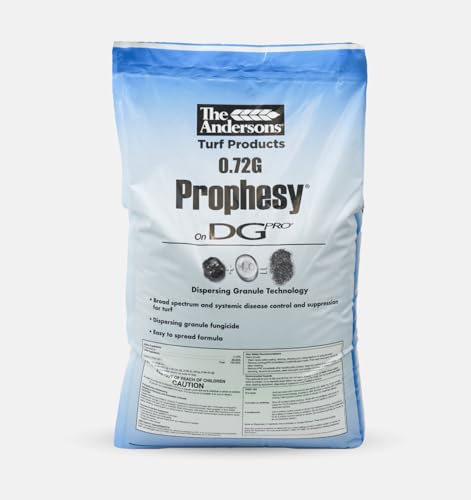
The Andersons Prophesy uses patented DG Technology that crushes the active ingredient particles into a fine dust that adheres to each granule, delivering many more particles per square foot than standard granular fungicides. This translates to more uniform coverage and consistent systemic suppression of rust, brown patch, and snow mold across a 10,000 square foot area. The 25-pound bag is heavy, but a single application knocks out red thread and necrotic ring spot according to verified owners.
One user reported that their lawn had necrotic ring spot that kept getting worse despite repeated treatments with other products. A single application of Prophesy combined with top soil stopped the ring spot entirely, allowing the turf to recover. The granular format is particularly convenient for large lawns where spraying a liquid concentrate across 10,000+ square feet is time-prohibitive and requires dialing in a boom or hose-end sprayer.
The price has increased in recent years, and some owners question the value compared to buying a concentrate and spraying themselves. Additionally, the product works best as a preventive or early-curative treatment — if you already see heavy orange spores blanketing the blades, a liquid concentrate will deliver faster results.
What works
- DG Technology delivers maximum coverage per square foot
- Effective for preventive control of rust, snow mold, and ring spot
- Granular format works with a standard broadcast spreader
What doesn’t
- Slower curative speed than liquid concentrate for active rust
- Bag price is high relative to concentrate alternatives
4. Atticus Gunner 14.3 MEC Propiconazole Fungicide
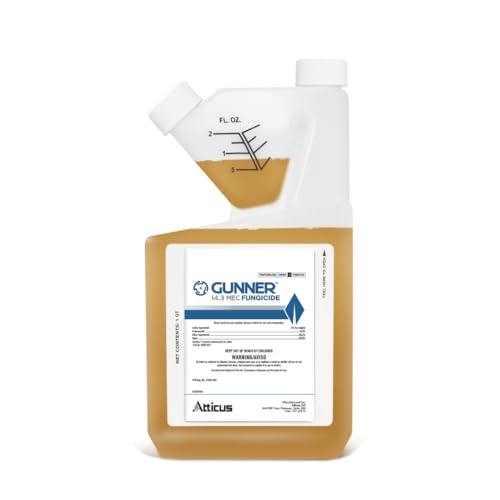
The Atticus Gunner 14.3 MEC uses the microemulsion concentrate technology from the same line as Quali-Pro, offering low-odor handling and superior tank stability. Once the spray dries on the leaf surface, it resists wash-off from rain or irrigation, making it a strong choice for regions with unpredictable spring and fall weather when rust spores germinate readily on wet turf. The broad-spectrum label covers brown patch, dollar spot, blights, powdery mildew, and all common rusts.
Users treating centipede and Bermuda grass during early season preventative applications report that Gunner stops the visual spread of rust pustules within the first week. One reviewer successfully treated a 12,000 square foot lawn using the 32-ounce bottle at standard rates and reordered immediately, confirming that the MEC formulation provides consistent results. The tank-mix compatibility with other fungicides simplifies rotation protocols against resistant rust strains.
Several critiques mention that the printed label instructions are extremely small and difficult to read without a magnifying glass. Additionally, the product is not registered for sale in Alaska, D.C., Hawaii, Puerto Rico, or Vermont, so buyers in those regions need to check state restrictions before purchasing.
What works
- Fast-acting 14.3% propiconazole with MEC stability
- Rainfast once dry — ideal for humid climates
- Compatible with tank-mix rotation partners
What doesn’t
- Label text is extremely small and hard to read
- Not registered in several states including AK and HI
5. Select Source Propiconazole 14.3 Pint Select Fungicide

Select Source delivers a 14.3% propiconazole liquid concentrate that matches the active ingredient of premium brands at a fraction of the cost per ounce. The 16-ounce bottle is ideal for smaller lawns under 5,000 square feet, and users consistently report that it cleans up rust and brown patch on Bermuda and centipede grass after two treatments spaced 14 days apart. The low-odor formulation is comfortable for spot spraying in areas where the family and pets spend time once the spray has dried.
Verified owners praise the product’s value, stating that Prime Source offers the same quality as big-box brands at a lower price while remaining safe for skin, plants, and turf when handled per label instructions. The label includes rust on both turf and ornamental applications, so you can apply it to flower bed edges as well. The bottle pairs well with a hose-end sprayer for fast, even coverage.
On the downside, the 16-ounce size runs out quickly if you have a larger lawn — homeowners with 12,000+ square feet will need multiple bottles. The added measuring spoon or calibrated sprayer is not included, so you must provide your own measuring equipment for accurate mix ratios.
What works
- Cost-effective 14.3% concentrate for budget-conscious buyers
- Low odor allows comfortable spot treatment
- Safe for skin, turf, and ornamentals per EPA label
What doesn’t
- Small 16-oz bottle insufficient for large lawns (12k+ sq ft)
- Measuring equipment not included
6. Bonide Infuse Lawn & Landscape Systemic Disease Control Granules

Bonide Infuse Granules combine azoxystrobin (a strobilurin QoI fungicide) with propiconazole in a dual-action systemic granular that prevents rust, dollar spot, brown patch, and powdery mildew for up to three months. Owners praise the convenience of simply sprinkling the granules on the lawn and letting irrigation activate the systemic uptake.
The dual-active formulation makes it an excellent rotation partner for homeowners who alternate between a liquid propiconazole spray and a granular QoI to slow resistance development. Verified users report that the product stopped die-off in camellias and roses and saved an estimated in replacement shrubs. The product also encourages turf rooting and improves color in woody ornamentals, giving the lawn a healthier overall appearance during recovery from rust stress.
One reviewer with gray leaf spot found it ineffective, which confirms that granular fungicides generally work better as preventives than as cures for active, spreading infections. If you already see thick orange spore dust on shoes and mower blades, a liquid concentrate will stop it faster, though Bonide remains a solid choice for maintenance in rust-prone years.
What works
- Dual-active systemic prevents rust for up to 3 months
- Granular format is fast and requires no mixing
- Works on turf, roses, and ornamentals
What doesn’t
- Granular action is too slow for curative treatment of active rust
- Ineffective against gray leaf spot in some reports
7. Monterey Complete Disease Control with Bacillus
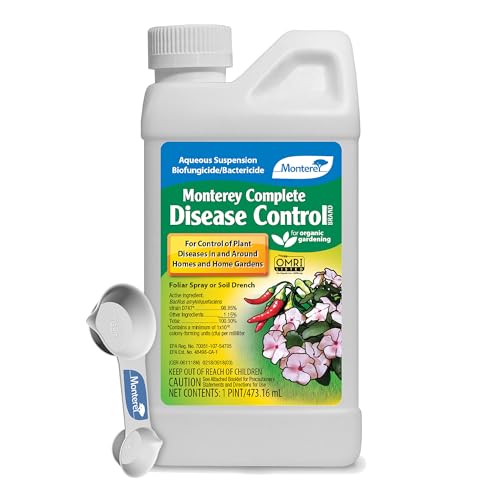
Monterey Complete Disease Control uses Bacillus amyloliquefaciens, a beneficial bacterium that colonizes root hairs and leaf surfaces to outcompete rust-causing fungi and bacteria. This OMRI-listed bio-fungicide is the only option on this list suitable for certified organic lawns, edible gardens, and areas where children and pets are active immediately after the spray dries. Users report that it works well on rust, leaf spot, and powdery mildew in tomato plants, peaches, and ornamental shrubs.
The product functions both as a foliar spray and as a soil drench. When drenched into the root zone, it colonizes the root hairs to provide internal protection against soil-borne rust spore germination. Southern growers dealing with high rainfall and persistent rust pressure say they have relied on Monterey for three years as a staple in their organic disease management rotation. The application rate is low — about 1 teaspoon per gallon — so a single pint provides many treatments for small to medium lawns.
Monterey’s bio-fungicide approach is slower and less aggressive than synthetic propiconazole. If your lawn is already coated in orange rust spores and you need a quick curative fix, the biological mode of action may not deliver fast enough results. It works best as a preventive applied early in the season before rust appears, or in combination with a synthetic rotation.
What works
- OMRI-listed for certified organic turf and gardens
- Colonizes root hairs for systemic biological protection
- Low application rate — pint lasts many seasons
What doesn’t
- Slower curative action than synthetic propiconazole sprays
- Best suited for preventive use, not heavy active infections
Hardware & Specs Guide
Propiconazole Concentration (14.3% vs. 20%)
The standard curative concentration for lawn rust is 14.3% propiconazole, found in most liquid concentrates. A 20% myclobutanil product like Eagle 20EW delivers a higher dose of DMI chemistry per ounce, which translates to faster spore suppression. For most homeowners, 14.3% is sufficient when applied at the label rate of 1 to 2 ounces per 1,000 square feet in a preventative program.
MEC vs. Emulsifiable Concentrate
Microemulsion concentrate (MEC) formulations use particles small enough that the solution remains stable in the spray tank without constant agitation. Emulsifiable concentrates (EC) can separate and require continuous mixing. For homeowners using a pump sprayer or hose-end that may sit idle, MEC formulations (Quali-Pro, Atticus Gunner) offer more predictable active ingredient delivery.
FAQ
Can I use a granular fungicide to cure active lawn rust?
How often should I reapply fungicide to prevent rust from returning?
Is organic fungicide effective against severe rust outbreaks?
Final Thoughts: The Verdict
For most gardeners, the fungicide for lawn rust winner is the Quali-Pro Propiconazole 14.3 because its MEC formulation delivers reliable curative action on rust, brown patch, and dollar spot while remaining stable in the tank and low-odor. If you want a premium fast-acting curative that hits rust harder and faster, grab the Dow AgroSciences Eagle 20EW with its 20% myclobutanil concentration. And for large-lawn preventive convenience without spraying, nothing beats the The Andersons Prophesy granular fungicide on DG Technology.