
Nothing kills the joy of a thriving garden faster than discovering spider mites have turned your investment into a mess of stippled leaves and fine webbing. These tiny arachnids reproduce at an alarming rate, and by the time you spot the damage, a single untreated plant can host thousands of mites across every life stage. The right miticide stops them at the egg, larval, and adult stages while protecting your edible and ornamental plants from collateral harm.
I’m Rikta — the co-founder and writer behind Lawn Gear Lab. I’ve spent countless hours comparing active ingredient concentrations, reading third-party efficacy trials, and sifting through thousands of verified owner reports to map out which miticides actually deliver permanent control for mites, aphids, thrips, and fungal diseases in a single treatment cycle.
Whether you’re protecting a small indoor herb garden or a large orchard facing an active outbreak, selecting the right chemistry is critical — and this guide breaks down the seven most effective options available today to help you find the perfect insecticide for mites.
How To Choose The Best Insecticide For Mites
Mite infestations demand specific chemistry because these pests are not true insects — they are arachnids, and many common insecticides simply do not affect them at all. A product labeled only as a general insecticide may kill beetles and caterpillars but leave spider mites free to multiply. You must look for a product that explicitly carries miticide activity and targets multiple life stages, including eggs and dormant adults.
Active Ingredient Chemistry: Know What Kills Mites
The most reliable mite-killing compounds include clarified hydrophobic neem oil, which suffocates adult mites and disrupts egg viability; Malathion, a powerful organophosphate that works contact and residual; and Abamectin (found in Avid), a translaminar miticide that penetrates leaf tissue and protects the entire leaf interior. Neem oil is ideal for organic gardens and edible crops, while Abamectin and Malathion are reserved for heavy outbreaks where quick knockdown is essential.
Formulation: Concentrate vs. Ready-to-Use vs. Oil-Based
Concentrates offer the most value per application because you mix exactly what you need and store the rest. Ready-to-use (RTU) sprays are more convenient for small gardens or indoor plants but cost significantly more per ounce. Oil-based formulations like neem oil require thorough mixing and agitation to prevent separation, and they can burn leaves if applied during hot, sunny hours. Always apply oil-based miticides in the early morning or late evening to avoid phytotoxicity.
Safety and Application Window for Edible Plants
If you plan to use a miticide on vegetables, fruits, or herbs, check the pre-harvest interval (PHI) on the label. Neem oil products typically allow same-day harvest, while synthetic options like Malathion may require a waiting period of 7 to 14 days. For flowering plants, avoid applying any miticide when bees are actively foraging — prefer early morning or dusk sprays to minimize impact on pollinators.
Quick Comparison
On smaller screens, swipe sideways to see the full table.
| Model | Category | Best For | Key Spec | Amazon |
|---|---|---|---|---|
| Syngenta Avid 0.15EC | Premium Miticide | Severe outbreaks / Commercial | Abamectin 0.15% — Translaminar | Amazon |
| Hi-Yield 55% Malathion | Synthetic Insecticide | General outdoor pests | 55% Malathion — Contact | Amazon |
| Lost Coast Plant Therapy | Organic Concentrate | Edible gardens / Bees safe | Contact suffocation — 12 oz makes 12 gal | Amazon |
| Bonide Captain Jack’s Orchard Spray | Multi‑Purpose Concentrate | Citrus / Fruit trees / Veggies | Lemon oil based — 32 oz makes 6.4 gal | Amazon |
| Fertilome Triple Action | Triple‑Action Spray | Apple trees / Roses | Insecticide + Miticide + Fungicide | Amazon |
| Garden Safe Fungicide3 | Neem Oil RTU | Indoor plants / Orchids | Neem oil extract — 1 Gallon RTU | Amazon |
| Monterey Neem Oil RTU | Ready‑to‑Use Neem | Small gardens / Houseplants | Clarified hydrophobic neem oil — 32 oz | Amazon |
In‑Depth Reviews
1. Syngenta Avid 0.15EC Miticide/Insecticide

Syngenta Avid 0.15EC is the industry benchmark for mite control in commercial and serious home gardens alike. Its active ingredient, Abamectin, is a translaminar miticide — meaning it penetrates the leaf cuticle and moves inside the leaf tissue, protecting both the upper and lower surfaces that mites typically feed on. Once absorbed, the product remains active inside the leaf for up to 28 days, providing a long residual window that catches newly hatched nymphs before they can establish a new colony.
Because Avid works through ingestion rather than contact alone, it is far less susceptible to wash-off from rain or overhead irrigation. Users report complete knockdown of severe spider mite infestations on dahlias, tomatoes, and ornamentals within hours of application, with no regrowth observed for two to four weeks. The concentrated 8 oz bottle goes a long way — a typical dilution rate is just 3 drops per liter of water, making this an extremely cost-effective option for large-scale outbreaks.
Avid is not a product for everyday maintenance. It is a targeted intervention for when neem oils and soaps have failed. The label requires full protective gear — long sleeves, gloves, goggles, and a respirator — and treated areas should not be re-entered for at least four hours. It is also critical to rotate Avid with another mode of action (like Floramite or Forbid 4F) to prevent miticide resistance from building in local mite populations.
What works
- Translaminar activity protects entire leaf interior from mites
- Extremely concentrated — one drop per liter provides effective control
- Residual protection lasts up to one month after a single application
- Suppresses leafminers, aphids, thrips, and whiteflies alongside mites
What doesn’t
- Requires full hazmat protective gear during mixing and application
- Not suitable for flowering plants due to pollinator toxicity
- Premium cost per bottle even though per-use cost is low
2. Hi-Yield 55% Malathion Spray
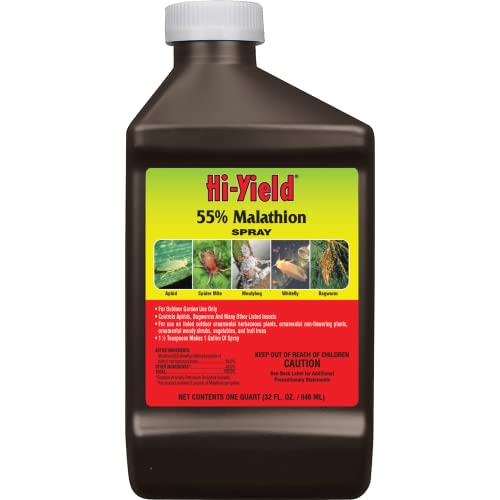
Hi-Yield 55% Malathion is a powerful organophosphate insecticide and miticide that has been a trusted weapon against spider mites, aphids, thrips, lace bugs, and mosquitoes for decades. At 55% active ingredient concentration, this 32 oz concentrate is one of the most potent general-use miticides available without a commercial applicator license, and it works through direct contact and residual action on treated foliage.
For gardeners facing a stubborn spider mite infestation that has resisted neem oil and insecticidal soaps, Malathion often delivers the quick knockdown needed to save plants. Verified users report that a single application wiped out red spider mites on dahlias and ornamental bushes within hours, and the residual effect kept pests at bay for weeks. The product is labeled for use on fruit trees, vegetables, ornamentals, and shrubs, making it a versatile inclusion in any serious pest management program.
Malathion carries significant safety warnings. It is a suspected carcinogen and should be handled only with full protective gear — long sleeves, gloves, and a respirator are mandatory. Spray only in calm weather with no rain predicted for 24 hours, and never apply during bloom when pollinators are active. Despite its effectiveness, this product should remain a last-resort tool for situations where all other options have failed.
What works
- High 55% active ingredient concentration delivers fast knockdown
- Broad spectrum — kills mites, aphids, mosquitoes, thrips, and scale
- Provides residual protection that lasts for weeks after application
What doesn’t
- Strong safety profile — requires hazmat-grade protective equipment
- Not safe for use on edible crops with a short pre-harvest interval
- Cannot be used during bloom due to high pollinator toxicity
3. Lost Coast Plant Therapy Organic Concentrate

Lost Coast Plant Therapy is a premium organic concentrate that kills mites, aphids, whiteflies, powdery mildew, and flea beetles through a contact mechanism of suffocation and dehydration. The formula is derived from food-grade essential oils and is OMRI-listed, making it one of the safest options for edible gardens where you want to avoid synthetic residues. The 12 oz concentrate mixes with water to produce 12 gallons of finished spray, providing excellent coverage for large vegetable beds and ornamental borders.
What sets this product apart is its pollinator safety profile — it is labeled as safe for bees, ladybugs, and praying mantises once the spray has dried. Users who maintain pollinator-friendly gardens appreciate that they can treat infested plants without destroying the beneficial insect populations that naturally suppress pest outbreaks. The peppermint-scented formula leaves no oily residue and does not burn leaves even under bright light, unlike many neem oil products that require precise timing to avoid phytotoxicity.
Because Lost Coast works strictly through contact, achieving full coverage is critical. You must spray the underside of every leaf, along stems, and into leaf axils where mites hide. For heavy infestations, repeat applications every 3 to 5 days are necessary to break the mite life cycle. The premium price per ounce is the main drawback, but for gardeners who prioritize organic growing and pollinator health, this miticide delivers outstanding results without compromise.
What works
- Organic, OMRI-listed formula safe for edible plants up to harvest day
- Safe for bees, ladybugs, and praying mantises once spray dries
- No oily residue — pleasant peppermint scent
- 12 oz concentrate makes 12 gallons of finished spray
What doesn’t
- Premium price per bottle compared to neem oil concentrates
- Requires thorough undersurface coverage for effective control
- Needs repeated applications every 3–5 days for heavy outbreaks
4. Bonide Captain Jack’s Orchard Spray

Bonide Captain Jack’s Citrus, Fruit & Nut Orchard Spray is a multi-purpose concentrate that functions as an insecticide, miticide, and fungicide all in one bottle. Its active ingredient, derived from lemon oil, works through contact to kill spider mites, aphids, caterpillars, whiteflies, thrips, and leafhoppers, while also providing disease control against powdery mildew, rust, blight, and leaf spots. This makes it an excellent one-stop product for home orchardists and vegetable gardeners who want to simplify their spray routine.
The 32 oz concentrate is highly economical — one pint makes up to 6.4 gallons of finished spray at typical dilution rates. Users note that it is gentle on plants but tough on Japanese beetles, tent caterpillars, and cucumber beetles, often killing them within an hour of direct contact. The product is labeled for use up to the day before harvest on fruits, vegetables, nuts, and herbs, giving gardeners flexibility in timing their applications during the growing season.
Because this product is contact-based, thorough spray coverage is non-negotiable. The sulfur content can leave a slight temporary residue on leaves, and the product does not have translaminar activity, so it will not protect new growth that emerges after application. Reapplication every 7 to 10 days is recommended during active outbreaks, especially after rain washing the residue off foliage.
What works
- Triple-action formula: insecticide, miticide, and fungicide combined
- Economical concentrate — each pint makes over 6 gallons of spray
- Can be used up to day of harvest on edible crops
What doesn’t
- Contact-only action requires thorough coverage of all leaf surfaces
- Leaves a sulfur residue on leaves that some users find unsightly
- Must be reapplied after heavy rain to maintain protection
5. Fertilome Triple Action Spray
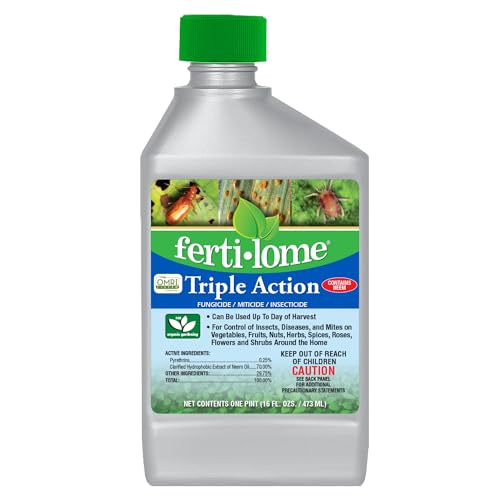
Fertilome Triple Action is a three-in-one concentrate that serves as an insecticide, miticide, and fungicide, making it a budget-friendly workhorse for small to mid-sized gardens. The formula targets spider mites, aphids, leafminers, leafrollers, armyworms, and other common pests while preventing fungal diseases including powdery mildew, rust, and leaf spot. The 16 oz bottle is compact but concentrated — it is designed to be mixed with water and applied with a hose-end or tank sprayer.
Long-term users appreciate this product for its consistent performance on apple trees and roses, where mite and fungal pressure peaks simultaneously in spring. The neem oil base provides gentle but effective control, and the product is labeled for use on fruits, herbs, vegetables, nuts, spices, and flowers. When applied on a 7-to-14-day schedule, it keeps plants healthy without requiring multiple separate products for pest and disease management.
Some users note that the product does not work as rapidly as synthetic options like Malathion — you need patience and consistent scheduling to see full results. The 16 oz bottle is also on the smaller side for large orchards, and the price per ounce has risen in recent years, making it less economical for big spray jobs. For small to medium gardens, however, this is a reliable, proven option.
What works
- Three functions in one bottle: insecticide, miticide, and fungicide
- Proven formula trusted for years on apple trees, roses, and vegetables
- Gentle on plants — neem oil base reduces risk of phytotoxicity
What doesn’t
- Slower action than synthetic miticides — requires consistent scheduling
- Small 16 oz bottle size may not be enough for large gardens
- Price per ounce has increased, making it less economical than before
6. Garden Safe Fungicide3 with Neem Oil Extract
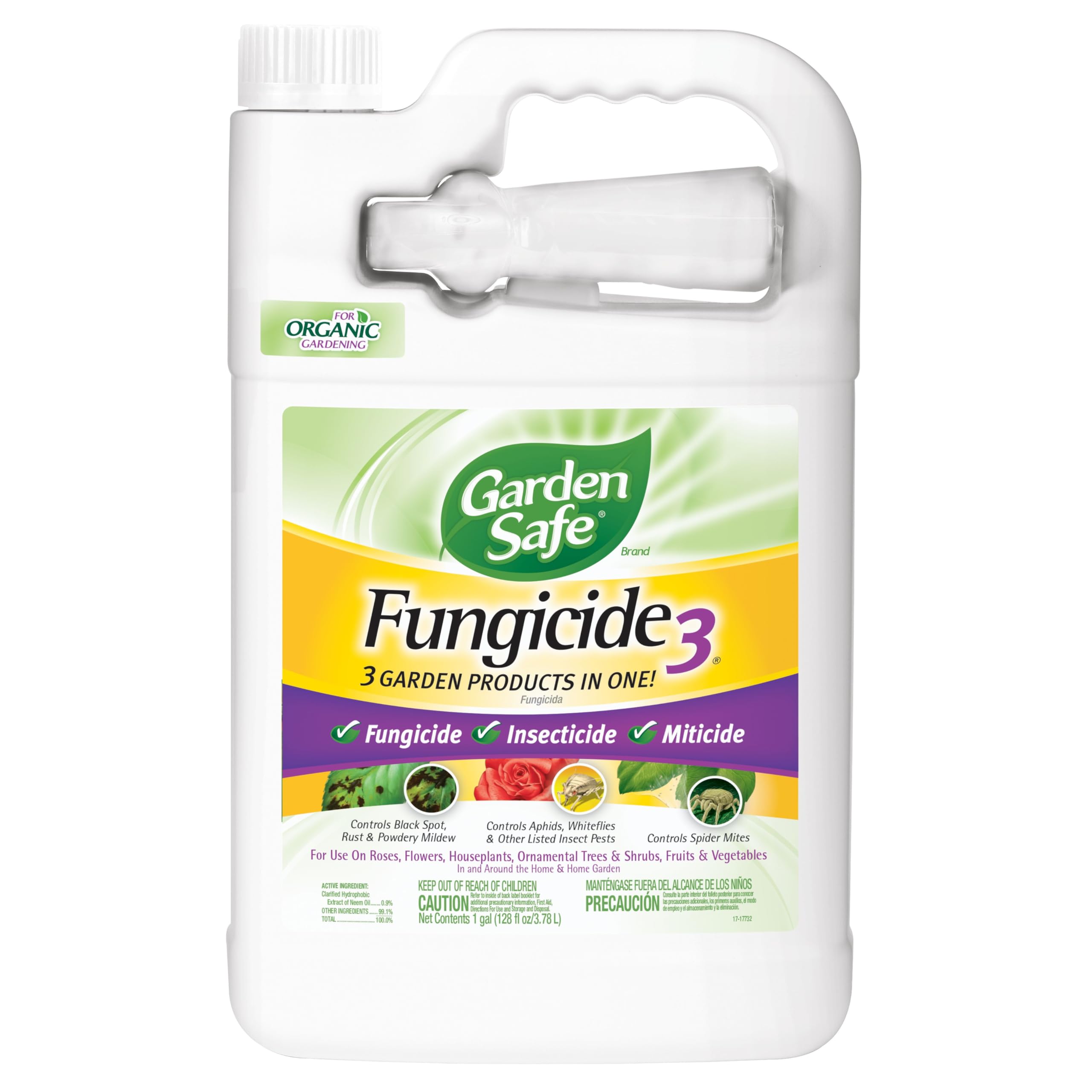
Garden Safe Fungicide3 delivers a ready-to-use 1-gallon container of neem oil extract that kills spider mites, aphids, whiteflies, and powdery mildew on contact. The product is labeled for use on roses, ornamentals, houseplants, fruit trees, and vegetables, making it a versatile pick for indoor and outdoor gardeners alike. The large 128 oz volume at a low price per ounce makes this one of the most economical RTU options for those who do not want to mix concentrates.
The attached sprayer is a convenient design feature — just connect your garden hose and spray. However, several users note that the sprayer’s hose reach is very short (about 4 inches), which forces you to hold the bottle close to the plant. For larger garden beds or tall shrubs, this can be frustrating. Some gardeners advise buying a separate hose-end sprayer to replace the factory unit, but this adds to the overall cost and complexity.
Performance-wise, neem oil is effective at preventing mites and mildew when applied weekly, but it does not heal leaves that are already damaged — it prevents new infections. For active mite infestations, you need to apply at half the recommended strength to avoid burning sensitive plants, and always spray in the evening to let the oil dry before the sun hits the leaves. For preventative care on orchids, hibiscus, and tomatoes, this product delivers consistent results.
What works
- Ready-to-use formula — no mixing required for quick application
- Large 1-gallon jug provides good value for regular preventative sprays
- Works as fungicide, insecticide, and miticide in a single product
What doesn’t
- Integrated sprayer has very short reach and may fail over time
- Can burn leaves if applied during daytime heat at full strength
- Does not reverse existing leaf damage — only prevents new outbreaks
7. Monterey Neem Oil RTU Fungicide/Insecticide/Miticide
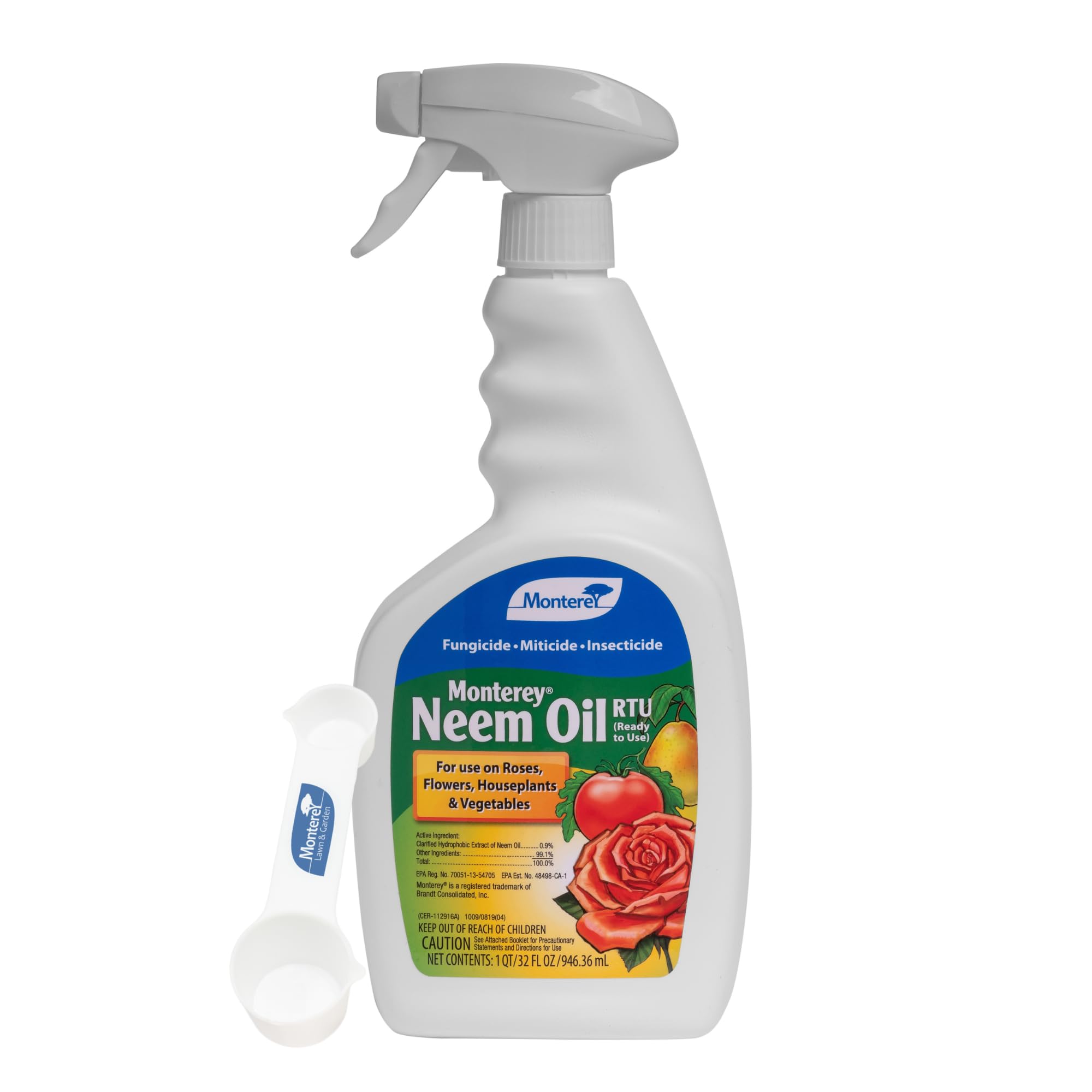
Monterey Neem Oil RTU is a convenient ready-to-use formula that combines clarified hydrophobic neem oil in a pre-diluted 32 oz spray bottle. It functions as a fungicide, insecticide, and miticide, controlling spider mites, aphids, whiteflies, black spot, powdery mildew, rust, scab, and anthracnose. The bundle includes a garden measuring spoon, a thoughtful addition for gardeners who may later switch to concentrates and need a standardized measuring tool.
The main selling point here is convenience — you can grab the bottle and spray immediately without mixing, measuring, or cleaning a sprayer. For small container gardens, houseplants, or a few rose bushes, this is the most hassle-free way to apply neem oil protection. Users report that it effectively controls caterpillars and powdery mildew on tomatoes, and the neem oil smell dissipates after the spray dries, making it pleasant to work with in confined spaces.
The biggest drawback is cost per ounce — RTU neem oil is always more expensive than buying concentrate and mixing your own. For larger gardens with frequent mite pressure, the 32 oz bottle will run out quickly, and the per-application cost becomes steep. Additionally, neem oil is not the best choice for heavy infestations of spider mites — multiple users note it is ineffective against established mite colonies and recommend stronger products like Avid or Malathion for outbreak control.
What works
- Convenient RTU formula — shake and spray with no mixing required
- Safe for use on vegetables, herbs, and fruits up to harvest day
- 3-in-1 action: insecticide, miticide, and fungicide in one bottle
What doesn’t
- High cost per ounce compared to concentrate alternatives
- Limited efficacy against heavy spider mite infestations
- Small 32 oz volume requires frequent repurchase for larger gardens
Hardware & Specs Guide
Translaminar vs. Contact-Only Action
Translaminar miticides like Abamectin (Avid 0.15EC) penetrate leaf tissue and protect the interior of the leaf from mites that feed on the underside. Contact-only products like neem oil and Lost Coast Plant Therapy must physically land on every mite to kill it. For heavy infestations inside dense foliage, a translaminar product provides superior coverage because it reaches mites that direct spray cannot touch. Contact killers require meticulous spraying — missing even a single leaf cluster can allow mites to survive and recolonize.
Active Ingredient Concentration and Dilution Ratios
Hi-Yield Malathion contains 55% Malathion, a very high concentration that requires precise mixing (typically 1.5 to 2 fluid ounces per gallon of water) and full protective gear. By contrast, Abamectin-based products use very low concentrations — 0.15% in Avid — because the compound is so potent that 3 drops per liter is sufficient. Neem oil concentrates like those in Bonide Captain Jack’s are gentler but require higher dilution rates (2.5 to 5 ounces per gallon). Always match your product’s concentration to the correct dilution rate — using too little active ingredient wastes time, and too much can cause phytotoxicity.
FAQ
Can one product treat both spider mites and powdery mildew at the same time?
How often should I reapply insecticide for mites during an active infestation?
Is neem oil safe to use on flowering plants with active pollinators?
Final Thoughts: The Verdict
For most gardeners, the insecticide for mites winner is the Syngenta Avid 0.15EC because its translaminar activity delivers unmatched residual protection against heavy infestations while requiring only a tiny amount of concentrate per treatment. If you want a pollinator-safe organic option for edible gardens, grab the Lost Coast Plant Therapy. And for a versatile all-in-one concentrate that handles mites, insects, and fungal diseases in a single bottle on fruit trees, nothing beats the Bonide Captain Jack’s Orchard Spray.