
Forcing your Monstera to survive on a north-facing windowsill is a losing battle. The answer is a dedicated fixture that delivers the photosynthetic photon flux density (PPFD) your plants actually need, not just a warm glow for your decor. Selecting the wrong spectrum or skimping on actual wattage leads to leggy seedlings, stunted flowering, and wasted electricity.
I’m Rikta — the co-founder and writer behind Lawn Gear Lab. I spend my time deep-diving into horticultural specs, comparing PPFD maps, analyzing driver efficiency, and cross-referencing thousands of owner reports to separate genuine photosynthetic power from bathroom-vanity lighting dressed up as a grow lamp.
After combing through technical datasheets and real-world performance data, I have identified the models that earn a spot in a serious indoor garden. This guide ranks the seven most compelling options on the market today, helping you find the best indoor grow lights for your specific setup, from a single succulent on a desk to a 3×3 flowering tent packed with tomatoes.
How To Choose The Best Indoor Grow Lights
The wrong grow light is just an expensive nightlight for your plants. To make an informed choice, you need to look past the marketing promises and focus on the few specs that actually drive photosynthesis. Here is what separates a productive fixture from a pretty lamp.
Actual Wattage vs. HID Replacement Claims
Ignore any “3000W equivalent” sticker. The only number that matters is the actual power draw from the wall, measured in watts. A desktop clip-on fixture typically draws 5W to 20W, while a serious panel for a 2×2 tent pulls 100W to 200W. Higher real wattage generally translates to more photons, but efficiency—measured in micromoles per joule—varies widely between cheap diodes and quality SMD chips.
Spectrum Selection: Broad White vs. Blurple
For most home growers, a full-spectrum white LED (3000K-5000K) is the safest bet. It renders leaf color accurately, is comfortable for your eyes, and supports healthy growth from seed to harvest. “Blurple” fixtures (heavy on red and blue) are designed for flowering but are hard on the eyes and make spotting pests or nutrient deficiencies difficult. A good fixture will offer a balanced white spectrum with added red (660nm) and far-red (730nm) for enhanced flowering response.
Coverage Area and PPFD Uniformity
A light with 150W of raw power is useless if the photons are all concentrated in a hot spot directly under the center. Look for a published PPFD map that shows readings at multiple points across the target area (e.g., a 2×2 or 3×3 space). You want a uniformity ratio (center-to-edge variance) of less than 20-25%. Panels with a high density of diodes and a wide beam angle (120 degrees) deliver more even coverage than narrow, focused arrays.
Dimming, Timers, and Daisy Chain Capabilities
A dimmer is critical for adjusting light intensity to match your plant’s growth stage without having to raise or lower the fixture. An integrated timer (3H, 6H, 9H, 12H) automates the photoperiod, which is essential for consistent growth. For multi-light setups in a larger tent, a daisy chain feature lets you control several fixtures from a single dimmer, saving outlets and complexity.
Quick Comparison
On smaller screens, swipe sideways to see the full table.
| Model | Category | Best For | Key Spec | Amazon |
|---|---|---|---|---|
| MARS HYDRO TS1000 | Premium Panel | 2×2 to 3×3 Grow Tents | 150W Actual Draw, 354 LEDs | Amazon |
| VIPARSPECTRA XS1500 Pro | Premium Panel | Full-Cycle Growing | 150W, Lens PPFD Uniformity | Amazon |
| VIVOSUN LumaLight 200W | High-End Panel | App-Controlled Automation | 200W, IP65, Smart Control | Amazon |
| GLOWRIUM Floor Lamp | Floor Lamp | Tall, Large Houseplants | 20W, 63″ Height, 66 LEDs | Amazon |
| SANSI 4-Gooseneck Clip | Clip-On | Versatile Target Lighting | 40W Total, 4x Flexible Necks | Amazon |
| FECiDA 5-Head | Desktop Panel | Seed Starting & Bonsai | 45W, 5-Head, 5000 Lumens | Amazon |
| SANSI Pot Clip 4-Pack | Pot Clip | Individual Potted Plants | 5W Each, 4-Level Dimming | Amazon |
In‑Depth Reviews
1. MARS HYDRO TS1000

The MARS HYDRO TS1000 is the gold standard for indoor growers who need a serious quantum-board panel without venturing into commercial pricing. Its 150W actual power draw drives 354 SMD LEDs through a patented highly-reflective white hood that increases light utilization by 25% compared to standard boards. The 120-degree beam angle and a new diode layout—dense in the center, sparse on the edges—create a remarkably even PPFD footprint across a 2.5×2.5 foot area, with max coverage extending to 3×3 feet. This uniformity eliminates the hot-spot-over-shade-under problem that plagues cheaper panels.
What sets the TS1000 apart is its quiet, fanless design paired with a dimmable external driver that lets you dial from 0% to 100% intensity. The daisy-chain capability means you can link up to 50 units for a single control point, a feature usually reserved for much pricier commercial fixtures. Owners consistently report dense internodal spacing during veg and heavy, frosty buds during flower, with many noting that their plants responded visibly within 24 hours of replacing older blurple LEDs. The aluminum heatsink keeps temperatures manageable, though running at 100% in a small tent can raise ambient temps, so the dimmer is a welcome tool.
The TS1000 lacks a built-in timer and its included rope hangers are adequate but not premium. The instruction manual for the daisy-chain setup could be clearer for first-time users. These are minor trade-offs for a panel that delivers genuine 150W of photosynthetic power at a price point that undercuts most competitors with similar PPFD output. For a dedicated tent grower who wants a proven, quiet, and expandable solution, this is the standard to beat.
What works
- Exceptional PPFD uniformity across the 2.5×2.5ft footprint
- Silent, fanless operation is perfect for bedroom or office tents
- Dimmable driver and daisy-chain for multi-light setups
What doesn’t
- No built-in timer; requires an external outlet timer
- Rope hangers feel basic for a premium panel
- Manual could provide better daisy-chain diagrams
2. VIPARSPECTRA XS1500 Pro

VIPARSPECTRA has refined the quantum-board formula by adding an optical-lens layer over its SMD array. The XS1500 Pro uses these lenses to focus the 150W of output into a more concentrated beam with minimal spill, delivering a measured PPFD of 747 μmol/m²/s at 50% intensity and 13 inches. This concentrated punch makes it particularly effective for flowering in a 2×2 tent, where you need high photon density to pack on bud weight. The lens design also ensures nearly identical PAR readings from the center to the edges of the canopy, solving the uneven growth patterns that occur with un-lensed panels.
The full spectrum includes white 3000K, 5000K, red 660nm, and far-red 730nm LEDs, covering the entire photosynthetically active waveband. The dimming function allows for 0-100% adjustment via an external dial, and the daisy-chain port lets you connect up to 20 units for centralized control. Owners growing super-hot peppers and cherry tomatoes report that the adjustable intensity is critical—the light is powerful enough to scorch seedlings if left at 100% too close, so the dimmer is not optional but essential for a staged grow. The aluminum heatsink manages heat well, though the fixture does run warmer than fanless designs like the TS1000.
The XS1500 Pro lacks an integrated timer and doesn’t include a physical off switch on the driver, which some users find inconvenient. The included rope hangers are functional but the kit could benefit from more robust mounting hardware. For the grower who demands maximum PPFD from a 150W footprint and values the evenness that optical lenses provide, this is a formidable choice that outperforms many 200W units in raw photon density.
What works
- Optical lenses produce industry-leading PPFD uniformity
- Measured 747 μmol/m²/s at 50% intensity and 13 inches
- Daisy-chain control for up to 20 lights
What doesn’t
- No built-in timer for photoperiod automation
- Driver lacks a dedicated on/off switch
- Runs warmer than fanless competitors
3. VIVOSUN LumaLight 200W
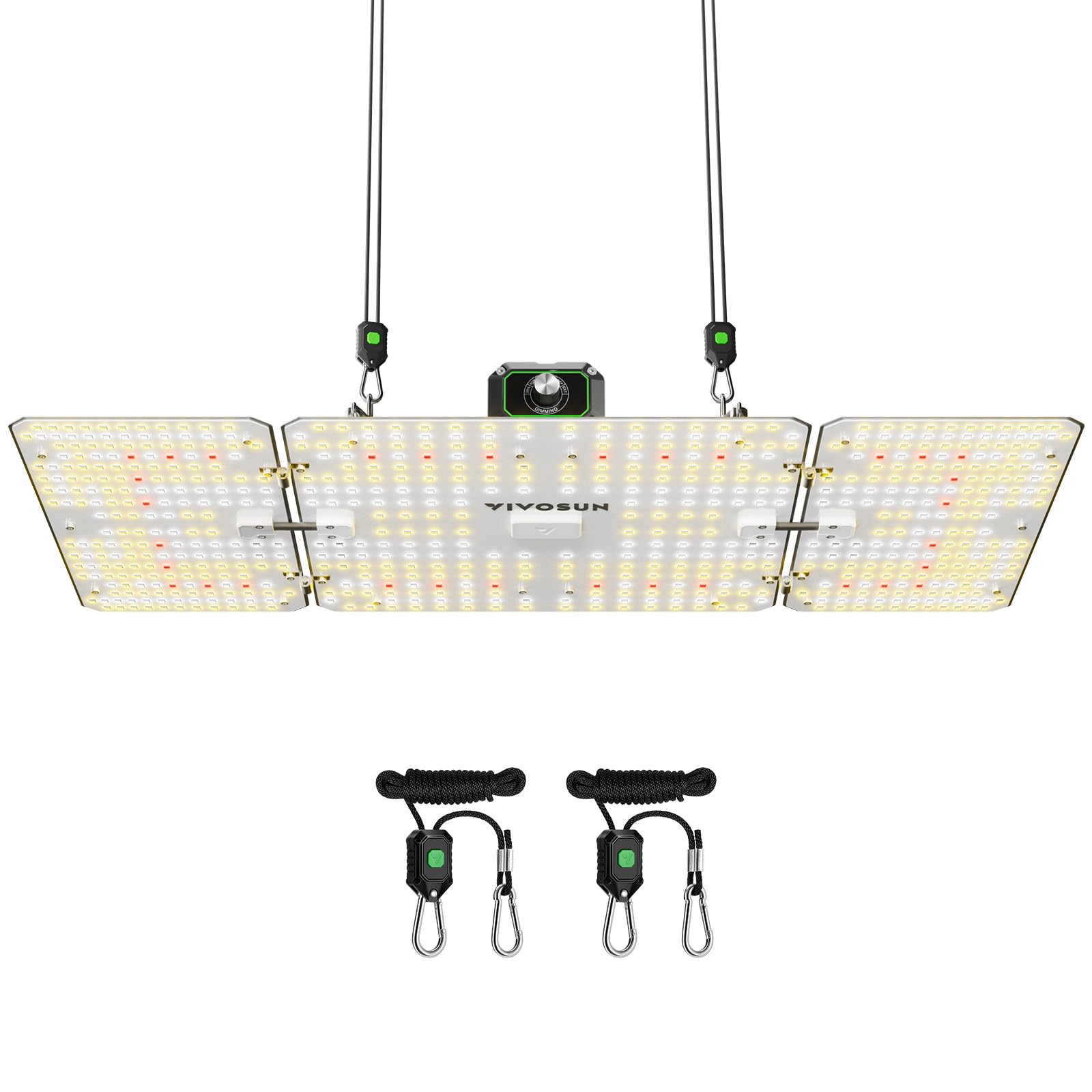
The VIVOSUN LumaLight 200W is the heavy hitter of this lineup, delivering a full 200W of actual power with a spectrum optimized for high-yield flowering. It combines white (3000K, 5000K), blue, red (660nm), and far-red (730nm) diodes to cover the complete PAR range, with the far-red specifically shown to speed up flowering times and increase harvest weight. The strategic diode layout ensures a high and uniform PPFD across a 3×3 footprint, making it a natural fit for a 3×3 or 2×4 tent where you want to maximize canopy density.
The standout feature here is smart controllability. The LumaLight is compatible with the Vivosun GrowHub (sold separately), which unlocks app-based scheduling and remote monitoring. You can also adjust intensity via a 4-level dimming knob (25%, 50%, 75%, 100%). The IP65 waterproof and dustproof rating is a significant advantage for high-humidity tents, allowing you to spray nutrients or clean the fixture without fear of damage. Advanced thermal management keeps the fixture running cool despite the 200W draw, and the Q90 flux rating of 36,000 hours promises long-term reliability.
The LumaLight is expensive and the smart features require additional hardware to unlock fully. The power connection to the driver has been noted by some users as feeling a bit delicate, and the intense output can easily cook seedlings if the light isn’t raised high enough (12-inch seedlings were killed at the minimum recommended height). This is a purpose-built tool for the serious grower who wants automation and is willing to invest in the ecosystem. For a single 2×4 tent aiming for maximum yield, the raw power and smart control make it a compelling flagship choice.
What works
- Full 200W power draws for dense flowering in a 3×3 tent
- IP65 rating allows worry-free use in high-humidity tents
- App control with GrowHub adds remote scheduling
What doesn’t
- Requires separate GrowHub for full smart functionality
- Very intense output can scorch seedlings at close range
- Power connector to driver feels slightly fragile
4. GLOWRIUM Floor Lamp
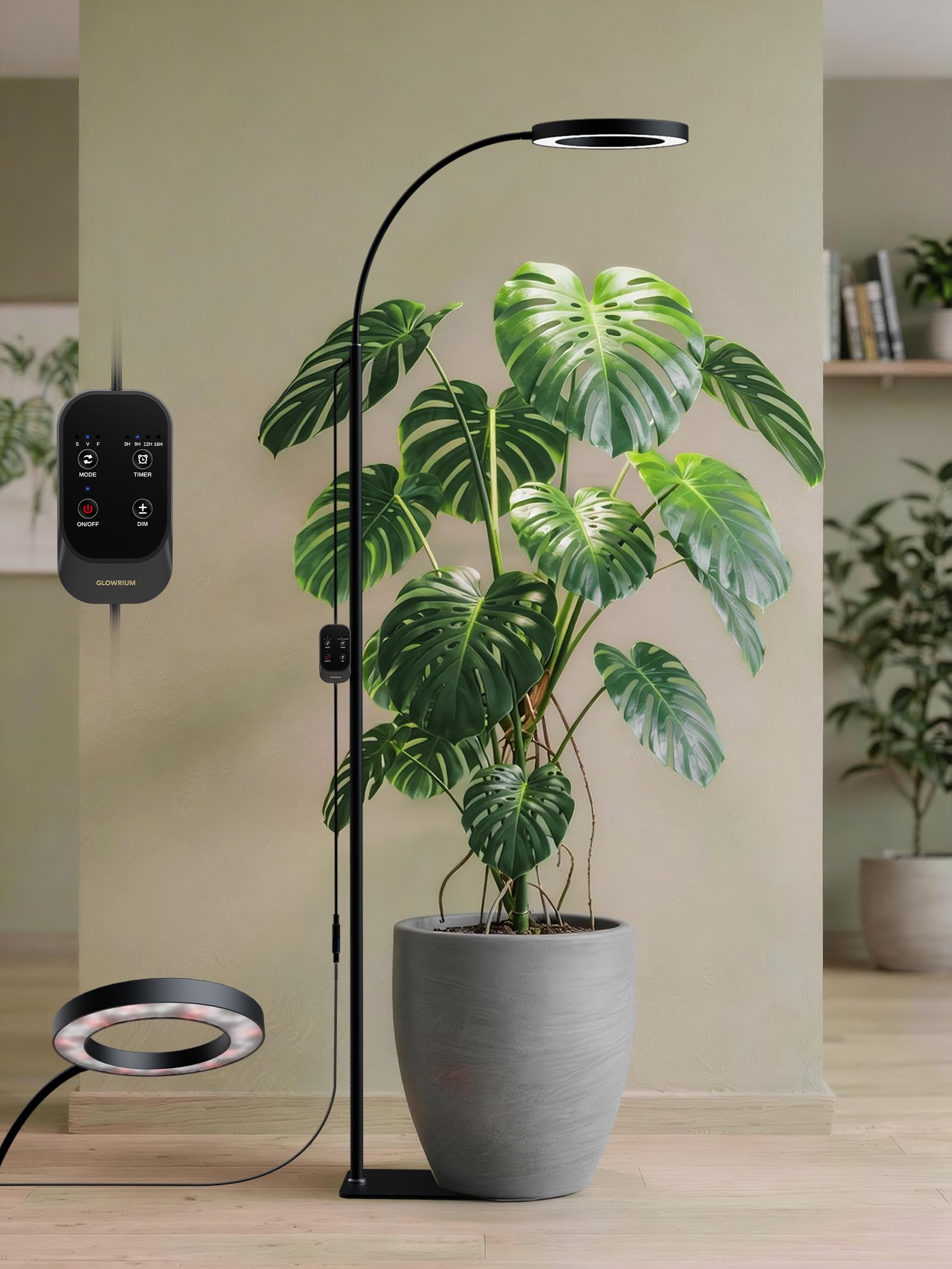
The GLOWRIUM floor lamp is a refreshing departure from clip-ons and hanging panels, designed specifically for medium to large floor plants. Its detachable three-section aluminum-alloy pole adjusts from 32 inches to 63 inches, letting you position the 360-degree adjustable head directly over a tall fiddle-leaf fig or a multi-tiered plant stand. The 20W actual power draw is modest compared to the premium panels, but the 66 full-spectrum LEDs (3000K and 5000K white, plus red) are more than adequate for supporting a single large plant or a small collection of low-to-medium light species.
Three spectrum modes let you tailor the light: white for general growth and rooting, white plus red for enhanced photosynthesis and flowering, or all LEDs combined for the full growth cycle. The 6-level dimming (10% to 100%) is seamless and paired with a 3/9/12 hour auto on/off timer. The remote control is a welcome touch for adjusting from across the room. The 13-foot power cord eliminates the need for extension cables, and the anti-slip base prevents tipping. Owners consistently praise how well their dieffenbachia and other shade-loving plants have responded, with some reporting rare indoor flowering.
The 20W output is not enough for a full tent grow or high-light crops like tomatoes or peppers in the flowering stage. The remote is IR-based and requires a direct line of sight. For the home grower who wants to keep a large living room Monstera or a collection of orchids thriving away from windows, this is a stylish and effective solution that doubles as a decor piece.
What works
- Adjustable 32-63 inch height suits tall floor plants perfectly
- Three spectrum modes for different growth stages
- Seamless 6-level dimming and easy 13-foot cord
What doesn’t
- 20W output is underpowered for demanding flowering crops
- Remote control requires direct line of sight
- Base, while stable, could be wider for extra safety
5. SANSI 4-Gooseneck Clip

The SANSI 4-Gooseneck Clip system is a versatile powerhouse for anyone who needs to target light at multiple plants from a single base. Each of the four arms houses a 10W PAR20 bulb (40W total draw) that emits a full spectrum from 380nm to 800nm, including the red and far-red wavelengths that drive flowering. The goosenecks are long and sturdy, capable of holding their position even when angled horizontally to reach plants on the edge of a shelf. The light output is genuinely bright—4000 lumens across the four heads—and the white light is comfortable for extended viewing.
The built-in auto timer offers 4, 8, and 12 hour settings based on a 24-hour cycle, so the light turns on and off at the same time daily. The clip itself is substantial and can grip surfaces like shelves, poles, or thick tabletops. The standout feature is the lifetime free bulb replacement from SANSI—if a bulb fails, they replace it at no cost, which defuses the biggest concern with integrated LED fixtures. Owners report excellent results overwintering outdoor plants in dark garages and reviving light-starved specimens.
The clip jaws, while strong, have a limited maximum opening that won’t fit all desk or shelf thicknesses. The timer resets if power is interrupted, which is a minor annoyance during outages. The bulbs also run warm; users report that leaves can burn if the heads are placed closer than 6 inches. For a mid-range investment, you get four independently adjustable high-power heads that can cover a 2×2 shelf, making this a fantastic choice for a seedling station or a mixed collection of medium-light plants.
What works
- Four independently adjustable goosenecks for precise targeting
- Lifetime free bulb replacement is a game-changer for longevity
- Bright 4000 lumen output with a wide full spectrum
What doesn’t
- Bulbs get hot and can burn leaves if placed too close
- Clip opening is too narrow for very thick desktops
- Timer resets after a power outage
6. FECiDA 5-Head Table Top
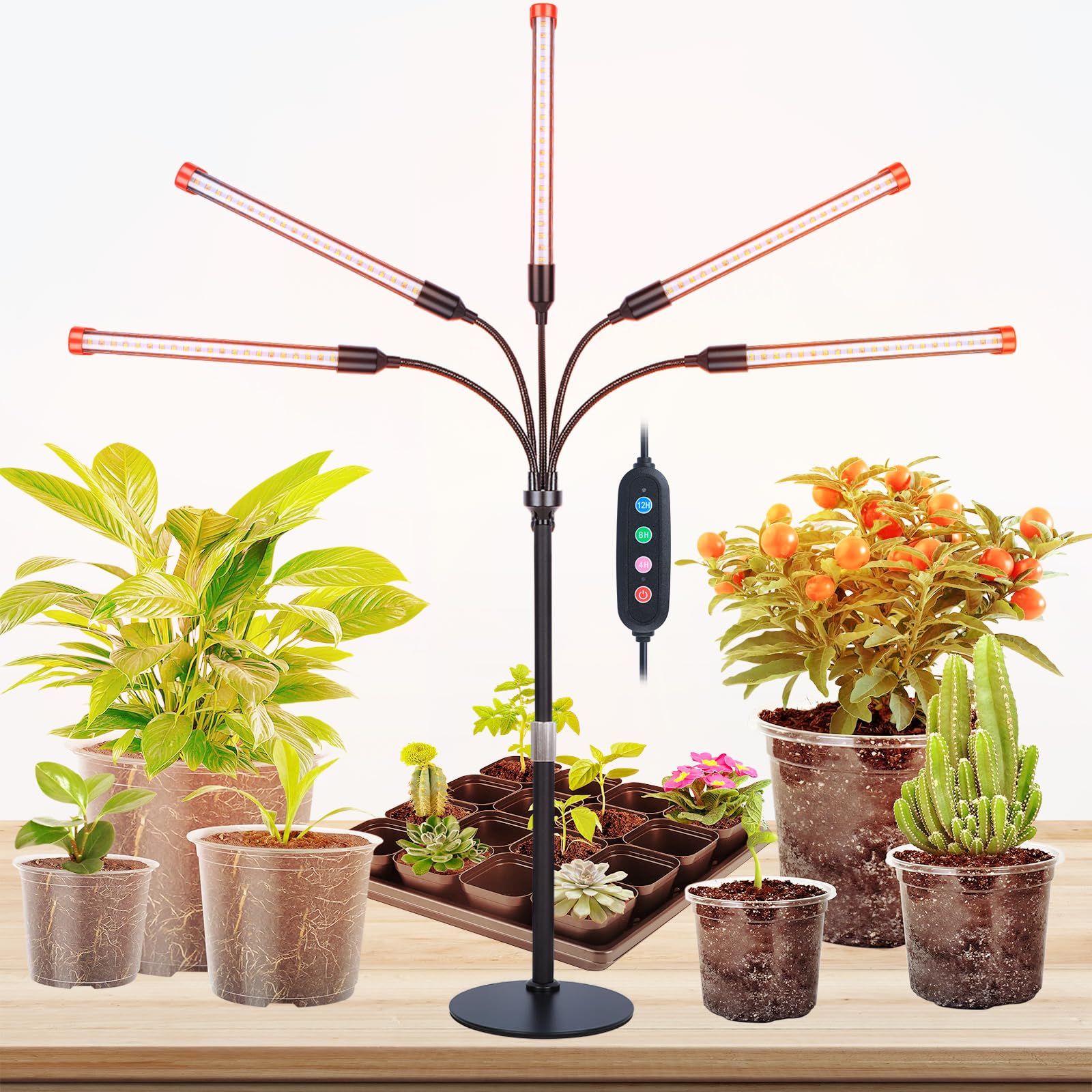
The FECiDA 5-Head Table Top grow light is a surprisingly capable desktop unit that punches above its weight class for seed starting and small bonsai. The 45W actual power draw and 210 high-quality LEDs push out 5000 lumens of full-spectrum light, which is exceptionally bright for a fixture that sits on a desk without requiring a separate driver or adapter. The five heads are individually adjustable and mounted on a stable base, allowing you to direct light at multiple tiny seedlings or a single compact plant from various angles.
The timer system is more flexible than many premium competitors, offering 4, 8, 12, 16, and 20 hour settings by combining button presses (push 8 and 12 together for 20 hours). The height is adjustable from 16 inches to 24 inches, which is the sweet spot for germinating seeds to early vegetative growth. Owners specifically note that seedlings that failed under window light thrived after switching to this unit, with many commenting on how quickly plants got greener and more compact. The desk-friendly design means no clamps or hanging gear needed—just set it on a table and plug it in.
The 45W output is not sufficient for a full flowering cycle or for medium-to-high light adult plants like tomatoes or peppers. The base, while stable, is plastic and can feel light if the arms are extended too far horizontally. For the budget-conscious indoor gardener who needs a dedicated seed-starting station or a boost for a small collection of succulents and herbs, this light delivers high brightness and useful timer features at a very accessible entry point.
What works
- 5000 lumens from 210 LEDs creates very bright desktop coverage
- Timer supports up to 20 hours for long-day seedlings
- No adapter needed and free-standing base is easy to place
What doesn’t
- Not powerful enough for flowering stage of demanding plants
- Plastic base feels light when arms are fully extended
- Limited height range (16-24 inches) restricts use as plants grow tall
7. SANSI Pot Clip 4-Pack
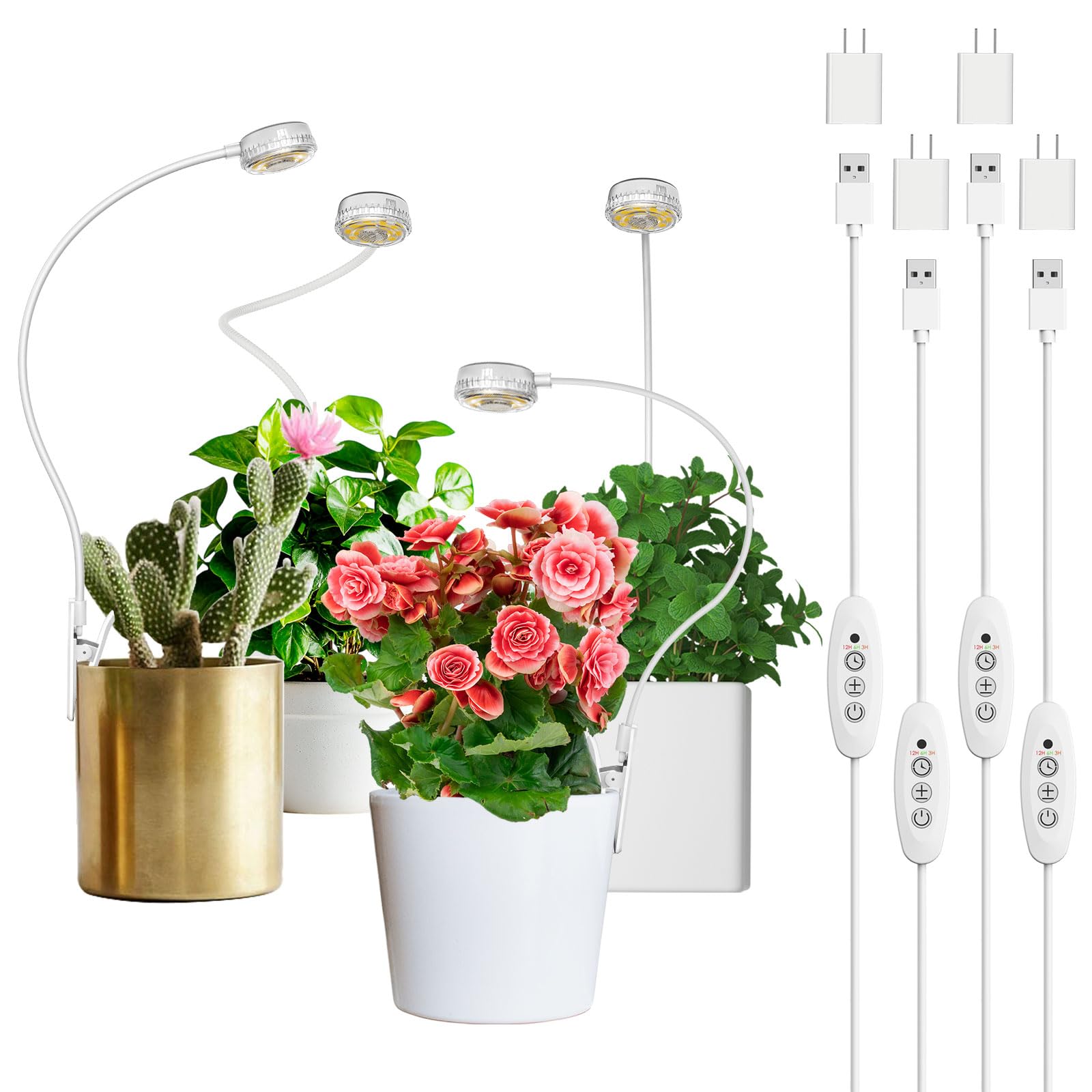
The SANSI Pot Clip 4-Pack is the most unobtrusive entry on this list, specifically designed for owners of small, individual potted plants. Each unit draws just 5W but delivers a focused 35.78 μmol/s/m² at 6 inches, thanks to SANSI’s efficient ceramic technology that saves 50% power while improving plant effect. The full-spectrum 4000K white light is comfortable on the eyes and blends into a room’s decor, unlike harsh blurple lights. The clip attaches directly to the rim of a pot, and the 360-degree gooseneck lets you aim the light precisely at the center of the canopy.
The four-level dimming (25%, 50%, 75%, 100%) paired with a 3/6/12 hour auto timer gives you granular control over the daily photoperiod and intensity. The 5V USB input is a genius feature—it can be powered by a laptop, power bank, or any standard USB-A brick, making it perfect for an office desk or a shelf near a computer. Owners report that small succulents, aloe, and African violets respond extremely well, with one owner’s daughter’s pothos doubling in size within a few weeks. The clips are lightweight and the fixtures look good enough to leave visible year-round.
The clips themselves are the weak point. They are made of plastic and can feel flimsy, failing to hold the light’s position securely on irregular pot rims. The 5W output is strictly for low-light, small plants; it will not support a lettuce or basil seedling through a full grow cycle. This is a niche tool for the person who wants to keep a few specific desktop succulents or an orchid happy without any bulky hardware. For that specific use, it’s nearly perfect.
What works
- 5V USB power allows use with power banks and laptops
- Four-level dimming and a 3/6/12 hour timer give great control
- Compact and discreet design blends into a home decor
What doesn’t
- Clips feel flimsy and struggle to hold position on some pot rims
- 5W output is only suitable for small, low-light plants
- Not enough power for seed starting or vegetables
Hardware & Specs Guide
Actual Power Draw (Wattage)
This is the single most important number. A light labeled “2000W equivalent” that only draws 45W is fundamentally a 45W light. The MARS HYDRO TS1000 and VIPARSPECTRA XS1500 Pro pull a true 150W from the wall, delivering the photon density needed for a full grow cycle. Desktop units like the FECiDA and GLOWRIUM draw between 20W and 45W, which is sufficient for low-light houseplants and seedling starting but not for flowering.
PPFD (Photosynthetic Photon Flux Density)
Measured in μmol/m²/s, PPFD tells you how many useful photons hit a given area. Seedlings thrive at 100-300 μmol/m²/s, vegetative growth requires 300-600, and flowering needs 600-900+. The premium panels (MARS HYDRO, VIPARSPECTRA, VIVOSUN) easily exceed 700 μmol/m²/s at the center of their footprint. Smaller units like the SANSI pot clip offer around 35 μmol/m²/s at 6 inches, which is fine for a desktop succulent but useless for a flowering tomato.
Spectrum Composition
Full-spectrum white (3000K-5000K) is the baseline recommendation for general indoor growing. Adding deep red (660nm) and far-red (730nm) LEDs enhances the Emerson effect, improving photosynthesis efficiency and shortening flowering times. The VIVOSUN and VIPARSPECTRA panels include these specific wavelengths. Blurple-only fixtures are a legacy format and should be avoided unless you are running a very specific light-cycle protocol.
Dimming & Automation
A continuous dimmer (0-100%) is preferable to stepped settings because it lets you fine-tune light intensity to the exact stage of growth. Programmable timers (3H/6H/9H/12H) are essential for photoperiod automation and pay for themselves in consistency. Daisy-chain ports allow you to control multiple lights with a single dimmer, which is critical for expanding a tent setup without adding clutter.
FAQ
What PPFD level do my seedlings need from a grow light?
How far should I hang my grow light during the flowering stage?
Can I use a 150W grow light in a 2×4 tent for the whole cycle?
Is full spectrum white light better for my plants than blurple lights?
Final Thoughts: The Verdict
For most gardeners, the best indoor grow lights winner is the MARS HYDRO TS1000 because it delivers genuine 150W of even, fanless, full-spectrum output with a dimmer and daisy-chain capability at a price that feels like a bargain for the performance. If you want maximum PPDF density with optical-lens precision, grab the VIPARSPECTRA XS1500 Pro. And for a large single houseplant that needs a stylish, dimmable floor lamp, nothing beats the GLOWRIUM Floor Lamp.