
A standard wire ring cage turns into a leaning tower of tomatoes by early August, collapsing under the weight of a single Celebrity vine. The real problem isn’t the plant—it’s that most cages are too short, too flimsy, or rust out after one rainy season, leaving your prized Brandywines sprawled across the soil. Serious growers need a support system that stands tall, stays anchored, and endures the full weight of a mature harvest without bending a single post.
I’m Rikta — the co-founder and writer behind Lawn Gear Lab. I’ve spent dozens of hours analyzing steel-gauge thicknesses, plastic-coating durability, connector mechanisms, and real owner feedback on this season’s most promising tomato support structures.
After breaking down the specs and sorting through hundreds of verified owner reports, the top contenders for the title of best cages for tomato plants come down to designs that prioritize metal-core strength over hollow tubing and true height adjustability over fixed-ring systems.
How To Choose The Best Cages For Tomato Plants
Selecting a tomato cage is more nuanced than grabbing the cheapest green wire ring at the garden center. The wrong choice leads to snapped legs, rusted rings, and plants collapsing under their own fruit. Focus on these three factors to get a support system that lasts from seedling to final harvest.
Height and Adjustability
Indeterminate tomato varieties routinely reach 6 feet or more by mid-summer. A 48-inch fixed cage forces the plant to flop over the top, breaking stems and reducing airflow that invites blight. Look for cages that reach at least 55 inches, with modular rings or stacked sections that let you start low and add height as the vine grows. This feature alone separates a season-long solution from a mid-season headache.
Material and Rust Resistance
Bare galvanized steel eventually develops rust spots that stain stems and weaken the structure. The best tomato cages use a steel core wrapped in a thick plastic coating—the metal provides the backbone, while the sleeve prevents corrosion and protects plant stems from abrasion. Verify that the coating is UV-resistant, or it will crack after one season in direct sun, exposing the metal underneath.
Base Geometry and Stability
Round cages with only two or three thin legs tend to wobble in wind and tip under heavy fruit loads. Triangular and square designs offer more surface contact with the soil, distributing weight more evenly. A true heavy-duty cage should have at least four anchoring legs that push deep into the ground and a wide enough base (11–13 inches) to resist being pushed over by a top-heavy plant.
Quick Comparison
On smaller screens, swipe sideways to see the full table.
| Model | Category | Best For | Key Spec | Amazon |
|---|---|---|---|---|
| LOMNYIY 55-Inch (2-Pack) | Mid-Range | Adjustable height for indeterminate tomatoes | 55.1″ Height, Steel Core, 3-Ring Design | Amazon |
| K-Brands Square 41-Inch (3-Pack) | Mid-Range | Stable square base for raised beds | 41″ Height, Square Frame, Plastic Coated Steel | Amazon |
| SORANGEUN Triangle 48-Inch (6-Pack) | Mid-Range | High-value pack for large gardens | 48″ Height, Triangular, 6-Pack | Amazon |
| Halatool 72-Inch (4-Pack) | Premium | Full-season height for indeterminate varieties | 72″ Height, Triangular, 4-Pack | Amazon |
| Poray Large Tunnel 8.2’x4′ | Premium | Total pest protection plus support | 8.2’L x 4’W x 6’H, Steel Frame, Netting | Amazon |
| LOMNYIY 55-Inch (1-Pack) | Budget-Friendly | Entry-level adjustable cage for single plants | 55.1″ Height, Steel Core, 1-Pack | Amazon |
In‑Depth Reviews
1. LOMNYIY 55-Inch Heavy Duty Tomato Cage (2-Pack)

This LOMNYIY cage hits the sweet spot between build quality and practical height. At 55.1 inches, it clears the biggest determinate tomatoes and gives indeterminate varieties a fighting chance before they need extra staking. The steel-core legs are wrapped in a full plastic coating, so you won’t see rust blooms after a wet season—verified in dozens of owner reports from humid climates. Each cage packs three stabilizing rings, and the plug-in connector system uses a double-layer metal tube interface that keeps sections tighter than simple push-fit joints.
Assembly is tool-free, and the modular ring design lets you start with only one or two rings for young seedlings, then stack the rest as the plant gains height. Owners frequently note that the legs push deeper into loose garden soil than standard wire cages, giving the whole structure better anchor points against gusty summer storms. The 2-pack configuration covers two plants economically, making it a strong match for home gardens with four to six indeterminate starts.
A few owners report that the snap hinges on the rings can break if forced at an angle—gentle assembly is advised. The circular ring card slots hold well under normal vine weight, but very aggressive plants may need a zip-tie reinforcement at the connector points. Overall, this is the most balanced package of height, durability, and mid-range pricing we evaluated.
What works
- Three stabilizing rings distribute vine weight evenly.
- Plastic coating prevents rust and stem abrasion.
- Modular height adjustment fits young seedlings to mature plants.
What doesn’t
- Ring hinges are brittle and can snap if forced.
- Some connectors feel slightly loose until fully seated.
2. K-Brands Square Tomato Cage 41-Inch (3-Pack)
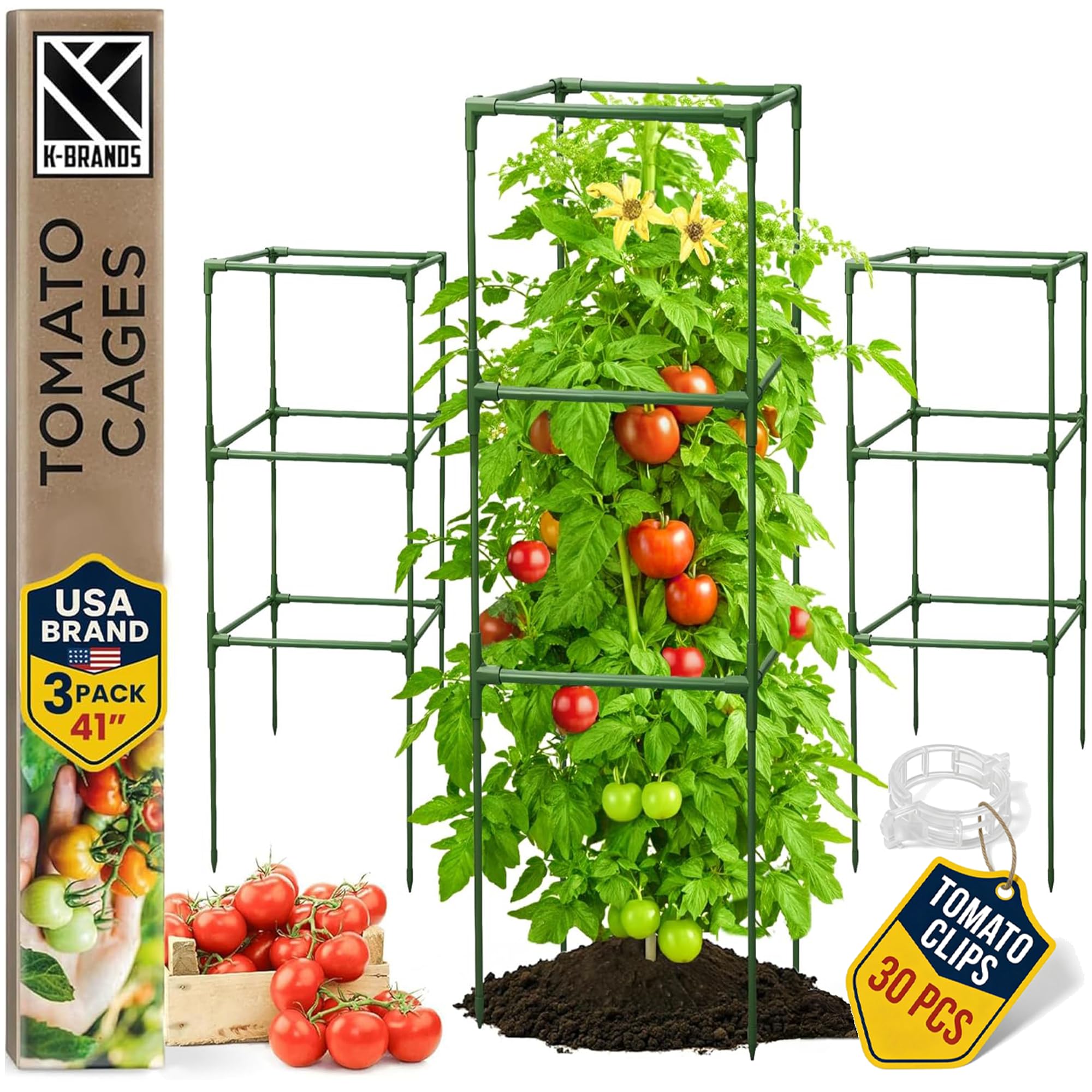
The square geometry of the K-Brands cage is a genuine improvement over round rings. Four corner stakes anchor into the soil with more surface area, reducing wobble even when the plant is loaded with fruit. At 41 inches, this cage is shorter than our top pick, but the square shape compensates by offering better lateral stability—especially important in raised beds where soil depth limits how deep you can push the legs. The steel core is fully encased in a plastic coating that resists fading and cracking under UV exposure.
Assembly uses interlocking snap connectors—no tools required—and the modular sections can be added as the plant grows. Owners in the feedback consistently praise the sturdiness compared to traditional round cages, with many noting that the square frame doesn’t deform under heavy weight. The 3-pack is a good fit for small garden plots or container rows on a patio, and the cages break down flat for off-season storage in a shed or under a workbench.
The main limitation is the 41-inch maximum height, which may require supplemental staking for aggressive indeterminate varieties that push past 5 feet. One owner received a set missing a cross bar, pointing to quality-control occasional gaps. Still, for determinate tomatoes, peppers, and bush cucumbers, this square cage provides excellent support in a compact footprint.
What works
- Square base offers superior wind resistance.
- Modular snap assembly is fast and intuitive.
- Sturdy enough to support heavy pepper and bean plants.
What doesn’t
- 41-inch height is short for indeterminate tomatoes.
- Occasional missing parts reported by some buyers.
3. SORANGEUN Triangle 48-Inch Tomato Cage (6-Pack)
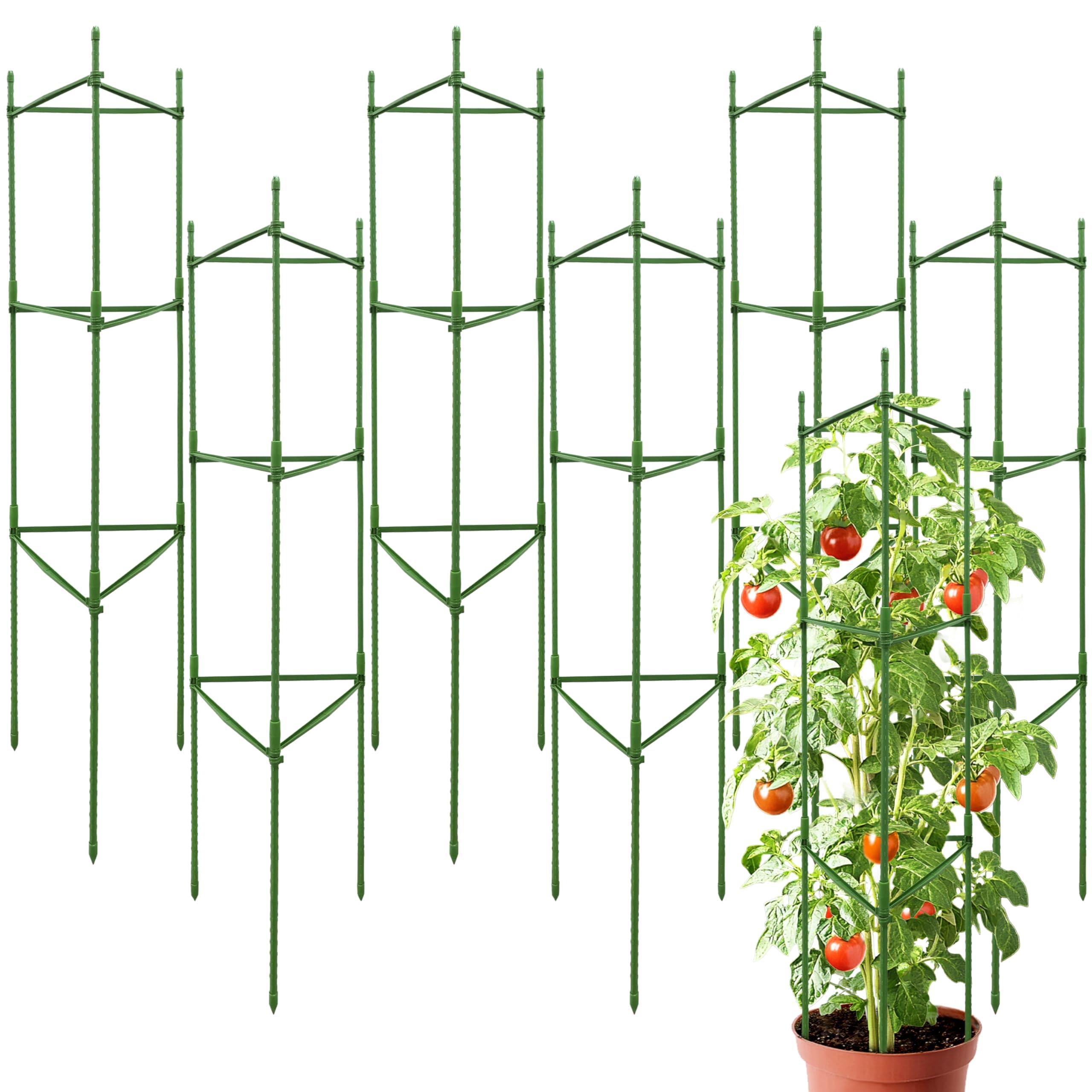
When you need to support an entire row of tomatoes without blowing your budget, the SORANGEUN 6-pack delivers serious per-unit value. Each cage forms a triangle with 13-inch sides, giving three points of ground contact that resist tipping more effectively than two-legged round cages. At 48 inches tall, they clear the average determinate plant and give indeterminate vines a solid base before they require extension. The steel core is plastic-coated, so rust buildup won’t compromise the structure over multiple seasons.
Assembly is tool-free—three pole sections snap together at the top, with the legs spreading into the triangular configuration when pushed into the soil. Owners mention that the modular sections can be disassembled and stored flat, which is helpful for winter organization. Many reviewers also discovered that the three-pole design can be arranged in a star pattern (overlapping multiple cages) for even greater coverage around a single large plant. The 6-pack covers a 12-foot row with no gaps.
Some owners received units with missing connector pieces, requiring a field repair with duct tape. The triangular structure is sturdy once assembled, but the connectors themselves are the weakest link—a few users noted that the poles can pull apart if the cage is lifted or moved after installation. For stationary garden support where you set it and leave it, this 6-pack offers performance per cage that is hard to beat.
What works
- Six cages per pack for full garden coverage.
- Triangular base provides stable three-point anchoring.
- Break down flat for compact off-season storage.
What doesn’t
- Connector fit is inconsistent across the set.
- Poles can separate if the cage is moved after installation.
4. Halatool 72-Inch Heavy Duty Tomato Cage (4-Pack)
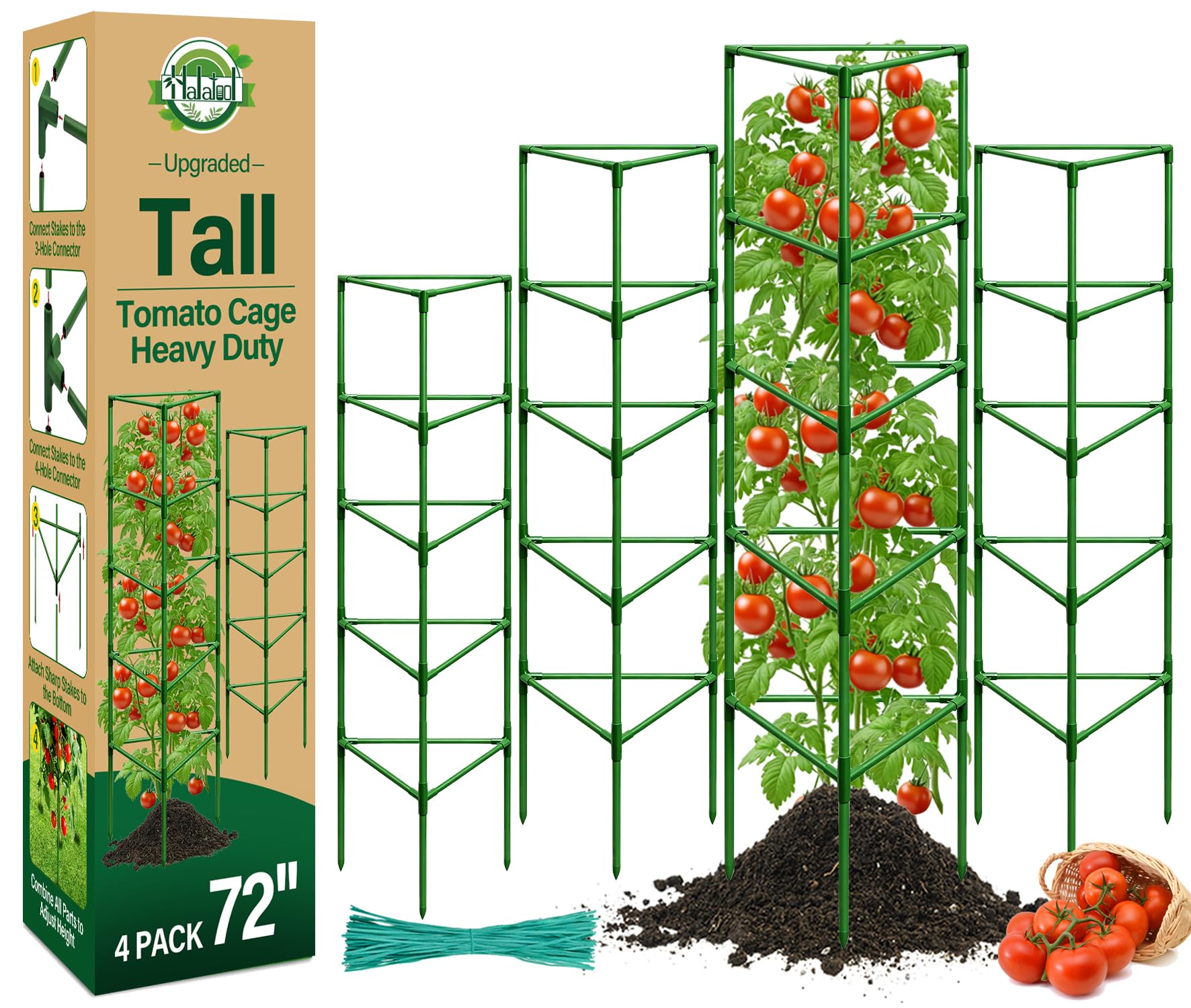
If you grow indeterminate tomatoes that routinely hit 6 feet by August, this Halatool cage is the only one on our list that matches the plant’s full height out of the box. At a full 72 inches, it eliminates the mid-season scramble for extension stakes or zip-tie towers. The frame uses a triangular geometry with a steel core and a UV-resistant plastic sleeve—a combination that keeps the metal from rusting while protecting stems from the abrasion that happens with bare wire. Each cage comes with four pieces per side that snap together by hand, letting you start the ring stack low and add sections as the vine climbs.
Owners report that the upgraded connectors hold securely during assembly, and the modular approach works well for both patio pots and in-ground rows. The triangular frame resists wind shear better than round cages at this height, and the steel core prevents the legs from bending when you push them into compacted garden soil. Several users also use these cages for indoor potted plants, thanks to a minimum height of just 14.56 inches when using only the bottom section.
The primary drawback is connector stability under heavy load. Some reviewers mention having to push the poles back together after windy days, suggesting that while the clips are improved, they aren’t perfect for extreme weather. The cage is also heavier than mid-range options, which is a trade-off for the extra height. For serious indeterminate tomato growers, the Halatool delivers the tallest ready-to-use support we tested.
What works
- Full 72-inch height handles the tallest indeterminate vines.
- UV-resistant plastic sleeve prevents rust and stem damage.
- Modular sections allow progressive height adjustment.
What doesn’t
- Connectors can loosen in sustained high winds.
- Heavier build makes repositioning more cumbersome.
5. Poray Large Tunnel 8.2’x4′ Plant Netting Cover

This isn’t a cage in the traditional sense—it’s a walk-in tunnel that combines structural support with pest exclusion. The frame uses 16mm round steel tubing, and the netting has a 96g/m² density with openings under 3mm, which is fine enough to block deer, squirrels, rabbits, and large insects while still letting through full sunlight and airflow. The dimensions (8.2 feet long, 4 feet wide, 6 feet tall) provide enough interior space for a row of indeterminate tomatoes to grow naturally upright without crowding against the netting. Two large double-zipper doors on the front give you easy access for pruning and harvesting.
Setup takes about two minutes—the frame snaps together, and the netting drapes over the top. The kit includes six long camping ropes and sturdy stakes to anchor the tunnel in strong winds, which is critical given the higher wind profile. Owners confirm that the tunnel holds up through heavy thunderstorms, keeping plants safe while the netting remains taut and free of tears. The cover also provides some UV protection, reducing leaf scorch during intense afternoon sun without blocking the light needed for fruit development.
The main consideration is the cost, which positions this as a premium investment rather than a simple cage. For a small garden with only a few plants, the tunnel’s footprint may be oversized. But if you’re dealing with persistent wildlife pressure—squirrels that strip ripe fruit, deer that browse leaves—the Poray tunnel eliminates that variable entirely, giving your plants a protected microclimate to grow in.
What works
- Blocks deer, squirrels, and large insects effectively.
- Steel frame withstands heavy storms with proper staking.
- Double-zipper doors allow easy plant access.
What doesn’t
- Footprint is large for small or container gardens.
- Price places it in the premium investment category.
6. LOMNYIY 55-Inch Heavy Duty Tomato Cage (1-Pack)

For gardeners who only need to support a few plants or want to test a new cage design before committing to a multi-pack, this single-unit version of the LOMNYIY 55-inch cage offers the same steel-core construction and three-ring adjustability as its 2-pack sibling. At 55.1 inches, it provides substantial vertical clearance for indeterminate varieties, and the modular rings let you start low for seedling support and add height as the plant grows. The plastic coating covers the entire metal surface, preventing rust and protecting stems from abrasion.
Assembly is tool-free and takes under a minute—the three ring sections snap onto the four support legs using the plug-in connection system with the double-layer metal tube interface. Owners who bought this single pack alongside other cages report consistent build quality: the legs are rigid enough to push into moderately compacted soil, and the rings hold their shape under the weight of mature vines. The cage also breaks down flat for winter storage, which is a practical advantage over fixed-wire designs that take up permanent space in the shed.
The single-pack format limits its value compared to the 2-pack, which offers a lower per-cage cost. A few owners noted that the ring hinge can snap if the connection is forced, and the overall stability is decent but not as rock-solid as the triangular or square designs. This is a smart entry point for a new gardener who wants a durable, adjustable cage without buying a full set upfront.
What works
- Same build quality as the 2-pack version.
- Tool-free assembly with three adjustable ring levels.
- Collapses flat for compact storage.
What doesn’t
- Single-pack cost per cage is higher than the multi-pack.
- Round frame is less stable than square or triangle designs.
Hardware & Specs Guide
Steel Core vs. Bare Wire
The steel core wrapped in a plastic coating is the critical material upgrade in modern tomato cages. Bare galvanized wire—still common in budget cages—develops rust spots after one wet season and can stain plant stems. Plastic-coated steel resists moisture contact with the metal, prolonging the cage’s usable life to three or more seasons. Verify that the coating is UV-stabilized; non-stabilized plastic will become brittle within 12 months of direct sun exposure.
Base Geometry: Round vs. Square vs. Triangular
Round cages typically have only two or three ground-contact points, making them prone to tipping when the plant becomes top-heavy. Square cages add a fourth anchoring leg and distribute the plant’s weight across a wider footprint, improving stability in loose soil. Triangular cages use three points but space them wider apart than round rings, effectively increasing the moment arm against tipping. For raised beds where soil depth limits leg penetration, a square or triangular base offers a measurable stability advantage over standard round designs.
Height Requirements by Tomato Type
Determinate (bush) tomatoes rarely exceed 4 feet, so a 48-inch cage is usually sufficient. Indeterminate (vining) tomatoes routinely reach 6 feet or more—if your cage stops at 48 inches, the vine will fold over the top, creating breakage points and reducing air circulation that encourages disease. A cage of 55–72 inches allows the plant to grow naturally upright without topping out. Adjustable-height cages with modular rings let you add height progressively as the vine climbs.
Connector Mechanism Durability
Snap-together connectors are the standard for tool-free assembly, but not all clips are equally reliable. The best designs use a double-layer metal tube interface that creates a friction fit even before the clip snaps—this prevents the poles from separating under the cyclic loading from wind. Cheaper designs rely solely on the plastic clip’s grip, which can loosen as the material fatigues. Look for cages where the connection point includes a mechanical interlock or a metal-on-metal contact surface.
FAQ
How tall should a cage be for indeterminate tomato plants?
Are plastic-coated steel cages better than galvanized wire cages?
What is the best cage shape for stability in windy areas?
Final Thoughts: The Verdict
For most gardeners, the cages for tomato plants winner is the LOMNYIY 55-Inch 2-Pack because it combines a rust-proof steel core, three-ring adjustability, and a price per cage that sits right in the mid-range sweet spot for home vegetable gardens. If you need full-season height for indeterminate vines that top 6 feet, grab the Halatool 72-Inch 4-Pack. And for total wildlife protection plus support structure in one package, nothing beats the Poray Large Tunnel 8.2’x4′.