
Specs are compiled from manufacturer listings and verified buyer reviews and can change over time — please confirm the key details on the product page before buying.
You want a thick, green lawn, not a scraggly patch, and the day you plant seed or lay sod decides it. The right starter fertilizer delivers a phosphorus-heavy dose that fuels root growth, helping new grass establish before heat or weeds take over. Below, you’ll find the top new lawn starter fertilizers ranked by their N-P-K numbers (the ratio of nitrogen, phosphorus, and potassium), coverage, and real owner results, so you can match one to your yard’s size and planting plan.
I’m Rikta — the founder and writer behind Lawn Gear Lab. This guide is built by comparing the manufacturers’ published specifications and the patterns across verified customer reviews, so you get each pick’s real strengths and trade-offs instead of marketing spin.
Whether you are overseeding a tired lawn or installing sod, choosing the right new lawn starter fertilizer sets the stage for deep roots, faster green-up, and a thicker stand you can actually mow sooner.
Our Picks at a Glance
How To Choose The Best New Lawn Starter Fertilizer
Starter fertilizers are different from the regular feed you use on an established lawn. They are built around one job: getting young grass roots to spread deep and fast before leaf growth takes over. The three numbers on the bag — the N-P-K ratio — tell you exactly how much of each primary nutrient is inside, and the middle number is the one that matters most for new plantings.
Read the middle number first
Phosphorus is the nutrient responsible for root formation, so a true starter formula always has a higher middle number than a standard maintenance blend. A ratio like 20-27-5 means 27% phosphorus, which fuels the root system while the lower potassium number supports overall plant function. If the middle number is low or equal to the others, it’s not a dedicated starter — it’s an all-purpose feed that won’t give new seed the same targeted boost.
Match the bag to your yard’s square footage
Coverage is printed right on the bag, and it varies wildly — a 15 lb bag might cover 5,000 sq ft while a 10 lb bag covers only 2,500 sq ft. Measure your planting area before you buy so you don’t run out halfway through the job. Buying a bag that’s far too large for a small patch means storing half-used fertilizer, which can clump and lose potency by next season.
Granular vs. liquid application
Granular fertilizers spread evenly with a drop or broadcast spreader and release nutrients over weeks, which suits large lawns and overseeding projects. Liquid concentrates mix with water in a sprayer and deliver nutrients faster to the root zone, which works well for small areas or spot treatments. Granules are the standard for covering 5,000 sq ft in one pass, while liquid wins when you want precision on a small patch.
Quick Comparison
| Model | Best For | N-P-K Ratio | Coverage | Form | Amazon |
|---|---|---|---|---|---|
| The Andersons 20-27-5★ Best Overall | Root development & deep green | 20-27-5 | 5,000 sq ft | Granules | Amazon |
| Fertilome 9-13-7Root Builder | Seeding & sod on small lots | 9-13-7 | 2,500 sq ft | Granules | Amazon |
| Scotts Turf Builder Starter | Thicker, quicker growth | 24-25-4 | 5,000 sq ft | Powder | Amazon |
| Covington Liquid 3-18-18 | Spot treatment & small areas | 3-18-18 | 3,250 sq ft | Liquid | Amazon |
| Jonathan Green 12-18-8 | Seeding, sodding & humates | 12-18-8 | 5,000 sq ft | Granules | Amazon |
| Southland Sod 15-15-15 | Sod installation & transplant | 15-15-15 | 18 lb bag | Granules | Amazon |
| Yard Mastery 12-12-12 | Year-round slow-release feed | 12-12-12 | 15,000 sq ft | Granules | Amazon |
In-Depth Reviews
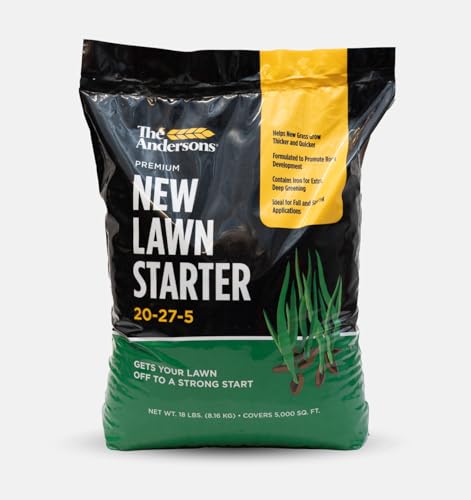
1. The Andersons Premium New Lawn Starter 20-27-5
Our pick — over 4.5★ from 550+ verified ratings; the strongest balance of quality and price.
The heavy-phosphorus pick that turns fresh seed into deep roots fast.
The Andersons leads this list because its 20-27-5 ratio puts a full 27% phosphorus behind root development — the highest middle number here — which is exactly what young seedlings need before leaf growth takes over. The 18 lb bag covers 5,000 sq ft, making it a true one-bag solution for a standard quarter-acre front yard or a full overseeding pass. It also carries 1% iron, which is why owners describe dark green seedlings rather than the pale, washed-out look you get from nitrogen alone.
What wins people over is the effectiveness — it’s the single most-discussed trait in the owner feedback, and the results show up quickly. Several buyers report visible grass fill-in within a week, with one seeing germination in just over a week and another noting a thriving, filling-in lawn shortly after application. The formula blends quick- and slow-release nitrogen, so new turf gets an immediate feed for establishment plus a sustained supply that carries it through the critical first weeks. It’s explicitly safe for all turf types and positioned for both spring and fall applications.
Versus the Ferti-lome below, The Andersons covers double the ground (5,000 sq ft vs. 2,500 sq ft) in a single 18 lb bag, and its phosphorus content more than doubles the Ferti-lome’s 13% for a stronger rooting push. Reviewers who use it for annual fall overseeding say the germination is great and the yard greens up nicely, with several calling it a must-buy for lawn work.
Why it wins the yard
- 27% phosphorus is the strongest rooting boost in this lineup
- 1% iron delivers the deep green owners rave about
- Quick- and slow-release nitrogen feeds for weeks
Before you buy
- 18 lb bag is oversized for small patch repairs
- Granular form needs a spreader for even coverage
The verdict: This is the pick for anyone seeding or overseeding a standard-sized lawn and wanting the strongest root push plus visible greening.
Think twice if: You only need to repair a small bare spot — the bag size simply overshoots a tiny job.
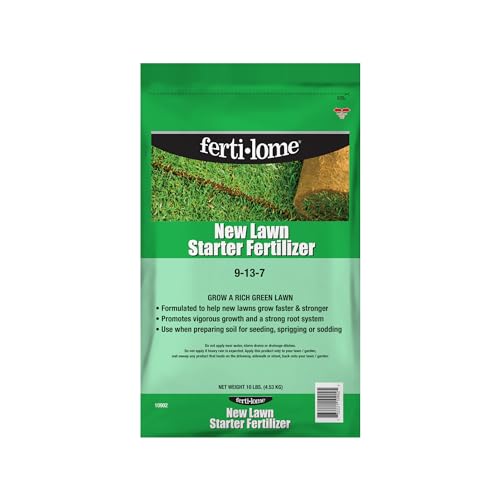
2. Ferti-lome (10902) New Lawn Starter 9-13-7
A compact 10 lb bag that targets root growth without overfeeding a small yard.
Ferti-lome’s 9-13-7 formula keeps the middle number — phosphorus — comfortably above the nitrogen, which is the signature of a true starter fertilizer built for root and stem development. The 10 lb bag covers 2,500 sq ft, so it’s the right fit for a smaller front yard, a re-seeded patch where a tree was removed, or a new sod installation on a modest lot. Owners describe it as helping new lawns establish quickly, with one noting it worked well specifically with annual rye seed.
The biggest praise centers on effectiveness and quality, with easy granular spread and quick density and color gains reported within weeks. One owner spread it on freshly tilled soil before laying zoysia sod and credited it with establishing root growth in the backyard one fall and the front yard the following spring. The manufacturer specifies applying 4 lbs per 1,000 square feet with a drop or broadcast spreader, and notes you should spread evenly to avoid streaking, skips, or overlaps.
Compared to The Andersons above, this is the scaled-down option — half the coverage (2,500 sq ft vs. 5,000 sq ft) and a gentler 13% phosphorus. It’s the better match when your planting area is genuinely small and you don’t want to store a half-used 18 lb bag. The honest caveat is that in poor soil, owners note it needs multiple applications to really shine, and the granular form requires dry storage to stay free-flowing.
Smart sizing: The 10 lb bag matches a 2,500 sq ft lawn perfectly, so you buy what you need instead of storing leftovers.
Real-world track record: Owners using it under zoysia sod report established root growth across two seasons, which is the exact job this product is designed for.
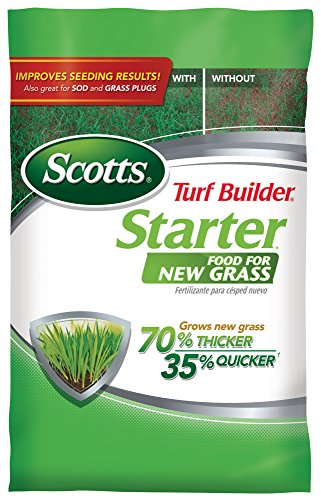
3. Scotts Turf Builder Starter Food for New Grass
The household name that delivers thicker, quicker grass by the numbers.
Scotts is the pick with the most owner feedback in this lineup by a wide margin — a crowd favorite that new and seasoned lawn owners reach for when planting seed, laying sod, or installing sprigs and plugs. The 24-25-4 ratio puts the phosphorus at 25%, edging out the Andersons’ 27% middle number for a very close second in the rooting department. Its standout claim is measurable: new grass grows 70% thicker and 35% quicker on average versus unfed lawns, and the 15 lb bag covers 5,000 sq ft.
Owners most often praise grass growth, describing lawns that turn from brown and pale to deep, dark, and lush. Grass health is the second-strongest theme, and ease of use rounds out the praise — one amateur owner who had failed with weed-and-feed and over-fertilizing finally succeeded using this with aeration, fall seeding, and daily watering, seeing visible improvement in three weeks. It works for new grass, sod, and plugs, and owners note great germination with thickness visible in just a few days.
The honest wrinkle here is value: opinions split sharply, with some saying it’s worth every cent and others calling it overpriced. That mixed reception is the single biggest trade-off, so if you’re on a tight budget, the Andersons above delivers a comparable 5,000 sq ft coverage with a higher phosphorus percentage. But if you want the reassurance of the most widely tested starter on the market, this is it — owners who used it on new sod called it exactly what they needed.
What owners love
- 70% thicker and 35% quicker growth versus unfed lawns
- 25% phosphorus for strong rooting on any grass type
- Visible thickness in days, not weeks
The honest catch
- Value for money is genuinely mixed — some call it overpriced
- Weeds can still appear, since starter food isn’t a weed killer
Who it’s for: First-time lawn owners who want a proven, forgiving product with the most real-world track record of any pick here.
Who should pass: Budget-focused buyers who see the 27% phosphorus in The Andersons at similar coverage as the better deal.
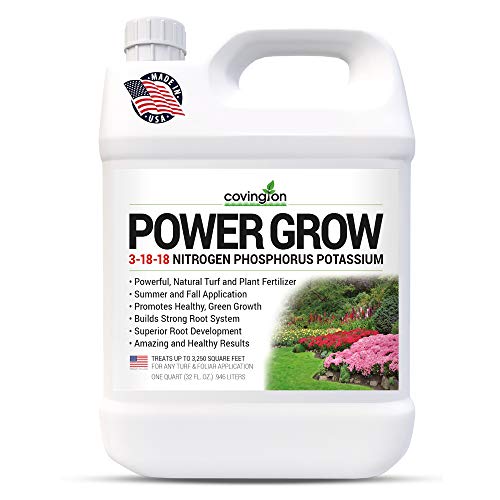
4. Covington Naturals Liquid 3-18-18 NPK
A spray-on concentrate that delivers 18% phosphorus straight to the root zone.
This is the liquid wildcard in a granular lineup, and it earns its place for a specific job: spot treatments and small areas where a spreader is overkill. The 3-18-18 ratio is dominated by phosphorus at 18% and potassium at 18%, with just 3% nitrogen — so it’s built almost entirely around root and flower development rather than leaf growth. The 32 oz bottle covers 3,250 sq ft when mixed at a rate of 2-4 oz per gallon of water.
Owners who used it at seeding time were surprised at how fast germination happened — one reported seed coming up in just 4 days. Another described blades of grass almost doubling in size with clumping expanding well, and noted the price is tough to top for the results. The manufacturer, a family-owned US business, positions it for all grass types including Bermuda, Ryegrass, Kentucky Bluegrass, Fescue, Bahia, Centipede, Zoysia, and St. Augustine.
The recurring feedback is that the nitrogen content feels low — one owner explicitly wished for more nitrogen after spraying and finding the grass still a little pale. That’s the honest trade-off of a rooting-focused liquid: it’s superb for establishment but won’t drive the deep green that a nitrogen-heavy granular like the Scotts 24-25-4 will. The manufacturer’s pro tip is to keep a suitable watering schedule and avoid mowing 24 hours before and after application for proper uptake.
Precision tool: This is the pick for reseeding a small patch or feeding new sod without dragging out a spreader.
Know the limit: The low 3% nitrogen means you’ll likely pair it with a nitrogen source later for full leaf greening.
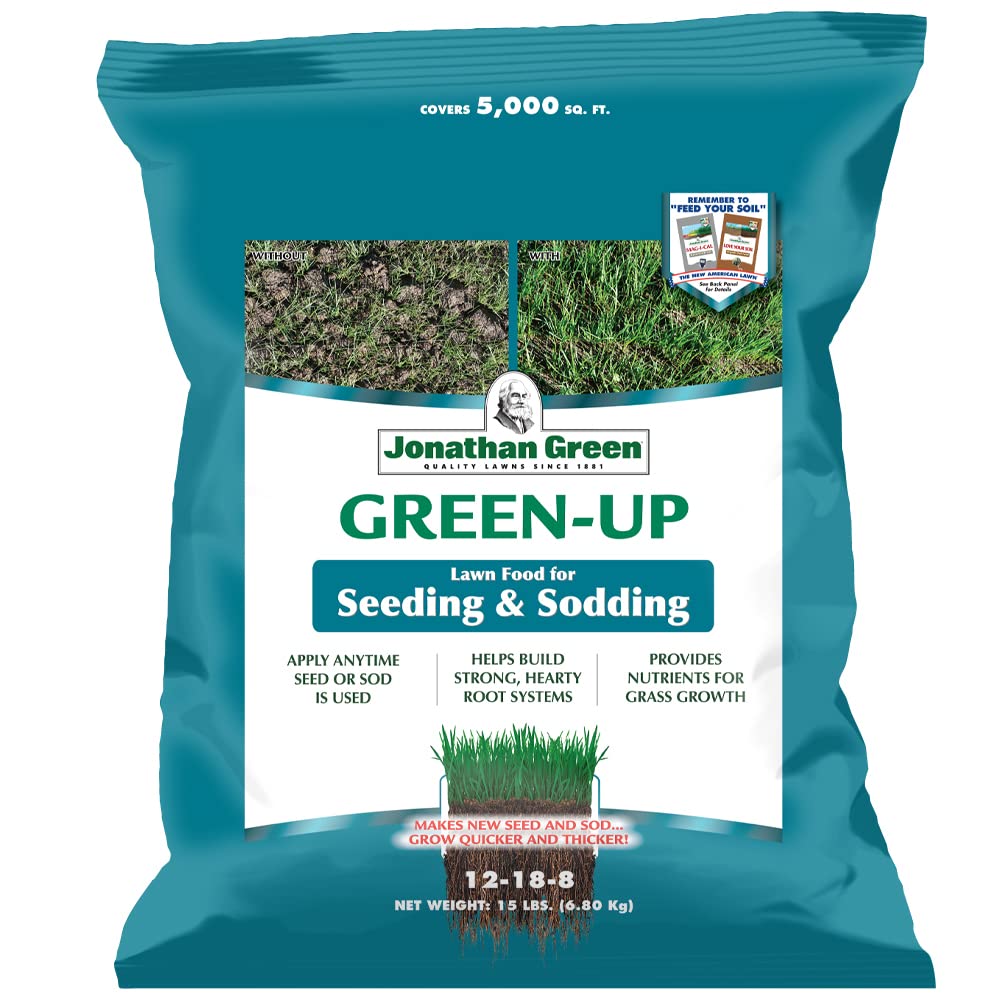
5. Jonathan Green Green-Up Lawn Food 12-18-8
The phosphorus-rich formula that adds humates to open up soil nutrients.
Jonathan Green’s 12-18-8 formula fuels root formation for new seedlings with 18% phosphorus (the nutrient that drives root growth), and it’s designed for seeding, overseeding, and laying sod alike. what separates it from the others here is the inclusion of humates, organic compounds that enhance the efficiency and availability of plant nutrients in the soil. That means the fertilizer works with your soil’s natural biology rather than just dumping nutrients on top. The 15 lb bag covers 5,000 sq ft and feeds for up to 2 months.
The real-world results are striking. One owner on a 5,000 sq ft shaded lawn in Minnesota reported 90% coverage in 4 weeks, with grass visible in 1 week and mowable in 4. Another owner in Kansas — where weather swings from excessive rain to hot and dry — said this lawn food strengthens grass to handle all conditions. It also contains iron for deep greening, which owners notice as a rich color that holds up better than neighboring lawns.
The starkest contrast in this entire lineup comes from the shade performance. While one owner had spectacular results on a shaded lawn, another reported failed germination in dense shade and blamed the product’s need for more sunlight than expected. That’s a genuine split, so if your planting area gets less than 5 hours of direct sun, you may want to lean toward a different pick. For everyone else, the humates and iron make this a premium-feeling granular that punches above its feed duration.
What stands out
- Humates improve nutrient uptake from the soil itself
- Feeds for up to 2 months from a single application
- Iron delivers deep greening that owners notice
The shade split
- Mixed results in dense shade — some owners saw failed germination
- Performs best with 5+ hours of direct sun
Reach for this if: You want a granule that feeds for 2 months and improves soil nutrient exchange via humates.
Look elsewhere if: Your seeding area is deep shade, where this product has shown inconsistent results.
6. Southland Sod Farms 21 Sod and Seed Starter 15-15-15

A perfectly balanced 15-15-15 that’s pre-fertilized to ease transplant shock.
Southland Sod Farms takes a different approach than the high-phosphorus starters above — its 15-15-15 ratio is perfectly balanced across all three primary nutrients, which makes it less of a rooting rocket and more of a gentle, complete meal for new turf. The manufacturer describes it as a pre-fertilized soil that accelerates establishment of a new lawn and nurtures it through its critical first weeks. The defining benefit is reducing the risk of transplant shock, which is exactly what sod needs when it’s lifted from a farm and laid on your property.
The 18 lb bag is a premium sized offering that owners apply every 3 months — one owner who let the interval slide to 5 months saw several browning spots on his lawn, which tells you the product is doing real work on a schedule. Another owner reported 100% seed germination and said they’d order again next year. The balanced formula helps roots develop faster while providing a carefully mixed set of vital nutrients, and one fall-season user who watered 3 times a week watched grass sprout into a plush lawn look.
Where this fits best is sod installation and the weeks that follow, when the lawn is vulnerable and needs steady, balanced nutrition rather than a hard rooting push. It’s also forgiving — one owner called it “zero prep work needed.” The trade-off versus The Andersons is that a balanced 15-15-15 doesn’t deliver the same phosphorus wallop for seed germination, so it’s stronger under sod than under a heavy overseed. An occasional owner notes the granules can arrive a bit clumpy, though it still worked well.
Transplant insurance: The balanced formula and quick establishment make this the go-to for new sod installations.
Not the same job: For pure seed germination, a higher-phosphorus starter like the Andersons 20-27-5 is the stronger choice.
7. Yard Mastery 12-12-12 with 3% Iron and Bio-Nite

The big-bag slow-release option that covers an acre-sized lot in one pass.
Yard Mastery’s 12-12-12 is the volume play of this list — a balanced 1:1:1 ratio that covers up to 15,000 sq ft, which is roughly a third of an acre. That’s triple the coverage of the Scotts and Andersons bags above, making this the clear choice for large properties where buying multiple 15 lb bags gets expensive fast. The formula adds 3% iron for greening and uses a slow-release design that offers prolonged nutrient delivery, reducing the need for frequent applications.
Effectiveness is the most-praised trait, with owners reporting their rye grass turning a rich dark green and noting great results when seeding yards. One owner said seed comes up in approximately ten days, while another who used it on new sod saw the lawn looking better a few days after application. The slow-release aspect is the key differentiator — several owners note it’s safe in the heat and use it all year round, with one saying they’ve used it for 4 years and won’t buy anything else.
The honest split is on value: some owners consider it good value for money given the massive coverage, while others find it too expensive for what it is. That’s the trade-off of a premium-size bag — the per-square-foot cost is competitive, but the upfront outlay is higher than a single small bag. For a standard 5,000 sq ft lawn, bag coverage of 15,000 sq ft means you’ll have fertilizer left for next season, which is either a benefit or a storage problem depending on your space.
Built for big yards
- 15,000 sq ft coverage is triple most competitors
- Slow-release formula feeds steadily and works in summer heat
- 3% iron drives the dark green owners mention
Consider this
- Value opinions split — some call it expensive
- Bag size means storing leftover fertilizer for a small lawn
Best for: Owners of large properties who want one bag, one application, and slow-release feeding all season.
Not ideal for: Small-lot owners who would store a 15,000 sq ft bag for years.
Understanding the Specs
The N-P-K ratio deciphered
Every fertilizer bag carries three numbers — nitrogen, phosphorus, and potassium. Nitrogen drives leaf and blade growth, which is why it’s the dominant number in regular lawn food. Phosphorus fuels root development and flower growth, making it the critical nutrient for new seed and sod. Potassium balances overall plant function and stress tolerance. For a starter fertilizer, the middle number should be at or above the first number, so roots establish before the leaves take off.
Quick-release vs. slow-release nitrogen
Quick-release nitrogen delivers an immediate green-up that owners notice within days, but it fades fast. Slow-release nitrogen breaks down gradually, feeding the lawn steadily for weeks and reducing the number of applications you need. The best starters — like The Andersons 20-27-5 — blend both, giving new grass an instant boost for establishment plus a sustained supply that carries it through the critical first month. The trade-off is that pure quick-release formulas require more frequent reapplication.
FAQ
What does the middle number in 20-27-5 mean for my new lawn?
How much starter fertilizer do I need for a 5,000 sq ft lawn?
Is liquid or granular starter fertilizer better for new grass?
Can I use starter fertilizer on existing grass?
How long does starter fertilizer take to show results?
What is the difference between 20-27-5 and 12-12-12 starter fertilizer?
Should I apply starter fertilizer before or after laying sod?
Will starter fertilizer work in shaded areas?
How often should I reapply starter fertilizer?
Does starter fertilizer work for overseeding an existing lawn?
Final Thoughts: The Verdict
Across the board, the new lawn starter fertilizer winner is the The Andersons 20-27-5 because its 27% phosphorus delivers the strongest root push of any pick here, the 1% iron drives the deep green owners rave about, and the 18 lb bag covers a full 5,000 sq ft. If you want the most widely tested option with the most owner feedback, grab the Scotts Turf Builder Starter for its proven 70% thicker and 35% quicker growth claims. And for a large property where you want one bag to last, the Yard Mastery 12-12-12 covers 15,000 sq ft with a slow-release formula that’s safe in summer heat — the crowd favorite among the big-bag options here, backed by a strong rating across its owner base.
How We Picked
We do not accept paid placement. Every pick is matched to a real buyer and a real use-case; we do not hands-on test units.
Sources & Methodology
Specifications: manufacturer listings and product documentation. Review insights: verified customer reviews, as of August 2026. Pricing: not shown on this page (it changes often); check the current price via the retailer link.
As an Amazon Associate, Lawn Gear Lab earns from qualifying purchases. This does not affect which products we feature.