
Specs are compiled from manufacturer listings and verified buyer reviews and can change over time — please confirm the key details on the product page before buying.
Most tree problems start underground, where you cannot see what is happening. A short probe only reads the soggy top inch, so you end up drowning roots that are dry three feet down. This guide separates the moisture probes that actually reach a tree’s root zone from the ones that just scratch the surface.
I’m Rikta — the founder and writer behind Lawn Gear Lab. This guide is built by comparing the manufacturers’ published specifications and the patterns across verified customer reviews, so you get each pick’s real strengths and trade-offs instead of marketing spin.
One note before the picks: this list uses flexible matching on probe length, so not every unit hits the exact same depth; the closest same-type sizes serve the same deep-soil purpose. Here is how to choose the right moisture probe for trees without wasting money on a tool that lies to you.
Our Picks at a Glance


How To Choose The Right Moisture Probe For Trees
Tree roots run deep, so the first rule is simple: the probe must be long enough to reach them. A probe that stops at four inches tells you about the grass, not the tree. Look for a shaft of at least eight inches, and ideally longer for established trees with deep root balls.
Analog vs digital readouts
Analog meters use a needle on a numbered dial — usually a 0 to 10 scale — and need no power beyond a small battery for the sensing circuit. Digital meters show a percentage on an LCD and often include extras like data hold or memory. Digital units give you a precise number fast; analog units are simpler and often sturdier in the field.
Calibration is non-negotiable
Every probe drifts, and the accuracy of your reading depends on resetting it properly. Some units calibrate automatically, while others need a hidden screw turned after you soak the soil. Ignore this step and you are just guessing with extra steps.
Quick Comparison
| Model | Best For | Probe Length | Readout | Weight | Amazon |
|---|---|---|---|---|---|
| Gain Express Soil Meter★ Best Overall | pH plus moisture in one tool | 295mm electrode | Analog dial | 5.6 oz | Amazon |
| TEKCOPLUS 2-in-1 MeterBest Diagnostic | Diagnosing overwatered trees | 295mm electrode | Analog dial | 0.23 kg | Amazon |
| A.M. Leonard 24-Inch Probe | Standing depth readings | 24 inches | Analog dial | 12 oz | Amazon |
| General Tools DSMM500 | Research-backed digital precision | 8 inches | Digital LCD | 11.2 oz | Amazon |
| Extech MO750 | Professional field work | 8 inches | Digital LCD | 0.27 kg | Amazon |
In-Depth Reviews
1. Gain Express Soil PH & Moisture Meter
Our pick — over 4★ from 650+ verified ratings; the strongest balance of quality and price.
The dual-duty probe that reads both pH and moisture down a 295mm shaft
The long, slender 295mm electrode reaches tree roots, not just the surface crust. It reads both pH levels and moisture content, so you get two answers from one push into the ground. The waterproof metal electrode withstands repeated stabbing into hard soil.
You never need batteries — this meter is self-powered, which means it is always ready and never dies mid-inspection. Owners praise the build quality, and the dial is easy to read once you learn the scales. The moisture scale reads in percent, which is not obvious at first glance; give yourself a few minutes with the dial before trusting it.
There is a real catch: some owners found the pH readings consistent but inaccurate against a lab test, with the meter showing 6.6 and 6.3 where lab results read 7.4 and 7.6. That gap could hide alkaline soil that needs sulfur. Moisture response is quick, but pH settles slowly over minutes, so patience is part of the process.
What wins people over
- Durable, heavy-duty probe that survives tough soil
- Self-powered — no batteries to replace
- Measures both pH and moisture in one tool
The honest trade-offs
- pH accuracy can drift from lab results — verify before treating soil
- pH readings take minutes to settle, not seconds
- Dial scales need study before they feel intuitive
Reach for this if: you want one affordable self-powered tool that checks both pH and moisture at root depth for garden and orchard alike.
Think twice if: you need lab-grade pH precision — verify its numbers against a test kit before making soil amendments.
2. TEKCOPLUS 2-in-1 Soil pH Moisture Meter
The meter that exposed a clay-soil overwatering problem and saved a new tree
This 2-in-1 meter matches the Gain Express’s 295mm reach, so it reads deep around roots where a shallow probe would miss the problem. Buyers report it lasted through two full seasons and stays reliable across outdoor use. The pH scale runs 3.0 to 8.0, and the moisture side handles the humidity check.
Its best real-world moment came from a tree owner in clay soil: the meter showed the soil was very wet, they stopped watering, and the tree improved. That is the exact scenario this tool exists for — catching overwatering before root rot takes hold. It works well in deep containers too, which is a bonus for anyone growing trees in pots.
Here is the honest wrinkle: the probe must stay in the soil for 10+ minutes before a reading is trustworthy. A quick insert gives a different number than a patient wait, and the printed instructions contradict themselves on technique. Moist the soil to depth, wait, and press the button while the probe is still buried.
Reliability is the headline: this unit earned the most owner praise for dependability, and the depth reach makes it a genuine tree-watering tool rather than a houseplant toy.
The patience tax: accurate readings demand a 10-minute soak-in — this is not a quick-dip tool.
Best for: anyone fighting overwatered trees in heavy clay who will wait out a proper reading.
Look elsewhere if: you want instant numbers — the lag here will frustrate you.
3. A.M. Leonard 24-Inch Soil Moisture Meter Probe
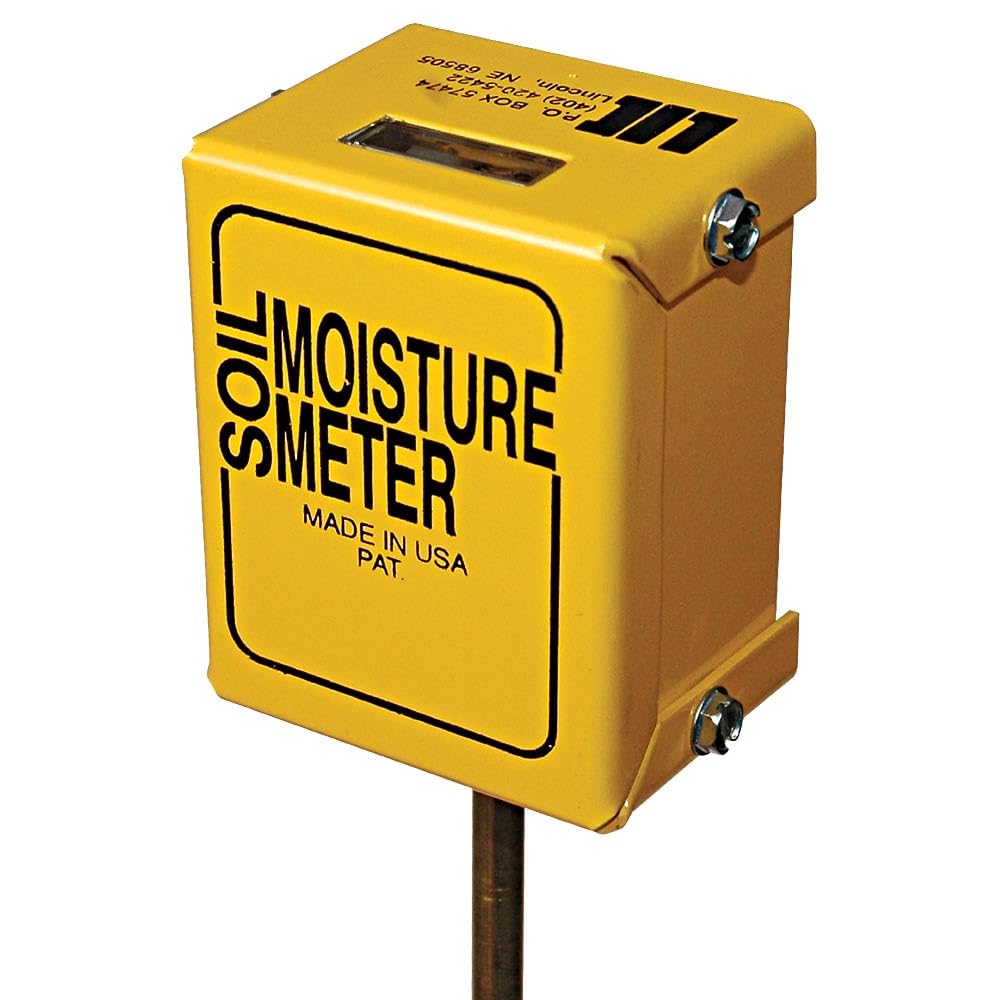
A 24-inch shaft that lets you read moisture standing up, no crouching required
This is the longest shaft on the list, and that length changes how you work. The 2-foot probe reaches root-ball depths that shorter meters cannot touch, and the tip-mounted sensor gives you depth-specific readings as you push down. The analog needle on the 0 to 10 scale is easier to read at a glance than a tiny digital display, especially outdoors in glare.
The all-metal, US-made construction is built to last for years, and owners call it rugged and simple, with one comparing it to a tank. It runs on a 9V battery included in the box, and the brass probe resists corrosion if you maintain the conditioning film. Commercial operators use it too, which speaks to the build.
Now the setup cost: this unit MUST be calibrated before first use, via a hidden screw that is genuinely hard to turn with a small screwdriver. Owners also found the meter readout is loosely mounted and can drop down. A few units failed after battery changes, with the needle staying at zero — so buy from a seller with good returns.
Depth is the differentiator: at 12 ounces versus the Gain Express 5.6 ounces, but that mass and the 24-inch reach are exactly what you want for mature trees.
The setup hurdle: calibration is mandatory and fiddly — factor in ten minutes before your first real reading.
Reach for this if: you manage established trees or containers where buried root balls sit a foot or more down.
Think twice if: you want a grab-and-go tool — the mandatory calibration and maintenance will test you.
4. General Tools DSMM500 Precision Digital Soil Moisture Meter
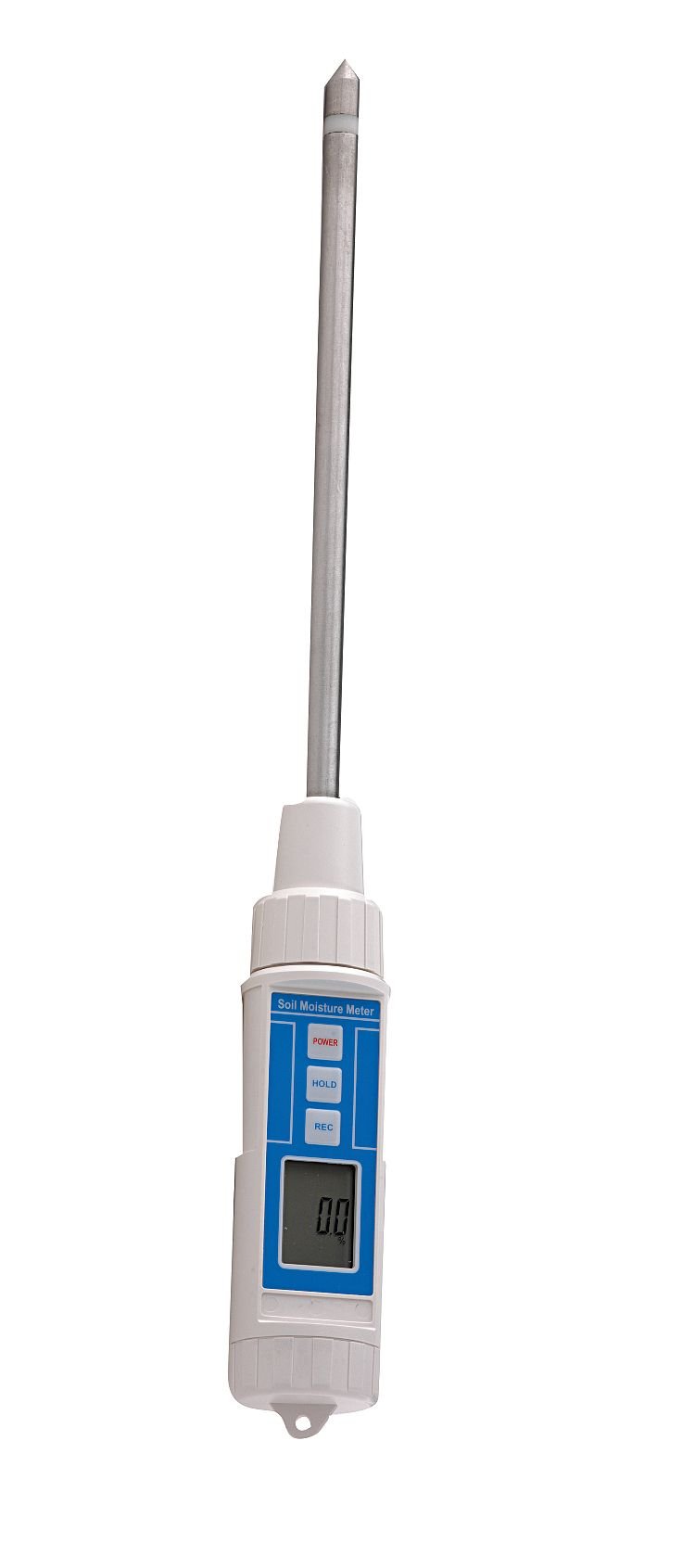
The digital meter cited in university research, with a fast 0.8-second sampling time
Its research backing from the University of Wisconsin and Bartlett Tree Research Lab is why owners trust it. It measures moisture from 0 to 50 percent with a resolution of 0.1 percent, and it samples in just 0.8 seconds — so you get a number almost instantly. The auto-calibration adjusts itself for different soil compositions, so sand reads differently from clay automatically.
The heavy-duty 8-inch probe is built for commercial and agricultural use, with IP65 water resistance for fieldwork rain. It has minimum/maximum memory and data hold, which helps you compare readings across a row of trees. Power comes from 4 AAA batteries, not included.
The one honest miss: a silt-loam test showed saturated mud reading 15 percent when roughly 30 percent was expected, and a water test confirmed 14.3 percent. That means the numbers are consistent but not tied to standard soil moisture levels — use it to track changes over time, not as an absolute truth. The 8-inch probe also means more bending over to insert it.
Why it leads on paper
- 0.8-second sampling — nearly instant feedback
- Auto-calibrates across different soil types
- IP65 water resistance for outdoor work
Where it slips
- Readings may not match standard soil moisture scales
- 8-inch probe is short for deep tree roots
- Needs 4 AAA batteries you must supply
Best for: professionals and serious gardeners who want research-backed, fast digital numbers and will treat them as relative trends.
Look elsewhere if: you need an industry-standard absolute reading or a probe that reaches deep root zones without bending.
5. Extech MO750 Soil Moisture Meter
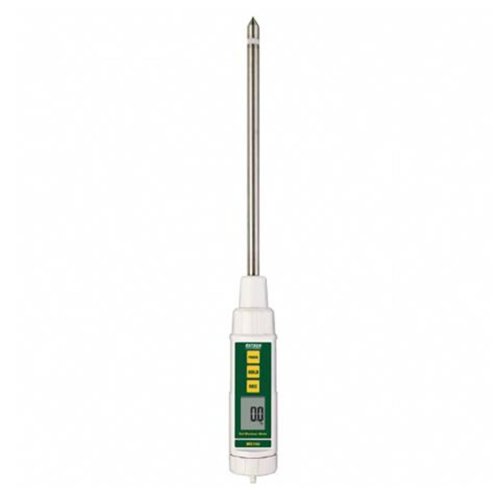
The field-grade meter for those who have been burned by cheap devices before
One owner with three acres of varied plantings put it plainly: cheap devices gave cheap results, and this one works every time it is used. The durable 8-inch stainless steel probe reads deep beneath the surface, and the large LCD screen beats squinting at a tiny analog dial. It measures moisture for gardening, agriculture, and forestry — a wider brief than the others here.
Accuracy is rated at ±(5% + 5d), and it runs on standard AAA batteries. The lightweight body handles field conditions, and its 50 °C upper temperature rating keeps it working in serious heat. For a home gardener or greenhouse manager, this is the last meter you will buy.
The honest caveat is the cost — owners themselves admit it is expensive — and you must learn what moisture level suits your specific soil type. The manufacturer also suggests calibrating for your soil, so the first readings are a baseline, not a verdict. It is a long-term tool for people who treat watering as a science.
The trust factor: owners who graduated from cheap probes report this one simply works, every single time.
The barrier: a premium price tag that only makes sense if you are serious about getting moisture right.
Best for: serious gardeners, landscapers, and anyone managing large or varied plantings who wants reliability over savings.
Think twice if: you just want a casual check — this is more tool than a balcony planter needs.
Understanding the Specs
Probe length
This is the single number that matters most for trees. Roots sit deep, and a short probe reads only the soggy surface. Look for a shaft of at least 8 inches — and the 24-inch A.M. Leonard shows what real depth looks like if you have mature trees.
Calibration & soil type
Every meter drifts, and every soil reads differently. Clay gives better contact than sand, so a reading in one soil type is not a universal truth. Calibrate before first use, and treat early readings as a baseline to track changes over time.
FAQ
How deep should a tree moisture probe reach?
Can one probe measure both pH and moisture?
Do these meters need batteries?
Why does my reading change if I wait longer?
How accurate are analog probes compared to lab tests?
Can I use a tree probe in pots and containers?
What does the IP65 rating on a moisture meter mean?
What is the difference between the 0 to 10 scale and a percentage?
Final Thoughts: The Verdict
For most tree owners, the moisture probe for trees winner is the Gain Express Soil Meter because it pairs a 295mm root-reaching electrode with both pH and moisture readings in a self-powered body that never needs batteries. If you want digital speed and research backing, grab the General Tools DSMM500 with its 0.8-second sampling. And for mature trees where depth is everything, the A.M. Leonard 24-inch probe is the one to reach for.
How We Picked
We do not accept paid placement. Every pick is matched to a real buyer and a real use-case; we do not hands-on test units.
Sources & Methodology
Specifications: manufacturer listings and product documentation. Review insights: verified customer reviews, as of July 2026. Pricing: not shown on this page (it changes often); check the current price via the retailer link.
As an Amazon Associate, Lawn Gear Lab earns from qualifying purchases. This does not affect which products we feature.