
Specs are compiled from manufacturer listings and verified buyer reviews and can change over time — please confirm the key details on the product page before buying.
When Japanese beetle grubs chew your lawn roots and attract moles and skunks, you want them gone without harsh chemicals. Milky Spore is a natural bacteria-based treatment that targets only the grubs, and picking the right format for your yard size decides between a one-time fix and a multi-year chore.
I’m Rikta — the founder and writer behind Lawn Gear Lab. This guide is built by comparing the manufacturers’ published specifications and the patterns across verified customer reviews, so you get each pick’s real strengths and trade-offs instead of marketing spin.
Here is the breakdown of the best Milky Spore granules for your lawn, with honest trade-offs and real coverage numbers to help you pick the right one.
Our Picks at a Glance

How To Choose The Best Milky Spore Granules
Milky spore is a naturally occurring bacteria that infects and kills Japanese beetle grubs living in your soil. Once established, it keeps working for years — but only if you apply it correctly and to the right size area.
Granular vs. powder: which one is for you?
The biggest fork in the road is format. Granular formulas pour easily through a drop spreader or cyclone spreader, which makes covering a large lawn quick and painless. Powders are more concentrated by weight (a 40-ounce bag covers 10,000 sq ft, for instance) and are applied in teaspoons every 4 feet, which is precise but far more tedious on a big yard.
Your patience level matters more than the price tag
Milky spore is not a fast fix. The recommended program is three applications per year for two years, because the bacteria needs time to multiply in the soil and reach grub populations. If you want instant relief this season, milky spore will frustrate you; if you can commit to the two-year cycle, the payoff is a lawn that essentially protects itself.
Quick Comparison
| Model | Best For | Product Weight | Dosage Method | Protection Window | Amazon |
|---|---|---|---|---|---|
| St. Gabriel 20 lb Granular★ Best Overall | Large lawns & mole reduction | 20 pounds | Drop or cyclone spreader | Up to 10 years | Amazon |
| St. Gabriel 40 oz PowderUSDA Organic Pick | 10,000 sq ft coverage in one bag | 2.5 pounds (powder) | 1 tsp every 4 ft | Years of active protection | Amazon |
| Milky Spore 10.1 oz | Small beds & precise spot treatments | 10.1 ounces | 1 tsp per 4 sq ft | Season after season | Amazon |
In‑Depth Reviews
1. St. Gabriel Organics Milky Spore Granular, 20 lb
Our pick — 4.5★ from 2,500+ verified ratings; the strongest balance of quality and price.
The big-bag workhorse that turns a grub problem into a memory
You get 20 pounds of granular product here, which makes it the clear choice for homeowners covering a genuinely large lawn in one pass. Because it’s granular, you can pour it straight into a drop spreader or cyclone spreader and walk the yard without measuring teaspoons — a difference you’ll feel immediately on a big property.
What wins people over is the mole reduction. More owners single out mole activity disappearing than any other benefit, and the second-largest praise is effectiveness against grubs. The biology makes sense: kill the grubs and the moles lose their food source, so the tunnels stop appearing. The manufacturer rates this for up to 10 years of protection with a single application, which explains why it’s priced as a long-term investment rather than a seasonal purchase.
Buyers report a real trade-off: this is expensive as a per-application cost, and one owner who applied in spring still saw dormant grubs early on — before reporting zero grubs for three years with no pesticides used afterward. The recurring gripe is that it jams drop spreaders; the fix that worked for multiple owners was switching to a cyclone spreader.
What Owners Applaud
- Mole activity drops noticeably — the most-praised outcome by far
- Granules spread easily through a cyclone spreader
- Safe around people, pets, and beneficial insects
Watch Out For
- Jams certain drop spreaders — open with a cyclone model
- Cost is steep for a quarter-acre yard
- Results build over months, not days
Reach for this if: you have a large lawn, hate fussing with tiny measurements, and want the biggest single bag that walks through your spreader.
Look elsewhere if: you need to treat only a small garden bed — this much product is overkill for a spot treatment.
2. St. Gabriel Organics Milky Spore Granular, 15 lb
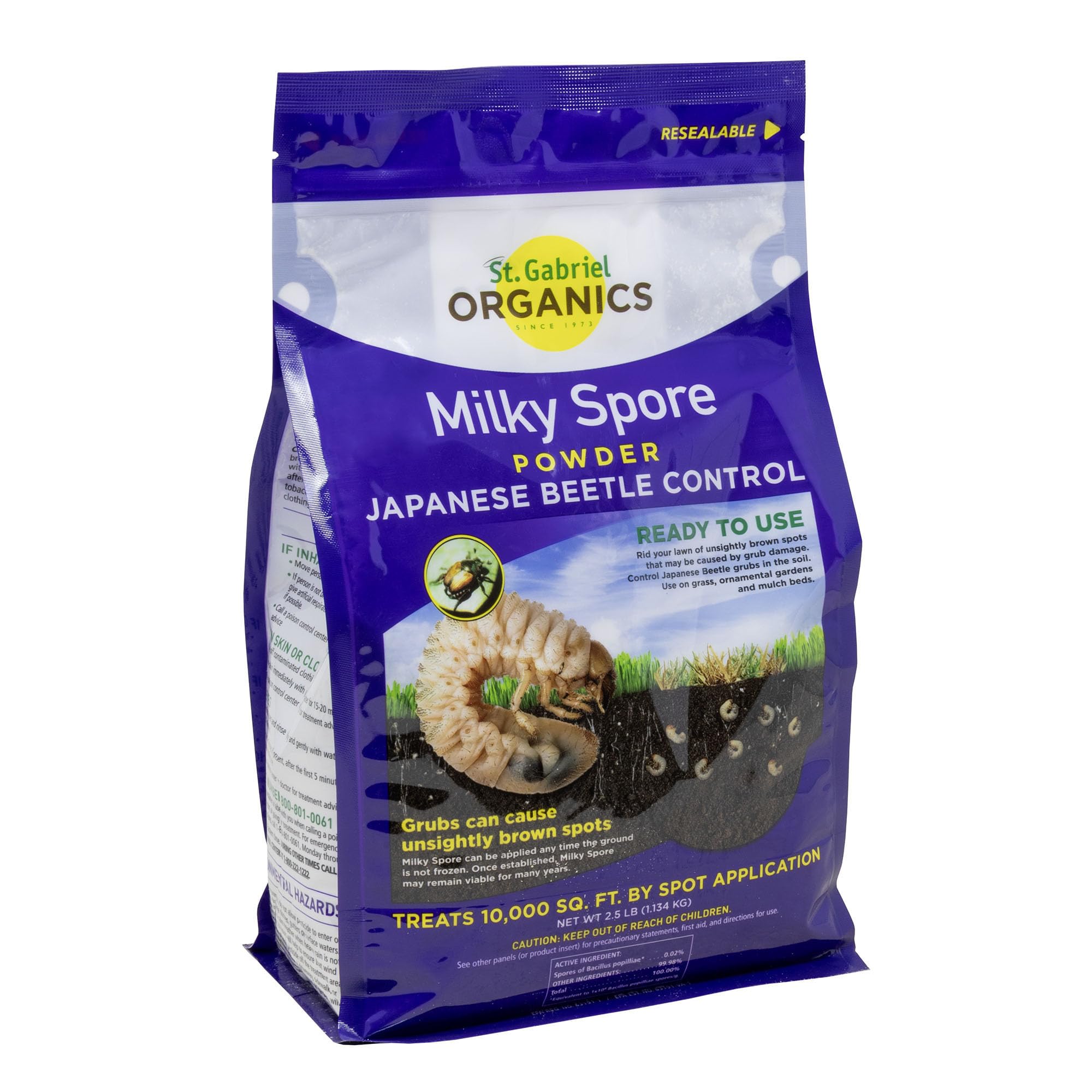
Tiny bag, massive footprint — 40 oz covering 10,000 sq ft
Here’s the packaging trick that surprises every first-time buyer: this is only a 2.5-pound bag, yet it covers up to 10,000 sq ft. That’s because the powder is concentrated — you apply just 1 teaspoon every 4 feet along rows, either by hand or with the Milky Spore Dispenser Tube sold separately. Weight-for-weight, this is the most ground you’ll cover per pound of product in this lineup.
Owners consistently report it works well for up to 7 years and successfully eliminates Japanese beetles, and they appreciate that it’s safe around pets and plants. The big real-world win for some was indirect: kill the grubs and the skunks, possums, and raccoons that dig for them lose their food source. One owner who was getting skunked repeatedly because of the grub feast solved the whole cycle with this powder.
Customers note the powder is more tedious to apply than granules — measuring teaspoons every few feet is real work. One owner found the “cost is crazy for this product” and was surprised by how small the bag is, though they expected it to work. The pro application tip that came up repeatedly: only apply when soil temps are above 60°F, and the bacteria establishes fastest when watered in.
Why it earns a top slot: It’s the same trusted bacteria as the granular picks but covers more ground per dollar, making it the smart buy for a larger yard if you can handle the hand-application work.
Choose this for: max coverage per bag and a willingness to spread by hand or with the dispenser tube.
Skip it for: anyone who wants to walk a spreader across a big lawn instead of measuring teaspoons.
3. Milky Spore 80010-9, 10.1 oz
The small-bag powder for beds, borders, and targeted grub zones
At 10.1 ounces, this is the smallest format in the roundup — roughly a quarter of the weight of the 40-ounce powder. That makes it the right call when your problem is a specific garden bed, tree line, or shrub border rather than an entire lawn. The dosage stays the same precision game: 1 teaspoon per 4 square feet, watered in after application.
Effectiveness wins people over — it’s the most-cited positive, with owners reporting grub control that persists season after season. One buyer says, “Worth every penny and all the time invested. I have NOT had a problem with grubs or Japanese beetles this year.” It’s also gentle on your garden: owners note it didn’t harm worms or fireflies while killing the grubs.
There are two honest catches. The packaging is easily mistaken for a larger amount than it holds, so check the ounces before assuming coverage. And the powder is fine and dusty — open it carefully away from food prep, and note it’s inactive when soil temps drop below 50°F, so timing your spring application matters.
The practical angle: No printed instructions come in the bag, so pull up the dosage online before you start. One owner salvaged their whole crop after a shady patch recovered in about a week once applied properly.
Grab this if: you’re treating beds, borders, or a smaller yard and don’t want to store a 20-pound bag.
Pass if: you need to cover acres — you’d burn through this tiny bag fast.
Understanding the Specs
Bacillus Popilliae — the active ingredient
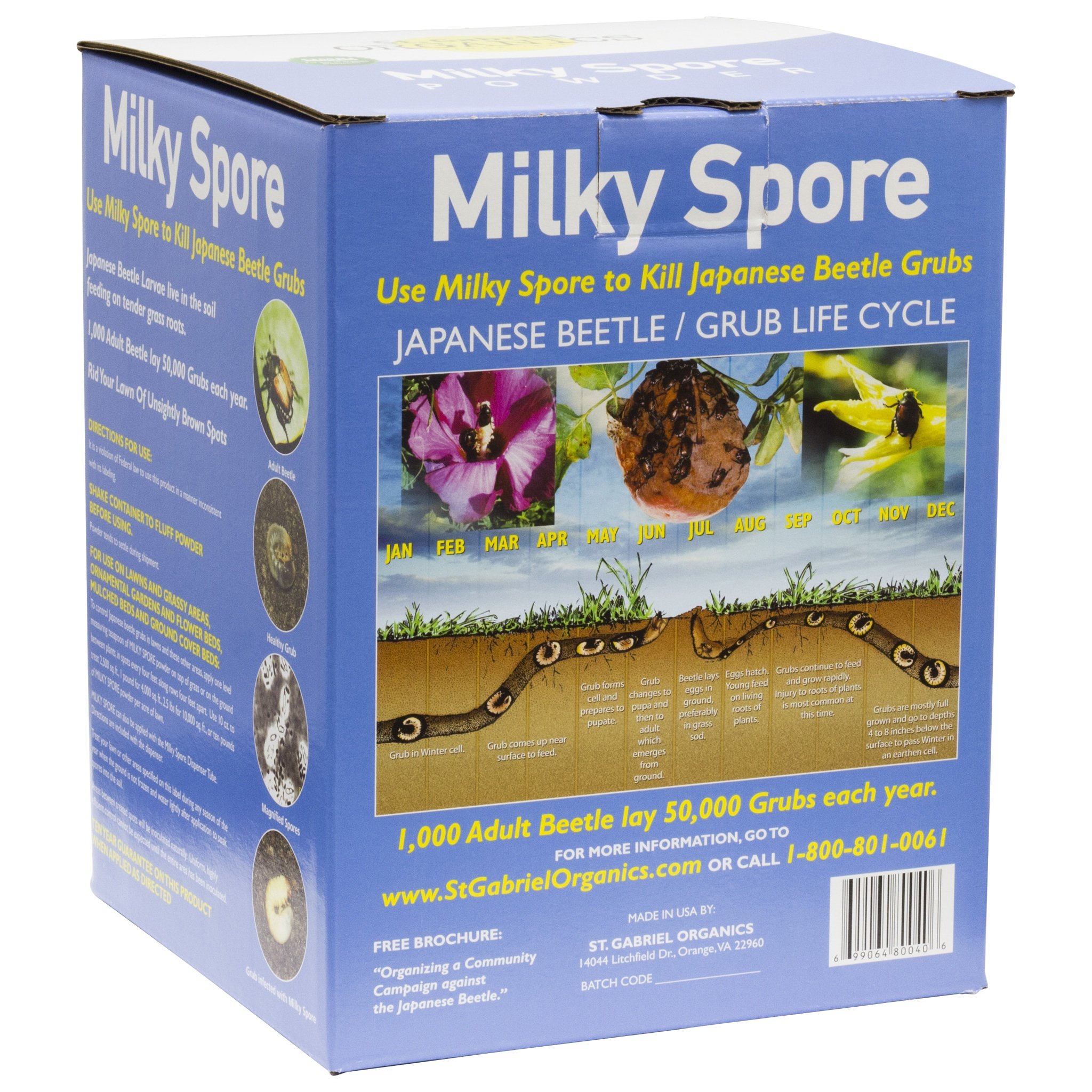
This is the naturally occurring bacteria that gives milky spore its name. It infects Japanese beetle grubs as they feed in the soil, and when the grub dies, it releases new spores that spread the infection. That’s why one application builds over time — the bacteria multiplies in your soil instead of washing away.
Granular vs. powder format
Granular formulas (like the 20 lb and 15 lb bags) are heavier but pour cleanly through drop and cyclone spreaders, making them best for whole-lawn coverage. Powder formulas are concentrated by weight — a 40 oz bag covers 10,000 sq ft — but require measuring teaspoons every few feet by hand or with a dispenser tube.
The two-year, three-application protocol
Milky spore isn’t a one-and-done seasonal spray. The recommended program is three applications per year for two years, because the bacteria needs time to establish a strong population in the soil and reach all the grub zones. Owners who follow it report protection lasting anywhere from 7 to 15 years depending on the formula.
Soil temperature and watering in
Milky spore is inactive when soil temps drop below 50°F, so spring and early summer applications are the norm — one owner used 60°F as their trigger. Watering the product in after application moves the spores down into the grub zone, which is why the instructions emphasize it and why owners who skip it see slower results.
FAQ
Will milky spore granules work through a drop spreader?
How long does a single application of milky spore last?
Is granular or powder milky spore better for a large lawn?
Does milky spore harm bees, pets, or beneficial insects?
Will milky spore get rid of moles in my yard?
When is the best time of year to apply milky spore?
How many applications does milky spore really need?
Why is milky spore so expensive per bag?
Does milky spore work on other beetles or just Japanese beetles?
Can I apply milky spore around vegetable gardens and fruit crops?
Final Thoughts: The Verdict
For the majority of shoppers, the milky spore granules winner is the St. Gabriel 20 lb Granular because it pairs the largest single bag with the strongest real-world results — especially the mole-reduction effect that more owners praise than any other outcome. If you want the certified-organic label for a mid-size yard, grab the 15 lb Granular. And if you’re determined to cover the most ground per bag and don’t mind hand-application, the 40 oz Powder is the one to reach for.
How We Picked
We do not accept paid placement. Every pick is matched to a real buyer and a real use-case; we do not hands-on test units.
Sources & Methodology
Specifications: manufacturer listings and product documentation. Review insights: verified customer reviews, as of August 2026. Pricing: not shown on this page (it changes often); check the current price via the retailer link.
As an Amazon Associate, Lawn Gear Lab earns from qualifying purchases. This does not affect which products we feature.