
Specs are compiled from manufacturer listings and verified buyer reviews and can change over time — please confirm the key details on the product page before buying.
Few things frustrate a gardener more than watching heavy tomatoes or cucumbers flop onto the soil, where rot and pests move in fast. The right plant support netting lifts vining crops off the soil, keeping fruit clean and simplifying harvests. This guide breaks down the real trade-offs between polyester, nylon, polyethylene, and jute nets so you can pick the one that actually matches how your garden grows.
I’m Rikta — the founder and writer behind Lawn Gear Lab. This guide is built by comparing the manufacturers’ published specifications and the patterns across verified customer reviews, so you get each pick’s real strengths and trade-offs instead of marketing spin.
Weighing length, mesh size, materials, and real owner experience tells you which plant support netting earns its place in your garden this season.
Our Picks at a Glance


How To Choose The Best Plant Support Netting
Roll differences in material, length, and mesh size determine how the net performs all season. Start with the material, then look at the length and mesh size, and finally consider how the net arrives on its roll.
Match the material to your season
Polyester and nylon nets, like the AlpineReach and Toolazy picks, resist UV rays well and tend to last multiple seasons since they won’t degrade quickly under harsh sun. Polyethylene (PE) nets, like the HHTHH green and white rolls, are tough and affordable but owners often treat them as a one-season product. Jute nets are the natural choice — they are fully biodegradable, so you can cut the whole thing down and toss it on the compost heap at season’s end.
Count the coverage and check the mesh
A 350-foot roll covers a long fence line or multiple raised-bed seasons, while a 100-foot roll fits a smaller plot. The roughly 6-inch mesh lets plants weave through and allows easy two-sided harvesting. A 5.9-inch square is nearly identical to a 6-inch square, so pick based on roll length and material.
Quick Comparison
| Model | Best For | Material | Length | Mesh Size | Amazon |
|---|---|---|---|---|---|
| AlpineReach 5×350 ft★ Best Overall | Long runs & multi-season use | Polyester | 350 ft | 6 in | Amazon |
| Toolazy Nylon 5×350 ftPremium Pick | Greenhouse & delicate stems | Nylon | 350 ft | 6 in | Amazon |
| Toolazy HDPE 59″x328′ | Raised beds & grow tents | HDPE | 328 ft | 6 in | Amazon |
| ATICCA Plastic 47″x328 ft | Wide coverage on a budget | Polyethylene (PE) | 328 ft | 6 in | Amazon |
| Green HHTHH 4×100 ft | Windy spots & flower beds | Polyethylene (PE) | 100 ft | 5.9 in | Amazon |
| White HHTHH 4×100 ft | Pole beans & value buys | Polyethylene (PE) | 100 ft | 5.9 in | Amazon |
| Miuezuth Jute 6.6×9.8 ft | Compostable, natural setups | Jute | 9.8 ft | 5.9 in | Amazon |
In-Depth Reviews
1. AlpineReach Trellis Netting 5 x 350 ft
Our pick — over 4.5★ from 700+ verified ratings; the strongest balance of quality and price.
The 350-foot roll that spans a whole fence line and still covers next season.
You get 350 feet of climbing space here, which is roughly ten times what the jute pick offers — 9.8 ft stands next to 350 ft. That kind of length makes it the obvious pick for long trellis runs, and the polyester weave is built to shrug off sun exposure so the net keeps its strength through multiple seasons. The 6-inch mesh squares give tomatoes, cucumbers, and beans ample room to weave through.
You can stretch it across an A-frame, run it horizontal for a SCROG setup, or hang it vertically — the flexibility is genuinely useful. The net weighs 1.81 kg, which means it feels substantial in hand, and owners say that quality is the first thing they notice. The roll’s 4.6-star crowd favorite status among 700 ratings confirms this is a product people trust enough to reorder year after year.
The honest catch is the unrolling. As buyers report: “It took longer to get this untangled than to put up.” That’s a recurring theme — the net is sturdy and functional, but it can arrive as a tangled mess that demands patience. You’ll want to stretch it over rigid top support, like a fence board or conduit, because the net itself is soft and needs a frame to hold its shape.
What wins people over
- 350 ft of coverage — one roll handles an entire garden
- 6-inch mesh gives tomatoes and cucumbers room to spread
- Sun-resistant polyester holds up across multiple years
Where it stumbles
- Arrives tangled — plan for an extra 20 minutes of setup
- Needs a rigid frame at the top to stay taut
Reach for it if: you have a long fence or large raised beds and want a multi-season net you won’t outgrow.
Expect: a patient hour untangling on day one before you ever touch a stake.
2. Toolazy Trellis Netting 5 x 350 ft Nylon
The corrosion-resistant nylon net that stays gentle on delicate stems and vines.
Unlike the stiffer polyethylene rolls, this one is woven from corrosion-resistant nylon fibers that are soft enough to avoid chafing fragile stems — a real advantage for peas and young tomato shoots. The 350-foot roll with 6-inch square mesh gives you the same generous coverage as the top pick, but the nylon material is what earns its premium label. Because it resists UV rays, chemicals, and weathering, it’s designed to hold its integrity through wind and rain without fraying.
Setup is where this net pulls ahead of the AlpineReach. It’s pre-wound on a sturdy cardboard reel, which owners say makes unrolling and cutting easy — no tangled mess on the lawn. You can cut it to any size for A-frames, vertical poles, or SCROG configurations, and it mounts cleanly with zip ties, garden clips, or twine. Owners note it held up well under heavy cucumbers and kept critters away from plants, which makes it a strong choice for a greenhouse.
At 2 pounds for the full 350 feet, it’s remarkably light, yet it’s held up in 30 mph winds — a few owners note the knots can slip slightly, so check tension after a storm. This is the net to grab if you want the durability of the top pick without the tangled unboxing, and you’re happy to pay a little more for the smoother experience.
Built for easy days
- Cardboard reel means no tangling — unroll and go
- Soft nylon protects delicate stems from chafing
- Corrosion-resistant and UV-stable for multi-year use
What to watch
- Knots can slip slightly, so re-tension after heavy wind
- Priced above the plastic rolls for the same length
Pick this when: you want the 350-foot coverage but refuse to wrestle a tangled mess on setup day.
The trade-off: you pay a premium for the reel and the softer, gentler nylon mesh.
3. Toolazy Trellis Netting 59″ x 328′

A taller 59-inch drop that suits raised beds and medium grow tents.
Most rolls give you a 4- or 5-foot width, but this one stands 59 inches tall — that extra height covers taller crops and fits standard raised beds and medium grow tents without awkward gaps. The 328-foot length still provides over 1,615 square feet of support, which is plenty for a serious vegetable garden. It’s made from high-density polyethylene (HDPE), a tougher cousin of standard plastic netting that resists wear and holds its shape well.
Owners consistently describe it as easy to use, with the roll-wound packaging preventing tangles — just unroll, cut with scissors, and attach. The 6-inch square mesh allows climbing vegetables room to grow while keeping pruning and harvesting easy. It handles cucumbers and green beans well, and some owners mention leaving it out in all weather for two full years with no issues at all.
The one recurring note is that the bottom edge sometimes arrives tied up, so you’ll need to untie it to stretch the net fully. Compared to the 350-foot nylon pick above, this one trades a little length for a materially taller drop, which matters if your crops grow head-high. It’s a strong mid-range value that works in grow tents, on fence lines, or draped over an A-frame.
The height advantage
- 59-inch drop covers taller crops than standard 4-ft nets
- Over 1,615 sq ft of coverage from one roll
- Reported to hold up for two years in all weather
Setup quirks
- Bottom edge can arrive tied — untie before stretching
- Sturdiness gets mixed feedback under very heavy loads
Best for: raised bed gardeners and grow tent users who want a tall net without buying multiple shorter rolls.
Skip if: you need the absolute longest single roll available — the 350-foot options edge it out.
4. ATICCA Plastic Trellis Netting 47″ x 328 ft
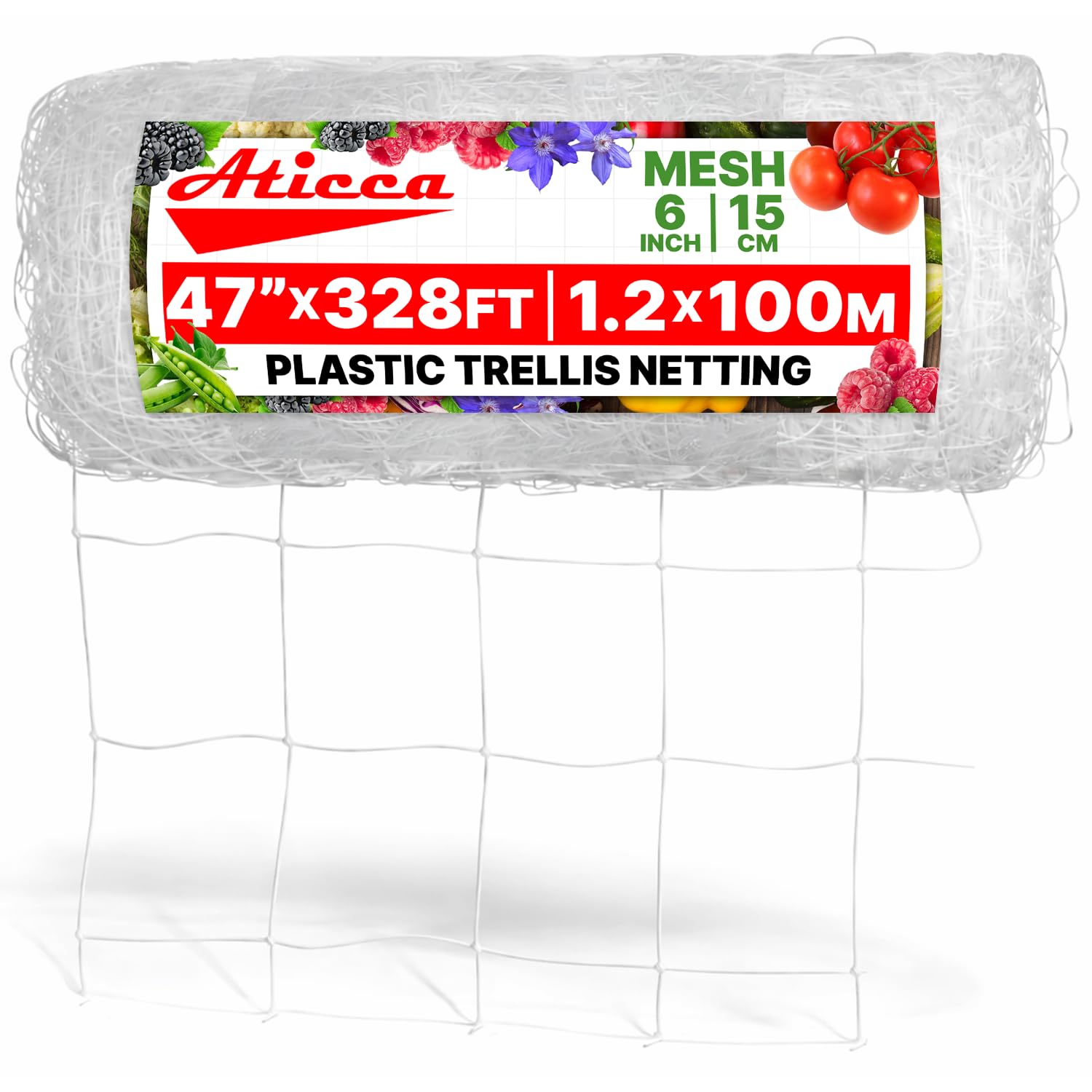
The plastic roll owners say beats pricier polypropylene brands, at a fair price.
This net earns its value label the old-fashioned way: owners who compared it side-by-side with a polypropylene brand found this one held up better, and they’re happy to say so. At 47 inches tall and 328 feet long, it covers a long raised bed garden or fence line economically, and the 6-inch mesh works for tomatoes, peas, beans, and cucumbers. One owner noted they have 320 feet of beans growing on it and it “works just fine.”
Setup is straightforward — the roll cuts to any size, and you simply wrap and tie it around a support structure without worrying about unraveling. Customers note it’s easy to unroll and use, and that it blends nicely into the garden rather than standing out as an eyesore. The length also makes it useful beyond plants: it can double as a barrier to protect chickens from hawks or even frame a children’s soccer goal.
The honest limitation is lifespan. As one owner put it, “It probably is only good for one year” — so treat it as a seasonal investment rather than a permanent structure. You’ll also want a rigid top support, like a conduit pipe, to hang the top string from, because the mesh itself doesn’t hold its shape under heavy vine weight. For the price, it’s hard to argue with that trade-off.
Why owners love it
- 328 ft of coverage at a budget-friendly price
- Reported to outperform pricier polypropylene brands
- Easy to unroll, cut, and tie into place
Plan for this
- Consider it a one-season net, not a permanent structure
- Needs a rigid top bar to hold heavy vines
Buy it for: a big garden on a budget where you’ll replace the net each spring.
Who it’s not for: gardeners wanting a multi-year install who should step up to the nylon or polyester rolls.
5. Green Trellis Netting 4×100 ft

The net that stood up to a bad windstorm with a fully grown zinnia crop.
This green polyethylene net has built its reputation on durability in rough conditions. As reviewers point out: “Held up my fully grown zinnia crop through a bad windstorm!” — and that’s the kind of real-world stress test that matters more than any spec sheet. The 4×100 ft size with 5.9-inch mesh squares is a classic setup for cucumbers, dahlia gardens, and vine vegetables, and the green color disappears visually so your garden looks natural.
The material uses a UV absorber to handle heat and cold, which extends its usable life across several years. Owners also report it works well as a squirrel, deer, or dog barrier when strung along the top of pig panels or fence lines. The mesh is sturdy enough to hold a full-grown crop while remaining nearly invisible from a distance.
The recurring gripe is tangling — the net can catch on itself while unrolling, and owners advise taking your time and unwinding rather than pulling. It’s also roughly a third of the length of the ATICCA roll above, so measure your garden before committing. But for a 100-foot run where wind is a real threat, this is the net owners trust to hold its ground.
Proven in the field
- Survived a windstorm while holding a full zinnia crop
- Green color blends into the garden naturally
- UV absorber extends lifespan across several years
The frustration
- Catches on itself while unrolling — patience required
- 100 ft is short compared to 328-350 ft rolls
Reach for this when: your garden sits in open, windy ground and you need a net that won’t tear mid-season.
Think twice if: you need long fence-line coverage — the 328-ft rolls deliver far more for a similar layout.
6. White Trellis Netting 4×100 ft

The cheap-and-tough white net that owners say beats pricier nylon and metal cages.
Owners describe this roll as “light but tough” — a material that feels deceptively delicate in hand but holds bean vines and pole beans without complaint. The 100-foot length with 5.9-inch mesh squares is a solid, entry-level setup, and the white color makes it easy to see your plants through the grid. It’s made from high-density polyethylene with a UV absorber to resist sun damage, giving it several years of potential use.
The value argument here is strong. As shoppers say: “It will not last more than one season.” One owner was blunt: “It will not last more than one season” — so keep your expectations in check. But the same owner notes it’s a better value than nylon trellis and far cheaper than metal wire tomato cages, which makes it a smart seasonal buy for gardeners who replant every spring anyway.
It’s somewhat difficult to hang because the material is soft, so you’ll want a sturdy frame. The real appeal is pole bean beds, where buyers report it’s particularly effective. If you’re looking for the lowest-cost way to support a single season of climbing vegetables, this white roll delivers exactly that without fuss.
The budget appeal
- Light material that’s surprisingly tough for the price
- Better value than nylon trellis and metal cages
- Effective in pole bean beds
Set expectations
- Most owners treat it as a one-season product
- Soft material makes hanging a bit awkward
Choose it for: a single-season bean or pea crop where cost matters more than longevity.
Look elsewhere if: you want a net that will survive multiple winters — the polyester options last longer.
7. Miuezuth Jute Trellis Netting 6.6 x 9.8 ft

The 100% biodegradable jute net you can toss straight onto the compost heap.
This is the net for gardeners who want zero plastic in their beds. Made from 100% biodegradable jute, it means no more untangling spent vines at the end of the season — you simply cut the whole thing down and compost it, plants and all. The 3mm jute twine is strong enough to hold beans, peas, and cucumbers, and the 5.9-inch squares give climbing plants room to grow straight and tall.
Setup is notably easier than the plastic rolls. It arrives pre-marked with different color ties at each corner to make hanging simple, and it comes out tangle-free for most owners. One cucumber grower reported the beans love it better than the chicken wire they’d used in past seasons, and it works perfectly on an arched trellis. The natural rustic look also pleases gardeners who prefer their support to blend into the landscape.
The major caveat is scale — at 6.6 ft wide and 9.8 ft long, this is a fraction of the coverage of the other rolls here, about one-tenth the length of the 100-foot options. A few owners also report quality-control issues where netting was tied together mid-roll, creating a tangled knot. If you’re covering a single arch or a small cucumber patch, this natural net is a delight. For a long fence line, you’d need several rolls.
The natural advantage
- 100% biodegradable — compost the whole thing at season’s end
- Color-coded corner ties make hanging easy
- Sturdy 3mm jute holds beans, peas, and cucumbers
Know before buying
- Short 9.8-ft length suits arches, not long runs
- Occasional rolls arrive with knotted joins
Perfect for: the organic gardener with an arched trellis or small cucumber bed who composts everything.
Not for: long fence-line coverage where the 100-ft plastic rolls are far more practical.
Understanding the Specs
Mesh size
The mesh size — almost always around 6 inches — is the single most important spec for how your plants grow. A 5.9- or 6-inch square lets vine crops weave tendrils naturally while leaving space for two-sided harvesting. Smaller mesh can trap plants, while much larger mesh fails to support heavy fruit.
Material & lifespan
Your material choice sets the net’s lifespan. Polyester and nylon resist UV rays and weathering, making them multi-season investments. Polyethylene (PE) and HDPE nets are tough and affordable but are often treated as one-season products by owners. Jute is fully biodegradable, so its lifespan is intentionally short — you compost it at season’s end.
FAQ
Will trellis netting support heavy tomatoes or just light peas?
How do I stop the net from tangling when I unroll it?
What is the difference between a 4-foot and a 5-foot wide net?
Can I reuse trellis netting for multiple seasons?
Is jute netting better than plastic for the garden?
How long should a 350-foot roll actually last me?
Will the netting hurt my plants’ stems as they grow?
Can I use this netting for anything besides climbing plants?
Final Thoughts: The Verdict
For most gardeners, the plant support netting winner is the AlpineReach 5×350 ft because its polyester build survives multiple seasons while the 350-foot length covers an entire garden in one purchase. If you want the easiest setup with soft, stem-friendly nylon and no tangled unboxing, grab the Toolazy Nylon 5×350 ft. And for the eco-conscious gardener with a single arch or cucumber patch, the Miuezuth Jute net is the one to reach for — knowing it goes straight onto the compost heap when the season ends.
How We Picked
We do not accept paid placement. Every pick is matched to a real buyer and a real use-case; we do not hands-on test units.
Sources & Methodology
Specifications: manufacturer listings and product documentation. Review insights: verified customer reviews, as of August 2026. Pricing: not shown on this page (it changes often); check the current price via the retailer link.
As an Amazon Associate, Lawn Gear Lab earns from qualifying purchases. This does not affect which products we feature.