
Specs are compiled from manufacturer listings and verified buyer reviews and can change over time — please confirm the key details on the product page before buying.
The best post-emergent herbicide for your lawn matches your grass type, weed problem, and patience level. This guide breaks down nine proven liquid and granular sprays so you can pick the formula that kills weeds without harming your turf.
I’m Rikta — the founder and writer behind Lawn Gear Lab. This guide is built by comparing the manufacturers’ published specifications and the patterns across verified customer reviews, so you get each pick’s real strengths and trade-offs instead of marketing spin.
Here are the top-performing post-emergent weed killers, ranked by real-world results, grass safety, and value. these are the best post-emergent herbicides for lawns that kill weeds without killing your grass.
Our Picks at a Glance


How To Choose The Best Post-Emergent Herbicide For Lawns
Post-emergent weed killers are designed to kill weeds that are already growing and visible in your lawn. Unlike a pre-emergent (which stops seeds from sprouting), these products work by being absorbed through the weed’s leaves or roots. The key is finding a selective formula that targets broadleaf weeds but leaves your grass healthy.
Match the Product to Your Grass Type
Your grass is the most important factor. Cool-season lawns like Kentucky bluegrass, tall fescue, and perennial ryegrass tolerate most formulas. Warm-season grasses like Bermudagrass and zoysiagrass are pickier. St. Augustinegrass is the most sensitive — you need a product that is labeled safe for it, or you’ll damage your lawn.
Know the Weed You’re Fighting
Broadleaf weeds like dandelion, clover, and ground ivy respond to standard blends like 2,4-D and Dicamba. Grassy weeds like crabgrass and foxtail need different chemistry entirely — look for Quinclorac. Nutsedge is harder still and often needs a dedicated active ingredient like Sulfosulfuron. Match the active ingredient to the weed type for the fastest kill.
Consider Cool-Weather Performance
Most weed killers work best when weeds are actively growing in warm weather. Some formulas — particularly SpeedZone — are designed to work in cooler temperatures. If you want to get ahead of weeds in early spring, choose a product that boasts fast-acting, cool-weather performance so you’re not waiting for summer heat.
Quick Comparison
| Model | Best For | Volume | Weed Focus | Key Active | Amazon |
|---|---|---|---|---|---|
| PBI Gordon SpeedZone EW★ Best Overall | Tough broadleaf + cool weather | 128 oz | Broadleaf, Clover | 2,4-D, Dicamba | Amazon |
| Select Source Triad TZTop Performer | Broadleaf variety + nutsedge | 32 oz | Broadleaf + Nutsedge | 4-way blend | Amazon |
| SpeedZone EW Lawn Weed KillerCool-Weather Pick | Fast-acting, cool-season turf | 20 oz | 90+ Broadleaf | 2,4-D, Dicamba | Amazon |
| ALLIGARE 2,4-D Amine | Large areas, pigweed, thistle | 128 oz | Broadleaf | 2,4-D Amine (47.2%) | Amazon |
| Liquid Harvest Mesotrione | Crabgrass & nimblewill | 8 oz + surfactant | 46 species | Mesotrione | Amazon |
| Primesource Quinclorac 1.5L | Mature crabgrass, foxtail | 64 oz | Grassy weeds | Quinclorac 18.92% | Amazon |
| Certainty Turf Herbicide | Nutsedge (purple & yellow) | 1.25 oz | Nutsedge & grassy weeds | Sulfosulfuron | Amazon |
| Blindside Herbicide WDG | Warm-season turf, tough weeds | 8 oz | 70+ Broadleaf & sedges | Sulfentrazone | Amazon |
| Agralawn Crabgrass Killer | Spot-treating crabgrass | 32 oz | Crabgrass | Powder | Amazon |
In-depth Reviews of the Top 9 Formulas
1. PBI Gordon SpeedZone EW Broadleaf Herbicide
Our pick — over 4.5★ from 450+ verified ratings; the strongest balance of quality and price.
The heavy hitter that nukes deep-rooted weeds even in cool spring weather.
If you’ve got a stubborn, years-old weed infestation, this is the cannon you want. This 128-fluid-ounce jug delivers control of clover in as little as 1 week, with visible activity on the weeds within just hours of the spray drying. It’s specially formulated to perform when temperatures drop, so you’re not stuck waiting for summer heat to get to work.
The results speak for themselves: a 10-year Morning Glory/bindweed infestation killed to the root in 10 days. The most dramatic win reported: a 10-year Morning Glory/bindweed infestation killed to the root in 10 days — no regrowth. This is the kind of deep, systemic kill that weaker formulas simply can’t deliver. It holds a 4.7-star average from owners, making it the highest-rated product here and a crowd favorite.
The trade-off is real: this is a concentrated, hardworking chemical. This is a concentrated, hardworking chemical — it’s banned in many states, including CA, NY, and TX. You’ll need to supply your own sprayer since no applicator is included. And because it stays wet on the leaf longer, you need to keep pets and kids off the lawn until it dries fully.
Why owners swear by it
- Kills deep-rooted weeds like bindweed and Morning Glory to the root
- Works in cool weather when other killers stall
- Visible wilting in hours, clover gone in a week
The honest catches
- No sprayer included in the box
- Not legal to buy in many states
- Handle with care — it’s a strong, long-lasting chemical
The pick for: anyone fighting a long-term broadleaf invasion who wants the fastest, most reliable kill available.
Look elsewhere if: you’re in a restricted state or want a gentler, organic-leaning option.
2. Select Source Triad TZ 4-Way Herbicide
A four-ingredient cocktail that wipes out clover, ground ivy, and even nutsedge.
When you’re not sure what weed you’re fighting, a 4-way combination is your best bet. This 32-fluid-ounce quart packs four active ingredients — 2,4-D, Dicamba, Triclopyr, and Sulfentrazone — giving you broad-spectrum power over dandelion, spurge, white clover, plantains, and ground ivy. It’s even labeled for suppression of yellow nutsedge. That multi-pronged attack is why buyers report it’s more effective than Tenacity.
The speed is impressive: weed growth stops within hours of application, with full death in 1 to 4 weeks depending on conditions. In real-world testing on a 6,000 sq ft bluegrass/rye lawn, users saw roughly 95% of weeds killed — clover gone entirely — even when applied at a chilly 45–50°F. The formula is versatile enough for residential lawns, athletic fields, and golf courses.
One practical tip from the owner community: the odor is strong and serves as a wetness warning. You’ll want to keep foot traffic off the lawn until it’s dry. It’s a concentrated product, so a little goes a long way — many report using about a third of the bottle per major application.
Multi-weed muscle: four active ingredients make this a true broad-spectrum solution, and it takes on yellow nutsedge that many rivals skip entirely.
Reach for this if: you have mixed broadleaf weeds and want one product that handles nearly all of them plus some nutsedge.
Keep hunting if: you’re extremely sensitive to chemical odors.
3. SpeedZone EW Lawn Weed Killer
The same trusted SpeedZone chemistry in a smaller, reseed-friendly bottle.
Here’s the little sibling to our top pick that’s perfect for smaller yards or spot treatments. While the gallon jug is for big operations, this 20-fluid-ounce bottle is more approachable, yet it holds the same fast-acting promise: visible effects on weeds within hours. It’s labeled to control 90+ listed weeds, including white clover, dandelion, ground ivy, and spurge, and it’s a standout for cool-weather application.
You can reseed your lawn in as little as 7 days after spraying, so you can fix bare patches fast without waiting weeks. It’s rainfast in as little as 3 hours once dried, meaning a surprise shower won’t wash away your work. It’s safe for Kentucky bluegrass, perennial ryegrass, tall fescue, Bermudagrass, and zoysiagrass, so it works on most common lawns.
Owners consistently report that it kills the weeds and leaves the grass alone. Its effectiveness is the most-praised feature by a wide margin. One large-lawn owner with 13,000 sq ft sprayed with a mower-mounted boom and found nearly all weeds dead within a week.
Fast follow-up: the 7-day reseed window is the fastest here, letting you repair your lawn almost immediately after the weeds die.
The pick for: cool-season grass owners who want SpeedZone’s power without committing to a gallon jug.
Think twice if: you have a very large lawn and need the bigger, more economical gallon size.
4. ALLIGARE 2,4-D Amine Weed Killer
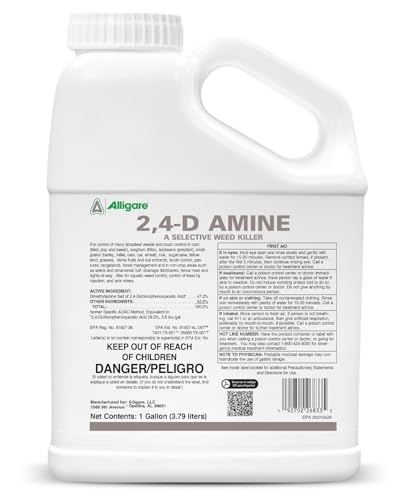
Farm-grade 2,4-D at 47.2% strength that stretches across huge properties.
This is the workhorse for people with serious acreage. With 47.2% active 2,4-D Amine, this 128-fluid-ounce (1 gallon) jug packs a higher concentration than most homeowner products. It’s designed to take out pigweed, thistle, and ragweed, and it’s labeled for use across lawns, pastures, and even aquatic sites. If you’re managing a farm, a large field, or just a very big lawn, this is built for the job.
Mix just a few ounces per gallon of water to cover large areas, which makes this gallon jug go a very long way. Owners who’ve ordered it multiple times praise it for killing weeds within a few days without harming the grass. For the volume and concentration, it’s an outstanding value that keeps performing across many seasons.
The catch is chemistry: a simple amine formulation is generally less fast-acting on certain tough weeds than the multi-ingredient blends. Pay attention to the mix ratio — owners warn that if you don’t follow the instructions carefully, you can damage your grass. It’s also restricted from sale in some states, including California and Texas.
Big-acreage power: the highest concentration-to-volume ratio here makes this the clear choice for covering farms, pastures, and sprawling lawns economically.
Reach for this if: you measure your lawn in acres, not square feet, and want a versatile, high-strength concentrate.
Look elsewhere if: you need a fast-acting multi-weed blend for a small suburban yard.
5. Liquid Harvest Mesotrione Bundle
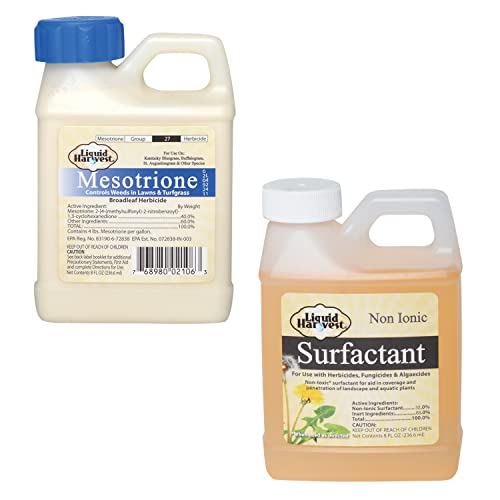
The rare killer that takes on nimblewill and blasts crabgrass white.
This bundle is the specialist’s secret weapon. It pairs 8 fluid ounces of Mesotrione concentrate with an 8 oz surfactant (a spreader-sticker that helps the chemical cling to waxy leaves). Mesotrione is one of the only effective chemical options for nimblewill, a pesky grassy weed that resists standard broadleaf killers. It’s also highly effective on crabgrass, clover, and creeping charlie.
Here’s the visual drama: treated weeds turn white before they die. Owners describe crabgrass and clover getting “bleached out” white within days, with full results in about 3.5 weeks. It targets 46 broadleaf species and grasses. The package covers 2,000 square feet, and the included surfactant makes the mix ready to go.
The activation requirement is unique — Mesotrione needs water to work, so if no rainfall occurs within 10 days, you must apply 0.15 inches of water yourself. It also has grass limits: it’s safe for Kentucky Bluegrass and Tall Fescue, but you should avoid it on Bentgrass, Bermudagrass, and zoysiagrass. Be patient with it; full weed death takes 2 to 3 weeks.
Nimblewill nuker: if that wispy grass is invading your lawn, this is the only formula here that reliably stops it in its tracks.
The pick for: homeowners battling nimblewill or crabgrass in cool-season turf who want a pre and post-emergent combo.
skip it if: you have Bermudagrass or zoysiagrass lawns, as this chemistry can harm them.
6. Primesource Quinclorac 1.5L Select
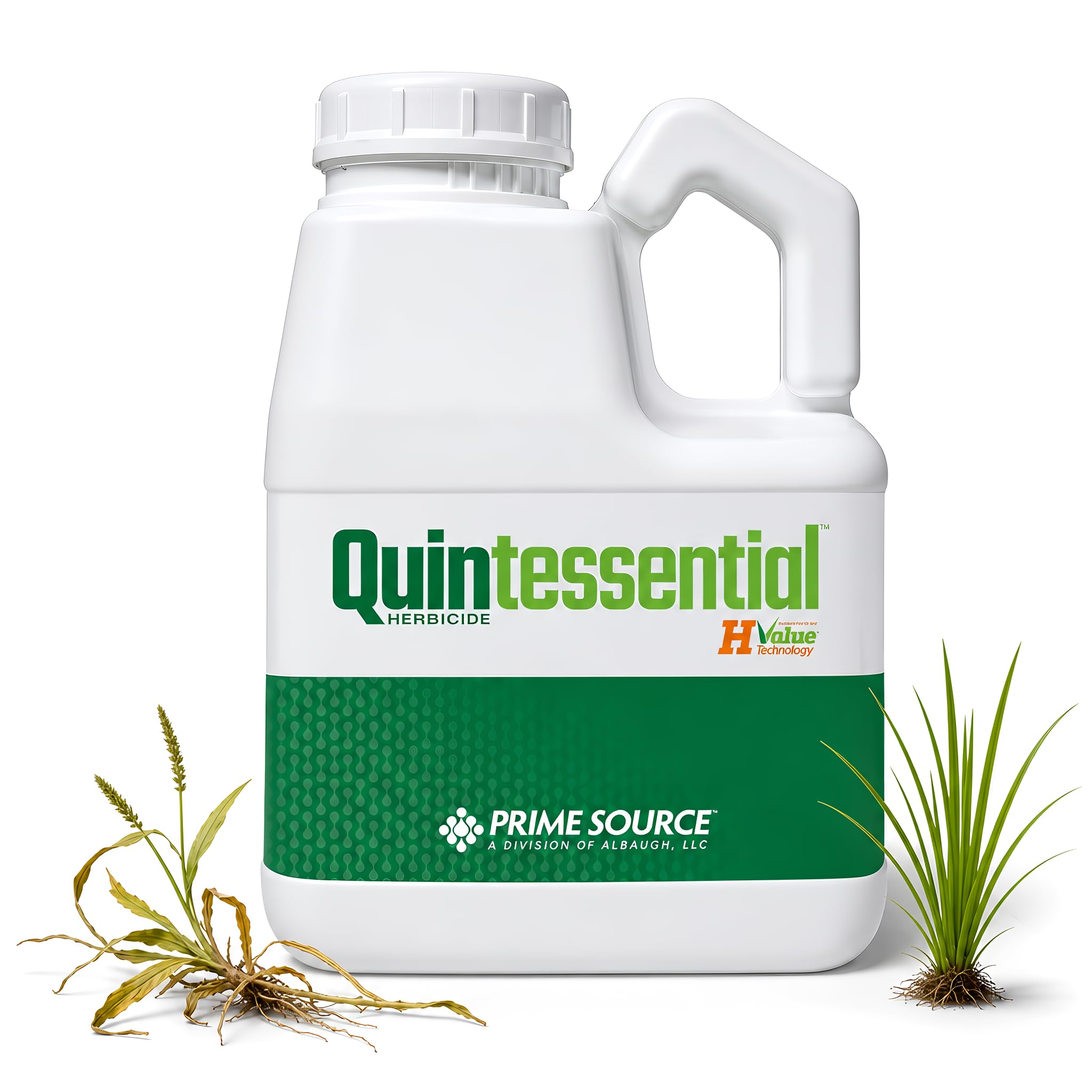
The go-to for mature crabgrass that laughs at standard weed killers.
Crabgrass that’s already established late in the season is notoriously stubborn. This 64-fluid-ounce bottle of Quinclorac 1.5L Select is the specialist’s answer. With 18.92% Quinclorac as the active ingredient, it’s a selective, post-emergent herbicide that takes out large and smooth crabgrass, foxtail, and even torpedograss. It’s approved for both residential and non-residential turf.
Owners mention dramatic speed: crabgrass begins dying in 3 days and is fully rotted within a week. The key to success is adding a surfactant (like MSO or even a few drops of dish soap) to the mix so the liquid sticks to the weed’s leaves instead of beading off. A late-August application on mature crabgrass showed death signs in just 24 hours.
The one complaint that pops up is discoloration on sensitive grass — one report noted Zoysia turning yellow. It’s not the cheapest option per square foot, and the 64-ounce size treats about 500 square feet per the label, so understand your coverage before you buy.
Grassy-weed assassin: the 18.92% Quinclorac concentration targets crabgrass, foxtail, and kikuyugrass—weeds that broadleaf-only blends miss. Quinclorac is a selective herbicide that kills grassy weeds without harming your lawn.
Reach for this if: crabgrass and foxtail are your main enemy and you’ve had zero luck with hose-end sprays.
Think twice if: your lawn is Zoysia, as temporary yellowing is a known risk.
7. Certainty Turf Herbicide

A tiny 1.25-ounce box that covers acres and kills the toughest nutsedge.
Don’t let the small box fool you. This 1.25-ounce pack of Certainty Turf Herbicide is extremely concentrated, covering 0.75 to 2.0 acres depending on application rate. The active ingredient, Sulfosulfuron, is specifically formulated to attack both purple and yellow nutsedge — often considered one of the hardest weeds to eliminate because of its underground root system.
Customers note visible dieback in 10 to 14 days as the chemical works its way through the nutlet chain underground. Combined with a non-ionic surfactant, it’s effective through both broadcast applications and spot treatments. For a Bermuda lawn with a nutsedge problem, this delivers a one-and-done solution that lasts.
The trade-off is patience and precision: it’s a systemic herbicide, not an instant contact killer. It’s a systemic herbicide, not an instant contact killer — expect to wait 2 to 3 weeks for full results. It’s also the priciest option here per ounce, though the coverage area offsets that. Users emphasize measuring carefully because it’s so concentrated, and note that tougher weeds like quackgrass may require repeat applications.
Underground attack: Sulfosulfuron works systemically through the root chain, which is exactly what’s needed to finally beat nutsedge for good.
The pick for: Bermuda and Zoysia owners ready to wage war on yellow and purple nutsedge with a long-lasting, concentrated tool.
pass on it if: you want instant visible results or only have a tiny patch of common broadleaf weeds.
8. Blindside Herbicide WDG
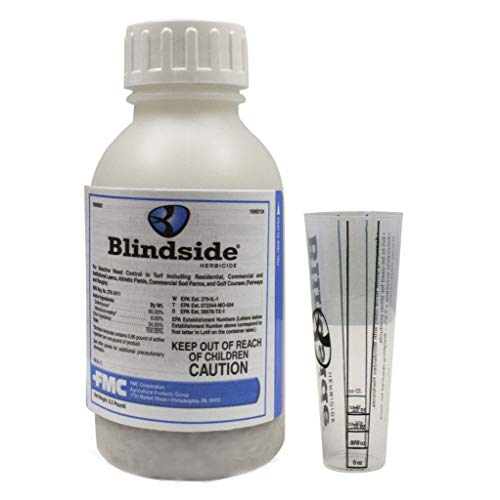
The warm-season savior that’s gentle on St. Augustine but brutal on weeds.
St. Augustinegrass owners have the hardest time finding a weed killer that won’t also fry their lawn. This 8-ounce WDG (water-dispersible granule) formula from FMC is the exception. It’s approved for use on virtually all warm-season turfgrass, including St. Augustine, plus Kentucky Bluegrass and Tall Fescue for transition-zone flexibility. It targets over 70 broadleaf weeds and sedges, including dollarweed, doveweed, and buttonweed.
Speed is a major selling point. The manufacturer states visible signs of control appear within just a week, which is notably faster than many competitive products. It works through both foliar and root uptake for a dual-action kill. Owners in Central Florida report a huge difference between their treated lawns and their neighbors’ untreated ones.
The measured dosing chamber is a thoughtful touch, dispensing enough product to treat 1,000 square feet at low and high rates. Each 8-ounce package treats over 50,000 square feet total. It’s not an overnight killer — Dallisgrass is the one weed it won’t take down, and you need to be patient for about a week to see results.
Warm-season winner: finally, a tough broadleaf killer you can trust on sensitive St. Augustine without sacrificing weed control.
Reach for this if: you have St. Augustine or other warm-season grass and a serious broadleaf or sedge problem.
Look elsewhere if: Dallisgrass is your target weed, as this won’t touch it.
9. Agralawn Crabgrass Killer (2 lb Shaker Jar)

A no-mixing granular shaker for quick, targeted crabgrass spot-treatments.
Not everyone wants to mix liquids and drag a sprayer around. This 2-pound shaker jar of granular powder is the grab-and-go solution for spot-treating crabgrass. The application is as simple as shaking the powder directly onto the weed patches. It’s a post-emergent formula that’s safe for St. Augustine grass, which is a big plus for southern lawns.
There’s a real learning curve, though, and results are genuinely split among owners. The success stories describe a moment of panic: “At first we were afraid it was killing the good grass as it yellowed.” But with regular watering, the crabgrass died off and the lawn recovered beautifully. This granular approach works well when you have isolated patches rather than a lawn-wide infestation.
The criticisms are worth noting. The 32-ounce jar covers roughly 100–200 feet, which is modest for the money. Some owners found it did nothing to their crabgrass, and a few noted the treatment could cause the surrounding grass to yellow temporarily. The application itself also gets mixed reviews, with some finding the shaker method easy and others laborious for large areas.
Keep it simple: if you hate mixing chemicals, this shaker jar delivers decent spot-treatment power with zero setup time.
The pick for: the casual gardener with a few crabgrass patches who wants a no-fuss, sprayer-free option.
Think twice if: crabgrass has taken over a large portion of your lawn, or you want guaranteed results.
Understanding the Specs: Active Ingredients Explained
2,4-D & Dicamba
These are the classic broadleaf weed killers, usually blended together. They work by mimicking plant growth hormones, causing the weed to grow itself to death. They’re excellent on dandelions, clover, and ground ivy, and are safe for most lawn grasses when mixed correctly. Look for these in the SpeedZone and ALLIGARE formulas for fast, reliable broadleaf control.
Quinclorac & Mesotrione
When grassy weeds are your problem, you need different chemistry. Quinclorac (in the Primesource bottle) is the gold standard for mature crabgrass and foxtail. Mesotrione (in Liquid Harvest) is a versatile multi-tasker that bleaches weeds white and even works on nimblewill. These are your targeted tools for grassy, grass-like invaders.
Sulfentrazone & Sulfosulfuron
For the toughest weeds — nutsedge and certain sedges — you need specialized actives. Sulfentrazone (in Blindside) gives broad-spectrum power plus nutsedge control. Sulfosulfuron (in Certainty) is laser-focused on purple and yellow nutsedge, working systemically through the root chain. These are the heavy artillery for weeds that survive everything else.
Surfactants and Why They Matter
A surfactant is a wetting agent that helps the herbicide spread evenly across the weed’s leaves instead of beading up into droplets and rolling off. Many weeds have naturally waxy leaves that repel water. Adding a surfactant — or buying a bundle that includes one, like the Liquid Harvest Mesotrione — dramatically improves coverage and speeds up the kill.
FAQ: Your Weed-Killer Questions Answered
What’s the difference between pre-emergent and post-emergent herbicides?
Will these herbicides kill my grass if I over-apply?
How long does it take to see weeds die after spraying?
Can I use these on a St. Augustine grass lawn?
Why add surfactant or dish soap to the herbicide mix?
When is the best time of year to apply a post-emergent?
How long should I wait before mowing or reseeding after application?
Why is my grass turning yellow after I sprayed?
Are these products safe for pets and children after they dry?
Can these herbicides be used in vegetable gardens or flower beds?
Final Thoughts: The Verdict
Across the board, the post-emergent herbicides for lawns winner is the PBI Gordon SpeedZone EW because it delivers the fastest kill on the toughest broadleaf weeds, even in cool weather, with a crowd-pleasing 4.7-star rating. If you want a single bottle that handles nearly any broadleaf plus some nutsedge, grab the Select Source Triad TZ. And for St. Augustine and warm-season lawns where safety is non-negotiable, the Blindside Herbicide is the one to reach for.
How We Picked
We do not accept paid placement. Every pick is matched to a real buyer and a real use-case; we do not hands-on test units.
Sources & Methodology
Specifications: manufacturer listings and product documentation. Review insights: verified customer reviews, as of August 2026. Pricing: not shown on this page (it changes often); check the current price via the retailer link.
As an Amazon Associate, Lawn Gear Lab earns from qualifying purchases. This does not affect which products we feature.