
Specs are compiled from manufacturer listings and verified buyer reviews and can change over time — please confirm the key details on the product page before buying.
Your lawn struggles when soil gets hard and compacted, blocking water and oxygen from reaching the roots. An aerator fixes that by punching through the hard layer and pulling out plugs of dirt, so roots can breathe and fertilizer reaches deeper. The key choice is between a tow-behind unit for your riding mower or a manual tool for smaller patches — here’s how to pick the right one for your yard.
I’m Rikta — the founder and writer behind Lawn Gear Lab. This guide is built by comparing the manufacturers’ published specifications and the patterns across verified customer reviews, so you get each pick’s real strengths and trade-offs instead of marketing spin.
We’ve dug through the specs and owner experiences to find the professional lawn aerator that fits your yard size, your tractor, and your patience for assembly.
Our Picks at a Glance


How To Choose The Best Professional Lawn Aerator
Match the aerator to your lawn size and soil type. A tow-behind unit with a 40-inch working width is too much for a 2,000-square-foot yard, while a manual step tool will wear you out on a full acre.
Core Aerators vs. Spike Aerators
Core aerators (also called plug aerators) physically remove a finger-sized cylinder of soil from the ground, which is the only way to truly relieve compaction. Spike aerators simply poke holes, which can actually compress the soil further around each hole in heavy clay. If your grass gets heavy foot traffic or your soil is dense, you want a core aerator that pulls plugs.
Weight Capacity and Tine Depth
The single biggest factor in penetration is how much ballast you can pile on the weight tray. A heavier unit with 150 pounds of weight capacity will sink its tines deeper into dry or hard soil than a lighter one. Look for tines that penetrate at least 2 to 3 inches deep, which is the depth where grass roots actually live.
Quick Comparison
| Model | Best For | Type | Width | Weight Capacity | Amazon |
|---|---|---|---|---|---|
| Brinly 40″ Plug Aerator★ Best Overall | Best Overall | Core / Plug | 40 inches | 150 lbs | Amazon |
| Step ‘N Tilt Core AeratorManual Pick | Small Yards | Manual Core | 3.4″ tines | — | Amazon |
| Landzie Hollow TineNo-Assembly Pick | Manual Value | Manual Core | 3 tines | — | Amazon |
| CRAFTSMAN Spike Aerator | Budget Tow | Spike | 36 inches | 90 lbs | Amazon |
| Brinly Spike Aerator | Spike Value | Spike | 40 inches | 150 lbs | Amazon |
| Suchtale 40″ Plug Aerator | Mid-Range Plug | Core / Plug | 40 inches | 125 lbs | Amazon |
| Rolling Lawn Aerator | Manual Push | Manual Roller | Roller | — | Amazon |
| Craftsman 40″ Plug Aerator | Premium Plug | Core / Plug | 40 inches | 140 lbs | Amazon |
| Agri-Fab 48″ Plug Aerator | Large Acreage | Core / Plug | 48 inches | 175 lbs | Amazon |
In‑Depth Reviews
1. Brinly Tow Behind Plug Aerator, 40″
Our pick — over 4★ from 950+ verified ratings; the strongest balance of quality and price.
The 40-inch tow-behind that pulls deep plugs with serious muscle.
The Brinly is the gold standard for a reason: its 24 heat-treated, 16-gauge steel plugging spoons are narrower with sharpened ends, so they slice into compacted soil instead of just pushing against it. Buyers report pulling clean 2.5-inch plugs and even 3-inch plugs with added weight, and buyers describe it as “works perfectly, 2.5″ plugs, well-built.”
The fully-enclosed weight tray holds up to 150 pounds, which is what makes the difference on hard clay lawns where lighter units bounce. At 63.9 pounds empty, at 63.9 pounds, it weighs nearly triple the Step ‘N Tilt manual corer — but that heft is exactly what keeps the tines engaged in the dirt. It’s 37 x 51 x 28 inches, so it needs some garage floor space, but the single transport lever lifts the tines using 10-inch semi-pneumatic tires to cross driveways without tearing up pavement.
Three independently rotating tine sections minimize turf damage on turns, and the universal single-pin hitch attaches to most lawn tractors, ZTRs, and ATVs. Assembly takes about an hour with a drill, and the recurring tip from owners is to grease the axle bearings before first use and water the lawn first for the best plugs.
What wins people over
- Deep 2.5-3 inch plugs with proper ballast
- All-steel build with 150 lb weight tray holds up
- Sharpened, narrow tines penetrate with less weight
The honest trade-offs
- Assembly takes about an hour and some patience
- At 63.9 pounds, storage isn’t “hang it on a hook” easy
Reach for this if: you tow behind a riding mower and want the deepest plugs the category offers; it holds a 4.4-star rating across 900+ verified owner reviews.
Look elsewhere if: your yard is small enough that a manual tool makes sense — this much steel wants open ground, not a postage-stamp lawn.
2. Step ‘N Tilt Core Lawn Aerator v4
A manual corer that does a front yard in an hour, without wrecking your back.
The Step ‘N Tilt works on a simple principle: you step onto the platform and tilt backward, which lifts the case-hardened tines out with a soil core intact. The tilting motion spares your shoulders and back, and the larger stepping surface gives you a solid footing. Owners mention a “front yard done in an hour,” and the performance aspect leads the feedback — the step-and-tilt mechanism handles even super-saturated ground without clogging.
The tines create 3.4-inch deep, 0.79-inch diameter holes, and the included soil core container lets you collect plugs and deposit them in low spots to level the yard without killing grass. It’s recommended for operators between 4-feet and 6-feet 5-inches tall, and the minimum operator weight is 80 pounds for one set of tines. You can add a second set of tines if you weigh more than 150 pounds, which doubles the holes per step.
At 21 pounds, this is a 3x lighter machine than the Brinly tow-behind, and its 14 x 16 x 44-inch footprint tucks into a corner easily. The catch is that it’s designed for small yards or areas a motorized unit can’t reach — doing a large lawn with this will take significantly longer than towing. Owners also note that soil must be moist about 4 inches deep for clean cores, ideally one day after at least an inch of rain.
Why owners praise it
- No clogging, even in clay or saturated ground
- Very sturdy thick metal, handle feels solid
- Soil core container levels ruts while you aerate
Who should skip it
- Large lawns will take a serious time commitment
- Tines are welded on — replacement means a new plate
The bottom line: the best manual option we track, ideal for small yards or tight spots your tractor can’t reach; the step-and-tilt motion is genuinely easier on your body than a two-prong tool.
One caveat: expect frequent jams in damp clay — keep the clearing tool handy and it’s a five-second fix.
3. Landzie Original Hollow Tine Aerator
The clog-free three-tine fork that arrives fully assembled and ready to plunge.
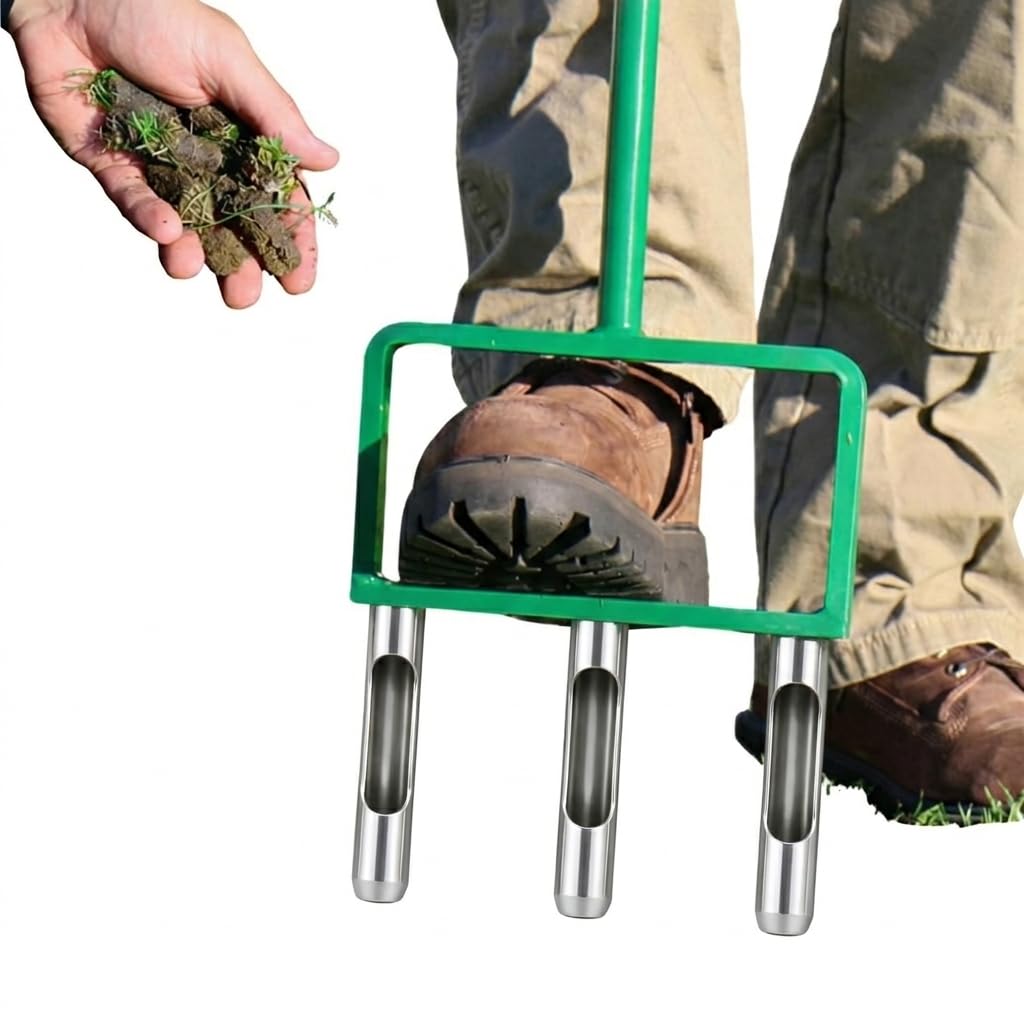
Landzie solved the biggest annoyance of manual aerators — clogged tines — with a beveled, open design that pushes old material up and out each time you press it into the ground. The three solid stainless steel tines break up soil and let air and water penetrate deeper, and owners note the plugs pop out continuously with no cleaning required, even in dense clay soil. It’s the top pick for anyone who hates assembly: it ships with tines already fitted to the powder-coated steel frame and is ready from the start.
At 5.6 pounds, this manual aerator is much lighter than the 21-pound Step ‘N Tilt, but you supply all the force. Customers note a 2,200-square-foot lawn taking about 4 hours, with one calling it “lawn care cross-fit.” It works best on damp soil — after rain, a 25×25-foot section takes under an hour — but dry or caliche soil will resist and clog the tines.
You can remove the tines for cleaning and replace them when they wear out — a clear advantage over the Step ‘N Tilt’s welded design. Most owners see this as a lifetime tool, but the first pass on heavily compacted soil is genuinely hard work. If your yard is rock-hard, renting a machine is the faster route.
What stands out
- Self-cleaning plug ejection, no unclogging mid-job
- No assembly — tines come pre-fitted to the frame
- Replaceable stainless tines extend the tool’s life
The honest catch
- Strenuous on large or compacted lawns
- Foot bar can get slippery when wet
Choose this if: you want a grab-and-go manual corer for tight areas and you’re willing to work in sections on damp soil; its 4+ star rating across hundreds of owners points to long-term durability.
Think twice if: your yard is large and hard-packed — you’ll want a motorized or tow-behind unit instead of this fork.
4. CRAFTSMAN 36-Inch Tow Spike Aerator

The entry-level tow spike that gets holes in the ground without the plug-aerator price tag.
This Craftsman is a spike aerator, not a core aerator, which means it pokes holes with 9 galvanized steel disks rather than pulling plugs. It’s the budget-friendly way to improve water penetration on a 1/2-acre lawn, and owners confirm it successfully aerated half an acre without issues. The 36-inch working width covers good ground per pass, and the 10-gauge steel frame is genuinely durable for the money.
The 90-pound capacity weight tray is the key to making it work, and owners stress that you’ll need to load it up — a couple of cinder blocks or sandbags do the trick. On hard or rocky soil, the spikes can struggle to penetrate and the whole unit may bounce, so soft, moist ground is your friend here.
Assembly takes about an hour, and the universal adjustable hitch fits all brands of riding mowers and tractors. It’s covered by a 3-Year Limited Warranty, which is solid for the price tier. The recurring note from owners is that assembly instructions can be unclear and some units arrive missing key components — check the box contents before you start bolting things together.
Why it earns its place
- 36-inch width aerates a half-acre without issues
- 10-gauge steel frame is durable for the price
- 90 lb weight tray takes cinder blocks or sandbags
Who it’s not for
- Spike design compacts soil edges in heavy clay
- Needs added weight to penetrate hard ground
Grab this if: you’re on a budget, have decently soft soil, and just want holes in the ground for overseeding.
Look elsewhere if: your soil is heavy clay — a spike aerator won’t relieve compaction the way a plugger will.
5. Brinly SAT2-40BH-P Tow Spike Aerator

A beefed-up spike aerator with patent-pending tines that resist bending in compacted soil.
Brinly takes the spike approach and makes it tougher with patent-pending 3-D tines in galvanized steel that resist rust and bending, even in compacted soil. The 11 tine stars each carry 12 spike tips, and the stars are 8 inches in diameter, penetrating up to 2 inches deep. It’s a step up from the Craftsman in build quality — the all-steel design uses a 5/8-inch solid steel axle and nylon spacers between stars for durability.
The 150-pound capacity rigid weight tray matches the flagship Brinly plug aerator, so you can load it heavy and keep the spikes buried. Owners transformed cracked, clay-like hard soil with this unit, noting it penetrated easily and left the lawn looking fabulous after one season. The single transport lever engages turf-tread wheels to cross driveways and sidewalks without gouging pavement.
Assembly is where opinions split — some owners find it fairly easy, others call it very difficult. The sharp blades demand heavy-duty gloves, and one owner recommends swapping the regular nuts for 5/8-inch nylon lock nuts after a wheel fell off. For monthly maintenance aeration and overseeding, owners find it ideal, connecting easily to John Deere mowers and covering a lawn in about 1.5 hours.
What you get
- Patent-pending 3-D galvanized tines resist bending
- 150 lb weight tray for deep penetration
- Transport wheels make driveway crossings clean
Fair warnings
- Assembly difficulty gets mixed reviews
- Blades are very sharp — wear heavy-duty gloves
Go with this if: you want a tougher spike aerator than budget options and regularly tow behind a riding mower.
skip it if: you need to relieve true compaction — spikes just can’t pull the plugs that cores do.
6. Suchtale 40-Inch Tow Plug Aerator

A value-priced plug aerator with thicker steel than the usual budget fare.
Suchtale brings core aeration to the mid-range tier with 24 heat-treated plugs that penetrate compacted soil up to 2 inches deep. The 6 spools of integral aerator knives are built from high-quality alloy steel, and the reinforced side plate and solid steel axle deliver extra strength where cheaper units bend. The 6mm thick adjust handle is notably thicker than the 4mm usual on budget models, which is a small detail that suggests this unit is built to last.
The 125-pound weight tray takes cement blocks or other ballast easily, and owners confirm it works well on clayish soil, especially after rain. One owner did several acres with ease, and another found it “perfect size even for big yards” with grass sprouted within 4 days of overseeding. The pin-style universal hitch attaches to ATVs or riding mowers quickly, and the transport handle raises the plugs for crossing driveways.
Assembly runs 1-2 hours with a ratchet and wrench, and the instructions include full pictorial breakdowns. At 55 pounds, it’s lighter than the Brinly’s 63.9 pounds, making it a bit easier to maneuver, though owners note it’s wider and heavier than cheaper models and less maneuverable on hills. One owner reported missing bolts (M6x40 and M10x55), which Amazon resolved, and another found the build “not built to last” — quality control seems to vary between units.
Strong points
- 24 heat-treated plugs for serious core aeration
- 6mm thick handle resists bending
- 125 lb weight tray takes 5 cinder blocks
Watch out for
- Quality control varies — some units missing bolts
- Less maneuverable on hills than compact units
Pick this if: you want a mid-range plugger for serious core aeration on clay and don’t need the premium badge.
Think twice if: you value consistent quality control — the occasional missing-bolt report means checking your box carefully.
7. Patented Rolling Lawn Aerator Manual Corer
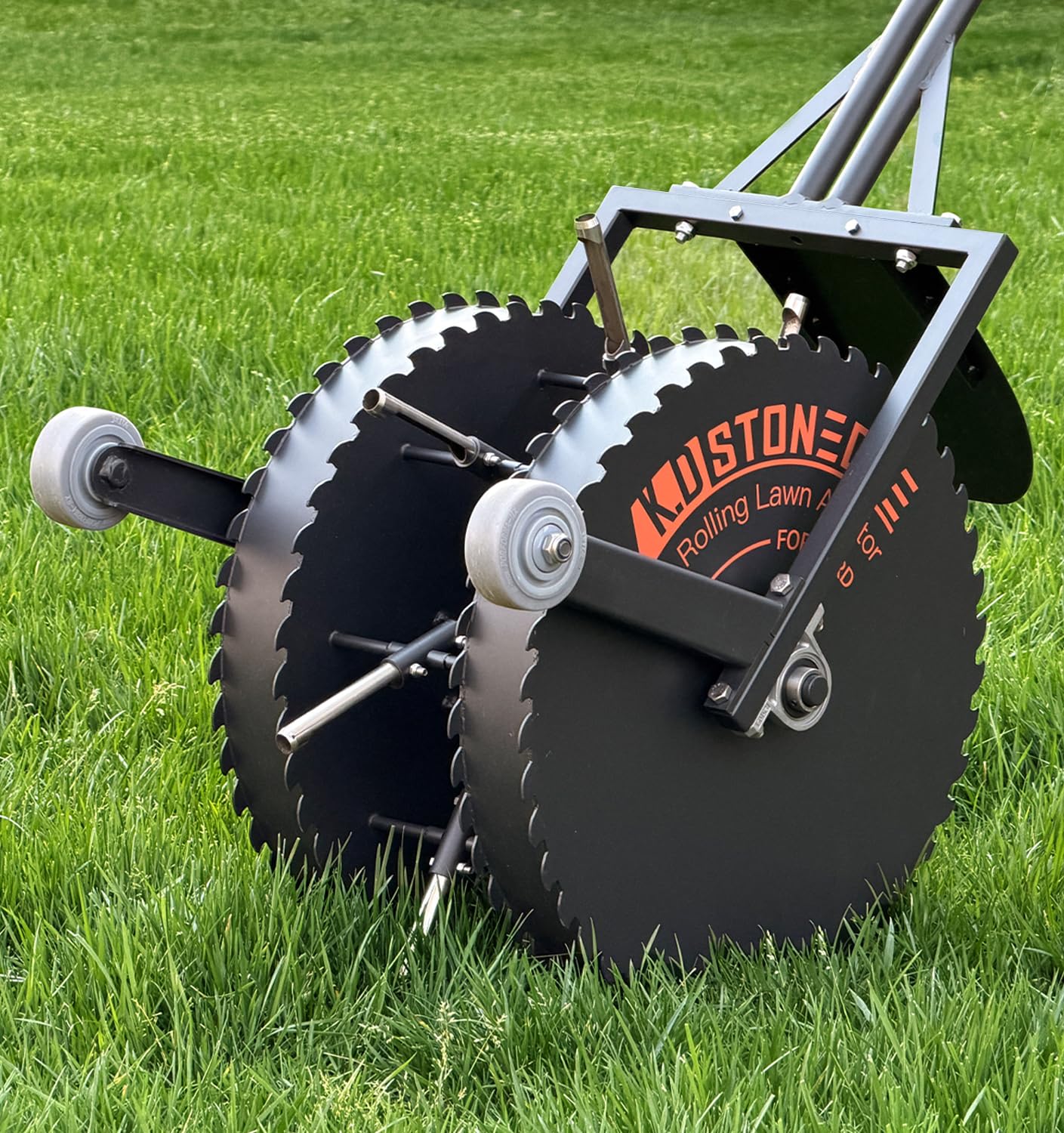
A push-roller core aerator that treats aeration like a workout while pulling real plugs.
This patented rolling aerator bridges the gap between manual forks and tow-behind units. The rotary coring design pulls soil plugs as you push it, with a scientifically balanced weight that makes the motion efficient — owners describe getting deep 2-3 inch holes with no clogging across 3,000 square feet. It’s genuinely a full-body workout, with owners calling it “very intense cardio” and noting your heart rate will spike, but the results justify the effort.
The transport wheels and reinforced dual push rod make it mobile, and the 43.4-pound frame provides the mass needed to drive tines into the soil. Reviewers point out excellent coring in wet conditions with full deep plugs even without filling the wheels with sand, though adding sand makes it heavier and more effective on dry clay. Assembly takes about 20 minutes, though the instructions are poor, and the tines prove durable over regular use.
The rotating wheels can be filled with sand for extra weight, but owners note the filling process is tricky (10-15 minutes per wheel) and suggest a funnel. Tight turns can tear grass, so concentric laps work best. The axle screws are a weak point — a dab of Loctite prevents them from working loose. At 60 x 17 x 11 inches, it stores flat but takes up more floor space than a fork.
What impresses
- Deep 2-3 inch plugs without clogging
- Wheels fill with sand for extra penetration
- Better value than renting a machine
Know before you buy
- Extremely strenuous — it’s a real workout
- Sand-filling wheels is fiddly; axle screws need Loctite
Choose this if: you have a small-to-medium lawn, want core aeration, and don’t mind sweating for it.
pass on it if: you have mobility issues or a large yard — this is work, not a relaxing afternoon.
8. Craftsman 40″ Tow Plug Aerator

The premium Craftsman plugger built in Illinois with a space-saving vertical storage trick.
This Craftsman 40-inch plug aerator pulls soil plugs up to 3 inches deep using 24 galvanized steel coring points, and it’s built by Agri-Fab in Sullivan, IL with global materials. The 140-pound capacity weight tray is wide and heavy-duty, letting you load serious ballast for tougher soil. Shoppers say it handled 1.5 acres including hard, rocky soil without complaint — one calling it “superior to cheaper model that broke on first use.”
Its lift handle release lets you store it vertically against a wall, freeing garage floor space that most tow-behinds consume. Flat-free tires keep it easy to maneuver, and a universal hitch attaches to most lawn and garden tractors. The 3-year limited warranty covers this machine for longer than many rivals.
Assembly is the main hurdle — buyers report 2-3 hours, with one noting a step 12 bolt issue where a 1-inch bolt (from the hitch) works better than the specified 1.25-inch for clearance. The lever can pop out on bumpy rides, so a bungee cord is a common field fix. At 78.8 pounds, it’s the heaviest of the 40-inch pluggers here, which translates directly to better tine engagement in hard ground.
Why it’s worth it
- 3-inch deep plugs even in rocky soil
- Stores vertically against a wall, saving space
- 140 lb weight tray boosts penetration
The price of premium
- Assembly runs 2-3 hours with some fiddly steps
- Lever may pop off on bumpy terrain — carry a bungee
Buy this if: you want a USA-built plugger with the deepest tines and don’t mind a long build session.
Pass if: your garage is tight and you can’t spare a wall corner for vertical storage.
9. Agri-Fab 48″ Tow Plug Aerator

The 48-inch wide beast that chews through hard clay and covers large lawns fast enough to justify its price by the second use.
The Agri-Fab is the widest unit here at 48 inches, and its 32 galvanized self-sharpening knives pull plugs up to 3 inches deep. It’s the clear choice for large acreage — owners mention aerating 4 half-acre lots without issues, and one called it “very economical way to aerate your lawn,” costs less than two rental sessions for a comparable machine. The 175-pound weight tray is the largest in this lineup, giving you the ballast to drive those 32 knives through hard Kansas clay that defeats lighter units.
Flat-free tires handle transport, and the cantilever lift lets you raise the knives from the tractor seat — though owners note you might need to dismount if you’re under 6 feet tall, since the lever sits high. The universal hitch fits most lawn and garden tractors, and the whole machine weighs 92.5 pounds, making it the heaviest here by a clear margin. That mass is exactly why it penetrates so consistently.
Assembly is the recurring sore spot: customers note confusing instructions, missing parts (4 lock nuts in one case), and sharp burrs on metal edges that need deburring before use. The lever also needs a bungee cord on bumpy rides. Avoid sharp turns over 45 degrees and never back up with the knives down, or you’ll bend the tow bar. It stores poorly — it’s too wide and heavy to lean against a wall like the Craftsman can.
The big-rig advantages
- 48-inch width covers ground fast — 4 half-acre lots with ease
- 32 self-sharpening knives pull 3-inch plugs
- 175 lb weight tray chews through hard clay
Fair warnings
- Assembly is tedious with confusing instructions
- Poor storage — can’t lean against a wall
- Never back up with knives down or you’ll bend the tow bar
Go big with this if: you have multiple acres and want the widest, heaviest plugger that gets the job done fast — its 4.2-star rating across 2,400+ owner reviews confirms consistent performance.
Choose smaller if: your yard is under a half-acre or your garage can’t host a 60-inch-wide machine.
Understanding the Specs
Core vs. Spike Tines
Core (or plug) aerators pull a cylinder of soil out of the ground, typically 2-3 inches long, which is the only true fix for compaction. Spike aerators just push holes into the soil, which can actually densify the surrounding earth in heavy clay. For a professional-grade result, core aeration is the standard.
Weight Tray Capacity
Load the weight tray with cinder blocks, sandbags, or steel plates to push tines deeper. A 150-pound capacity tray gives serious penetration, while a 90-pound tray may bounce on hard ground. Adding more weight always means deeper holes, up to the frame’s structural limit.
FAQ
How often should I aerate my lawn?
Should I choose a core aerator or a spike aerator?
How much weight do I need to add to the tray?
Can I tow a plug aerator behind any riding mower?
Is a manual aerator worth it for a small yard?
When should I aerate my lawn?
How deep should the aerator tines penetrate?
Can I overseed right after aerating?
Final Thoughts: The Verdict
Across the board, the professional lawn aerator winner is the Brinly 40″ Plug Aerator because it pairs a 150-pound weight tray with sharpened, narrow tines that pull 2.5-3 inch plugs without fighting the soil. If you want a manual option for a small yard, the Step ‘N Tilt is the one to reach for — it does a front yard in an hour. And for multiple acres, the Agri-Fab 48″ is the heavy hitter that chews through hard clay with 32 self-sharpening knives.
How We Picked
We do not accept paid placement. Every pick is matched to a real buyer and a real use-case; we do not hands-on test units.
Sources & Methodology
Specifications: manufacturer listings and product documentation. Review insights: verified customer reviews, as of August 2026. Pricing: not shown on this page (it changes often); check the current price via the retailer link.
As an Amazon Associate, Lawn Gear Lab earns from qualifying purchases. This does not affect which products we feature.