
Specs are compiled from manufacturer listings and verified buyer reviews and can change over time — please confirm the key details on the product page before buying.
Starting seeds indoors is a race against time and rot. The right mix keeps baby roots aerated and evenly moist without turning into a waterlogged brick — and that balance is exactly what a peat moss seed starter is engineered to deliver.
I’m Rikta — the founder and writer behind Lawn Gear Lab. This guide is built by comparing the manufacturers’ published specifications and the patterns across verified customer reviews, so you get each pick’s real strengths and trade-offs instead of marketing spin.
For germinating tomatoes or reviving a Venus fly trap, the crowd favorite — 4.7 stars from 800+ owners — is Espoma Organic Peat Moss for its pure, additive-free consistency.
Our Picks at a Glance


How To Choose The Best Peat Moss Seed Starter
A good seed starter balances moisture retention and aeration, keeping seeds hydrated while letting tender roots push through easily. Understanding the differences between pure peat and a blended mix is the first step.
Pure Peat vs. Pre-Mixed Blends
You have two ways to start seeds: buy pure sphagnum peat moss and mix it yourself with perlite (a lightweight volcanic rock that improves drainage) and vermiculite (a mineral that holds water), or grab a pre-mixed seed starter that already has those amendments blended in. Pure peat lets you customize your blend; pre-mixed bags are ready to sow straight away. Your choice depends on how much time you want to spend mixing versus planting.
Volume and Your Tray Count
Peat moss is sold by volume in quarts or cubic feet. A smaller 2.2-quart bag suits a few houseplant repottings, while a 16-quart or larger bag fills multiple 72-cell seed trays. Estimate roughly 1 quart per standard seed tray to avoid running out mid-sowing.
Texture and Re-Wetting
Dried peat moss can become hydrophobic — meaning it repels water instead of absorbing it. Look for mixes with fine texture or a wetting agent included. The finest mixes absorb water from the bottom without needing aggressive pre-soaking, which is a huge advantage for tiny, delicate seeds.
Quick Comparison
| Model | Best For | Volume | Ingredients | Texture | Amazon |
|---|---|---|---|---|---|
| Espoma Organic Peat Moss★ Best Overall | Pure, additive-free mixing | 8 quarts | 100% Peat Moss | Soft, some twigs | Amazon |
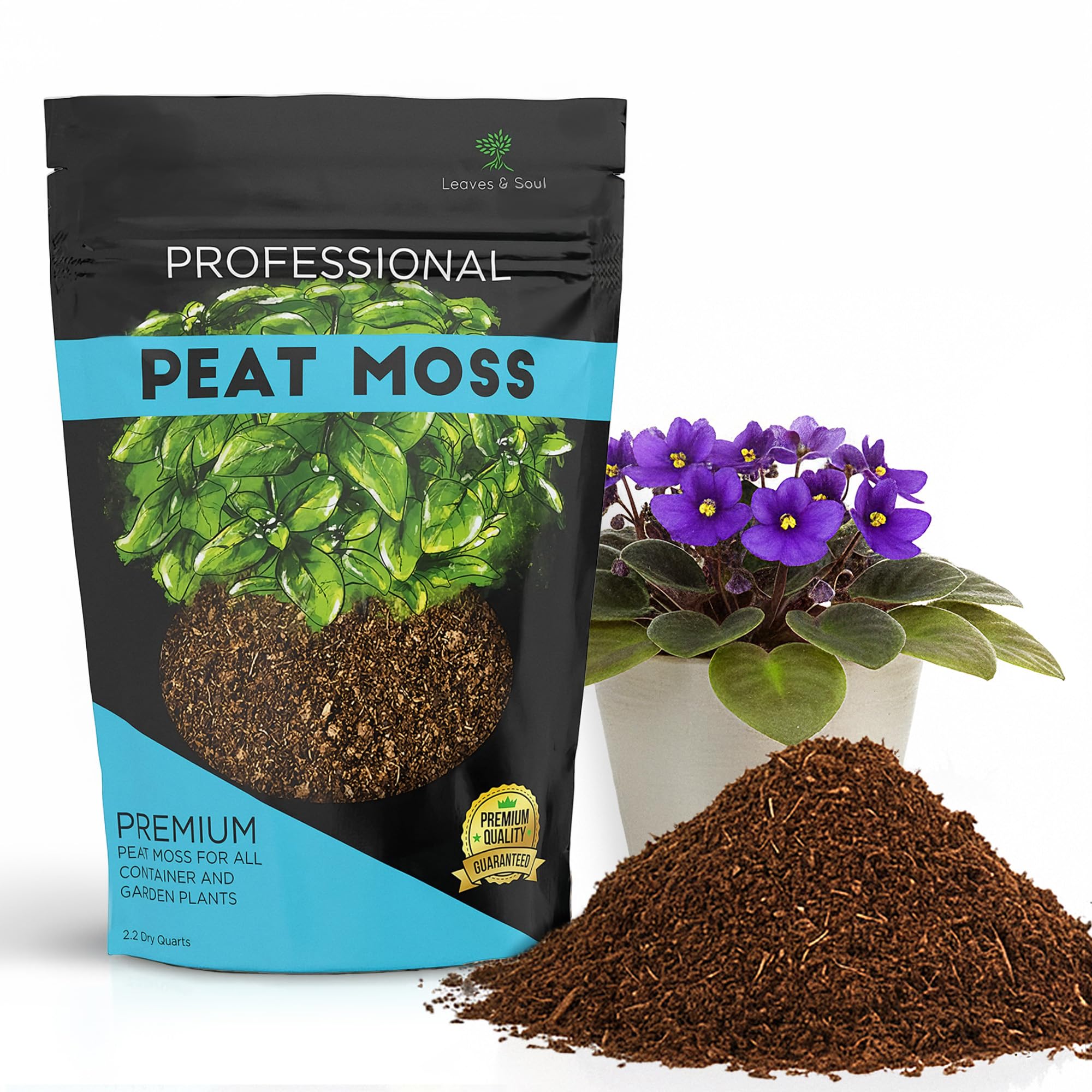
| Leaves and Soul Peat MossBest Value | Small jobs & lawn repair | 2.2 quarts | 100% Peat Moss | Lightweight | Amazon |
| Jiffy Seed Starting Mix (10 QT)Transplant Favorite | Holds shape for transplanting | 10 quarts | Peat, Vermiculite, Lime | Fine | Amazon |
| Black Gold Seedling Mix | Best germination rates | 16 quarts | Peat, Perlite, Lime | Fine & uniform | Amazon |
| Hoffman Canadian Sphagnum | Topdressing & DIY mixes | 18 quarts | 100% Coarse Peat Moss | Coarse | Amazon |
| GARDENWISE Sphagnum Peat | Orchids & terrariums | 15 quarts | 100% Sphagnum Peat | Pre-fluffed & loose | Amazon |
| Jiffy Seed Starting Mix (16 QT) | Long-term repeat sowing | 16 quarts | Peat, Vermiculite, Lime | Greenhouse-like | Amazon |
| Old Potters Germination Mix | Fine-texture germinating | 24 quarts | Peat, Perlite, Vermiculite | Fine granule | Amazon |
| Old Potters Organic Peat Moss | Large-scale potting | 3.8 Cu. Ft. | 100% Sphagnum Peat | Semi-compressed | Amazon |
In‑Depth Reviews
1. Espoma Organic Peat Moss
Our pick — over 4.5★ from 850+ verified ratings; the strongest balance of quality and price.
The pure peat that blends into any custom soilless mix you can dream up.
This is the mixing block for gardeners who like control. The bag holds 8 quarts of 100% peat moss with no additives, so you decide exactly what goes into your seed starter. Blend it with perlite for a classic 50/50 mix — a combination that has fly trap owners reporting happy, thriving plants.
What wins people over is the quality and how it boosts plant health. The soft texture is easy to work with, and the drainage helps prevent the dreaded overwatering that kills young seedlings. It is also a registered Organic Input Material, meeting the requirements for certified organic production.
It is not without its quirks. The bag itself is flimsy, and the zip closure can break within minutes of opening, so have a clip ready. There are also occasional twigs mixed in, which is normal for natural peat. The 8-quart size sits between the giant bales and the tiny trial bags, making it a solid middle ground.
What wins people over
- Pure, additive-free peat for custom mixing
- Approved for organic gardening
- Soft texture that handles delicate roots well
The honest trade-offs
- Bag zipper is fragile and breaks easily
- Contains some natural twigs and debris
- Moisture consistency can vary bag to bag
Reach for this if: you want a versatile, organic base to mix your own seed starter and potting soils.
Look elsewhere if: you want a ready-to-use blend — this is an ingredient, not a complete mix.
2. Leaves and Soul Organic Peat Moss
A pint-sized bag that punches well above its weight for small seed projects.
This is the entry point for testing whether peat moss works for your setup. The 2.2-quart bag is 100% organic peat, lightweight and ready to blend. It is a 2.2-quart bag compared to the Espoma’s 8 quarts, so it is best for a few trays or a single raised bed, not a full spring sowing marathon.
What the reviews rave about is the texture and how fast it works. One gardener patched dead spots in a lawn by raking out the grass, laying down this peat, and spreading seed on top — new grass emerged within 5 days. It mixes beautifully with coco coir and worm castings for a custom seed starter, and the resealable bag keeps leftovers fresh.
The trade-off is pure mathematics: you simply do not get a lot of material here. If you are starting hundreds of seeds, you will burn through this bag quickly. It is the right size for houseplants, a few seedlings, or a small patch of lawn repair.
Small but mighty: Excellent for targeted jobs and testing peat moss for the first time without committing to a giant bag.
The catch: The volume is genuinely small — buy the bigger Espoma if you plan to fill more than a couple of trays.
3. Jiffy Natural & Organic Seed Starting Mix (10 QT)
The pre-mixed blend that holds its shape when you lift seedlings out.
Jiffy takes the guesswork out of mixing by combining peat moss, vermiculite, and lime in one bag. The vermiculite soaks up water and prevents compaction, while the lime balances the natural acidity of the peat. You open the bag, wet it, and sow — no blending required.
What wins people over here is how the mix holds together during transplanting. As owners put it: “By far my favorite starter soil, holds together when transplanting to larger pots.” That structural integrity means the delicate root ball stays intact when you move it, reducing transplant shock. The fine texture is also praised for fast germination, even with finicky seeds like peppers.
The one habit you need to learn: this mix must be fully saturated before you sow. Pre-wet it in a bucket to a fluffy, moist consistency — dry mix will repel water. Some find it slightly pricey for the volume, but the consistent results justify the cost for many.
Why it earns its keep
- Holds together cleanly when transplanting
- Includes lime for balanced pH
- Fine texture germinates fast
Things to know
- Must be pre-wetted before use
- Considered pricey by some for the volume
- Great for smaller seed trays
Best for: gardeners who want a ready-to-go blend without buying separate perlite and lime.
Think twice if: you are filling huge flats — the 10-quart size disappears faster than you expect.
4. Black Gold 16-Quart Seedling Mix
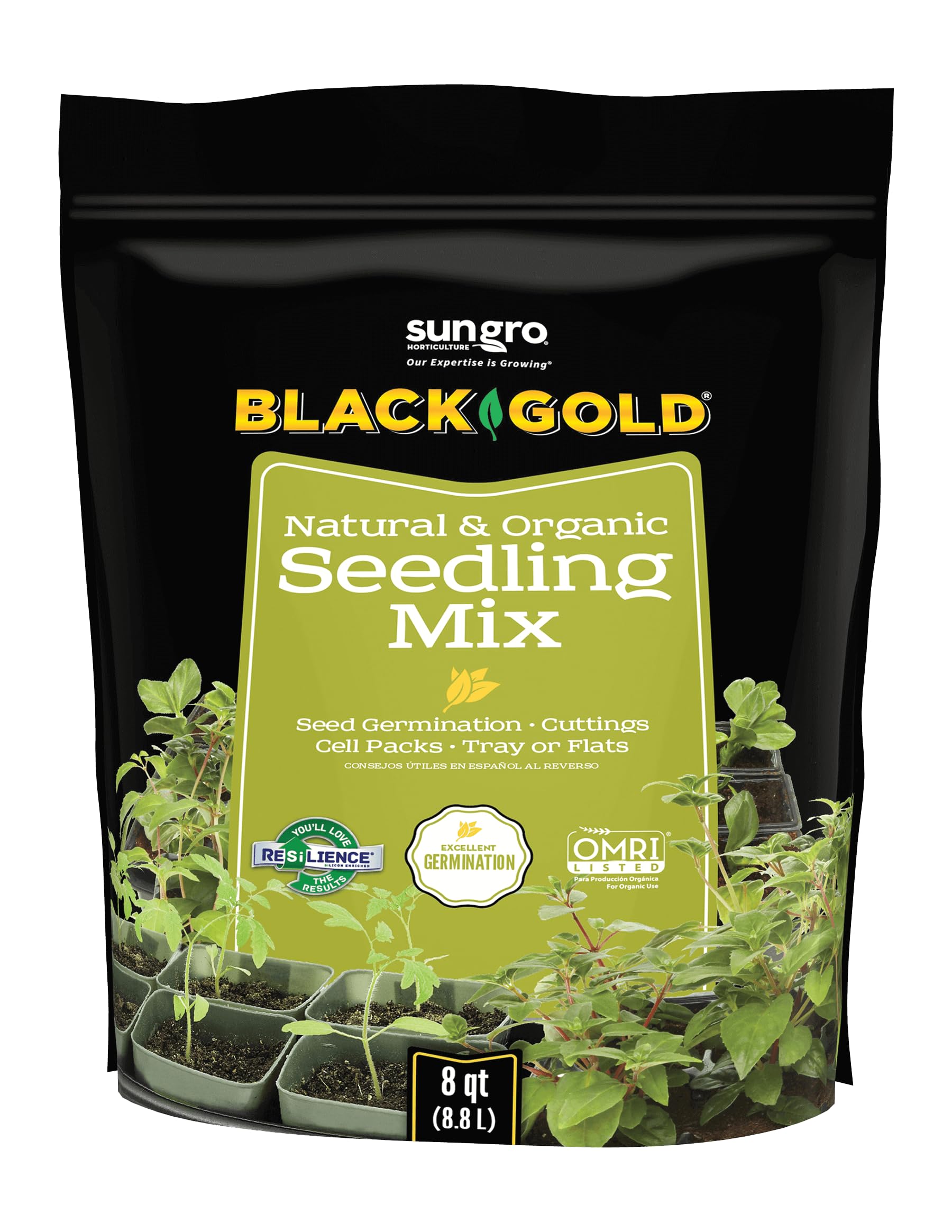
The fine, uniform mix that strawberry seeds sprout in 7 days flat.
If germination rate is your obsession, this is the mix to beat. Black Gold combines double-screened Canadian sphagnum peat moss with perlite, dolomite lime, and an organic wetting agent. The double screening produces a uniformly fine texture with no debris, which tiny seeds absolutely love.
The germination results are the standout story here. Strawberry seeds that typically take 14-21 days to sprout emerged in just 7. In a side-by-side trial, this mix germinated in 3 days versus 5 for a competitor. The wetting agent means no aggressive pre-soaking — it absorbs water from the bottom, which is ideal for finicky tiny seeds.
There is one catch: this mix contains no fertilizer. Seedlings grow faster initially but can slow down after the cotyledon stage, so plan to add a diluted feeding once true leaves appear. The moisture retention also divides opinion — most find it excellent, though a few report it dries out quickly in warm rooms.
The germination edge
- Fine, debris-free texture
- Absorbs water from the bottom
- Faster germination than homemade mixes
The missing piece
- No fertilizer — needs feeding after sprouting
- Moisture retention is hit-or-miss for some
- Pricey for the volume
Who it beats: nearly every homemade mix on germination speed and uniformity.
Who it doesn’t: anyone wanting a complete mix with nutrients built in — you will need to add fertilizer.
5. Hoffman Canadian Sphagnum Peat Moss

A coarse, clean Canadian peat built for topdressing and custom soil blending.
Hoffman brings an 18-quart bag of premium New Brunswick quality peat moss — a coarse grade that holds water and nutrients exceptionally well. This is not a fine seed-starting texture; it is a chunkier, aerating ingredient for building your own potting mixes or covering freshly sown grass seed.
The reviews are quiet but consistent: “Works great for putting over seeding for moisture control.” That is the core use case here — a moisture blanket over new grass. It is also a favorite for reviving struggling houseplants and feeding carnivorous plants when mixed with perlite, with new growth visible within a week.
Compared to the finer Black Gold mix above, Hoffman is the workhorse option for bigger outdoor jobs. The coarse texture means it is less ideal for tiny seed trays but perfect for raised beds and DIY soil mixes where aeration is the priority. It ships clean of debris, which is a frequent point of praise.
Outdoor workhorse: The volume-to-price ratio makes it a smart buy for topdressing lawns, amending garden beds, and blending custom potting soil.
Not for trays: The coarse texture is wrong for fine seed germination — choose Black Gold for that job.
6. GARDENWISE Organic Sphagnum Peat Moss
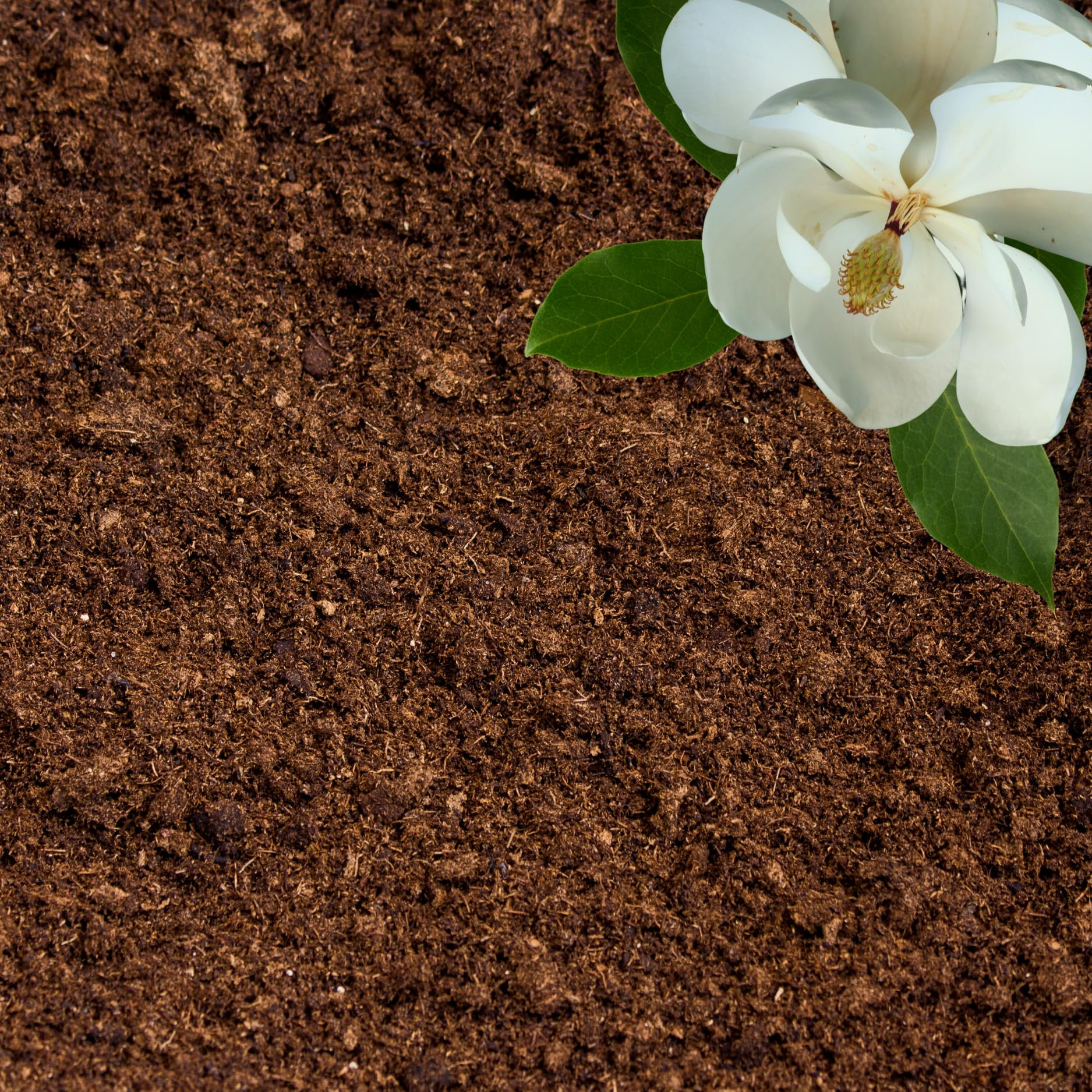
Pre-fluffed, loose peat ready to use straight from the bag with zero soaking.
This is the convenience pick. GARDENWISE delivers 15 quarts of sphagnum peat moss that arrives naturally light and fluffy — no compacted bale, no soaking needed. You open the bag and it is immediately mixable, which saves a step every other compressed peat on this list requires.
The natural acidity of this sphagnum moss makes it a go-to for acid-loving plants. Orchids, blueberries, azaleas, camellias, and hydrangeas all crave that low pH, and this delivers it for repotting or blending. It is also a safe, clean substrate for reptiles and amphibians in terrariums, holding humidity without getting swampy.
The honest caveat is that some buyers find the volume smaller than expected. A gardener with two 8-foot by 4-foot raised beds reported it covered four of them, but another felt they needed to buy more sooner than planned. It also contains some small sticks, which is typical of natural moss.
Why it stands out
- Pre-fluffed and ready to use immediately
- Ideal acidic pH for orchids and blueberries
- Safe for reptile terrariums
Keep in mind
- Volume can underwhelm for big beds
- Contains some small sticks
- Not the cheapest per quart
Reach for this if: you want a no-fuss peat for orchids, terrariums, or a quick seed-starting mix.
Look elsewhere if: you are filling multiple large garden beds and want maximum volume per dollar.
7. Jiffy Natural & Organic Seed Starting Mix (16 QT)

The bigger sibling of the 10-quart Jiffy mix, designed to replicate greenhouse conditions at home.
This is the Jiffy formula you already met in position 3, scaled up to 16 quarts for serious sowing sessions. The peat moss, vermiculite, and lime blend is specifically formulated to mimic the controlled conditions of a commercial greenhouse, giving your seeds a professional head start.
Loyalty is the theme in the reviews here. Gardeners who try this often make it their permanent seed-starting mix, with a couple of seasons of successful germination behind them. The nice blend of vermiculite is a frequent point of praise — it keeps the mix light and prevents the compaction that strangles young roots.
The bigger bag solves the main complaint about the 10-quart version: running out halfway through spring. It still requires pre-wetting before sowing, so keep that bucket of water handy. And it is an organic mix, which matters if you are growing food starts.
Set-and-forget formula: A proven blend that gardeners stick with season after season for consistent germination.
The routine: Pre-wetting is non-negotiable with this mix — dry peat will simply float on water.
8. Old Potters Germination Mix
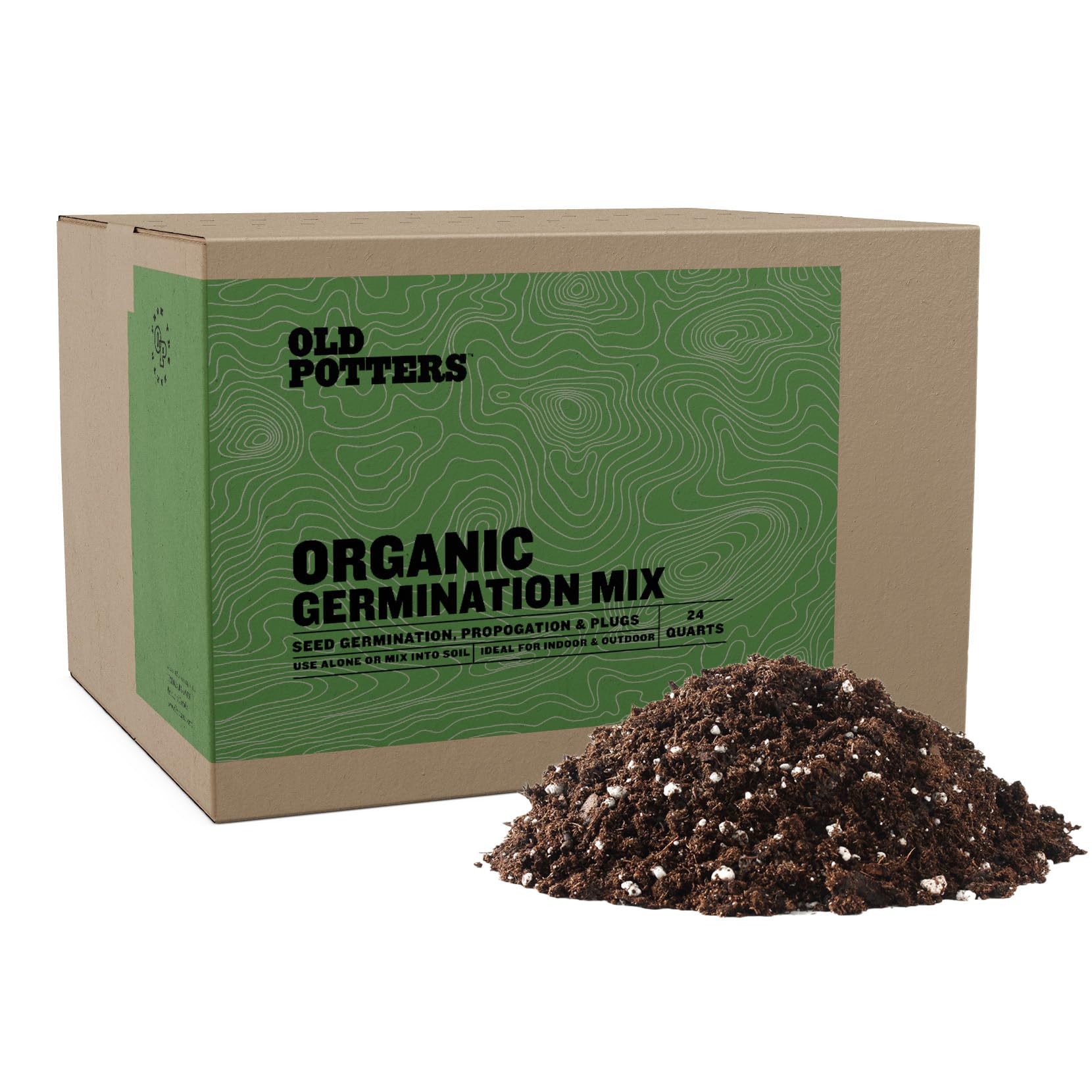
A professional-grade fine granule mix that a 90% germination rate backs up.
Old Potters built this mix for one job: germination. It contains 80-90% fine Canadian sphagnum peat moss, plus fine horticultural perlite and vermiculite, with calcitic and dolomitic limestone to hold the pH steady. The particle size is the star — everything is ground fine so even the tiniest seeds make perfect soil contact.
The results speak in hard numbers: a 90% germination rate across a large seed batch, with no fungus gnat issues reported. Gardeners who struggled to find fine-texture soil at local nurseries call this “the most perfect potting soil” they have found. It is loose, easy to work with, and expands well when hydrated.
This is also the highest-volume pre-mixed bag on this list at 24 quarts. The pH range of 5.4–6.3 keeps nutrients available, and the fine texture means it works for both bottom-watering and overhead sprinkling. The only downside is the price — this is premium territory, but the consistency justifies it for serious growers.
The pro-grade edge
- Fine granule texture for perfect seed contact
- Balanced pH of 5.4-6.3
- Bug-free with high germination rates
- Large 24-quart volume
Before you buy
- Premium price point
- Overkill for casual home gardeners
Best for: serious seed starters who want professional-grade consistency and volume in one bag.
Think twice if: you only start a few trays a year — the fine texture is wasted on casual sowing.
9. Old Potters Organic Peat Moss (3.8 Cu. Ft.)
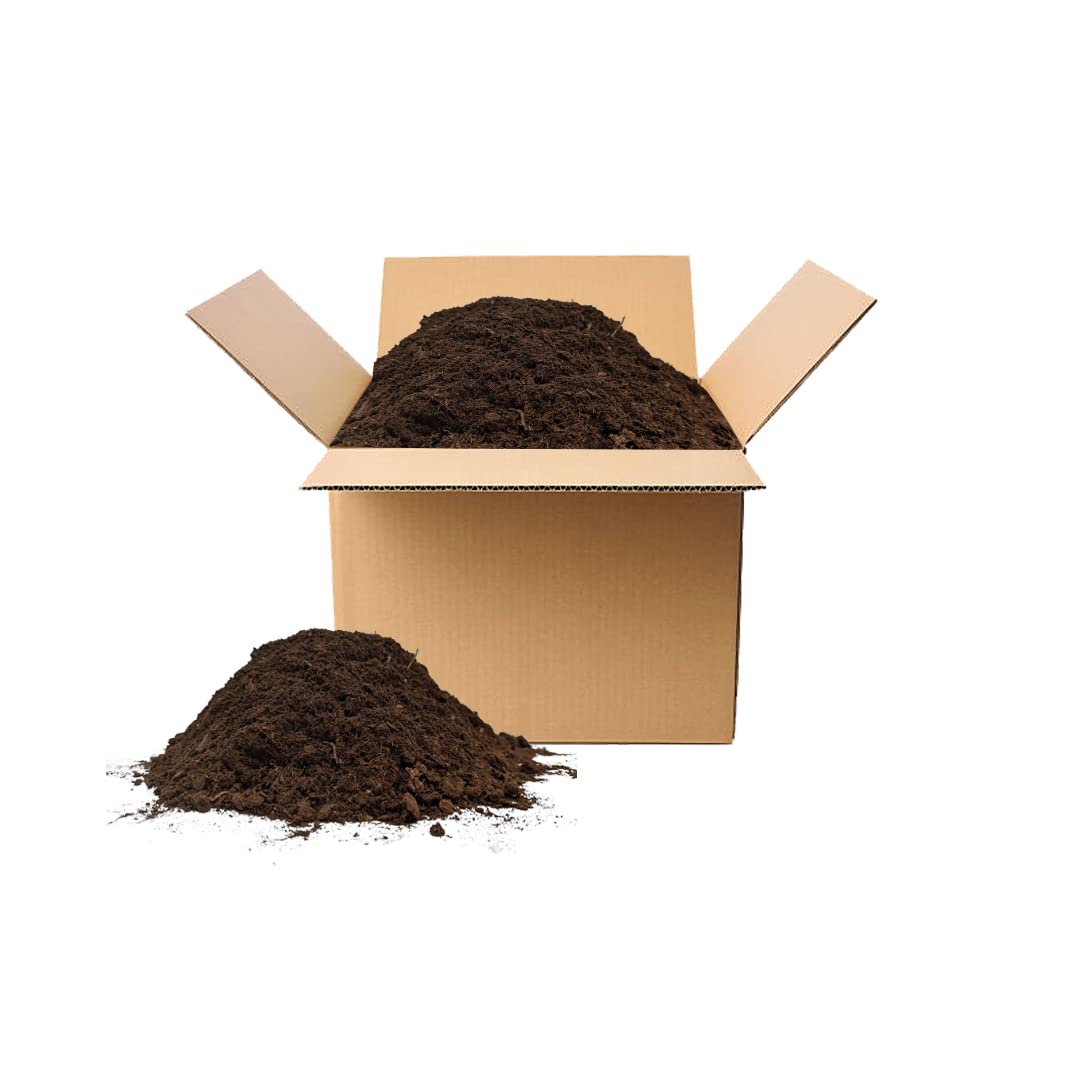
The big semi-compressed bale for gardeners who measure projects in cubic feet, not quarts.
This is the bulk play. At 3.8 cubic feet, this semi-compressed bale dwarfs every other bag on this list — it measures 3.8 cubic feet (about 114 quarts) versus the 2.2-quart starter bag. This is the one to grab when you are amending a full raised bed, mixing large batches of potting soil, or going commercial.
The reviews call it “great peat moss” that works well for plants and shrubs. It is 100% sphagnum peat, organic, and designed to prevent the water-logging that plagues container plants. It also holds onto nutrients that would otherwise wash away, making it a strong base for seedlings in larger propagation setups.
Semi-compressed means it is easier to fluff than fully compressed bales, but you still need to break it up and wet it before use. Some buyers report the quantity feels smaller than expected once fluffed, so plan accordingly. The biggest bale on the list is also the biggest price tag — this is for committed gardeners with space to store it.
Maximum volume: The best cost-per-cubic-foot math on this list for heavy soil mixers and bed amenders.
The commitment: Storage space and a willingness to fluff and hydrate a large bale are prerequisites.
Understanding the Specs
Volume Measurement (Quarts vs Cubic Feet)
Peat moss is sold by volume, not weight. A quart is a standard measure for small bags — a 10-quart bag fills roughly 10 standard seed trays. Large bales are sold in cubic feet, where 1 cubic foot equals about 30 quarts. Always compare the same unit before choosing a size.
Ingredients: Pure Peat vs. Blended Mix
Pure peat moss is just the moss — you add perlite and vermiculite yourself to create a soilless mix. A blended seed starter already includes those ingredients plus lime to balance the naturally acidic pH of peat. Blends are easier for beginners; pure peat offers total control for experienced mixers.
FAQ
What is the difference between peat moss and a seed starting mix?
How many seed trays will a 10-quart bag fill?
Why does my peat moss repel water instead of absorbing it?
Is peat moss acidic and will it harm my seedlings?
Can I use pure peat moss alone to start seeds?
How long does an opened bag of peat moss stay good?
Is peat moss better than coco coir for seed starting?
Do I need to add fertilizer to a peat moss seed starter?
Why does my seed starting mix have sticks and debris in it?
Can I reuse peat moss seed starter for a second season?
Final Thoughts: The Verdict
For most gardeners, the peat moss seed starter winner is the Espoma Organic Peat Moss — it’s pure, organic, and flexible enough to blend into any custom mix, and buyers have rated it 4.7 stars. If you’d rather skip mixing and want seedlings that transplant cleanly, the Jiffy 10 QT is your pick. And if speed of germination is your only goal, the Black Gold Seedling Mix has a track record of getting seeds up fast.
How We Picked
We do not accept paid placement. Every pick is matched to a real buyer and a real use-case; we do not hands-on test units.
Sources & Methodology
Specifications: manufacturer listings and product documentation. Review insights: verified customer reviews, as of August 2026. Pricing: not shown on this page (it changes often); check the current price via the retailer link.
As an Amazon Associate, Lawn Gear Lab earns from qualifying purchases. This does not affect which products we feature.