
Specs are compiled from manufacturer listings and verified buyer reviews and can change over time — please confirm the key details on the product page before buying.
A Clusia hedge is a thirsty, fast-growing machine that turns a light feeding into a wall of thick, glossy leaves — but only if the food actually reaches its roots. The four options here split into two camps: hammer-in spikes that release slowly at the root zone, and granular or liquid feeds you spread and water in. The real question is which format fits your watering habits, soil hardness, and available time.
I’m Rikta — the founder and writer behind Lawn Gear Lab. This guide is built by comparing the manufacturers’ published specifications and the patterns across verified customer reviews, so you get each pick’s real strengths and trade-offs instead of marketing spin.
The picks below are ranked for how well they match the way Clusia roots feed, so you can find the fertilizer for clusia that fits your soil type, schedule, and the size of your planting.
Our Picks at a Glance
How To Choose The Best Fertilizer For Clusia
Clusia grows as a dense privacy hedge, which means it uses food mostly to build leaves and stems, not flowers. That makes a nitrogen-heavy formula the right starting point, and it’s why the N-P-K numbers on the bag matter more than the brand name.
Match the format to your soil
Spikes are hammered into the ground and release food right at the roots, which is efficient — but only if your soil is soft enough to take them. Granules and liquids just need water to carry them down, so they work better in hard, compacted clay where driving a spike is a fight.
Count the nitrogen, not the marketing
The first number in the N-P-K ratio is nitrogen, the engine of leafy green growth. For a Clusia hedge you want that number to be the clear leader in the mix, since a balanced feed with equal parts of everything will push roots and blooms instead of the foliage you actually want.
Quick Comparison
| Model | Best For | Form | N-P-K Ratio | Weight | Amazon |
|---|---|---|---|---|---|
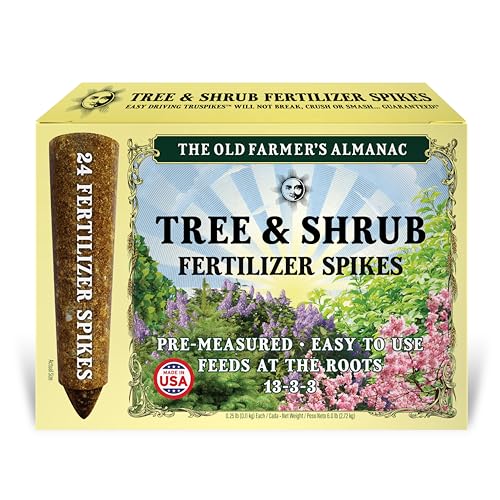
| Old Farmer’s Almanac Spikes (24-pack)★ Best Overall | Large hedges needing a slow, reliable feed | Spikes | 13-3-3 | 6 lbs | Amazon |
| Bloom City Liquid | Gentle feeding without leaf burn | Liquid | — | 2 lbs | Amazon |
| Old Farmer’s Almanac Spikes (12-pack) | Smaller plantings and a spring boost | Spikes | 13-3-3 | 3 lbs | Amazon |
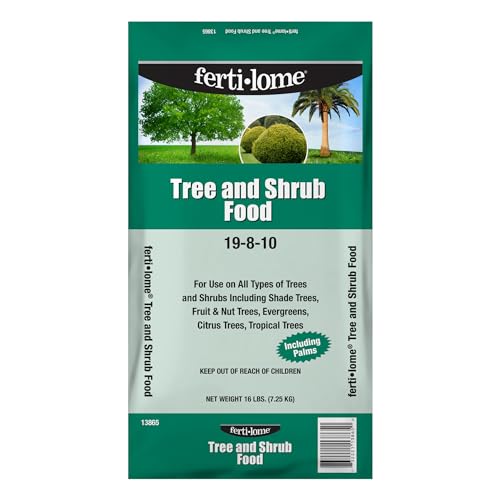
| Fertilome Granules | No-dig feeding across a whole yard | Granules | 19-8-10 | 16 lbs | Amazon |
In-Depth Reviews
1. The Old Farmer’s Almanac Tree & Shrub Fertilizer Spikes (Box of 24)
Our pick — over 4.5★ from 400+ verified ratings; the strongest balance of quality and price.
The spike that powers a full hedge line without crumbling on impact.
For a Clusia hedge that runs the length of a yard, this 24-spike box is the set-and-forget answer. Each 5-inch TruSpike is packed with a 13-3-3 formula — 13% nitrogen to drive that dense leafy growth Clusia is known for, with 3% phosphorus and 3% potassium backing up roots and blooms. You hammer each one in near the drip line, and the food releases straight into the root zone, which is exactly where a fast-growing hedge needs it.
Buyers report the spikes stay intact even when driven with a mallet into heavy clay soil, which is the difference between a 20-minute job and a frustrating afternoon. The natural ingredients, like molasses, help feed the soil biology around the roots rather than just dumping salts on top. For feeding rhythm, the guidance is simple: once in early spring and once in late fall keeps continuous nutrition flowing through the growing season.
The trade-off is hard soil. A few owners found the spikes crack during installation and suggest pre-drilling a hole instead of forcing them in with a hammer. For anyone with compacted ground, that’s a small extra step for a feed that otherwise takes minutes. On the results side, the proof is in the canopy: owners mention trees they fed put out more flowers than ever and filled in with leaves sooner, which is the exact response you want from a privacy hedge.
In a direct comparison, the 24-spike box contains 24 spikes at 6 pounds, while the 12-spike box has 12 spikes at 3 pounds.
What wins people over
- Ease of use is the #1 praised aspect — the spikes are simpler to place than the brand owners used before
- Stays intact in clay soil when hammered, so no crumbling mess
- One box covers a long hedge line, with 24 spikes in a 6-pound box
Where it demands care
- Hard, dry soil can crack the spikes — wet the ground or pre-drill holes first
- Results show over a season, not overnight
Reach for this if you have a long Clusia hedge and want one application that feeds for months without mixing or measuring.
Look elsewhere if your soil is rock-hard — you’ll spend more time digging holes than hammering spikes.
2. Bloom City Tree & Shrub Fertilizer – Liquid Plant Food (32 oz)

A liquid that feeds new Clusia without the burn risk of stronger mixes.
If your Clusia is young, freshly planted, or showing stress, this liquid is the gentler on-ramp. It comes ready to mix from a 32-ounce bottle and is formulated to support healthy growth in landscape trees and ornamental shrubs — which is precisely the “dense foliage” job a Clusia hedge performs. Because it’s liquid, it reaches the roots through water, so there’s zero need to dig or hammer into hard soil.
The defining trait buyers come back to is how safe it is on leaves. Multiple owners note it didn’t cause the leaf burn they’d seen with other fertilizers, which matters if you’re feeding a hedge that gets direct afternoon sun. It’s also easy to apply with one thumb over the bottle opening — no spreader, no gloves, no measuring cups to rinse. On the downside, one honest owner described the smell as “absolutely wreaking” and suspected it’s essentially liquid fish, so expect a brief earthy odor after application.
For results, the timeline is real but patient: a buyer feeding a new olive tree saw visible improvement within the first two months. That’s the pattern here — this isn’t a one-week miracle; it’s steady, root-deep support for plants finding their footing. If you’re mixing it into a routine for a newly installed Clusia hedge, that gradual response is exactly what you want to avoid shocking the roots.
Compared to the spike options elsewhere in this list, this liquid trades long-lasting convenience for immediate, even coverage — and it weighs just 2 pounds versus the 6-pound spike box, so it’s easier to store on a shelf.
The gentle route: Ideal for young or stressed Clusia where burn risk is your biggest fear — the leaf-burn-free record is the standout trait here.
The honest catch: The fishy smell lingers after application, so time your feeding for a day you can let the yard air out.
3. The Old Farmer’s Almanac Tree & Shrub Fertilizer Spikes (Box of 12)

A smaller spike box for a single hedge stretch or a mid-season boost.
This is the 12-spike version of the same 5-inch TruSpike design, built for a shorter run of Clusia or for topping up a hedge that already had its spring feed. The identical 13-3-3 ratio — 13% nitrogen, 3% phosphorus, 3% potassium — means the leaf-driving power is exactly the same as the bigger box, just in a smaller, 3-pound package that’s easier to store in a shed.
What sets this one apart in the reviews is a dramatic recovery story: a struggling dogwood brought back with 6 spikes placed in a ring 10 feet from the trunk last fall, then explosive white blooms and lush green foliage by spring. The same logic applies to a sparse Clusia — place spikes around the root zone and let the slow release do the work over months. The brand says each spike feeds continuously for up to 3 months, so two applications a year (early spring, late fall) covers the full season.
The recurring note from owners is to be smart about installation. They advise inserting spikes by hand or by stepping on them, then tapping below the surface with a bar or piece of wood, rather than hammering — this avoids the breakage that happens in hard ground. Saturated soil after rain makes the job noticeably easier, so time your application for a damp day.
There’s an honest split in the feedback here: while many see real results, one owner flatly noted “I don’t see any difference” — a reminder that spikes work best when your soil is soft enough for them to seat properly and release evenly.
Why owners stick with it
- Spikes feed for up to 3 months each, so two applications cover a season
- Quality and durability are the top-praised aspects — they don’t break apart during normal install
- Smaller box fits a single hedge run without leftover clutter
The installation reality
- Hammering into dry clay can crack them — step them in or pre-moisten soil
- A small share of owners saw no visible change, so results vary with soil and plant health
Best for a single mature Clusia or a short hedge where 12 spikes is the right count and you can water the ground first.
Think twice if your soil is dense clay — you’ll fight the installation more than you feed the plant.
4. Fertilome Tree & Shrub Food 19-8-10 (16 lbs)
The scatter-and-soak granule that skips hole-digging entirely.
This is the heavyweight of the group — a 16-pound bag of granules with a 19-8-10 formula, where that leading 19% nitrogen is the strongest leaf-growth driver on this list. It’s built around a penetrating formula that feeds feeder roots without any hole-digging: you simply sprinkle it around the plant’s drip line and water it in. For a Clusia hedge that’s the fastest application method of all four picks.
Customers note dramatic new growth on oaks, Bartlett pears, hollies, evergreens, and shrubs after just two applications in early spring. Several note the results show up “surprisingly fast,” and one landscape professional has used it for years. One 16-pound bag covers a whole yard, making it the pick for properties with multiple trees and a long hedge line.
On the safety front, owners say you don’t have to be quite as careful about burning as with other fertilizers, though the best practice is still to put it down before rain and keep watering it in. It’s explicitly suitable for shade trees, evergreens, citrus, and tropical trees — the tropical category being a natural fit for Clusia. The trade-off is that granules can wash away on a slope if you don’t water them in quickly, and the 16-pound bag is heavier to haul than the liquid or spike options.
Compared to the spike formats, this one leads on nitrogen — 19% versus the 13% in the Old Farmer’s Almanac spikes — so it pushes leaf mass harder when your hedge needs a growth spurt.
What earns its keep
- Effectiveness is the #1 praised aspect — visible new growth reported across multiple tree types
- No digging requirement saves real time on a long hedge line
- 16-pound bag goes a long way, with one bag covering a whole property
Where it’s less ideal
- Needs watering-in right after spreading, or granules can sit on top
- Heavier bag to carry and store than liquid or spike formats
Reach for this if you want the fastest possible application — sprinkle, water, done — with the strongest nitrogen push of the four.
skip it if you need pinpoint, root-zone feeding for a single specimen and don’t want to manage a 16-pound bag.
Understanding the Specs
N-P-K Ratio
The three numbers on any fertilizer bag stand for nitrogen, phosphorus, and potassium, in that order. Nitrogen is the first and most important for Clusia, because it drives leafy green growth — which is the whole point of a privacy hedge. A ratio like 13-3-3 or 19-8-10 puts nitrogen clearly first, which is what you want. A balanced feed with equal numbers would push roots and flowers instead of the dense foliage you’re after.
Release Speed and Root Delivery
Spikes release food slowly and directly in the root zone, which means less waste and fewer applications — but they need soft soil to seat properly. Liquids reach roots fast through water and are gentler on young plants, but they need repeat applications. Granules sit on the surface and rely on rain or watering to carry them down, making them the easiest to spread but the most dependent on your watering habits.
FAQ
How often should I fertilize Clusia hedges?
Will fertilizer spikes work in hard clay soil?
What N-P-K ratio is best for Clusia leaf growth?
Is liquid fertilizer safer for young Clusia plants?
How many spikes do I need for a single Clusia shrub?
Should I water in granular fertilizer right after applying?
Can I use a fertilizer meant for trees and shrubs on a Clusia hedge?
How fast will I see results on my Clusia?
Final Thoughts: The Verdict
For most people, the fertilizer for clusia winner is the Old Farmer’s Almanac 24-pack because it pairs the highest praised ease-of-use with a 13-3-3 ratio built for leafy growth — and 24 spikes covers a full hedge line in one go. If you want the gentlest start for young plants, grab the Bloom City liquid, which shoppers say won’t burn leaves. And if you’d rather not dig or hammer at all, the Fertilome granules give you the strongest nitrogen push at 19% with a simple sprinkle-and-water routine — a 16-pound bag that goes a long way across a whole yard.
How We Picked
We do not accept paid placement. Every pick is matched to a real buyer and a real use-case; we do not hands-on test units.
Sources & Methodology
Specifications: manufacturer listings and product documentation. Review insights: verified customer reviews, as of August 2026. Pricing: not shown on this page (it changes often); check the current price via the retailer link.
As an Amazon Associate, Lawn Gear Lab earns from qualifying purchases. This does not affect which products we feature.