
Specs are compiled from manufacturer listings and verified buyer reviews and can change over time — please confirm the key details on the product page before buying.
You have goosegrass taking over your lawn, and you are tired of pulling it by hand, only to have it come back a week later. This guide breaks down the top 3 selective herbicides that kill this grassy weed without torching your turf. You get the good, the bad, and the honest trade-offs, all in plain English.
I’m Rikta — the founder and writer behind Lawn Gear Lab. This guide is built by comparing the manufacturers’ published specifications and the patterns across verified customer reviews, so you get each pick’s real strengths and trade-offs instead of marketing spin.
You want goosegrass gone without harming your lawn. The right selective formula kills goosegrass fast, spares your turf, and covers the whole yard. Here are the actual products that do the job, so you can pick the best herbicide for goosegrass and stop the weeds from winning this season.
Our Picks at a Glance

How To Choose The Best Herbicide For Goosegrass
Goosegrass is a summer annual that loves compacted, sun-baked soil. By the time you see it, it has often already set seed, which is why you need a killer that works on established plants, not just a barrier for new ones. The right selective formula kills fast, protects your turf, and stops goosegrass from spreading.
Check how it treats your grass type
Not every weed killer is safe for every lawn. You need a selective herbicide that targets grassy weeds like goosegrass while leaving your fescue, bluegrass, or Bermuda undamaged. Look at the label to ensure it lists your specific turf type — this is non-negotiable.
Consider speed and re-seeding
Some formulas show browning within hours, while others take weeks to show full results. If you plan to re-seed bare spots, you also need to know how soon you can plant. A shorter re-seed window means less downtime for your yard.
Decide on your application method
Ready-to-use bottles are convenient for spot treatment, but a bottle without a sprayer is a trap if you lack your own gear. Handy sprayer attachments make mixing and coverage a breeze, while ready-to-spray hoses cover large areas fast. Match the method to the size of your lawn.
Quick Comparison
| Model | Best For | Volume | Weight | Active Ingredient | Amazon |
|---|---|---|---|---|---|
| SpeedZone EW★ Best Overall | Fast cool-weather control | 20 fl oz | 8 oz | 2,4-D & Dicamba mix | Amazon |
| Bonide Sedge Ender | Nutsedge & goosegrass combo | 16 fl oz | 1.2 lbs | Sulfentrazone | Amazon |
| Roundup Crabgrass Destroyer2 | Bulk multi-pack buyers | 384 fl oz | 5 lbs | Topramezone | Amazon |
In‑Depth Reviews
1. SpeedZone EW Lawn Weed Killer
Our pick — over 4.5★ from 250+ verified ratings; the strongest balance of quality and price.
The cool-weather phenom that burns weeds in hours, not weeks.
SpeedZone EW is the crowd-pleaser for a reason: it controls 90+ listed weeds, from white clover and dandelion to goosegrass and nimblewill, all in one jug. What wins people over is the speed — visible effects appear within hours, even when the mercury drops. This is the formula you reach for in early spring or late fall when other killers stall out.
It also fits your schedule. Your grass stays safe, and you can reseed in as little as 7 days—far faster than most competitors. It is rainfast in as little as 3 hours, so a surprise shower won’t ruin your afternoon spray session. Buyers report weeds burn within 3 days and are fully dead by day 7, even on sprawling 13,000 sq ft lawns applied with a boom sprayer.
The label is a bit of a cheat sheet: mix 1.8 fl oz in 0.5 to 1 gallon of water per 1000 sq ft on warm-season grasses. It is safe for Kentucky bluegrass, perennial ryegrass, tall fescue, Bermudagrass, and zoysiagrass. The trade-off? One critical rule: avoid overspray, as hitting the grass itself with heavy doses causes browning — follow the application rate and it stays clean.
Selective strength: Kills the broadleaf intruders while the turf remains untouched — the review pages sum it up: “This only kills the weeds and not the grass.”
Who this is for: The lawn nut who wants results this week and a grass-safe formula that works in cooler temps.
Reach for this if: You want the fastest visible kill and a reseed window measured in days, not months.
Look elsewhere if: You tend to over-apply chemicals — this one punishes sloppy spraying by burning the turf.
2. Bonide Sedge Ender Weed Killer

The double-duty specialist that tackles nutsedge and goosegrass in one pass.
Bonide Sedge Ender is the ready-to-spray workhorse, and its active ingredient, sulfentrazone, is a proven weapon against both yellow nutsedge and goosegrass. Its selling point is pre and post emergent control—apply before weeds sprout or after they appear, and it kills roots and shoots while blocking new seedlings. That flexibility is rare.
The 16 oz bottle is an economical pick, treating up to 8,700 square feet straight from the hose. It is rainproof within hours, so you do not have to sprint inside when clouds roll in. Owners mention it is effective on nutsedge when applied to leaves, with dying in 1-2 weeks and roughly a 90% reduction after the first use.
You can spray it on both warm and cool season grasses—bluegrass, ryegrass, fescue, Bermuda, and carpetgrass—without killing them. For hybrid Bermuda, apply twice, 3-4 weeks apart, and skip spraying when it’s above 90°F to avoid browning. The catch: the on/off dial is stiff, and some customers note needing pliers to turn it.
What wins owners over
- Pre and post emergent kill stops goosegrass at any stage
- Simple hose-end sprayer covers big yards without mixing
What to know
- The locking dial can be frustratingly hard to turn
- Coverage claims vary — some found it covers far less than expected
Best for: The homeowner juggling nutsedge and goosegrass who wants one bottle to handle both.
Think twice if: You hate wrestling with stiff plastic dials on sprayers.
3. Roundup for Lawns Crabgrass Destroyer2
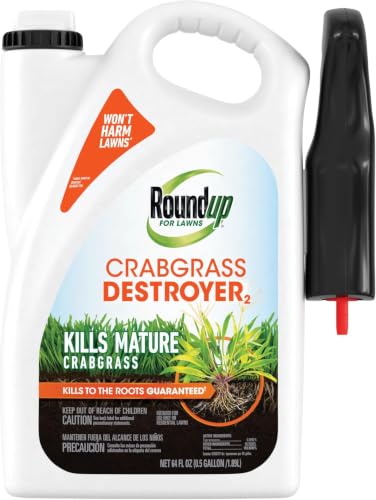
The bulk six-pack that drowns crabgrass with a 384-fluid-ounce arsenal.
Roundup Crabgrass Destroyer2 is the heavy hitter for sheer volume — a pack of six 64 oz bottles totaling 384 fluid ounces, weighing in at 5 pounds. Its active ingredient, topramezone, targets grassy weeds to the root. While its specialty is crabgrass, it is explicitly labeled for goosegrass, making it a solid multi-season buy for big lawns.
The math favors the bulk buyer: 384 fluid ounces is a 24.0x gap versus the 16 oz Bonide bottle, and the heavier 5-pound crate beats the 1.2-pound Bonide by a 4.2x margin. Best of all, it works on Kentucky bluegrass, fine fescue, perennial ryegrass, and tall fescue when daytime temps sit between 45°F and 90°F. Owners confirm it makes mature crabgrass turn white before dying back.
Here is the catch: the sprayer. This ready-to-use container ships without the trigger sprayer shown in the photos, and reviewers point out it is a recurring issue across batches. If you already own your own sprayer or wand, this is a bargain. If not, factor in buying one before you order.
Volume advantage: At 384 fl oz, this six-pack outguns every other pick here for pure square-footage coverage.
Hard truth: Effectiveness draws the most chatter for the wrong reason — the application struggle overshadows the weed-killing for a chunk of buyers.
Grab this when: You have a large fescue lawn and already own a reliable pump sprayer.
Pass if: You expect a grab-and-go trigger bottle — this one arrives bare.
Understanding the Specs
Active ingredients
The chemical that does the killing matters more than the brand name. SpeedZone uses a 2,4-D and Dicamba blend for broadleaf control, Bonide uses sulfentrazone for grassy weeds like nutsedge, and Roundup uses topramezone for crabgrass. Match the ingredient to the weed you actually have.
Rainfast and reseed windows
Rainfast means how soon rain will not wash the chemical off your grass. Shorter is better — SpeedZone is rainfast in 3 hours. Reseed window tells you how quickly you can plant new grass after spraying; SpeedZone allows reseeding in as little as 7 days, getting your lawn back to full health faster.
FAQ
Will these products hurt my fescue lawn?
Are these goosegrass killers effective in cool weather?
How long does goosegrass take to die?
Will these killers damage my garden plants?
Are these pre-emergent or post-emergent weed killers?
Do these come ready to spray?
How much lawn will each bottle cover?
Can I reseed after using these products?
Final Thoughts: The Verdict
If you want one dependable pick, the herbicide for goosegrass winner is the SpeedZone EW because it pairs fast cool-weather results with a reseed window you can actually plan around. If your problem is a mix of nutsedge and goosegrass, grab the Bonide Sedge Ender. And for a massive lawn where volume matters most, the Roundup Crabgrass Destroyer2 six-pack is the one to reach for — just make sure you have your own sprayer first.
How We Picked
We do not accept paid placement. Every pick is matched to a real buyer and a real use-case; we do not hands-on test units.
Sources & Methodology
Specifications: manufacturer listings and product documentation. Review insights: verified customer reviews, as of August 2026. Pricing: not shown on this page (it changes often); check the current price via the retailer link.
As an Amazon Associate, Lawn Gear Lab earns from qualifying purchases. This does not affect which products we feature.