
Specs are compiled from manufacturer listings and verified buyer reviews and can change over time — please confirm the key details on the product page before buying.
Japanese beetles don’t just eat your leaves—they skeletonize them, turning your prize roses and fruit trees into lace in a matter of days. The best approach isn’t a single miracle spray; it’s understanding the two distinct battles: killing the adult beetles feasting on your plants right now, and stopping the grubs in your soil from becoming next year’s swarm. This guide breaks down the top sprays by their real strengths, so you can pick the one that matches your specific garden battle.
I’m Rikta — the founder and writer behind Lawn Gear Lab. This guide is built by comparing the manufacturers’ published specifications and the patterns across verified customer reviews, so you get each pick’s real strengths and trade-offs instead of marketing spin.
We analyzed top-rated, science-backed formulas to match the best Spray For Japanese Beetles to your garden, pets, and patience level.
Our Picks at a Glance


How To Choose The Best Spray For Japanese Beetles
Before you buy, you need to know if your problem is adult beetles on leaves or grubs in the lawn, because the right product for one is often the wrong tool for the other. Adult beetles fly in from late spring through summer, eating and mating, while the grubs stay underground eating roots until they emerge. A spray that kills on contact handles the current invasion; a systemic product gets absorbed into the plant and kills the beetles as they feed, offering longer protection.
Evaluate the Active Ingredient
Choosing the right spray depends on how it kills, how long it lasts, and how safe it is for your family. Pyrethroids like permethrin and deltamethrin kill on contact fast, often become rainproof within an hour, and are common in many garden sprays. Neonicotinoids like imidacloprid work systemically—you water them into the soil once, and the plant carries the chemical to every leaf, killing beetles for weeks or months—but they are highly toxic to bees, so avoid them on flowering plants. If your pets and kids play in the yard, a natural cedar oil-based spray kills on contact with a gentler profile.
Understand the Difference Between Contact and Systemic
A contact spray kills the beetles it touches—great for a quick knock-down, but it won’t protect new growth that appears after you spray. Systemic products are taken up by the plant’s roots or leaves, so the whole plant becomes toxic to chewing insects, preventing infestations for weeks or months. The catch with systemics is that they don’t discriminate; if a bee lands on a treated flower, it’s at risk, so they’re best for trees and shrubs rather than blooming ornamentals.
Match the Formula to Your Application Method
Ready-to-spray (RTS) bottles connect directly to your garden hose and automatically mix the concentrate with water—perfect for covering large trees and shrubs without a separate sprayer. Concentrates require you to mix the product with water in a tank sprayer, which takes a few extra minutes but lets you control the exact rate and is far more economical over a season. For edible gardens, you must check the pre-harvest interval—how many days you must wait between spraying and picking fruit.
Quick Comparison
| Model | Best For | Protection Type | Coverage | Active Ingredient | Amazon |
|---|---|---|---|---|---|
| BioAdvanced Tree & Shrub★ Best Overall | Hose-end convenience | Contact + Residual | Hose-end spray | — | Amazon |
| Sevin 3-in-1 RTS3-in-1 Guard | Flowers & shrubs with fungi | Contact | 2,500 sq ft | — | Amazon |
| BioAdvanced Fruit & VegSystemic Defender | Edible gardens & fruit trees | Systemic | 640 sq ft | Imidacloprid | Amazon |
| Harris Beetle Killer | Large areas & long residual | Contact + Residual | 1 Gallon | Deltamethrin | Amazon |
| Ortho Bug B Gon | Multi-pest lawn defense | Contact + Residual | 42 gallons | — | Amazon |
| Sevin Concentrate | Budget-friendly versatility | Contact | 946 ml | — | Amazon |
| Wondercide Ready-to-Use | Pet-safe natural control | Contact | 5,000 sq ft | Cedarwood oil | Amazon |
| Pro Grub Control | Targeted grub & beetle control | Systemic | 32 oz concentrate | Imidacloprid | Amazon |
| Wondercide Concentrate | Max coverage natural option | Contact | 10,000 sq ft | Cedarwood oil | Amazon |
In‑Depth Reviews
1. BioAdvanced Tree & Shrub Insect Killer Spray
Our pick — 4.5★ from 300+ verified ratings; the strongest balance of quality and price.
The hose-end hero that turns a beetle war into a 5-minute task.
When beetles are devouring your trees, the last thing you want is a complicated mixing routine. This ready-to-spray bottle connects directly to any garden hose, so you’re covering a 20-foot silver maple or a row of dogwoods in minutes, not hours. It kills aphids, caterpillars, and Japanese beetles on contact and becomes rainproof in one hour.
What makes this a standout is the two-week protection window. The spray keeps killing and controlling listed insects on treated trees and shrubs for up to 14 days, which means you’re not out there every single evening. Buyers wiped out white flies on front bushes with two sprays and kept apple trees pest-free with biweekly applications.
The 32-ounce bottle weighs just 2.1 pounds, making it easy to handle even on a long garden hose run. Compared to the BioAdvanced Fruit & Vegetable concentrate at 2.4 pounds, this is the lighter, grab-and-go option. For a homeowner who wants broad tree and shrub protection without owning a separate sprayer, this is the most direct path to a healthy yard.
The Quick-Win List
- Ready-to-spray bottle—no mixing required
- Holds up in rain after 60 minutes
- Protects trees and shrubs for two weeks
Watch For
- Contact spray—won’t protect brand-new growth after it dries
- Hose-end dilution means less control over exact dose
Your pick if: you have beetles on trees, shrubs, or bushes and want the fastest, simplest coverage path.
Reconsider if: you need a systemic option to protect a single prized tree for a full season without repeat spraying.
2. Sevin 3-in-1 Flower & Shrub RTS
The triple threat that handles beetles, mites, and fungus in one pass.
If your garden has more than one problem—say, beetles chewing the leaves and powdery mildew spotting them—this ready-to-spray formula handles both in a single treatment. It’s a 3-in-1 product: an insecticide that kills ants, aphids, and armyworms on contact, a miticide for spider mites, and a fungicide that attacks rust, powdery mildew, and black spots. For flower beds and shrubs, that means one bottle does the work of three.
The coverage math is compelling: a single 32-ounce quart treats up to 2,500 square feet, so it stretches across a substantial border of crape myrtles, petunias, and rose bushes. Buyers report Japanese beetles dying off crape myrtles quickly, with no beetles returning after the initial spray, and no harm to the plants themselves. One gardener killed mites on petunias that another ready-to-spray formula couldn’t touch.
It’s rain proof, so you don’t have to time your application around the forecast, and protection against diseases lasts up to two weeks. Just remember the label’s caution: do not broadcast this spray on the lawn. Its strength is directed at your flowers and shrubs, and that’s exactly where it belongs.
Why it wins: the only spray here that combines beetle control, mite control, and disease prevention in one bottle, saving you from buying three separate products.
Reach for this if: your flower beds face both insect damage and fungal spots, and you want one hose-end solution.
Look elsewhere if: your main battle is on trees or edibles rather than ornamental flowers and shrubs.
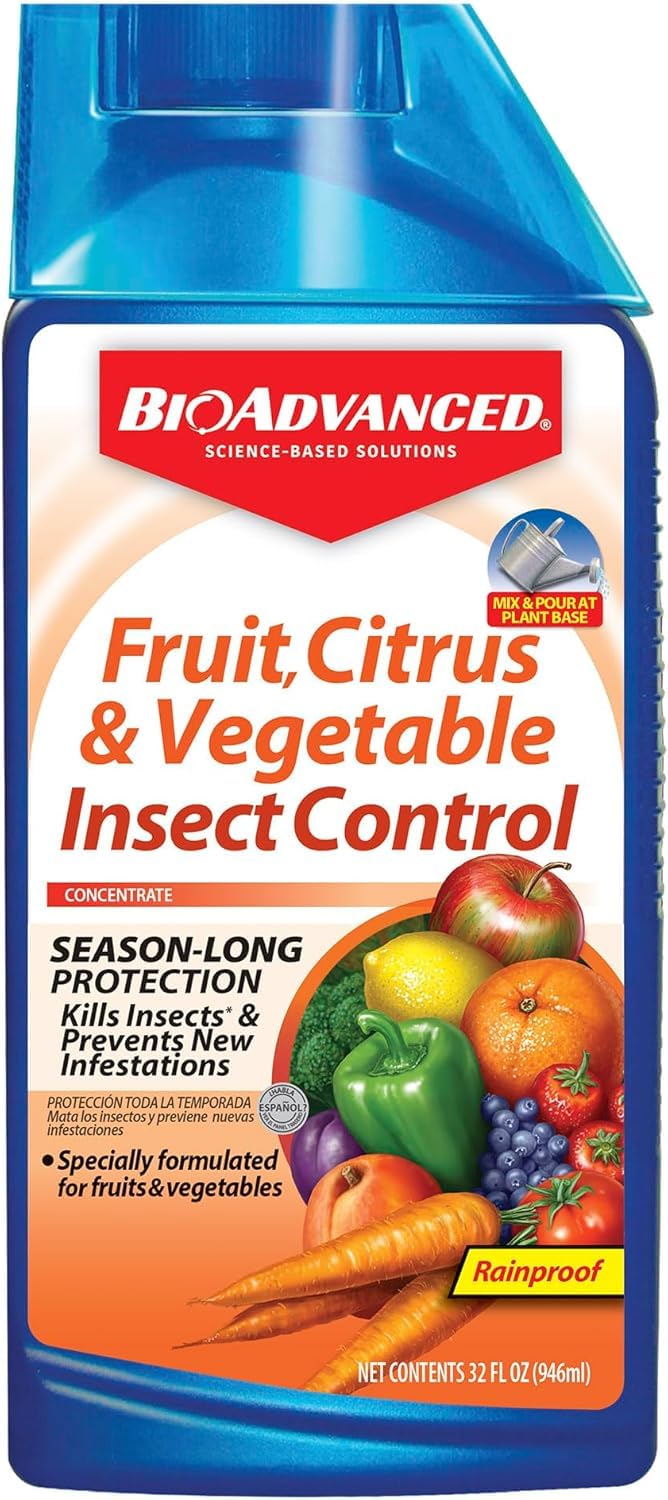
3. BioAdvanced Fruit, Citrus & Vegetable Insect Control
The one-and-done systemic that keeps your harvest safe for months.
Unlike a contact spray that washes away or breaks down, this concentrate works from the inside. It’s a systemic product, meaning the plant absorbs it and carries the protection to every leaf, so when a Japanese beetle takes a bite, the insect dies. One treat-and-forget application prevents new infestations for up to 2 months, which is why reviewers call it the answer for the busy gardener who can’t spray weekly.
Formulated for edibles, it’s labeled for use on over 100 listed fruits, vegetables, and citrus plants. The protection is rainproof because it’s absorbed into the plant—water can’t wash it off. It kills a long list of pests including aphids, Asian citrus psyllid, leafhoppers, Japanese beetles, and notably, Japanese beetle grubs in the soil.
There’s a trade-off to respect: the active ingredient, imidacloprid, is toxic to bees and other pollinators, so reviews repeatedly stress removing flowering plants before spraying. The same gardener who wiped out hundreds of flower thrips in a week saw some plants droop—follow rates exactly. At 32 fluid ounces, it treats up to 640 square feet, and at 2.4 pounds it’s slightly heavier than the Tree & Shrub hose-end spray at 2.1 pounds.
The low-maintenance List
- Up to 2 months of protection from one application
- Absorbed by the plant—rain can’t wash it off
- Kills grubs in the soil as well as adult beetles
The Catch
- Highly toxic to bees—keep it off flowering plants
- Pre-harvest interval of up to 21 days on edibles
Best for: fruit tree owners who want season-long protection without repeated spraying.
Skip if: your garden is full of blooming ornamentals that bees love, or you’re growing short-cycle leafy greens you harvest often.
4. Harris Asian Lady Beetle, Japanese Beetle, and Box Elder Killer

The odorless gallon jug built for serious beetles and serious coverage.
When you’re fighting beetles across a whole yard, the sprayer you already own is all you need here. This is a one-gallon jug (128 fluid ounces) of concentrated killing power that you apply with the included trigger sprayer, and it stays on the job long after the spray dries. The formula kills Asian lady beetles, Japanese beetles, and box elder bugs as the residue dries, and continues killing for weeks in treated areas.
The active ingredient, deltamethrin, is a fast-acting pyrethroid. Owners mention spraying the garden one evening and finding no Japanese beetles on the plants the next morning, with dead ones on the ground—a level of overnight effectiveness that turns believers fast. It’s also odorless and non-staining, so there’s no chemical smell lingering in your garden, and the label says it won’t damage fabrics when used as directed.
At 8.8 pounds, this is the heaviest bottle in our lineup, but that’s the price of a full gallon of ready-to-use liquid. The main thing owners single out is the residual kill: beetles that land on treated leaves days later still die, which is why many needed only two applications in a whole season.
The value read: more liquid per dollar than any concentrate here, with a formula that keeps killing long after you walk away.
Choose this when: you have a large property and want a full gallon of odorless, residual spray you can reapply all season.
Not the pick: if you need a hose-end sprayer convenience or a formula safe for edible crops.
5. Ortho Bug B Gon Insect Killer for Lawns and Gardens

The multi-tasker that treats the whole yard, not just the beetles.
If your yard has a whole cast of pests—spiders on the foundation, ants in the patio, mosquitoes at dusk, and Japanese beetles on the roses—this concentrate is the one-stop arsenal. It kills 235 listed insects, and one 32-ounce bottle concentrates into up to 42 gallons of spray once you mix it in a hose-end sprayer or tank. That’s staggering value when you’re treating a perimeter around the house, foundation, and garden beds.
You get up to 6-month protection for spiders (excluding black widow, brown recluse, and hobo), which covers a full season. It works on lawns, around house foundations, on roses, ornamentals, flowers, trees, shrubs, vegetable gardens, melons, and fruit trees, so it’s among the most versatile sprays here. Customers note one annual spray kept mosquitoes gone from a cabin for 2-3 months, and the product survived a harsh winter in storage.
It kills listed insects outdoors before they come inside, which is the whole point of a perimeter defense. The product’s many fans note that organic sprays often failed where this worked in one treatment, though you’ll want to keep it away from flower and bird feeder areas per the label.
The Coverage Payoff
- One bottle makes up to 42 gallons of spray
- Long-lasting protection—up to 6 months for spiders
- Covers lawns, foundations, vegetables, and ornamentals
The Trade-Off
- Requires owning or buying a hose-end sprayer
- Broad-spectrum means it also hits beneficial insects
Grab this if: you want one product to handle a perimeter bug problem that goes beyond beetles—mosquitoes, ants, fleas, and ticks included.
Pass if: you need a targeted, gentler spray for a small flower bed and don’t want broad-spectrum chemistry.
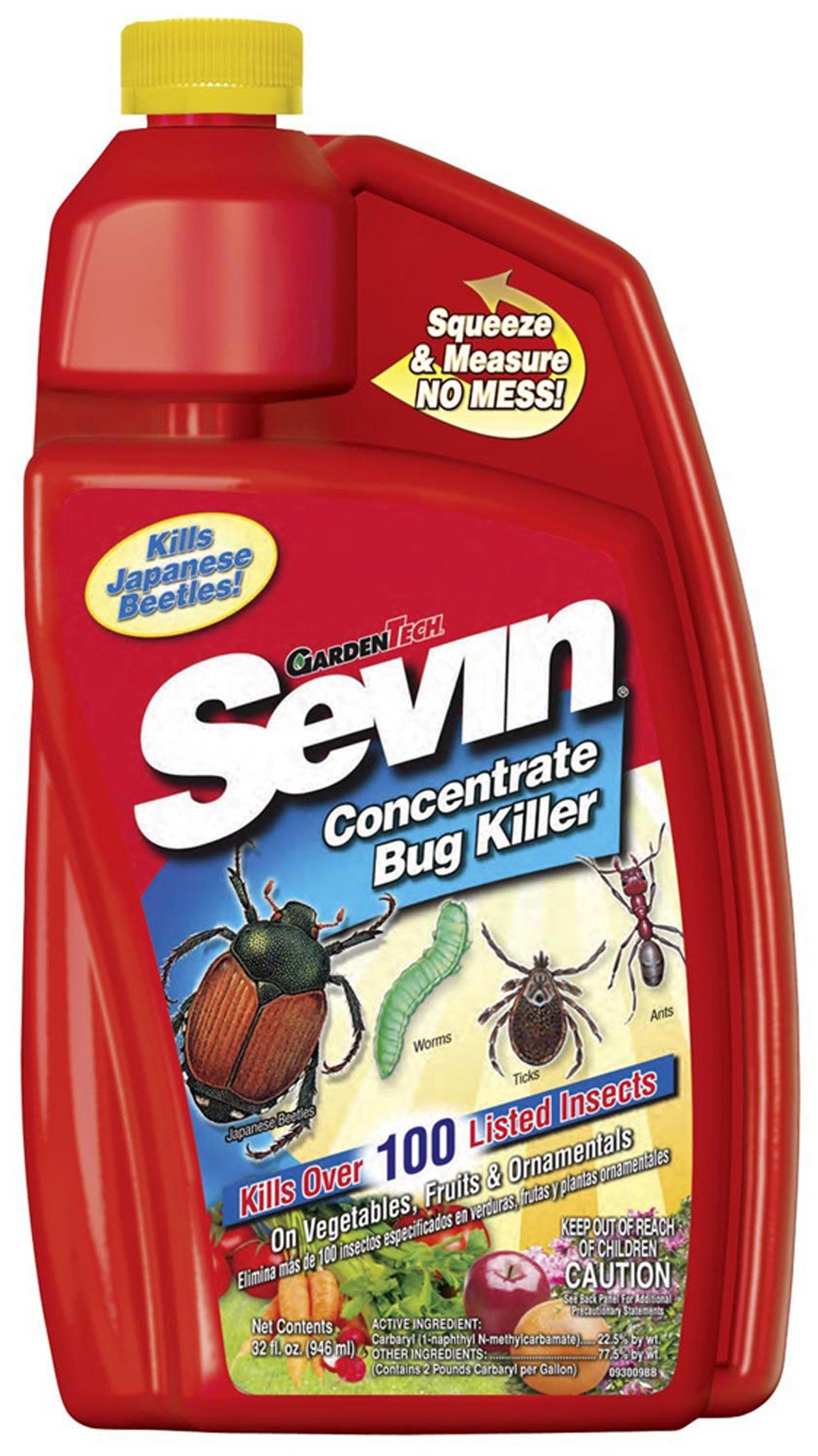
6. Sevin Concentrate Bug Killer
The concentrated classic that makes a single quart feel endless.
Here’s the concentrate that proves “a little goes a long way” isn’t just marketing. This 946-milliliter quart is a concentrated bug killer, so you mix just a small amount with water in your own sprayer, and the bottle lasts many treatments. It kills over 100 insects on vegetables, fruit, and ornamentals, including the Japanese beetles skeletonizing your roses and the squash bugs wrecking your garden.
Buyers are emphatic about the results: roses, Japanese maples, hibiscus, and magnolias bounced back and bloomed within days of treatment, with one gardener crediting it with saving plants from death. The formula is considered a safer alternative to some other products, and the concentrate is cheaper than buying ready-to-use bottles over a full season.
The recurring gripe isn’t the chemistry—it’s the packaging. The squeeze-and-measure bottle has a specific technique (one-way valve, funnel) that frustrates some owners, and a few found the thick liquid clogging or spilling. But for the gardener who transfers it to their own sprayer, the value and effectiveness remain the headline.
The honest take: the insecticide earns five-star loyalty from owners; the bottle design earns the complaints. Buy it for the chemistry and decant it into a tank sprayer.
Best for: vegetable and ornamental gardeners who already own a sprayer and want maximum bug-killing bang for their buck.
Think twice if: you want a grab-and-go hose-end spray and don’t want to deal with measuring and mixing.
7. Wondercide Outdoor Pest Control Spray

The plant-powered spray that lets pets and kids back in the yard immediately.
For pet owners who cringe at synthetic chemicals on the lawn, Wondercide is the spray-and-play answer. This ready-to-use formula is powered by natural essential oils like steam-distilled cedarwood, and it’s labeled safe around pets and the whole family with no wait time for drying or reentry. You attach it to the hose, spray the backyard, and your dog can run right out—no waiting, no worrying.
It kills and repels mosquitoes, ants, ticks, fleas, Japanese beetles, gnats, and crickets, treating up to 5,000 square feet. The plant-based residue is safe for beneficial insects like bees and butterflies when used as directed, which is a huge point for pollinator-conscious gardeners. Reviewers point out a 70-80% reduction in mosquito bites that lasts about 4 weeks, and many switched to it permanently after a pet’s cancer diagnosis made them wary of chemicals.
Be honest about its limits: it’s a repellent and contact killer, not a systemic, so persistence matters. Several reviews note it’s less effective after heavy rain and that mosquitoes may need a reapplication, and its effectiveness is a step below DEET for the toughest mosquito pressure. But for families prioritizing safety and a pleasant cedar smell over maximum knockdown, this is the clear choice.
The Peace-of-Mind List
- No dry time—safe for pets and kids immediately
- Kills and repels up to 5,000 sq ft
- Cedarwood oil base with no artificial fragrances
Know The Limits
- Repels and kills on contact—won’t match systemic persistence
- Effectiveness drops after heavy rain
Reach for this if: you have kids, dogs, or pollinators visiting your yard and want a natural formula you can spray and forget.
Look elsewhere if: you’re facing a severe beetle infestation and need a heavy-duty, long-residual synthetic spray.
8. Pro Grub Control – 32oz Concentrate

The professional-grade concentrate that kills beetles before they ever fly.
This is the strongest systemic play in our lineup, and it targets the root of the problem—literally. Pro Grub Control is a 21.4% imidacloprid concentrate, a professional-strength dose of the same systemic chemistry BioAdvanced uses, but at a much higher concentration. You can apply it to turf, as a foliar spray, or directly to the soil, making it a flexible weapon for trees, shrubs, and landscape ornamentals.
For a big property, the numbers work in your favor: for turfgrass, use up to 1.6 pints per acre (0.6 fl oz per 1,000 sq ft), and for soil, just 0.4 fl oz in one gallon of water per inch of trunk diameter. One buyer with a hemlock infestation called it “a lifetime supply” to protect his trees, though an agave lost before treatment didn’t come back the season after using this product. The high concentration means you buy once and treat for years.
Owners respect this product’s power, and they also respect its danger—reviews mention double-gloving and wearing long sleeves, which is the right caution for a 21.4% concentrate. The 32-fluid-ounce jug covers a huge area, but the measuring bottle earns mixed reviews for user-friendliness. This is a pro-grade tool for the gardener who reads labels and follows rates carefully.
Who it’s for: the serious gardener battling grubs and beetles on multiple trees who wants professional concentration at a fraction of the local retailer cost.
Pick this when: you want to treat soil or turf to break the beetle life cycle and have the acreage to make a concentrate worthwhile.
Avoid if: you’re a casual gardener who wants a quick hose-end spray, or you don’t want to handle a high-strength chemical concentrate.
9. Wondercide Outdoor Pest Control Spray Concentrate

The natural concentrate that covers a full acre of yard, pets included.
This is the big-property version of the Wondercide story. A single 16-ounce concentrate mixes with water in any applicator to treat up to 10,000 square feet—double the coverage of the ready-to-use bottle—making it the largest-area natural option we reviewed. It kills and repels mosquitoes, ants, fleas, ticks, roaches, flies, crickets, Japanese beetles, no-see-ums, and gnats, using just steam-distilled natural essential oils like cedarwood.
For families in rural or septic-heavy areas, shoppers say it eliminated black ants in a rural septic field, and it’s a favorite where dogs and chickens share the yard because it’s safe around animals and people of all ages with no wait time. The cedar smell is strong—some love it as a yard deodorizer, while one buyer found it overpowering after accidental indoor use. The manufacturer states it’s Permethrin-Free, which is a decisive factor for many.
Set expectations right: this is a killer and repellent, not a systemic. A few reviewers found mosquito control faded after about 24 hours under heavy pressure, and it takes a fair amount of product to cover a large yard. But for an editorially natural, pet-safe spray that keeps Japanese beetles and their kin off your edible garden and play areas, this is the most economical way to get Wondercide’s benefits at scale.
The Scale Advantage
- Treats up to 10,000 sq ft per bottle
- Safe for pets, kids, and edible gardens
- Concentrate is a cost-effective refill for ready-to-use bottles
The Reality Check
- You must mix it yourself—applicator not included
- Reapplication needed under heavy pest pressure
Best for: large yards and edible gardens where you want natural, pet-safe beetle control without spraying synthetic chemicals.
Not for: you need a one-and-done systemic treatment that kills grubs and beetles for months without reapplication.
Understanding the Specs
Contact Kill vs. Systemic Action
The biggest decision you’ll make is between these two modes of action. A contact spray kills the beetles it actually touches—great for immediate relief, but it won’t protect leaves that grow after spraying. A systemic product is absorbed into the plant itself, so the entire plant becomes toxic to chewing pests for weeks or months. That systemic persistence is exactly why one application of a product like BioAdvanced Fruit & Vegetable or Pro Grub Control can prevent infestations for up to 2 months, where a contact spray needs regular reapplication.
Active Ingredients to Know
Knowing the active ingredient tells you how the spray behaves. Deltamethrin (found in Harris) and pyrethroids are fast, synthetic contact killers with strong residual action. Imidacloprid (found in BioAdvanced and Pro Grub Control) is a systemic neonicotinoid—highly effective on beetles and grubs, but toxic to bees, so keep it off blooming plants. Cedarwood essential oil (found in Wondercide) is the natural option: it kills on contact, smells pleasant, and is safe around pets, but it demands more frequent reapplication.
Ready-to-Spray vs. Concentrate
Ready-to-spray (RTS) bottles connect straight to your garden hose and dose the chemical automatically as water flows—perfect for fast, large-area coverage with zero measuring. Concentrates require you to measure and mix with water in a sprayer you already own, which is more work but dramatically cheaper per treatment. If you’re covering a large yard or many trees, a concentrate like Ortho Bug B Gon (which makes up to 42 gallons) or Sevin Concentrate will save you significant money over a season.
Crop Safety and Pre-Harvest Intervals
If you’re spraying anything edible, the pre-harvest interval matters—it’s the number of days you must wait between spraying and picking fruit. The BioAdvanced Fruit, Citrus & Vegetable label lists a pre-harvest interval up to 21 days, which makes it unsuitable for short-cycle leafy greens you harvest weekly. Always check this number on any product before spraying edible crops, and remember that systemic chemicals absorbed into the plant can’t be washed off by rinsing your produce.
FAQ
What is the best spray for killing Japanese beetles on contact?
How long does a Japanese beetle spray last on plants?
Will these sprays kill Japanese beetle grubs in my lawn?
Which spray is safe to use on vegetable gardens and fruit trees?
Are any of these sprays safe around dogs and children?
Do I need a sprayer, or can I just attach the bottle to a hose?
What’s the difference between deltamethrin and imidacloprid sprays?
How soon after rain can I spray for Japanese beetles?
Which spray offers the longest protection with the least effort?
Should I spray the lawn or just the plants for Japanese beetles?
Final Thoughts: The Verdict
For most gardeners, the spray for japanese beetles winner is the BioAdvanced Tree & Shrub Insect Killer because it balances easy hose-end application with rainproof, two-week protection across your trees and shrubs. If your priority is protecting edible crops with a single season-long treatment, the BioAdvanced Fruit, Citrus & Vegetable systemic is the one to reach for. And for pet owners who want their family and dogs back in the yard immediately without synthetic chemicals, the Wondercide Ready-to-Use stands alone as the crowd favorite for safety and versatility.
How We Picked
We do not accept paid placement. Every pick is matched to a real buyer and a real use-case; we do not hands-on test units.
Sources & Methodology
Specifications: manufacturer listings and product documentation. Review insights: verified customer reviews, as of August 2026. Pricing: not shown on this page (it changes often); check the current price via the retailer link.
As an Amazon Associate, Lawn Gear Lab earns from qualifying purchases. This does not affect which products we feature.