
Specs are compiled from manufacturer listings and verified buyer reviews and can change over time — please confirm the key details on the product page before buying.
If you have St. Augustine grass, you know the drill: the weeds seem to love it as much as you do, and the wrong fertilizer can burn those broad blades faster than a summer afternoon. The fix is a weed and feed formulated for southern turf, and this guide cuts through the two biggest options to tell you which one actually thickens your lawn and which one risks wasting your weekend. You will get a clear winner for most yards, plus the honest trade-offs of the heavier professional-style bag.
I’m Rikta — the founder and writer behind Lawn Gear Lab. This guide is built by comparing the manufacturers’ published specifications and the patterns across verified customer reviews, so you get each pick’s real strengths and trade-offs instead of marketing spin.
Here is how to pick the right st augustine grass weed and feed without risking a burned lawn or a wasted application this season.
Quick Picks
- Fertilome (13915) St. Augustine Weed & Feed — Best Overall
- LESCO 50 lb. St. Augustine Grass Weed & Feed — Premium Pick
How To Choose The Right St Augustine Grass Weed And Feed
St. Augustine is a southern grass that needs a specific diet and specific weed killers that northern blends simply don’t carry. The wrong product can leave you with a yard full of dead weeds but a weakened lawn, or worse, a lawn that burns from too much nitrogen at the wrong time.
Check the NPK ratio first
The three numbers on the bag tell you the percentage of nitrogen, phosphorus, and potassium. For St. Augustine, you want a low or zero middle number, because too much phosphorus can feed the weeds as much as the grass. A 15-0-4 mix delivers a strong nitrogen boost for green growth and potassium for root strength, with no phosphorus to spare.
Know your weed control type
A pre-emergent stops weed seeds from sprouting, which makes it a spring-time tool. A post-emergent kills weeds that are already growing, which is a summer or fall tool. Some formulas combine both, so you get season-long protection with a single pass, but timing still matters for the best result.
Quick Comparison
In-Depth Reviews
1. Fertilome (13915) St. Augustine Weed & Feed 15-0-4
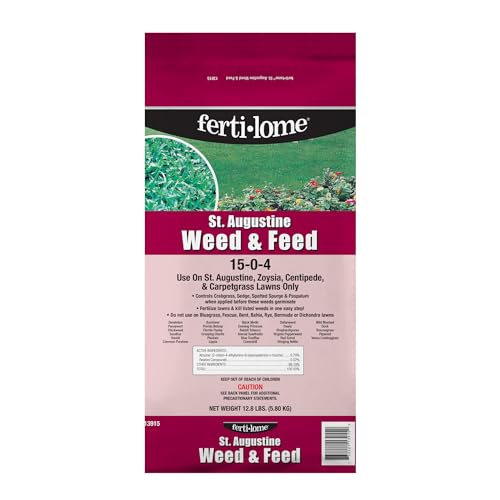
The 12.8-pound bag that turns a patchy southern lawn into the pride of the block without the back strain.
This pick pairs a 15-0-4 fertilizer blend with atrazine, a herbicide that works both before weeds sprout and after they appear, which makes it a single-pass solution for St. Augustine lawns. At just 12.8 pounds, it is roughly a quarter of the weight of the LESCO bag below, so carrying it from the garage to the spreader is genuinely easy for anyone.
The coverage is where this bag gets interesting: it handles 2,500 square feet at a fuller rate, or 5,000 square feet at a lighter rate, so you can dial the application to your yard’s actual needs. Owners in Florida report the product made their St. Augustine “thrive, thicken up and green up” even after heavy rain, which tells you the nitrogen is being put to work.
There is one hard rule that comes up again and again in the feedback: it is formulated for Centipede, Zoysia, and St. Augustine lawns, so you must not use it on Bermuda grass or northern grass types. One owner who waited until the grass grew about 5 inches after a drought still saw it work well on brown patches, but timing the application for early spring is the move that gets the best season-long weed defense.
Why owners swear by it
- Dual-action atrazine stops weeds before they sprout and kills the ones already growing
- At 12.8 lbs, it is a 3.9x lighter carry than the 50-lb. LESCO bag
- Covers 2,500 or 5,000 sq. ft. so you can match the rate to your lawn
The rules to respect
- Absolutely not for Bermuda or northern grass types
- Must be applied at the right time of year to see results
Reach for this if: you have a small to mid southern lawn and want a proven, easy-to-handle bag that feeds and defends in one pass.
Look elsewhere if: you manage a very large property that needs the massive coverage of a professional 50-lb. bag.
2. LESCO 50 lb. St. Augustine Grass Weed & Feed with Penoxsulam

A half-hundredweight professional bag built for big southern lawns that need weeks of steady feeding.
This is the serious-acreage option: a 50-pound bag of granules that covers 12,000 to 14,000 square feet, which is more than double the top-end reach of the Fertilome bag above. The 17-0-17 mix leans even heavier on nitrogen and potassium while still skipping phosphorus, and the “slow release” label means the grass gets fed gradually instead of all at once.
That slow-release design comes from a coating on the nitrogen, and the maker says it provides up to 8 weeks of feeding from a single application. It is safe for the Floratam variety of St. Augustine, and the instructions call for applying it when the turf is wet, letting it dry, and expecting total results in 2 weeks.
The trade-off here is the weight and the mixed reception. Carrying 50 pounds — a 3.9x jump from the Fertilome’s 12.8 pounds — is a real chore, and the review pages split sharply. Some owners say it “works so good” that it kills weeds and improves insect infestation too, but others report, “I wasted my money, time, and water. Nothing,” after following all instructions. The slow-release nature means patience is required, and one reviewer noted it simply takes a couple of weeks to judge.
Best for large spreads: this is the pick for a multi-thousand-square-foot yard where one bag, one trip, and 8 weeks of steady feeding beats a lighter bag you’d have to rebuy.
The honest catch: results are not instant, and a few owners saw no improvement at all, so this is a gamble if you need fast, visible weed knock-down.
Choose this if: you have a large St. Augustine lawn and want the slow-release feeding power that a 50-lb. professional bag delivers.
Think twice if: you want quick results, or you don’t want to haul and spread a 50-lb. load for a smaller yard.
Understanding the Specs
NPK Ratio
The three numbers on any fertilizer bag stand for nitrogen, phosphorus, and potassium. Nitrogen drives the green top growth you see, phosphorus feeds roots and blooms, and potassium builds overall plant strength. For St. Augustine, a 15-0-4 or 17-0-17 mix gives you the nitrogen and potassium the grass craves, with a zero in the middle to avoid feeding weeds.
Weed Control Type
A pre-emergent herbicide stops weed seeds from germinating, which makes it a spring tool for prevention. A post-emergent kills weeds that have already broken the surface. The Fertilome bag carries atrazine, which does both, while the LESCO bag leans on penoxsulam for its weed control, so your choice depends on whether you are preventing problems or fighting an active invasion.
FAQ
Can I use this weed and feed on Bermuda grass?
How much area does a 12.8 lb bag cover?
When is the best time to apply weed and feed to St. Augustine?
What does a 15-0-4 NPK ratio mean for my lawn?
How long does the LESCO slow-release feeding last?
Is the LESCO bag safe for Floratam St. Augustine?
Why is the LESCO bag so much heavier than the Fertilome?
Do I need to water after applying these granules?
Final Thoughts: The Verdict
For the majority of shoppers, the st augustine grass weed and feed winner is the Fertilome (13915) because it pairs dual-action atrazine with a 15-0-4 feed in a far easier 12.8-pound bag. If you are managing a very large lawn and want slow-release feeding over weeks, grab the LESCO 50 lb.. And if you want the safest, most proven pick for a typical southern yard, the Fertilome is the one to reach for.
How We Picked
We do not accept paid placement. Every pick is matched to a real buyer and a real use-case; we do not hands-on test units.
Sources & Methodology
Specifications: manufacturer listings and product documentation. Review insights: verified customer reviews, as of August 2026. Pricing: not shown on this page (it changes often); check the current price via the retailer link.
As an Amazon Associate, Lawn Gear Lab earns from qualifying purchases. This does not affect which products we feature.