
Specs are compiled from manufacturer listings and verified buyer reviews and can change over time — please confirm the key details on the product page before buying.
Spring is when your lawn wakes up — and so do the dandelions, clover, and crabgrass that have been hiding all winter. The right spring weed and feed does two jobs at once: it feeds your grass so it thickens up, and it kills the broadleaf weeds stealing water and nutrients from it. The problem is choosing between granular spreads, hose-end sprays, and formulas built for specific grass types like St. Augustine or bluegrass. This guide breaks down the real differences, so you can pick the one that matches your yard and your grass.
I’m Rikta — the founder and writer behind Lawn Gear Lab. This guide is built by comparing the manufacturers’ published specifications and the patterns across verified customer reviews, so you get each pick’s real strengths and trade-offs instead of marketing spin.
From the spread-and-go granules to the hose-end sprays, here’s the honest breakdown of the best spring weed and feed options for your lawn type and coverage needs.
Our Picks at a Glance
How To Choose The Best Spring Weed And Feed
Picking the right product starts with knowing your grass type and the weeds you’re fighting. A formula that’s perfect for a St. Augustine lawn can damage a fescue yard, so check the label before you buy.
Know your grass type first
Warm-season grasses like Bermuda, St. Augustine, and Zoysia need different herbicides than cool-season grasses like fescue and bluegrass. Some products, like the Fertilome St. Augustine formula, are specifically designed for southern lawns and warn you not to use them on Bermuda or northern grasses. Others, like The Andersons Premium, list eight compatible grass types on the label.
Understand pre-emergent vs. post-emergent
Pre-emergent herbicides stop weed seeds from germinating, which is why timing matters for crabgrass control. Post-emergent formulas kill weeds that are already growing and visible above the soil. Some products, like the Fertilome, combine both — killing existing weeds while preventing new ones from sprouting.
Match the coverage to your yard size
Coverage per bag varies wildly — from 5,000 square feet to 15,000 square feet. Measure your lawn before buying so you don’t end up with way too much or far too little. A 50-pound bag covers a big yard, while a smaller bag might be better for a modest front lawn.
Quick Comparison
| Model | Best For | NPK Ratio | Coverage | Form | Amazon |
|---|---|---|---|---|---|
| Scotts Turf Builder Weed & Feed3★ Best Overall | Dandelion & clover control | 2,4-D & Mecoprop | 5,000 sq ft | Granule | Amazon |
| Spectracide Weed & FeedBest Value | Hose-end spot spraying | 20-0-0 | 7,500 sq ft | Spray | Amazon |
| Fertilome St. Augustine Weed & Feed | Southern grass types | 15-0-4 | 2,500–5,000 sq ft | Granules | Amazon |
| The Andersons Premium Weed & Feed | Fast green-up + iron | 24-0-16 | 5,000 sq ft | Granule | Amazon |
| Jonathan Green Green-Up Crabgrass Preventer | Season-long crabgrass control | 20-0-3 | 15,000 sq ft | Granules | Amazon |
| The Andersons Professional Surge | Large lawns, post-emergent | 16-0-9 | 16,000 sq ft | Granule | Amazon |
| Jonathan Green Green-Up Weed & Feed | Broadleaf weed control | 21-0-3 | 15,000 sq ft | Granule | Amazon |
In-Depth Reviews
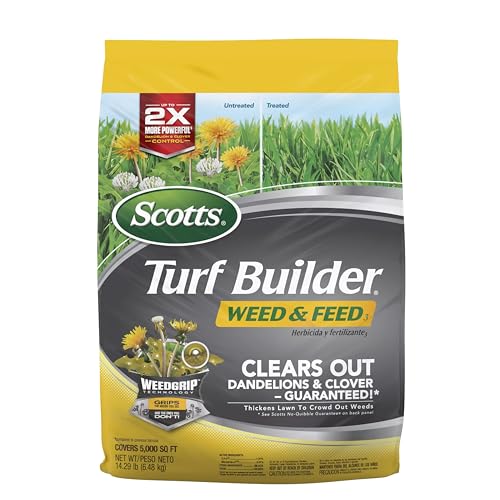
1. Scotts Turf Builder Weed & Feed3
Our pick — over 4★ from 36,500+ verified ratings; the strongest balance of quality and price.
The crowd favorite that clears visible dandelions while feeding your grass thicker.
Scotts holds its spot as the most trusted name in lawn care, and this Weedgrip Technology formula is their most powerful weed and feed yet. The key advantage here is the dual-active herbicide mix (2,4-D at 1.220% and Mecoprop at 0.081%) that targets the weeds you see and the ones you don’t. With up to 2X more powerful dandelion and clover control vs. the previous formula, it’s built for the most common spring lawn invaders.
The 14.3-pound bag of granules covers 5,000 square feet, making it a solid match for a typical suburban lot. Buyers report that plantain, dollar weed, and clover were killed within 2 days and gone within a week, though Japanese clover took about 2 weeks to fully disappear. The grass comes in thick and green after application, which is exactly what you want from a spring feed.
There are some honest limitations. This formula does not kill active crabgrass, and it can burn bare spots if you walk on treated areas before the granules break down. You’ll also need to keep pets off the lawn for at least 24 hours after application, and bare spots will require re-seeding separately. For the most common broadleaf weeds, though, this is the one most homeowners reach for — backed by a satisfaction guarantee.
What wins people over
- Kills dandelions and clover fast — many see results in days
- Thickens grass to crowd out future weeds
- Easy to apply with a standard spreader
What to watch
- Doesn’t kill active crabgrass
- Requires 24+ hours before pets can roam the lawn
- Bare spots need separate re-seeding
Reach for this if: you have a standard yard with dandelions and clover and want a proven, spreader-friendly granule that also feeds the grass.
Look elsewhere if: crabgrass is your main problem — you’ll need a product with a pre-emergent herbicide instead.
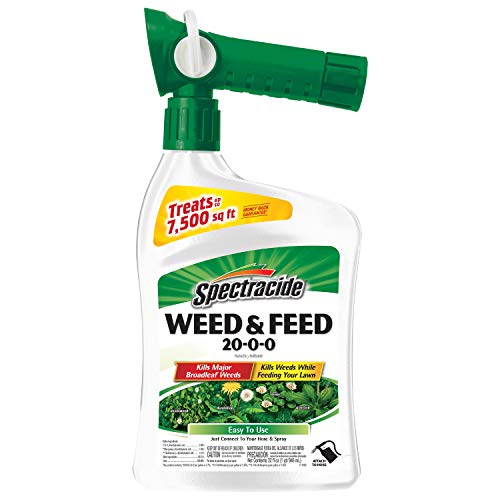
2. Spectracide Weed & Feed 20-0-0
The hose-end sprayer that covers 7,500 square feet without lugging a spreader.
If you’d rather spray than spread, this ready-to-use liquid hooks straight to your garden hose with the QuickFlip sprayer — just grip, flip, and go. The 20-0-0 nitrogen formula feeds your lawn while the dual-action herbicide kills broadleaf weeds like dandelion, chickweed, knotweed, plantain, clover, mallow, and purslane. One 32-ounce bottle treats up to 7,500 square feet, compared to the granular 5,000-square-foot bags above.
The biggest practical plus is how easy it is to reach weeds in tight spots, along fences, or in irregular yard shapes where a spreader struggles. Owners mention weeds turning white and dying while the grass gets greener, even on St. Augustine lawns, which many products aren’t safe for. It’s also far cheaper than hiring a lawn service for the same job.
The honest trade-off is in the mixed effectiveness reports — some weeds survive, and tough ones like lawn violets may need 2-3 treatments. The salty smell can linger for days after spraying, and you should avoid using it when temperatures climb above 85°F. It’s a great value for spot-treating and feeding, but don’t expect a perfect 100% weed kill on the first pass.
The easy-application edge
- Covers 7,500 sq ft compared to the 5,000 sq ft granules
- Safe for St. Augustine grass, which many products aren’t
- Hose-end sprayer reaches tight spots and fence lines
Know before you spray
- Effectiveness is mixed — tough weeds may need repeat sprays
- Salty smell lingers for days
- Avoid spraying above 85°F
Best for quick coverage: you have a St. Augustine lawn or awkward yard shapes where a spreader struggles, and you prefer spraying over spreading.
Not the one if: you expect one pass to eliminate every weed — stubborn species like lawn violets will test your patience.
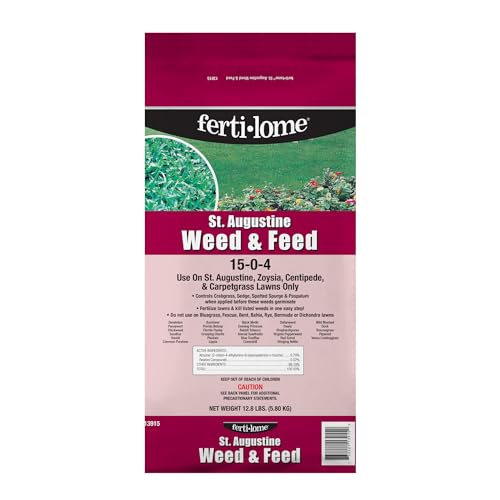
3. Fertilome St. Augustine Weed & Feed 15-0-4
The specialist formula that keeps southern St. Augustine lawns thick and weed-free.
Southern lawns have different needs, and this Fertilome formula is built specifically for St. Augustine, Centipede, and Zoysia grass — the warm-season types that dominate Florida and Gulf Coast yards. The 15-0-4 NPK mix includes Atrazine, which works as both a pre-emergent (stopping weed seeds from sprouting) and post-emergent (killing weeds already growing). This dual action makes it especially valuable for early spring application, setting up your lawn for the whole season.
The 12.8-pound bag covers 2,500 to 5,000 square feet, and customers note it works well on drought-damaged lawns with brown patches, thickening up even grass around 5 inches tall. One long-time user applied it with a standard Scotts spreader at the recommended setting and watered it in, with great results on weed inhibition and grass growth.
The catch is the compatibility warning: do not use this product on Bermuda grasses or any northern grass types like fescue. If your lawn is Bermuda, you need a different formula entirely. But for the southern homeowner with St. Augustine, this is the niche specialist that gets the job done right.
The southern specialist: this pre- and post-emergent combo is the right call for St. Augustine, Centipede, and Zoysia lawns battling weeds all spring.
The hard limit: it’s strictly a warm-season product — Bermuda and northern grasses are off-limits.
4. The Andersons Premium Weed and Feed 24-0-16

The iron-boosted granule that delivers a fast green-up plus extended feeding.
This Andersons formula stands out for its nutrition package: a 24-0-16 NPK ratio that includes both quick-release and slow-release nitrogen. That means you get a fast visible green-up within days, plus a steady feed that keeps working over time — no single spike and crash. The added iron pushes the green even deeper, which is why buyers describe their lawns looking “much better” within two weeks of application.
The 18-pound bag covers 5,000 square feet, and the 288-ounce unit count versus the 204.8-ounce Fertilome above. It controls existing dandelions and over 250 broadleaf weeds, and the label lists compatibility with eight grass types: bahia, bermuda, bluegrass, centipede, fescue, rye, St. Augustine, and zoysia. That’s a much wider net than most weed and feed products cast.
The honest caveat: results on weeds are not universal. Some buyers found it ineffective on most weeds after two applications, and nutsedge requires a special dedicated killer. The label also warns against use on dichondra and carpet grass, and it’s not sold in NY, FL, CA, or IN. For grass feeding and greening, it’s excellent — for the toughest weeds, pair it with a targeted herbicide.
The green machine: dual-release nitrogen plus iron makes this the quickest path to a deep, dark green lawn.
The weed caveat: stubborn weeds like nutsedge will need a separate specialist product.
5. Jonathan Green Green-Up Crabgrass Preventer 20-0-3

The season-long crabgrass barrier that feeds your lawn for up to three months.
Crabgrass is the most stubborn spring invader, and this Jonathan Green formula attacks it from both angles — pre-emergent (before germination) and post-emergent (after it’s already sprouted). The 20-0-3 analysis provides gradual, consistent nutrient release for up to 3 months, so one application covers most of the spring growing season. It also controls goosegrass, dallisgrass, chickweed, henbit, oxalis, and spurge when applied before they germinate.
The 50-pound bag covers a massive 15,000 square feet, making it the best value for large properties — 15,000 sq ft compared to the 5,000 sq ft bags above. Buyers call it “rocket fuel” for lawns, with visible changes within a couple of days and thick, green growth that drew compliments from neighbors. Long-term users in southeast Michigan report using it for 3 years straight with excellent crabgrass and dandelion suppression.
The key limitation: you cannot use this at the same time as seeding a new lawn, because the pre-emergent prevents grass seed from germinating too. And the 3-month feeding window means you’ll need to reapply for summer-long protection. One reviewer noted grass tips turned white briefly after application — a normal sign of the weed-killing action working.
The coverage champion
- 15,000 sq ft coverage from one 50 lb bag
- Feeds for up to 3 months with gradual release
- Pre- and post-emergent crabgrass control
Plan around these
- Can’t be used when overseeding a new lawn
- Reapplication needed after 3 months
Grab this for: big lawns where crabgrass is the main enemy and you want to skip mid-season reapplications.
skip it if: you’re planning to overseed this spring — the pre-emergent will block your new grass seed too.
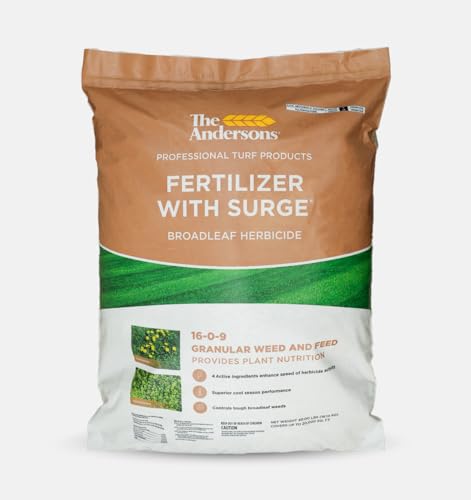
6. The Andersons Professional Surge 16-0-9
The professional-grade four-way formula for lawns that measure in acres, not feet.
This is the heavy lifter of the group. The Andersons Professional Surge is a 40-pound bag covering up to 16,000 square feet — the largest footprint on this list, and 16,000 sq ft compared to the 5,000 sq ft standard bags. The four-way herbicide eliminates over 250 common weeds including dandelions, clover, chickweed, and plantain, with small particles engineered for more coverage per square inch and superior performance across the whole growing season, even in the cooler temps of spring and fall.
Buyers who switched from Scotts report being “super happy” with how fast it killed weeds, and one specifically noted it wiped out creeping charlie — a notoriously tough ground cover that many products miss. The timing lesson from experienced users: put down a pre-emergent early, then follow with this Surge formula for the best one-two punch.
The honest caveat is in the mixed value feedback — some buyers found no noticeable difference from cheaper brands and wouldn’t spend the extra money again. It’s also not for use on Floratam St. Augustine grass, dichondra, carpetgrass, creeping bentgrass, or turf containing desirable clovers, and it’s not sold in NH or WA. If you have a very large lawn and want pro-grade results, this is the right tool — but for a small yard, the coverage is overkill.
The acre-yard answer: 16,000 sq ft of coverage and creeping charlie control make this the choice for big properties.
The value question: some buyers see equal results from cheaper brands, so weigh the premium carefully.
7. Jonathan Green Green-Up Weed & Feed 21-0-3

The fine-particle feed that kills 250+ weeds to the root while grass thrives.
Jonathan Green earns its reputation with this 21-0-3 formula that promotes lush green growth while the weed killer works down to the root. The fine particle size is the standout feature — it feeds desirable grass longer while weeds gradually disappear, which is a smarter approach than a harsh one-time hit. The label claims control over 250+ broadleaf weeds including dandelions, chickweed, clover, wild onions, thistle, and even poison ivy.
With 15,000 square feet of coverage, this pairs with the same massive footprint as the Jonathan Green crabgrass preventer above. Buyers who’ve tried big-box store brands say nothing compares to Jonathan Green products, with one noting their yard “looked the best on my street.” The feeding action is genuinely impressive — lawns get visibly greener and thicker.
But there’s a real split in the feedback. The recurring disappointment: some buyers saw the grass green up beautifully while the weeds greened up right alongside it — the product didn’t kill the weeds as claimed. One frustrated user even applied a heavier dose with no better results. The bag also ran smaller than expected and arrived with clumps that were hard to break down. For those who hit the right timing — when weeds are actively growing — it shines. Miss the window and you may be disappointed.
The feeder’s choice: superb grass nutrition and coverage, with a root-level weed killer that works best on actively growing weeds.
The timing risk: apply when weeds are actively growing or you may see grass green up without the weed control you wanted.
Understanding the Specs
NPK Ratio — What Those Numbers Mean
The three numbers on the bag stand for Nitrogen, Phosphorus, and Potassium — the primary nutrients grass needs. The first number (Nitrogen) drives green growth and is the most important in spring. A 24-0-16 formula, for example, delivers heavy nitrogen for fast greening plus potassium for root strength. The zero in the middle tells you there’s no phosphorus, which many states now restrict in lawn fertilizers. Higher nitrogen numbers like 21-0-3 or 20-0-3 mean more aggressive grass feeding per pound.
Pre-Emergent vs. Post-Emergent Herbicide
Pre-emergent herbicides create a chemical barrier in the soil that stops weed seeds from germinating — they must be applied before weeds sprout, which is why spring timing is critical for crabgrass control. Post-emergent herbicides kill weeds that are already growing and visible above ground. Some products, like the Fertilome St. Augustine formula, combine both in one bag so they prevent new weeds while killing existing ones — the easiest option for spring application.
FAQ
When should I apply spring weed and feed to my lawn?
Can I use any weed and feed on a St. Augustine lawn?
Will weed and feed kill crabgrass?
How long after applying weed and feed can pets go on the lawn?
Can I overseed and apply weed and feed at the same time?
What is the difference between granular and liquid weed and feed?
How much weed and feed do I need for my lawn size?
Why do some weed and feed products have a zero in the middle of the NPK?
Final Thoughts: The Verdict
For most homeowners, the spring weed and feed winner is the Scotts Turf Builder Weed & Feed3 because it combines trusted weed-killing power with the grass-feeding action that leaves lawns thick and green. If you have a southern St. Augustine lawn, grab the Fertilome 15-0-4 instead — it’s the specialist formula your grass type demands. And for large properties battling crabgrass, the Jonathan Green Crabgrass Preventer with its 15,000 sq ft coverage is the one to reach for.
How We Picked
We do not accept paid placement. Every pick is matched to a real buyer and a real use-case; we do not hands-on test units.
Sources & Methodology
Specifications: manufacturer listings and product documentation. Review insights: verified customer reviews, as of August 2026. Pricing: not shown on this page (it changes often); check the current price via the retailer link.
As an Amazon Associate, Lawn Gear Lab earns from qualifying purchases. This does not affect which products we feature.