
Specs are compiled from manufacturer listings and verified buyer reviews and can change over time — please confirm the key details on the product page before buying.
Autumn is the one season where the right fertilizer does the heavy lifting for next spring — the grass is storing energy in its roots instead of pushing new blades. The best fall feeds shift the nutrient mix toward potassium (the last number on the bag) to harden your lawn against winter stress, while keeping nitrogen moderate so you don’t force vulnerable top growth before frost. This guide sorts through the winterizers, the slow-release blends, and the specialty warm-season formulas so you can pick the bag that matches your grass type and your calendar.
I’m Rikta — the founder and writer behind Lawn Gear Lab. This guide is built by comparing the manufacturers’ published specifications and the patterns across verified customer reviews, so you get each pick’s real strengths and trade-offs instead of marketing spin.
You will learn which N-P-K ratios actually matter for autumn, how much ground each bag realistically covers, and where the honest trade-offs are hiding. The crowd favorite here — the Scotts WinterGuard — holds a 4.6-star score from tens of thousands of owners, which makes it the safest starting point for most lawns.
Our Picks at a Glance


How To Choose The Best Fertilizer For Grass In Autumn
Fall feeding is about preparation, not instant beauty. You want the grass to bank carbohydrates in its roots so it survives the freeze and explodes green in spring. That changes which nutrients you prioritize compared to a summer bag.
Read the N-P-K numbers backwards
The three numbers on the bag are nitrogen, phosphate (phosphorus), and potash (potassium). In autumn, the last number — potassium — is the workhorse. It strengthens cell walls and boosts cold tolerance. The middle number should be zero or very low for most established lawns, since phosphorus already sits in most soils and can wash into waterways.
Slow-release nitrogen is the safety net
A quick burst of nitrogen in fall pushes soft, fast top growth that frost will kill and that invites snow mold. Slow-release nitrogen feeds steadily over weeks, which is exactly what you want as the soil cools. Look for “controlled release” or “slow release” on the label, and note the feeding window — some bags promise 8, 12, or 16 weeks of continuous nutrition.
Match the bag to your grass type and lot size
Warm-season grasses like centipede and St. Augustine have different autumn needs than cool-season fescue or bluegrass — the right ratio differs. Coverage also varies wildly, from 4,000 sq. ft. on a 10-pound Scotts bag up to 15,000 sq. ft. on the big 45-pound bags, so measure your lawn before you buy to avoid either underfeeding or buying a bag that rots in your garage.
Quick Comparison
| Model | Best For | N-P-K Ratio | Coverage | Feed Duration | Amazon |
|---|---|---|---|---|---|
| Scotts WinterGuard★ Best Overall | All grass types | — | 4,000 sq. ft. | — | Amazon |
| GreenView Fairway FormulaTop Performer | Winter hardiness | 30-0-12 | 7,500 sq. ft. | Up to 12 weeks | Amazon |
| Green Thumb Winterizer | Deep root building | 32-0-10 | 5,000 sq. ft. | Up to 16 weeks | Amazon |
| Fertilome Centipede | Warm-season grasses | 15-0-15 | 5,000 sq. ft. | Slow-release | Amazon |
| The Andersons Fall Food | Balanced fall program | 24-0-14 | 5,000 sq. ft. | Multi-release | Amazon |
| GreenView Fall Lawn Food | Large lawns | 22-0-10 | 15,000 sq. ft. | Up to 8 weeks | Amazon |
| Jonathan Green Winter Survival | High potassium | 10-0-20 | 15,000 sq. ft. | Slow-release | Amazon |
In-Depth Reviews
1. Scotts Turf Builder WinterGuard Fall Lawn Food
Our pick — over 4.5★ from 13,500+ verified ratings; the strongest balance of quality and price.
The proven crowd-pleaser that rebuilds roots before the freeze
Scotts WinterGuard is the bag most first-time fall feeders start with, and for good reason — it does the essential autumn job of building strong, deep grass roots so next spring’s lawn comes back thicker. The 10-pound bag covers 4,000 sq. ft., which makes it the smallest footprint in this lineup — you will want a second bag if your lawn runs much past a quarter-acre.
The label targets recovery from summer heat, drought, and foot traffic damage, and it works on any grass type, so you do not need to know your turf species before buying. One owner who spread it on a freshly grown lawn that only gets a few hours of sun a day found it stabilized the grass through the cold months.
Buyers report that after one fall application, their lawn returned in spring “looking healthier and greener than ever before.” Reviewers consistently note grass greening within two weeks and staying green through winter. But the Scotts covers 4,000 sq. ft. versus the Green Thumb’s 5,000 sq. ft. — so measure your yard first.
Why it wins
- Works on every grass type — zero guesswork
- Proven spring recovery from summer damage
- Apply to wet or dry lawn, no special steps
Know before you buy
- Smallest coverage in this list at 4,000 sq. ft.
- No stated feeding window on the label
Start here if: you want the safest, most-tested winter feed for any grass type with zero ratio math.
Think twice if: your lawn is bigger than 4,000 sq. ft. — you will be buying multiple bags.
2. GreenView Fairway Formula Fall Lawn Fertilizer
The premium winterizer with a 59% slow-release nitrogen shield
GreenView Fairway Formula is the pick for owners who treat their lawn like a fairway and want winter protection plus a fast spring comeback. The 30-0-12 ratio delivers a hefty nitrogen punch for recovery, while a proprietary 59% slow-release nitrogen blend keeps feeding steady for up to 12 weeks — so you are not tempting frost-killed top growth with a quick spike.
The 22.5-pound bag covers 7,500 sq. ft., compared to the Scotts’ 4,000 sq. ft. footprint from a single bag. The zero-phosphate formula is aimed at protecting waterways, which matters if you live near a lake or stream — one less nutrient running off your yard in autumn rains.
Buyers who switched after decades on other brands report a deep green lawn within two weeks of a mid-October application, holding color through winter into late spring even in cold, snowy climates. The most-discussed traits are quality and effectiveness, and people note the moisture-proof packaging keeps granules from clumping in the spreader — a small thing that saves real frustration. One owner who used it three consecutive falls kept repurchasing, calling the steady lawn-health gains worth the higher price.
Standout strengths
- 59% slow-release nitrogen feeds up to 12 weeks
- Zero phosphate protects nearby waterways
- Moisture-proof bag prevents spreader clumps
Fair trade-offs
- Sits at the premium end of the price range
- Heavy nitrogen may be overkill for low-maintenance yards
Reach for this if: you want maximum winter hardiness and a fast spring green from one premium application.
Look elsewhere if: you want minimal input — this bag wants a real spreader and a real feeding plan.
3. Jonathan Green Winter Survival Fall Lawn Food

The potassium king that pushes deep roots and early spring green
Jonathan Green Winter Survival flips the fall formula on its head with a 10-0-20 analysis — the highest potassium-to-nitrogen ratio in this entire list, at 20% potash against just 10% nitrogen. That heavy potassium is exactly what drives deep rooting and nutrient storage for spring, while the moderate nitrogen keeps grass greener later into the year without forcing risky winter growth.
The 45-pound bag covers up to 15,000 sq. ft., tying the GreenView Fall Lawn Food for the largest footprint here, so it is the obvious choice for acreage or big corner lots. The brand also sells it as a booster for newly seeded lawns, meaning it can pull double duty if you are overseeding this fall.
Buyers who spread it in early November in the Northeast saw their treated front lawn look significantly healthier than the untreated backyard by mid-December. The growth results are mixed — one owner noted newer grass died off anyway — so do not expect this bag to rescue a failing overseed. What it reliably does, owners say, is turn established grass “super green” and hold that color late into the season.
The potassium play: this 20% potash (a nutrient that strengthens roots against cold) is the highest in this guide, so your grass survives winter better and greens up earlier in spring.
The reality check: if you are seeding new grass this fall, manage expectations — this feeds established turf best.
4. GreenView Fall Lawn Food 48 lb Bag

The big-bag bargain that feeds a full acre-sized lot
GreenView Fall Lawn Food is the cost-per-square-foot champion of this guide, throwing a 48-pound bag that covers 15,000 sq. ft. — the joint-largest coverage here at a lower price than the Jonathan Green. The 22-0-10 NPK formula keeps the middle number at zero, and the GreenSmart enhanced-efficiency design feeds continuously for up to 8 weeks.
This one is pitched at restoring nutrients lost during summer and building a deeper root system to carry the lawn through winter, with a faster spring green-up as the payoff. It also improves water and nutrient absorption, which pays off if your soil runs sandy or compacted.
Owners consistently rate the quality and effectiveness highly, and the most-praised theme is healthy grass — the kind of deep, vibrant green that makes neighbors ask what you switched to. One buyer using it as a winterizer noted it feeds all winter long and expects a fast spring green. The honest catch from a minority: some saw “no real difference” versus other brands, so if your lawn is already healthy, the visible payoff may be subtle.
The value call: 15,000 sq. ft. of feeding from one bag at a mid-range price is the best square-footage deal in this lineup.
The honest note: a healthy lawn may not show dramatic results — this is maintenance, not a rescue.
5. The Andersons Premium Fall Lawn Food 24-0-14
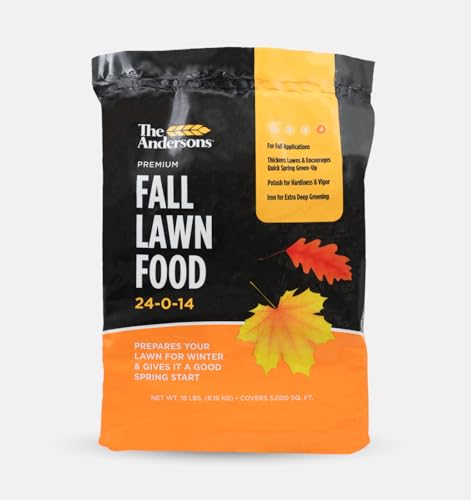
The three-stage nitrogen feed that greens up in days
The Andersons Premium Fall Lawn Food uses a blend of quick-, intermediate-, and slow-release nitrogen, which means you get a visible green-up fast while the slower fractions keep feeding through the cooling season. The 18-pound bag covers 5,000 sq. ft. — compared to the Scotts’ 4,000 sq. ft., and at 18 pounds versus the Green Thumb’s 12.6 pounds — which tells you the granules carry more actual nutrient density.
The 24-0-14 ratio keeps phosphate at zero and adds iron for deep, dark greening that owners notice within days. This is Application 4 of The Andersons’ own lawn program, so if you already follow their seasonal calendar, this slots in as the winter-prep step.
Buyers in a Texas drought watched the grass “pop” to a deep dark green with new sprouts once rain finally arrived, and more than one owner calls it the best fertilizer they have ever used. The most-praised theme is effectiveness, with a fast green-up in as little as three days cited repeatedly. One word of caution from the data: it is safe for all turf types, but owners with mixed warm-and-cool season lawns note the cold-weather grass responds most visibly before spring fully assesses the zoysia.
The winning mix
- Triple-release nitrogen: fast green plus extended feeding
- Iron added for deep, dark color
- Zero phosphate, safe for all turf types
Weigh this
- Mid-premium price for a 5,000 sq. ft. bag
- Warm-season grass payoff may wait until spring
Choose this if: you want visible green-up now plus slow-release staying power, all in one application.
skip it if: you only need basic winter prep and do not care about fast cosmetic greening.
6. Green Thumb GT58105 Winterizer Lawn Fertilizer
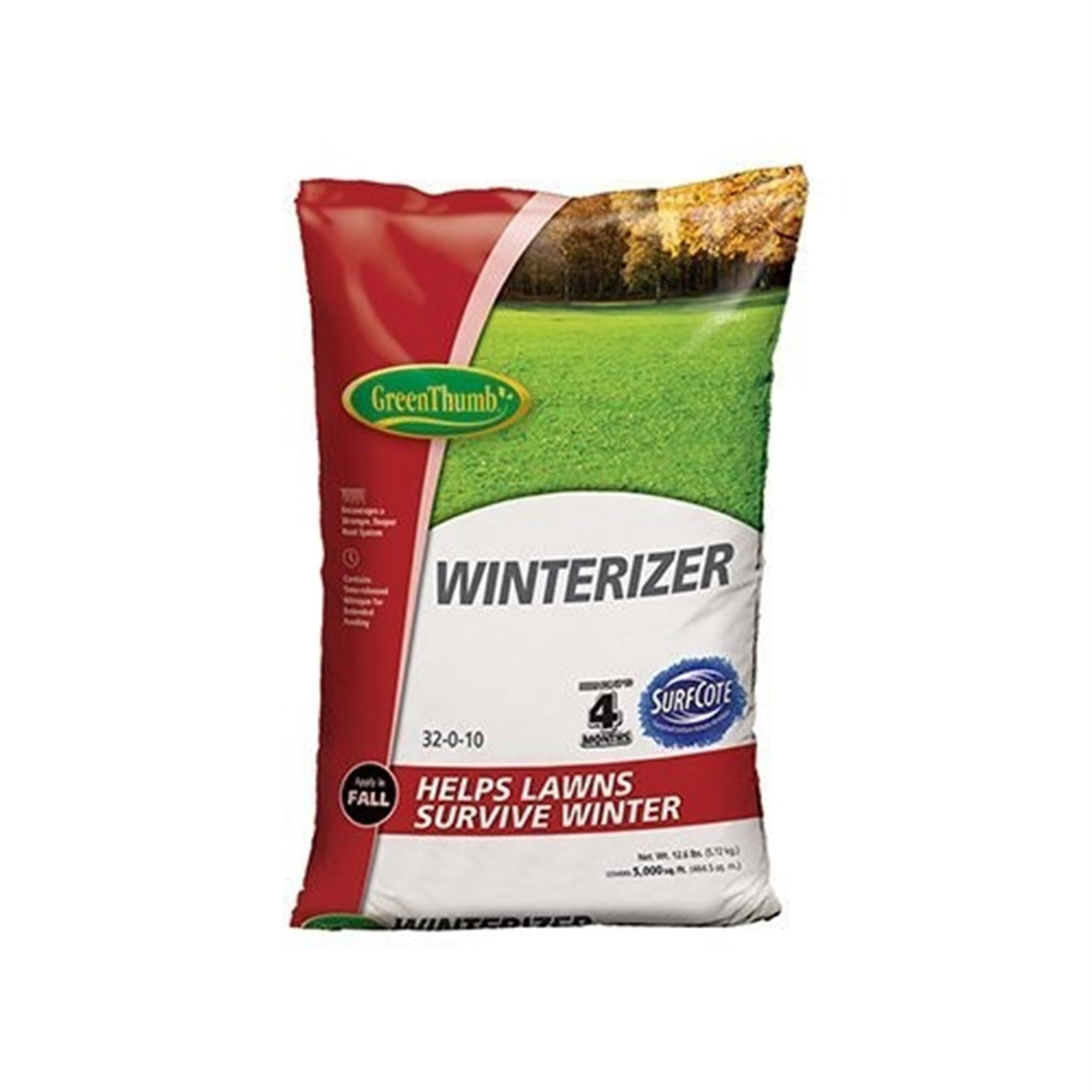
The longest-feeding winterizer at the friendliest price
Green Thumb Winterizer feeds your lawn for up to 16 weeks from one application, while the GreenView Fall Lawn Food feeds for up to 8 weeks. Its 32-0-10 formula (32% nitrogen, 0% phosphate, 10% potash) leads this guide in nitrogen for strong root growth, and 50% of that nitrogen is controlled-release, so the feeding stays steady instead of spiking.
It also packs 2% iron for that deep green tint, and the “winterizer” positioning focuses on helping lawns survive winter stress.
Owners who followed a disciplined fall plan — applying around October 1, watering lightly for four weeks, then irrigating monthly through a dry winter — saw strong results by April. The spring green-up is the recurring payoff, with one buyer who applied in late November reporting the lawn greened “just as promised.” This one gives you 5,000 sq. ft. of coverage versus the Scotts’ 4,000 sq. ft., for a comparable outlay, which makes it the smarter buy if your yard is on the larger side.
Why it stands out
- Up to 16 weeks of continuous feeding — longest here
- 50% controlled-release nitrogen prevents spikes
- 2% iron for deep greening
Watch this
- Powder form can be messier to spread than granules
- Results genuinely depend on fall watering discipline
Grab this if: you want the longest feeding window and the best coverage-per-dollar in the value tier.
Pass if: you cannot commit to fall watering — the slow-release design leans on moisture to activate.
7. Fertilome Centipede Lawn Fertilizer 15-0-15
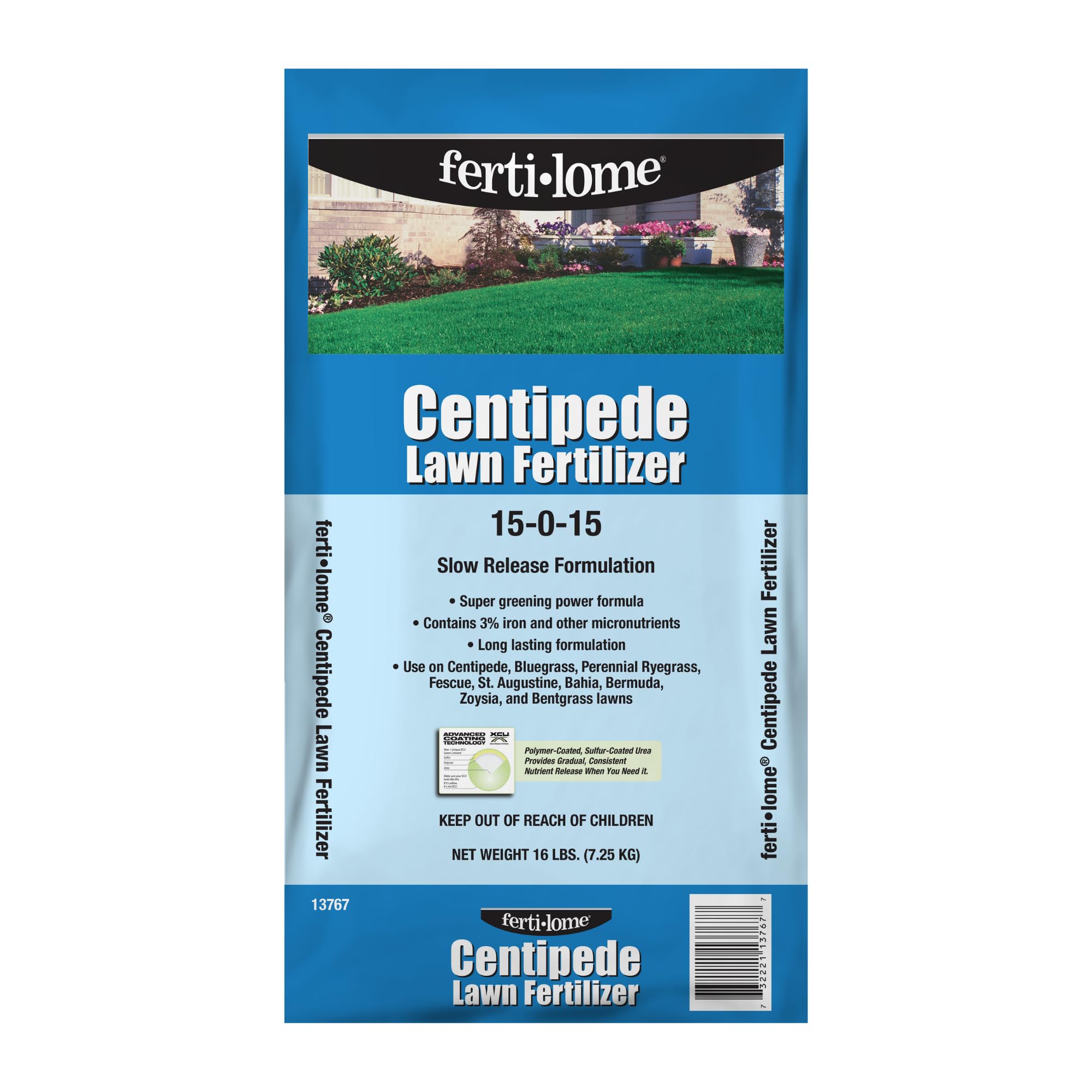
The warm-season specialist that greens centipede without burning it
Fertilome’s 15-0-15 is the outlier here because it is built for warm-season grasses — centipede, St. Augustine, bahia, bermuda, and zoysia — which have different autumn habits than cool-season fescue. The balanced 15% nitrogen and 15% soluble potash, plus high iron, targets yellow foliage and delivers the fast, super-green color centipede owners chase.
The slow-release nitrogen cuts the risk of nitrogen burn, which is the classic beginner mistake on sensitive warm-season turf. The 16-pound bag covers up to 5,000 sq. ft., and the label calls for a 4 lbs. per 1,000 sq. ft. application rate in early spring and early fall — so this is your autumn pass if you run a southern lawn.
Buyers using it with new grass plugs report not losing a single plug while the surrounding grass turned a visibly deeper green than the rest of the block. What wins people over is the germination response — it is the most-praised aspect by a wide margin, with strong value-for-money feedback second. The recurring theme is a thick, fast-growing lawn, so be ready to mow more often after application.
Who this serves: southern homeowners with centipede, St. Augustine, or other warm-season turf who want a safe, iron-rich fall feed.
Who should pass: cool-season northern lawns — they need a different potassium-heavy winterizer instead.
Understanding the Specs
N-P-K ratio
The three numbers on the bag stand for nitrogen, phosphate (phosphorus), and potash (potassium). In autumn, you want the last number high — it builds cold tolerance — and the middle number low, often zero. A 10-0-20 like the Jonathan Green is the classic winterizer shape, while a 32-0-10 like the Green Thumb pushes more recovery nitrogen.
Slow-release nitrogen
Nitrogen that releases gradually over weeks prevents a soft, frost-vulnerable growth spurt. Look for “controlled release,” “slow release,” or a stated feeding window like 8, 12, or 16 weeks. The GreenView Fairway Formula’s 59% slow-release blend is a standout example of steady feeding.
Coverage in square feet
The bag’s coverage number tells you how much lawn it will feed at the labeled rate. Small bags like the Scotts cover 4,000 sq. ft., while the big 45-48 pound bags stretch to 15,000 sq. ft. Measure your lawn before buying so you neither underfeed nor overbuy.
Iron content
Iron is a color booster, not a food — it deepens the green without pushing growth. The Green Thumb carries 2% iron, and Fertilome’s high-iron formula targets yellow foliage on warm-season grasses. If your grass looks pale but healthy, iron is often the missing piece.
FAQ
When exactly should I apply fall fertilizer?
What is the difference between a winterizer and regular lawn food?
Is a high nitrogen number bad for fall feeding?
Should I use a zero-phosphate fertilizer in autumn?
Can I use a warm-season grass fertilizer on my cool-season lawn?
How much fertilizer do I need for my lawn?
Will fall fertilizer help my grass survive a snowy winter?
Can I apply fall fertilizer and overseed at the same time?
Why does my lawn look green but not thick after fall feeding?
Is a cheaper winterizer just as good as a premium one?
Final Thoughts: The Verdict
For most yards, the fertilizer for grass in autumn winner is the Scotts Turf Builder WinterGuard because it works on every grass type with zero ratio guesswork and a proven spring payoff. If you want the longest feeding window and the best coverage per dollar, grab the Green Thumb Winterizer. And for a large lawn or a warm-season southern yard, the GreenView Fall Lawn Food and the Fertilome Centipede formula are the ones to reach for — one for sheer square footage, the other for the right nutrient match.
How We Picked
We do not accept paid placement. Every pick is matched to a real buyer and a real use-case; we do not hands-on test units.
Sources & Methodology
Specifications: manufacturer listings and product documentation. Review insights: verified customer reviews, as of August 2026. Pricing: not shown on this page (it changes often); check the current price via the retailer link.
As an Amazon Associate, Lawn Gear Lab earns from qualifying purchases. This does not affect which products we feature.