
Specs are compiled from manufacturer listings and verified buyer reviews and can change over time — please confirm the key details on the product page before buying.
A handheld tree pruner lives or dies on two things: how cleanly it slices through live wood, and whether it still works next spring. The right one slices through a branch in one smooth squeeze, no sawing or wrestling.
I’m Rikta — the founder and writer behind Lawn Gear Lab. This guide is built by comparing the manufacturers’ published specifications and the patterns across verified customer reviews, so you get each pick’s real strengths and trade-offs instead of marketing spin.
Whether you are shaping fruit trees, clearing brush, or deadheading perennials, the best handheld tree pruner boils down to your grip, the branch thickness you face most often, and how much weight you want to carry around the yard all afternoon.
Our Picks at a Glance

How To Choose The Best Handheld Tree Pruner
A pruner that fits your hand and your trees turns a dreaded chore into a satisfying task. Here is what matters most.
Bypass vs. Anvil Blades
Bypass blades work like scissors — the upper blade slides past the lower one for a clean, precise cut. This is the style for live, green branches because it does not crush the stem. Anvil blades smash the branch against a flat edge, which can damage living wood. Nearly every pick in this guide uses a bypass design.
Blade Length and Steel Quality
A longer blade, like the 14-inch or 16-inch saw blades on the pruning saws here, lets you get through thicker limbs in fewer strokes. But for a handheld pruner you use every day, a 2-inch to 3-inch blade is usually plenty, especially if it is made from high-carbon steel or Japanese steel that stays sharp longer.
Handle Material and Weight
Aluminum handles keep the tool light — under 10 ounces for most bypass pruners — which matters when you are working through a whole hedge or orchard. Plastic handles lower the cost but can flex under heavy use. A non-slip grip is essential when your hands are damp or sweaty.
Cutting Capacity
Check the maximum branch diameter the manufacturer states. A 1-inch capacity covers most shrub and small-tree work. If you regularly cut 2-inch or thicker limbs, you will need a pruning saw rather than a bypass pruner. Exceeding the rated capacity bends the blade or leaves a ragged cut.
Quick Comparison
| Model | Best For | Blade Length | Cutting Capacity | Weight | Amazon |
|---|---|---|---|---|---|
| Corona BP 4250★ Best Overall | High-volume daily pruning | — | 1 inch | 9.6 oz | Amazon |
| Haus & Garten EnduroPROPremium Pick | Long-term durability with titanium coating | 2.06 inches | 1 inch | 8.8 oz | Amazon |
| EXTEND-A-REACH Hand Saw | Thick limbs with optional pole attachment | 14 inches | 4–5 inches | — | Amazon |
| TelesPro Handheld Saw | Multi-purpose yard work and camping | 16 inches | 5 inches | — | Amazon |
| SUIZAN Bypass Shears | Precision cuts on flowers and small branches | 2.76 inches | 15 mm | 7.36 oz | Amazon |
| Prunrt 4-Foot Pole Pruner | Extended reach without a ladder | 2 inches | 0.25 inches | 16 oz | Amazon |
In‑Depth Reviews
1. Corona Tools BP 4250 MAXFORGED Aluminum Bypass Pruner
Our pick — over 4.5★ from 350+ verified ratings; the strongest balance of quality and price.
A forged steel blade and a lightweight 9.6-ounce build make this the pick for daily heavy pruning without arm fatigue.
The Corona BP 4250 keeps going through heavy weekly use on trails and dense woods, according to the customer consensus. This is because the forged steel blade (made from alloy and carbon steel) slices through live branches up to 1 inch thick with a clean bypass cut (like scissors), so the wound heals fast. The lightweight aluminum handles keep the whole tool at just 9.6 ounces, so your hand does not tire halfway through a hedge. At that weight, it is over 9% lighter than some steel alternatives — a difference you will feel after the hundredth snip.
Quality is what owners praise most — 26 people call it out specifically, and sharpness follows close behind at 18 mentions. “The size allows me to use them more instead of having to grab the loppers,” notes a long-time gardener. The non-slip red grips stay secure even in damp conditions, and the built-in safety lock (a switch that snaps the blade shut) keeps the blade closed when you toss it in a tool bag. The honest catch is the locking mechanism: after heavy weekly use, some owners find the lock slips unless you press it firmly closed. “The lock is a little finicky so you have to make sure you lock them hard,” one trail-clearing owner reports. For most people, that is a minor inconvenience on a tool that otherwise delivers professional-grade performance at a very fair price. The replacement blade costs about three-fifths of the pruner’s price, which makes long-term ownership a consideration — but for regular trimming of 1-inch branches, you may not need a new blade for years. The Haus & Garten EnduroPRO has a more sturdy latch system if the lock slips are a dealbreaker for you.
What Wins People Over
- Forged steel blade stays sharp through heavy weekly use on dirt bike trails and dense woods
- Lightweight aluminum body at 9.6 oz reduces hand strain during extended pruning
- Ergonomic non-slip grips provide secure hold in damp conditions
The Recurring Caveat
- Locking mechanism can slip if not engaged firmly; requires a deliberate press
- Replacement blade costs about three-fifths of the pruner’s price, making long-term ownership a consideration
Reach for this if: you want a proven, sharp, lightweight pruner that handles 1-inch branches day in and day out while staying affordable.
Think twice if: you need a rock-solid lock that never slips — you may want to check the Haus & Garten below for its more sturdy latch system.
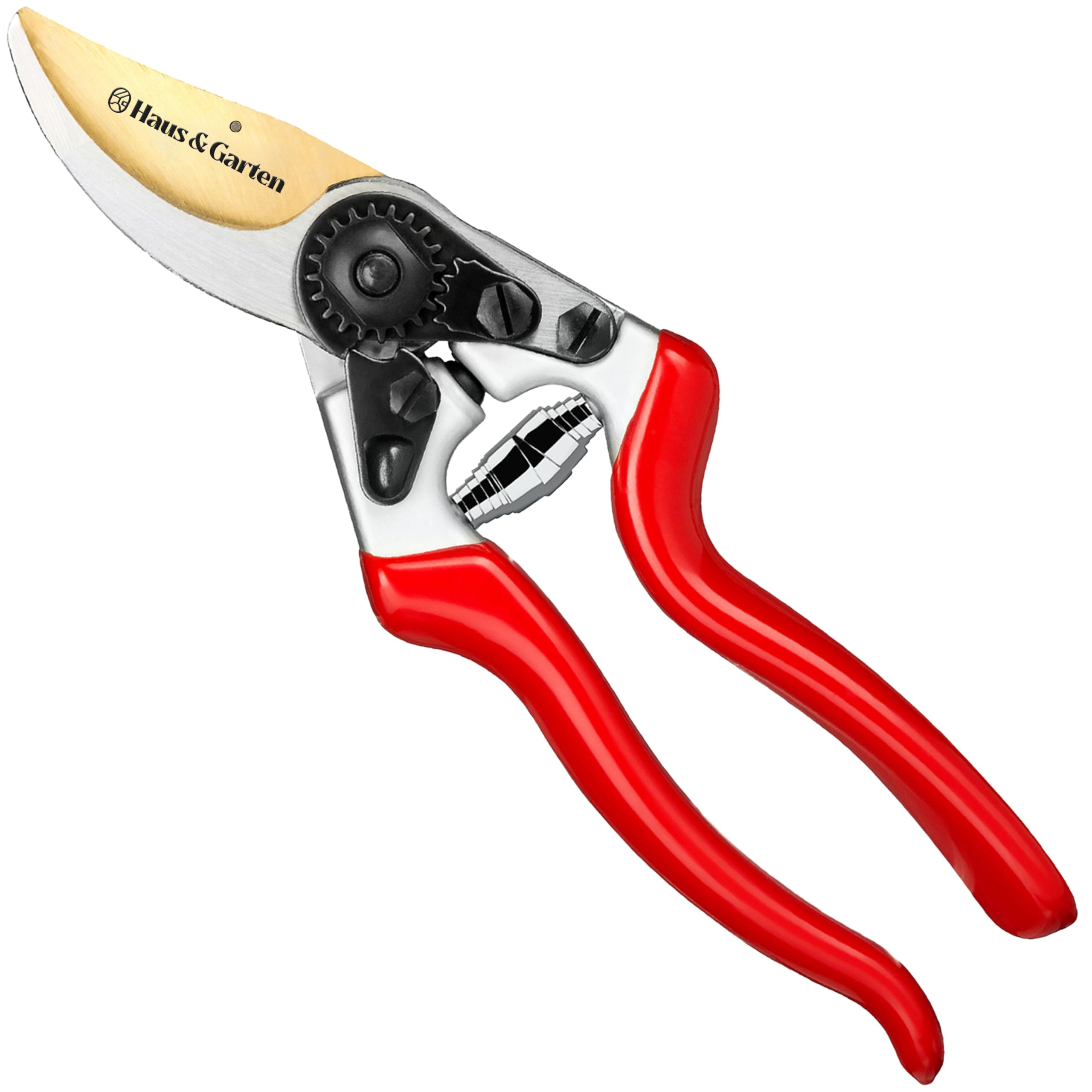
2. Haus & Garten EnduroPRO Ergonomic Bypass Pruners
A titanium coating (a thin layer that reduces friction and blocks rust) on Japanese high-carbon steel makes this a true buy-it-for-life pruner.
This is the pruner that the review pages sum up as “the best pruners that I have ever owned.” The blade is Japanese-grade high-carbon steel with a titanium coating, which reduces friction so the blade glides through wood and resists rust. At a blade length of 2.06 inches, it is built for precision — slicing cleanly through branches up to 1 inch thick without the drag you get on uncoated steel. The heavy-duty anodized aluminum body (a surface treatment that hardens the metal) and drop-forged handles (hammered into shape while hot for strength) mean this tool is designed to hold up to countless seasons, and the curved ergonomic design aligns your wrist properly to cut down hand strain. It is noticeably more refined than the Corona’s locking system, with a sturdier latch that buyers do not report slipping.
Quality is the most-discussed aspect — 142 owners single it out — and functionality and sharpness each draw well over 80 mentions. “They cut sharp and clean, are adjustable and have replacement parts available,” one regular user notes. At 8.8 ounces, it is about 9% lighter than the Corona pruner, which makes it a touch more nimble for precision work like trimming roses and small fruit trees. The only persistent feedback is that the grip could be larger for people with arthritic hands; one owner specifically wished for “larger handle so the grip is easier for arthritic hands.” That is a relatively narrow fit issue rather than a design flaw, but note if your hands are on the larger side or you have joint stiffness. The premium price sits above budget options, though owners overwhelmingly find it worth it for the Japanese steel and titanium coating.
What Owners Rave About
- Titanium-coated Japanese steel blade stays sharp and resists rust season after season
- Ergonomic handle reduces wrist fatigue by aligning the hand naturally during cuts
- Heavy-duty anodized aluminum body and drop-forged construction are built to last
The Fit Note
- Handle grip may be too narrow for some larger hands or those with arthritis
- Premium price sits above budget options, though owners overwhelmingly find it worth it
Best for: the gardener who wants one pruner that will outlast cheap replacements and cuts cleaner every time — a true buy-it-for-life tool.
Look elsewhere if: you have large hands or arthritis and need a thicker, padded handle — the Corona is a safer fit.
3. EXTEND-A-REACH Pruning Manual Hand Saw
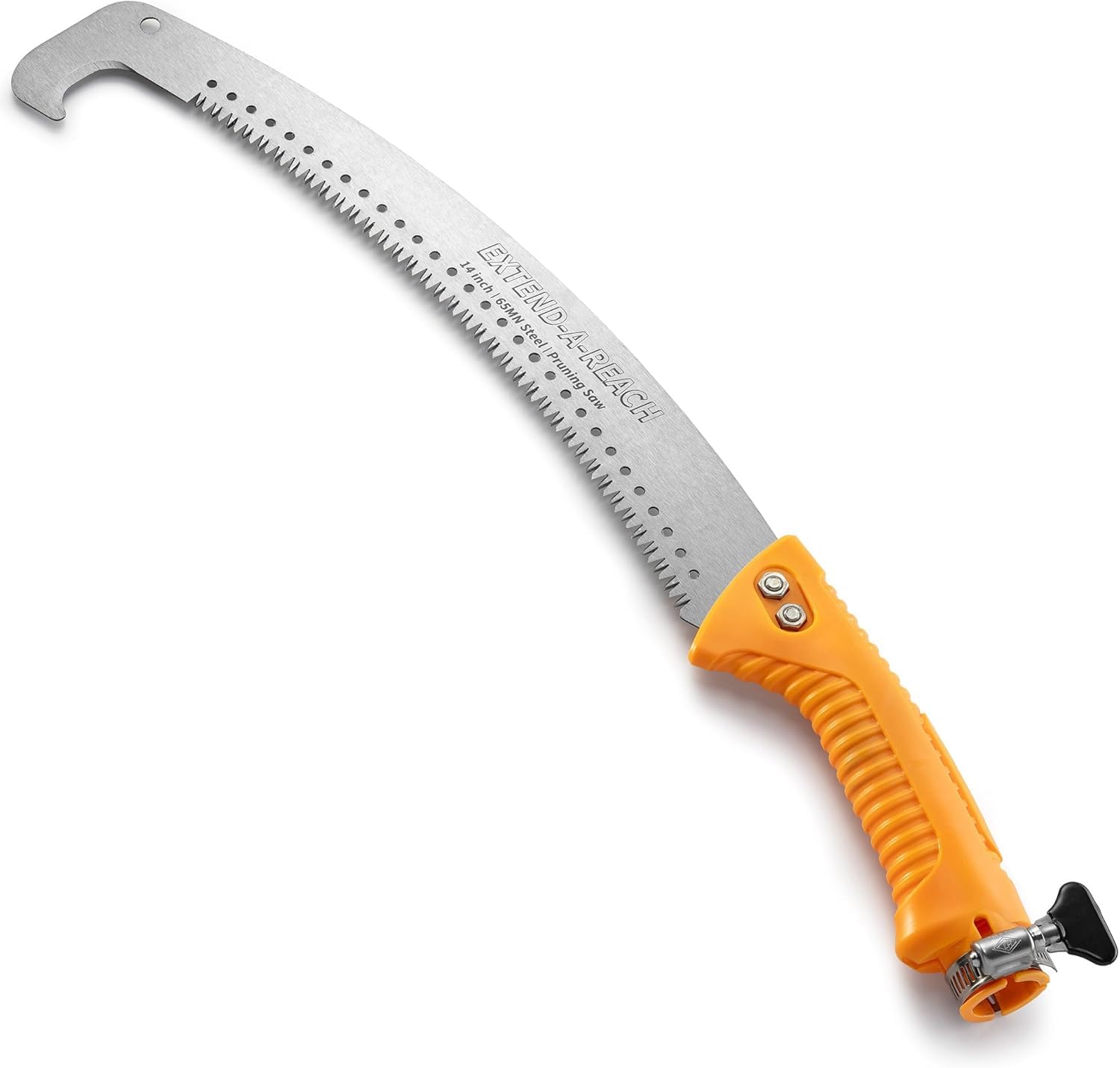
A 14-inch curved carbon steel blade that chews through 5-inch limbs and screws onto a standard pole for high branches — no ladder required.
This is not your average bypass pruner — it is a manual pruning saw with a 14-inch curved carbon steel blade that chews through limbs up to 4–5 inches in diameter. Owners confirm that the blade is “very sharp and cuts 4-5″ maple branches easily,” which puts it in a completely different class from the shears above. The saw attaches to any standard US Acme threaded extension pole (sold separately), so you can switch from handheld trimming to reaching 20-foot limbs without climbing a ladder. The curved blade design lets you cut on the pull stroke, which gives you more control and power with less effort. This saw shines where the Corona and Haus & Garten simply cannot go — it tackles limbs far too thick for any bypass pruner.
Effectiveness and quality are the most-mentioned aspects, each with 62 mentions. Sharpness follows at 54 mentions. The saw comes with an extended 3-year warranty, and the company donates a portion of profits to cleaning cancer patients’ homes — a detail note if corporate values influence your purchase. The honest trade-off is durability: 54 owners mention it with mixed feedback, and some report the saw wobbling when used with the thinnest pole extension. “Avoid using the thinnest pole extension to reduce wobble,” one experienced buyer advises. For handheld use it is solid, but if you plan to use it exclusively as a pole saw, be selective about the pole you pair it with — a sturdy one reduces wobble.
The real appeal: a sharp, aggressive 14-inch blade that tackles limbs far too thick for any bypass pruner, with the option to go pole-mounted when needed.
The honest limit: durability is mixed — the blade is excellent, but the pole system has some wobble at full extension; pick a sturdy pole.
Reach for this if: you need a single saw that does double duty — handheld for fallen branches and pole-mounted for high limbs — and you already own or plan to buy a standard Acme-thread extension pole.
skip it if: you only prune small branches under 1 inch; a bypass pruner is faster and more precise for that work.
4. TelesPro Multi-Purpose Handheld Pruning Saw

A 16-inch blade that handles 5-inch branches and costs less than most 14-inch saws — a true budget win.
This saw goes even bigger than the EXTEND-A-REACH, with a 16-inch curved blade made from 65 manganese steel. It handles branches up to 5 inches in diameter, works on both green and dry wood, and even cuts plastic. The 3-sided razor teeth cut on both the push and pull strokes, which speeds up the work. Like the saw above, it is compatible with standard US Acme threaded poles, so you can extend your reach for high branches. The co-molded handle gives a firm, comfortable grip, and the turquoise color makes it easy to spot in a cluttered shed. At this price point, the 16-inch manganese steel blade is a lot of saw for the money — the EXTEND-A-REACH costs more for a 14-inch blade.
Functionality is the most-praised aspect with 39 mentions, and ease of use follows at 28. “Very sharp and efficient tree saw. Good hand grip,” one owner reports. “The threaded end also makes it work on a collapsible pole. Just what I needed.” The saw is lightweight enough to carry camping or hiking, and it handles heavy-duty landscaping work without fuss. The recurring concern is blade flimsiness — 25 owners rate sturdiness as mixed, and some note that the blade requires the correct cutting angle to avoid bending. “Blade flimsy, requires proper cutting angle to avoid bending,” one experienced user cautions. For occasional weekend use it is a superb value, but for daily professional abuse you may want the stronger build history of the EXTEND-A-REACH.
Where it shines: at this price point, a 16-inch manganese steel blade that cuts up to 5-inch limbs and works with standard extension poles is tough to top for the weekend warrior.
The fine print: the blade can bend if you force it at the wrong angle; treat it with care and it will serve you well for moderate jobs.
Best for: the budget-conscious homeowner who needs a long blade for thick branches but does not prune every day.
Think twice if: you are a professional landscaper who needs a saw that can survive daily abuse — the EXTEND-A-REACH has a stronger build history.
5. SUIZAN Bypass Pruning Shears 8″

Japanese steel forged in a town with over 250 years of blade-making history gives you crisp, accurate cuts in a 7.36-ounce package.
These 8-inch shears come from a town in Japan with over 250 years of blade-making history, and that heritage shows in how they cut. The blade is Japanese steel with a bypass design that makes clean, precise cuts through live branches up to 15 mm (about 5/8 inch). At just 7.36 ounces, it is the lightest pruner in this lineup — noticeably lighter than the 9.6-ounce Corona — which makes a real difference during a full afternoon of deadheading roses or harvesting vegetables. “Excellent for harvesting beans without plant damage,” one owner notes. The compact size fits small hands well and is ideal for bonsai, flowering plants, and fruit trees. If you mostly do detail work and rarely see a branch thicker than your thumb, this is a more precise and lighter tool than the Corona.
Quality is the top aspect at 27 mentions, and sharpness follows at 17. “Comfortable, crisp, accurate cuts. Layered carbonized steel stays sharp,” one long-time Japanese pruner user reports. The rubberized handles and steel closure add a professional feel. The mixed feedback centers on durability: some buyers report blade corrosion if not properly cared for, and the 15 mm capacity means it cannot handle branches much thicker than your thumb. “Requires rust prevention and careful handling,” one owner advises. This is a specialist tool for precision cutting, not a heavy-duty branch buster. The Japanese carbon steel needs a light oil coating during storage to prevent rust — something you do not have to worry about with the Haus & Garten’s titanium coating.
What Makes It Special
- Japanese steel from a 250-year-old blade-making tradition delivers crisp, accurate cuts
- Weighs just 7.36 oz — the lightest option here, reducing fatigue in long sessions
- Compact 8-inch size fits smaller hands and is perfect for detailed garden work
What Limits It
- 15 mm (5/8 inch) cutting capacity is too small for thicker branches
- Japanese carbon steel requires rust prevention and careful storage
Reach for this if: you do detailed garden work — deadheading, bonsai, harvesting, flower trimming — and want a precise, light tool that feels like part of your hand.
pass on it if: you regularly cut branches thicker than your thumb; the Corona or Haus & Garten pruners handle 1-inch limbs with ease.
6. Prunrt 4-Foot Pole Pruner

A cut-and-hold mechanism (a teethed jaw that grabs the branch after cutting so nothing falls on you) makes this 4-foot pruner a safe pick for overhead trimming.
This is the only fully self-contained pole pruner in the lineup — a 48-inch aluminum shaft with a bypass blade on one end and a foam grip on the other. The precision-ground high carbon steel blade has a cut-and-hold design: the teethed jaws grab the branch after cutting so it does not drop on your head or into a thorny bush. The handle rotates 90 degrees freely, so you can adjust the cutting angle without moving your body. At 16 ounces, it is heavier than the handheld pruners but still notably lightweight for a 4-foot tool. “Better than expected. Used to trim tall honeysuckle. Light weight but still sturdy,” one owner reports. The cut-and-hold safety is its standout feature — no other pruner in this guide offers it, and it is a real benefit when working over a flower bed or thorny hedge.
Cutting performance is the top aspect at 26 mentions, and quality follows at 18. “The blades got through branches that I never thought it could. Pleasant surprise for a tree trimmer!” another owner writes. The 0.25-inch cutting capacity is very modest, though — this is designed for thin stems, live branches, and deadheading, not thick limbs. Some owners find the leverage lacking: 8 people mention it as a mixed point, noting that thicker growth requires more force than expected. The one-year limited warranty provides some confidence, but the narrow cutting window makes this a tool for light duty only. If you need to cut branches thicker than a pencil, the EXTEND-A-REACH saw offers much more power for high limbs.
Its superpower: the cut-and-hold mechanism safely grabs the pruned branch, so nothing falls on your head or into a thorny thicket — ideal for reaching into dense bushes or while on a ladder.
The honest limit: the 0.25-inch cutting capacity is quite small; this is for thin stems and light trimming, not serious branch work.
Best for: anyone who struggles to bend or kneel and needs to reach ground-level or mid-height branches without a ladder — especially good for deadheading and light trimming.
Think twice if: you need to cut branches thicker than a pencil; consider the EXTEND-A-REACH saw instead for more oomph.
Understanding the Specs
Bypass vs. Anvil Blade
A bypass blade slides past a lower blade like scissors, making a clean cut that heals fast on live wood. Anvil blades crush the branch against a flat edge; they work for dead wood but damage living stems. For tree pruning, bypass is the standard — all the pruners here use it except the manual saws, which cut with a serrated edge instead.
Cutting Capacity
This number tells you the maximum branch diameter the tool can handle. Bypass pruners typically max out at 1 inch. Beyond that, you need a pruning saw with a longer blade (14–16 inches) that can take 4–5 inch limbs. Exceeding the rated capacity risks bending the blade or leaving a ragged cut that invites disease.
Blade Material
High-carbon steel holds an edge longer than standard steel and is easier to resharpen. Japanese steel adds layered forging that keeps the blade sharp through many cuts. Titanium coating reduces friction (the blade glides through wood) and resists rust. For the manual saws, 65 manganese steel offers a good balance of toughness and flexibility.
Weight and Handle Material
Aluminum handles keep pruners under 10 ounces, reducing fatigue. Plastic handles are lighter but flex under heavy pressure. A non-slip grip matters when your hands are damp. For pole pruners, the overall weight jumps to 16 ounces or more, but the extended reach means you are not holding it at arm’s length for long.
Pole Compatibility
Some pruning saws have a threaded base that fits standard US Acme thread extension poles. This turns a hand saw into a pole saw without buying a dedicated long-reach tool. The threads are the same as many paint roller poles, so you may already own a compatible handle. Check the thread type before buying — not all poles use the same standard.
Cut and Hold Mechanism
A few pruners have teethed jaws that grab the branch after cutting it. This prevents the pruned limb from falling to the ground, which is helpful when working over a flower bed, a pond, or a roof. It also lets you safely remove cut branches from thorny bushes without reaching in a second time.
FAQ
Can I use a bypass pruner on dead wood?
How do I clean and maintain my pruner blades?
What is the difference between a bypass pruner and a pruning saw?
How thick of a branch can a handheld tree pruner cut?
Will a pruning saw fit on my existing extension pole?
What does the titanium coating on a pruner blade do?
Is a lightweight pruner always better?
Can left-handed people use these pruners?
How long should a quality pruner last?
What is the cut and hold feature for?
Final Thoughts: The Verdict
If you want one dependable pick, the best handheld tree pruner is the Corona BP 4250 because it combines a forged steel blade, a comfortable sub-10-ounce build, and a proven track record with over 360 ratings. If you want maximum durability and a titanium-coated blade that cuts cleaner each season, grab the Haus & Garten EnduroPRO. And for tackling thick limbs that no bypass pruner can touch, the EXTEND-A-REACH 14-inch saw is the one to reach for — especially if you pair it with a pole to reach those high branches without a ladder.
How We Picked
We do not accept paid placement. Every pick is matched to a real buyer and a real use-case; we do not hands-on test units.
Sources & Methodology
Specifications: manufacturer listings and product documentation. Review insights: verified customer reviews, as of July 2026. Pricing: not shown on this page (it changes often); check the current price via the retailer link.
As an Amazon Associate, Lawn Gear Lab earns from qualifying purchases. This does not affect which products we feature.