
Specs are compiled from manufacturer listings and verified buyer reviews and can change over time — please confirm the key details on the product page before buying.
You spot the first hole in your tomato leaf by lunchtime, and by dinner a handful of fat green caterpillars are stripping the plant bare. That is the moment you stop reading marketing labels and start hunting for something that actually stops the chewing. Spinosad-based insecticides work at a biological level — they are derived from a naturally occurring soil bacterium that targets the nervous system of foliage-feeding insects while being gentler on the beneficial bugs you want to keep around.
I’m Rikta — the founder and writer behind Lawn Gear Lab. This guide is built by comparing the manufacturers’ published specifications and the patterns across verified customer reviews, so you get each pick’s real strengths and trade-offs instead of marketing spin.
Every product on this list uses spinosad as its active ingredient, ranging from ready-to-use sprays for quick rescues to professional concentrates that treat hundreds of gallons of mix — this is your field manual to finding the best insecticide with spinosad for your garden or lawn.
Our Picks at a Glance

How To Choose The Best Insecticide With Spinosad
Buying the wrong spinosad product usually means paying for a bottle that is either too weak to kill the pest on your plant or too strong for the tiny patch you need to treat. Here are the three factors that separate a smart buy from a regret.
1. Concentration — the percentage of spinosad
This is the single most important spec. A ready-to-use spray might contain just 0.005% spinosad, which works fine for light caterpillar pressure on a few tomato plants. A professional concentrate like the Atticus Contraxio SC packs 11.6% spinosad — that is over 2,300 times more active ingredient per ounce. A higher percentage means you mix a smaller amount into your sprayer and get far more total gallons of finished spray from one bottle. If you are treating large areas, heavy infestations, or tough pests like thrips and bagworms, skip the weak stuff and go straight to a concentrate.
2. Formulation — RTU spray vs concentrate vs dust vs granules
Ready-to-use (RTU) sprays come in a trigger bottle and are perfect for small vegetable gardens and spot treatments — you pull the trigger and you are done. Concentrates require you to mix the liquid with water in a sprayer but give you far more coverage per dollar. Dusts, like the Bonide Captain Jack’s Deadbug Brew dust, let you puff the powder directly onto foliage and crawl spaces, which is useful for tight spots like cabbage heads. Granules are scattered on the soil surface and are designed for crawling pests like slugs, earwigs, and pillbugs — they lure the insect out, then kill it. Pick the form that matches how you garden.
3. Plant and pollinator safety
Spinosad is OMRI-listed for organic gardening, meaning it meets the standards for certified organic production. However, it is toxic to bees and other beneficial insects when wet, so the rule is simple: spray at dusk or dawn when bees are not actively foraging, and never spray open flowers. Some formulations include potassium salts of fatty acids (insecticidal soap) which can burn tender new growth if applied in full direct sun — always check the label for temperature warnings. A few products explicitly note they are “pet-friendly” once dry, but even then keep pets away during application.
Quick Comparison
| Model | Best For | Spinosad Concentration | Form | Coverage / Yield | Amazon |
|---|---|---|---|---|---|
| Fertilome Spinosad Soap★ Best Overall | Leaf miners, caterpillars | 0.005% + soap | Ready-to-Use Spray | 32 oz bottle | Amazon |
| Atticus Contraxio SCAlso Great | Heavy infestations, large areas | 11.6% | Liquid Concentrate | Makes up to 128+ gallons | Amazon |
| Monterey SpinosadTop Performer | Vegetables, fruit trees | 0.5% | Liquid Concentrate | 32 oz bottle | Amazon |
| Conserve SC | Thrips, bagworms, roses | 11.6% | Liquid Concentrate | ~400 gallons | Amazon |
| Southern Ag Conserve Naturalyte | Fire ants, leafminers, scale | 0.5% | Liquid Concentrate | Makes up to 8 gallons | Amazon |
| Natural Guard Spinosad Soap | Quick rescue on small gardens | 0.005% + soap | Ready-to-Use Spray | 32 oz bottle | Amazon |
| Bonide Deadbug Brew Dust | Budworms on roses, hard-to-reach spots | 0.5% | Dust | 1.5 lb container | Amazon |
| Bonide Bug & Slug Killer Granules | Slugs, earwigs, pillbugs | Spinosad + Iron Phosphate | Granules | Covers up to 3000 sq ft | Amazon |
In‑Depth Reviews
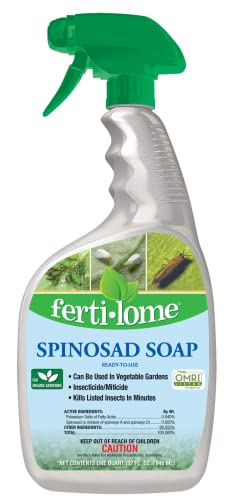
1. Fertilome Spinosad Soap, 32 oz
Our pick — over 4.5★ from 200+ verified ratings; the strongest balance of quality and price.
The OMRI-listed RTU that earned a near-perfect score from hundreds of gardeners.
Fertilome’s spinosad soap spray comes ready to use in a 32-ounce bottle and weighs 2 pounds — heavier than the Bonide dust below, but that weight reflects the liquid volume and the sturdy sprayer. It contains 0.005% spinosad combined with 0.940% potassium salts of fatty acids, and it is OMRI Listed for organic gardening. Reviewers point out that it eliminated caterpillars and beetles on Cleveland Pear trees after just two applications spaced a week apart, and that leaf miners on columbine were gone with no recurrence after 2 weeks.
The target list is extensive: adelgids, ants, aphids, armyworms, Colorado potato beetle, borers, caterpillars, chinch bugs, codling moth, earwigs, fruit flies, gypsy moth, lace bugs, leafhoppers, and more. The “effectiveness” aspect is the most-discussed by a wide margin — 37 owners single it out as the product’s strongest trait. The weight difference vs the Bonide dust is notable: Fertilome is 2 pounds versus 1.5 pounds for the dust, a 33% weight gap that matters if you are carrying supplies to a distant garden plot. The main limitation is that at 0.005% spinosad, it is a light-duty option — one owner notes the need to alternate with oil products to prevent insect resistance. The bottle also covers about two full applications for a moderate-sized garden before needing a refill.
What wins gardeners over
- OMRI Listed — suitable for certified organic gardening
- Ready-to-use sprayer means zero setup time
- Controls a very broad list of insects from adelgids to webworms
- Highly praised effectiveness with 37 positive mentions from owners
Honest limitations
- Very low spinosad concentration (0.005%) — may need repeated applications for stubborn pests
- Heavier than the dust alternatives at 2 pounds for a 32 oz bottle
Reach for this when: you want the easiest possible start with a proven, organic-ready spray that does not require any mixing or measuring.
Look elsewhere if: your pest pressure is heavy enough that you are spraying every few days — a concentrate will save you money and trips to the garden store.
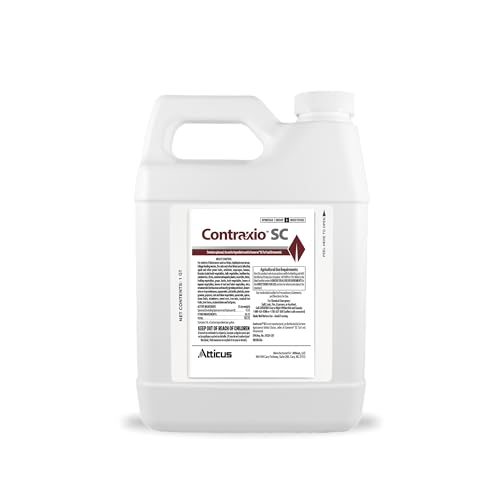
2. Atticus Contraxio SC (32oz)
The heavy hitter that turns one bottle into a season’s worth of protection.
You do not buy this for a single aphid on a houseplant. You buy this for armyworms shredding your lawn, bagworms encasing your arborvitae in silk, and thrips turning your roses into brown lace. The active ingredient is 11.6% spinosad — owners point out that weaker products hover at just 0.5%, so this concentrate is effectively 40 times stronger per ounce. That means you use less than one ounce in a 4-gallon sprayer, and a single 32-ounce bottle makes well over 128 gallons of finished spray. It kills on contact within minutes, and the ingestion effect provides residual control up to 2 weeks.
The target insect list stretches past 50 — everything from Colorado potato beetles (owners call it the best they have found) to fire ants, leafminers, and loopers. It is labeled for turfgrass, ornamentals, vegetables, fruit trees, and even greenhouse use. The downside is the upfront cost, which is higher than any RTU bottle. But when you do the math per gallon of mix, it is by far the most economical choice on this list. Just note that it is not for sale in Alaska, Hawaii, DC, or Puerto Rico, so check state restrictions before ordering.
What earns the top spot
- 11.6% spinosad — 40x stronger than typical RTU products; one bottle makes 128+ gallons of spray
- Kills on contact and by ingestion with residual control up to 2 weeks
- Controls 50+ insect types including bagworms, thrips, armyworms, and Colorado potato beetles
- Versatile across turf, ornamentals, vegetables, and fruit trees
The honest trade-offs
- Higher upfront price than ready-to-use sprays
- Not available for purchase in Alaska, Hawaii, DC, or Puerto Rico
- Requires measuring and mixing with a sprayer — not grab-and-go
Reach for this if: you have more than a few plants to protect, a serious infestation, or you want the lowest cost-per-gallon over a full growing season.
Think twice if: you only need to spray a single raised bed twice a year — a ready-to-use bottle will be simpler.
3. Monterey Spinosad Insecticide, 32 oz
The go-to mid-concentrate for vegetable growers who want OMRI confidence.
Monterey sits in the balance between a weak RTU and a professional-grade jug. It is a 0.5% spinosad concentrate that comes with a measuring spoon, and it is OMRI Listed for organic gardening. Buyers report using it on sweet potato vines to knock out armyworms (one combined it with BT for a one-two punch) and on corn tassels where earworms lay eggs. The label says it controls caterpillars, leafminers, codling moths, tent caterpillars, gypsy moths, thrips, borers, and fire ants. It is fast-acting and odorless, which matters when you are spraying vegetables you plan to eat.
The bottle is a concentrate, so you mix it with water in a trigger, backpack, or hose-end sprayer. Unlike the Atticus or Conserve SC, this is a lower concentration (0.5% vs 11.6%), so you use more product per gallon — but it is also far less expensive per bottle and does not require the same level of caution during mixing. One owner with corn noted that regular spraying kept worm damage far lower than the previous year’s Sevin treatment. The catch is that as a mid-concentrate, it is not the best choice for very large lawns or professional-scale applications where the 11.6% products deliver better efficiency.
Why gardeners pick this
- OMRI Listed for organic production — meets USDA organic standards
- Works on vegetables, citrus, fruit trees, and ornamentals
- Odorless and fast-acting, so treated plants are safe to harvest sooner
- Comes with a measuring spoon for easy mixing
What to keep in mind
- 0.5% spinosad is much lower than professional concentrates — you use more per gallon
- Not the most cost-effective option if you are treating acres of turf or hundreds of plants
Grab this for: a mid-sized vegetable garden, a few fruit trees, or citrus — the OMRI label and low odor make it a natural fit for edible crops.
Skip it for: heavy bagworm or thrips infestations on ornamentals where 11.6% spinosad would hit harder per drop.
4. Conserve SC Insecticide, 32 oz

The professional-grade spinosad that rose growers swear by for chili thrips.
Conserve SC is the 11.6% spinosad concentrate from Dow AgroSciences, and it is the product that experienced gardeners turn to when weaker sprays fail. The most telling use-case comes from rose enthusiasts battling Chili Thrips in the southeastern US — owners say Conserve SC is the only treatment that works in one or two applications, using just 1 teaspoon per gallon. At that rate, a single 32-ounce jug yields approximately 400 gallons of finished spray, which puts its long-term cost far below any ready-to-use bottle.
It also handles Colorado potato beetles on tomatoes and eggplants, bagworms on evergreens, and fire ants on lawns. One owner reported a visible reduction in bagworms the very next day after application. The high spinosad concentration means you use very little per sprayer load, making this a strong value despite the price on the shelf. The trade-off is that the upfront cost is steep, and a few owners mention the value is “mixed” — the price is real, but the math works out in your favor if you actually use the whole bottle. It is a biological pesticide derived from a soil organism, so it is tough on pests while being easier on the garden ecosystem than synthetic chemicals.
What justifies the price
- 11.6% spinosad — one jug makes roughly 400 gallons of finished spray
- Only effective treatment for Chili Thrips on roses according to owners in the Southeast
- Kills adults and successive generations of potato beetles, bagworms, and aphids
- Low odor compared to alternative treatments like Thuricide
One real hesitation
- High upfront cost — you pay more at checkout even though each gallon of mix is cheap
- Not a grab-and-go spray; requires measuring and mixing
Reach for this if: you have roses plagued by thrips, a large vegetable patch, or any pest that survived weaker treatments — the 11.6% concentration ends the fight fast.
Hold off if: one bottle of RTU spray will cover your whole season and you do not want to mix.
5. Southern Ag Conserve Naturalyte, 16 oz

A 16-ounce concentrate that punches well above its size for fire ants and scale.
Southern Ag packs its 0.5% spinosad concentrate into a 16-ounce pint bottle that makes up to 8 gallons of spray — perfect for the home gardener who does not want to store a quart jug. Owners mention that it wiped out scale on a Miracle Fruit plant where neem oil, agricultural oil, and soap all failed. It also knocks back spider mites after one application and a follow-up, and handles potato bugs, aphids, and citrus leafminers. One owner specifically mentions it is a “great organic solution” that does not hurt the good bugs in the garden.
The small bottle size is both the feature and the limitation. For a small vegetable patch, a few fruit trees, or houseplant rescues, this is the most economical concentrate choice. It is OMRI listed and has almost no odor, so you can use it around edible crops without worrying about chemical taste. The catch is that the 16-ounce bottle runs out faster than the 32-ounce competitors, and some owners wish the residual effect lasted longer than a week before needing reapplication. If you are battling a persistent infestation on a large area, the bigger jugs from Monterey or Atticus will give you more staying power per dollar.
Where it shines
- Small 16-ounce bottle is easy to handle and store — makes up to 8 gallons of spray
- Effective on scale, spider mites, leafminers, aphids, and fire ants
- Low toxicity and OMRI-listed; no strong odor during application
The size factor
- 16 oz goes fast if you spray a large garden weekly — reapply every 7-10 days for heavy pressure
- 0.5% spinosad means you use more product per gallon than 11.6% concentrates
Pick this for: small to mid-sized gardens, targeted treatments on specific plants, and first-time concentrate users who want a lower-commitment bottle.
Pass if: you need to cover a large lawn, an orchard, or a heavy thrips infestation — go with the 32-ounce 11.6% options instead.
6. Natural Guard Spinosad Soap, 32 oz

The trigger-bottle answer when you need instant caterpillar control with no mixing.
Natural Guard combines 0.005% spinosad with insecticidal soap (potassium salts of fatty acids) in a ready-to-use spray that works on contact. Customers note that a single spray eliminated a cactus beetle infestation — the beetles were gone after days of checking. Another owner sprayed fruit trees and said that two days later, no bugs flew off when they rinsed the trees with water. It controls spider mites, aphids, and powdery mildew when sprayed directly, and the soap component helps the solution stick to foliage and break down soft-bodied insects on contact.
The catch is that this is the lowest-concentration product on the list (0.005% spinosad), so it works best for light to moderate pest pressure on small gardens. The bottle is a generous 32 ounces, but for a massive garden, owners note you may run through it quickly. There are also scattered reports of bottles leaking during shipping and of the soap causing leaf burn if applied in hot, direct sunlight. The crowd consensus is that it is a fantastic value for the money and far more effective than neem oil for most common pests, but it demands careful use — spray at dusk or on cloudy days to avoid burning tender leaves.
Why owners reach for it
- No mixing required — pull the trigger and spray directly on pests
- Spinosad + soap combo kills on contact and helps control powdery mildew
- 32 ounces covers a fair amount of garden space at a budget-friendly price
What to watch for
- Lowest spinosad concentration (0.005%) — not ideal for heavy infestations or large areas
- Can burn plant leaves if sprayed in hot direct sunlight
- Some bottles arrive leaking; inspect the cap on delivery
Choose this for: a quick response to a spotted infestation on a small vegetable garden, ornamentals, or a few fruit trees — no measuring, no cleanup.
Skip it for: large lawns, persistent bagworm problems, or any situation where a concentrate would give you more spray for the same money.
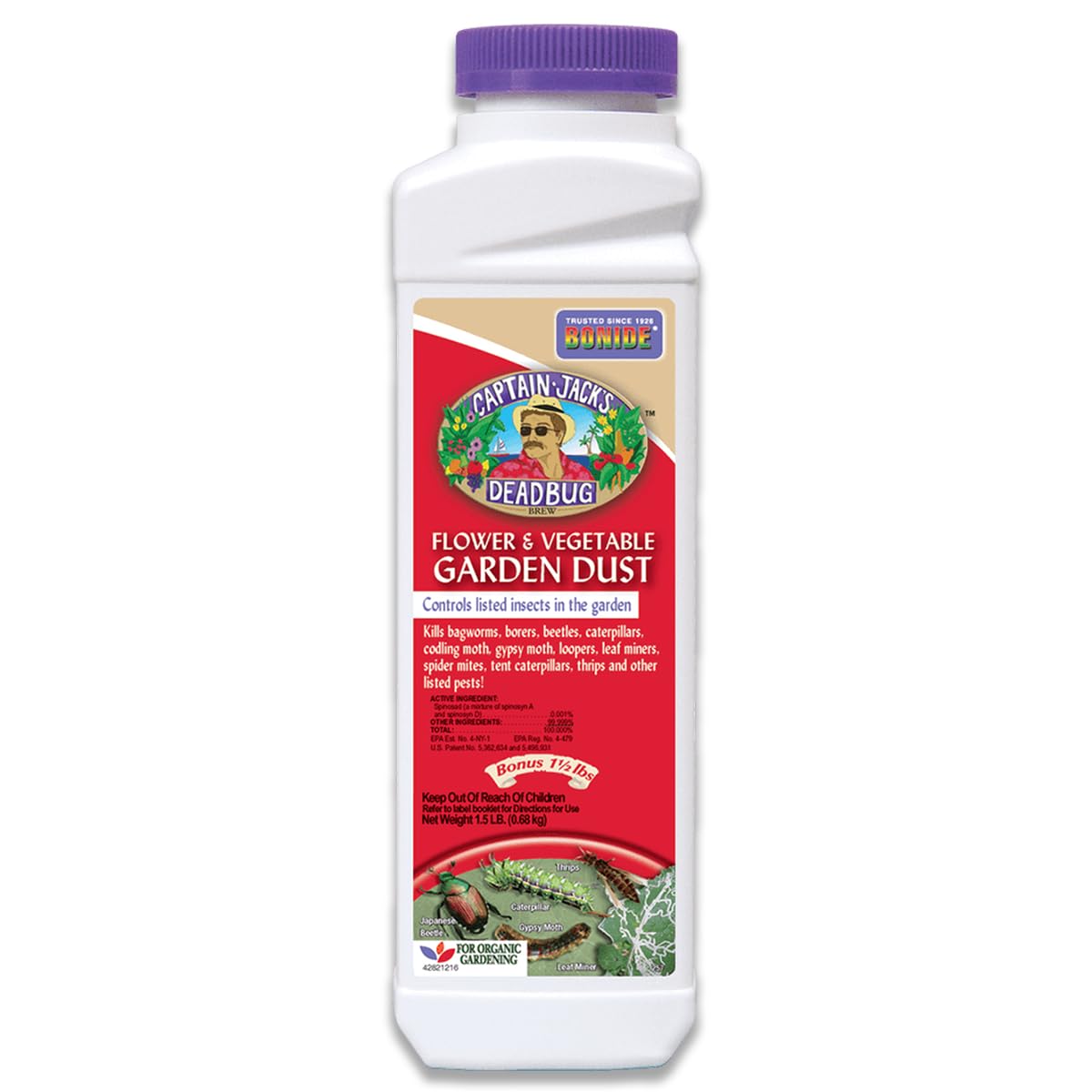
7. Bonide Captain Jack’s Deadbug Brew Dust, 1.5 lb
The dust format that rose owners turn to when sprays just will not reach.
Bonide’s Captain Jack’s Deadbug Brew is a ready-to-use dust containing 0.5% spinosad in a 1.5-pound container. The dust format solves a specific problem: budworms on roses. Owners describe hundreds of budworms that survived every spray, but this dust killed them on contact and helped break the reproductive cycle — especially when combined with diatomaceous earth around the base of the plant. The dust puffs into tight spaces where sprays cannot penetrate, like the crevices of cabbage heads and the centers of rose buds.
Bonide says it does not significantly impact beneficial insects, predatory mites, or spiders while controlling target pests like bagworms, borers, caterpillars, codling moth, gypsy moth, spider mites, loopers, leaf miners, tent caterpillars, and thrips. The dust is also labeled as pet-friendly once applied. The practical downside is the applicator design — the side with holes can be hard to sprinkle evenly, and the other side tends to dump too much at once. It is also a bit pricey for the volume, as a few owners note. The weight is 1.5 pounds, which is lighter than the Fertilome RTU spray (2 pounds) but the dust goes further because a light coating is all you need.
What makes it effective
- Dust format reaches into buds, crevices, and leaf axils that liquid sprays miss
- Controls budworms, caterpillars, thrips, and spider mites without harming beneficial insects and spiders
- Pet-friendly label — safe around pets once applied
- 0.5% spinosad is 100x stronger than the 0.005% RTU sprays
The dust trade-offs
- Applicator is awkward — the hole side dusts unevenly and the slit side pours too much
- Some owners find it pricey for the 1.5 lb container size
- Dust can wash off in rain and may need reapplication sooner than a spray residue
Grab this for: roses with budworms, cabbage-family plants, or any pest hiding in tight plant crevices where spray drips off before it hits the target.
Think twice if: you prefer uniform coverage on broad-leaf foliage — a liquid spray or concentrate will coat more evenly.
8. Bonide Bug & Slug Killer Granules, 1.5 lb

The granular bait that handles the ground-level crew — slugs, earwigs, and pillbugs.
This is the only product on the list formulated as a granular bait, and it solves a different problem than the sprays and dusts. While the other products kill insects that chew on leaves above ground, Bonide’s Bug & Slug Killer Granules target the pests that hide in the soil and organic matter — slugs, snails, earwigs, cutworms, sowbugs, pillbugs, crickets, and ants. The active ingredients are iron phosphate and spinosad, a combination that lures these pests out of their hiding places and kills them. One owner described how their strawberry plants were being destroyed by slugs and earwigs, and after applying these granules, the problem stopped completely.
The 1.5-pound bag covers up to 3,000 square feet, and one application lasts up to 4 weeks. The granules are easy to scatter by hand or with a small spreader, and the label says people and pets can enter the treated area immediately after application. The most common owner praise is effectiveness — 114 owners mention it, making it the most-discussed positive trait by far. The downsides that show up in reviews are mold growth on the granules in damp conditions and occasional complaints about receiving a bag that was not completely full. The granules also need reapplication sooner than the 4-week claim in some cases — one owner noted slugs returned after about a week and a half.
Why it works for ground pests
- Granules lure and kill slugs, snails, earwigs, pillbugs, cutworms, and ants
- Covers up to 3,000 square feet with a single 1.5 lb bag — good for large garden beds
- Lasts up to 4 weeks per application according to the label
- Safe for people and pets to enter the area immediately after application
What to expect in practice
- Granules can develop mold in consistently wet conditions
- Some shoppers say that the 4-week residual is optimistic — slugs may return sooner
- Occasional bag filling complaints from buyers
Use these granules if: slugs, earwigs, or pillbugs are your primary garden nemesis and you want a scatter-and-forget solution that works at the soil level.
Skip them if: you are only dealing with caterpillars, aphids, or leaf-chewing insects — those pests need a spray or dust that covers the foliage.
Understanding the Specs
Spinosad Concentration (%)
This is the percentage of the active ingredient (spinosad) in the bottle. A ready-to-use spray might have 0.005% — strong enough for a few caterpillars on a tomato plant. A professional concentrate can hit 11.6%, which is over 2,300 times more concentrated. Higher percentages mean you use less product per gallon of water and get far more total spray from the same bottle. For a large garden or heavy infestation, always calculate the cost per gallon of mixed spray, not the cost per bottle.
Formulation: RTU vs Concentrate vs Dust vs Granules
Ready-to-use (RTU) is a trigger bottle with no mixing — perfect for quick spot treatments on a few plants. Concentrates require you to mix the liquid with water in a sprayer, which gives you more control over strength and far more coverage per dollar. Dusts are dry powders puffed onto foliage; they reach into tight spots like rose buds and cabbage heads that liquids miss. Granules are scattered on the soil surface and attract crawling pests like slugs and earwigs that never touch the leaves above. Match the form to where the pest lives.
FAQ
Is spinosad safe for vegetable gardens and edible crops?
Will spinosad kill bees and other beneficial insects?
How long does spinosad take to kill insects?
Can I mix spinosad with other insecticides or fungicides?
What is the difference between 0.5% and 11.6% spinosad products?
Does spinosad work on fire ants?
How should I store spinosad products between uses?
What is the shelf life of spinosad insecticide?
Can I use spinosad on houseplants?
Which spinosad product is best for bagworms on arborvitae?
Final Thoughts: The Verdict
Across the board, the best insecticide with spinosad is the Atticus Contraxio SC because its 11.6% spinosad concentration delivers the lowest cost per gallon and the widest control spectrum — over 50 insect types — in a single bottle. If you want a garden-friendly mid-concentrate with an OMRI label and no odor, grab the Monterey Spinosad. And for the gardener battling slugs and earwigs at ground level, the Bonide Bug & Slug Killer Granules are the one to reach for.
How We Picked
We do not accept paid placement. Every pick is matched to a real buyer and a real use-case; we do not hands-on test units.
Sources & Methodology
Specifications: manufacturer listings and product documentation. Review insights: verified customer reviews, as of July 2026. Pricing: not shown on this page (it changes often); check the current price via the retailer link.
As an Amazon Associate, Lawn Gear Lab earns from qualifying purchases. This does not affect which products we feature.