
Specs are compiled from manufacturer listings and verified buyer reviews and can change over time — please confirm the key details on the product page before buying.
Every rose grower knows the frustration: lush green leaves everywhere, but not a single bud in sight. The secret isn’t luck — it’s giving your plants the precise nutrient balance they crave at the right time. This guide cuts through the dozens of bags, bottles, and spikes to find the formulas that actually deliver those big, fragrant, long-lasting blooms you’re after.
I’m Rikta — the founder and writer behind Lawn Gear Lab. This guide is built by comparing the manufacturers’ published specifications and the patterns across verified customer reviews, so you get each pick’s real strengths and trade-offs instead of marketing spin.
Whether your roses are climbing a trellis or packed in pots on the patio, the right good plant food for roses turns a season of hope into a summer of armloads of color.
Our Picks at a Glance


How To Choose The Best Good Plant Food For Roses
Picking the right food for your roses depends on three things: how much time you have to feed them, if you want to feed the plant or the soil, and what kind of flower show you are expecting. Mix them right and your bushes will reward you with waves of color all season long.
Understand the NPK Ratio
Every bag or bottle sports three numbers — nitrogen (N), phosphorus (P), and potassium (K). You want a formula where the middle number (phosphorus) is a little higher than the others. That phosphorus pushes buds and blossoms, which is exactly what you want from a rose food. A ratio like 4-3-2 or 15-5-15 is a solid starting point.
Granular vs. Liquid vs. Spikes
Granular foods are the low-maintenance choice: you sprinkle them on the soil, water them in, and they break down over weeks. Liquids work fast — your roses get a dose the same day — but you have to mix and apply more often. Spikes are the easiest of all: push them into the ground around the bush and they feed slowly for a month or two.
Organic vs. Synthetic
Organic feeds come from natural ingredients like bone meal, feather meal, or composted manure. They feed the soil microbes, which in turn feed your roses. They are gentler and improve soil texture over time, but you might need to apply them more often. Synthetic formulas are chemically precise and fast-acting, but they do nothing for the life of your soil.
Quick Comparison
| Model | Best For | Form | NPK Ratio | Weight/Size | Amazon |
|---|---|---|---|---|---|
| Espoma Organic Rose-Tone★ Best Overall | Organic gardens | Granules | 4-3-2 | 8 lb (2 x 4 lb) | Amazon |
| Farmer’s Secret Rose BoosterTop Performer | Quick results | Liquid | — | 8 oz (concentrate) | Amazon |
| Schultz Rose & Flower Slow-ReleaseExcellent Value | Even feeding | Granules | 15-5-15 | 3.5 lb | Amazon |
| Jobe’s Rose Spikes | No-mess feeding | Sticks | — | 20 spikes (2.4 lb) | Amazon |
| Miracle-Gro Performance Organics Blooms | Organic color bursts | Granules | 5-7-10 | 2.5 lb | Amazon |
| Miracle-Gro Bloom Booster | Massive blooms fast | Water-soluble | 10-52-10 | 5.5 lb | Amazon |
| Scotts Rose & Bloom Food | Slow & steady | Powder | 12-4-8 | 6 lb (2 x 3 lb) | Amazon |
| Dr. Earth Total Advantage Rose & Flower | Certified organic purity | Granules | — | 4 lb | Amazon |
| Great Big Roses Fertilizer Booster | Reviving struggling roses | Liquid | — | 32 oz | Amazon |
In‑Depth Reviews
1. Espoma Organic Rose-Tone 4-3-2 (Pack of 2)
Our pick — over 4.5★ from 700+ verified ratings; the strongest balance of quality and price.
The organic granular feed that makes rose bushes explode with blooms.
This is the crowd favorite for a reason — a 4-3-2 NPK ratio combined with a proprietary Bio-tone formula and 5% calcium. The calcium is the sleeper here: it strengthens cell walls, so your stems hold those heavy blossoms without flopping over. It is approved for organic production and made in the USA by a company that has been in the natural organics game since 1929.
Buyers report that after using Rose-Tone monthly from May through September, their roses show “greener leaves, stronger growth, and more buds.” One owner with around 30 rose bushes called the results “stellar.” It covers multiple plant types too — viburnum, bougainvillea, and clematis all respond well. The 4-pound bag goes a long way in a typical garden bed.
A few owners find the natural odor off-putting, but most describe it as earthy and pleasant. The biggest win: at 4.8 stars across 700+ ratings, it scores higher than any other pick here, including the budget contender which has more reviews overall.
Why It Wins
- Approved for organic gardening — no sludges or toxic ingredients
- Bio-tone formula with calcium boosts both bloom count and stem strength
- Works on roses, climbers, and many other flowering shrubs
The Honest Trade-Off
- Odor gets mixed reactions — some find it pleasant, others call it strong
- Requires monthly reapplication through the growing season
Reach for it if: you want a proven, organic granular feed that nourishes the soil as it feeds your roses and has the highest owner satisfaction in the lineup.
Look elsewhere if: you prefer a fast-acting liquid or a no-measure spike — this is a sprinkle-and-water routine.
2. Farmer’s Secret Rose Booster Fertilizer (8 oz)
The super-concentrated liquid that revives even the most stubborn roses.
This is for the grower who wants to see a difference in days, not weeks. A little goes a very long way — you dilute just two teaspoons into a gallon of water and apply weekly during the growing season. Bottled in Kentucky, it brings formulation methods used in commercial farming down to the home garden.
Owners mention that “all my flowers and roses took off about 2 weeks earlier than normal” and that blooms are “bigger flowers than they have in years.” One owner revived a white climbing rose that had stopped blooming, watching it fill out and bloom again after weekly feedings. The 8-ounce bottle treats a surprising number of plants given the super-concentrated mix rate.
The main conversation point is the sulfur smell — it is noticeable during mixing, though it fades quickly after application. A few owners wish the bottle were larger, but the concentrated formula makes each drop count.
Instant impact: this liquid gets into the root zone fast, making it the top pick for reviving tired or struggling rose bushes.
Size reality: the bottle is small at 8 ounces, but because you use so little per feeding, it typically lasts a full season for a modest rose garden.
Best for: gardeners who notice their roses are underperforming and want a fast-acting, concentrated formula that works across the whole garden.
skip it if: you dislike any smell during mixing and want a no-odor option.
3. Schultz Spf48410 Rose & Flower Slow-Release Plant Food, 15-5-15
A simple, no-mix granular that feeds for weeks with zero measuring.
You sprinkle it on the soil and walk away — no mixing, no diluting, no mess. The 15-5-15 ratio delivers a strong dose of nitrogen for leafy growth and potassium for overall plant health, with a moderate phosphorus kick for blooms. It includes micronutrients that support healthy root function and flower development across roses, annuals, and perennials.
Buyers share a standout story: an indoor Gerber daisy that had produced lush leaves but zero blooms for three years — after switching to Schultz, it “produced 13 buds and now blooms profusely.” Another owner saw a tired iris bed revive with “lush leaves up to thigh and flowers hip high.” Roses responded with abundant growth and flowers.
The caution here is not to overdo it — following the directions matters with a slow-release granular to avoid over-fertilization. The 3.5-pound bag covers a good-sized bed, and the price per pound is tough to top.
Easiest granular on the list: shake it on, water it in, and let the slow-release coating do the work for a full season.
Watch the rate: a few owners note that applying too much can lead to leggy growth, so stick to the label.
Choose this for: a low-effort, reliable granular feed that works on roses and every other flowering plant in your garden.
Not for: growers who want organic ingredients or a fast-acting liquid boost.
4. Jobe’s 4102 Rose Outdoor Fertilizer Food Spikes (Pack of 2)

The spike system that makes feeding as simple as pushing a stick into the ground.
If you have ever hated measuring, mixing, or cleaning up spilled granules, this is your answer. Each spike is pre-measured — you push it into the damp soil around the drip line of the bush, and the slow-release formula feeds the roots for weeks. There is no chemical runoff because the nutrients go straight into the root zone rather than washing across the surface.
Customers note that three knockout roses in pots “are blooming profusely” with “brilliant” blooms after using these spikes. Another owner with white hedge roses gave each bush one spike in early spring and got “full, healthy bushes with endless blooms.” The pack of 2 contains 20 spikes total, enough to feed a dozen bushes for a full season.
The main gripe is that a couple of spikes can arrive broken in the bag — the material is dense but brittle in cold weather. Owners suggest using a light hammer or trowel handle to drive them in if the soil is hard. Overall, the ease of use earns nearly as much praise as the effectiveness.
Why People Love It
- Zero measuring, zero mixing, zero mess — push in and walk away
- Slow-release formula prevents runoff and keeps feeding for weeks
- 20 spikes per pack — great value for multiple bushes
What to Know
- Spikes can snap in the bag if handled roughly in cold weather
- Hard or dry soil may require a small tool to insert them
Ideal for: the forgetful or busy gardener — set the spikes once and let them work for a month or two.
Not for: anyone who wants to control the exact nutrient mix per feeding or who has very large rose beds.
5. Miracle-Gro Performance Organics Blooms Plant Nutrition Granules
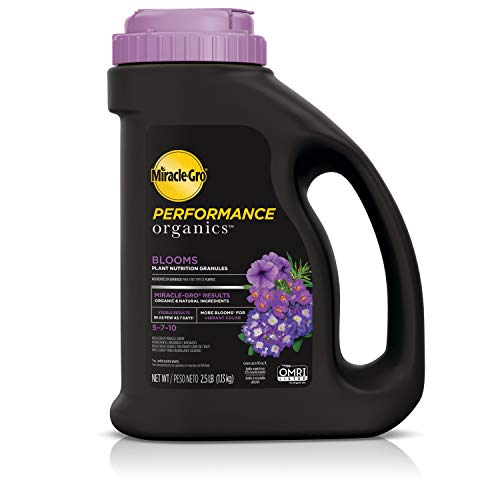
The organic granular from a trusted name that pushes blooms on stubborn plants.
This is Miracle-Gro’s answer for gardeners who want organic ingredients but still expect the brand’s famous performance. The 5-7-10 NPK ratio leans heavily on phosphorus to drive blooming, and the formula is OMRI listed — so it meets organic production standards. One 2.5-pound bag covers up to 165 square feet of garden space.
Buyers consistently report visible results within one to two weeks, with “ginormous blooms” on butterfly bush and a Mandevilla that “was being slow this summer” suddenly popping with color. The granules are easy to sprinkle around the base of the plant, and the every-4-to-6-week schedule means a single bag can last a full growing season for a small to medium bed.
The only recurring complaint is the packaging — a few owners find the seal under the lid is loose, leading to minor spillage in transit. The product itself earns strong praise across effectiveness and bloom growth.
Organic meets reliable: you get the OMRI organic listing alongside the kind of fast visible results Miracle-Gro is known for.
Package hiccup: an occasional unit arrives with a loose inner seal, but the granules inside are fine.
Pick this if: you want an organic granular food from a brand you trust, and you want to see blooms in under two weeks.
Look elsewhere if: you need the strongest possible bloom-boosting ratio — the 5-7-10 is good but not extreme.
6. Miracle-Gro Water Soluble Bloom Booster Flower Food, 10-52-10

The high-phosphorus power punch that turns rose bushes into bloom factories.
The middle number tells the story: 52. That is a massive phosphorus dose designed to kick bud production into overdrive. You mix two tablespoons into a gallon of water and apply every 7-14 days during the growing season. It works on roses, hydrangeas, dahlias, hibiscus, and pretty much every flowering plant you have. One 5.5-pound container covers roughly 2,200 square feet of garden area.
Reviewers point out “twice as many blooms per plant, very quickly after application at budding stage.” Another owner describes “big, beautiful blooms and healthy leaves” and calls it the “best fertilizer for all blooming plants to attract butterflies and hummingbirds.” The granules dissolve easily even in cold water, so there is no clumping at the bottom of the watering can.
The only real downside is the resealable bag — the Velcro-style closure is finicky and can take several attempts to seal properly. The fine powder also gets stuck in the closure hooks. A few owners transfer the contents to a separate container for easier access.
Why It Dominates
- Extremely high phosphorus (52) drives explosive bud and bloom production
- Water-soluble for instant uptake — visible results in 7-14 days
- Enormous coverage — 2,200 sq. ft. per container
Honest Gripes
- The resealable bag closure is unreliable and frustrating to use
- Requires mixing every 1-2 weeks, not a low-maintenance option
Reach for it when: you want the maximum possible bloom output from your roses and are willing to mix a fresh batch every week or two.
Think twice if: you prefer organic inputs or want the lowest-maintenance feeding schedule.
7. Scotts Rose & Bloom Food 12-4-8 (2 Pack)

A slow-release powder that feeds continuously for up to two months per application.
Scotts packs a 12-4-8 ratio into a slow-release formula that keeps feeding for up to two months without any mixing or measuring — you just sprinkle it on the soil. The 2-pack gives you 6 pounds total, which covers a substantial rose bed all season long. And because it is slow-release, it is safe on your plants and won’t burn them when used as directed.
Buyers who have used it for several seasons report that it “works very well on my perennial garden.” Another owner noted that within 72 hours of application, they saw a noticeable difference in “so many of my shrubs and flowers.” The slow-release nitrogen is the key: it provides an even, continuous supply rather than a quick spike followed by a crash.
The formula is not organic, so soil-life purists should look elsewhere. A few owners note that the powder can be dusty when sprinkling, so working it into the top layer of soil helps.
low-maintenance: one application feeds for up to two months, making it one of the lowest-maintenance granular options.
Synthetic only: this is a conventional formula, not suitable for organic-only gardens.
Best for: the gardener who wants to feed their roses twice a season and be done with it — maximum convenience.
pass on it if: you need an organic product or prefer liquid feeding for faster results.
8. Dr. Earth Total Advantage Rose & Flower Fertilizer 4 lb

The only Non-GMO Project Verified rose fertilizer in the US — pure ingredients from the ground up.
Dr. Earth takes purity further than any other pick here. It is not only OMRI listed and CCOF certified, but also Non-GMO Project Verified — the only fertilizer in the country to hold that distinction. It is handcrafted from human and feed grade ingredients with no synthetic chemicals, no GMO-infested chicken manure, and no toxic additives. The blend includes multi-minerals, proteins, carbohydrates, humic acids, and trace elements.
Buyers who have used it for years say it “keeps my roses producing beautiful blooms.” Another owner noted that it helped newly transplanted roses “adjust and bloom amazingly” and that the smell was pleasant — a rare compliment in the organic fertilizer world. It works on roses, flowering trees, shrubs, annuals, and perennials.
The price is a step above other organic granulars, but the certification level is class-leading. A few owners wish the bag were larger, given how well their plants respond. The 4-pound bag is what you get, and for many, the results justify the cost.
Transparency leader: multiple third-party certifications mean you know exactly what is — and is not — in this bag.
Premium cost: you pay a noticeable premium for that certification, but long-time users say it is worth it.
Choose this for: the most demanding organic gardeners who want verified purity and proven bloom results.
Not for: budget-focused shoppers or those who are happy with a simpler organic granular.
9. Great Big Roses Fertilizer Booster for Rose & Flower Gardens, 32 Ounce
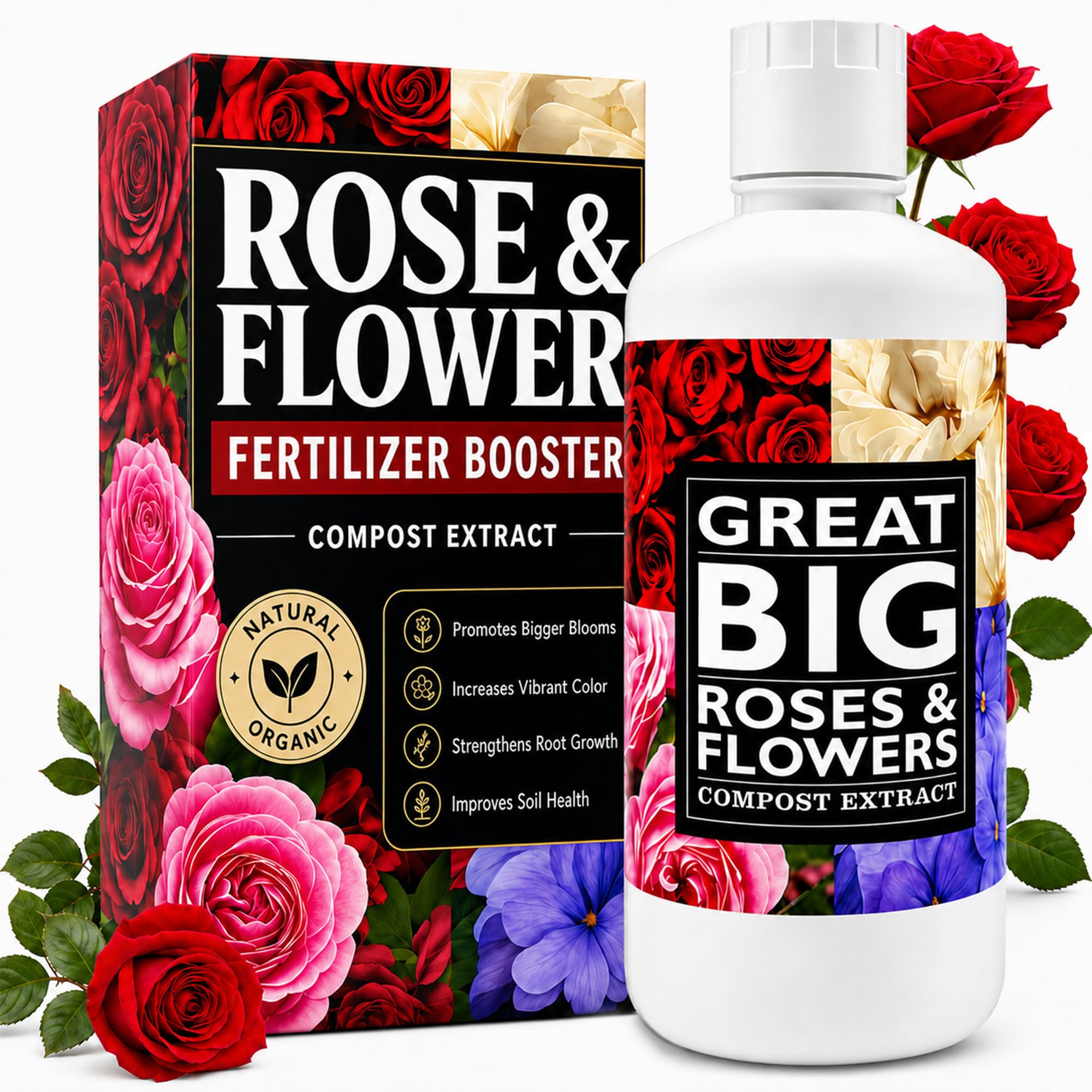
The liquid booster that unlatches nutrients already in your soil for a massive bloom surge.
This is not a standard fertilizer — it is a soil activator. The formula delivers humic acids, seaweed, and over 70 chelated trace minerals into the root zone, converting locked-up soil nutrients into forms the plant can use. You mix 4 ounces per gallon of water and apply it alongside your regular fertilizer to amplify results. It works on roses, hydrangeas, citrus, fruit trees, hibiscus, and perennials.
Shoppers say dramatic turnarounds: roses that “had not bloomed in years producing big, beautiful flowers within weeks.” Another owner noted that the booster “transformed small, fair bushes into large, healthy ones with many roses over 3 years.” The concentrate makes over 30 gallons, so one 32-ounce bottle goes a long way.
The biggest complaint is the jug design — the wide mouth makes measuring into a watering can messy, and spilled concentrate is expensive. The value-for-money sentiment skews negative because the upfront cost is higher than a standard fertilizer. But for reviving truly stubborn roses, nearly 1,000 ratings at 4.6 stars say it works.
What Makes It Unique
- Activates dormant soil nutrients — makes your existing fertilizer work harder
- Over 70 chelated trace minerals plus humic acids and seaweed
- One bottle makes 30+ gallons of feed
The Practical Caveats
- The jug opening is wide — expect some splash when measuring
- Higher upfront cost, and some owners find it expensive per application
Ideal for: rescuing long-neglected rose beds or plants that refuse to bloom despite regular feeding.
Think twice if: you are happy with your current results and just want a simple maintenance feed.
Understanding the Specs
NPK Ratio
The three-number code on every bag — nitrogen (N), phosphorus (P), and potassium (K). For roses, you usually want the middle number (phosphorus) to be the highest one, because phosphorus drives bud and bloom production. A ratio like 10-52-10 is all-in on blooms, while a more balanced ratio like 5-7-10 or 4-3-2 supports both foliage and flowers over a longer period.
Slow-Release vs. Water-Soluble
A slow-release food (granules or spikes) feeds the plant gradually over weeks or months with a single application. That is the low-effort route. A water-soluble food (powder you mix with water) feeds the plant instantly but requires reapplication every 1-2 weeks. Liquids are faster, but they need you to keep up a schedule.
FAQ
How often should I feed my roses during the growing season?
Can I use a general flower food on my roses?
Should I stop feeding my roses in the fall?
What happens if I over-fertilize my roses?
Is organic or synthetic rose food better?
Will rose food work on my potted roses?
How do I apply granular rose food without burning the plant?
Can I use rose spikes in clay soil?
Final Thoughts: The Verdict
For most gardeners, the good plant food for roses winner is the Espoma Organic Rose-Tone because it balances certified organic ingredients, a proven 4-3-2 formula with calcium, and the highest owner satisfaction in the lineup. If you want instant bloom-boosting power, grab the Miracle-Gro Bloom Booster with its 10-52-10 ratio. And for reviving truly stubborn rose bushes, the Great Big Roses Fertilizer Booster is the one to reach for — it open up the nutrients already waiting in your soil.
How We Picked
We do not accept paid placement. Every pick is matched to a real buyer and a real use-case; we do not hands-on test units.
Sources & Methodology
Specifications: manufacturer listings and product documentation. Review insights: verified customer reviews, as of July 2026. Pricing: not shown on this page (it changes often); check the current price via the retailer link.
As an Amazon Associate, Lawn Gear Lab earns from qualifying purchases. This does not affect which products we feature.