
Specs are compiled from manufacturer listings and verified buyer reviews and can change over time — please confirm the key details on the product page before buying.
The bag of granular fertilizer you grab from the shelf can mean the difference between a tomato plant that limps along and one that practically shoves fruit into your hand. Nitrogen numbers, calcium content, and whether the label says “organic” all matter far more than most first-time gardeners realize. A 5-7-3 blend tailored for heavy feeders like peppers works completely differently from a balanced 10-10-10 meant for a whole yard — and picking wrong can leave you with a jungle of leaves and zero blossoms.
I’m Rikta — the founder and writer behind Lawn Gear Lab. This guide is built by comparing the manufacturers’ published specifications and the patterns across verified customer reviews, so you get each pick’s real strengths and trade-offs instead of marketing spin.
Whether you are sowing a raised bed, nursing container plants on a balcony, or trying to coax a prize-winning harvest from a patch of clay, here is what actually works when you shop for a granular fertilizer for garden.
Our Picks at a Glance


How To Choose The Best Granular Fertilizer For Garden
Granular fertilizers break down slowly in the soil, feeding roots over weeks instead of blasting them with a quick hit. That slow-release profile makes granular the safer choice for beginners — and the smarter choice for long-season crops like tomatoes, peppers, and squash. Here is what to check on the bag before you buy.
NPK Ratio — What Each Number Actually Does
The three numbers on the front (like 5-7-3) stand for nitrogen, phosphorus, and potassium. Nitrogen (N) pushes green leafy growth — great for lettuce and spinach, bad in excess for tomatoes that need to fruit. Phosphorus (P) drives bloom and fruit set. Potassium (K) builds strong roots and overall plant toughness. For a vegetable garden, a middle or slightly higher phosphorus number (the second digit) helps you get more produce rather than just more leaves.
Organic vs. Synthetic Sources
Organic granules come from things like bone meal, feather meal, kelp, and rock phosphate. They feed the soil microbes that in turn feed the plant, and they release nutrients slowly with very low risk of burning roots. Synthetic granular fertilizers deliver exact NPK numbers fast but can harm soil life with heavy use. If you want to build your soil year after year, an OMRI-listed organic bag is the way to go.
Calcium for Blossom End Rot
Blossom end rot — that sunken, dark spot on the bottom of a tomato or pepper — is a calcium deficiency. A fertilizer with added calcium (6%, for instance) can prevent the problem before it starts, especially for gardeners growing in containers where watering flushes calcium out of the potting mix.
Application Coverage and Bag Size
Check how many square feet a bag covers. An 8-pound bag may cover roughly 140 square feet, while a 33-pound bag can handle 3,300 square feet for the whole yard. If you are just feeding a few pots, a 4-pound or 5-pound bag is plenty. For row gardens and shrub beds, a larger bag saves money per feeding.
Quick Comparison
| Model | Best For | NPK Ratio | Weight | Special Additives | Amazon |
|---|---|---|---|---|---|
| FoxFarm Happy Frog Tomato & Vegetable★ Best Overall | Heavy feeders (tomatoes, peppers) | 5-7-3 | 4 lb | Calcium + Mycorrhizal Fungi | Amazon |
| True Organic Tomato & Vegetable FoodCalcium Defense | Organic harvests + calcium protection | 4-5-6 | 8 lb | 6% Calcium | Amazon |
| Down To Earth All Purpose 4-6-2Best Value | Gentle all-purpose organic feeding | 4-6-2 | 5 lb | Fish Bone Meal, Kelp Meal | Amazon |
| FoxFarm Happy Frog All Purpose | Versatile garden + ornamentals | — | 4 lb | Soil Microbes + Mycorrhizal Fungi | Amazon |
| Espoma Organic Plant-Tone 5-3-3 | All-purpose organic for landscapes | 5-3-3 | 4 lb | Bio-tone formula + 5% Calcium | Amazon |
| Hi-Yield Grower’s Special 12-6-6 | High-nitrogen feeding for shrubs/trees | 12-6-6 | 10 lb | Slow-release nitrogen | Amazon |
| Supply Solutions 16-16-16 | Balanced all-purpose for entire yard | 16-16-16 | 5 lb | Triple-16 balanced blend | Amazon |
| GreenView Multi-Purpose 10-10-10 | Budget-friendly yard and garden maintenance | 10-10-10 | 33 lb | Balanced NPK | Amazon |
| Jobe’s Organics All Purpose 4-4-4 | Large organic gardens (value size) | 4-4-4 | 16 lb | OMRI Listed, no synthetic chemicals | Amazon |
In-Depth Reviews
1. FoxFarm Happy Frog Tomato & Vegetable Fertilizer
Our pick — over 4.5★ from 600+ verified ratings; the strongest balance of quality and price.
The premium pick that turns struggling zucchini into a bloom machine in one application.
This is the crowd favorite, and for a very clear reason: the 5-7-3 NPK ratio is built specifically for heavy feeders like tomatoes, peppers, and berries that need more phosphorus for fruit set. The calcium in the mix helps prevent blossom end rot — a common heartbreak when you see a perfect tomato with a sunken black bottom. Buyers report exactly that kind of relief: “After one application, my plant is much happier and has more blooms.” The bag also contains mycorrhizal fungi, which latch onto roots and help the plant pull more water and nutrients from the soil, so every feeding works harder than the NPK numbers alone suggest.
The natural formulation means there is no harsh chemical or fishy odor — a real bonus if you are working close to a patio or kitchen door. At 4 pounds, the bag is compact enough for a small garden yet potent enough for a serious container setup. Seasoned gardeners pair it with FoxFarm Ocean Forest soil, perlite, and coco coir for what they call “bumper tomato crops.” The only adjustment is that heavy-feeding plants in large grow bags may want a slightly larger bag size than 4 pounds if you are going all-in on a full row garden.
What wins people over
- Plant health and blooming improvements are the most-cited wins across hundreds of users
- Calcium and mycorrhizal fungi address two common headaches (rot and weak roots)
- No strong smell, unlike many organic granular options
- Versatile across vegetables, soft fruits, and berries
The honest trade-off
- 4-pound bag is best suited to containers or small gardens; larger plots need multiple bags
- Potency is high, so beginners should follow the label carefully to avoid over-feeding
Reach for this if: you grow tomatoes, peppers, or berries in containers or raised beds and want a targeted bloom-booster with rot protection built in.
Look elsewhere if: you need a general-purpose fertilizer for a huge lawn or mixed shrub border — the 5-7-3 is too specialized for that.
2. True Organic Tomato & Vegetable Food
The heavyweight organic contender that fights blossom end rot with 6% calcium.
This bag weighs 8 pounds, while the FoxFarm option weighs 4 pounds, yet the NPK ratio (4-5-6) is different — it carries less nitrogen and a touch more potassium, which supports overall plant toughness and root strength. The standout feature is the 6% calcium content, aimed squarely at preventing blossom end rot in tomatoes and peppers. It covers roughly 140 square feet per bag, so you know exactly how much garden you are feeding per purchase. Owners running container gardens on balconies report “faster growth than expected” and harvests that lasted through July heat.
There is one honest complaint that comes up regularly: the smell. Several buyers describe it as “horrible” or “strong,” though they quickly add that the results make it worth holding your nose. The granular form is easy to apply monthly, and many users found success with frequent small doses — a few dashes per watering — rather than one heavy application. Compared to the FoxFarm 5-7-3, this True Organic formula has a higher potassium number (6 vs 3), so it is the better pick if your soil already has decent phosphorus but needs more overall resilience.
Best match for: any gardener who has battled blossom end rot and wants an organic, OMRI-friendly solution that covers a good area. The smell is real, but the harvest payoff keeps people coming back.
3. Down To Earth All Natural All Purpose 4-6-2
The gentle giant that revived pale, flimsy tomato plants in under two weeks.
Down To Earth uses a straightforward 4-6-2 ratio with a short ingredient list (fish bone meal, blood meal, feather meal, rock phosphate, langbeinite, greensand, humates, and kelp meal) — all premium organic sources. The quality of the raw ingredients is the aspect owners praise most, and the effectiveness is right behind it. One owner shared that this formula “revived pale, flimsy tomato plants within two weeks of application,” which aligns with the broad owner consensus that it works well for a wide range of vegetables and container plants.
The 5-pound box is OMRI listed for organic production. Unlike some organic fertilizers that smell strong for days, this one’s odor tends to fade within a couple of days after application. Gardeners with larger spaces often buy the 15-pound bag and report it lasting nearly a full season, replacing a shelf full of separate amendments. The 4-6-2 ratio is fairly low in potassium, so it is ideal for soil that already has decent K levels. If your garden soil is very depleted, you may want to supplement with a potassium source later in the season.
Why it earns a spot
- Simple, high-quality organic ingredient list that builds soil life
- Gentle non-burning formula — safe for transplants and seedlings
- OMRI listed for certified organic gardening
- Cost per pound is very competitive for the ingredient quality
The realistic limit
- Lower potassium (2) means heavy-fruiting plants may need a booster mid-season
- Opinions on value are mixed — some find it expensive per bag, others consider it very fair
4. FoxFarm Happy Frog All Purpose Fertilizer

The gentle all-rounder that made yellow tomato and zucchini plants green in a week.
Unlike the brand’s tomato-specific 5-7-3, this Happy Frog blend is designed for pretty much everything — flowers, vegetables, ornamentals — and it is OMRI listed. The real draw is the beneficial soil microbes and mycorrhizal fungi packed into the granules. These microorganisms enhance nutrient uptake and water absorption, which explains why Monstera owners and vegetable gardeners alike report “explosive growth.” One owner noted that yellow tomato and zucchini plants perked up within a week of application, and after a monthly schedule they called it “the most successful garden ever.”
The downside is that this stuff smells distinctly like manure for a few days after watering. Anyone with a container garden on a balcony or near a seating area will notice it. The 4-pound bag is best for moderate-sized gardens or container collections — heavy users may want a larger size. It is also note that this all-purpose formula does not carry an NPK ratio printed as clearly as the 5-7-3 tomato version, so if you need a precise ratio for heavy feeders, the dedicated tomato blend above is a sharper fit.
The call: an excellent pick if you grow a mix of ornamentals and edibles and want the soil-microbe advantage. The smell is the trade-off, and the bag size works best for gardeners with modest square footage.
5. Espoma Organic Plant-Tone 5-3-3

The century-old organic formula that pro landscapers use for perennial beds.
Espoma has been around since 1929, and the Plant-Tone formula has earned recognition from plant organizations as a preferred organic fertilizer. The 5-3-3 ratio is designed for a broad range — flowers (annuals and perennials), vegetables, trees, and shrubs — and it includes 5% calcium to prevent blossom end rot. The Bio-tone formula is a proprietary blend of beneficial microbes that accelerates root growth. Owners in the landscaping business use it when planting perennials, noting it “gives the new plants a healthy start.”
The downsides are familiar territory with organics: the smell. More than one owner warns that it is “foul smelling as chicken poop” and advises standing upwind while applying. The effectiveness scores are high — the majority of buyers see fast growth in spring and appreciate the simple schedule (spring and fall for trees and shrubs, monthly for flowers and vegetables). Compared to the Down To Earth option, the Espoma has slightly more nitrogen (5 vs 4) and a pinch more potassium (3 vs 2), making it a marginally better fit for leafy greens and overall plant vigor.
Strong suits
- Trusted brand with a proven Bio-tone microbe formula
- Works across vegetables, ornamentals, trees, and shrubs equally
- 5% calcium addresses blossom end rot before it starts
- As a 2-pack, excellent for multiple garden beds
Fair warning
- Strong manure-like odor is the most-cited drawback by a wide margin
- Some owners felt the price is high relative to the bag size
6. Hi-Yield Grower’s Special Fertilizer 12-6-6
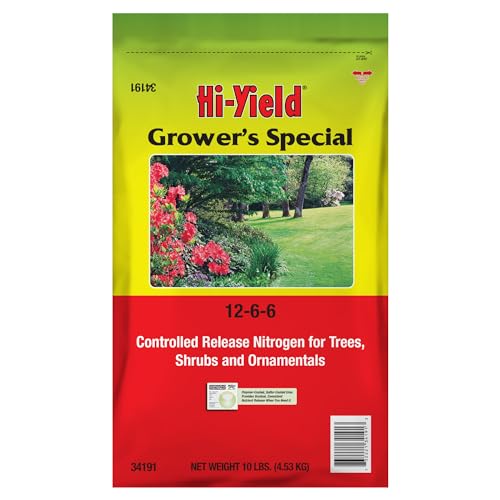
The nitrogen-heavy workhorse that turned magnolias full and crepe myrtles lush.
With a 12-6-6 ratio, this is a high-nitrogen formula designed for trees, shrubs, and ornamentals rather than vegetable fruiting. Slow-release nitrogen reduces the risk of burning plants, which is critical when you are feeding larger perennials that you cannot watch every day. Container plants get a teaspoon per 6-inch pot every 6 weeks, while trees and shrubs need applications only in early spring and late fall.
Buyers who have used Hi-Yield for years consistently call it “the best fertilizer for everything.” The 10-pound bag is a solid value for the nitrogen content, especially for gardeners with several shrubs or a small orchard. The main consideration is that a 12% nitrogen blend is too heavy for tomatoes and other fruiting vegetables — it will push leaf growth at the expense of blooms and fruit. This is a specialist product for foliage and structural growth, not for the vegetable patch.
The niche: ideal for shrub borders, ornamentals, and trees that need a strong green-up in spring. Skip it for your veggie beds unless you specifically need more leaf growth.
7. Supply Solutions 16-16-16 Complete Fertilizer
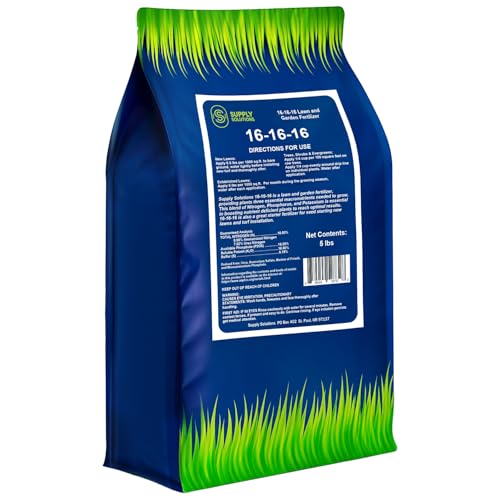
The equal-dose triple-16 that transformed bare-root roses into 6-foot climbers.
An equal 16-16-16 NPK split is about as straightforward as granular fertilizer gets — every number is the same, so you get balanced nutrition for leaves, roots, and blooms. The Supply Solutions bag uses a “Triple 16” formula that excel on lawns and gardens alike. One owner described how weekly feeding of bare-root roses turned them into 6-foot climbers with 3/8-inch wood after a failed expensive rose fertilizer. The same owner reported that hydrangea loved it too.
At 5 pounds, this bag is relatively small for a 16-16-16 product, but the nutrient density means a little goes a long way. The main usability hiccup is that the instructions for setting a spreader are not included, so beginners may need to look up a generic 16-16-16 spreader chart. Because the nitrogen number is high (16), you want to be careful with newly planted seedlings — the risk of burn is real if you overapply. The crowd reports excellent results on established plants and lawns, but it is less forgiving than an organic 4-6-2 for tender transplants.
Great for: established gardens, roses, hydrangeas, and lawns that need an even boost of everything. Not the best pick for brand-new seedlings or container veggies.
8. GreenView Multi-Purpose Fertilizer 10-10-10

The 33-pound bag that handles the whole yard while staying affordable.
When your garden, flower beds, shrubs, and lawn all need feeding, a balanced 10-10-10 formulation is the sensible approach. GreenView packs 33 pounds into one bag, covering roughly 3,300 square feet — enough for an entire suburban lot. Buyers in Hawaii specifically switched to this from a 16-16-16 because the 10-10-10 gave them the same greening effect at a lower cost per nutrient. The granules are well-formed and non-clumping, which makes spreading even and reduces clogging in a broadcast spreader.
The biggest practical plus is convenience: people who cannot lift heavy bags or haul them from the store appreciate Prime delivery straight to the door. The main caveat is that 10-10-10 is a synthetic balanced formula, not organic. If you are committed to building soil microbes and avoiding synthetic chemicals, one of the OMRI-listed organics above is a better fit. Also, the bag is sized for the whole yard — if you only have a few pots, it will take years to use up, and stored fertilizer can absorb moisture and clump over time.
What makes it practical
- Massive 33-pound bag at a very low cost per application
- Balanced 10-10-10 works on vegetables, flowers, trees, and lawns
- Non-clumping, non-dusty granules for clean spreading
Know before you buy
- Synthetic formula — not OMRI listed for organic gardening
- Overkill for small container gardens; best for larger landscapes
9. Jobe’s Organics All Purpose Fertilizer 4-4-4

The 16-pound organic bag that kept neighbors asking how the garden got so good.
For the gardener with a large organic plot, this 16-pound bag of Jobe’s Organics at a 4-4-4 NPK delivers big value. It is OMRI listed, contains no synthetic chemicals, and uses a simple even ratio that works for vegetables, flowers, shrubs, and trees. One owner turned the granules into a liquid tea (1 cup per gallon of dechlorinated water, steeped for 24 hours) and reported that squash plants budded flowers within 48 hours. Another describes the results as so impressive that “neighbors kept asking us how we did it.”
The smell is a factor here — owners compare it to chicken manure, and it lingers for a couple of days after application. The granules themselves are small, dark, and friable, and they break down into humus in about a week. The 4-4-4 ratio is very gentle, so the risk of over-fertilizing is lower than with high-nitrogen synthetics. All of that makes it an excellent choice for beginners who want to go organic from the start but do not want to mess with complex blends.
Pick this if: you have a large garden, prefer organic methods, and want a balanced, forgiving granular that works across your whole yard. The smell is the price of admission, and the bag size means it will last the season.
Understanding the Specs
NPK Ratio
The three numbers (e.g., 5-7-3) represent the percentage of nitrogen (N), phosphorus (P), and potassium (K) by weight. A higher first number (N) fuels leaf and stem growth. A higher second number (P) promotes blooms and fruit set. A higher third number (K) strengthens roots and overall plant immunity. For vegetable gardens, a fertilizer with a middle phosphorus number at least as high as the nitrogen number (like 4-5-6) often yields more fruit than one that is nitrogen-heavy.
Organic vs Synthetic
Organic granular fertilizers use ingredients like bone meal, blood meal, feather meal, and kelp. These feed soil microbes, improve long-term soil structure, and release nutrients slowly. Synthetic granular fertilizers offer precise NPK control and faster results but can degrade beneficial soil organisms over time and may burn plants if overapplied. An OMRI listing means the product meets USDA organic certification standards — a reliable signal for organic gardening.
Calcium Content
Calcium is crucial for preventing blossom end rot, the dark sunken patch on the bottom of tomatoes and peppers. Fertilizers with a stated calcium percentage (like 6% calcium) help crops absorb the mineral even when watering is inconsistent. Container-grown plants are especially prone to calcium deficiency because frequent watering leaches it from the potting mix.
Mycorrhizal Fungi and Soil Microbes
These beneficial microorganisms form a symbiotic relationship with plant roots. The fungi extend the root system’s reach, helping the plant absorb water and nutrients (especially phosphorus) more efficiently. A fertilizer containing mycorrhizal fungi or “active soil microbes” can reduce the amount of fertilizer you need over time, because the plant can access the nutrients already present in your soil.
FAQ
What does 5-7-3 mean on a bag of granular fertilizer?
Can I use a tomato-specific fertilizer on my flowers or shrubs?
How often should I apply granular fertilizer to my vegetable garden?
What is the difference between 4-4-4 and 10-10-10 fertilizer?
Why does my organic granular fertilizer smell so bad?
Can granular fertilizer burn my plants?
Will granular fertilizer work for container vegetables?
What is OMRI listed and why does it matter?
Should I use a balanced fertilizer (10-10-10) or a specialized one (5-7-3)?
How long does it take to see results from granular fertilizer?
Final Thoughts: The Verdict
For most gardeners, the granular fertilizer for garden that earns the top spot is the FoxFarm Happy Frog Tomato & Vegetable 5-7-3 because it pairs calcium for rot prevention with mycorrhizal fungi for better nutrient uptake, and owners consistently report a visible difference in plant health after just one feeding. If your priority is fighting blossom end rot with organic ingredients, grab the True Organic Tomato & Vegetable 4-5-6 with 6% calcium. And for a massive organic garden that needs a gentle, even 4-4-4 feed across the whole season, the Jobe’s Organics 16-pound bag is the smart bulk purchase that keeps your soil alive and your neighbors impressed.
How We Picked
We do not accept paid placement. Every pick is matched to a real buyer and a real use-case; we do not hands-on test units.
Sources & Methodology
Specifications: manufacturer listings and product documentation. Review insights: verified customer reviews, as of July 2026. Pricing: not shown on this page (it changes often); check the current price via the retailer link.
As an Amazon Associate, Lawn Gear Lab earns from qualifying purchases. This does not affect which products we feature.