
Specs are compiled from manufacturer listings and verified buyer reviews and can change over time — please confirm the key details on the product page before buying.
Invasive vines are relentless. Kudzu, poison ivy, wild blackberry, and buckthorn don’t just grow — they strangle your trees, climb your fences, and swallow your yard. The question isn’t whether to fight back, but which chemical will actually reach the root system and stop the regrowth for good. This guide cuts through the noise to find the herbicide that delivers a complete kill.
I’m Rikta — the founder and writer behind Lawn Gear Lab. This guide is built by comparing the manufacturers’ published specifications and the patterns across verified customer reviews, so you get each pick’s real strengths and trade-offs instead of marketing spin.
Whether you are clearing a fence line of wild blackberry or eradicating poison ivy around prized oaks, finding the best herbicide for invasive vines means weighing active ingredients, concentration, and coverage against your specific patch of ground and the trees you want to protect.
Our Picks at a Glance

How To Choose The Best Herbicide For Invasive Vines
Picking the wrong bottle means wasted money and, worse, a vine that bounces back stronger. Prioritize the active ingredient first — glyphosate is a great generalist, but triclopyr is usually the sharper tool for woody, waxy-leaved vines like poison ivy. Next, check for a built-in surfactant. A surfactant (a spreader-sticker chemical that helps the liquid cling to and penetrate the leaf surface) makes a massive difference on vines with thick, water-resistant leaves. Finally, think about delivery: a concentrate stretched over your sprayer covers acres, while a ready-to-use bottle is perfect for spot-treating cut stumps on a Saturday morning.
Active Ingredient: Your Main Weapon
The two heavyweights are glyphosate and triclopyr. Glyphosate is non-selective, meaning it kills almost any green thing it touches, and it moves systemically through the plant down to the roots. Triclopyr is often formulated specifically for woody plants and brush, and it’s especially good on tough vine species. Many of the strongest products blend them or use a high concentration of one. A 41% glyphosate concentrate is the standard for serious work; an 8.8% triclopyr mix like Southern Ag’s is a dedicated vine specialist.
Surfactant: The Sticking Power
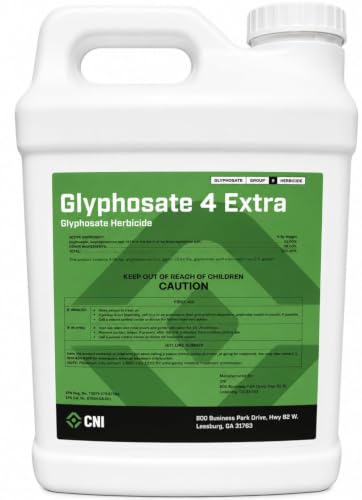
A surfactant is not optional for waxy vine leaves. Without it, the herbicide beads up and rolls off, wasting your effort. Some concentrates (like the Glyphosate 4 Extra) come with a surfactant already loaded in the jug, saving you a mixing step. If a product lacks one, you will need to add a few drops of dish soap or buy a commercial surfactant to make the chemistry work.
Concentrate vs. Ready-to-Use
A 2.5-gallon jug of concentrate can make 50 to 150 gallons of spray mix — the right choice for big acreage, fence lines, or recurring battles with kudzu. A ready-to-use quart bottle costs more per ounce but eliminates mixing errors and is safer for small jobs around desirable plants. If you only have a few poison ivy vines in a corner of the lot, a quart of Brush Killer, Ready to Use is simpler. If you are brushing the whole property line, a concentrate pays for itself quickly.
Quick Comparison
| Model | Best For | Active Ingredient | Liquid Volume | Coverage | Amazon |
|---|---|---|---|---|---|
| Glyphosate 4 Extra★ Best Overall | Large-scale general vine control | 41% Glyphosate | 2.5 gallons | Refer to label | Amazon |
| Image Brush & Vine KillerBudget Champion | Kudzu, poison ivy on a budget | — | 32 oz | 4000 sq ft | Amazon |
| Tordon Rtu Brush KillerStump Stopper | Stump treatment & cut saplings | — | 1 qt | Non-selective broad spectrum | Amazon |
| Southern Ag Brush Killer 8.8% Triclopyr | Tough woody vines & hard-to-control plants | 8.8% Triclopyr | 1 gallon | 4096 sq ft | Amazon |
| Plus Herbicide (Credit 41 Extra) | General weed & blackberry bushes | 41% Glyphosate | 2.5 gallons | 50-1,000 sq ft | Amazon |
| Roundup Pro Concentrate 2.5 gal | Industrial-scale fence lines | Herbicide | 2.5 gallons | Up to 435,600 sq ft | Amazon |
| Roundup Pro Herbicide Industrial 2.5 gal | Industrial & roadside woody brush | Herbicide | 2.5 gallons | 435,600 sq ft | Amazon |
| Remedy Ultra Specialty Herbicide | Rangeland, pasture & fence lines | Herbicide | 1 gallon | Selective brush coverage | Amazon |
| Southern Ag Crossbow Specialty | Tough English ivy, poison oak & blackberry | Garlon, 2,4-D | 128 oz | 2.23 acres | Amazon |
In‑Depth Reviews
1. Glyphosate 4 Extra Herbicide (2.5 Gallons) Glyphosate Concentrate (41%) with Surfactant
Our pick — over 4.5★ from 450+ verified ratings; the strongest balance of quality and price.
The gallon-jug workhorse that owners say beats name brands on both price and punch.
This is the crowd favorite for a reason — a massive 2.5-gallon jug of 41% glyphosate concentrate that already has a surfactant (a sticking agent) blended in. That means you do not need to buy a separate additive to make the chemical grip waxy vine leaves. The concentration is the same active ingredient as Roundup Ultra, buyers report, and at roughly a tenth the per-ounce cost. One owner shared their exact mix: “I mix 2-1/2 oz per gallon of water.” That consistency gives you visible results on most annual weeds in 2-4 days and on deeper-rooted perennials in 7 days or more. The 15-pound jug is a commitment, but the crowd — over 450 ratings — lands at a near-perfect score for a reason. The effectiveness is what wins people over most, with 71 owners singling out how well it works.
A key detail for careful applicators: this is non-selective. It kills any vegetation it touches, so you need to keep it off your grass and ornamentals. The good news, as buyers point out, is that the “fully loaded surfactant system ensures no residual activity remains in the soil,” meaning you can replant areas soon after. Just note that it is not for sale to CA, MT, NV, OR, WA, or WY. For the volume and built-in surfactant, this is the most versatile foundation for a year-round vine war.
What Owners Love
- Built-in surfactant saves a mixing step and improves leaf adhesion.
- Enormous value — makes gallons of spray from a single jug.
- Works on everything from lake lily pads to woody brush.
One Thing to Note
- Non-selective — overspray kills any plant it hits.
- Not shippable to several western states.
Reach for this if: you need to tackle a large area of mixed vegetation and want the most chemical for your dollar with no extra purchases.
Think twice if: you are only treating a few vines around valuable trees — the 2.5-gallon size is more than you need, and a smaller ready-to-use bottle will be simpler.
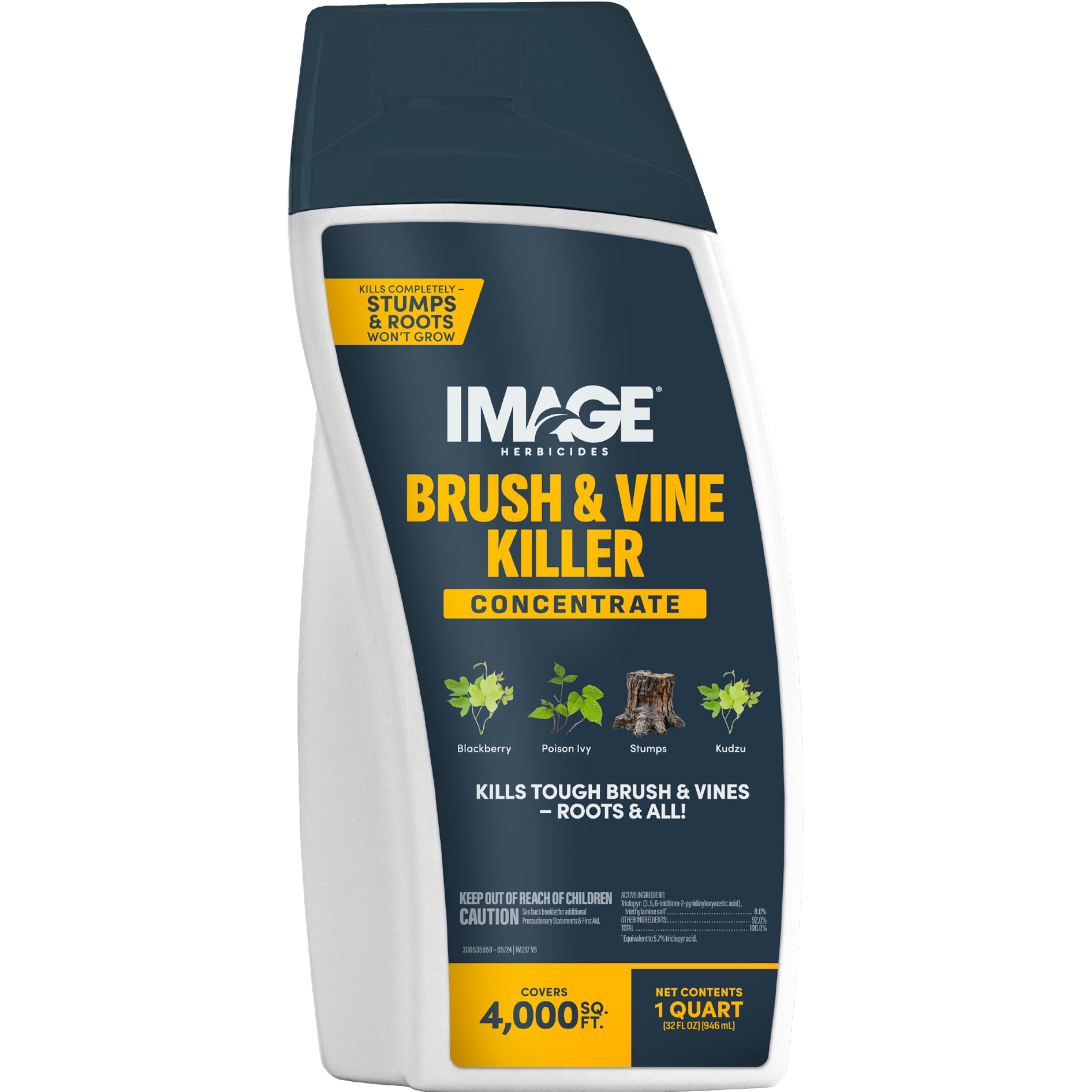
2. Image Brush & Vine Killer Concentrate, 32 oz
The small-bottle specialist that took down Himalayan blackberry and horsetail where others failed.
At just 32 fluid ounces, this concentrate covers up to 4,000 square feet, which puts it in the same coverage ballpark as the larger Southern Ag jug. The difference is the active ingredient mix — Image is formulated specifically for woody brush and vines like poison ivy, poison oak, poison sumac, wild blackberry, and kudzu. The real-world timeline from a buyer who tackled 12,000-15,000 square feet of Himalayan blackberry is instructive: “4oz/gal showed yellowing/wilting after 10+ days, full browning by 4 weeks.” That patience pays off. Another owner found it effective on horsetail weed where everything else had failed, calling it “cost-effective vs. professional service.” The catch is that it lacks a built-in surfactant. Several buyers recommend adding a squirt of dish soap to your sprayer to improve coverage on those slick, waxy vine leaves. Without it, the solution beads up and runs off.
For the price, this is the most targeted chemical on this list for ivy, kudzu, and blackberry specifically. The 2-pound bottle is easy to handle and store, and it works out to a very low cost per square foot. Just budget for an extra surfactant if you want the best results on thick, glossy leaves.
Why It Works
- Labeled specifically for poison ivy, poison oak, kudzu, and blackberry.
- Concentrated formula stretches to 4,000 square feet.
- Proven on the toughest weeds like horsetail where others fail.
One Extra Step
- No surfactant included — you will need to add your own for waxy leaves.
- Results are slow; full browning can take 4 weeks on stubborn species.
Best for: the homeowner with a targeted kudzu or poison ivy problem who wants an affordable, dedicated vine killer.
skip it if: you need instant gratification — this is a slow, thorough killer, not a fast burn-down.
3. Brush Killer, Ready to Use (Tordon RTU)
The ready-to-go fix that owners call “magic” on stumps, buckthorn, and honeysuckle.
This is the grab-and-go weapon for cut-stump treatment. It comes ready to use, so you do not mix anything — you paint or spray it directly onto a fresh cut. The results are dramatic. Owners mention: “Great product. Has helped me get invasive buckthorn and honeysuckle under control. Effectively kills the root on everything I’ve used it on.” It is also effective on mulberry trees and other weed trees that resprout aggressively after cutting. The formula is non-selective and potent, so the clear instruction from owners is to “use carefully.” One buyer found it works well on stumps and appreciates the “great price for the money.”
The trade-off is its size and price per ounce. At 32 fluid ounces (1 quart), it is expensive measured against a concentrate. The crowd also flags value as a mixed point — 6 owners mention it, with some finding it pricey. This is not the bottle for blanketing a hillside of kudzu. But for spot-treating a dozen cut stumps or painting poison ivy stems after you pull them, it is tough to top for convenience and precision. It is the surgical tool in a drawer full of sledgehammers.
Where It Shines
- Zero mixing — simply open and apply to cut stumps or stems.
- Extremely effective on invasive buckthorn, honeysuckle, and weed trees.
- Kills the root system, preventing regrowth.
Where It Falls Short
- Very expensive per ounce compared to concentrates.
- Too small for large-area broadcast spraying of vines.
Perfect for: the methodical gardener who cuts first and treats immediately to stop regrowth.
Not for: anyone hoping to spray a large area of kudzu or blackberry brambles — you need a concentrate for that.
4. Southern Ag Brush Killer 8.8% Triclopyr (Vines, Hard-to-Control Plants, Stump Sprouts), 1 Gallon

The slow-but-certain poison ivy and poison oak killer that customers call the “best” for large bushes.
This is a triclopyr-based concentrate (8.8% active) formulated specifically for hard-to-control woody vines and stump sprouts. It works on a different biochemical pathway than glyphosate, making it an excellent rotation or alternative when weeds start showing resistance to the standard stuff. One buyer who tackled overgrown bushes reported: “Works really well on large bushes that are overgrown. Poor around the trunk and wait a day or two and then cut it down, or cut it down low first to make easier stump removal. Kills the roots!!” Another owner saw no regrowth after 8 months on poison ivy, oak, and briars. It covers 4,096 square feet — nearly identical to the Image concentrate but with a different chemistry that some vines respond to better.
The most-discussed negative is the lack of labeling on the bottle. Several owners received jugs with no directions or ingredient list, which is a genuine safety concern if you are handling concentrated chemicals. While the formula works, the packaging quality control is inconsistent. If you buy this, check the label immediately. The effectiveness is mixed according to the data — 82 owners mention it, but Amazon flags it as mixed, not all positive. That tracks: when it works, it works brilliantly; when you get a badly labeled bottle, it is frustrating. For the price per gallon, it is still a solid value for someone who knows their triclopyr mix rates.
What Impresses
- Triclopyr formula excels on poison ivy, oak, and woody brush.
- One gallon makes up to 128 fluid ounces of spray mix for large jobs.
- Buyers confirm no regrowth for months on treated stumps and vines.
The Recurring Problem
- Frequently ships without any product labeling or mixing directions.
- Slow acting — takes 2-3 weeks for full kill.
Best for: the experienced user who already knows triclopyr rates and wants a dedicated brush killer for poison ivy and briars.
Look elsewhere if: you need clear, printed instructions on the bottle — the lack of labeling is a recurring frustration.
5. Plus Herbicide – 41% Glyphosate with Surfactant – 2.5 Gallon Credit 41 Extra

The cheaper cousin that owners say matches Roundup performance on blackberry and sticker bushes.
Another 41% glyphosate concentrate with a built-in surfactant, this one from the Alligare brand. The label recommends a general application mix of 2 ounces per gallon of water. Buyers are clear: “This works just as good as Roundup at a much cheaper price.” One owner who went after blackberry bushes was emphatic: “This stuff killed all my sticker bushes and weeds.” The surfactant is already in the jug, so you spray with confidence that the liquid will cling to the leaf. The effectiveness is the standout — 85 owners mention it as a positive, the highest count of any aspect. It shares the same 2.5-gallon size and 320-ounce unit count as the Glyphosate 4 Extra, making it a direct alternative.
The main complaint is a packaging issue: several buyers received jugs with silicone sealant around the cap, making it extremely difficult to open. One owner had to filter out silicone from the jug before using it. That is a frustrating annoyance for a 2.5-gallon purchase. The factory quality control on the cap seal is clearly a rougher process than the name-brand jugs. If you grab this one, be prepared with a pair of pliers and a strainer. The chemistry is sound, the price is right, and it works aggressively.
High marks on chemistry: The 41% glyphosate with surfactant is proven on blackberry bushes, poison ivy, and general weeds. Owners consistently call it a Roundup clone at a discount. But check the cap: silicone sealant in the threads is a recurring headache that can make your first use messy.
Perfect for: the budget-conscious landowner who wants a big jug of name-brand-equivalent chemistry and can handle a sticky cap.
pass on it if: you loathe packaging hassle or need a pristine user experience from the start.
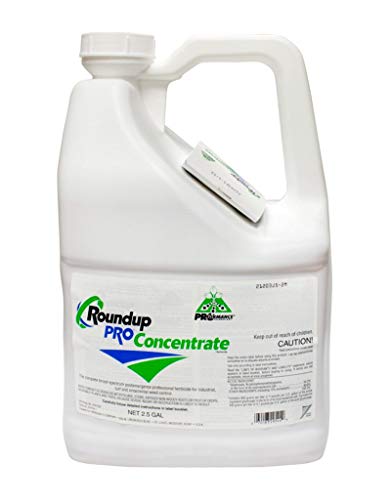
6. Roundup Pro Concentrate Herbicide – 1 jug (2.5 gal.)
The super-concentrate that stretches to cover miles of fence line for under a hundred bucks.
This is the pro-grade Roundup concentrate, and the numbers are staggering. One 2.5-gallon jug can make approximately 150 gallons of standard spray mix or about 30 gallons of super-strength mix for heavy brush. The label says coverage is up to 435,600 square feet — that is 10 acres. Owners confirm it: “Makes many gallons of concentration. Works all season.” The active ingredient profile is the same proven glyphosate chemistry, and it is a super concentrate, meaning you use less per gallon of water than the standard 41% mixes. One reviewer noted the pump on the jug “pumps out exactly 1oz of product,” which makes measuring easy. Roundup Pro is not for sale to Wisconsin or New Jersey, so check your location.
The main drawback is the physical heft. The jug is heavy when full, and without a proper pump spigot, pouring it into a smaller container is awkward. Owners recommend buying a 63mm hand pump separately. Also, at this concentration, safety gear is non-negotiable — gloves, long sleeves, and eye protection are mandatory. This is not a casual weekend sprayer; it is a serious tool for a serious job. If you have multiple miles of fence line or a large pasture overtaken by vines, the cost per gallon of mixed spray is the lowest you will find.
Unbeatable for volume: covers up to 435,600 square feet per jug, making it the absolute champion for large properties. But you need a pump: the heavy jug requires a separate hand-pump spigot for easy dispensing, and the super-concentrate demands careful mixing.
Reach for this if: you are managing a farm, ranch, or multi-acre property with serious vine encroachment.
Pass on this if: you are treating a suburban backyard — the size and mixing complexity are overkill.
7. Roundup Pro Herbicide Industrial Weed Control for Annual and Perennial Weeds such as Woody Brush, Trees, and Vines, 2.5 Gal.

The most potent Roundup variant owners have found — one user killed tree roots in a single day.
This is the highest-concentration Roundup on the list, clocking in at 50.2% glyphosate-isopropylammonium. That extra potency matters when you are facing deep-rooted woody brush, trees, and vines along roadsides, utility rights-of-way, and fence lines. The data sheet lists it for industrial, turf, ornamental, forestry, and railroad management use. The result is dramatic: one owner reports it “kills cottonwood root sprouts under driveway in one day, no re-treatment needed.” The general consensus is that visible effects show on most annual weeds in 2-4 days and most perennial weeds in 7 or more days. It covers the same 435,600 square feet as the standard Roundup Pro but with a higher concentration of active ingredient.
The effectiveness is the most-discussed aspect — 158 owners mention it, the highest count of any aspect across all products in this guide. Owners also strongly praise the value for money (71 mentions). The main caution is drift. Because it is so potent, any overspray on desirable plants or trees is lethal. The product dries in about 3 hours, which is excellent for rainy climates. Check the expiration date on the jug when it arrives; one owner received a bottle that expired in 60 days. For the absolute strongest off-the-shelf Roundup, this is the pick.
The Heavy Hitter
- Highest glyphosate concentration at 50.2% for maximum penetration of woody vines.
- Industrial coverage: up to 435,600 square feet per jug.
- Customers note one-day kill on root sprouts that normally require re-treatment.
The Catch
- Drift risk is serious — this kills any plant it touches.
- Jug size and weight (20 pounds) require a separate pump and careful handling.
Best for: the property owner facing really stubborn woody vines and tree sprouts who needs the most concentrated chemical available.
Not for: beginners or small-yard treatments — the potency and drift risk demand experience and caution.
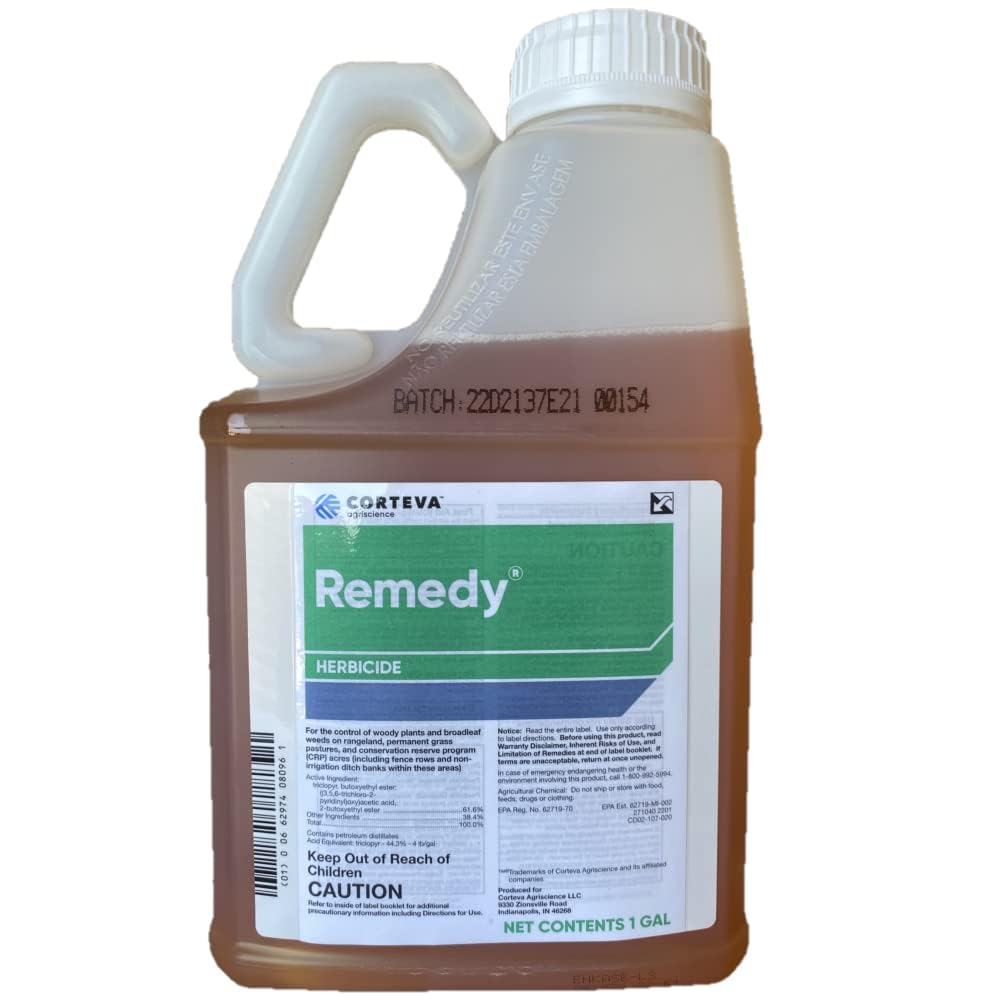
8. Remedy Specialty Herbicide Weed Killer & Brush Control, Triclopyr Concentrated, 1 Gallon
The selective brush killer that takes down multiflora rose and locust thorns without harming your pasture grass.
Remedy Ultra is a major brand in range and pasture management, and its big selling point is selectivity. It targets broadleaf brush and woody plants while leaving grass alone. The data says it is “safe to use around children and pets when applied according to the product label.” One owner who manages a Florida lawn reports it kills weeds without harming the grass. The typical mix for pasture trees and brush up to 5 feet tall is 4.5 cups to 26 gallons of water. The root kill takes about a week. For basal bark application on trees up to 2-3 inches in diameter, the trick is “1 part Remedy to 3 parts diesel on sprouts.” That kills the root system and prevents resprouting.
The biggest advantage here is the low odor. Compared to some other brush killers, Remedy is less pungent, which makes large-area application more tolerable. It is also labeled for use around sensitive areas like ponds and fence lines. The main cost is the price — it is a premium product. But as one owner who conquered cogon grass put it, “absolutely annihilated my cogon grass problem. I paid close to USD 100, which seems expensive,” but they were satisfied. If you need to reclaim pasture or fence lines from woody brush and blackberry without nuking your grass, this is the right tool.
Key strength: selective action kills brush without harming grass, making it ideal for pasture and fence-line maintenance. The price is real: it is among the most expensive jugs here, but owners who need its selectivity find it worth every penny.
Best for: the farmer or rancher who needs to clear brush from grazing land without damaging the pasture.
Not the pick if: you are spot-treating a few poison ivy plants in your yard — a cheaper, non-selective concentrate will do the job.
9. Southern Ag Crossbow Specialty Herbicide Low Volatile Weed & Brush Herbicide, 128oz – Gallon

The glyphosate-free alternative that owners call “super effective” on English ivy, poison oak, and blackberry.
Crossbow is a blend of two active ingredients — Garlon and 2,4-D — with zero glyphosate. That makes it a different tool entirely. Reviewers point out it works exceptionally well on tough-to-kill English ivy and poison oak. One owner notes it has a “3-day soil half-life” and is safe for bees when used as directed, making it a more environmentally conscious choice if you are concerned about glyphosate and neonicotinoids. It makes up to 96 gallons of spray solution from a single gallon jug, covering a massive 2.23 acres. That is the largest coverage of any product on this list. The formula is low-volatile, meaning less drift, which is critical when you are spraying near desirable shrubs and trees. One owner reported complete die-off of ivy, vines, 8-foot weeds, and small trees within 48 hours, with full kill in a week.
The downsides: it is expensive per gallon, and results can vary by soil type and weather. One buyer saw 85-95% kill on creeping Charlie in Ohio but only 30-60% in Illinois, blaming rich black soil and rain. The strong odor is another common complaint, though it dissipates. The owners who love it really love it — the effectiveness is the top aspect, with 123 positive mentions. If you are battling English ivy on a large property or need a non-glyphosate option for sensitive areas, Crossbow is a specialist that earns its premium price.
The Standout Feature
- Glyphosate-free formula is selective for broadleaf weeds and woody brush.
- Covers 2.23 acres per gallon — the highest coverage in this guide.
- Shoppers say visible results in 48 hours on ivy and poison oak.
The Honest Trade-Offs
- Strong chemical odor during application.
- Performance can vary significantly based on soil type and rainfall.
- Premium price per gallon compared to glyphosate-only concentrates.
Perfect for: large properties fighting English ivy, poison oak, or blackberry where you want a non-glyphosate option with massive coverage.
it’s not for you if: you are on a tight budget or only treating a small area — the Southern Ag Brush Killer or Image concentrate will do the same job for less.
Understanding the Specs
Glyphosate 41% vs Triclopyr 8.8%
Glyphosate at 41% concentration is the standard go-to for non-selective, systemic weed control. It kills the whole plant by blocking an enzyme essential for growth, and it works on nearly every green thing. Triclopyr at 8.8% is a different chemical family that targets woody plants and brush more specifically. Where glyphosate is a sledgehammer, triclopyr is a chisel — it is often more effective on waxy-leaved, tough-to-kill vines like poison ivy, oak, and sumac. The right choice depends on what you are spraying. For mixed vegetation, a high-concentration glyphosate with surfactant is your best bet. For dedicated woody brush, triclopyr is often the sharper tool.
Surfactant: Why It Matters
A surfactant is a chemical added to the herbicide mix that reduces surface tension on the leaf, helping the liquid spread out and stick instead of beading up and rolling off. Vines like poison ivy and kudzu have naturally waxy, water-resistant leaves. Without a surfactant, a significant portion of your spray drips to the ground and never penetrates. Some concentrates, like the Glyphosate 4 Extra and the Plus Herbicide, come with surfactant already in the jug. Others, like the Image Brush & Vine Killer, do not. If your chosen product lacks it, add a few drops of dish soap or buy a commercial non-ionic surfactant. It is the difference between a 50% kill and a 95% kill.
FAQ
Which active ingredient is best for killing poison ivy vines?
What does a surfactant do and do I really need it?
Can I spray herbicide on vines without harming nearby trees?
How long does it take for herbicide to kill invasive vines?
What is the difference between a concentrate and ready-to-use herbicide?
Is it safe to use herbicide around pets and children?
Why is some herbicide not available in my state?
Can I use a brush killer on my lawn without killing the grass?
How much herbicide do I need to cover an acre of kudzu?
What is the best time of year to spray invasive vines?
Final Thoughts: The Verdict
For most buyers, the herbicide for invasive vines winner is the Glyphosate 4 Extra because it gives you the highest concentration of glyphosate (41%) with a built-in surfactant in a 2.5-gallon jug that earns a near-perfect crowd score. If you want a dedicated brush killer for poison ivy and blackberry on a budget, grab the Image Brush & Vine Killer. And for the absolute strongest Roundup available — 50.2% concentration — the Roundup Pro Industrial is the one to reach for.
How We Picked
We do not accept paid placement. Every pick is matched to a real buyer and a real use-case; we do not hands-on test units.
Sources & Methodology
Specifications: manufacturer listings and product documentation. Review insights: verified customer reviews, as of July 2026. Pricing: not shown on this page (it changes often); check the current price via the retailer link.
As an Amazon Associate, Lawn Gear Lab earns from qualifying purchases. This does not affect which products we feature.