
Specs are compiled from manufacturer listings and verified buyer reviews and can change over time — please confirm the key details on the product page before buying.
Fertilizing a fruit tree shouldn’t feel like a chemistry experiment. You already know your trees need a spring and fall feeding, but mixing, measuring, and worrying about runoff turns a simple chore into a weekend project. That is where fruit tree spikes come in — pre-measured sticks you hammer into the soil around the drip line, releasing nutrients straight to the roots with zero mess and zero guesswork.
I’m Rikta — the founder and writer behind Lawn Gear Lab. This guide is built by comparing the manufacturers’ published specifications and the patterns across verified customer reviews, so you get each pick’s real strengths and trade-offs instead of marketing spin.
Every spike here has been put through its paces by real owners — from single backyard Meyer lemons to multi-tree orchards — and the crowd favorite (4.6 stars across nearly 700 owners) makes a strong case for itself, but the right choice depends on your tree count, your soil, and if you want synthetic speed or organic confidence. Understanding which fruit tree spikes actually deliver on their promises depends on three things: the NPK ratio, the release mechanism, and the sheer number of spikes per dollar.
Our Picks at a Glance


How To Choose The Best Fruit Tree Spikes
The first number to look at is the NPK ratio — the three hyphenated numbers on the package (like 8-11-11). The first number (N for nitrogen) drives leaf and branch growth. The second (P for phosphorus) powers root development and flowers. The third (K for potassium) boosts fruit size and disease resistance. A citrus tree that needs more blossoms will want a higher middle number, while a young tree still building its canopy benefits from more nitrogen.
Spike Count and Scale
A single spike usually feeds one small tree for a season. A 5-count pack covers a couple of dwarf trees. A 70-count case is for a serious orchard. Count your trees and the spacing instructions (typically 2-4 spikes per tree, applied twice a year) before picking a pack size — buying too few means an extra order, and buying too many means storing spikes that might crumble before next season.
Synthetic vs Organic
Synthetic spikes like the Miracle-Gro 10-15-15 formula deliver a fast, predictable nutrient hit and are often reinforced so they don’t shatter when you hammer them into dry soil. Organic spikes like Jobe’s Organics with Biozome use microbial action to break down nutrients more slowly, improving long-term soil health and carrying an OMRI-listed certification for organic gardening. The trade-off is speed versus sustainability — synthetic shows results within weeks, organic builds the soil over seasons.
Quick Comparison
| Model | Best For | NPK Ratio | Spike Count | Spike Weight | Amazon |
|---|---|---|---|---|---|
| Miracle-Gro 12-Pack★ Best Overall | Best Overall | 10-15-15 | 12 | 16 oz | Amazon |
| Jobe’s 5-CountQuick Results | Quick Results | 8-11-11 | 5 | 0.4 kg | Amazon |
| Jobe’s Organics 6-PackOrganic Choice | Organic Feeding | 3-5-5 | 6 | — | Amazon |
| Jobe’s 5-Count Slow Release | All-Round Balance | 9-12-12 | 5 | 16 oz | Amazon |
| Power Spike 10-Pack | Deficiency Correction | — | 10 | 3.2 lb | Amazon |
| Miracle-Gro 24-Spike (2-Pack) | Multi-Tree Groves | 10-15-15 | 12 per pack | 3 lb each | Amazon |
| EarthPods 100 Capsules | Potted & Dwarf Trees | — | 100 | 3.9 oz | Amazon |
| Winchester Gardens 70-Pack | Home Orchards | 8-18-18 | 70 | 18 lb | Amazon |
| SimplyGro 72-Pack | Large Scale Feeding | 8-4-8 | 72 | 18 lb | Amazon |
In‑Depth Reviews
1. Miracle-Gro Fertilizer Spikes for Fruit and Citrus Trees, 12-Pack
Our pick — over 4.5★ from 650+ verified ratings; the strongest balance of quality and price.
The spike that turned a spring feeding into a fruit explosion by late May.
For a straight-up, no-nonsense fertilizer spike that the majority of owners swear by, the Miracle-Gro 12-Pack hits the balance. It carries a 10-15-15 NPK formulation designed specifically for the nutrient demands of fruit and citrus trees — pushing phosphorus and potassium over nitrogen to prioritize blossoms and fruit over leafy growth. The routine is dead simple: use spikes once in spring and again in fall, driving them into the root zone around the drip line.
Buyers report genuinely dramatic turnarounds. The crowd consensus is that this product “promotes lush foliage and enhanced fruit production” — and the results back it up. One long-time user described “massive amounts” of fruit starting to appear within about 6 weeks of an early April application. The easy-to-use nature is a recurring theme, with buyers noting it is “easier than liquid fertilizer” and that you can “put the spikes in and forget it for several months.” The main caveat is physical durability: spikes are brittle and around half can arrive cracked. Owners say you can salvage them with a spade, but it is worth expecting some breakage in transit.
Why Owners Keep Buying
- Proven blossom-to-fruit results — “lots of fruit starting on the trees” within weeks
- Twice-a-year schedule fits any routine, no mixing or measuring
- 12 spikes cover several small to medium trees for a full season
The One Real Trade-off
- Spikes arrive brittle and often cracked; have a spade ready for salvage
- Synthetic formula, not suitable for organic gardening certifications
Reach for this if: you want a proven fruit-boosting spike with a simple seasonal schedule and don’t mind handling a few broken sticks.
Look elsewhere if: you need an OMRI-listed organic feed, or you have very dry, hard soil that would shatter these further on insertion.
2. Jobe’s Garden Fertilizer Spikes, Easy Plant Care Slow Release, 5 Count
The spike that made a barren pomegranate tree flower in under two weeks.
Jobe’s 8-11-11 formulation tilts even harder toward phosphorus than the Miracle-Gro, making it a strong contender if your tree’s problem is poor flowering or fruit set. The 5-count pack is an economical entry point for owners with one or two small trees, and the slow-release design prevents the wasteful runoff and mess that liquid fertilizers cause. Application is simple: drive the spike into the soil around the drip line twice a year — early spring and late fall — or as needed during the growing season.
The real-world stories from owners are hard to ignore. A pomegranate tree that had sat fruitless and flowerless for several years saw blossoms within two weeks of hammering in one of these spikes. Meyer lemon trees that had never fruited started producing buds and flowers the same season. Growth is the most-praised aspect by a clear margin, with ease of use and quality tied close behind.
Why Gardeners Reach for This
- High phosphorus (11) targets flower and fruit development directly
- “Within two weeks flowers started appearing” on previously barren trees
- No measuring, no mixing, no smell — true set-and-forget simplicity
Know Before You Buy
- 5 spikes per pack means frequent reorders for multi-tree owners
- Not an organic formulation — lacks microbial soil-building additives
Grab it for: one or two citrus or fruit trees that need a flowering kickstart and you want to see results fast.
skip it if: you run a home orchard with several trees — you will need multiple packs or the larger count versions from Jobe’s.
3. Jobe’s Organics Fruit & Citrus Tree Fertilizer Spikes, 3-5-5, 6 Spikes
The OMRI-listed spike that turns a Meyer lemon into a 60-70 bloom powerhouse.
If organic certification matters to you, Jobe’s Organics is the spike to beat. The 3-5-5 NPK ratio is deliberately lower in nitrogen, formulated for in-ground citrus and fruit trees where you want to avoid forcing leaf growth at the expense of fruit. The secret weapon here is Jobe’s Biozome — a proprietary microorganism archaea that aggressively breaks down organic material for faster results while improving soil conditions and helping trees resist disease, insects, and drought.
Owners of potted Meyer lemon trees report “an abundance of juicy, sweet lemons every year” using this spike. One detailed account describes 60-70 blooms appearing within 7-10 days after application, which explains why effectiveness and bloom growth are the top two praised aspects. The pre-measured spikes prevent waste and runoff, and the OMRI listing means no synthetic chemicals touch your soil. The main complaint is the price per spike compared to synthetic alternatives, and some wish there were more than 6 spikes per bag — you will need multiple packs for more than two trees. Timing and spacing matter; owners who ignored the placement instructions initially saw no results until they followed the guidelines.
Why Organic Growers Love It
- OMRI listed for organic gardening — “no synthetic chemicals” per the manufacturer
- Biozome microbes improve soil health and disease resistance long-term
- Blooms reported within days — “60-70 blooms within 7-10 days” from one owner
The Honest Trade-off
- Higher cost per spike than synthetic options
- Only 6 spikes per pack means larger orchards need multiple purchases
Choose this for: organic gardeners who want soil-building microbes and proven bloom results from a certified organic spike.
Not the one if: you are on a tight budget for a large number of trees — the per-spike cost adds up fast.
4. Jobe’s 01002 Fertilizer Spikes, Fruit and Citrus, 5 Count

The 9-12-12 spike that perked up a neglected orange tree in two months flat.
Jobe’s 01002 sits in a different NPK bracket than the others — 9-12-12, with the highest potassium in the lineup. Potassium is the nutrient most responsible for fruit size, disease resistance, and winter hardiness, so this spike is a smart pick if your tree already has good leaf cover but the fruit is small or the tree looks stressed after a cold season. It works on apple, orange, lemon, grapefruit, mango, and more — targeting the dripline for slow-release feeding that prevents wasteful runoff.
One owner described an orange tree that had not been fed for years. After placing spikes around the tree a few inches deep and a foot or two from the trunk, the leaves looked noticeably better within two months, and the next harvest surpassed anything in recent memory. The tree health improvement and overall effectiveness are the most frequently praised aspects. The slow-release mechanism means you “put the spikes in and forget it for several months,” which owners appreciate for its convenience.
Why This Stands Out
- Potassium content (12) supports fruit size and stress recovery
- Works across a wide range: “Apple, Orange, Lemon, Grapefruit, Mango and more”
- Owners saw leaves perk up and harvests improve within 2 months on neglected trees
What Limits It
- 5 spikes disappear fast with multiple trees
- Not organic — synthetic formulation
Best for: reviving an older, underfed fruit tree where you want to see leaf and fruit improvement within a single growing season.
Think twice if: you need an organic-certified product, or you have more than two trees and want a pack size above 5.
5. Power Spike for Fruit Trees, 10 Spikes, 3.2 Lbs
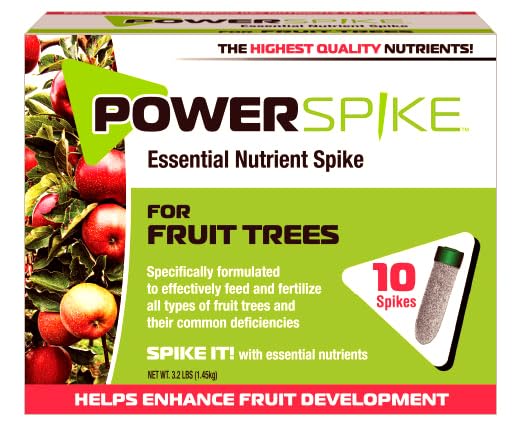
The targeted spike that packs key nutrients commonly missing in backyard soil.
Power Spike approaches tree feeding from a slightly different angle — it describes itself as a “combination fertilizer and nutrient spike” packed with elements that are “commonly deficient in fruit trees.” The 10-spike count at 3.2 pounds makes it a mid-sized option that covers more ground than a 5-pack without jumping to a full case. The included pounding cap is a small but useful addition, protecting the spike head when you hammer it into tough soil. It feeds at the root zone for effective uptake by feeder roots, targeting apple, pear, peach, plum, and all types of fruit trees.
Owner reports are positive but mixed in specificity. Several note that the trees “look really good and growing well” after use, and one enthusiastic report mentioned a healthy tree yielding 96 pieces of fruit on the first try. Effectiveness and plant health are the two aspects praised most equally, though at lower mention counts than the bigger brands. The drawback is inconsistency — a few owners felt the spikes did not have the effectiveness their trees needed, suggesting this spike works best as a general maintenance boost rather than a rescue product for severely deficient trees. It is a solid mid-tier option that competes well on value per spike but lacks the massive owner consensus of the top picks.
What Works for Owners
- 10 spikes at 3.2 lb offers more coverage than entry-level 5-packs
- Includes a pounding cap for easier soil insertion
- Formulated to address “commonly deficient” trace elements in fruit trees
Where It Comes Up Short
- Mixed owner results — some saw no improvement for their trees
- Lower review volume means less data on long-term performance
Pick this for: routine maintenance feeding on healthy trees where you want extra micronutrients and don’t need a targeted NPK ratio.
pass on it if: your tree has a specific deficiency or you need the proven track record of a top-rated spike with thousands of reviews.
6. Miracle-Gro Fruit & Citrus Plant Food Spikes, 12 Spikes, 3 lb (2-Pack)
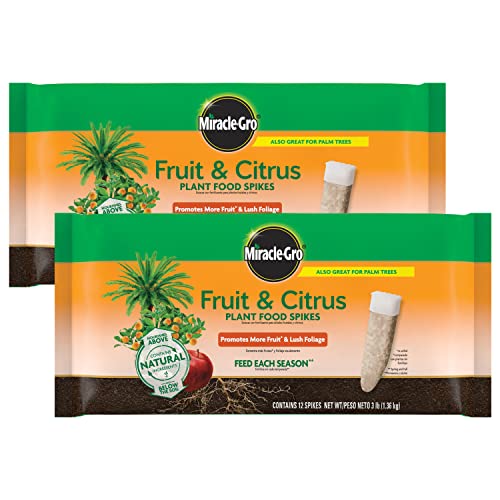
Double the 10-15-15 feeding power for larger groves that need continuous nutrition.
This is essentially the single 12-pack from product #1 doubled into a 2-pack bundle, giving you 24 spikes across 6 pounds of fertilizer. The 10-15-15 NPK formulation is identical — pushing fruit production and lush foliage over leaf growth — and the application schedule is the same simple twice-yearly routine (early spring and mid-fall). The manufacturer also notes this formula works great on palm trees, broadening its use beyond the fruit tree category. Each 3-pound package holds 12 spikes, and the instructions recommend driving them below the soil surface around the dripline using a rubber mallet or by stepping on them.
Owner experiences echo the single-pack version: trees bloom more heavily, fruit is consistently sweet, and the convenience of a seasonal feeding routine is widely appreciated. One owner who uses them every fall “on all of my fruit trees” reports “lots of fruit, and always sweet.” The bundle is particularly smart if you have 4-6 trees and want to buy once for the full year without reordering mid-season. The same caveat applies — the spikes are brittle and a few owners noted breakage during insertion, though they were willing to overlook it given the results. The 2-pack format also makes this the most economical route if you are already committed to the Miracle-Gro system.
Why the Bundle Wins
- 24 spikes total covers 4-6 trees for a full spring and fall cycle
- Same proven 10-15-15 formula that owners call “lots of fruit, always sweet”
- Also formulated for palm trees, adding versatility beyond fruit trees
One Thing to Watch
- Spikes can break during insertion in hard or dry soil
- Heavy bundle — 6 pounds total — more storage space needed
Get this if: you already trust Miracle-Gro spikes and have multiple trees to feed — the 2-pack saves you a reorder mid-season.
Not for you if: you have just one small tree and the 12-pack from product #1 is already more than you need.
7. Earth Pods Organic Citrus Fertilizer, 100 Capsules
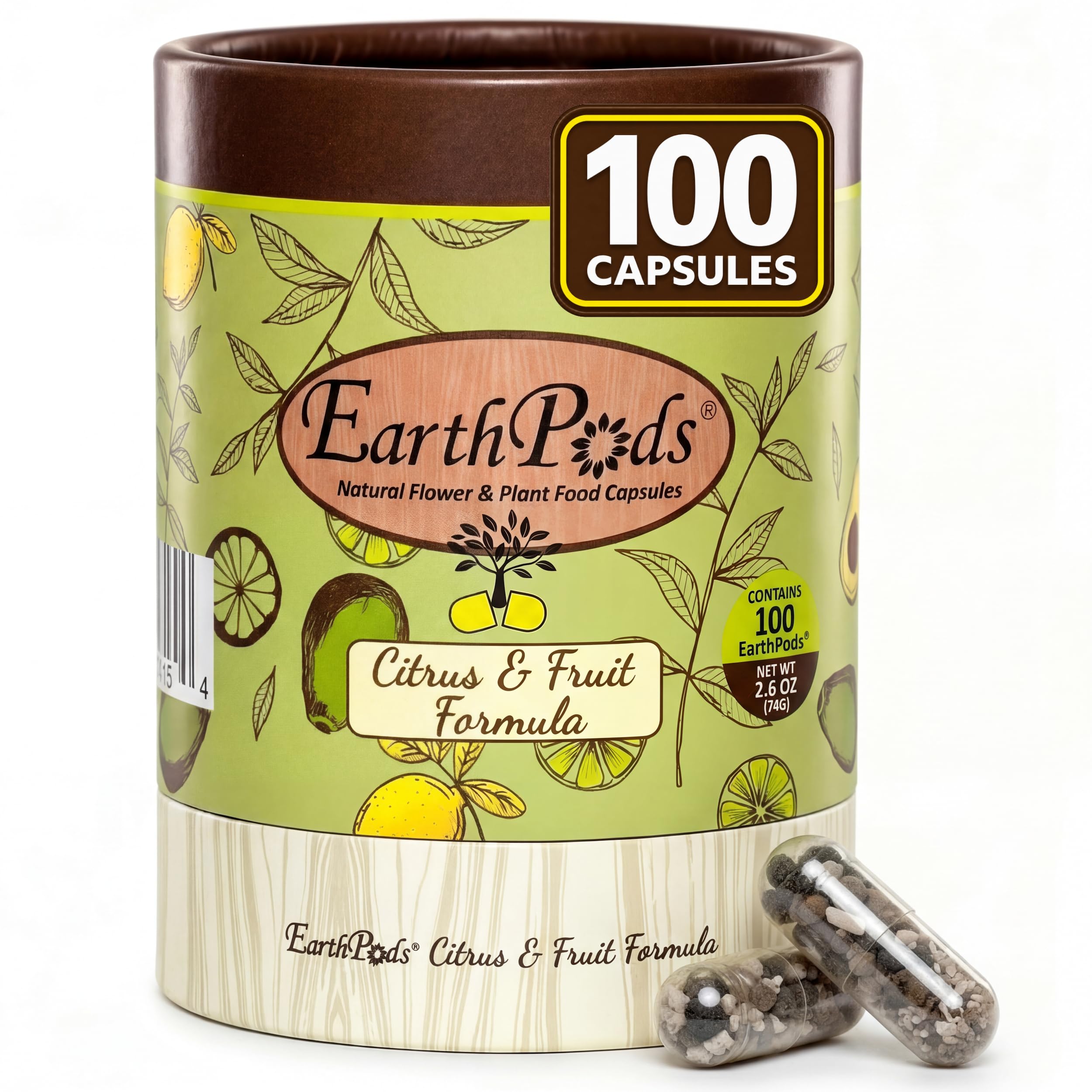
100 capsules that feed a potted lemon tree for up to four years — no mixing, no mess.
Earth Pods breaks the spike mold entirely. Instead of a single solid stick, you get 100 concentrated organic fertilizer capsules that you push into the potting soil near the trunk — a process that takes about 5 seconds per capsule. The formula uses worm castings, humic acids, kelp, rock minerals, and beneficial soil biology, all hand-made in small batches at a USA facility. It is designed specifically for container and dwarf fruit trees: Meyer lemon, lime, orange, kumquat, avocado, dwarf banana, and potted berry plants. The manufacturer claims a single tube can last up to 4 years for one small potted tree, using 2-4 capsules every 2-3 weeks during the growing season.
Owner reports are enthusiastic, especially for indoor and patio citrus. Multiple owners describe “dramatic new growth” and plants that were “thriving” after starting the capsule regimen. The plant growth and ease of use are the top praised aspects. The capsule format is gentle — “no harsh salts, won’t burn roots when used as directed” — and is vegan-friendly, recyclable, and free of single-use plastic. The value-for-money perception is mixed: owners agree it works great but some find it “pricey for the amount you get,” especially if you have multiple large trees rather than a single dwarf specimen. This is a premium product for the enthusiast who wants organic, targeted, long-term feeding for their potted fruit tree collection.
What Makes It Unique
- 100 capsules can last up to 4 years for one small potted tree
- Organic ingredients: worm castings, humic acids, kelp, rock minerals
- “No harsh salts, won’t burn roots” — safe for container-grown trees
The Catch
- Higher upfront cost than traditional spike packs
- Best suited for small potted trees, not in-ground orchard feeding
Ideal for: the indoor or patio gardener with a single Meyer lemon or dwarf fruit tree who wants fuss-free, organic feeding for years.
Not the pick if: you have in-ground trees or a large orchard — the capsule format is designed for container feeding, not broad soil coverage.
8. Landscaper Pack Fruit and Citrus Fertilizer Spikes, 8-18-18, 70 Spikes

70 spikes with the highest phosphorus-to-nitrogen ratio for massive blossoms.
This is the volume play for the serious home orchardist. Winchester Gardens packs 70 spikes per case at an 8-18-18 NPK ratio — the most extreme phosphorus and potassium boost in this lineup. With nitrogen intentionally low, this spike is designed to push flower development and fruit production without encouraging excessive leafy growth. The spikes are child and pet-friendly, pre-measured to prevent waste, and come with less packaging than individual retail boxes. At 18 pounds total, this is a substantial case that will feed dozens of trees through a full season.
Owners with large properties have reported excellent results. One owner with a Midwest orchard of around 50 trees described this as the “perfect formula” for fruit trees, noting a low nitrogen ratio is ideal for boosting flowering and fruit over foliage, and called their apple harvest “the best ever” the season after switching. Citrus trees that took a winter hit bounced back well, with owners confident the sticks “will promote a good comeback.” Effectiveness and value for money are the two most praised aspects, with ease of use close behind. The one recurring issue is physical installation — the spikes are hard to drive into dry ground. Owners recommend installing after rain or in moist spring soil for the easiest insertion.
Why Orchard Owners Rely on It
- 70 spikes cover an entire home orchard — one owner runs about 50 trees
- 8-18-18 ratio is the most aggressive bloom and fruit booster here
- Described as “economical solution for fruit tree care” by owners
Consider This First
- Difficult to install in dry soil — best applied after rain or watering
- 18-pound case is heavy and requires storage space
Buy this for: any serious orchard with multiple trees where you want the best per-spike value and a bloom-focused NPK profile.
Too much if: you have one or two trees — the 70-count will take years to use and spikes can degrade.
9. SimplyGro Fertilizer Spikes for Citrus & Fruit Trees, 72 Spikes, 18 Lbs
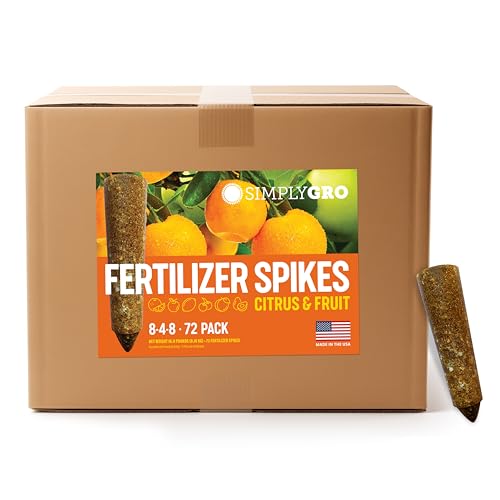
The broken-spike-proof TruSpike that brought an orange tree back from the brink.
SimplyGro’s 72-spike case takes a different NPK approach with an 8-4-8 formula — higher in nitrogen than the Landscaper Pack, making it better suited for young trees still building canopy or trees recovering from stress. The headline feature is the patented TruSpike design: the manufacturer guarantees these spikes “will NOT break, crush or smash,” eliminating the brittleness issue that frustrates owners of other brands. Each 5-inch spike feeds continuously for up to 3 months, with application recommended twice a year (spring and fall). The formula covers citrus, fruit, berry, nut, and decorative trees and shrubs.
Owner stories here are genuinely dramatic. One owner described an orange tree that produced zero fruit for a full year, with a lime tree they thought was dead. A few months after using these spikes, the orange tree was producing oranges and the lime tree started coming back. Another owner called it the “biggest box of fertilizer I’ve ever purchased” and reported tree growth beginning to “grow twice as fast.” Plant health and effectiveness are the top praised aspects, with ease of use close behind. The 72-count at 18 pounds is a serious commitment in both storage space and upfront investment, but for owners with large properties or multiple trees, the per-spike cost becomes very attractive. The TruSpike design is a genuine differentiator — no broken spikes, no salvage operations.
The Big Advantages
- TruSpike design guaranteed not to break, crush, or smash — unlike every other spike
- 72 spikes at 18 lbs covers a large orchard; “biggest box of fertilizer I’ve ever purchased”
- Real turnaround stories — a dead lime tree revived and orange tree fruited after months
Worth Knowing
- Nitrogen at 8% — better for young or stressed trees
- Large case requires significant storage space and upfront investment
Reach for this if: you have a larger property or multiple recovering trees and the unbreakable spike design matters to you.
Not the one if: you only have 1-2 small trees and don’t want to store 18 pounds of fertilizer spikes.
Understanding the Specs
NPK Ratio — The Three Numbers
The only spec that matters most on a fertilizer spike package. The first number (Nitrogen) drives leaf and stem growth. The second (Phosphorus) fuels root development and flower production. The third (Potassium) supports fruit size, disease resistance, and winter hardiness. A ratio like 10-15-15 pushes fruit, while 3-5-5 is gentler for organic soil-building. Match the ratio to your tree’s current need — high nitrogen for young saplings, high phosphorus and potassium for established bearing trees.
Slow Release vs Time Release
Every spike here is a slow-release product, meaning nutrients dissolve gradually as moisture moves through the soil. “Time release” means the manufacturer has engineered a specific release window — often 2-3 months or up to a full season per spike. This is why you only need to apply spikes twice a year (spring and fall). The advantage over granular or liquid fertilizer is zero guesswork: the spike sits at the root zone and feeds steadily, with no risk of over-fertilizing or runoff into local waterways.
Spike Count and Scale
Know your tree count before you buy. A single 12-pack covers a small backyard with 2-3 trees for one season. A 70-count case feeds a home orchard of 10-15 trees for a full spring and fall cycle. Overshooting means storing spikes that may dry out and become brittle; undershooting means placing a mid-season order. Most manufacturers recommend 2-4 spikes per tree, placed evenly around the drip line, applied twice a year.
Organic vs Synthetic
Organic spikes carry certifications like OMRI (Organic Materials Review Institute) and use microbial additives — like Jobe’s Biozome — that break down nutrients through natural soil biology. They improve long-term soil structure and are safer around kids and pets. Synthetic spikes release nutrients through chemical dissolution, are typically faster-acting, and cost less per spike. Neither is “better” — they serve different priorities. Organic builds soil over years; synthetic feeds the tree right now.
FAQ
How do I know how many spikes to use per tree?
Can I use fruit tree spikes on potted indoor citrus trees?
How often should I apply fruit tree spikes?
What does the NPK ratio mean on a fruit tree spike?
Are organic fruit tree spikes better than synthetic ones?
Why do some fertilizer spikes arrive broken?
Can I use fruit tree spikes on apple and peach trees?
Will fruit tree spikes harm my pets or children?
How long do fruit tree spikes take to show results?
What happens if I use too many fruit tree spikes on one tree?
Final Thoughts: The Verdict
For most people, the fruit tree spikes winner is the Miracle-Gro 12-Pack because it balances proven results with high owner consensus — the 10-15-15 ratio reliably boosts fruit production and the twice-yearly schedule is dead simple. If you want faster flowering and have 1-2 trees, the Jobe’s 5-Count with 8-11-11 has the most dramatic bloom-triggering owner stories. And for the organic gardener with container trees, the Earth Pods 100-pack offers years of gentle, certified organic feeding in a single tube. Pick your NPK, count your trees, and go.
How We Picked
We do not accept paid placement. Every pick is matched to a real buyer and a real use-case; we do not hands-on test units.
Sources & Methodology
Specifications: manufacturer listings and product documentation. Review insights: verified customer reviews, as of July 2026. Pricing: not shown on this page (it changes often); check the current price via the retailer link.
As an Amazon Associate, Lawn Gear Lab earns from qualifying purchases. This does not affect which products we feature.