
Specs are compiled from manufacturer listings and verified buyer reviews and can change over time — please confirm the key details on the product page before buying.
Your electric fence works hard to keep livestock in and predators out. But when the zap drops — because a branch touches the wire, a deer breaks a line, or a joint corrodes — you face hours of walking and guessing. A good fault finder turns that guesswork into a ten-minute fix. It shows you the voltage right under your thumb and tells you which direction the problem lies.
I’m Rikta — the founder and writer behind Lawn Gear Lab. This guide is built by comparing the manufacturers’ published specifications and the patterns across verified customer reviews, so you get each pick’s real strengths and trade-offs instead of marketing spin.
For a multi-paddock rotational grazing system or a small backyard chicken run, picking the right electric fence fault finder means choosing between simple voltage checks and smart directional diagnostics. The tool below is the one serious owners trust.
Our Picks at a Glance


How To Choose The Best Electric Fence Fault Finder
Not every tester does the same job. Some just read voltage, others tell you which way to walk. Here is what separates a tool you will reach for weekly from one that sits in the toolbox.
Directional vs. Simple Voltage Readout
A basic voltmeter tells you the fence is live and gives you a number. That is useful, but you still have to walk the entire line until the voltage drops — then you know the fault is between where it dropped and where you started. A directional fault finder (like the top Gallagher model) goes further. It shows you which side of your current test point the problem is on, cutting a multi-hour walk down to a short hike in the right direction.
Maximum Voltage Range
Most energizers push between 5,000 and 12,000 volts (5 to 12 kV). A tester that only reads up to 10 kV might not show the full picture on a hot 12 kV energizer. Look for a model that measures up to at least 10 kV for standard livestock fences. For high-voltage systems or long runs, a unit that reaches 19.9 kV — like several on this list — gives you the ceiling you need.
Display Readability in Sunlight
Out in the field, the sun is the enemy of a dim LCD. A regular LCD that looks crisp indoors often washes out completely when you need it most. A backlit display helps at night, but the real test is whether you can read the numbers with full sun on your shoulder. Digital models with large digits and high contrast fare much better than older analog needles.
Battery Type and Life
You do not want a tester that drains its battery sitting in the drawer. Most use a standard 9V battery. A few use a small 1.5V coin-style battery, which can be trickier to find in a rural hardware store. Look for a model with a long battery life — owners of the Gallagher Smartfix report the original battery lasting three years and still going.
Quick Comparison
| Model | Best For | Voltage Range | Fault Direction | Reads Amperage | Amazon |
|---|---|---|---|---|---|
| Gallagher Smartfix★ Best Overall | Serious directional fault hunting | Not specified | Yes — arrows | Yes | Amazon |
| ALLOSUN EM555Top Value | Budget-friendly digital readout | 0.3–9.9 kV | No | No | Amazon |
| RentACoop Digital | Poultry and small-animal fences | Up to 13 kV | No | No | Amazon |
| L-FENCE LYDITE FENCE | High-voltage budget pick | 0.4–19.9 kV | No | No | Amazon |
| Zareba DEFT | Pocket-friendly all-arounder | 0.5–19.9 kV | No | No | Amazon |
| FenceMate FT5502 | Current + direction at a mid-price | Up to 19.9 kV | Yes — shows flow direction | Yes | Amazon |
| Gallagher G503014 | Weather-resistant daily driver | 0–12 kV | No | No | Amazon |
In‑Depth Reviews
1. Gallagher Smartfix Fence Volt & Current Meter
Our pick — over 4.5★ from 450+ verified ratings; the strongest balance of quality and price.
The arrow on the screen points you straight to the fault — no wandering needed.
Standard voltmeters tell you the fence is live, but then you have to wander until the number drops. The Gallagher Smartfix does not make you guess. It measures both voltage and amperage on a clear digital screen and uses directional arrows to show you exactly which side of your test point the fault sits on. The result: you find two faults at once, where cows grounded the fence by wrapping barb wire around it — without walking the entire pasture, according to owners. It works with every fence type: high-tensile wire, braid, tape, polywire (a flexible plastic rope with metal strands), or netting, regardless of your energizer brand.
This tester is built for the ranch. The casing is weather-resistant, the LCD is backlit for low-light visibility, and it runs on a replaceable 9V battery that owners say can last three years without a swap. It measures voltage and current together, a feature most cheaper units lack. The crowd favorite, with a top-tier rating from hundreds of owners, this is the essential gear for rotational grazing (moving livestock between pastures) or multi-zone pastures. It saves more walking than the budget ALLOSUN because it points instead of just showing numbers.
The honest trade-off is the battery type: it uses a 9V rather than simple AA or AAA, which one buyer wished was easier to find in a pinch. That single gripe aside, the consensus is clear — it saves miles of walking and hours of work.
Why owners swear by it
- Directional arrows cut fault-finding time by showing you which way to walk
- Reads voltage and amperage simultaneously — gives you the full picture
- Weather-resistant build with a backlit display that works in low light
- Battery life is legendary: one owner’s unit is 3 years old on the original 9V battery
The small caveats
- Runs on a 9V battery rather than more common AA or AAA
- Premium price point reflects the dual-measurement capability
Reach for this if: You have a long fence line, multiple paddocks, or just want to stop guessing and start walking in the right direction.
Look elsewhere if: A basic voltage check is all you need — the simpler Gallaghers and budget picks cost less.
2. ALLOSUN Electric Fence Tester EM555
A solid digital reading at a price that leaves room in the budget for wire.
The ALLOSUN EM555 is the entry-level digital tester that actually works. It reads voltage from 0.3 kV up to 9.9 kV on a large, easy-to-read LCD screen (liquid crystal display). Owners say the display is visible from over an arm’s length away, even in bright daylight. It turns on automatically when it detects a fence pulse and shuts off after four seconds of silence, which saves the battery and your sanity. The 57-inch wire lead gives you reach without having to crouch right next to the wire.
The thing every owner raves about is how well it performs for the money. After a full year of regular use, buyers report it still reads accurately. It is simple: you touch the probe to the fence and the digital screen shows the voltage. The included zippered case keeps it protected in the truck or toolbox. Accuracy gets mixed feedback — a few owners note some inconsistency between readings — but the massive majority find it dependable enough to catch a weakening fence before the raccoons get to the pond. It costs less than the Gallagher Smartfix but offers no directional arrows or amperage readings.
It is noticeably more compact than the Gallagher Smartfix — its dimensions are 2.76 x 1.38 x 6.89 inches (7 x 3.5 x 17.5 cm). For a tool that does one job — voltage reading — and does it well, the price-to-performance ratio is tough to top.
The no-nonsense verdict: If you just need to know your fence voltage at a glance and do not need directional arrows or amperage readings, this is the tester to grab. It works after a year of use, the display is bright, and the case is a nice bonus.
The one honest caveat: Some units arrive with weak batteries — check them first before you assume the tester is broken.
Best for: The budget-conscious landowner who wants a reliable digital readout without paying for features they will not use.
skip it if: You need fault-direction arrows or amperage readings — step up to the Gallagher Smartfix.
3. RentACoop Digital Electric Fence Tester
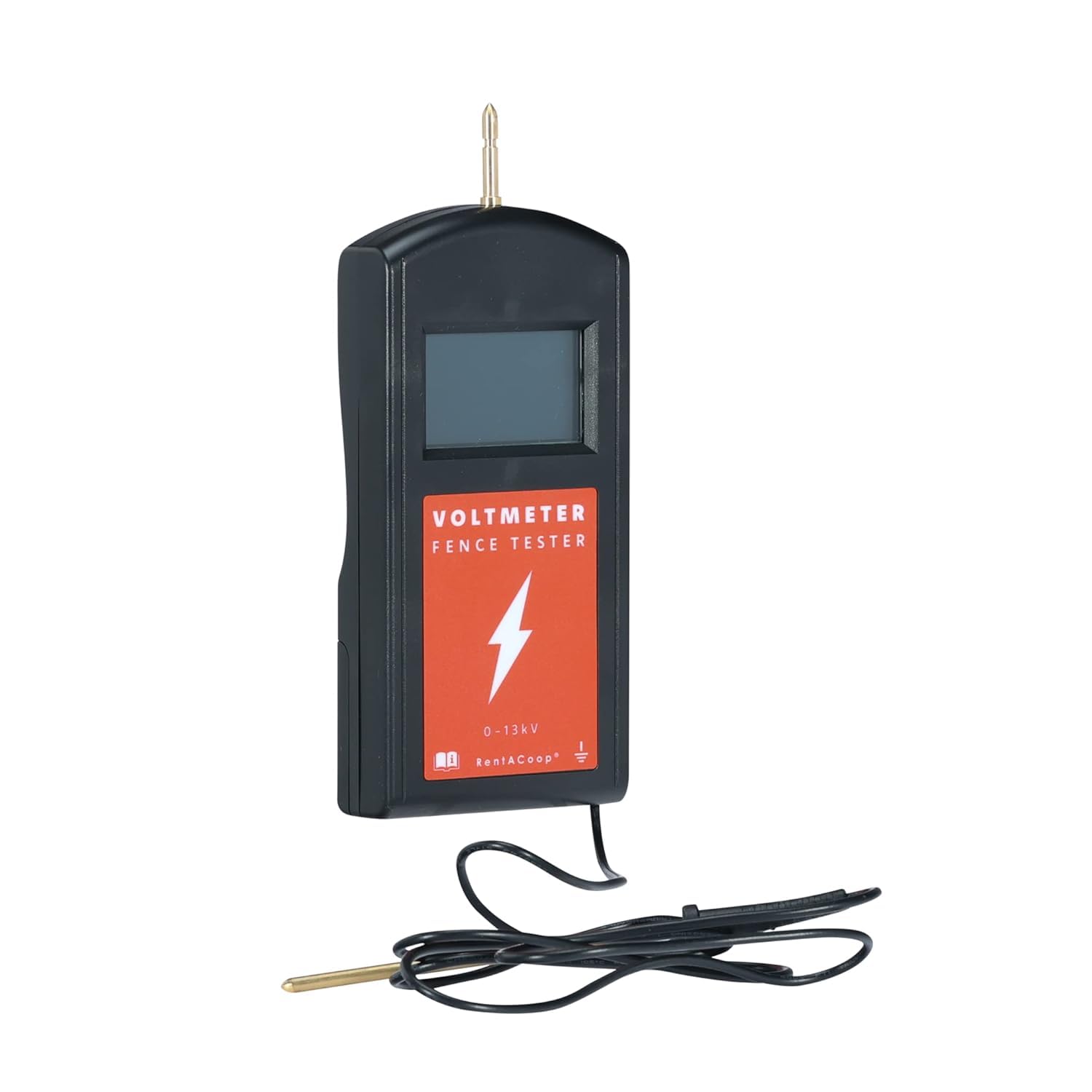
A poultry-and-pasture voltmeter that also doubles as a general-purpose electrical tester.
RentACoop built this tester specifically for its electric fencing and solar energizers, but it works with any electrical circuit up to 13,000 volts (13 kV). That is a higher ceiling than many budget models, which top out at 10 kV. The feature owners appreciate most is that it displays the exact voltage of your sender unit — not just a relative number — so you know at a glance whether your fence is delivering a strong enough jolt. For reference, the manual recommends a reading of at least 3,000 volts (3 kV) to deter common predators like raccoons or coyotes.
What makes this different from a basic tester is its accuracy: owners mention it takes an average across three readings, giving you a more reliable number than a single pulse. It also functions as a regular voltmeter, so you can use it for other low-voltage electrical checks around the barn or workshop. The display is clearly visible in sunlight — a complaint that plagues some cheaper models like the ALLOSUN EM555, which some users find fades in bright conditions.
The honest trade-off is build quality. It feels flimsier compared to professional tools like Fluke or Klein, lacking a rugged housing or a continuity tester (a device that checks if a wire is unbroken). It comes with a soft carrying case and a tip cover, which helps. For the chicken coop owner or the small-hobby-farm setup, it is more than enough.
The short story: Higher voltage ceiling than most budget testers, doubles as a regular voltmeter, and the sunlight readability is genuinely good. The housing feels light, so treat it carefully and it will serve well.
Who it fits: Poultry keepers, small-acreage owners, and anyone who wants a tester that also works on other circuits.
Who should skip it: Heavy-use professional farmers who need a daily-bash tool — look at the Gallagher models for tougher cases.
4. L-FENCE LYDITE FENCE Digital Tester
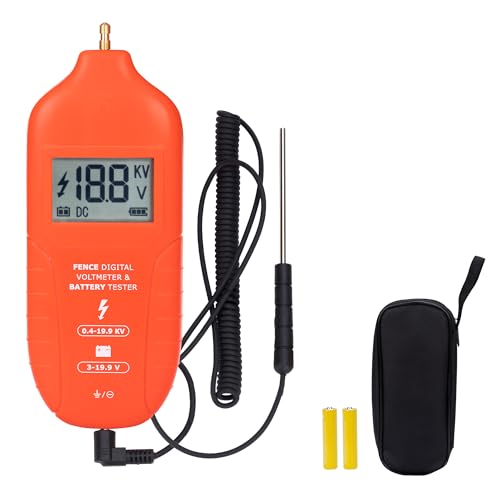
Measures up to 19.9 kV for less than most 10 kV testers.
This orange tester from L-FENCE / LYDITE FENCE covers an enormous voltage range — from 0.4 kV all the way to 19.9 kV — which is rare at this price point. Customers note it measuring over 10,400 volts (10.4 kV), surpassing other gauges that stop at 6,000 volts (6 kV). It comes with two 1.5V batteries included, so it is ready to go out of the package. The oval, ergonomic shell design is comfortable in the hand and the smooth surface won’t dig into your fingers during a long walk.
Buyers find it fast and simple for checking poly wire (plastic wire with metal filaments) and fence lines. It is handy enough to keep in the UTV for quick checks. It matches the energizer’s stated output closely, according to owners who have tested it against their charger’s specs.
The honest downside is reliability. One unit quit working after about two months, even after replacing the battery. The build feels cheap, which is the trade-off for the high-voltage range at a low price. Most owners are satisfied, but a few have had early failures. This is the pick for the buyer who wants maximum voltage range for minimum spend and is okay with a shorter expected lifespan.
The pitch: The best voltage ceiling per dollar on this list. Great for testing hot 10 kV+ energizers. Keep a spare battery handy, and do not expect it to last as long as a Gallagher.
Reach for it if: You run a high-voltage fence and need to confirm full output without spending mid-range money.
Think twice if: You want a tool that will survive years of daily farm use — this one has a shorter track record.
5. Zareba Digital Electronic Fence Tester DEFT

A durable, pocket-sized voltmeter that reads from half a kV to nearly 20.
The Zareba DEFT packs a 0.5 kV to 19.9 kV range into a compact, pocket-friendly body made of heavy-duty ABS (acrylonitrile butadiene styrene) plastic — a tough, impact-resistant material. That means it can handle everything from a low-voltage poultry fence to a full-power 12,000-volt (12 kV) cattle energizer. It runs on a 9V battery (not included) and the backlit display makes reading possible in low light or at night. It works on any type of wire — steel, aluminum, polywire, tape.
Owners who run a 12k (12,000 volt) fence charger say this tester has not let them down. It is so simple to use that one buyer called it “ridiculous.” A few note that the reading cable can wear at the connection point over time; one owner bought a second unit because the first one developed that issue, but liked it enough to replace it with the same model. The backlight is genuinely bright, and the screen is readable in full sunlight. This Zareba DEFT covers a wider voltage range than the Gallagher G503014, which tops out at 12 kV.
The mixed feedback centers on display readability in sunlight — some find it clear, others struggle. Zareba is a well-known brand in electric fencing, and this tester’s wide voltage range and proven durability make it a solid mid-range choice.
What stands out
- Wide range from 0.5 kV to 19.9 kV covers every fence type
- Backlit display for night-time fence checks
- Pocket-sized and made of tough ABS plastic
The drawbacks
- Display readability in sunlight gets mixed opinions
- The reading cable can wear at the connection point over time
Best for: The rancher who wants a durable, go-anywhere tester with a wide voltage range and a trusted brand name.
Consider another if: Sunlight readability is your top concern — the ALLOSUN EM555 is reported to have a clearer sunlit display by some owners.
6. FenceMate Digital Fence Tester FT5502

A directional alternative that reads voltage, current, and flow direction at once — for less than the top pick.
The FenceMate FT5502 is the closest competitor to the Gallagher Smartfix in the directional-fault-finder space. It reads voltage up to 19.9 kV, measures amperage (the flow of electrical current), and shows the direction of current flow on a large backlit LCD display. That triple readout means you can tell at a glance whether the fence is live, how much power is flowing, and which side of your test point the fault is on. It works with steel wire, aluminum, poly wire, rope, tape, and braid. Like the Smartfix, it saves hours of walking compared to a basic voltmeter.
Owners have used it to find shorts (unintended connections) in multi-strand fences and to locate a break after a storm, calling it a cost-effective tool that “saved hours of work.” The build is molded in engineering-grade polymer ABS with a belt clip, so it stays on your hip as you walk the line.
The honest feedback is mixed on durability. One owner reported the tester stopped working after six months. Another noted a safety concern: the unit gave a shock through the test button at 10 kV, requiring insulating gloves and boots. The replaceable 9V battery is included, which is a nice touch. For directional fault finding at a lower price than the Gallagher Smartfix, this is a strong contender with a shorter reliability track record.
The verdict: Does the same directional and current-sensing job as the top pick for less money. Great when it works, but some have hit durability issues. Use with rubber boots and gloves as a precaution.
Best for: Budget-conscious ranchers who need directional arrows and amperage readings but want to save compared to the Gallagher Smartfix.
Proceed with caution if: You rely on a tool every single day — a few owners experienced short service lives.
7. Gallagher Digital Volt Meter G503014

The no-fuss weather-resistant voltmeter that turns on when you touch the fence — no button needed.
This Gallagher model is the simpler cousin of the Smartfix — it reads voltage only, from 0 to 12,000 volts (0 to 12 kV), with 100-volt precision below 10 kV and 1,000-volt steps above. It turns on automatically when you connect it to the fence, so no fumbling for a power button. The water-resistant housing means it survives rain and morning dew without issue. It includes a ground rod probe (a metal stake you push into the soil) and a fence stud for direct contact, so no extra tools are needed to get an accurate reading.
Owners who have had this model for years say it works flawlessly, keeping cattle secure by ensuring fences are putting out enough voltage. It works with battery-powered, solar, and mains energizers — even in battery save mode (a low-power setting that reduces pulse rate to conserve energy). The 9V battery is included and has a 6–12 month lifespan. At 4.8 ounces, it is light enough to hang on the fence and leave there while you walk. It is more rugged than the RentACoop and has a proven track record compared to the L-FENCE LYDITE.
The honest limitation is that it only reads voltage, not current or direction. You get a rock-solid number, but you still have to walk the line to find the fault. For the owner who just wants to confirm the energizer is working and the fence is hot, this is a durable, trusted tool backed by years of positive owner feedback.
The short version: A weather-proof, auto-on voltmeter from Gallagher that simply works. No bells, no whistles, no directional arrows — just an accurate voltage read, time after time.
Reach for this if: You want a straightforward, rain-proof voltage check from a brand you trust, and you do not need directional hunting.
Choose another if: You are chasing faults on long fence lines and need a tool that tells you which way to walk — the Smartfix is the one for that job.
Understanding the Specs
Kilovolts (kV) – The Voltage Reading
Kilovolts are what measure the strength of the zap. One kilovolt (kV) equals 1,000 volts. A standard fence for cattle or horses needs around 3,000 to 5,000 volts (3–5 kV) to be effective — that is enough to give a memorable shock but not cause injury. Predator fences for chickens or raccoons need about 4,000 to 7,000 volts (4–7 kV) to overcome fur and feathers. The tester display shows you the number; if it is below the safe zone for your animal, the fence needs attention.
Amperage (Amps / Current) – The Power Delivery
Voltage is the push, amperage is the flow. Think of voltage as the pressure in a garden hose and amperage as the volume of water coming out. A fence can have high voltage but low amperage if something is draining the power, like heavy vegetation touching the wire. Testers that read both voltage and amperage give you a fuller picture — high voltage with low current means you have a leak somewhere, like a branch grounding the wire.
FAQ
Do I need a directional fault finder or just a voltmeter?
What voltage should my fence read for different animals?
How do I use a fault finder on a long fence line?
Can a tester shock me?
My tester shows a reading but the animals are not respecting the fence. What gives?
What battery do most fault finders use?
Will any tester work with solar-powered energizers?
Can I leave a tester on the fence overnight?
Final Thoughts: The Verdict
For the majority of shoppers, the best electric fence fault finder is the Gallagher Smartfix because it combines voltage, amperage, and directional arrows into one rugged, battery-sipping unit that owners trust for years. If you want a budget-friendly digital readout that works well, grab the ALLOSUN EM555. And for a weather-resistant, no-frills voltage check from a proven brand, the Gallagher Digital Volt Meter is the one to reach for.
How We Picked
We do not accept paid placement. Every pick is matched to a real buyer and a real use-case; we do not hands-on test units.
Sources & Methodology
Specifications: manufacturer listings and product documentation. Review insights: verified customer reviews, as of July 2026. Pricing: not shown on this page (it changes often); check the current price via the retailer link.
As an Amazon Associate, Lawn Gear Lab earns from qualifying purchases. This does not affect which products we feature.