
Specs are compiled from manufacturer listings and verified buyer reviews and can change over time — please confirm the key details on the product page before buying.
A grapefruit tree that yields only one sour fruit is a disappointment. A tree that drops its leaves and stays dormant all season feels like a loss. The real question for most backyard growers is which grapefruit tree fertilizer actually turns a struggling tree into a fruit-filled producer — without a degree in soil science. This guide puts eight of the most-popular citrus picks next to each other so you can see exactly what each one delivers and where it falls short.
I’m Rikta — the founder and writer behind Lawn Gear Lab. This guide is built by comparing the manufacturers’ published specifications and the patterns across verified customer reviews, so you get each pick’s real strengths and trade-offs instead of marketing spin.
Whether your tree lives in a pot on a patio or stands tall in a backyard row, matching its stage of life and soil to the right formula is what matters. That is where a focused look at the best grapefruit tree fertilizer makes the difference between a season of waiting and a season of picking.
Our Picks at a Glance


How To Choose The Best Grapefruit Tree Fertilizer
Grapefruit trees are heavy feeders, but they also burn easily if you throw too much nitrogen at them too fast. The three things to check before buying are the N-P-K ratio, the release speed, and whether the formula includes micronutrients that address the yellow-leaf problem common in citrus.
Match the N-P-K to the tree’s age
A young tree (first 2-3 years) needs a balanced or slightly nitrogen-leaning formula to push leafy growth and establish a strong root system. A mature tree needs a higher potassium number (the third digit in the ratio) because potassium drives fruit size, sweetness, and cold tolerance. If you see 12-10-10 on a bag, that is a heavy-duty maintenance feed for a large fruiting tree — not for a potted sapling.
Choose your application style
Spikes are the easiest option: you push them into the soil and they release over weeks. Granular formulas get spread on the surface and watered in, giving you more control over how much each tree gets. Liquid concentrates start feeding immediately and work fast on a tree that looks half-dead, but they require mixing and more frequent reapplication. Container trees generally handle liquid or spike feeding better than granular because the nutrients spread more evenly in a confined pot without overwhelming the roots.
Don’t forget the micronutrients
Grapefruit trees are prone to iron and zinc deficiencies that show up as yellowing between the veins of new leaves. A good citrus fertilizer will include iron, zinc, and manganese — sometimes listed as “minor elements” on the label. If your tree has been looking pale despite feeding, you may have plenty of primary nutrients in the soil but a shortage of one of these micronutrients.
Quick Comparison
| Model | Best For | NPK Ratio | Form | Coverage / Qty | Amazon |
|---|---|---|---|---|---|
| Farmer’s Secret★ Best Overall | Rescue & Quick Recovery | — | Liquid | 32 oz | Amazon |
| Miracle-Gro SpikesSet & Forget | No-Mess Simplicity | — | Spikes | 12 pack | Amazon |
| Jobe’s Organics SpikesOrganic Pick | Organic Container Care | 3-5-5 | Spikes | 6 per bag | Amazon |
| Jobe’s Organics Granular | Large In-Ground Trees | 3-5-5 | Granules | 4 lb (4 trees) | Amazon |
| GARDENWISE | Steady Fruit Production | 6-4-6 | Granules | 4 lb | Amazon |
| FoxFarm Happy Frog | Microbe-Rich Soil | 7-3-3 | Granules | 4 lb | Amazon |
| Down To Earth | Organic Orchard | 6-2-4 | Powder | 5 lb | Amazon |
| Nelson NutriStar | Strong Established Trees | 12-10-10 | Granules | 4 lb | Amazon |
In‑Depth Reviews
1. Farmer’s Secret Citrus Tree Booster Fertilizer (32 oz)
Our pick — over 4.5★ from 650+ verified ratings; the strongest balance of quality and price.
The liquid lifeline that pulls trees back from the brink.
This is the one you grab when your grapefruit tree looks more like a stick with a few sad leaves. The 32-ounce bottle is a super-concentrated liquid — you mix just one teaspoon per gallon of water and apply weekly along the drip line (the circle directly under the tree’s outer branches). A mature tree gets up to two teaspoons per week, and the formula also works for avocado trees if you happen to have one nearby. What wins people over is its speed: a number of owners saw new growth almost immediately after using it, with one buyer reporting it helped a tree they thought was dead. The crowd favorite — 4.7 stars across 650+ owners — backs up that kind of turnaround claim.
For container or indoor trees, you cut the dosage in half or apply every other week, which keeps the roots from getting overwhelmed. The liquid form makes it easier to adjust feeding than with spikes or granules, and it reaches the root zone faster than dry options. Compared to the Miracle-Gro spikes below (which are a different delivery method entirely), the concentrate here responds quicker to a tree in visible trouble. The main trade-off is the effort: you need to mix and apply weekly rather than setting and forgetting for months at a time. Glass this thin demands care; the ease-of-use trade-off is the biggest reason someone with 20 trees would pick a granular option instead.
Why owners love it
- Works fast — visible green growth reported within a week
- Simple mixing: 1 teaspoon per gallon
- Versatile enough for lemons, limes, oranges, and avocado trees
Who should think twice
- Requires weekly application — not a set-and-forget product
- Small bottle may not cover a large orchard economically
Reach for this if: you need to revive a tree that looks half-dead, or you prefer a liquid feed that starts working immediately after application.
Look elsewhere if: you want a single application that lasts a full season, or you have many trees and no time for weekly mixing.
2. Miracle-Gro Fertilizer Spikes for Fruit and Citrus Trees, 12-Pack
The spike-and-go solution that removes guesswork from feeding.
If mixing liquids and measuring granules feels like homework, these spikes are your answer. You push them into the soil near the root zone once in spring and again in fall. That is the whole commitment. The slow-release formula is tailored to fruit and citrus trees, feeding directly into the roots over several weeks. The big selling point here is the results owners see: one reviewer noted a massive amount of fruit starting after just six weeks of using the spikes. The product earns 4.6 stars across a strong base of nearly 700 ratings.
The catch is that spikes can be brittle during shipping. Some owners receive a box with broken spikes inside, though most salvage them by using a spade to push the pieces into the ground. They are also limited in what they can correct — if your tree is already suffering from a specific micronutrient deficiency, spikes do not let you fine-tune the mix the way a liquid concentrate does. Unlike the Farmer’s Secret liquid above, this option is slower to show results but dramatically easier to maintain for an entire season.
What makes it easy
- Two applications per year — spring and fall — no weekly chore
- No measuring, no mixing, no run-off mess
- Strong fruit-production results reported by many users
What to watch for
- Spikes can arrive broken in transit (though still usable)
- Not ideal for fixing a severely deficient tree quickly
Grab this for: low-maintenance feeding on established trees where you just want to maintain health and fruit output twice a year.
Skip if: your tree needs immediate rescue or you want to customize the nutrient mix to a specific soil deficiency.
3. Jobe’s Organics Fruit & Citrus Tree Fertilizer Spikes, 3-5-5
Organic spikes that promise — and deliver — sweet fruit every year.
These 3-5-5 spikes carry the OMRI (Organic Materials Review Institute) seal, which means they are certified for organic gardening. The key ingredient here is Jobe’s Biozome, a blend of bacteria, mycorrhizal fungi (fungi that team up with roots to pull more water and nutrients), and archaea (tiny single-celled organisms that help break down organic matter) that breaks down material fast and helps the tree resist disease and drought during the growing season. Owners of potted Meyer lemon trees are particularly loyal to this product, with one reporting an abundance of juicy, sweet lemons every single year. The 6-spike pack feeds a single large tree or several smaller container trees for a season, and the 3-5-5 ratio is heavier on phosphorus and potassium than nitrogen — perfect for encouraging flowers and fruit development.
The number of spikes per bag is a common wishlist item: owners consistently say they wish there were more than 6. At the mid-range price point, the per-spike cost is higher than what you pay for the granular Jobe’s option below. Spikes work best in moist soil where they can dissolve evenly; if your tree sits in very dry, compacted ground, the release can be inconsistent. Compared to the Miracle-Gro spikes, these are organic and slower-acting, but the built-in microbe boost adds a soil-health dimension that synthetic spikes do not touch.
Best organic qualities
- OMRI certified — no synthetic chemicals
- Biozome microbes improve soil health and disease resistance
- Consistent fruit production reported year after year
Real limitations
- Only 6 spikes per bag; large trees need multiple packages
- Dry, compact soil may slow the spike release
Choose this for: organic feeding with a microbe boost that helps the soil long-term, especially for container-grown citrus.
Think twice if: you have a large in-ground orchard where 6 spikes per bag would not stretch far enough.
4. Jobe’s Organics Granular Fertilizer for Fruit & Citrus (3-5-5) 4 lb
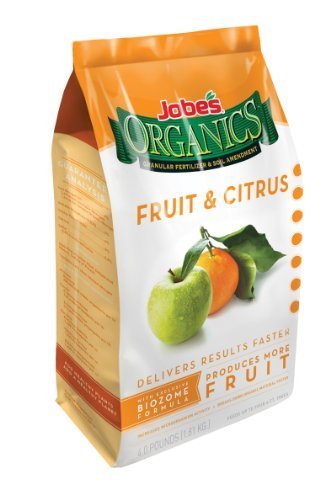
The first fast-acting organic granular that feeds four trees right.
This 3-5-5 formula is essentially the same organic recipe as the spikes above, but in a 4-pound bag of loose granules. It is designed to feed up to four 6-foot trees, which makes it the better choice for someone with multiple in-ground grapefruit trees. The key difference from the spike version is speed — the granules hit the soil and start working right away because they are not encased in a spike that needs to dissolve. Jobe’s Biozome is present here too, meaning the archaea, bacteria, and mycorrhizal fungi begin breaking down organic matter in the soil within days. Owners saw their Meyer lemon trees grow new leaves and bloom within a week after applying.
The trade-off is that granules require more effort to apply evenly around the drip line and need to be watered in thoroughly. For potted trees, loose granules are harder to control than spikes because water can push the food to one side of the container. One owner’s description sums up the honest feedback: “if it smells like cow dung, then it’s got to be good.” The organic smell is strong, but it fades once you water it into the soil. Compared to the Jobe’s Organics spikes, this option gives you more total food for the money and works faster on multiple trees.
Why this works for multiple trees
- 4 pounds covers four 6-foot trees — good for a small orchard
- Biozome microbes deliver faster results than standard organic granular
- 100% organic with a 3-5-5 ratio tailored for flowering and fruiting
Heads-up
- Strong natural odor (manure-like) until watered in
- Less precise for potted containers than spikes or liquid
Best suited for: the organic gardener with multiple in-ground citrus trees who wants faster soil penetration than spikes can provide.
Not ideal for: container growers who prefer mess-free, water-free spike application.
5. GARDENWISE Professional Citrus Fertilizer 6-4-6 (4 lb)

A granular blend that wakes up potted citrus with rapid results.
This 6-4-6 formula offers a more balanced NPK ratio than most citrus-specific foods, with equal nitrogen and potassium to support both leafy growth and fruit quality. It also includes magnesium for greener leaves, zinc for disease defenses, iron for rich foliage, and boron for flower development — a full micronutrient package that addresses the yellow-leaf issue common in grapefruit trees. The granules are coated to release slowly over 6-8 weeks, so one bag can last the entire growing season with just a handful of applications. Buyers report rapid new growth on lime and orange trees within a week of application, which is fast for a granular product.
The 4-pound bag is smaller than the Down To Earth option below, but it is also more concentrated by NPK-value. For potted citrus trees, the manufacturer recommends feeding every 6-8 weeks and warns that over-fertilization can harm container trees. Compared to the Farmer’s Secret liquid, this granular takes longer to activate but requires fewer applications. The company is known for responsive customer service, which several buyers noted positively in their feedback.
Standout features
- Full micronutrient suite: magnesium, zinc, iron, copper, boron
- Slow-release coating feeds for up to 2 months per application
- Visible results often within a week on potted citrus
Something to note
- Small bag compared to other granular options; large trees need multiple bags
- Over-fertilization risk is real for container trees — follow the 6-8 week schedule
Perfect for: potted citrus owners who want a slow-release granular with the micronutrient depth to cure yellowing leaves.
Pass on if: you have a large in-ground orchard where a 4-pound bag would disappear too fast to be economical.
6. FoxFarm Happy Frog Citrus and Avocado Fertilizer (4 lb)

A premium soil feed that fixes yellow leaves through microbes, not brute N-P-K.
The Happy Frog formula is unique on this list for its 7-3-3 ratio, which is heavily tilted toward nitrogen for vegetative growth. That makes it a strong choice for a young grapefruit tree that needs to bulk up its canopy. But the real story is the mycorrhizal fungi included in the mix — these soil microbes attach to the tree’s root system and increase nutrient and water absorption efficiency. Multiple owners mention that citrus trees with persistent yellowing turned dark green and produced new growth after switching to this product.
The biggest surprise for new buyers is the smell. The main ingredient is alfalfa meal, which gives the fertilizer a sweet, hay-like odor that some owners compare to horse feed. Dogs are reportedly drawn to it. A few owners note that the leaves on their trees turned yellow again later in the season, suggesting the feeding interval may need to be shorter than the package indicates for some soils. Unlike the Jobe’s Organics granular above, the Happy Frog has a higher nitrogen content, so it is better suited for leaf and branch growth than for pushing maximum fruit yield.
What makes it special
- Mycorrhizal fungi boost root efficiency and water absorption
- High nitrogen (7-3-3) for rapid leafy growth and greening
- Trusted brand with a decade-long following among citrus growers
Practical caveats
- Sweet smell attracts dogs; keep pets away and water in thoroughly
- Some trees may need more frequent feeding than the label suggests
Pick this for: citrus trees with yellowing leaves that need a nitrogen and microbe boost, and for growers who value long-term soil biology over fast fruit.
Skip if: your tree is already dark green and you want a low-nitrogen formula to focus on fruit production.
7. Down To Earth Organic Fruit Tree Fertilizer 6-2-4 (5 lb)

A 5-pound box of all-natural feed that rescued a wind-torn crabapple tree.
This is the only powder-form option on the list, and it packs a 6-2-4 ratio with added calcium for proper fruit development. The ingredients list reads like a whole-food recipe: feather meal, fish bone meal, calcium carbonate (a natural source of calcium), langbeinite (a mineral providing potassium and magnesium), potassium sulfate, alfalfa meal, and kelp meal. The calcium content is important for grapefruit trees because it strengthens cell walls and helps prevent blossom-end rot (a dark, sunken spot on the bottom of the fruit). The 5-pound box is the largest package by weight in this lineup, making it a good value for owners with several trees. A standout owner story: a crabapple tree uprooted by wind and stripped of leaves was revived after 2 years of feeding with this fertilizer, eventually producing abundant berries and strong enough roots to remove the support stakes.
The calcium carbonate and fish bone meal give this a fine, dusty texture that one owner described as easy to spread and quick to blend into soil. The trade-off is that powder can be messier to handle than granules or spikes, especially on a windy day. It also does not expire if stored in a cool, dry place, so you can buy the 5-pound box and use it across multiple seasons. Compared to the FoxFarm Happy Frog above, the Down To Earth formula is lower in nitrogen (6 vs 7) and adds potassium and calcium that directly support fruit quality rather than leaf growth.
what separates it
- 5 pounds is the largest package — best value for an orchard
- Added calcium boosts fruit quality and trunk strength
- 100% organic ingredients with no expiration if stored properly
Handling quirks
- Powder form can be dusty during application; use on a still day
- Some owners felt the per-pound cost was high for what is essentially alfalfa meal
Reach for this if: you want a large, all-organic box of calcium-rich feed for multiple in-ground fruit trees and you do not mind powder handling.
Consider another option if: you need a mess-free, on-the-spot application for a single container tree.
8. Nelson NutriStar Citrus Fruit & Avocado Tree Plant Food 12-10-10 (4 lb)
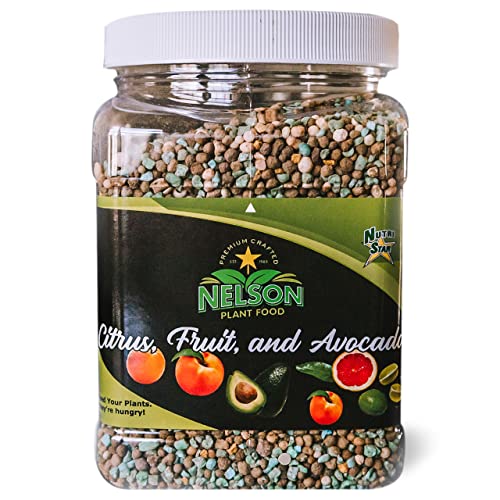
The high-octane granular that landscapers reach for when trees need a serious push.
Nelson NutriStar carries a 12-10-10 NPK ratio, which is roughly double the primary nutrient content of most organic citrus foods. This is a dense, synthetic-based formula that gives an immediate boost to any established citrus or avocado tree. The high potassium content (soluble potash at 10%) is specifically included to help trees survive and fruit in colder weather, and the formula also contains calcium for stronger trunks and limbs. Customers note that orange trees produce a full batch of new leaves within two months of first use, even when moved indoors. The Nelson brand has been the landscaper’s choice for over 30 years, which is a strong signal for reliability.
The potency is also the main risk: this 4-pound bag is meant for mature, established trees and should not be used on a young sapling or a tree in a small container. The manufacturer recommends application every 30 days during the growing season, which is more frequent than the slow-release GARDENWISE option. Compared to the Down To Earth organic powder, the Nelson has more than double the NPK value and no organic certification, but it costs roughly the same per bag. If your grapefruit tree is already large, healthy, and you want to boost fruit output under tough conditions, this is the calibrated push.
Key credentials
- 12-10-10 ratio is the highest NPK in this guide — serious feeding power
- High potassium boosts cold weather survival and fruit quality
- Trusted by professional landscapers for over 3 decades
Who should be careful
- Too strong for young or potted trees; root burn is a real risk
- Monthly application schedule demands more effort than a 6-8 week feeder
Best for: large, established in-ground grapefruit trees that need a dense nutrient charge to push through a cold season or ramp up fruit yield.
Not for: container trees or young saplings that would be overwhelmed by the 12-10-10 concentration.
Understanding the Specs
N-P-K Ratio Meaning
These three hyphenated numbers (like 6-4-6) stand for nitrogen (N), phosphorus (P), and potassium (K) — the primary nutrients for plant growth. Nitrogen drives leafy green growth and overall tree vigor. Phosphorus supports root development and flower formation, which is critical for fruit set. Potassium controls fruit quality, sweetness, and the tree’s ability to withstand cold and disease. A higher first number (like 12-10-10) is for mature trees that need a heavy push. A balanced or moderate ratio (like 6-4-6) is safer for young and container trees.
Micronutrients for Citrus
Grapefruit trees are especially sensitive to deficiencies in iron, zinc, and manganese, which cause a condition called interveinal chlorosis (yellowing between the veins of new leaves). A good citrus-specific fertilizer will list these as “minor elements” or “chelated micronutrients” on the label. Magnesium aids chlorophyll production for greener leaves. Boron supports flower development and fruit set. Without these trace elements, your tree can receive plenty of N-P-K and still look sickly.
FAQ
How often should I fertilize my grapefruit tree?
What happens if I over-fertilize my grapefruit tree?
Can I use all-purpose fruit tree fertilizer on a container grapefruit tree?
Is organic or synthetic fertilizer better for grapefruit trees?
My grapefruit tree has yellow leaves with green veins. What nutrient is missing?
Should I fertilize a newly planted grapefruit tree right away?
Can I use grapefruit tree fertilizer on avocado trees as well?
How long does it take to see results after fertilizing?
Will fertilizer burn a grapefruit tree if the soil is already rich?
Final Thoughts: The Verdict
For most people, the grapefruit tree fertilizer winner is the Farmer’s Secret Citrus Tree Booster because it rescues struggling trees faster than any other option on the list and works for both in-ground and container trees. If you want hands-off feeding with strong fruit results, grab the Miracle-Gro Spikes. And for organic growers with multiple in-ground trees, the {“@context”: “https://schema.org”, “@graph”: [{“@type”: “ItemList”, “name”: “8 Best Grapefruit Tree Fertilizer”, “url”: “https://lawngearlab.com/best-grapefruit-tree-fertilizer/”, “numberOfItems”: 8, “itemListElement”: [{“@type”: “ListItem”, “position”: 1, “name”: “Farmer’s Secret Citrus Tree Booster Fertilizer (32 oz)”, “url”: “https://lawngearlab.com/best-grapefruit-tree-fertilizer/#product-1”}, {“@type”: “ListItem”, “position”: 2, “name”: “Miracle-Gro Fertilizer Spikes for Fruit and Citrus Trees, 12-Pack”, “url”: “https://lawngearlab.com/best-grapefruit-tree-fertilizer/#product-2”}, {“@type”: “ListItem”, “position”: 3, “name”: “Jobe’s Organics Fruit & Citrus Tree Fertilizer Spikes, 3-5-5”, “url”: “https://lawngearlab.com/best-grapefruit-tree-fertilizer/#product-3”}, {“@type”: “ListItem”, “position”: 4, “name”: “Jobe’s Organics Granular Fertilizer for Fruit & Citrus (3-5-5) 4 lb”, “url”: “https://lawngearlab.com/best-grapefruit-tree-fertilizer/#product-4”}, {“@type”: “ListItem”, “position”: 5, “name”: “GARDENWISE Professional Citrus Fertilizer 6-4-6 (4 lb)”, “url”: “https://lawngearlab.com/best-grapefruit-tree-fertilizer/#product-5”}, {“@type”: “ListItem”, “position”: 6, “name”: “FoxFarm Happy Frog Citrus and Avocado Fertilizer (4 lb)”, “url”: “https://lawngearlab.com/best-grapefruit-tree-fertilizer/#product-6”}, {“@type”: “ListItem”, “position”: 7, “name”: “Down To Earth Organic Fruit Tree Fertilizer 6-2-4 (5 lb)”, “url”: “https://lawngearlab.com/best-grapefruit-tree-fertilizer/#product-7”}, {“@type”: “ListItem”, “position”: 8, “name”: “Nelson NutriStar Citrus Fruit & Avocado Tree Plant Food 12-10-10 (4 lb)”, “url”: “https://lawngearlab.com/best-grapefruit-tree-fertilizer/#product-8”}]}, {“@type”: “Product”, “position”: 1, “name”: “Farmer’s Secret Citrus Tree Booster Fertilizer (32 oz)”, “image”: “https://m.media-amazon.com/images/I/41bcpfVbPNL.jpg”, “brand”: {“@type”: “Brand”, “name”: “Farmer’s”}, “url”: “https://www.amazon.com/dp/B0DLVHNZH9/”, “offers”: {“@type”: “Offer”, “url”: “https://www.amazon.com/dp/B0DLVHNZH9/”}}, {“@type”: “Product”, “position”: 2, “name”: “Miracle-Gro Fertilizer Spikes for Fruit and Citrus Trees, 12-Pack”, “image”: “https://m.media-amazon.com/images/I/71CxQrKBRlL.jpg”, “brand”: {“@type”: “Brand”, “name”: “Miracle-Gro”}, “url”: “https://www.amazon.com/dp/B000JJYPYE/”, “offers”: {“@type”: “Offer”, “url”: “https://www.amazon.com/dp/B000JJYPYE/”}}, {“@type”: “Product”, “position”: 3, “name”: “Jobe’s Organics Fruit & Citrus Tree Fertilizer Spikes, 3-5-5”, “image”: “https://m.media-amazon.com/images/I/91Wo5kGiRiL.jpg”, “brand”: {“@type”: “Brand”, “name”: “Jobe’s”}, “url”: “https://www.amazon.com/dp/B07CGD2L53/”, “offers”: {“@type”: “Offer”, “url”: “https://www.amazon.com/dp/B07CGD2L53/”}}, {“@type”: “Product”, “position”: 4, “name”: “Jobe’s Organics Granular Fertilizer for Fruit & Citrus (3-5-5) 4 lb”, “image”: “https://m.media-amazon.com/images/I/41xrMSXQaoL.jpg”, “brand”: {“@type”: “Brand”, “name”: “Jobe’s”}, “url”: “https://www.amazon.com/dp/B06XNJBD6J/”, “offers”: {“@type”: “Offer”, “url”: “https://www.amazon.com/dp/B06XNJBD6J/”}}, {“@type”: “Product”, “position”: 5, “name”: “GARDENWISE Professional Citrus Fertilizer 6-4-6 (4 lb)”, “image”: “https://m.media-amazon.com/images/I/5104AOkqazL.jpg”, “brand”: {“@type”: “Brand”, “name”: “GARDENWISE”}, “url”: “https://www.amazon.com/dp/B0CP2S2CFV/”, “offers”: {“@type”: “Offer”, “url”: “https://www.amazon.com/dp/B0CP2S2CFV/”}}, {“@type”: “Product”, “position”: 6, “name”: “FoxFarm Happy Frog Citrus and Avocado Fertilizer (4 lb)”, “image”: “https://m.media-amazon.com/images/I/516wLdTC2WL.jpg”, “brand”: {“@type”: “Brand”, “name”: “FoxFarm”}, “url”: “https://www.amazon.com/dp/B07NPYZP7Z/”, “offers”: {“@type”: “Offer”, “url”: “https://www.amazon.com/dp/B07NPYZP7Z/”}}, {“@type”: “Product”, “position”: 7, “name”: “Down To Earth Organic Fruit Tree Fertilizer 6-2-4 (5 lb)”, “image”: “https://m.media-amazon.com/images/I/513vT5xKOaL.jpg”, “brand”: {“@type”: “Brand”, “name”: “Down”}, “url”: “https://www.amazon.com/dp/B07DXNJRQ7/”, “offers”: {“@type”: “Offer”, “url”: “https://www.amazon.com/dp/B07DXNJRQ7/”}}, {“@type”: “Product”, “position”: 8, “name”: “Nelson NutriStar Citrus Fruit & Avocado Tree Plant Food 12-10-10 (4 lb)”, “image”: “https://m.media-amazon.com/images/I/51lHg4uRBUL.jpg”, “brand”: {“@type”: “Brand”, “name”: “Nelson”}, “url”: “https://www.amazon.com/dp/B004F1W5L2/”, “offers”: {“@type”: “Offer”, “url”: “https://www.amazon.com/dp/B004F1W5L2/”}}, {“@type”: “FAQPage”, “mainEntity”: [{“@type”: “Question”, “name”: “How often should I fertilize my grapefruit tree?”, “acceptedAnswer”: {“@type”: “Answer”, “text”: “This depends entirely on the product you choose. Liquid concentrates like Farmer’s Secret work best with weekly applications during the growing season. Slow-release granules such as GARDENWISE need feeding every 6-8 weeks. Spikes are the most hands-off option — you push them in once in spring and once in fall. Mature in-ground trees can handle more frequent feeding than young or potted trees.”}}, {“@type”: “Question”, “name”: “What happens if I over-fertilize my grapefruit tree?”, “acceptedAnswer”: {“@type”: “Answer”, “text”: “Too much fertilizer, especially nitrogen, can burn the roots and cause leaf tips to turn brown and crispy. In potted trees, the salts from synthetic fertilizers can build up in the soil and damage the root system over time. If you see sudden leaf drop, yellowing at the edges of older leaves, or a white crust on the soil surface, flush the pot with plenty of water and cut back to half the recommended dose.”}}, {“@type”: “Question”, “name”: “Can I use all-purpose fruit tree fertilizer on a container grapefruit tree?”, “acceptedAnswer”: {“@type”: “Answer”, “text”: “Yes, but you need to watch the dosage. Container trees have limited root space, so a high-NPK formula like 12-10-10 can overwhelm them. A balanced 6-4-6 or a 3-5-5 ratio, applied at half the label rate or every other week, is safer. Liquid fertilizers are easier to control in containers because you can adjust the dilution with each watering.”}}, {“@type”: “Question”, “name”: “Is organic or synthetic fertilizer better for grapefruit trees?”, “acceptedAnswer”: {“@type”: “Answer”, “text”: “Both can work. Organic options (like Jobe’s Organics or Down To Earth) improve long-term soil health by feeding soil microbes and releasing nutrients slowly. They are less likely to burn roots and do not leave salt residues in pots. Synthetic formulas (like Nelson NutriStar) deliver a faster, more concentrated nutrient hit that can correct visible deficiencies quickly, but they do less to improve the soil biology over time. For a potted tree you plan to keep for years, organic is usually the better long-term bet.”}}, {“@type”: “Question”, “name”: “My grapefruit tree has yellow leaves with green veins. What nutrient is missing?”, “acceptedAnswer”: {“@type”: “Answer”, “text”: “That specific pattern (green veins on yellow tissue) is a classic sign of iron deficiency in citrus. It is very common in container trees and in alkaline soil. Look for a fertilizer that lists chelated iron among its ingredients. The GARDENWISE and Down To Earth formulas both include iron and other micronutrients that directly address this type of chlorosis.”}}, {“@type”: “Question”, “name”: “Should I fertilize a newly planted grapefruit tree right away?”, “acceptedAnswer”: {“@type”: “Answer”, “text”: “No. A freshly planted tree needs time for its roots to settle and start growing into the surrounding soil. Wait 4-6 weeks before applying any fertilizer. When you do feed, use a gentle, slow-release formula at half the recommended rate. The Jobe’s Organics spikes are a good fit here because the release is gradual and the pre-measured spike prevents you from overdoing it.”}}, {“@type”: “Question”, “name”: “Can I use grapefruit tree fertilizer on avocado trees as well?”, “acceptedAnswer”: {“@type”: “Answer”, “text”: “Several citrus fertilizers are specifically formulated for avocado trees too. The Farmer’s Secret booster, the FoxFarm Happy Frog, and the Nelson NutriStar all include avocados in their target species list. Avocados generally prefer a slightly higher nitrogen ratio, so a 7-3-3 or 12-10-10 product is a natural fit, while a 3-5-5 ratio is better suited for citrus that is already well-established.”}}, {“@type”: “Question”, “name”: “How long does it take to see results after fertilizing?”, “acceptedAnswer”: {“@type”: “Answer”, “text”: “With a liquid concentrate like Farmer’s Secret, some reviewers point out visible new growth within a week. Granular products usually take 2-4 weeks for the nutrients to break down and reach the roots. Spikes are the slowest, but they provide steady feeding for months. The soil temperature also matters — fertilizer uptake slows significantly when soil temperatures drop below 55°F. You will see the fastest response by feeding in early spring when the tree starts putting out new growth.”}}, {“@type”: “Question”, “name”: “Will fertilizer burn a grapefruit tree if the soil is already rich?”, “acceptedAnswer”: {“@type”: “Answer”, “text”: “Yes. Grapefruit trees are sensitive to salt buildup, especially from synthetic fertilizers. If you have naturally fertile soil or have been feeding heavily, a soil test is the safest first step. A high-NPK product like the Nelson 12-10-10 can cause leaf burn if applied to soil that already holds adequate phosphorus and potassium. When in doubt, start with a balanced organic formula at half strength and watch how the tree responds before increasing the dose.”}}]}]}