
Specs are compiled from manufacturer listings and verified buyer reviews and can change over time — please confirm the key details on the product page before buying.
Japanese beetles don’t nibble — they skeletonize. One morning your roses are flawless, and by lunch the leaves are lace. The right spray stops the destruction fast, but the wrong one leaves you spraying again next week. This guide cuts through the shelf of options to the eight treatments that actually deliver, from a concentrate that protects an entire yard to a ready-to-spray hose-end that tackles a single prized shrub.
I’m Rikta — the founder and writer behind Lawn Gear Lab. This guide is built by comparing the manufacturers’ published specifications and the patterns across verified customer reviews, so you get each pick’s real strengths and trade-offs instead of marketing spin.
The goal is simple: help you find the absolute best japanese beetle sprays for your garden, your schedule, and your tolerance for mixing and measuring.
Our Picks at a Glance


How To Choose The Best Japanese Beetle Spray
Picking a spray starts with where the beetles live. If they are chewing on your rose bushes, a contact killer you spray directly on the leaves works fast. If they are attacking a mature tree, a systemic that the plant absorbs protects from the inside out. Two main categories cover most situations.
Contact Killers vs. Systemic Insecticides
A contact killer (like pyrethrin or malathion) kills beetles when it touches them. You spray the foliage, the beetle lands, and it’s over. The trade-off is that rain or new growth can wash the protection away. A systemic (like imidacloprid) is absorbed into the plant’s vascular system. When a beetle bites a leaf, it ingests the chemical and dies. This lasts longer but takes days to work, and it is not the best choice for edible crops you harvest soon.
Ready-to-Spray vs. Concentrate
Ready-to-spray bottles connect to your garden hose. You turn the faucet and walk the yard. It is the easiest method for a quick perimeter treatment or a small garden. Concentrates require you to mix the right amount of product with water in a pump sprayer. It takes more effort but saves money when you need to treat a large lawn or multiple trees, and it gives you precise control over the dose.
Application Method: Foliar vs. Soil Drench
A foliar spray goes on the leaves. It works immediately on adult beetles that are feeding or flying. A soil drench is poured around the base of the plant. The roots pull the chemical up into the leaves, stems, and flowers. This method targets larvae and provides long-term protection, but it needs careful dosing based on the trunk diameter of the tree or shrub.
Quick Comparison
| Model | Best For | Liquid Volume | Application | Protection Duration | Amazon |
|---|---|---|---|---|---|
| Sector Mosquito Misting System Refill★ Best Overall | Automated misting systems | 128 fl oz | Misting system / Sprayer | Varies by schedule | Amazon |
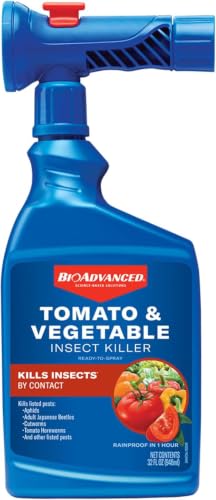
| BioAdvanced Tomato & VegetableBest for Edibles | Edible gardens | 32 fl oz | Hose-end sprayer | Rainproof in 1 hour | Amazon |
| Bonide Eight Insect ControlYard Defender | Broad yard treatment | 32 fl oz | Hose-end sprayer | Up to 4 weeks | Amazon |
| Neudorff Indoor Plant Spray | Indoor & greenhouse use | 32 fl oz | Ready-to-use spray | Contact kill | Amazon |
| BioAdvanced Tree & Shrub Spray | Ornamental trees & shrubs | 32 fl oz | Hose-end sprayer | Up to 2 weeks | Amazon |
| Southern Ag Malathion 50% E.C. | Citrus & fruit trees | 16 fl oz | Foliar spray (mix) | Contact kill | Amazon |
| Ortho Bug B Gon Insect Killer | Lawn & perimeter | 32 fl oz | Concentrate (makes 42 gal) | Up to 6 months (spiders) | Amazon |
| Pro Grub Control (Imidacloprid 21.4%) | Soil drench for ornamentals | 32 fl oz | Foliar / Soil drench | Season-long | Amazon |
In‑Depth Reviews
1. Sector Mosquito Misting System Refill 1 Gallon
Our pick — over 4.5★ from 400+ verified ratings; the strongest balance of quality and price.
The heavy-hitter that turns a misting system into a beetle fortress.
This gallon jug packs 128 fluid ounces of concentrated insecticide — that is four times the volume of the 32-ounce sprays elsewhere in this list. You dilute it yourself and run it through a compressed air sprayer, a ULV cold fogger, a power sprayer, or an automatic misting system. One owner reports a single gallon lasting two years in a 55-gallon system. The target list is enormous: it kills adult Japanese beetles, mosquitoes, flies, wasps, hornets, and over 70 more insect species.
The catch is the price and the setup. This is not a grab-and-go bottle — you need a sprayer or a misting system already in place, and the label requires personal protective equipment (gloves, respirator) during application because it is harmful to fish while wet. Once dry it is safe, but you must follow the mixing directions precisely. Buyers rave about the effectiveness, with the most-mentioned praise going to how well it keeps yards mosquito-free even in environments surrounded by ponds.
Why it dominates
- 128 fl oz concentrate makes up to 55 gallons of finished spray
- Kills adult Japanese beetles plus mosquitoes, flies, and 70+ other pests
- Compatible with misting systems, foggers, and power sprayers
- “One gallon lasts me two years in my 55 gallon misting system,” one buyer reports
Who should pass
- Requires equipment — not a ready-to-spray bottle
- Harmful to aquatic life when wet; needs careful application near water
- Overkill for a small rose garden or a single shrub
Reach for this if: you own a misting system or a power sprayer and need to protect a large property (half-acre or more) from multiple flying pests season-long.
Look elsewhere if: you want a hose-end sprayer for a small garden bed, or you are not comfortable mixing concentrates and wearing PPE.
2. BioAdvanced Tomato & Vegetable Pest Control and Insect Killer, 32-Ounce
The one you trust on tomatoes, peppers, and leafy greens.
This ready-to-spray bottle connects straight to your garden hose and kills Japanese beetles, aphids, and cutworms on contact. The formula is fast-acting, and buyers confirm it is “waterproof in 1 hour, safe for leafy greens.” That means a sudden rain shower an hour after you spray will not wash the protection off your vegetable patch. It works on leafy, fruiting, and root vegetables — tomatoes, peppers, carrots — plus cucurbits like squash and cucumbers.
The liquid volume is 32 fluid ounces, which is a standard size that covers a solid raised-bed garden. A buyer with multiple raised beds found it “so easy to use when you have a lot to spray.” The flip side is that it is not a systemic, so it does not provide long-lasting residual protection. You will need to reapply after heavy rain or when new growth appears. One owner noted they expected to respray every couple of months for lantern flies on grapevines, which is typical for a contact insecticide.
Smart spray for food gardeners: The 1-hour rainproof window gives you flexibility, and the formula is safe on vegetables right up to harvest day.
Best if: you grow vegetables and need a Japanese beetle spray that won’t harm your tomatoes or leafy greens.
Pass if: you need a systemic that protects ornamental trees for weeks — this is a contact killer, not a long-term solution.
3. Bonide Eight Insect Control Yard & Garden, 32 oz Ready-to-Spray
The fast-acting yard spray that keeps working for weeks.
This 32-ounce bottle attaches to a garden hose and treats up to 5,000 square feet. The claim that wins people over is the speed: buyers report that a tree “being destroyed by Japanese beetles” was stopped “right away.” The formula delivers long-lasting results, keeping working for up to 4 weeks after application. It controls over 100 insects, so it handles beetles, ants, fleas, ticks, and mosquitoes in one pass. One owner who battled box elder bugs and lady beetles for years said that after two seasons of using this product, “their number were less and half.”
There is one real quirk: the hose-end sprayer can be finicky. Some owners mention the nozzle blows off, and it is incompatible with newer “pocket hoses” — it needs an old-style garden hose connection. A few also found it ineffective on Japanese beetles that had already settled into landscape bushes, suggesting you catch the infestation early. The consistency is that it works best as a preventive and immediate-contact treatment for active feeding.
What works
- One quart covers a large 5,000 sq ft area
- Fast-acting — customers note stopping beetle damage immediately
- Lasts up to 4 weeks, reducing the spray schedule
The hitch
- The hose-end sprayer may pop off under pressure or on non-standard hoses
- Less effective on well-established beetle populations in dense bushes
- Does not work with pocket hoses — use a traditional rubber hose
Reach for this if: you need a broad yard treatment that covers beetles plus mosquitoes and ticks, and you have a standard garden hose.
Consider something else if: your hose is a modern pocket-hose style, or you are very detail-oriented about a perfect nozzle connection every time.
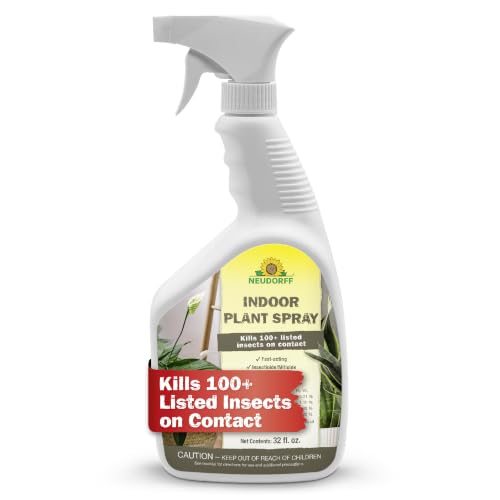
4. Neudorff Indoor Plant Spray Kills 100+ Listed Insects on Contact 32 OZ
The botanical spray that hits hard without the chemical hangover.
This 32-ounce ready-to-use spray contains pyrethrins and canola oil — both botanical insecticides approved for organic gardening. It kills Japanese beetles, spider mites, aphids, fungus gnats, and over 100 other listed insects on contact. It also kills eggs (it is an ovicide), so it intercepts the next generation before they hatch. The label allows use on edible fruits and vegetables right up to and including the day of harvest, which is rare for a broad-spectrum insecticide. Reviewers point out it works in “1-2 sprays” and has no strong odor.
The active ingredients are contact-only, so thorough coverage of the leaf undersides is essential. Some users note it does not work on scale insects, and a few found it slow on gnats. Because it is a botanical, it breaks down faster in sunlight and rain than synthetic chemicals, meaning you may need to reapply more often during a heavy beetle invasion. But for an indoor plant collection or a small greenhouse where you want minimal residue, this is a clean, effective pick.
Gentle on plants, tough on bugs: Owners of sensitive crops like cannabis report zero plant damage alongside permanent pest elimination. The fact that the most-praised aspect is “no bad smell” tells you a lot about who this is for.
Best for: indoor plants, greenhouses, and organic gardeners who want a harvest-day-safe spray without a lingering chemical smell.
Not ideal for: large outdoor yards during a Japanese beetle outbreak, where its quick degradation means more frequent applications.
5. BioAdvanced Tree & Shrub Insect Killer Spray – 32 oz Ready-to-Spray

The ready-to-spray that keeps your maples and dogwoods safe.
This is the same BioAdvanced blue-bottle family as the vegetable spray, but formulated specifically for trees and shrubs. It kills Japanese beetles, aphids, caterpillars, and whiteflies on contact and continues to protect for up to 2 weeks. The ready-to-spray bottle connects to a garden hose, and the formula is rainproof in 1 hour — a key feature when summer thunderstorms roll through right after you spray. Shoppers say that dogwood trees that were “dying due to bugs” in late June bounced back with “bright green and much larger” leaves the following year.
The liquid volume is 32 fluid ounces, and buyers found the spray throw adequate for a 20-foot tall silver maple. The main difference from the vegetable version is the pest focus and the extended residual. One buyer who typically uses granular treatments said this spray is “really good too” for their maple tree. A very small number of owners noticed odd leaf coloration after spraying, but the overwhelming consensus — and it’s a strong one at 4.5 stars — is that it saves trees from defoliation.
Why it works for trees
- Rainproof in 1 hour, so a sudden storm doesn’t waste your treatment
- Long-lasting protection for up to 2 weeks reduces the chore of respraying
- Hose-end sprayer reaches tall branches without a ladder
One caveat
- Not designed for vegetable gardens — stick to the Tomato & Vegetable version for edibles
- A few owners noticed leaf discoloration, though the tree’s health improved overall
Reach for this if: Japanese beetles are skeletonizing your ornamental trees (maple, dogwood, apple) and you want a hose-end spray that sticks through rain.
Look elsewhere if: you need a granular systemic for trunk-soil drenching — this is a foliar spray, not a root-feeding treatment.
6. Southern Ag Malathion 50% E.C. Insecticide, 16 OZ

The old-standard concentrate that citrus growers swear by.
Malathion has been a reliable insecticide for decades, and Southern Ag’s 50% E.C. (emulsifiable concentrate) formulation is a straight-up powerhouse. The label says to use it at 4.5 oz per gallon of water for outdoor areas, targeting Japanese beetles, aphids, scale, spider mites, and mosquitoes. It works on citrus, ornamentals, fruit trees, strawberries, and listed vegetables. One buyer fighting bugs on small citrus trees said neem oil failed, but “using this took care of them and tree came back and now producing fruit again.”
The 16-ounce bottle is a concentrate, so it goes a long way — but it requires mixing and a sprayer. It also has a strong odor that buyers report clears in a few hours. The biggest divide is that malathion is non-selective: it kills beneficial insects and pollinators if you spray during bloom. You must apply it as a full-coverage foliar spray in the early morning or evening when bees are not active. For a fruit tree grower who already manages a spray schedule, this is an effective, economical tool. For a casual flower gardener, it may be more than you need.
Pro-level control for a specific job: This is the concentrate you grab when a heavy beetle infestation threatens your citrus or fruit tree harvest, and organic options have not cut it.
Best for: citrus growers, fruit tree owners, and anyone comfortable mixing concentrates and managing pollinator safety.
Not for: casual flower beds, no-mix enthusiasts, or gardens where bees are actively foraging during your spray window.
7. Ortho Bug B Gon Insect Killer for Lawn and Gardens Concentrate 1, 32 fl. oz.

The concentrate that turns one bottle into 42 gallons of yard-wide defense.
This 32-ounce concentrate makes up to 42 gallons of finished spray. That is enough to treat a large lawn, the foundation of your house, your ornamentals, and your vegetable garden multiple times. It kills 235 listed insects including Japanese beetles, spiders, ants, fleas, ticks, and mosquitoes. For spiders (excluding black widow, brown recluse, and hobo), the label claims up to 6 months of protection. One owner who sprays at their cabin says a single annual application eliminates mosquitoes for 2-3 months, even at -20°F over winter.
The application requires a hose-end sprayer and a bit of math to mix correctly. Some owners mention that you should avoid spraying directly on flowers and bird feeder areas to protect pollinators. A few report that while it knocks down the beetle population, reinfestation from neighboring properties can happen — that is true of any non-systemic spray. The general sentiment is summarized by a buyer who says “skip the organic gluten free crap. This WORKS and KILLS on one treatment.” It is a synthetic, broad-spectrum insecticide, so it is not for the organic purist, but it is incredibly effective for the scale.
Why it covers ground
- 32 ounces makes up to 42 gallons — enormous value for the price
- Kills 235 insect types, so one bottle handles beetles, mosquitoes, and ticks
- Up to 6-month protection for spiders (longest in this list for that pest)
Heads up
- Non-selective — avoid spraying open flowers during pollinator hours
- Concentrate requires mixing; not as grab-and-go as a ready-to-spray bottle
Reach for this if: you have a medium-to-large property and want one concentrate that treats the whole yard — lawn, foundation, shrubs, and garden — for multiple pests.
skip it if: you are strictly organic, or you only need a spot-treatment for a single rose bush.
8. Pro Grub Control – 32oz Concentrated Imidacloprid (21.4%) Insecticide

The soil drench that protects from the roots up.
This is not a contact spray — it is concentrated imidacloprid at 21.4%, a systemic insecticide that you apply to the soil. The roots absorb it and transport it throughout the tree, shrub, or ornamental. When a Japanese beetle bites a leaf, it ingests the chemical and dies. This method is ideal for tall trees that are hard to spray from top to bottom. The 32-ounce bottle is highly concentrated: the label suggests using up to 0.4 fl oz in 1 gallon of water per inch of trunk diameter for a soil drench. One buyer protecting hemlocks from adelgid said the bottle is so economical that they “probably have a lifetime supply.”
The trade-off is speed. A foliar spray kills beetles in minutes, but a soil drench takes days for the chemical to move through the plant. You need patience and must water the soil before application to help uptake. The bottle design also drew complaints — one double-gloved buyer called it “not all that user-friendly.” Because it is a neonicotinoid (a systemic chemical that moves through the plant), it can affect bees if applied to flowering plants, so you apply it strictly to the soil after the bloom period. For a long-term defense strategy on specimen trees, this is tough to top.
low-maintenance protection: One soil drench in spring can carry your hemlocks, maples, or ornamentals through the entire beetle season without needing to spray again.
Best for: owners of large ornamental trees who want season-long, systemic control without weekly spraying.
Not for: quick relief — this takes time to work, so it is a preventive tool, not an emergency rescue spray.
Understanding the Specs
Active Ingredient
The chemical that does the killing. Pyrethrins and canola oil (botanical) break down quickly and are safe for organic gardens. Malathion is a broad-spectrum organophosphate (a synthetic chemical) that kills on contact. Imidacloprid is a systemic neonicotinoid (a chemical that moves through the plant) that provides long-lasting protection. The right choice depends on if you want fast contact kill, long residual, or minimal environmental footprint.
Liquid Volume & Coverage
Measured in fluid ounces. A 32-ounce ready-to-spray bottle typically covers a few hundred square feet of garden beds. A 32-ounce concentrate like Ortho Bug B Gon makes 42 gallons of spray — far more coverage. The Sector gallon (128 fl oz) is the largest volume here, designed for misting systems that cover entire properties.
FAQ
Can I use Japanese beetle spray on my vegetable garden?
How long does it take for a spray to kill Japanese beetles?
Will these sprays harm bees and other pollinators?
What is the difference between a ready-to-spray and a concentrate?
How often should I reapply Japanese beetle spray?
Is it safe to spray Japanese beetle killer on fruit trees?
Can I use a misting system for Japanese beetle control?
Does rain wash away the spray?
Final Thoughts: The Verdict
For the majority of shoppers, the best japanese beetle sprays winner is the Sector Mosquito Misting System Refill because its 128-ounce concentrate covers entire properties and kills over 70 insect species through a misting system or sprayer. If you want an easy hose-end treatment for edibles, grab the BioAdvanced Tomato & Vegetable. And for long-term systemic protection on ornamental trees, the Pro Grub Control is the one to reach for.
How We Picked
We do not accept paid placement. Every pick is matched to a real buyer and a real use-case; we do not hands-on test units.
Sources & Methodology
Specifications: manufacturer listings and product documentation. Review insights: verified customer reviews, as of July 2026. Pricing: not shown on this page (it changes often); check the current price via the retailer link.
As an Amazon Associate, Lawn Gear Lab earns from qualifying purchases. This does not affect which products we feature.