
Specs are compiled from manufacturer listings and verified buyer reviews and can change over time — please confirm the key details on the product page before buying.
Container plants are a different beast from open garden beds. Their roots are trapped, so they dry out fast, and manual watering turns into a twice-daily chore that either drowns or starves each pot. A good drip system for containers delivers water right to each pot’s root zone at a rate the soil can absorb — no runoff, no guessing, no dead plants when you go on a trip.
I’m Rikta — the founder and writer behind Lawn Gear Lab. This guide is built by comparing the manufacturers’ published specifications and the patterns across verified customer reviews, so you get each pick’s real strengths and trade-offs instead of marketing spin.
You want to stop hauling watering cans to every pot on your patio or balcony. The right drip irrigation for container plants turns that daily chore into a low-maintenance system that keeps each plant hydrated without your constant attention.
Our Picks at a Glance


How To Choose The Best Drip Irrigation For Container Plants
Container setups are different from in-ground rows. The ideal kit for pots and planters needs enough reach to snake between containers, emitters that deliver a slow, targeted trickle, and a timer that can handle the shorter, more frequent cycles container roots prefer.
Tubing length and number of pots
Measure the distance from your water source to the furthest pot, then add the path between each container. A 50-foot kit is comfortable for a small patio collection, while a 60 or 82-foot hose lets you stretch across a larger balcony or greenhouse bench. Check the number of included stakes or emitters — each one usually serves one pot, so a 15-pot kit with 15 watering spikes fits a moderate container garden perfectly.
Flow rate and pressure
High flow (900 ml/min or more) is great if you have several large pots that need a lot of water quickly, but it can overwhelm small containers. Lower flow, paired with adjustable emitters, lets you dial back for a single herb pot or open up for a large vegetable container. Pressure-compensated emitters keep the drip rate even whether the pot is near the faucet or at the far end of the hose.
Timer programmability
Container soil dries faster than ground soil, so a timer that lets you water every 6 or 12 hours is more useful than a system limited to once a day. The best kits offer multiple settings for duration (2 to 30 minutes) and interval (hours or days), so you can match the cycle to the plant type and season.
Quick Comparison
| Model | Best For | Tubing Length | Flow Rate | Max Pots | Amazon |
|---|---|---|---|---|---|
| PNNEQ 60FT Kit★ Best Overall | Best Overall | 60 ft | Water-pressure driven | 19 (nozzles) | Amazon |
| Moistenland 33FT KitBest for Travel | Indoor & Travel | 33 ft | — | 15 | Amazon |
| HEKIWAY Solar 49FT KitSolar Workhorse | Solar Versatility | 49 ft (15m) | 900 ml/min | 15 | Amazon |
| HIRALIY 50FT Kit with Timer | Balcony & Patio | 50 ft | 40 psi max | 12 | Amazon |
| VIVOSUN Professional Kit | Grow Tents & Buckets | — | 1000 L/H | 8 | Amazon |
| HEKIWAY 82FT Solar Kit | Large Container Collections | 82 ft | 900 ml/min | 30 | Amazon |
| MQUPIN 50FT Solar Kit | USB Backup Power | 49.21 ft | — | 15 | Amazon |
| Beday 50FT Solar Kit | Precision Programming | 50 ft | 400 ml/min | 15 | Amazon |
| Blumat Tropf Starter Kit | No-Power, No-Timer Simplicity | 23 ft | — | 5 | Amazon |
In‑Depth Reviews
1. PNNEQ 60FT Drip Irrigation Kit
Our pick — over 4.5★ from 150+ verified ratings; the strongest balance of quality and price.
The kit that gives you 60 feet of reach at a price that most 40-foot kits charge.
This PNNEQ kit uses 5/16-inch tubing — noticeably wider than the standard 1/4-inch hose you see on most budget sets. That wider tube lets more water flow through without clogging, so the pressure stays strong all the way to the last nozzle, even across a full 60-foot run. The 19 brass nozzles rotate 360 degrees, which means you can aim a fine mist at a hanging basket or direct a tight stream into a deep pot.
You get a pipe cutter and 20 cable ties in the box, so you can customize the layout without a trip to the hardware store. Buyers report it works well on a timer with a garden hose, and owners mention it provides “good coverage for an 8×8 ft raised bed.” A common note is that the included cable ties are a little too short for thicker plants, but there is enough spare tubing to work around it. The connection system gets mixed feedback — some customers note the tee fittings can leak if not pushed in firmly, while others have zero leaks.
What owners praise most
- Very easy to set up — owners call it plug-and-play and many had it running in minutes.
- Performance is strong: even flow, no clogging, and the brass nozzles hold their aim.
- Solid value for a 46-piece kit at this price tier.
The honest trade-off
- Connection quality is inconsistent — a minority report leaks at the tee joints.
- Included cable ties are short; you may need your own for thicker stems or stakes.
Reach for this if: You have a medium-to-large container garden or raised beds and want a wide-hose kit that delivers steady pressure from start to finish.
Think twice if: You need a purely gravity-fed, no-pressure system — this relies on standard garden hose water pressure to push through those brass nozzles.
2. Moistenland Automatic Watering System
A timer-driven setup made for indoor pots that runs on batteries or USB-C.
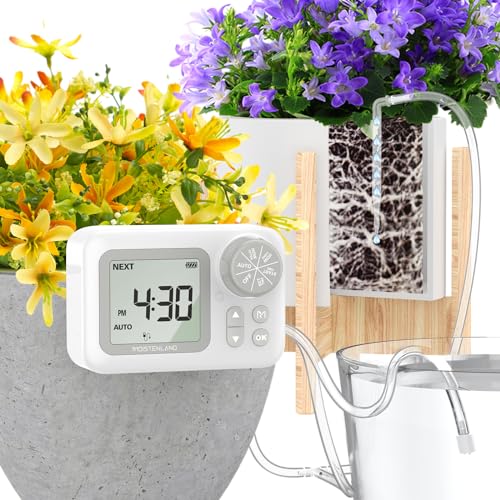
Where the PNNEQ kit needs a garden hose tap, the Moistenland system works from a bucket or reservoir, making it ideal for indoor container collections or apartment balconies with no outdoor spigot. The digital timer lets you set watering start times and durations, and the system delivers water directly to each pot’s root zone — which cuts down on evaporation and reduces the risk of overwatering that plagues indoor plants.
The kit comes with 33 feet of tubing and supports up to 15 pots. Buyers consistently praise it as a vacation solution: one owner confirms it kept 7 plants watered across a 3-week trip without any dry soil or soggy pots. The 33-foot hose is a noticeable 45% shorter than the 60-foot PNNEQ kit (33 ft vs 60 ft), so it fits small to medium layouts. A few owners note the LCD display can be confusing at first, and the instruction manual is sparse on troubleshooting.
The travel companion: Setup takes roughly 15 minutes per the instructions, and the programmable timer means you set it once and forget it. The main caveat is the siphon effect — if your water reservoir is higher than the pots, water can keep dripping after the timer stops. Place the reservoir lower than all plants to prevent this.
Best for: Indoor plant parents who travel often or want a timer-controlled system that lives on a shelf, not a hose bib.
skip it if: You need to cover a large patio or outdoor garden with wide spacing between pots — the 33-foot hose runs out fast beyond a few containers.
3. HEKIWAY 49FT Solar Drip Irrigation Kit
A solar-powered system that also charges via USB-C when the sun hides.
The HEKIWAY kit is one of the few that truly works year-round for containers. In summer, the solar panel keeps the pump running automatically during daylight. In winter, you plug in a USB-C cable and it waters your indoor pots without skipping a beat. The pump pushes up to 900 ml/min through 49 feet of tubing to as many as 15 pots, and the 25 programmable timer modes let you set durations from 3 to 20 minutes and intervals from 12 to 96 hours.
The kit includes a smart alarm that buzzes or flashes if the pump is blocked or the water container is empty — a useful failsafe if you are away for a week. That said, a few reviewers point out that calcium buildup on the water level sensor triggers false low-water alarms, and the beeping can get loud indoors. The plastic T-joints are also prone to brittleness if left in direct sun for long stretches. Overall, owners say it is easy to set up in about 20 minutes and works well for 5 to 8 pots.
The smart feature: The anti-siphon design and built-in filter reduce clogging, but the sensor needs periodic cleaning to avoid false alarms.
Reach for this if: You want a self-contained solar setup that moves between indoor and outdoor use without rewiring.
Look elsewhere if: You are sensitive to device beeps — the alarm can’t be silenced, and it triggers regularly when the sensor gets dirty.
4. HIRALIY 50FT Drip Irrigation Kit with Timer
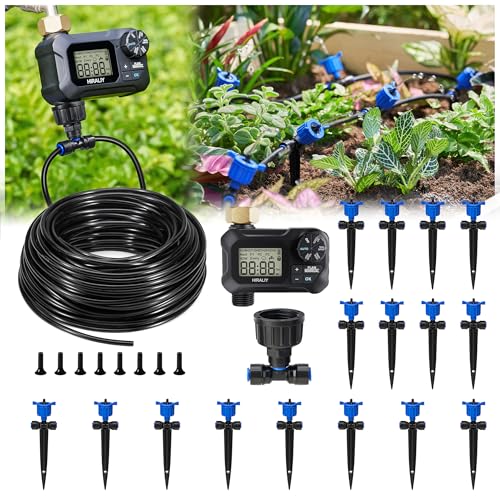
Pressure-compensated emitters that deliver the same drip rate to every pot, from first to last.
This is a kit that solves the most common container irrigation problem: the pot closest to the water source gets soaked while the far pot stays dry. HIRALIY’s pressure-compensated emitters keep the flow consistent along the full 50-foot line, so a ficus at the end receives the same amount as the basil near the faucet. Each emitter also adjusts from shutoff to drip to a stronger stream, letting you give herbs a lighter touch and tomatoes a heavier drink in the same system.
The kit includes a programmable timer, quick-connect fittings, and enough parts (39 pieces) to set up 12 pots without extra purchases. Owners appreciate the easy assembly and say the instructions are clear. A repeated complaint, however, is that the timer programming instructions are sparse — some owners had to experiment to get the water flowing from the tips. The system works best with standard hose pressure; it is not designed for gravity-fed rain barrels.
The strongest points
- Installation is straightforward — owners consistently call it “very easy to install.”
- Water efficiency is excellent for container gardens, with minimal evaporation waste.
- Good value for money given the included timer and pressure-compensated heads.
The rough edges
- Timer instructions are thin — plan for some trial and error when setting your schedule.
- Quality is mixed: some shoppers say leaks at push-fit connections that need re-seating.
Best for: Container growers who want even watering across a patio or balcony where different plants sit different distances from the tap.
pass on it if: You prefer a gravity-fed system without hose pressure — this needs at least 40 psi to operate the compensation mechanism.
5. VIVOSUN Professional Automatic Drip Irrigation Kit

A submersible pump kit built for soilless grow media and precise nutrient delivery.
The VIVOSUN kit is fundamentally different from the hose-and-timer designs above. It uses a 15W submersible pump that sits inside a bucket, pulls water (or nutrient solution), and pushes it through 8 drip emitters at a rate of up to 1000 L/H. That means no connection to a garden tap — this is a closed-loop system for grow tents, greenhouses, or any setup where you mix liquid fertilizer directly into the reservoir.
The pump runs at a low 30-40 dB during irrigation, so it won’t hum loudly in a living room or bedroom. It supports 20 sets of irrigation times, switching between manual and automatic modes. Owners praise the consistent distribution — even across 8 pots — and the fact that the tubing arrived kink-free. But there is a known issue: the injection-molded splitters can vary in flow, and some owners found that only 5 of 8 lines had decent pressure. Others fixed it by trimming the tip on the 4-way splitter or drilling out a clogged hole.
The pro tip: Poke the anti-siphon hole before first use and avoid cranking the regulators fully open — barely adjusted drippers prevent flooding and keep flow even.
Reach for this if: You are growing in coco coir, rockwool, or clay pebbles and need a pump that cycles reliably every few minutes.
Think twice if: You only have 2-3 containers — the 8-pot design is tune for larger setups, and the pump may be overkill for a small windowsill.
6. HEKIWAY 82FT Solar Drip Irrigation Kit
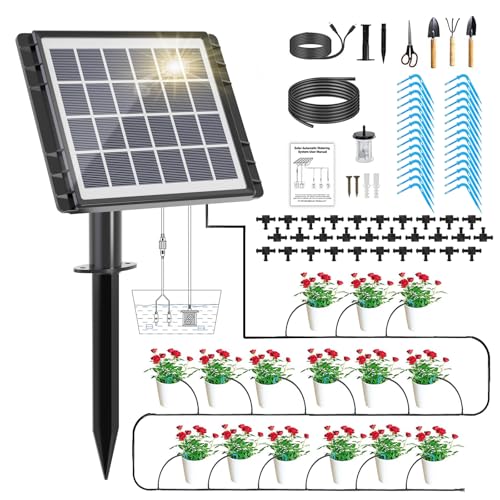
The solar kit that stretches 82 feet to hydrate up to 30 container plants in one run.
This is essentially the bigger sibling of the HEKIWAY 49FT kit above, but scaled to handle twice the pots. The same 900 ml/min pump and 25 timer modes are here, but now with 82 feet of tubing and 30 watering stakes — enough to circle a large greenhouse bench or snake through a dense balcony collection. Just like its smaller counterpart, it runs on solar during sunny months and accepts USB-C charging for winter indoor use.
The smart alarm (buzzer or flashing light) still warns you about clogs or empty reservoirs, which is helpful when you are managing 30 pots. The biggest concern here is pump longevity: several buyers report the pump failing after 2-3 months of continuous use, though many others say theirs ran flawlessly for a year. The sensor and uptake tubes may need fishing weights to stay submerged in a deep reservoir, and the tubing can detach if not pushed in fully.
The honest read: The 82-foot reach and 30-pot capacity are class-leading for the price, but pump reliability is a genuine gamble — keep your receipt and consider a backup plan for long vacations.
Best for: Large container gardens or greenhouse benches where running 30 individual pots over 80-plus feet is the goal.
Heads up: Reliability is the most-discussed aspect — about half of owners mention early pump failure, while the other half get a full season of use.
7. MQUPIN 50FT Solar Automatic Drip Irrigation Kit
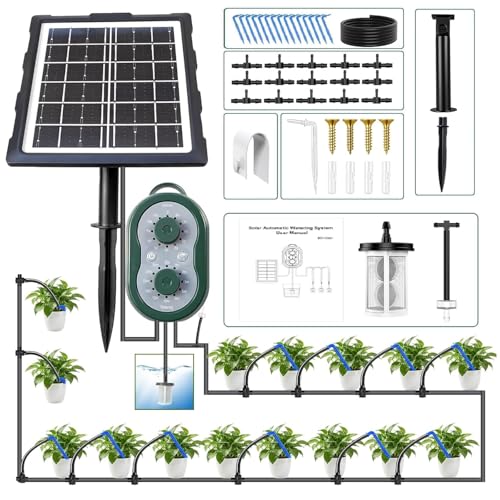
A solar system with a built-in 2200mAh battery that keeps watering through cloudy spells.
Unlike solar kits that stop the moment a cloud passes, the MQUPIN unit stores energy in its 2200mAh battery, so the pump stays on schedule even during overcast days or overnight. When the battery runs low, you switch to USB-C charging for indoor or nighttime operation. The large LCD display makes programming straightforward — 12 watering durations (30 seconds up to 30 minutes) and 12 interval settings (0 hours up to 15 days).
Setup takes about 30 minutes and requires no tools. Owners note the soft, flexible tubing is less likely to kink than stiffer alternatives, and the barbed fittings let you reposition without breaking the joints. The kit covers 49.21 feet of tubing with 15 watering stakes — enough for a small to medium patio collection. The most common praise is how quickly it starts working in direct sunlight — “within seconds” per one owner. Long-term durability is still unproven given the product’s newer release, but early feedback is overwhelmingly positive.
The standout feature: The 2200mAh battery bridges the gap between sunny and cloudy days, so you don’t lose a watering cycle to weather.
Reach for this if: You want a solar setup that doesn’t die the second the sun hides, with USB-C as a reliable backup.
it’s not for you if: You need to water more than 15 containers — this kit is capped at 15 pots and 49 feet of hose.
8. Beday Solar Drip Irrigation System (490 Timer Modes)

490 watering combinations and a soil moisture sensor for those who want surgical precision.
The Beday system is for the container gardener who wants total control. The 490 timer modes come from 14 frequency options (every 1 hour up to 7 days) multiplied by 35 durations (10 seconds to 30 minutes). That means you can program a 10-second mist every hour for a succulent tray and a 30-minute soak once a week for a tomato pot — all from the same controller. The LED screen shows real-time status including battery level and your current schedule.
Flow is 400 ml/min (less than half the 900 ml/min of the HEKIWAY kits), but this is by design — the slower, targeted delivery works better for small to medium containers where you want deep root hydration without runoff. The kit is IP67 waterproof (meaning it survives rain and splashes) and includes an anti-siphon valve and a soil moisture sensor. Owners call it reliable and easy to set up, though a few note the plastic solar bracket feels flimsy outdoors. An occasional complaint is that the tubing uses a non-standard diameter, making it hard to find extension parts.
What owners love
- Extremely reliable — 138 owners single out consistent performance as the top positive.
- Setup is straightforward for any DIY level, even first-timers.
- Battery life is excellent; the solar panel keeps it running without hardwiring.
The catch
- Maximum interval is 7 days — not flexible enough for plants that need watering every two weeks in winter.
- Tubing size is non-standard, so adding third-party extensions requires trial and error.
Best for: Detail-oriented container plant owners who want to fine-tune every watering cycle and monitor battery levels on an LED screen.
look elsewhere if: Your plants go dormant in winter and need longer than a 7-day interval between waterings — the controller caps at a week.
9. Blumat Tropf Patio and Deck Starter Kit
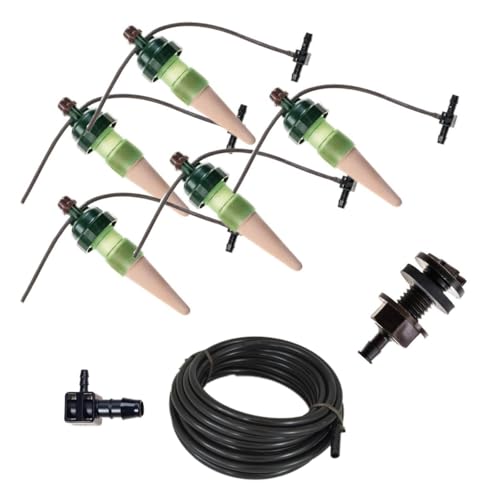
A ceramic sensor that opens a drip line only when the soil is dry — no electricity, no pump, no timer.
The Blumat system operates on an elegantly simple principle: a ceramic cone (called a “carrot”) is buried in each container’s soil. When the soil is dry, the carrot pulls moisture from the attached reservoir, creating a vacuum that opens a valve and releases water. When the soil is moist again, the valve closes. No batteries, no solar panels, no pump noise — just physics.
This starter kit includes 5 Blumat carrots and 23 feet of tubing, enough for 5 large or 10 small pots (each carrot can water up to 4 drip emitters if you expand). Owners rave about how much faster plants grow with consistent moisture, and a commercial buyer purchased worth after testing. The trade-off is setup: the system takes a few days to tune, and the instructions require careful reading. Organic nutrients can clog the lines, so pure water or synthetic fertilizers work best. An occasional owner reports that the tubing can pop off if not fitted with the full loop feed line.
The simplicity win: No electronics means zero failure points from dead batteries or failed pumps. If you lose power for a week, the Blumats keep running from gravity alone.
Best for: Small container collections (5-10 pots) where you want a set-and-forget system that works by soil moisture rather than a clock.
steer clear if: You use heavy organic nutrients in your water — the organic solids clog the precision ceramic valve.
Understanding the Specs
Flow Rate (L/H or ml/min)
This tells you how much water the pump pushes through the system per hour or per minute. A higher rate (like 900-1000 ml/min) is good for filling several large pots quickly, but can overshoot small containers. A lower rate (400 ml/min) delivers a slower, deeper soak that works well for most houseplant-size pots. Match the flow to the size and number of your containers — not just the number of emitters.
Pressure Compensation
A pressure-compensated emitter delivers the same volume of water per minute whether it’s the first pot in the line or the last, 50 feet away. Without it, the pot closest to the water source gets a heavy stream while the far pot gets a trickle. If you are running a single line across a patio with 6 to 12 pots, pressure compensation makes a noticeable difference in how evenly every plant grows.
Timer Programmability (Modes)
The number of timer modes refers to the combinations of watering duration and interval the controller supports. A system with 12 or 25 modes gives you enough flexibility for most container plants. Some advanced units offer 490+ combinations, letting you fine-tune between a 10-second mist every hour and a 30-minute soak every 7 days. More modes mean more control, but they also mean more button-pushing to set up.
Solar vs Battery vs Pump Systems
Solar kits use a photovoltaic panel to charge a battery that runs the pump. They work best in direct outdoor light and often include a USB backup for cloudy days. Battery-operated timers (common on Moistenland-style kits) run on AA or D batteries and control a valve at the faucet — these are simpler but require periodic battery swaps. Pump-based systems (like VIVOSUN) plug into AC power and submerge in a bucket, providing higher flow for larger setups but needing a wall outlet nearby.
FAQ
Can I use a drip irrigation kit with a rain barrel or gravity-fed water source?
How do I prevent the siphon effect from continuing to drip after the timer shuts off?
How many pots can one drip irrigation kit realistically water?
Will a drip irrigation system work for hanging baskets?
Can I leave a solar drip irrigation system outside in winter?
How do I clean a drip irrigation system between growing seasons?
Is it better to water container plants from the top or from below with a drip system?
How long should I run a drip irrigation system for each pot?
Can I mix different plant types (succulents and vegetables) on the same drip line?
What is the difference between a drip irrigation kit and a soaker hose for containers?
Final Thoughts: The Verdict
For most people looking for drip irrigation for container plants, the PNNEQ 60FT Kit hits the balance of reach, adjustability, and value — the 60-foot hose and 19 adjustable brass nozzles cover a large patio or greenhouse bench without breaking the budget. If you need a system for indoor pots while traveling, the Moistenland 33FT Kit with its digital timer and bucket-based design keeps your plants happy for weeks. And for a hands-off, no-electricity solution across a few special containers, the Blumat Tropf Kit delivers consistent moisture using only ceramic sensors and gravity — a quiet workhorse for the meticulous plant parent.
How We Picked
We do not accept paid placement. Every pick is matched to a real buyer and a real use-case; we do not hands-on test units.
Sources & Methodology
Specifications: manufacturer listings and product documentation. Review insights: verified customer reviews, as of July 2026. Pricing: not shown on this page (it changes often); check the current price via the retailer link.
As an Amazon Associate, Lawn Gear Lab earns from qualifying purchases. This does not affect which products we feature.