
Specs are compiled from manufacturer listings and verified buyer reviews and can change over time — please confirm the key details on the product page before buying.
Gypsy moth caterpillars are ravenous. One infestation can strip an entire oak, birch, or fruit tree bare in days — the sound of their droppings hitting the ground becomes a constant patter, and the tree goes from full canopy to skeletal twigs fast. You are not just looking for any insecticide; you need one that specifically lists gypsy moth caterpillars (now often called spongy moth, Lymantria dispar) on the label, and you need to hit them during their early feeding window before they climb high into the canopy. That accurate match is everything — the wrong general-purpose spray wastes time and leaves the tree unprotected.
I’m Rikta — the founder and writer behind Lawn Gear Lab. This guide is built by comparing the manufacturers’ published specifications and the patterns across verified customer reviews, so you get each pick’s real strengths and trade-offs instead of marketing spin.
Every product here lists gypsy moth caterpillars on its label, and the choices range from a powerful synthetic concentrate for perimeter defense to OMRI-listed (approved for organic gardening by the Organic Materials Review Institute) biological options that spare bees and birds. This is your straight-ahead look at the best insecticide for gypsy moths — no fluff, just what works and who it works for.
Our Picks at a Glance

How To Choose The Best Insecticide For Gypsy Moths
Choosing the right spray boils down to three things: where you are spraying (near a vegetable garden or around the house), how big the trees are, and if you need to protect bees and other good bugs. You also need to match the insecticide type to the caterpillar’s growth stage — early-hatching larvae are far easier to kill with biological options than the large, tough caterpillars of late spring.
Match the Active Ingredient to Your Situation
Bacillus thuringiensis (B.t. kurstaki) is a biological bacteria that only affects leaf-eating caterpillars — it leaves bees, earthworms, birds, and ladybugs alone, so it is the first choice for organic gardens and flowering fruit trees. Spinosad is another OMRI-listed ingredient that works fast and covers a wider range of chewing insects including thrips (tiny, rasping pests that scar leaves and flowers) and leafminers (larvae that tunnel inside leaves), but it is more broad-spectrum and needs careful timing to protect pollinators. Bifenthrin is a synthetic pyrethroid that gives a long-lasting barrier for the foundation and perimeter of your home — it kills ants, spiders, fleas, and ticks in addition to gypsy moth caterpillars, so use it away from open blooms and water sources.
Timing the Application Window
Gypsy moth eggs hatch over a few weeks in spring, and the tiny young caterpillars are the most vulnerable. If you spray a B.t. product when the caterpillars are still small (about half an inch long), they stop feeding within a day and die in a few days. Waiting until they are over an inch long and have developed a tougher skin may require spinosad or bifenthrin instead, since B.t. is less effective on larger larvae. Spray in the late evening or early morning so the liquid dries slowly and the caterpillars have more time to eat it before the sun breaks down the active ingredient.
Check the Concentration and Bottle Size
Concentrates come in different volumes — usually 8 oz, 16 oz, or 32 oz — and the price can look similar across sizes. A product that is the same active ingredient but sold in a small bottle (8 oz) for the same price as a 32 oz bottle from another listing means you pay more per ounce. Check the unit count in fluid ounces on the label so you compare apples to apples. A larger bottle like 32 oz may last a full season if you treat several mature trees, while a quart of bifenthrin concentrate can last two or three years for a homeowner treating the foundation and a few ornamentals.
Quick Comparison
| Model | Best For | Active Ingredient | Bottle Size | Organic | Amazon |
|---|---|---|---|---|---|
| Wisdom Pro Bifenthrin Qt★ Best Overall | Perimeter and home foundation defense | Bifenthrin 7.9% | 1 quart | No | Amazon |
| Monterey B.t. 16 ozAlso Great | Targeted caterpillar/budworm control | Bacillus thuringiensis | 16 fl oz | OMRI Listed | Amazon |
| Ferti-lome Spinosad Soap 16 oz | Broad chewing-insect knockdown | Spinosad 0.005% | 16 fl oz | OMRI Listed | Amazon |
| Summit Caterpillar Control Qt | Large tree coverage with hose end | Bacillus thuringiensis | 32 fl oz | Yes | Amazon |
| Monterey B.t. 8 oz | Spot treatment on petunias and small plants | Bacillus thuringiensis | 8 fl oz | OMRI Listed | Amazon |
In‑Depth Reviews
1. Wisdom Pro L&H 7.9% Bifenthrin Insecticide Concentrate (Quart)
Our pick — over 4.5★ from 200+ verified ratings; the strongest balance of quality and price.
The synthetic powerhouse that keeps bugs out of your house and off your ornamentals.
This is the only synthetic pyrethroid (a man-made chemical that mimics natural plant compounds to attack the insect nervous system) in the lineup, and it serves a different purpose. At 7.9% bifenthrin, it is a sodium channel modulator — meaning it attacks the insect’s nervous system on contact, causing paralysis and death. It is labeled for both indoors and outdoors, and the list of pests is huge: ants, fire ants, bagworms, gypsy moth caterpillars, tent caterpillars, chinch bugs, fleas, mosquitoes, spiders, and ticks. That makes it a strong choice if you want a perimeter spray around the foundation, windows, and doorways that also keeps the trees pest-free.
Buyers report: “Use 4x per year and never have bugs in my house.” The same owner said a quart bottle lasts them a couple of years and takes about 20 minutes to spray their entire house. The value is in the longevity — a quart of concentrate goes a long way when you are mixing at a rate of one to two ounces per gallon of water. It works on spiders and wasps too, so it covers the territory that biological sprays simply cannot touch.
The important distinction: bifenthrin is not selective. It kills beneficial insects on contact, including bees and predatory beetles, so you should never spray it on open flowers or anywhere pollinators gather. It is also toxic to aquatic life, so keep it away from ponds and streams. For gypsy moths on your trees and a general insect barrier around your home, this is the heavy hitter — but use it where you mean business, not where you want to protect a pollinator garden.
The clear strengths
- Extremely long residual on surfaces — lasts weeks outdoors
- Kills a huge range of pests: ants, spiders, ticks, fleas, and gypsy moth caterpillars
- Concentrate is economical — one quart can last two years for a home perimeter
The honest warning
- Harsh on beneficial insects and pollinators — never spray on blooms
- Toxic to aquatic life — avoid runoff into water sources
Use it when: you need a dual-purpose barrier that keeps the house bug-free and the ornamentals protected.
Avoid for: vegetable gardens, flowering fruit trees, or any area where you have bees and ladybugs.
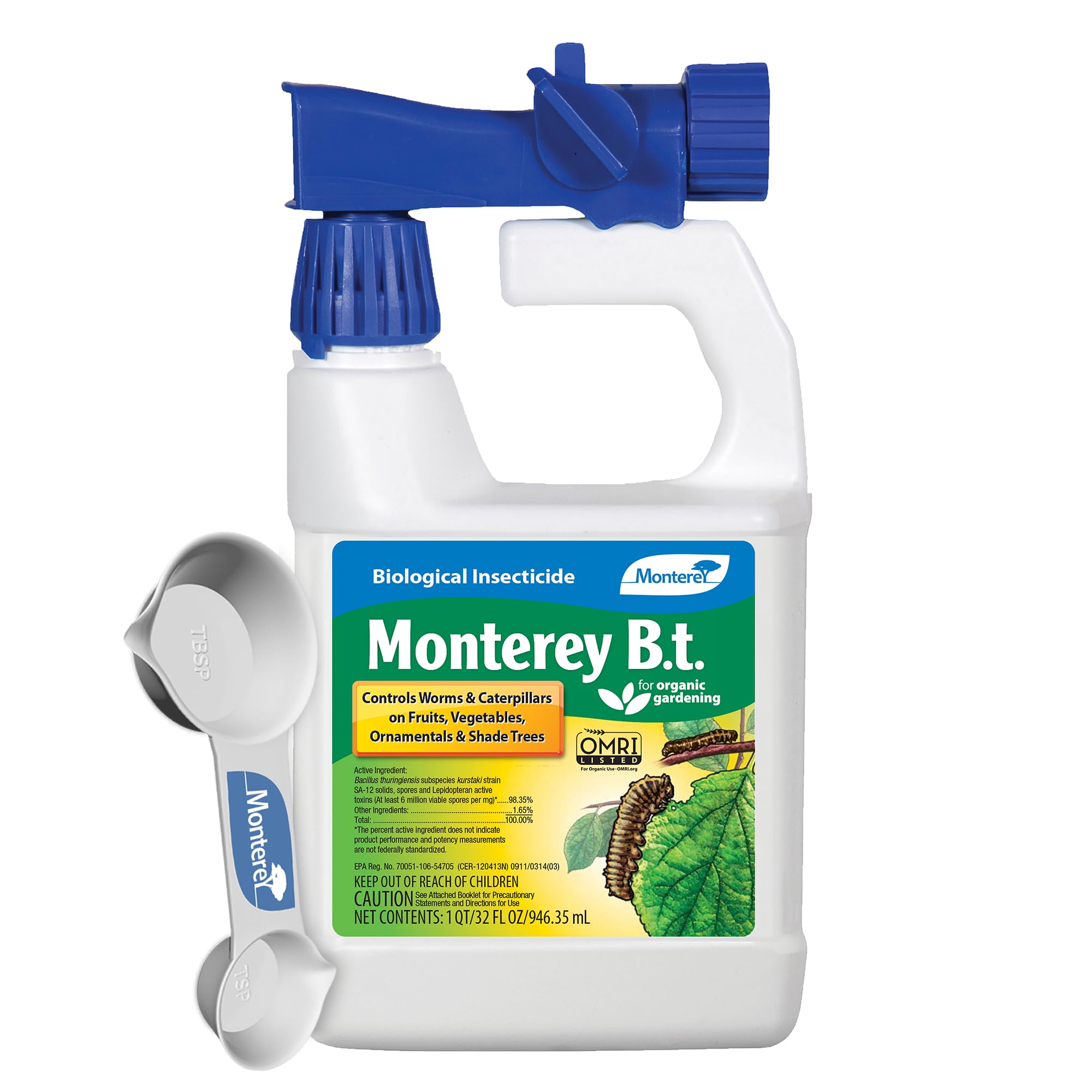
2. Monterey B.t. Bacillus Thuringiensis, 32 oz with Spoon
The mid-size B.t. concentrate that gives you the best per-ounce deal in the lineup.
This 16-ounce bottle is the balance for most homeowners — enough volume for a couple of medium trees, a vegetable patch, and a ring of ornamentals without paying for a gallon you might not finish. Effectiveness is the most-discussed aspect in the reviews, and the consensus is clear: it stops cabbage loopers, bagworms, and gypsy moth caterpillars squarely. It is OMRI listed (approved for organic production), and it comes with a measuring spoon so you can mix accurately every time.
The B.t. kurstaki in this bottle specifically targets leaf-eating caterpillars and nothing else — honeybees, ladybugs, and earthworms are unaffected when the label directions are followed. That precision is why gardeners who also grow squash, melons, and tomatoes reach for this over a broad-spectrum chemical. The review pages sum it up: one owner who had squash vine borers (larvae that burrow into squash stems) saw a significant improvement in their garden after treatments, and another described it as “the best preventative I use” when applied from early season.
The honest gripe is the bottle itself — some owners found the cap difficult to open, with one person having to cut the bottle to get to the concentrate. And because B.t. is short-lived, you can only mix what you will use that night; it does not store after mixing. Still, for a focused, budget-conscious approach to gypsy moth and similar leaf-eaters, this is a reliable pick that outperforms its modest price.
Why it wins
- 32 oz gives plenty of treatments for a typical yard without waste
- Selective on caterpillars only — safe for honeybees and earthworms
- Measuring spoon included for easy mixing
The small trade-off
- Some bottles have a stiff cap that is hard to open
- Must mix only what you use that same evening — B.t. degrades in sunlight
Grab this if: you want a known quantity for organic caterpillar control without paying for a giant bottle.
skip it if: you only have a single small plant — the 8 oz bottle costs less upfront.
3. Fertilome Spinosad Soap Insecticide, 16 oz
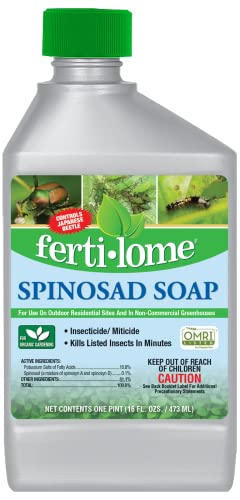
A spunky spinosad-and-soap combo that hits hard on contact.
This product is different from the B.t. options above because it combines two modes of attack: spinosad at 0.005% and potassium salts of fatty acids (insecticidal soap) at 0.940%. The soap helps break down the insect’s outer shell on contact, and the spinosad (a naturally occurring bacterial byproduct) finishes the job. The label covers gypsy moth, bagworms, tent caterpillars, codling moth, Colorado potato beetle, and even aphids — a broader spectrum than B.t. alone.
Because it works on contact, you get a faster knockdown when you spot the caterpillars already crawling on your leaves. The feedback pages highlight how well it works on hibiscus and columbine against leaf miners, with one owner saying the initial application worked “remarkably well — right on contact first use.” Another reported that it saved a Cleveland Pear tree that was being stripped by caterpillars and beetles, with a single 16 oz container enough for two applications to four trees. Because these are OMRI listed ingredients, you can use it on vegetables right up to harvest day.
The catch to note: insects can develop resistance to spinosad, so reviewers recommend alternating with a horticultural oil between applications. And because spinosad is more broad-spectrum than pure B.t., it should not be sprayed on open blooms where bees are actively foraging. For a tough, fast-acting organic option that handles gypsy moths plus a whole roster of other chewing pests, this is the power pick.
What stands out
- Dual-action formula (spinosad + insecticidal soap) gives contact kill and ingestion kill
- Works on a wide range of pests beyond caterpillars — borers, beetles, leafminers
- OMRI listed for organic gardening
Why to be careful
- Resistance can develop — rotate with a different mode of action (like oil)
- More broad-spectrum than B.t., so avoid spraying open flowers with bees
Choose this for: fast knockdown on active infestations where caterpillars are already large and visibly damaging leaves.
Think twice if: you want a totally pollinator-safe spray — pure B.t. is the safer bet for blooms.
4. Summit Caterpillar and Webworm Control-Hose End, 1 Qt Concentrate

The hose-end spray that makes treating tall trees a one-person job.
This product takes the guesswork out of dilution because it connects directly to your garden hose and meters the correct ratio as you spray. The active ingredient is Bacillus thuringiensis, making it another biological option that is safe for birds, pets, and people — only caterpillars are affected. The quart bottle (32 fluid ounces) is a generous size, and the hose-end sprayer reaches the upper canopy of mature trees without a ladder or a backpack sprayer.
The review pages note that two years of consistent spring treatment reduced a serious spongy moth caterpillar population significantly. One owner whose pine trees were covered in bagworms said the spray saved the remaining trees after two had already been killed. Another reviewer who grows vegetables in Florida reported that army worms and tomato hornworms were gone overnight, and the product is safe to use on veggies right up to the day of harvest.
Because B.t. breaks down in sunlight, you still need to reapply after rain and stick to evening applications. And since the hose-end attachment simplifies mixing, you might find yourself using more than you need out of sheer convenience — keep an eye on your spray pattern so you do not oversaturate one spot. For anyone with large, tall trees who wants a simple, non-toxic solution, this is the most effort-efficient choice.
Ease-of-use highlights
- Hose-end sprayer means no mixing pitchers — just attach and spray
- Coverage of tall trees is easy and even
- Safe for humans, birds, and pets even on harvest-day vegetables
The limitation
- B.t. needs reapplication after heavy rain
- Hose-end convenience can lead to using more concentrate than a hand sprayer
Best for: homeowners with tall shade trees who want a set-it-and-spray-it biological treatment without mixing.
Not ideal for: small targeted spots — a hand sprayer with the 16 oz bottle wastes less concentrate.
5. Monterey B.t. Caterpillar & Worm Killer, 8 oz with Spoon
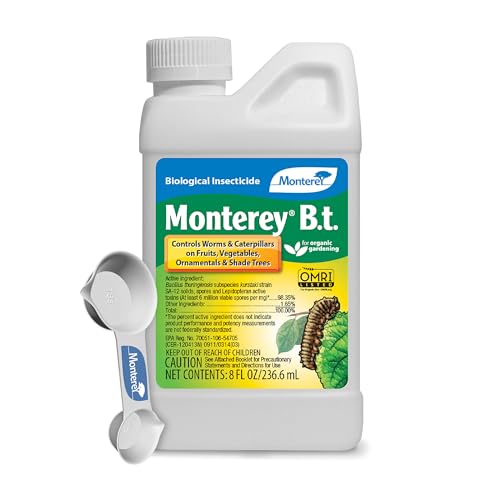
The precise B.t. option for a single plant or a handful of petunias.
If you only have one small tree, a few petunias with budworms, or a single catalpa tree that attracts caterpillars every year, this 8 oz bottle is the right size. The active ingredient is the same OMRI-listed B.t. kurstaki that works on gypsy moth, bagworm, fall cankerworm, and cabbage looper. It mixes instantly with water and can be applied with a trigger spray bottle or a small pressure tank — no hose-end needed.
One owner described it as the “rain of death” for catalpa worms, noting it killed the caterpillars without harming any beneficial insects around the tree. Another uses it specifically for bud worms attacking their petunias and values that it is organic and leaves other insects untouched. The product is labeled for use on broccoli, cabbage, melons, lettuce, tomatoes, shade trees, and ornamentals, so it fits almost any spot treatment scenario.
The significant catch is the bottle size versus price. Multiple buyers point out that this 8 oz bottle costs about the same amount as the 32 oz or 16 oz bottles of the same B.t. concentrate from the same brand. The product itself works great, but the value per ounce is poor compared to the other Monterey B.t. options in this guide. If you are okay with the small size for a tiny garden, it is convenient. If you have any future plans to treat a larger area, buy the 16 oz or 32 oz instead and save money.
The upside
- Easy to mix and apply to a single plant with a trigger sprayer
- Same effective OMI-listed B.t. as the larger bottles
- Safe for honeybees, ladybugs, and earthworms
The value issue
- 8 oz costs nearly the same as the 16 oz or 32 oz sizes — poor per-ounce value
- Only enough for spot treatments; you will repurchase quickly for a medium yard
Choose this only if: you have a single infested plant and want the smallest possible bottle with no leftover concentrate.
Otherwise: the 16 oz Monterey B.t. costs basically the same and gives you twice as much — buy that one unless you truly only need a few uses.
Understanding the Specs
Bacillus thuringiensis (B.t. kurstaki)
This is a naturally occurring soil bacterium that produces a protein crystal toxic to the gut of leaf-eating caterpillars. When a gypsy moth larva feeds on a sprayed leaf, the crystal activates in its stomach and paralyzes the digestive system — the caterpillar stops eating within hours and dies in a few days. B.t. is strain-specific: B.t. kurstaki targets caterpillars and worm-type larvae, not bees, birds, fish, or earthworms. The trade-off is that it breaks down in UV light (ultraviolet radiation from the sun) within 24-48 hours, so you have to apply in the evening and reapply after rain.
Spinosad
Spinosad is a bacterial byproduct from fermentation of Saccharopolyspora spinosa. It works on contact and through ingestion, targeting the insect’s nervous system and causing rapid paralysis and death. It is OMRI listed and covers a broader spectrum than B.t. — codling moth, thrips, leafminers, fire ants, and Colorado potato beetle in addition to gypsy moth caterpillars. Because it is harder on beneficial insects than B.t., you should avoid spraying open blooms with active pollinators, and experts recommend rotating with other modes of action to prevent resistance.
FAQ
Will B.t. kill honeybees or ladybugs on contact?
How long does it take for B.t. to kill gypsy moth caterpillars?
Can I use spinosad on vegetables right up to harvest?
Is bifenthrin safe to spray on fruit trees?
Do I need to cover the whole tree or just the trunk?
How often should I reapply B.t. during a heavy infestation?
Can I mix B.t. and spinosad together for a stronger spray?
Will these products hurt my dog or cat?
What does “OMRI Listed” actually mean?
Which bottle size should a homeowner with three large oaks buy?
Final Thoughts: The Verdict
Across the board, the best insecticide for gypsy moths is the Monterey B.t. 32 oz because it gives you the most biological control per dollar, spare honeybees and birds, and covers a whole season of tree treatments without repurchasing. If you need a faster knockdown on tougher, larger caterpillars in a vegetable or flower garden, grab the Ferti-lome Spinosad Soap 16 oz for its dual-action contact power. And for a non-option barrier around your home that also keeps foundation pests out, the Wisdom Pro Bifenthrin Quart is the one to reach for — just keep it away from blooming plants and water sources. Whichever you choose, spray in the evening and reapply after rain for real results.
How We Picked
We do not accept paid placement. Every pick is matched to a real buyer and a real use-case; we do not hands-on test units.
Sources & Methodology
Specifications: manufacturer listings and product documentation. Review insights: verified customer reviews, as of July 2026. Pricing: not shown on this page (it changes often); check the current price via the retailer link.
As an Amazon Associate, Lawn Gear Lab earns from qualifying purchases. This does not affect which products we feature.