
Specs are compiled from manufacturer listings and verified buyer reviews and can change over time — please confirm the key details on the product page before buying.
That garden hose should deliver clean, steady water — not a stream full of rust, sediment, or chemical taste. An in-line filter is the single piece that stands between your faucet’s impurities and your plants, pressure washer, or RV tank. The question is which filter actually does the job without cutting your water pressure or cracking in the sun.
I’m Rikta — the founder and writer behind Lawn Gear Lab. This guide is built by comparing the manufacturers’ published specifications and the patterns across verified customer reviews, so you get each pick’s real strengths and trade-offs instead of marketing spin.
You want water that won’t clog your pressure washer, harm your garden plants, or taste bad in your RV tank. The right in-line garden hose filter solves all three problems — and this guide names the one worth buying first.
Our Picks at a Glance


How To Choose The Best In-Line Garden Hose Filter
Most first-time buyers grab the cheapest filter, only to discover it slows their water to a trickle or leaks after a few weeks. A little knowledge about filter media, connection materials, and capacity saves that frustration.
Filtration Depth: Mesh vs Carbon vs KDF
A sediment screen (measured in mesh — the number of openings per square inch) catches visible particles like sand and rust. A carbon block or KDF media targets invisible contaminants: chlorine, chloramine, heavy metals, and odors. If you just need to protect a pressure washer, a simple mesh strainer is enough. If you are watering an organic garden or filling a fish pond, you need chemical reduction too.
Flow Rate and Water Pressure
Every filter creates some resistance. A fine 0.5-micron carbon block gives you cleaner water but slows the flow more than a 40-mesh screen. Check the filter’s rated flow rate — look for at least 1.5 gallons per minute for general hose tasks, and higher if you are running a sprinkler or pressure washer that demands volume.
Connection Material and Fitting Size
Standard garden hoses in the US use 3/4-inch GHT (garden hose thread). Most in-line filters match that, but you will also see NPT (national pipe thread) fittings on high-pressure washer models. Brass fittings resist cracking and corrosion far longer than plastic. A filter with plastic threads is fine for light use, but it can snap if overtightened or exposed to sun year-round.
Quick Comparison
| Model | Best For | Filter Media | Flow Rate | Connection Material | Amazon |
|---|---|---|---|---|---|
| Bringpure RV Water Filter 2-Pack★ Best Overall | Best Overall | KDF + GAC Carbon | — | Plastic + Brass | Amazon |
| 3/4” NPT In-Line StrainerTop Performer | Pressure Washer Protection | 200 Mesh Stainless Steel | 0–150 PSI | Plastic | Amazon |
| JOEJET Garden Hose FilterBest Value | Sediment Protection | 40 Mesh + 100 Mesh Screens | Up to 80 PSI | Plastic | Amazon |
| One Stop Outdoor 3/4″ Y Filter | Drip Irrigation Systems | 155 Mesh Screen | — | Plastic | Amazon |
| Camco GardenPURE Carbon Filter | Organic Gardens | Activated Carbon | 1 GPM optimal | Aluminum + Plastic | Amazon |
| Camco Hydro Life C-85 | High-Volume Filtration | Catalytic Carbon + KDF 85 | Up to 2.5 GPM | Plastic | Amazon |
| Crystala Filters 3-Pack | RV & Marine Use | GAC + KDF (20 Micron) | — | Brass + Plastic | Amazon |
| EcoOne Hose Filter | Hot Tub / Spa Filling | Dual-Stage Carbon + KDF | 20-Micron | Plastic | Amazon |
| FRIZZLIFE MV99 | Premium Whole-System Filtration | 0.5 Micron Carbon Block | 1.5 GPM | Brass | Amazon |
In‑Depth Reviews
1. Bringpure RV Water Filter 2-Pack
Our pick — over 4.5★ from 650+ verified ratings; the strongest balance of quality and price.
Two-pack coverage for a full season of chemical-free water, on the road or in the garden.
What wins people over here is build quality — owners call it out more than any other feature. The filter uses Kinetic Degradation Fluxion (KDF) and Advanced Granular Activated Carbon (GAC) tech inside, which means it targets chlorine, heavy metals, fluoride, rust, and sediment. And the NSF 42 certification backs up the claim that it actually reduces those hazards. The NSF 372 certification also confirms the materials are lead-free and BPA-free, so you are not adding chemicals while trying to remove them.
A two-pack covers roughly half a year for camping or an entire growing season. The included flexible hose protector reduces strain on the spigot connection, a thoughtful touch that matters when the filter hangs off a faucet for weeks. One buyer reports the water has “no odor or bread taste” and the setup is easy to attach and remove as you move locations.. A minor weak point: the filter connection can break off if the hose is not aligned straight down — worth a moment of care when positioning.
What Owners Love Most
- NSF 42 and 372 certified — real third-party safety testing for lead-free and BPA-free materials
- Two-pack design lasts a full camping season or half a year of regular use
- KDF and GAC media reduce chlorine, heavy metals, fluoride, and sediment in one pass
The One Thing to Watch
- Filter connection can snap if the hose does not hang straight down — handle the alignment carefully during setup
Grab it for: RV trips, marine use, or garden watering where you want certified chemical reduction from a filter that lasts the whole season.
Think twice if: You only need a simple sediment catcher for a pressure washer — a mesh strainer costs less and does not need NSF certification.
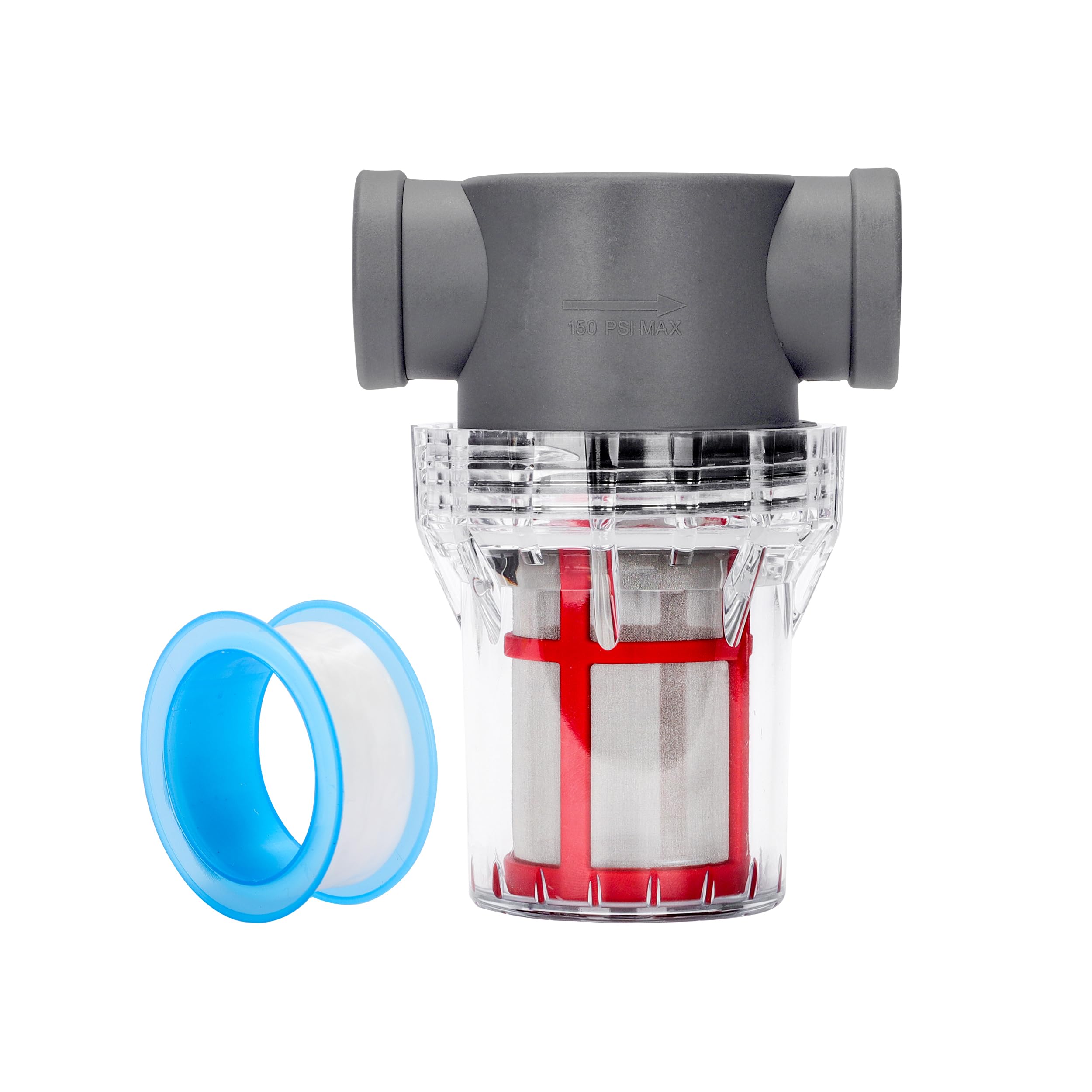
2. 3/4” Female NPT In-Line Strainer
A transparent-bodied workhorse that stops grit before it reaches your pressure washer pump.
This is a pure sediment strainer, not a chemical filter — and that focus makes it excellent at its job. The 200-mesh stainless steel screen catches particles that would otherwise score seals and clog nozzles in pressure washers and water pumps. The clear plastic bowl is the standout feature: you see exactly when the screen needs cleaning, and you unscrew it by hand with no tools. The unit handles a wide water pressure range of 0–150 PSI and water temperatures up to 80°C, which covers nearly any residential or light-commercial washer setup.
At 6.7 ounces, this strainer is noticeably lighter than the 10.9-ounce JOEJET filter, yet buyers report it builds a good seal. The recurring wisdom from owners: “Good seal but can crack if over tighten.” That is the honest trade-off — the plastic body is durable but does not forgive gorilla-grip tightening. A few owners also mention the threading on some units is not fully tapered, which can cause minor fit issues on certain hose ends.
What It Does Best
- Transparent bowl lets you see sediment buildup at a glance — no guessing when to clean
- 200-mesh stainless steel screen captures fine particles that damage pressure washer pumps and spray nozzles
- Hand-tool-free cleaning: unscrew the bowl by hand and rinse the screen in seconds
The Catch
- Plastic housing can crack if overtightened — snug it by hand, no wrench needed
Choose this for: Protecting pressure washers, water pumps, and RV plumbing from sediment, sand, and pipe debris.
skip it if: You need to remove chlorine, chloramine, or chemical contaminants — this is a mechanical strainer only.
3. JOEJET Garden Hose Sediment Filter
Two interchangeable mesh screens and extra O-rings make this the practical budget buy for clean water at the wand.
The JOEJET filter gives you a 40-mesh screen for general sediment removal and a finer 100-mesh screen for tighter filtration, both in the box. That means you choose the right level for the job — coarse for rain barrels, fine for protecting a pressure washer pump or watering wand nozzles. The 3/4-inch GHT male and female threads attach to standard hoses and spigots without adapters, and the working pressure tops out at 80 PSI, which covers most residential garden setups.
Buyers praise its filter performance — One buyer says it “will keep watering wands with small openings from getting plugged with particles in the water.” You get two extra O-rings, a big washer, and three filter washers, so replacement seals are on hand. The trade-off: like many affordable plastic filters, the housing can crack under sustained high pressure, and some owners mention leakage around the threaded bowl connection.
Best with care: If you keep the pressure under 80 PSI and unscrew the filter when not in use, this sediment catcher delivers excellent value. For heavy-duty or continuous high-pressure use, a brass-fitting filter is a safer bet.
Perfect for: Rain barrel setups, protecting watering wands, and light pressure washer use where budget matters.
Not ideal for: Continuous high-pressure commercial washing or chemical-contaminant removal — this stops sediment only.
4. One Stop Outdoor 3/4″ Y Filter

A purpose-built Y-filter for drip irrigation that saves you from constantly unclogging emitters.
This filter is designed for drip irrigation and micro-sprinkler systems, where even tiny particles can block the narrow emitter paths. The 155 mesh screen is finer than most hose-end strainers, so it catches the debris that would otherwise require you to disassemble and clean each dripper. The Y-shape body gives a large filter area with low friction loss, meaning you get long intervals between cleanings instead of weekly screen rinses.
Functionality is the top praise here — 20 owners highlight how well it integrates into drip setups. One buyer reports a dramatic improvement: “cleaning filter now replaces emitter replacement.” That is the real-world benefit — you spend a few seconds flushing the screen instead of hours swapping clogged drippers. The screen is color-coded for easy identification, and it slides out for cleaning without tools. A few customers note leakage around the swivel threads if the valve protrusion prevents full seating, so a small wrap of plumber’s tape on the threads is a wise precaution during installation.
Why Drip Gardeners Love It
- 155-mesh screen catches fine particles that clog drip emitters and micro-sprinklers
- Large filter area means less frequent cleaning — weeks between rinses in normal use
- Screen removes by hand for rinsing, no tools or disassembly of irrigation lines needed
The One Quirk
- Swivel threads can struggle to seat fully on some faucets — a bit of plumber’s tape solves the minor drip
Grab it for: Any drip irrigation or micro-sprinkler system where clogged emitters are a recurring headache.
Look elsewhere if: You need chemical filtration for potable water — this is a mechanical screen only, no carbon or KDF media.
5. Camco GardenPURE Carbon Water Filter
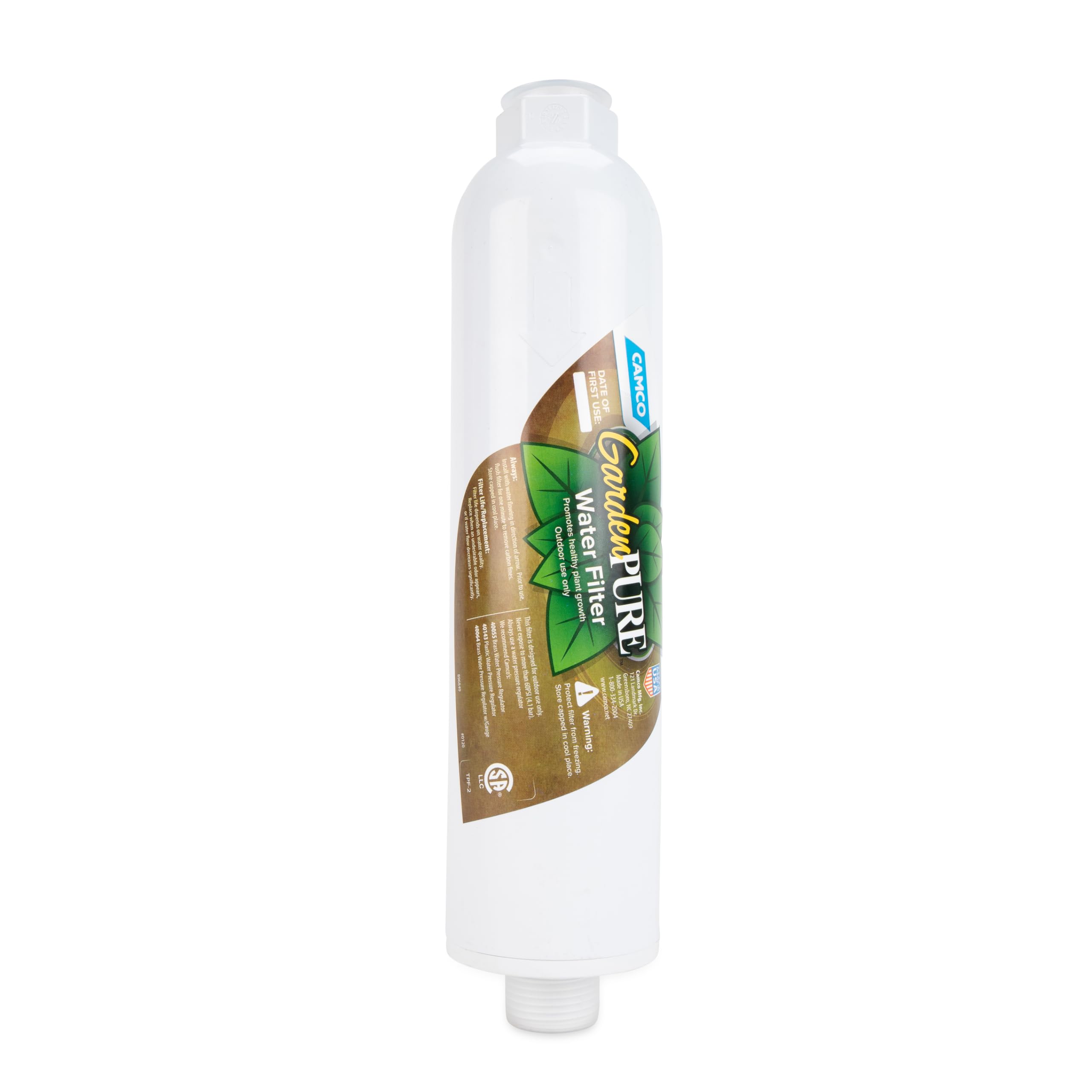
The carbon filter organic gardeners rely on to keep chlorine from killing beneficial soil bacteria.
Functionality leads here — 41 owners call it out — and for good reason. The activated carbon media inside the GardenPURE is designed to reduce chlorine and chloramine compounds that harm the microbial life essential for organic soil and hydroponic roots. It also targets lead, mercury, aluminum, and hydrogen sulfide, so you are not just protecting plants but getting cleaner water for compost tea and even pet bowls. The filter attaches to any standard garden hose, and for best results the manufacturer suggests keeping flow to 1 GPM.
What stands out in the owner feedback is a pattern: plants visibly improve after switching to filtered water. One buyer noticed “improved plant health” on heavily treated municipal water., and another reported the filter “didn’t suppress water pressure as much as other brands” — good news if you also run a sprinkler or fertilizer injector. The honesty point is that this is a consumable filter with a limited lifespan before replacement is needed, and the flow reduction is a trade-off some users find noticeable. The Camco is also made in the USA, which matters to buyers who prefer domestic manufacturing.
Bottom line for gardeners: If you are serious about organic soil health or run a hydro system, this is the filter to connect. For simple sediment blocking, a cheaper mesh screen does the same job without the carbon cost.
Best for: Organic vegetable gardens, hydroponic setups, and anyone who wants to remove chlorine and heavy metals from hose water.
Not for: High-volume pressure washing or continuous-flow applications — the 1 GPM optimal flow is too slow for those tasks.
6. Camco Hydro Life C-85 Inline Filter

An 8,000-gallon capacity filter that keeps water flowing fast while stripping chloramines.
This filter from Camco is built for volume. The catalytic carbon media is paired with KDF 85, which bonds with heavy metals and chloramines while protecting the carbon from bacterial fouling. The result is an 8,000-gallon capacity at up to 2.5 GPM flow rate — noticeably faster than many carbon filters that restrict to 1 GPM. That combination matters if you are filling a koi pond, running a large drip system, or watering multiple garden beds in one session.
Filtration performance is the top praise — 28 owners highlight it. One pond owner reports that after installing the C-85, regular water tests showed “very very low amounts of chlorine,” cutting their dechlorinator用量 significantly.. Another gardener noticed that their pots and tubs no longer developed the white crust from treated municipal water. The flexible hose protector is included to reduce strain on the spigot. The main caveat: some reviewers point out durability issues over time, and a few note leakage around the connections if the filter is left in direct sun year-round. Keeping it shaded extends its working life.
Why It Stands Out
- 8,000-gallon capacity is one of the highest in this class — replace yearly for most home gardens
- 2.5 GPM flow rate keeps water moving fast enough for sprinklers and pond top-offs
- Catalytic carbon + KDF 85 combination handles chloramines better than standard carbon alone
The Trade-Off
- Housing can degrade faster if left in direct sunlight — a shaded connection point helps the filter last its full lifespan
Reach for this if: You have a large garden, pond, or multiple watering zones that need chemical-free water without the flow bottleneck.
Pass on it if: Your water is already low in chloramines and you only need a simple sediment screen — you would pay for capacity you do not use.
7. Crystala Filters RV/Marine Inline Filter 3-Pack
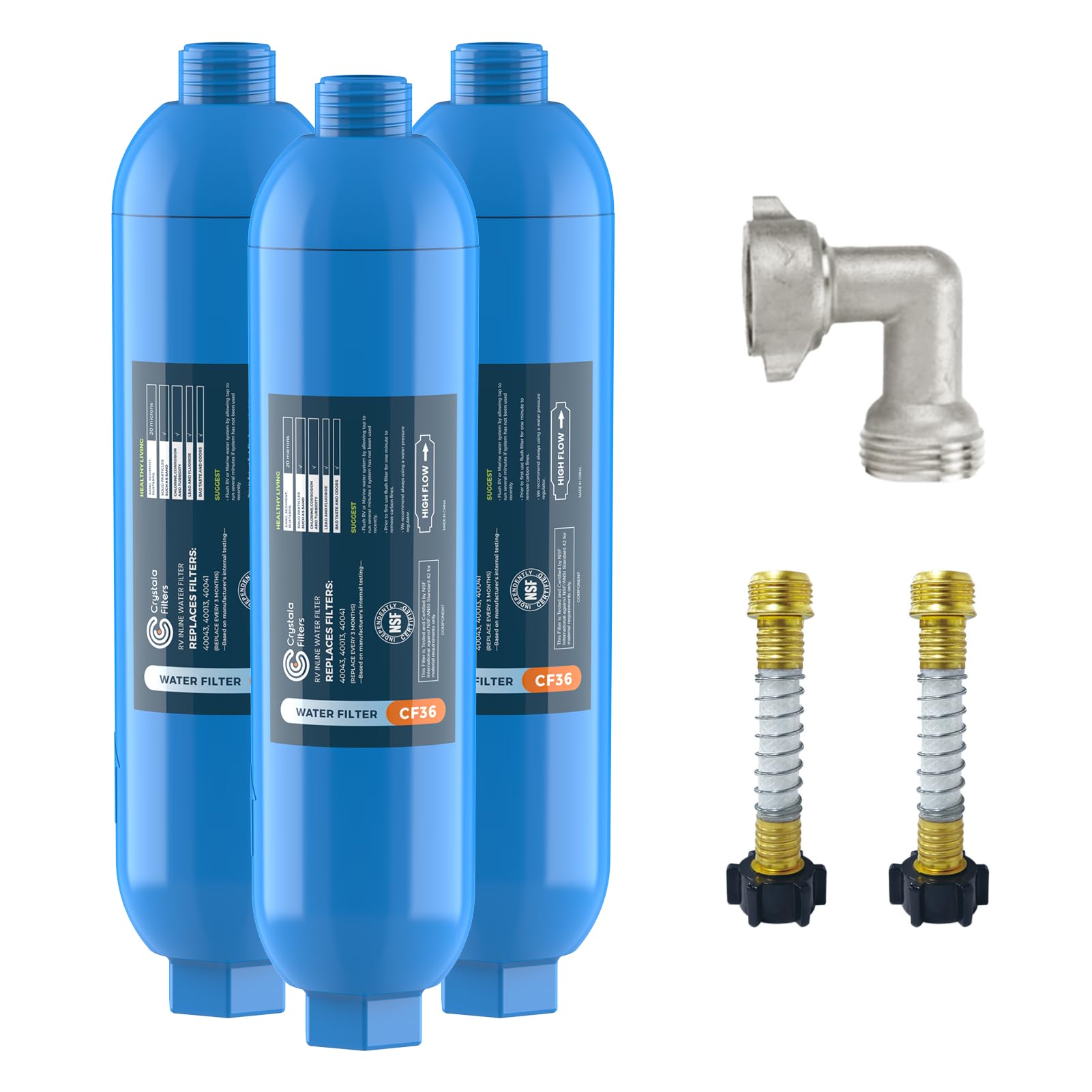
Three filters and a flexible hose kit that turns spigot water into bottled-tasting RV water.
This is a complete kit: three 20-micron filters using GAC and KDF media, plus two flexible hoses with brass fittings and silicone gaskets. The 360-degree rotating hose design reduces kinking and strain on the connection, which is a common failure point on RV filters. The 20-micron pore size is fine enough to reduce chlorine, bad taste, and odors while keeping beneficial minerals in the water — a balance that matters for drinking water.
Taste is the standout impression from owners. One buyer describes the output as “taste just like bottled water” with no smell of chlorine. Another buyer reports the filter “removed it all” regarding a bad chlorine taste in their water.. The three-pack gives you a whole-season supply for most campers, and the included brass fittings resist the cracking that plagues all-plastic filters. A small but notable point: opinions on water spots are mixed, so if you are filling an RV tank for washing, you may still see mineral residue depending on your source water hardness.
Best for RVers: If you rotate between campgrounds with different water quality, the flexible hose kit and three-pack supply make this the easiest RV filter bundle on this list.
Perfect for: RV freshwater tanks, boat water systems, and campers who want great-tasting filtered water without multiple trips to the store.
Not the pick if: You need a filter for high-pressure pressure-washer use — this is a low-pressure drinking water system.
8. EcoOne Hose Filter Advanced Purification

A dual-stage carbon filter that keeps hot tubs and pools free of hard water deposits and chlorine.
The EcoOne filter uses a four-layer system: a pre-filtration layer for big debris, then activated carbon, KDF media, and a post-filtration layer. The specification claims 20-micron filtration, which catches most sediment and reduces heavy metals, arsenic, VOCs, and chlorine. What makes this filter unique on the list is the 40,000-gallon capacity — nearly five times that of the Camco Hydro Life, though some long-term users estimate real-world replacement at 10,000 to 20,000 gallons.
Hot tub owners are the core audience here. One buyer reports it “eliminated lime deposits in hot tub from hard public water,” and another confirmed it “removed 40 ppm from tap water,” recommending it for cold plunge tubs as well.. The filter is easy to attach to any standard garden hose with no tools. A practical note from experienced owners: you can backwash this filter to extend its life, though backwashing may reduce chemical-removal effectiveness while still catching debris. The manufacturer is Snow Joe LLC, a familiar name in outdoor power equipment.
what separates it
- 40,000-gallon rated capacity handles multiple hot tub or pool refills before needing replacement
- Dual-stage carbon and KDF media reduces VOCs, heavy metals, and chlorine in one pass
- Backwashable design extends usable life beyond a single-use cartridge
Keep in Mind
- Practical capacity likely falls short of the 40,000-gallon claim — plan replacement around the 10,000 to 20,000-gallon mark
Best for: Hot tub, cold plunge, and pool owners who need high-volume chemical reduction without changing filters every month.
pass on it if: You only need a small garden filter — the capacity and size are overkill for a few flower beds.
9. FRIZZLIFE MV99 Inline RV Water Filter

The high-end filter with solid brass fittings and 0.5-micron precision that produces tap-quality water anywhere.
This is the most technically advanced filter in the lineup. The FRIZZLIFE MV99 uses a 0.5-micron composite activated carbon block — ten times finer than the standard 5-micron filter — and holds NSF/ANSI 53 and 42 certifications from IAPMO R&T for reducing chlorine, lead, heavy metals, sediment, and bad tastes. The connections are solid lead-free brass, which eliminates the crack-risk that plagues plastic fittings over time. The maximum flow rate is 1.5 GPM, which is respectable for a filter this fine.
An auto shut-off design lets you change the cartridge without turning off the water supply — a real convenience when you are connected at a campsite or garden spigot. The included wall-mount bracket with metal pegs keeps the filter upright and reduces hose kinking. One owner who upgraded from standard Camco filters calls it a “big upgrade,” noting it produces “super clear water, no visible particles, clear ice cubes, better taste” with no noticeable pressure drop.. The filter housing is reusable — you replace only the inner core, which reduces plastic waste. The twist-in cartridge replacement takes about three seconds.
Why It Is Worth the Premium
- 0.5-micron carbon block filters particles invisible to the naked eye — finer than any other filter on this list
- Solid brass connections will not crack like plastic fittings, even after years of sun exposure
- Auto shut-off and twist-in cartridge design mean filter changes are clean and tool-free
The Only Downside
- At a 1.5 GPM flow rate, it is fast for a fine filter but slower than a simple sediment screen — not ideal for high-volume pressure washing
Invest in this if: You want the best possible water quality from an RV, garden, or marine system, and you prefer brass fittings that last for years.
Opt for something simpler if: Your water source is already clean and you only need a basic sediment screen to protect a pressure washer nozzle.
Understanding the Specs
Micron Rating
This number tells you the size of the smallest particle the filter can trap. A lower micron number means finer filtration. A 0.5-micron filter catches particles invisible to the naked eye — good for drinking water. A 20-micron filter stops visible sediment but lets smaller particles through. Most carbon filters sit between 0.5 and 20 microns. Mesh screens, measured in “mesh” instead of microns, use a different scale: 200 mesh is roughly 74 microns.
Flow Rate (GPM)
Gallons per minute measures how fast water moves through the filter. Fine filters (0.5 micron) naturally restrict flow more than coarse screens. A filter rated at 1 GPM is fine for filling a watering can or an RV tank but will frustrate you if you are running a sprinkler or pressure washer. For most garden tasks, look for at least 1.5 GPM. High-capacity filters like the Camco Hydro Life push 2.5 GPM while still reducing chemicals.
FAQ
Can I drink water from an in-line garden hose filter?
Will an in-line hose filter reduce my water pressure?
How often should I replace an in-line garden hose filter?
Can I leave the filter on the hose all winter?
What is the difference between a mesh screen and a carbon filter?
Will a filter work with my rain barrel?
Do I need a brass or plastic connection?
What micron rating do I need for a pressure washer?
Can I use an RV water filter on a regular garden hose?
How do I clean a sediment filter screen?
Final Thoughts: The Verdict
If you want one dependable pick, the in-line garden hose filter winner is the Bringpure RV Water Filter 2-Pack because it combines KDF and carbon media with NSF 42 and 372 certifications in a two-pack that lasts a full season at a reasonable cost. If you need high-volume chemical reduction for a pond or large garden, grab the Camco Hydro Life C-85. And for the finest filtration available with brass fittings that will not crack, the FRIZZLIFE MV99 is the one to reach for.
How We Picked
We do not accept paid placement. Every pick is matched to a real buyer and a real use-case; we do not hands-on test units.
Sources & Methodology
Specifications: manufacturer listings and product documentation. Review insights: verified customer reviews, as of July 2026. Pricing: not shown on this page (it changes often); check the current price via the retailer link.
As an Amazon Associate, Lawn Gear Lab earns from qualifying purchases. This does not affect which products we feature.