
Specs are compiled from manufacturer listings and verified buyer reviews and can change over time — please confirm the key details on the product page before buying.
You shake the neighbor’s tree for windfall apples and drag home a bushel. Your reward should be jugs of golden cider, not a busted back fighting a wobbly press. The best fruit press for cider turns that two-hour wrestling match into a smooth hour of cranking over a bucket. The real trick is buying the right capacity and build for the volume you actually press — not the volume you daydream about.
This guide uses the published specs from each maker and patterns culled from verified customer reviews. You get each pick’s real-world strengths and honest drawbacks, not polished marketing.
Finding the right fruit press for cider means balancing how much juice you want against the elbow grease you are willing to give. Here is how to land on the one that fits your fall.
Our Picks at a Glance


How To Choose The Best Fruit Press For Cider
Before you dive into the reviews, focus on the three factors that separate a press you’ll use every season from one that collects dust after year one: capacity, basket material, and how much assembly you’re willing to tackle.
Capacity: Match It to Your Harvest
A 2-gallon press is perfect for a small backyard tree or a few grocery bags of apples — you’ll get a gallon or two of juice per session. A 3- to 5-gallon press handles a couple of bushels (roughly 40–50 pounds of fruit) in one go, which is the balance for most home cider makers. Jump to 5 gallons or more if you process from multiple trees or want to share juice with friends. The caveat: bigger baskets take up more storage space and weigh more to move around.
Basket Material: Wood vs. Stainless Steel
Solid beechwood baskets give a classic look and are naturally resistant to moisture, but they require drying and occasional mineral oil treatment to prevent cracking. Buyers report that wooden slats can sometimes snag filter bags if screws protrude. Stainless steel baskets are simpler to hose down after use, resist rust when dried promptly, and typically come on fully assembled frames — less tinkering before your first press. The trade-off is that stainless models often cost more upfront.
Drive Mechanism: Screw vs. Hydraulic
A manual screw press uses a threaded handle and a pressing plate — you crank down, wait for juice to drain, and crank again. It is simple, affordable, and gives you full control over pressure. A hydraulic (water-powered) press connects to a garden hose; the water pressure expands a rubber bladder inside the basket, pressing the fruit evenly from the center outward. Hydraulic models are faster and require far less physical effort, but they cost significantly more and need an outdoor tap with good water pressure.
Quick Comparison
| Model | Best For | Capacity | Material | Fully Assembled | Amazon |
|---|---|---|---|---|---|
| EJWOX 2.38 Gal★ Best Overall | Ready from the start | 2.38 gal (9 L) | Stainless Steel / Cast Iron | Yes | Amazon |
| EJWOX 4.75 GalAlso Great | Volume & Value | 4.75 gal | Beechwood / Steel | No (requires assembly) | Amazon |
| VEVOR 3.2 Gal | Budget-Minded Beginners | 3.2 gal (12 L) | Beechwood | No | Amazon |
| SQUEEZE master 3.17 Gal | Mid-Volume Simplicity | 3.17 gal (12 L) | Wood | No (requires assembly) | Amazon |
| EJWOX 5.3 Gal Hydraulic | High-Volume, Low Effort | 5.3 gal | Stainless Steel / Cast Iron | Yes | Amazon |
In‑Depth Reviews
1. 2.38 Gallon Fruit Wine Press — EJWOX
Our pick — over 4.5★ from 300+ verified ratings; the strongest balance of quality and price.
A pre-assembled press that is ready to crank the same day it arrives.
This is the only press in the roundup that ships fully assembled — no wood blocks to cut, no screws to turn, no guesswork. At 2.38 gallons (9 liters), it is the smallest, but the basket and handle are stainless steel, and the base plate, legs, and crossbeam are cast iron. The swing-open crossbeam lets you drop shredded apples straight into the basket without lifting the press arm, which saves effort compared to the 4.75-gallon EJWOX that requires you to lift the beam each time.
Owners consistently call it sturdy and easy to clean, and the math holds: one reviewer noted making “over two gallons of fresh apple cider” from six batches. At 21.5 inches tall, it is 6 inches shorter than the 4.75-gallon EJWOX model, so it tucks easily onto a basement shelf or garage cabinet. The trade-off is capacity — you cannot press a full bushel in one go, so plan multiple cycles for a heavy harvest. A few buyers mention that the T-handle can arrive slightly bent in shipping, but the brand sends a replacement part quickly.
If you process a few grocery bags of apples per season and want a press that is ready to go immediately, this is your pick. Not for heavy harvests — at 2.38 gallons, you will run multiple cycles if you work through a full bushel of apples in a single day.
Best for small-batch cider makers: if you process a few grocery bags of apples per season and want a press that is ready to go immediately, this is your pick.
Not ideal for heavy harvests: at 2.38 gallons, you will run multiple cycles if you work through a full bushel of apples in a single day.
2. 4.75 Gallon Fruit and Wine Press — EJWOX
The largest beechwood basket in this lineup for serious home pressing.
You get a 4.75-gallon capacity per load — a full 48% bigger than the 3.2-gallon VEVOR — so you can process a bushel of apples in fewer refills. The solid red beechwood basket resists moisture naturally, and the breakaway design lets you pop out spent pulp (the crushed fruit solids) quickly between batches. A built-in pour spout channels juice straight into your bucket or carboy (a fermentation jug). Each foot has a screw hole if you want to bolt it down for extra stability when you crank hard.
Performance is what owners lean on: over a hundred reviewers mention it. One buyer pressed 2.5 gallons of juice from a 5-gallon bucket of shredded fruit — about the real-world yield you can expect. The catch is assembly: it arrives in pieces, and several owners say pre-drilling pilot holes (small starter holes for screws) stops the wood slats from splitting. A few also warn that the metal parts must be rinsed and dried within hours or they will rust.
The consensus among buyers is clear: “Works well for apple cider.” You will want to plan an hour for setup, treat the wood with mineral oil before first use, and keep a towel handy for immediate cleanup afterward. This is your pick if you process a couple of bushels each season and want the most capacity per dollar in a wood-basket press. skip it if you want something you can use straight from the start — this one needs assembly and careful post-use drying.
Biggest strengths
- Massive 4.75-gallon capacity handles bigger harvests in fewer runs
- Breakaway beechwood basket lets you clear pulp quickly between presses
- Built-in pour spout makes juice collection mess-free
Things to plan for
- Assembly is required — plan an hour or more, and pre-drill holes to avoid splitting wood
- Metal parts can rust fast; must rinse and dry within hours after each use
- Large footprint (27.6 in. tall) needs dedicated storage space
Reach for this if: you process a couple of bushels each season and want the most capacity per dollar in a wood-basket press.
Think twice if: you want something you can use straight from the start — this one needs assembly and careful post-use drying.
3. VEVOR 3.2 Gal/12L Fruit Wine Press
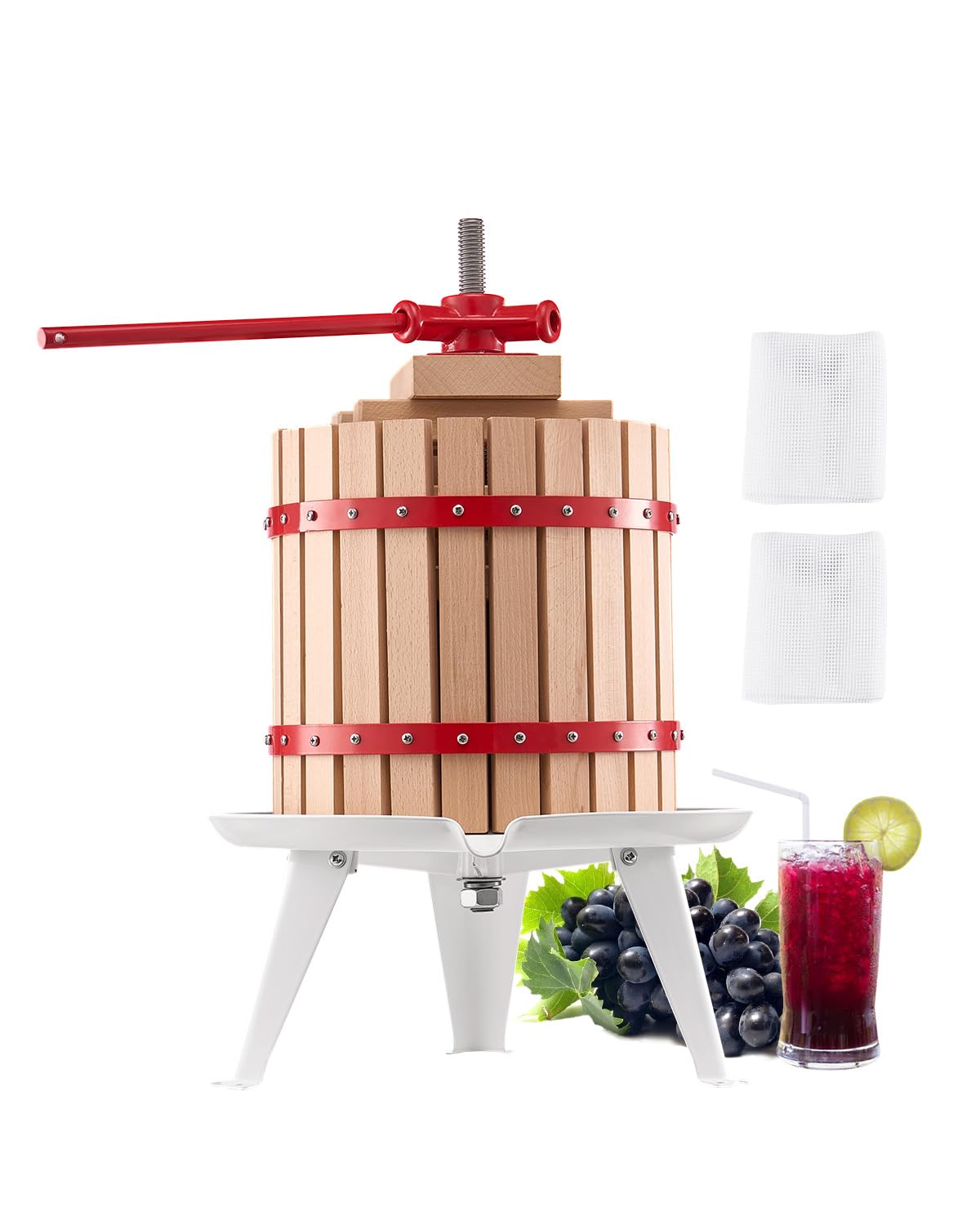
A 3.2-gallon wood basket press that keeps the entry price low.
You get a solid natural beechwood basket on a triangular base for stability, plus two food-grade filter bags (mesh pouches that catch pulp) included in the box. The pressing mechanism uses one thick beechwood block and eight supporting blocks, which owners mention extracts juice efficiently from apples and grapes. The extended rotating handle and spiral progressive mechanism mean you turn it downward and the screw does the real work — less grunt than the 2.38-gallon EJWOX requires at a full load.
Sturdiness and functionality are the two most-praised points, each mentioned by eight owners. The honest trade-off is assembly: it arrives completely unassembled. Most owners find the process straightforward, but a few call it tedious and suggest having a second person help. As one owner put it: “Take a while to put together, but I expected that.” Once assembled, it holds 3.2 gallons — a 48% gap smaller than the 4.75-gallon EJWOX, but still enough for a solid afternoon of pressing. The beechwood basket needs thorough drying after use and occasional mineral oil treatment to stop cracking. This is the best entry-level pick if you want a wood-basket press at the lowest cost and are comfortable with assembly. pass on it if you hate putting things together — it arrives in a box of parts requiring full assembly.
Good for the price
- 3.2-gallon capacity handles a decent volume while staying affordable
- Two filter bags included — no extra purchase needed
- Sturdy triangular base keeps the press stable during cranking
Assembly reality
- Completely unassembled — budget at least 30–45 minutes and a second set of hands
- Wooden basket needs thorough drying after each use to prevent mold or cracking
- Some owners find the assembly tedious despite clear instructions
Best entry-level pick: if you want a wood-basket press at the lowest cost and are comfortable with assembly, this is your starting point.
Skip if you hate putting things together: this press arrives in a box of parts and requires full assembly before you can press a single apple.
4. SQUEEZE master 3.17 Gallon Fruit Wine Cider Press

A T-handle press built for squeezing 11-16.5 pounds of fruit per load.
The T-shaped handle and spiral progressive mechanism make turning easier — even, owners say, for people with lower upper-body strength — compared to the standard crank handles on the VEVOR and the 4.75-gallon EJWOX. The large-diameter press plate covers more surface area, which the brand claims boosts juice yield per crank. It holds between 11 and 16.5 pounds of shredded fruit per load, putting it in the same capacity class as the VEVOR but with a different handle design aimed at cutting effort.
Customers note that it cleans up easily and works well without needing extra wood blocks. One owner squeezed 5 gallons of apple cider successfully. A few people found rough spots on the wooden parts that needed light sanding with fine-grit paper to avoid splinters — a quick fix before first use. There is one report of a welded joint breaking on the first pressing, though the seller sent a replacement part free of charge. The brand’s customer service consistently gets praise for handling issues after the return window. The press works without bolting down — you can step on the feet for stability — but screwing the legs to a heavy surface does make cranking easier during long sessions.
This is a solid mid-range press with responsive support behind it. Sand the wood slats before first use to avoid splinters, and you get a capable press for fall cider making.
A solid mid-range press with good support: the T-handle reduces effort, and the seller stands behind it with responsive customer service. Sand the wood slats before first use to avoid splinters, and you will have a capable press for fall cider making.
5. 5.3 Gal Hydraulic Fruit Press — EJWOX
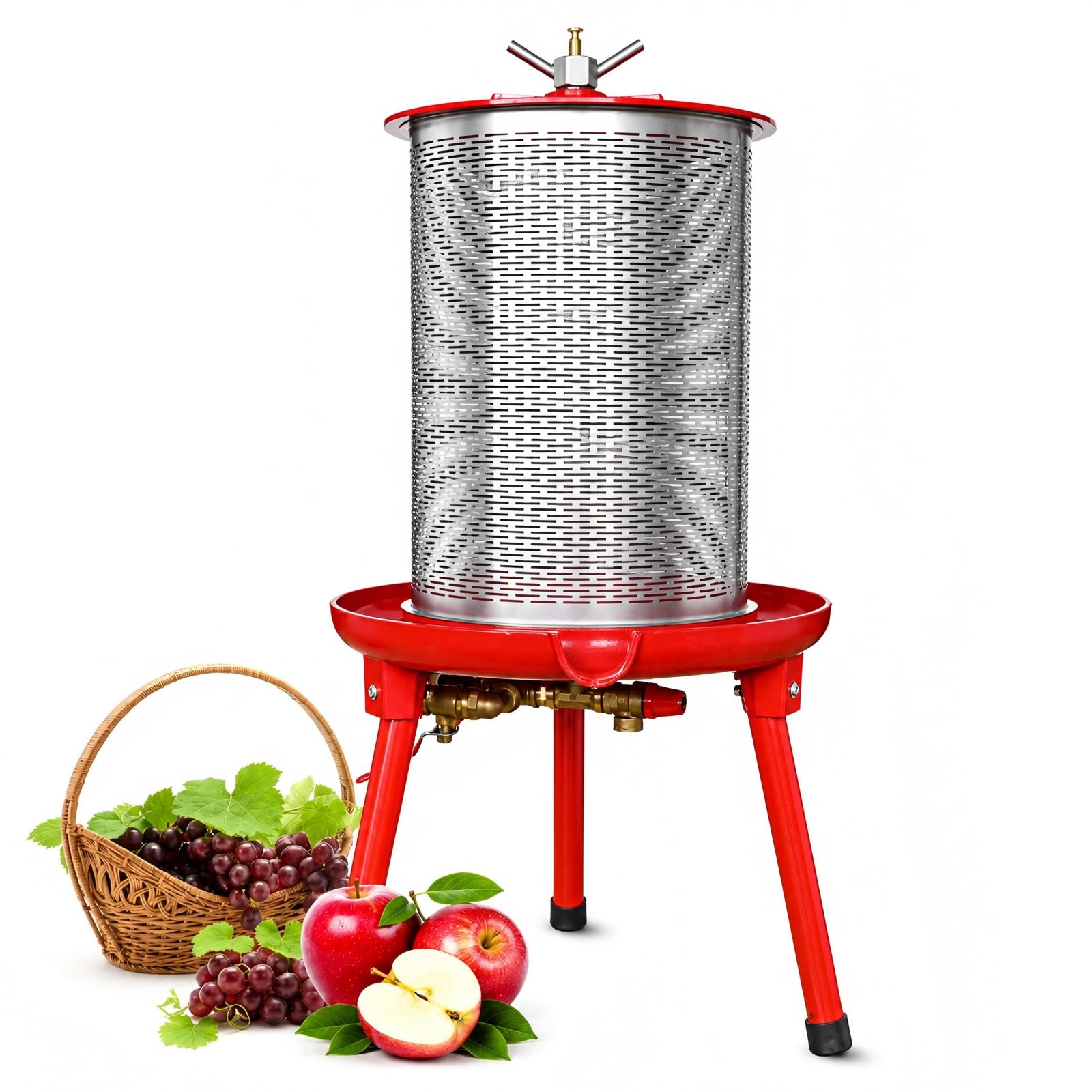
The water-powered press that lets a garden hose do the hard work.
This is the only hydraulic press in the lineup, and it works differently from all the screw-driven models. Instead of turning a handle, you connect a garden hose to the inlet, turn on the tap, and the water pressure expands a rubber diaphragm (a flexible bladder) inside the basket. The diaphragm presses the fruit evenly from the center outward against the mesh basket, squeezing juice out through the sides. No cranking, no muscle fatigue — just water pressure doing the work.
The 5.3-gallon capacity is the largest here. Reviewers point out 90% or higher juice extraction in 4–6 minutes per load — far faster than any screw model can manage. One owner processed 450 pounds of apples into 110 liters of juice across a season. The press comes with a filter bag and a splash guard, and the stainless steel basket is easy to hose down. The significant catch is the hose fitting: the press uses European GEKA connectors (a quick-connect coupling standard) that are incompatible with standard North American garden hoses from the start. Several owners detail workarounds — adapters or swapping quick-disconnects — so plan a trip to the hardware store. A few people also report minor leakage around the fittings, and there is concern about the painted iron parts chipping over time.
If you process 100+ pounds of apples per season and want the fastest, least physical extraction, this hydraulic press is your pick. Not for tool-averse buyers — you need a hardware store trip for a hose adapter.
What makes it special
- Hydraulic mechanism requires almost no physical effort — water does the pressing
- Fast extraction: 90%+ juice yield in 4–6 minutes per load
- 5.3-gallon capacity handles the biggest harvests in a single cycle
Before you buy
- Hose fittings are European GEKA — you need an adapter or modification for North American garden hoses
- Painted iron parts may chip over time with heavy use
- Must be used outdoors with a standard tap; not a countertop option
For heavy harvests and tired arms: if you process 100+ pounds of apples per season and want the fastest, least physical extraction, this hydraulic press is the pick.
Not for tool-averse buyers: plan a trip to the hardware store for a hose adapter unless you are comfortable modifying the fitting yourself.
Understanding the Specs
Capacity (Gallons)
This number tells you how much shredded fruit the basket holds per load, not how much juice you get out. A 4.75-gallon press filled with crushed apples typically yields 2–3 gallons of juice, because the fruit solids take up most of the basket volume. If you process a full bushel of apples (about 40–48 pounds), a 3-gallon press will need 2–3 cycles, while a 4.75-gallon press handles it in one or two. Match capacity to your typical harvest size to avoid too many refills.
Basket Material
Beechwood is traditional — it looks great, resists moisture naturally, and slides apart for easy pulp removal. The downside: it must be dried thoroughly after each use and treated with food-grade mineral oil every few seasons to prevent cracking. Stainless steel baskets are easier to clean (just hose them down) and do not require oiling, but they cost more and lack the classic look. Either material works well; your choice depends on how much maintenance you want to do.
Drive Mechanism
Screw presses use a threaded rod and a handle — you turn, wait for juice to drain, and turn again. They are simple, reliable, and cheap, but they require consistent effort, especially on a full basket. Hydraulic presses use water from a garden hose to inflate a rubber bladder inside the basket. They press faster and with less effort, but they cost significantly more and need an outdoor tap with decent water pressure. For occasional use (a few times per season), a screw press is plenty. For big annual hauls, the hydraulic route saves real time and physical strain.
Assembly Required
Some presses ship fully assembled — open the box, set it up, and start pressing. Others arrive as a box of parts that require an hour or more of assembly, including attaching wood slats, screwing in the base, and fitting the hardware. If you are not handy with tools or want to press apples the same day the press arrives, look for a model that states it is ready to use from the start. If you enjoy a weekend project, assembly can be a minor inconvenience, not a dealbreaker.
FAQ
Do I need to crush the apples before using the press?
How much juice will I get from a 3-gallon press?
Can I use a fruit press for grapes, berries, or other fruit?
Is a wood basket or a stainless steel basket easier to clean?
How long does a manual fruit press last?
Do I need to bolt the press down to use it?
Can I press hot or cooked fruit in a cider press?
What is the difference between a wine press and a cider press?
Can I leave my press assembled between seasons?
What size press do I need for one apple tree?
Final Thoughts: The Verdict
For most buyers, the fruit press for cider winner is the 4.75 Gallon EJWOX because it delivers the largest basket in this roundup at a price that undercuts many smaller presses — the performance reviews back it up by a wide margin. If you want a press that arrives fully assembled with no tinkering, grab the 2.38 Gallon EJWOX. And for high-volume seasons where you would rather turn a tap than a handle, the 5.3 Gal Hydraulic Press is the one to reach for — just plan a quick hardware store trip for the hose adapter.
How We Picked
We do not accept paid placement. Every pick is matched to a real buyer and a real use-case; we do not hands-on test units.
Sources & Methodology
Specifications: manufacturer listings and product documentation. Review insights: verified customer reviews, as of July 2026. Pricing: not shown on this page (it changes often); check the current price via the retailer link.
As an Amazon Associate, Lawn Gear Lab earns from qualifying purchases. This does not affect which products we feature.