
Specs are compiled from manufacturer listings and verified buyer reviews and can change over time — please confirm the key details on the product page before buying.
Scale insects are masters of disguise — those little brown or white bumps on your stems and leaves look like a plant disease, but they are actually sap-sucking pests that can slowly drain the life out of houseplants, citrus trees, and garden ornamentals. A true insecticidal soap works by breaking down the pest’s protective shell on contact, and the right one for scale is the one that sticks well enough to reach the pests hiding in leaf crevices without scorching your plant’s foliage.
I’m Rikta — the founder and writer behind Lawn Gear Lab. This guide is built by comparing the manufacturers’ published specifications and the patterns across verified customer reviews, so you get each pick’s real strengths and trade-offs instead of marketing spin.
The truth is that not every spray that claims to kill scale actually does — some slide right off the waxy coating these pests hide behind, while others burn tender leaves. Here is how to find the best insecticidal soap for scale for your specific plants.
Our Picks at a Glance

How To Choose The Best Insecticidal Soap For Scale
Scale insects have a tough, waxy outer covering that shields them from many sprays. A successful insecticidal soap needs the right active ingredient and the right application method to break through that armor.
Active ingredient: Potassium salts of fatty acids
This is the standard active ingredient in legitimate insecticidal soaps. It works by dissolving the scale insect’s protective cuticle and dehydrating the pest on contact. Products listing “Potassium Salts of Fatty Acids” are true soaps; products listing “mineral oil” are a different type of spray (horticultural oil) that works differently.
Concentrate vs. Ready-to-Use
A concentrate (like the Safer or Ecoworm options) lets you mix your own strength, which is more economical for treating multiple plants across a season. A ready-to-use spray (like the Summit Year-Round Spray Oil) is grab-and-go convenient but often runs out faster. For scale, having a concentrate allows you to tailor the strength to your plant’s sensitivity.
Application technique matters most
No soap works if you miss the undersides of leaves, the leaf axils, and the stems where scale hides. You must spray every surface of the infested plant until the solution drips off. Most products recommend treating every 5 to 7 days while scale is active.
Quick Comparison
| Model | Best For | Active Ingredient | Liquid Volume | Form | Amazon |
|---|---|---|---|---|---|
| Safer 5118-6★ Best Overall | All-around scale control | Potassium Salts of Fatty Acids | 16 fl oz | Concentrate | Amazon |
| Summit Year-Round Spray Oil | Gentle removal on delicate plants | Mineral Oil | 32 fl oz | Ready-to-Use | Amazon |
| Ecoworm Horticultural Soap | Multi-purpose leaf cleaning & pest control | Potassium Soap | 34 fl oz | Concentrate | Amazon |
| Trifecta Crop Control | Heavy-duty indoor & small garden use | Essential Oil Blend | 64 fl oz (2-pack) | Concentrate | Amazon |
In‑Depth Reviews
1. Safer 5118-6 Insect Killing Soap Concentrate
Our pick — over 4★ from 6,000+ verified ratings; the strongest balance of quality and price.
The concentrate that turns a 16-ounce bottle into a full season of scale defense.
Scale insects meet their match with potassium salts of fatty acids — the active ingredient that breaks down their waxy armor and dehydrates them on contact. This concentrate is a champ for a garden-wide approach: it targets soft scales (along with aphids, spider mites, mealybugs, and whiteflies) and is gentle enough for flowers, herbs, vegetables, trees, and houseplants. Buyers report it handles severe infestations decisively: “90% dead by day 1, all by day 3.”
The dilution is the lever here — mix between 2 and 4 tablespoons per gallon of water, starting low to avoid leaf burn on tender plants. OMRI Listed for organic use, so you can spray right up to harvest day. The crowd of thousands of owners gives this product the highest total review count in this roundup by a giant margin, which tells you it is the go-to for most gardeners facing scale.
Why it wins
- Effectiveness is the #1 thing owners praise — 786+ call it out
- Economical concentrate: one 16-ounce bottle stretches to multiple gallons of spray
- OMRI Listed for organic gardening, safe for beneficial insects when used properly
The fine print
- Over-diluting or using in direct sun can burn leaves — follow the mixing guide
- The concentrate can solidify in cold weather; a half-hour in the sun melts it
- Has a noticeable smell some owners find strong
Grab it for: any gardener who wants one economical concentrate that works on soft scale, aphids, mites, and whiteflies across indoor and outdoor plants.
Think twice if: you want a purely grab-and-go spray — this requires mixing. Also, sensitive plants like succulents may need a weaker mix.
2. Summit 122 Year-Round Spray Oil
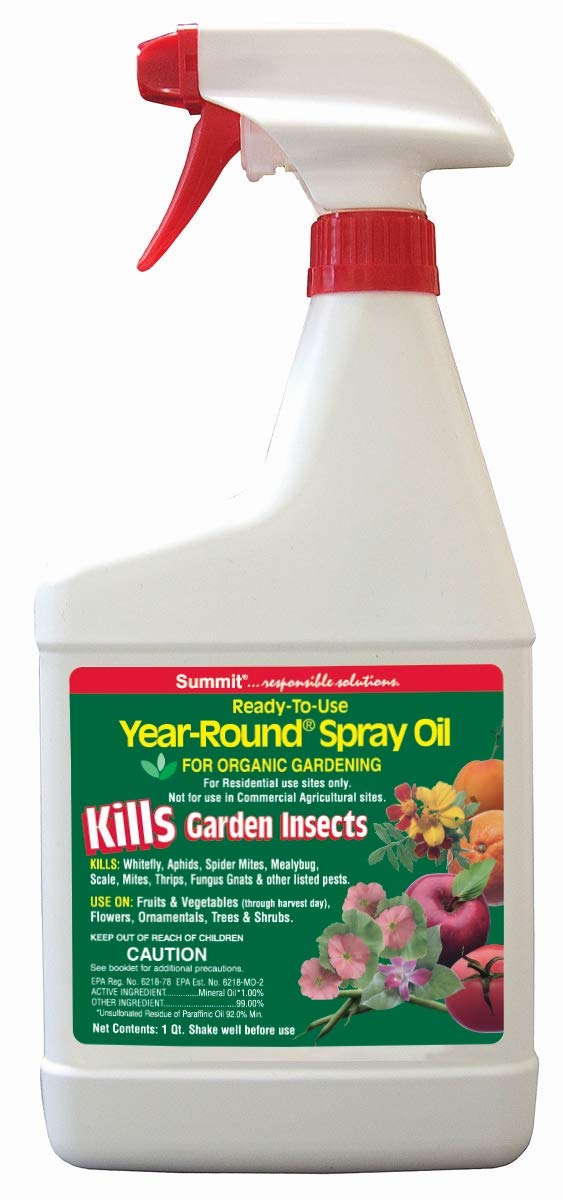
The gentle spray that stripped scale from a blooming adenium without a single burnt leaf.
This is technically a horticultural oil (mineral oil based), not a potassium-salt soap, but scale is the target it excels against. Owners repeatedly mention it cleared cotton scale on delicate indoor trees — “removed scale from a blooming adenium plant after two weekly treatments; plant remains healthy and blooming.” It is ready-to-use right out of the quart bottle, so there is no mixing, no measuring, no risk of over-concentrating. You just spray and watch the scale die within a day.
The 32-ounce bottle is 2.0x the volume of the Safer concentrate bottle, but the Safer concentrate stretches further per treatment because it is diluted. Where this product stands apart is precision: for a small collection of prized houseplants — orchids, citrus trees, a single lime tree — the gentle oil formula adds a shiny luster to leaves and even fights powdery mildew. A few owners note that the spray cap can fail after a few uses, and the formula is quite watery, so it drips off leaves quickly (spray over a catch tray).
What stands out
- Very gentle on delicate and blooming plants — no leaf burn reported
- Cleared scale in two weekly treatments with no recurrence for four months
- Ready-to-use; no mixing, no measuring
Watch points
- The spray cap has a reputation for failing after a few pumps
- Watery consistency means it drips off vertical leaves quickly
- At the per-quart price, it is not as economical as a concentrate for large gardens
Reach for this if: you have a small number of delicate indoor plants — orchids, citrus trees, or flowering houseplants — and want a no-mix solution that is proven gentle on foliage in bloom.
Pass it by for: large outdoor gardens or a recurring scale problem across many plants; you will use the quart faster than you expect and pay more per treatment.
3. Ecoworm Horticultural Soap Concentrate
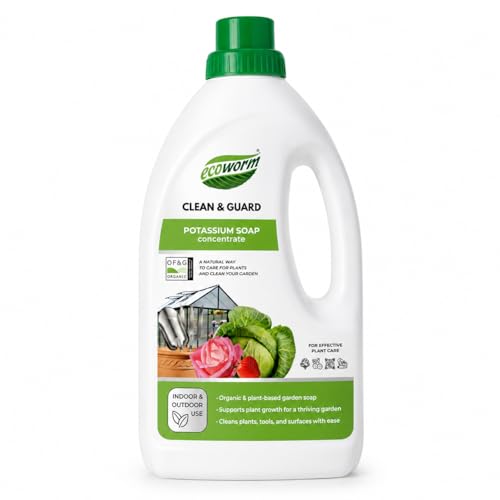
The 34-ounce concentrate that holds 6% more volume than the closest competitor.
This potassium soap concentrate comes at 1.06 quarts — slightly larger than the Safer 16-ounce bottle (a 6% gap). The mixing ratio is generous: dilute 200 to 600 ml of soap per 10 liters of water, which gives you tremendous flexibility to target scale with a strong mix or use a mild mix for routine leaf cleaning. Owners mention it killed pests in under 24 hours, as one put it: “Es de gran efectividad en menos de 24 horas desaparecen las plagas.” It is also marketed as a leaf cleaner — it washes away dust, sticky honeydew residue (the sticky mess scale leaves behind), and grime from leaves, pots, and tools.
The biodegradable formula is suitable for indoor plants, vegetables, herbs, flowers, and greenhouse use. It earns a strong 4.5-star average on a modest but revealing set of reviews — every single owner who took the time to write gave it 5 stars except one, who simply wanted a bigger bottle. The caveat is brand scale: Ecoworm is a smaller, less established name than Safer, so the long-term trust factor is lower, but the active ingredient is the same potassium soap that works.
Why you’d choose it
- Largest concentrate bottle in this lineup at 34 fluid ounces
- Dual-use as a pest spray and leaf cleaner — removes scale and the honeydew residue they leave
- Biodegradable and safe for vegetable gardens up to harvest
What to consider
- Only 55 ratings exist, so the long-term track record is thin next to established brands
- May not be as widely available in local garden centers as Safer
- Instructions are basic; new gardeners may need to research dilution best practices
Use this for: gardeners who manage multiple houseplants and want a generous concentrate that also cleans sticky leaf residue left by scale.
skip it if: you want a brand with decades of grower trust and thousands of reviews backing its consistency.
4. Trifecta Crop Control Insecticidal Soap

The one that fights scale and the powdery mildew that often follows.
Trifecta calls itself an insecticidal soap, but its active ingredients are a blend of essential oils — a different mechanism from potassium salts. It targets soft-bodied pests including scale, spider mites, aphids, and whiteflies, plus it works as a fungicide against powdery mildew. That dual-action makes it the only pick here that tackles both a live scale infestation and the fungal problems that often set in on weakened plants.
This 2-pack gives you 64 total fluid ounces of concentrate. Owners in grow rooms and indoor gardens vouch for it heavily — “the gold standard in my grow room” — and report it kills spider mites and similar pests when sprayed consistently. The catch is cost: at essentially a premium entry-level price for the 2-pack, and with owners finding it takes 2 to 4 ounces per gallon of water for effective treatment, a single bottle can deplete fast if you have many plants. One returning owner summed it up: “not cost-effective to use” for weekly treatments on a large collection. It also does not kill scale eggs, so you must reapply every few days to catch the next generation hatching.
What earns its reputation
- Dual insecticide and fungicide — tackles scale and powdery mildew in one spray
- Made with natural essential oils, quick-drying, leaves no residue
- Highly trusted by indoor growers and hydroponic gardeners
The real trade-offs
- Higher cost per treatment than a straight potassium-soap concentrate
- Kills live scale but not eggs; needs repeat sprays every 3 days for full life-cycle control
- Owners note it needs 2-4 oz per gallon, so a 32-oz bottle covers just 8-16 gallons
Best suited to: indoor grow rooms or small garden spaces where scale and mildew are both present and you prioritize a natural essential oil formula.
Not the right pick for: large outdoor gardens, budget-conscious buyers, or those who want a one-and-done spray — this demands repeat applications and costs more per gallon of mixed solution.
Understanding the Specs
Potassium Salts of Fatty Acids
This is the active compound in true insecticidal soaps. It works by penetrating and dissolving the waxy outer shell of scale insects (their protective cuticle), causing the pest to dehydrate and die. It is contact-only — the spray must hit the scale directly — and it leaves no toxic residue, which is why it is allowed in organic gardening. The same ingredient is broadly effective against other soft-bodied pests like aphids, spider mites, and mealybugs.
Concentrate vs. Ready-to-Use
A concentrate contains the undiluted active ingredient and must be mixed with water before spraying. This is the more economical choice if you have multiple plants or a recurring scale problem — one 16-ounce bottle can make several gallons of spray. A ready-to-use (RTU) bottle is already diluted and goes straight into a sprayer. RTU is convenient for a single treatment on one or two plants but costs more per ounce of active ingredient and runs out faster.
OMRI Listing
The Organic Materials Review Institute (OMRI) is an independent nonprofit that reviews products against USDA organic standards. An “OMRI Listed” soap has passed their review for use in certified organic production. This matters if you are growing vegetables or herbs you plan to eat and want to avoid synthetic pesticides.
Soft Scales vs. Armored Scales
Insecticidal soaps work best on soft scales — those that produce honeydew (the sticky substance on leaves) and have a softer, waxy covering. Armored scales, which have a separate, tougher shell, are harder to kill with soap alone and may require a horticultural oil or repeated soap applications to break through. If your scale does not produce honeydew, you may be dealing with armored scale, which often needs a different approach.
FAQ
Does insecticidal soap actually kill scale insects?
How often should I spray insecticidal soap for scale?
Can I use insecticidal soap on edible plants like herbs and vegetables?
Will insecticidal soap burn my plants?
Which is better for scale: ready-to-use spray or concentrate?
Does insecticidal soap kill beneficial insects like ladybugs and bees?
What is the difference between insecticidal soap and horticultural oil?
How long does it take to see results after spraying for scale?
Why are there still dead scale on my plant after spraying? Do I need to remove them?
Can I mix insecticidal soap with other pesticides or fungicides?
Final Thoughts: The Verdict
For most gardeners, the insecticidal soap for scale to reach for first is the Safer 5118-6 Insect Killing Soap Concentrate — it has the proven active ingredient, OMRI organic certification, and the massive owner base that confirms it works across thousands of gardens. If you need a gentler spray for a prized blooming plant like adenium, the Summit Year-Round Spray Oil is the no-mix pick that owners trust for delicate foliage. And if you want more total concentrate for the same money and also need to clean sticky honeydew residue, the Ecoworm Horticultural Soap offers the most liquid volume per bottle. Whichever you choose, the rule stays the same: spray every surface, repeat weekly, and scale will not stand a chance.
How We Picked
We do not accept paid placement. Every pick is matched to a real buyer and a real use-case; we do not hands-on test units.
Sources & Methodology
Specifications: manufacturer listings and product documentation. Review insights: verified customer reviews, as of July 2026. Pricing: not shown on this page (it changes often); check the current price via the retailer link.
As an Amazon Associate, Lawn Gear Lab earns from qualifying purchases. This does not affect which products we feature.