
Specs are compiled from manufacturer listings and verified buyer reviews and can change over time — please confirm the key details on the product page before buying.
Cracked plastic pots are a pain. Garden grow bags give you a portable, breathable home for tomatoes, peppers, and potatoes — they let air prune your roots instead of choking them. The trick is picking the right fabric weight and handle strength so your bag survives a full season of sun and lugging without falling apart.
I’m Rikta — the founder and writer behind Lawn Gear Lab. This guide is built by comparing the manufacturers’ published specifications and the patterns across verified customer reviews, so you get each pick’s real strengths and trade-offs instead of marketing spin.
The goal is simple: steer you to the best garden grow bags for your space and budget, based on what thousands of actual owners have discovered holds up and what falls short.
Our Picks at a Glance


How To Choose The Best Garden Grow Bags
Grow bags look simple — a fabric pot with handles — but the wrong one will sag, tear, or dry out so fast your plants suffer. Focus on three things: material thickness, handle reinforcement, and size matching your crop.
Fabric Thickness and Durability
Most bags use nonwoven fabric (a felt-like material made from bonded fibers) measured in grams (G). A 300G fabric is the standard for multi-season use. Step up to 500G and you get a much stiffer wall that holds its shape and resists abrasion — so it stays upright when empty and doesn’t fray against concrete. Thicker fabric also slows moisture loss, meaning fewer watering rounds on a hot afternoon.
Handle and Stitch Quality
Handles are the weak link. A bag full of wet soil is heavy, and a cheap handle rips on the first move. Look for X-shaped stitching or polypropylene webbing (a strong plastic strap) handles sewn through the bag wall. Cross-stitched reinforcement is a strong sign the maker expected real use.
Size and True Capacity
A 5-gallon bag works for one tomato or pepper plant. A 10-gallon bag handles potatoes or a small squash. Some brands list a nominal size that is slightly off — check the actual dimensions (diameter x height) so you know what you are really getting.
Quick Comparison
| Model | Best For | Capacity | Fabric Weight | Pack Size | Amazon |
|---|---|---|---|---|---|
| Gardzen 5 Gal (10-Pack)★ Best Overall | Best Overall | 5 gal | 300G | 10 | Amazon |
| AC Infinity Square 5 Gal (5-Pack)Premium Build | Premium Build | 5.39 gal | 500G | 5 | Amazon |
| NACHLYNN 15 Gal (5-Pack) | Large Capacity | 15 gal | Thickened | 5 | Amazon |
| ADORMA 3 Gal (20-Pack) | Best Value/Bulk | 3 gal | 300G | 20 | Amazon |
| OPPOLIFE 10 Gal (12-Pack) | Mid-Size Workhorse | 10 gal | 300G | 12 | Amazon |
| Cavisoo 5 Gal (24-Pack) | Versatile Multi-Pack | 5 gal | 300G | 24 | Amazon |
In‑Depth Reviews
1. Gardzen 10-Pack 5 Gallon Grow Bags
Our pick — over 4.5★ from 21,500+ verified ratings; the strongest balance of quality and price.
Over 21,000 buyers agree: these 5-gallon fabric bags beat plastic pots — and they are the standard everyone else is measured against.
The Gardzen set delivers on the most common need: one reliable 5-gallon bag per plant. The 300G thickened nonwoven fabric (a dense felt that breathes) gives roots enough oxygen to thrive while slowing evaporation so you do not have to water every few hours. The real highlight is the reinforced X-shaped stitching on the handles — cross-stitched so the strap does not rip when you drag a fully loaded bag across the patio. Each bag measures 12.8 inches across and 10 inches tall, a proven size for tomatoes, peppers, and cucumbers.
Reviewers consistently praise quality and durability above all else. Buyers report these bags are reusable, sturdy, and “still like new after a year.” The fabric stays open for filling, the drainage prevents root rot (root decay from standing water), and the whole 10-pack folds flat for off-season storage. Compared to the ADORMA 20-pack, this gives you twice the soil volume per bag for larger plants. One note: a few owners find these smaller than other 10-gallon bags they have used, so if you need true 10-gallon capacity, size up.
Why It Wins
- Proven durability — owners mention multi-season use with peppers and potatoes.
- Reinforced X-stitched handles that hold up under heavy wet soil.
- True 5-gallon size that matches the most common planting needs.
One Trade-Off
- Some owners note the bag runs slightly smaller than other 10-gallon options — stick with this for 5-gallon planting.
Best for: The gardener who wants one reliable 5-gallon bag per plant, backed by the largest owner base in this category.
Consider if: You are growing root vegetables or tomatoes and need a proven multi-season bag at a fair per-unit price.
2. AC Infinity Square Heavy Duty Fabric Pots, 5 Gallon (5-Pack)
This is the thickest fabric bag you can buy — 500G — in a square shape that saves space in a grow tent.
AC Infinity steps away from the round bag norm with a square design that gives roots more surface area to breathe than a cylinder of the same volume. The fabric is nearly double the standard 300G most bags use, at 500G (grams per square meter, a measure of density). The walls stand firm without flopping, and the material resists abrasion season after season. True capacity is 5.39 gallons — slightly above the 5-gallon label — and the bag includes fabric loops for plant stakes so you can support a heavy tomato vine without puncturing the root zone. You get only 5 bags per pack, compared to 10 from Gardzen.
Owners consistently praise the build quality. The nylon handles and reinforced stitching hold up so well that customers note the bags “wear like iron” compared to other brands whose threads disintegrate after one year. A few mention the square shape is superior to round bags because there is no side leakage around the edges. The trade-off is the higher per-bag cost — but for a grow tent user or anyone who wants a pot that truly lasts, the investment makes sense. The thickness also means the bag does not flop over when empty.
Square advantage: At 5.39 gallons true capacity with 500G fabric, this is the most durable option here — ideal for indoor tents or outdoor setups where you boost every inch of floor space.
Note: Only 5 bags per pack, so the upfront cost per bag is higher than the Gardzen 10-pack. Worth it if you plan to keep them for years.
Reach for this if: You run a grow tent or want the thickest, most rigid fabric bag available to support heavy yields. Gardzen is a better value for casual patio use.
Otherwise: A standard 300G round bag like Gardzen is lighter and cheaper if you only need a few seasons from each pot.
3. NACHLYNN 5-Pack 15 Gallon Grow Bags
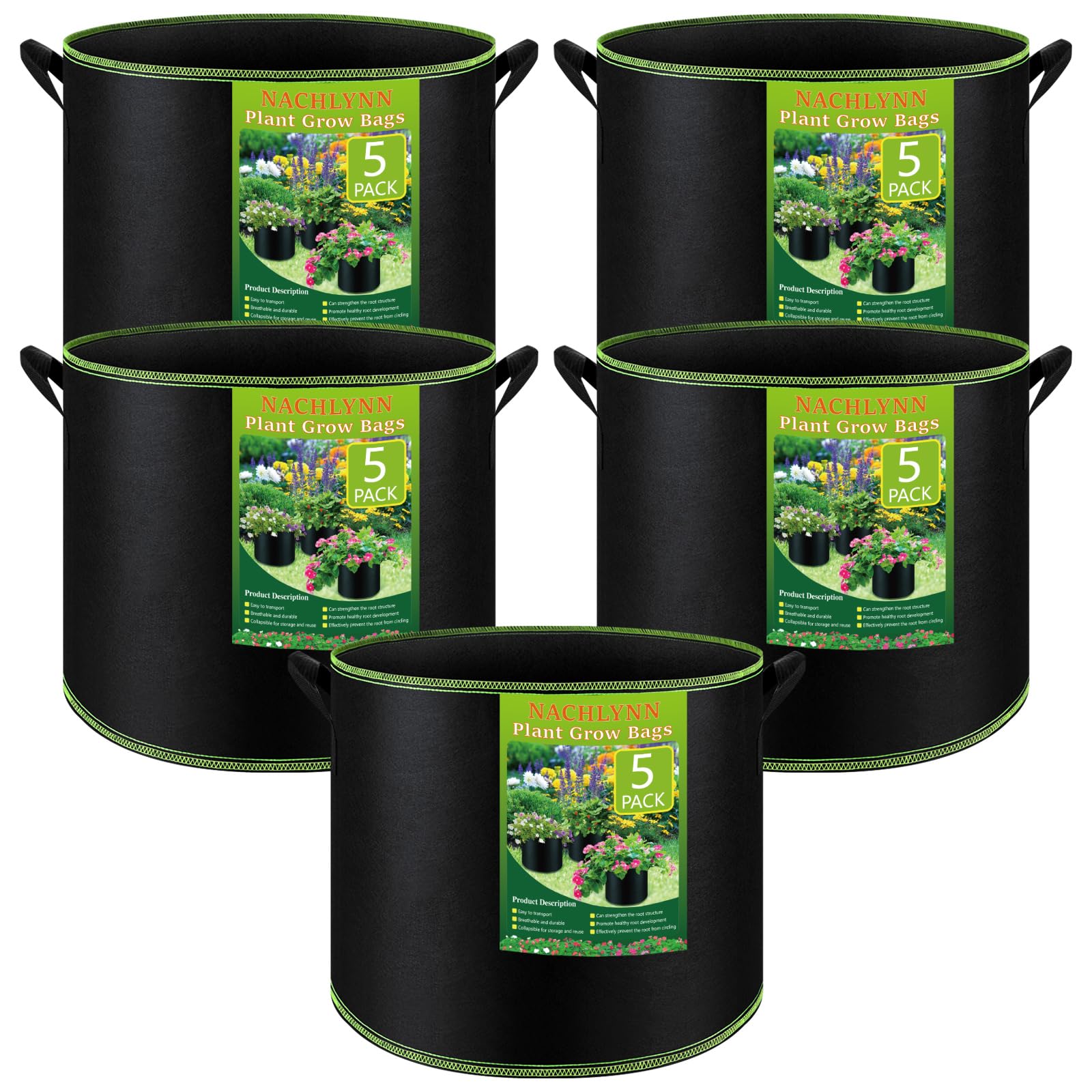
The thickened fabric stands up on its own — no floppy sack to wrestle with when you fill it.
Most large grow bags sag and collapse. The NACHLYNN 15-gallon bag does not. Owners call them “the absolute best grow bags I’ve ever had” because the thickened nonwoven fabric is stiff enough to support itself, making filling and moving much less frustrating. At 20 inches in diameter and 12.5 inches tall, this bag holds three times the volume of the Gardzen 5-gallon bags (15 gallons vs 5 gallons). It is a serious contender for pumpkins, large tomato plants, or multiple pepper plants in one container. The 5-pack brings the cost per bag down significantly compared to the AC Infinity 5-pack, for a much larger capacity.
The reinforced handles on both sides use heavy stitching sewn through the bag wall, so you can drag a fully saturated bag across the patio without tearing. Breathability prevents excess water retention, and reviewers point out healthy root growth with no spiral circling (roots wrapping around the inside of a pot). The main watchpoint is size — these bags are big, heavy when wet, and require more soil than a 5-gallon bag. Each bag needs roughly 2.5 cubic feet of potting mix. Make sure you have the space and back strength before committing.
Standout feature: The bag’s self-supporting structure is a genuine quality-of-life upgrade — no wrestling with a limp sack every time you fill it.
Know before you buy: At 15 gallons, each bag needs roughly 2.5 cubic feet of potting mix per bag. That is about 10 times the soil of a 3-gallon ADORMA bag.
Best for: Large root vegetables, indeterminate tomatoes, or anyone who wants fewer, bigger containers instead of many small ones.
Think twice if: You have a small patio or need to move your plants frequently — wet soil at this scale is heavy.
4. ADORMA 20-Pack 3 Gallon Grow Bags
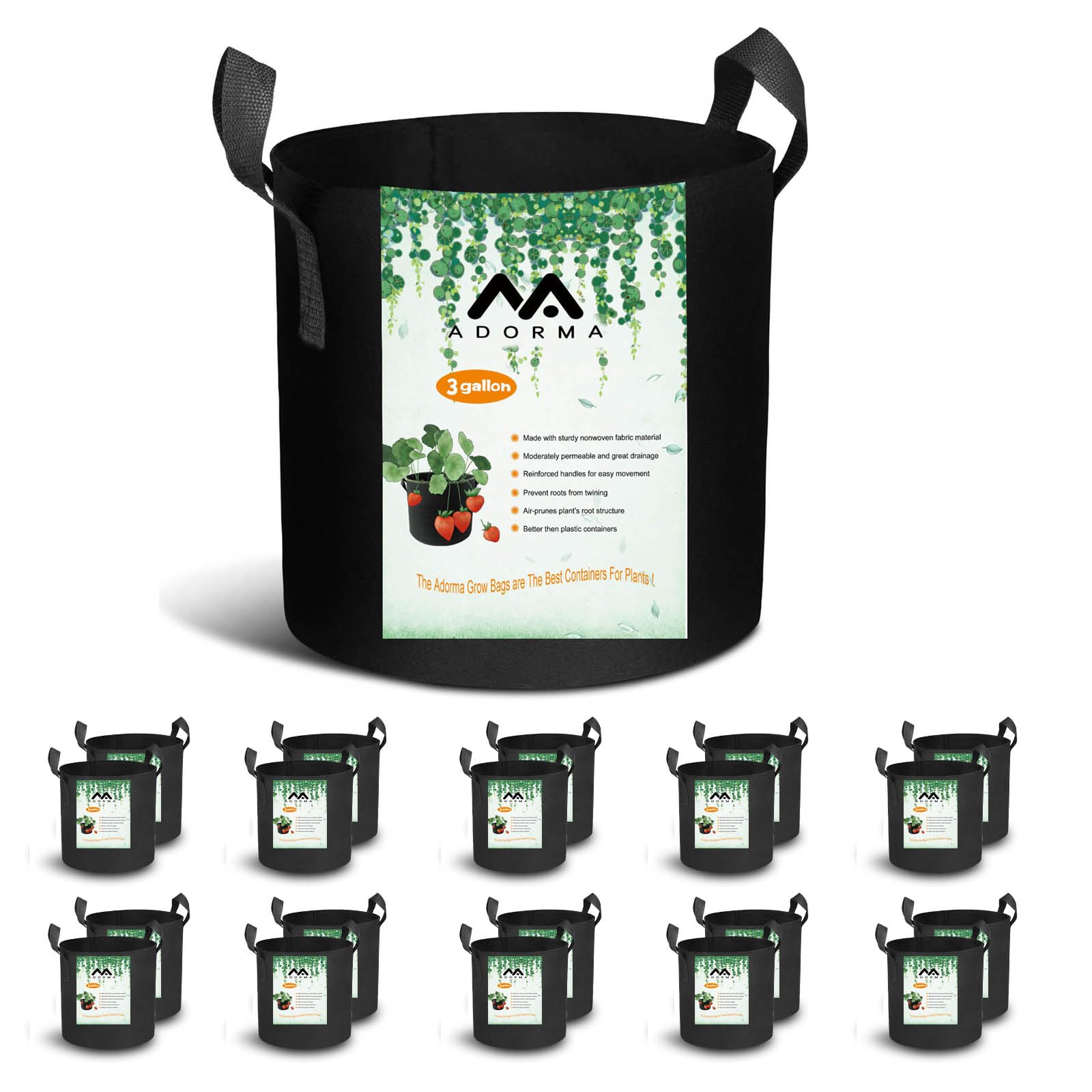
Twenty bags for the price of a few premium ones — the best per-bag deal if you need lots of small containers.
If you are starting seeds, growing herbs, or moving a big collection of pepper plants, the ADORMA 20-pack delivers the lowest cost per bag in this roundup without cheaping out on the fabric. Each 3-gallon bag measures 10 by 9 inches and uses 300G thickened nonwoven fabric with five-line edging on the top and double sewing on the side seams. The handles use polypropylene webbing (tough plastic strap) with X-shaped stitching, which the company claims provides “10 times more weight bearing” than a single stitch line. You get 20 bags here — four times as many as the Gardzen 10-pack for roughly a similar overall price.
Quality and sturdiness are the top praise points among owners. Buyers mention the bags held up all summer without mold, drained well, and are easy to move with the handles. The 3-gallon size is ideal for a single pepper plant, a small tomato, or a few heads of lettuce. One owner even used them as pond plant containers — the mesh holds mud and roots while letting water flow through. The catch is that a 3-gallon bag dries out faster in hot weather than a 5-gallon bag like the Gardzen, so you will water more often. Plan for daily checks if the temperature climbs above 80°F.
Why This Packs Value
- 20 bags for the price of 5 from premium brands — unbeatable per-unit cost.
- Five-line edging and double side seams for a bag that stays together through multiple seasons.
- Proven multi-use: vegetables, flowers, even pond plants.
The Speed Trade-Off
- Smaller soil volume means faster drying — expect to water daily in summer heat.
Perfect for: A high-volume seedling operation or a budget-conscious gardener who wants 20 stations for herbs and peppers. You get four times the count of the Gardzen 10-pack for about the same money.
Skip if: You need deep soil for root vegetables like potatoes or carrots — those want at least 5 gallons per plant.
5. OPPOLIFE 12-Pack 10 Gallon Plant Grow Bags
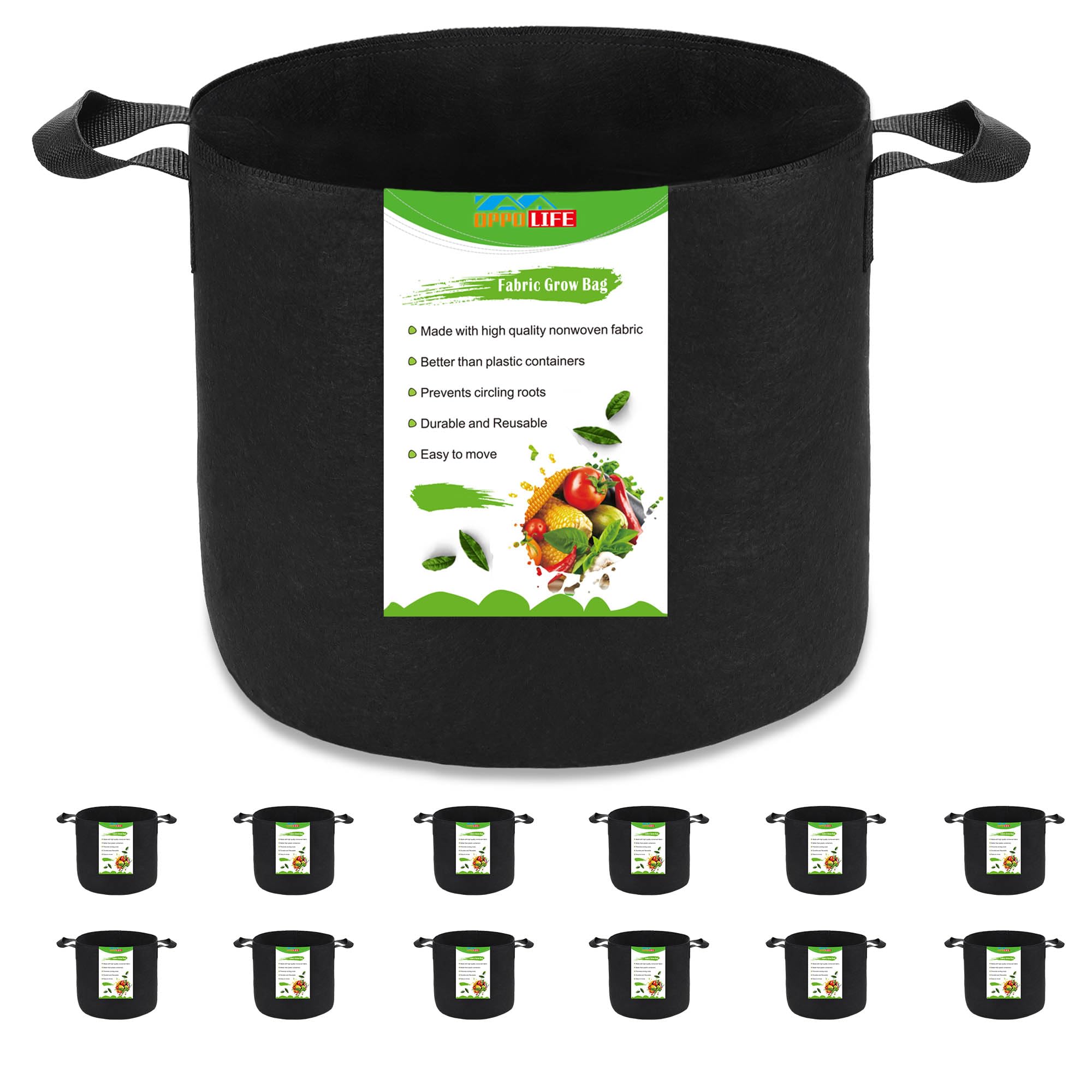
The handles are the key — extended polypropylene webbing with inner lining reinforcement so they do not pull loose when the bag is full.
OPPOLIFE builds a 10-gallon bag (12 inches diameter x 10 inches tall) that splits the difference between the Gardzen 5-gallon and the NACHLYNN 15-gallon. It uses 300G thickened nonwoven fabric with anti-ultraviolet (UV) performance — material designed to resist sun damage so the bag keeps its strength through a full growing season in direct light. The handles are extended and widened polypropylene webbing (a strong plastic strap) with an inner lining reinforcement, better suited for lifting than the standard handles on the Gardzen bags. You get 12 bags — more than twice the count of the NACHLYNN 5-pack.
Quality and functionality are the top owner praises. Gardeners report that the bags prevent root circling (roots tangling inside a pot) and work great for sweet potato slips, root veggies, and herbs. One buyer says they plan to buy the 10-gallon bags next, a strong sign of satisfaction. The 12-pack gives you a solid middle ground: more soil volume than a 5-gallon for bigger yields, but not as heavy to move as a 15-gallon. The main note is that some owners wished the bags were slightly taller, so check the 10-inch height against your planned crop’s root depth. For deep taproots like carrots, the NACHLYNN 15-gallon offers more vertical space.
Standout detail: UV-resistant fabric means these bags keep their strength through a full growing season in direct sun — a feature not all 300G bags offer.
Heads-up: At 10 inches tall, this is a wide, shallow bag — ideal for sprawling plants like squash, less ideal for deep taproots.
Reach for this if: You want the balance between 5-gallon and 15-gallon capacity, with handles designed to actually move a heavy bag. Go with the NACHLYNN if you need more vertical root depth.
Consider another size if: Your crop has a deep central root that needs more than 10 inches of vertical space.
6. Cavisoo 24-Pack 5 Gallon Grow Bags

Twenty-four bags with a 3-year warranty — that is a rare promise in this category, and it shows confidence.
Cavisoo packs 24 bags into one box, each made from 300G thick nonwoven fabric that the company says can be reused for over 3 years. The handles use polypropylene webbing (strong plastic strap) with X-shaped stitching for added support, and the bag itself measures 12.2 inches across and 10.2 inches tall — roomy enough for potato plants, according to owners. Durability and value for money are the top aspects owners mention. You get more than double the count of the Gardzen 10-pack for a comparable outlay.
The breathable material provides ventilation that prevents root circling (roots wrapping inside the pot) and promotes healthy root development. Shoppers say growing mini peppers, tomatoes, basil, potatoes, ginger, and bok choi on a deck with good results. The bags drain quickly — some owners note that water runs right through, which is great for preventing rot but means you need to water more frequently in hot weather. A few owners describe roots poking through the bottom, creating a “velcro-like” release when lifting. The included 3-year warranty adds confidence. The main practical note is that the fast drainage requires you to monitor moisture levels closely during heat waves — more so than with the thicker AC Infinity 500G fabric.
The Volume Advantage
- 24 bags give you capacity for a full vegetable garden in one purchase.
- 3-year manufacturer warranty — rare in this category and a sign of confidence.
- X-stitched handles proven to move heavy bags without tearing.
Drainage Note
- Very fast drainage means soil dries quickly in summer — plan for twice-daily watering above 80°F.
Best for: The high-volume gardener who wants a single, economical order to fill a deck or raised bed alternative with 24 plants. The 3-year warranty makes it a low-risk choice.
Think twice if: You have inconsistent watering habits or live in a dry climate where fast drainage is a problem rather than a benefit.
Understanding the Specs
Fabric Weight (Grams / G)
The most important durability spec. Measured in grams per square meter (G), a higher number means a denser, stiffer fabric — so it resists tears and holds its shape longer. Standard grow bags start around 200G, but the reliable options in this category use 300G as a baseline. The AC Infinity bags go up to 500G, which is nearly double the standard and provides much longer life.
Air Pruning
When a root tip reaches the fabric wall, the air flow stops its growth and forces the plant to branch out sideways. This prevents the root circling (roots winding around in a tight ball) that happens inside a smooth plastic pot and builds a dense, fibrous root ball. The result is a healthier plant that absorbs water and nutrients more efficiently.
FAQ
How many seasons will a 300G grow bag last?
Can I use grow bags indoors?
How often do I water plants in fabric grow bags?
What size grow bag do I need for tomatoes?
Do grow bags prevent root rot?
Can I reuse grow bags next year?
Is a square grow bag better than a round one?
Do I need handles on a grow bag?
Final Thoughts: The Verdict
For most gardeners, the best garden grow bags are the Gardzen 10-Pack 5 Gallon because they balance proven quality, a sensible size, and the largest owner base in the category — 4.7 stars across more than 21,000 ratings. If you want the thickest fabric available in a space-efficient square, grab the AC Infinity 5-Pack. And for large crops or a high-volume garden, the NACHLYNN 15-gallon and Cavisoo 24-pack each serve a specific use case that the others cannot match. No single bag does everything, but one of these six will fit your exact planting plan.
How We Picked
We do not accept paid placement. Every pick is matched to a real buyer and a real use-case; we do not hands-on test units.
Sources & Methodology
Specifications: manufacturer listings and product documentation. Review insights: verified customer reviews, as of July 2026. Pricing: not shown on this page (it changes often); check the current price via the retailer link.
As an Amazon Associate, Lawn Gear Lab earns from qualifying purchases. This does not affect which products we feature.